Time-dependent adaptive mesh refinement solver for the Gross-Pitaevskii-Poisson equations
Pith reviewed 2026-07-01 01:40 UTC · model grok-4.3
The pith
A new adaptive mesh refinement solver solves the time-dependent Gross-Pitaevskii-Poisson equations in three dimensions while preserving conservation laws.
A machine-rendered reading of the paper's core claim, the machinery that carries it, and where it could break.
Core claim
The solver uses adaptive mesh refinement driven by the magnitude of the gravitational potential together with high-order spatial discretization and explicit time integration. Benchmarks in the nonlinear regime demonstrate that it preserves global conservation laws, resolves strong wave interference and phase singularities, and maintains consistency across refinement levels in highly dynamical scenarios.
What carries the argument
Adaptive mesh refinement driven by the magnitude of the gravitational potential, applied to the time-dependent Gross-Pitaevskii-Poisson equations with high-order discretization and explicit integration.
If this is right
- The solver enables stable long-term evolution of self-gravitating bosonic matter in three-dimensional periodic domains.
- Global conservation laws remain intact during strong wave interference events.
- Phase singularities are resolved without introducing artifacts at refinement boundaries.
- Results stay consistent when the mesh is dynamically refined or coarsened in response to the potential.
Where Pith is reading between the lines
- The same refinement strategy could be tested on scalar-field models with additional self-interaction terms beyond the basic Gross-Pitaevskii-Poisson system.
- Simulations of bosonic structures in astrophysical settings might become feasible once the code is coupled to larger-scale cosmological initial conditions.
- Alternative refinement indicators based on the wave-function gradient could be compared directly to the potential-based trigger to check completeness.
Load-bearing premise
Refinement triggered only by the gravitational potential magnitude captures all critical wave features such as phase singularities without missing important dynamics in the nonlinear regime.
What would settle it
A nonlinear test run in which a phase singularity forms away from high-potential regions, causing measurable violation of a conservation law or inconsistency between refinement levels.
Figures
read the original abstract
This work presents a new numerical code for solving the time--dependent Gross--Pitaevskii--Poisson (GPP) system using adaptive mesh refinement (AMR). The code is designed to study the nonlinear dynamics of self--gravitating bosonic matter in three spatial dimensions under periodic boundary conditions. It combines high--order spatial discretization, explicit time integration, and dynamic refinement driven by the magnitude of the gravitational potential. The implementation is validated through a set of test problems in the nonlinear regime. These benchmarks demonstrate that the solver accurately preserves global conservation laws, resolves strong wave interference and phase singularities, and maintains consistency across refinement levels in highly dynamical scenarios.
Editorial analysis
A structured set of objections, weighed in public.
Referee Report
Summary. The paper presents a new time-dependent AMR code for the 3D Gross-Pitaevskii-Poisson system under periodic boundaries. It combines high-order spatial discretization with explicit time integration and dynamic refinement triggered by the magnitude of the gravitational potential. The central claim is that the resulting solver preserves global conservation laws, resolves strong wave interference and phase singularities, and maintains consistency across refinement levels on nonlinear test problems.
Significance. If the numerical claims are substantiated, the code would supply a practical tool for exploring multi-scale nonlinear dynamics of self-gravitating bosonic matter (e.g., fuzzy dark matter or axion stars). The AMR approach addresses the computational cost of 3D wave-function evolution, which is a recognized bottleneck in the field.
major comments (2)
- [Abstract / validation section] Abstract and validation section: the manuscript asserts that benchmarks demonstrate accurate preservation of conservation laws, resolution of phase singularities, and cross-level consistency, yet supplies no quantitative error norms, conservation-violation time series, L2-norm errors, or convergence tables. Without these metrics it is impossible to evaluate whether the stated accuracy is actually achieved.
- [AMR criterion description] AMR criterion description (likely §3): refinement is driven exclusively by |Φ|. The GPP system can develop phase singularities and large |∇ψ| in regions where |Φ| remains small (e.g., vortex cores or interference nodes far from density peaks). No controlled benchmark is reported that deliberately places such features away from potential maxima, leaving the consistency-across-levels claim dependent on an unverified assumption of feature co-location.
minor comments (2)
- Figure captions should explicitly state the refinement levels used and the diagnostic quantities plotted (e.g., total energy drift, L2 norm of ψ).
- Notation for the wave function and gravitational potential should be introduced once and used uniformly; occasional switches between ψ and Φ symbols are distracting.
Simulated Author's Rebuttal
We thank the referee for the constructive report and the recognition of the code's potential utility. Below we respond point-by-point to the two major comments. We will incorporate quantitative validation metrics into the revised manuscript; the second point will be addressed with additional discussion and, where possible, a clarifying test.
read point-by-point responses
-
Referee: [Abstract / validation section] Abstract and validation section: the manuscript asserts that benchmarks demonstrate accurate preservation of conservation laws, resolution of phase singularities, and cross-level consistency, yet supplies no quantitative error norms, conservation-violation time series, L2-norm errors, or convergence tables. Without these metrics it is impossible to evaluate whether the stated accuracy is actually achieved.
Authors: We agree that the current presentation relies on qualitative statements. In the revised manuscript we will add L2-norm error tables, time series of global conservation violations (mass, energy, momentum), and convergence rates under successive refinement for the nonlinear test problems. These additions will allow direct assessment of the claimed accuracy. revision: yes
-
Referee: [AMR criterion description] AMR criterion description (likely §3): refinement is driven exclusively by |Φ|. The GPP system can develop phase singularities and large |∇ψ| in regions where |Φ| remains small (e.g., vortex cores or interference nodes far from density peaks). No controlled benchmark is reported that deliberately places such features away from potential maxima, leaving the consistency-across-levels claim dependent on an unverified assumption of feature co-location.
Authors: The |Φ|-based trigger follows from the Poisson source term and was sufficient for the reported nonlinear benchmarks, where density peaks and wave features remain spatially correlated. We acknowledge that this does not exhaustively cover all possible configurations. The revision will include an explicit discussion of this assumption together with a new controlled test (or analytic argument) that deliberately separates a phase singularity from the potential maximum to verify cross-level consistency. revision: partial
Circularity Check
No circularity: numerical implementation and validation only
full rationale
The manuscript presents a time-dependent AMR solver for the GPP equations. It states the method (high-order discretization, explicit integration, refinement on |Φ|), then validates via benchmarks that the code preserves conservation laws and resolves features. No derivation chain exists that reduces a claimed result to its own inputs by construction, self-citation, or fitted-parameter renaming. The AMR criterion is an explicit design choice, not a prediction derived from the solver itself. This is a standard code paper whose central claims are empirical performance statements, not mathematical derivations.
Axiom & Free-Parameter Ledger
axioms (2)
- domain assumption High-order spatial discretization and explicit time integration are stable and accurate for the GPP system
- domain assumption Periodic boundary conditions are suitable for the modeled physical scenarios
Reference graph
Works this paper leans on
-
[1]
Table I shows that the parallel implementation ex- hibits near-ideal strong scaling over the range of proces- sor counts explored in this work
To reduce dependence on hardware characteristics, execution times are normalized using the wall-clock time measured for the 64 3 unigrid simulation evolved with a single MPI process. Table I shows that the parallel implementation ex- hibits near-ideal strong scaling over the range of proces- sor counts explored in this work. For the 643 benchmark, efficie...
-
[2]
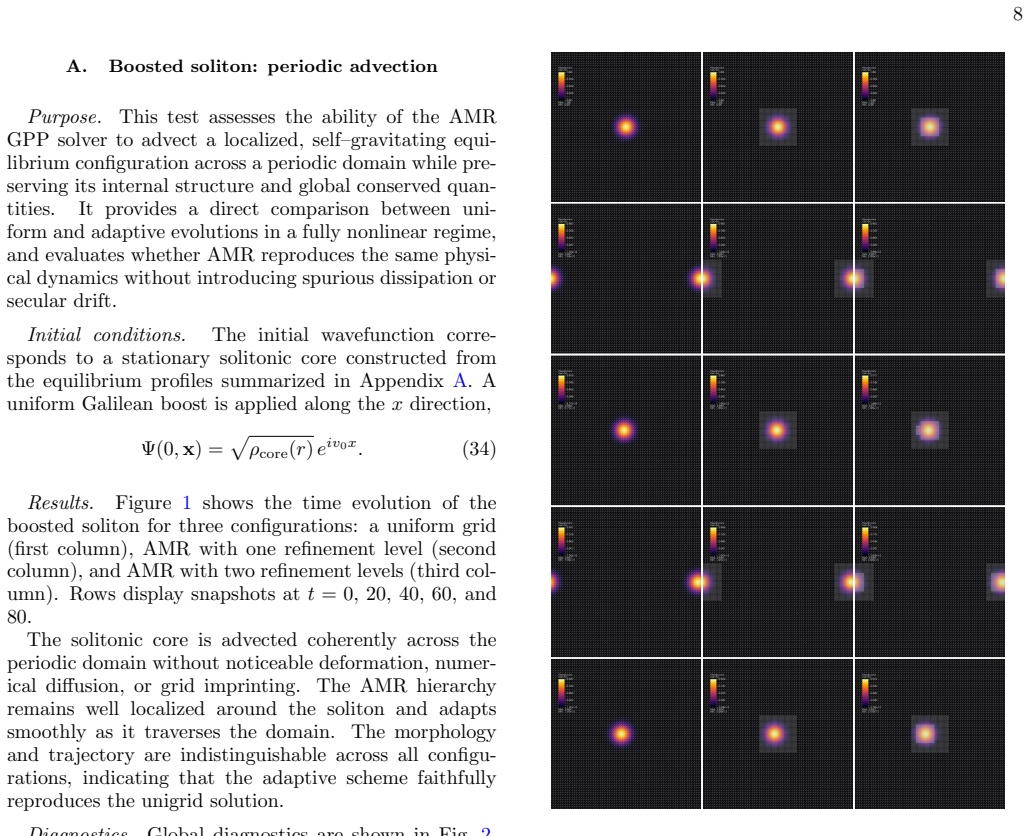
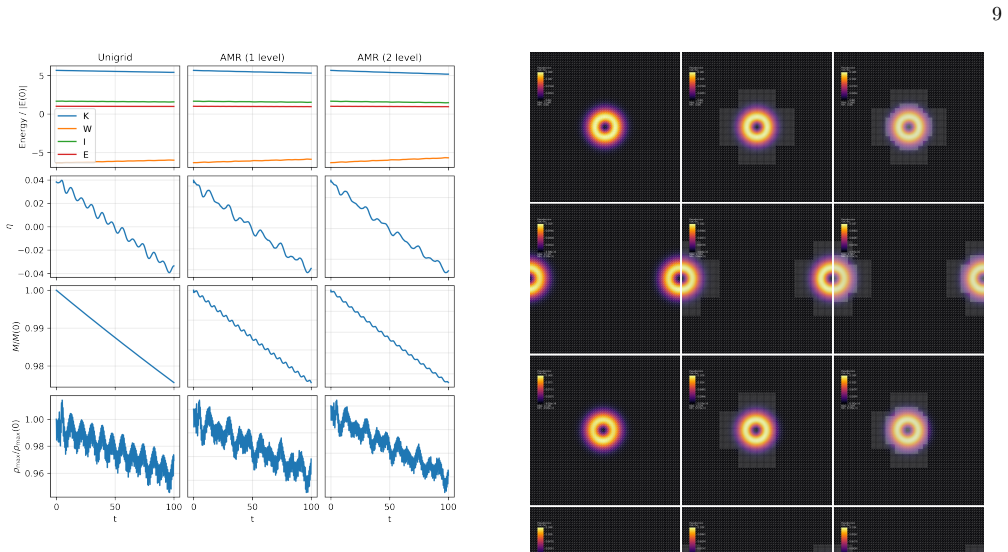
Advection of a boosted solitonic core
-
[3]
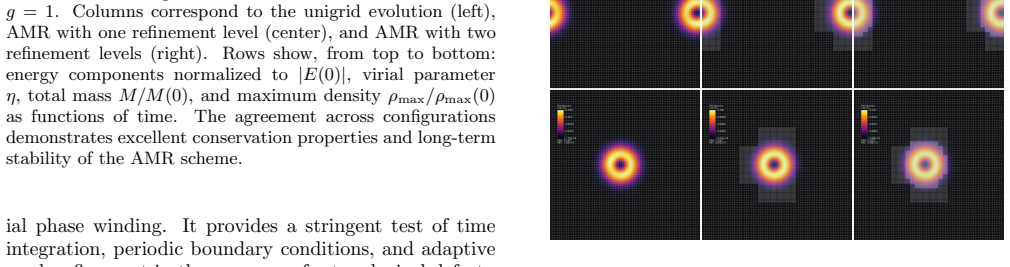
Advection of a boosted line vortex
-
[4]
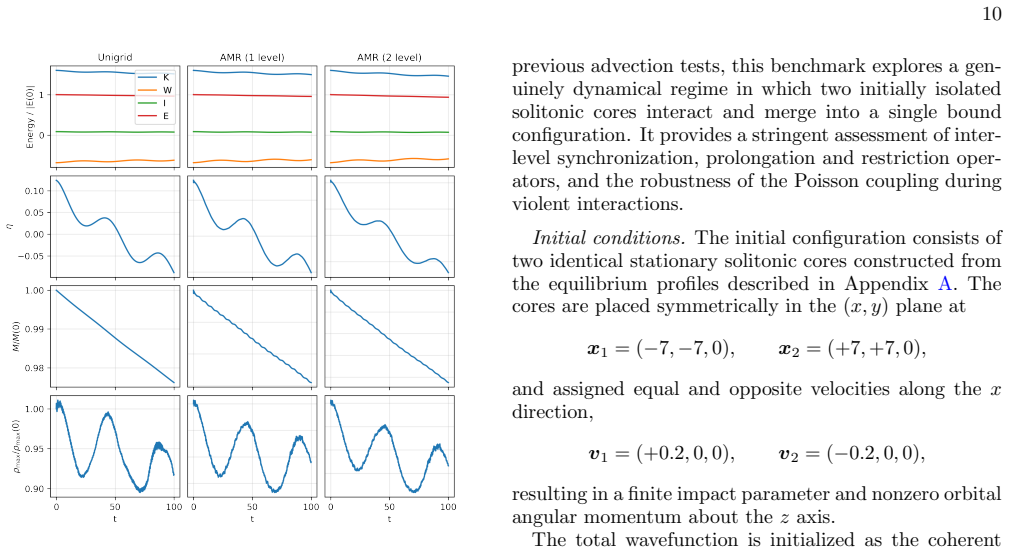
Merger of a binary system of solitonic cores
-
[5]
Merger of a binary system of line vortices
-
[6]
The first four tests are performed in the nonlinear regime with repulsive self–interaction,g= 1
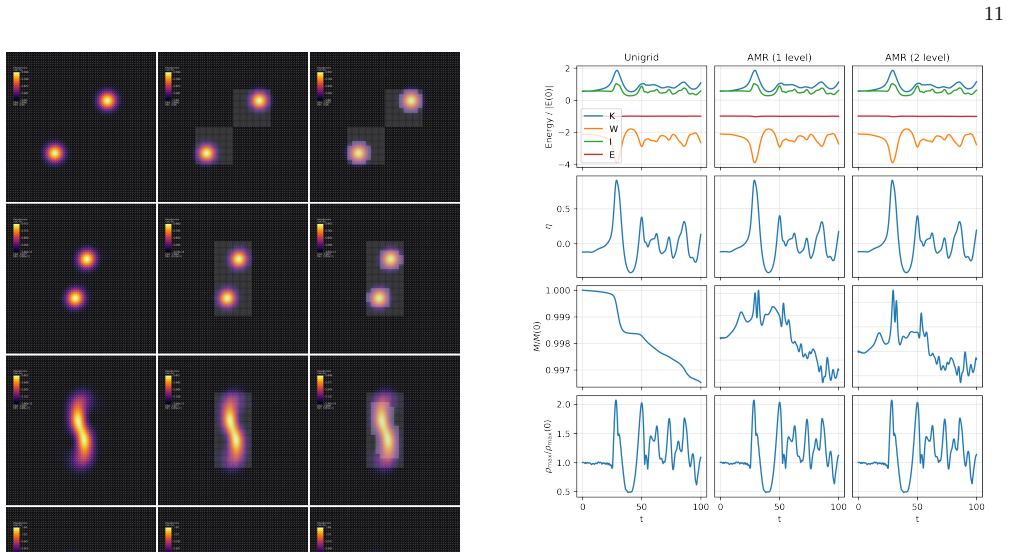
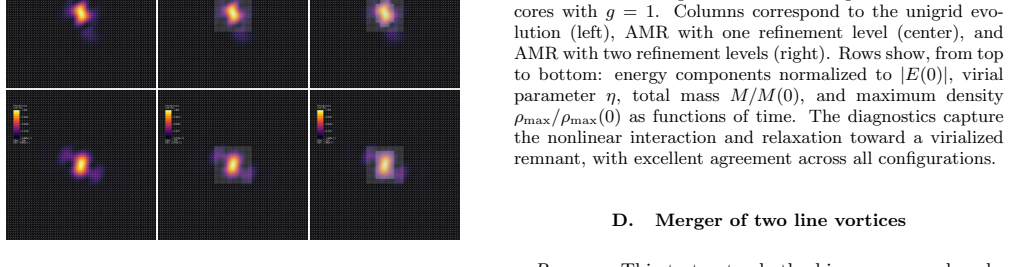
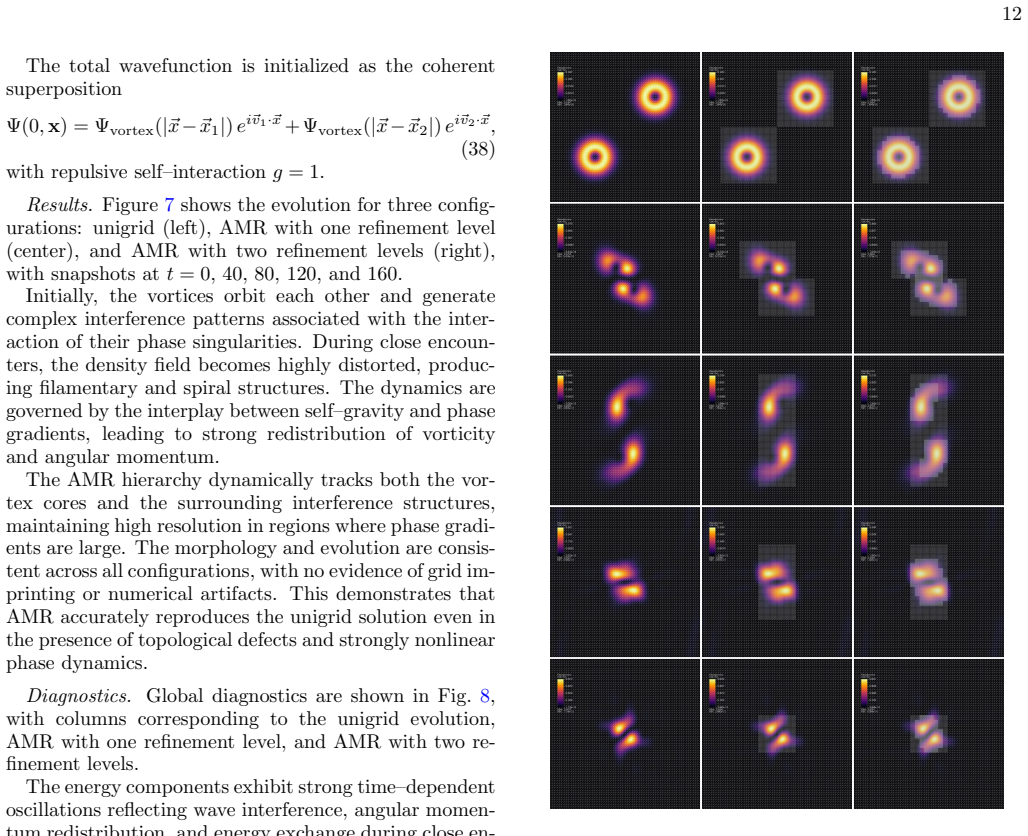
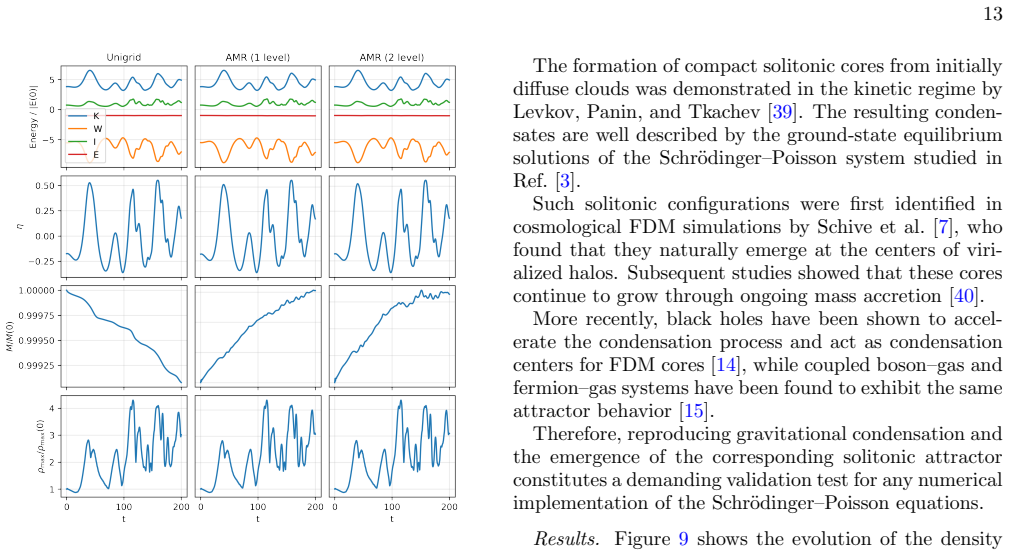
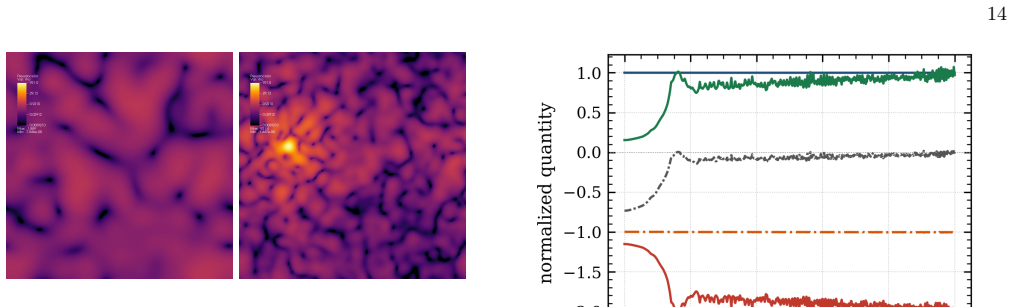
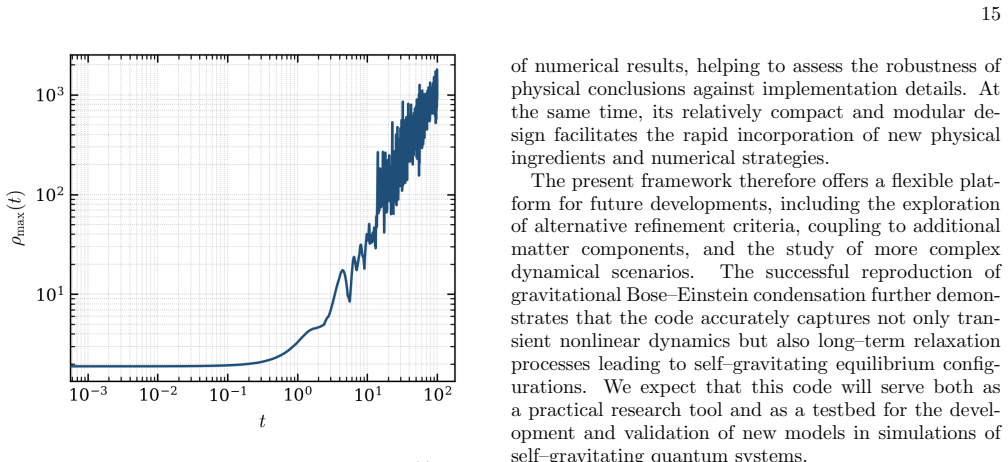
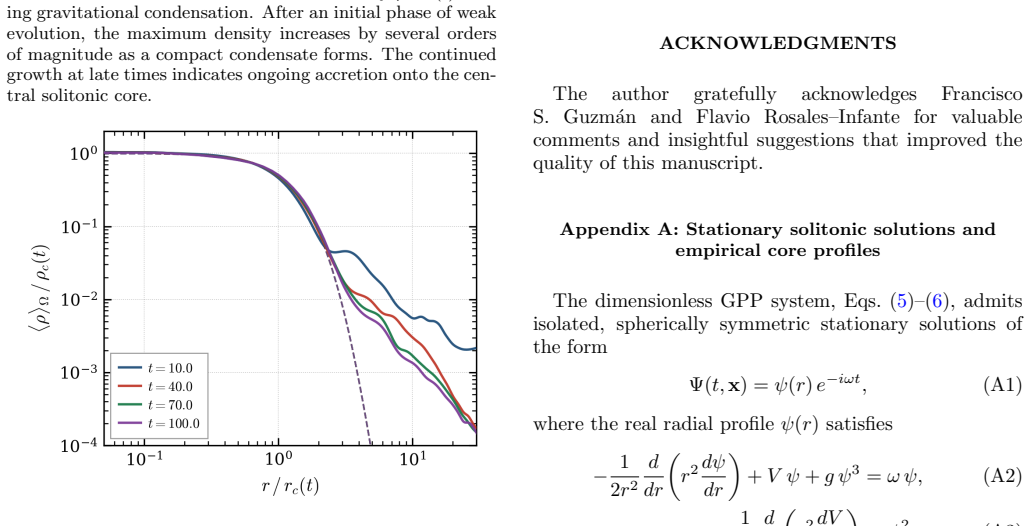
Gravitational condensation of a random bosonic cloud. The first four tests are performed in the nonlinear regime with repulsive self–interaction,g= 1. This choice allows us to probe nonlinear effects while avoiding addi- tional dynamical instabilities associated with attractive interactions (g <0). The fifth test employs a differ- ent physical setup, corr...
-
[7]
Equatorial symmetry with respect to the planez= 0 is imposed by requiring ∂ψ ∂z (r⊥,0) = 0,(B5) so that the solution is invariant underz→ −z. At large distances from the vortex core, the solution decays asymptotically, lim√ r2 ⊥+z2→∞ ψ= lim√ r2 ⊥+z2→∞ ∂ψ ∂r⊥ = lim√ r2 ⊥+z2→∞ ∂ψ ∂z = 0, (B6) ensuring normalizability of the stationary state. In the linear c...
-
[8]
Large-scale background temperature and mass fluctuations due to scale-invariant primeval perturbations,
P. J. E. Peebles, “Large-scale background temperature and mass fluctuations due to scale-invariant primeval perturbations,” Astrophysical Journal263, 1–19 (1982). 18
1982
-
[9]
Quintessence and scalar dark matter in the Universe,
T. Matos and L. A. Ure˜ na-L´ opez, “Quintessence and scalar dark matter in the Universe,” Classical and Quan- tum Gravity17, L75–L81 (2000), astro-ph/0004332
Pith/arXiv arXiv 2000
-
[10]
Evolution of the schr¨ odinger-newton system for a self-gravitating scalar field,
F. S. Guzm´ an and L. Arturo Ure˜ na L´ opez, “Evolution of the schr¨ odinger-newton system for a self-gravitating scalar field,” Phys. Rev. D69, 124033 (2004)
2004
-
[11]
Understanding the Core-Halo Relation of Quantum Wave Dark Matter from 3D Simulations,
Hsi-Yu Schive, Ming-Hsuan Liao, Tak-Pong Woo, Shing- Kwong Wong, Tzihong Chiueh, Tom Broadhurst, and W. Y. Pauchy Hwang, “Understanding the Core-Halo Relation of Quantum Wave Dark Matter from 3D Simulations,” Phys. Rev. Lett.113, 261302 (2014), arXiv:1407.7762 [astro-ph.GA]
Pith/arXiv arXiv 2014
-
[12]
Ultralight scalars as cosmological dark matter,
Lam Hui, Jeremiah P. Ostriker, Scott Tremaine, and Edward Witten, “Ultralight scalars as cosmological dark matter,” Phys. Rev. D95, 043541 (2017)
2017
-
[13]
Fuzzy Cold Dark Matter: The Wave Properties of Ultralight Par- ticles,
W. Hu, R. Barkana, and A. Gruzinov, “Fuzzy Cold Dark Matter: The Wave Properties of Ultralight Par- ticles,” Physical Review Letters85, 1158–1161 (2000), astro-ph/0003365
Pith/arXiv arXiv 2000
-
[14]
Cosmic Structure as the Quantum Interference of a Co- herent Dark Wave,
Hsi-Yu Schive, Tzihong Chiueh, and Tom Broadhurst, “Cosmic Structure as the Quantum Interference of a Co- herent Dark Wave,” Nature Phys.10, 496–499 (2014a), arXiv:1406.6586 [astro-ph.GA]
-
[15]
Iv´ an Alvarez-R´ ıos and Francisco S. Guzm´ an, “Construc- tion and Evolution of Equilibrium Configurations of the Schr¨ odinger–Poisson System in the Madelung Frame,” Universe8, 432 (2022), arXiv:2210.15608 [gr-qc]
arXiv 2022
-
[16]
Explo- ration of simple scenarios involving fuzzy dark matter cores and gas at local scales,
Iv´ an´Alvarez-Rios and Francisco S Guzm´ an, “Explo- ration of simple scenarios involving fuzzy dark matter cores and gas at local scales,” Monthly Notices of the Royal Astronomical Society518, 3838–3849 (2022)
2022
-
[17]
Carlos Tena-Contreras, Iv´ an Alvarez-R´ ıos, and Fran- cisco S. Guzm´ an, “Construction of ground-state solutions of the gross–pitaevskii–poisson system using genetic algo- rithms,” Universe10(2024), 10.3390/universe10080309
-
[19]
Galaxy formation with BECDM II. Cosmic filaments and first galaxies,
Philip Mocz, Anastasia Fialkov, Mark Vogelsberger, Fernando Becerra, Xuejian Shen, Victor H Robles, Mustafa A Amin, Jesus Zavala, Michael Boylan-Kolchin, Sownak Bose, Federico Marinacci, Pierre-Henri Chava- nis, Lachlan Lancaster, and Lars Hernquist, “Galaxy formation with BECDM II. Cosmic filaments and first galaxies,” Mon. Not. R. Astron. Soc.494, 2027–...
2027
-
[20]
Fuzzy dark matter soliton cores around supermassive black holes,
Elliot Y Davies and Philip Mocz, “Fuzzy dark matter soliton cores around supermassive black holes,” Monthly Notices of the Royal Astronomical Society492, 5721– 5729 (2020)
2020
-
[21]
Black holes as condensation points of fuzzy dark matter cores,
Curicaveri Palomares-Ch´ avez, Iv´ an´Alvarez Rios, and Francisco S. Guzm´ an, “Black holes as condensation points of fuzzy dark matter cores,” Physical Review D 112(2025), 10.1103/fwf5-n21g
-
[22]
Fermion-boson stars as attractors in fuzzy dark matter and ideal gas dynamics,
Iv´ an Alvarez-Rios, Francisco S. Guzm´ an, and Jens Niemeyer, “Fermion-boson stars as attractors in fuzzy dark matter and ideal gas dynamics,” Physical Review Letters135(2025), 10.1103/4tkh-7hjs
-
[23]
Merger of galactic cores made of ultralight bosonic dark matter,
F. S. Guzm´ an, I. Alvarez-R´ ıos, and J. A. Gonz´ alez, “Merger of galactic cores made of ultralight bosonic dark matter,” Rev. Mex. Fis.67, 75–83 (2021)
2021
-
[24]
Effect of boundary conditions on structure for- mation in fuzzy dark matter,
Iv´ an´Alvarez-Rios, Francisco S. Guzm´ an, and Paul R. Shapiro, “Effect of boundary conditions on structure for- mation in fuzzy dark matter,” Phys. Rev. D107, 123524 (2023)
2023
-
[25]
Stable vortex in bose-einstein condensate dark matter,
Y. O. Nikolaieva, A. O. Olashyn, Y. I. Kuriatnikov, S. I. Vilchynskii, and A. I. Yakimenko, “Stable vortex in bose-einstein condensate dark matter,” Low Tempera- ture Physics47, 684–692 (2021)
2021
-
[26]
Y. O. Nikolaieva, Y. M. Bidasyuk, K. Korshynska, E. V. Gorbar, Junji Jia, and A. I. Yakimenko, “Stable vortex structures in colliding self-gravitating bose-einstein con- densates,” Physical Review D108(2023), 10.1103/phys- revd.108.023503
-
[27]
Scalar dark matter vortex stabilization with black holes,
Noah Glennon, Anthony E. Mirasola, Nathan Musoke, Mark C. Neyrinck, and Chanda Prescod-Weinstein, “Scalar dark matter vortex stabilization with black holes,” Journal of Cosmology and Astroparticle Physics 2023, 004 (2023)
2023
-
[28]
Angular Momentum and Vortex Formation in Bose-Einstein- Condensed Cold Dark Matter Haloes,
Tanja Rindler-Daller and Paul R. Shapiro, “Angular Momentum and Vortex Formation in Bose-Einstein- Condensed Cold Dark Matter Haloes,” Mon. Not. Roy. Astron. Soc.422, 135–161 (2012), arXiv:1106.1256 [astro-ph.CO]
Pith/arXiv arXiv 2012
-
[29]
Kinematic imprints of vortex lines of bec dark matter on baryonic matter,
Iv´ an´Alvarez Rios, Carlos Tena-Contreras, and Fran- cisco S. Guzm´ an, “Kinematic imprints of vortex lines of bec dark matter on baryonic matter,” Physical Review D111(2025), 10.1103/x9mt-wprk
-
[30]
Gamer: a gpu-accelerated adaptive mesh refinement code for astrophysics,
Hsi-Yu Schive, Yi-Chih Tsai, and Tzihong Chiueh, “Gamer: a gpu-accelerated adaptive mesh refinement code for astrophysics,” Astrophysical Journal Supple- ment Series186, 457–484 (2010)
2010
-
[31]
E pur si muove: Galilean-invariant cosmological hydrodynamical simulations on a moving mesh,
Volker Springel, “E pur si muove: Galilean-invariant cosmological hydrodynamical simulations on a moving mesh,” Monthly Notices of the Royal Astronomical Soci- ety401, 791–851 (2010)
2010
-
[32]
Enzo: An adaptive mesh refinement code for astrophysics,
Greg L. Bryan, Michael L. Norman, Brian W. O’Shea, et al., “Enzo: An adaptive mesh refinement code for astrophysics,” Astrophysical Journal Supplement Series 211, 19 (2014)
2014
-
[33]
Pyultralight: a pseudo-spectral solver for ultralight dark matter dynam- ics,
Thomas D. P. Edwards and Lam Hui, “Pyultralight: a pseudo-spectral solver for ultralight dark matter dynam- ics,” arXiv e-prints (2018), 1807.04037
Pith/arXiv arXiv 2018
-
[34]
Spherical solutions of the schr¨ odinger-poisson system with core-tail structure,
Iv´ an´Alvarez-Rios and Francisco S. Guzm´ an, “Spherical solutions of the schr¨ odinger-poisson system with core-tail structure,” Phys. Rev. D108, 063519 (2023)
2023
-
[35]
Station- ary solutions of the schr¨ odinger-poisson-euler system and their stability,
Iv´ an´Alvarez-Rios and Francisco S. Guzm´ an, “Station- ary solutions of the schr¨ odinger-poisson-euler system and their stability,” Physics Letters B843, 137984 (2023)
2023
-
[36]
Iv´ an´Alvarez Rios, Tula Bernal, Pierre-Henri Chavanis, and Francisco S. Guzm´ an, “Galactic rotation curves of low surface brightness galaxies using core-halo fuzzy dark matter configurations,” Physical Review D110(2024), 10.1103/physrevd.110.063502
-
[37]
Solutions of the schr¨ odinger-poisson equations for n-dimensional states,
Iv´ an ´Alvarez and F. S. Guzm´ an, “Solutions of the schr¨ odinger-poisson equations for n-dimensional states,” Revista Mexicana de F´ ısica71, 020704 1– (2025)
2025
-
[38]
Gravita- tional cooling of self-gravitating bose condensates,
F. S. Guzm´ an and L. Arturo Ure˜ na L´ opez, “Gravita- tional cooling of self-gravitating bose condensates,” The Astrophysical Journal645, 814D819 (2006)
2006
-
[39]
Galaxy Forma- tion with BECDM: I. Turbulence and relaxation of ide- 19 alised haloes,
P. Mocz, M. Vogelsberger, V. Robles, J. Zavala, M. Boylan-Kolchin, and L. Hernquist, “Galaxy Forma- tion with BECDM: I. Turbulence and relaxation of ide- 19 alised haloes,” ArXiv e-prints (2017), arXiv:1705.05845
Pith/arXiv arXiv 2017
-
[40]
Cosmological structure formation in scalar field dark matter with repulsive self-interaction: the incredi- ble shrinking jeans mass,
Paul R Shapiro, Taha Dawoodbhoy, and Tanja Rindler- Daller, “Cosmological structure formation in scalar field dark matter with repulsive self-interaction: the incredi- ble shrinking jeans mass,” Monthly Notices of the Royal Astronomical Society509, 145D173 (2021)
2021
-
[41]
The amr technique,
MJ Berger and J Oliger, “The amr technique,” J. Com- putat. Phys53, 484–512 (1984)
1984
-
[42]
Numerical solution of partial differ- ential equations using the discrete fourier transform,
Daniela Estefan´ ıa Rodr´ ıguez Lara, Iv´ an´Alvarez, and Francisco Guzm´ an, “Numerical solution of partial differ- ential equations using the discrete fourier transform,” Re- vista Mexicana de F´ ısica E22(2025), 10.31349/revmex- fise.22.020221
-
[43]
Scalar: an amr code to simulate axion-like dark matter models,
Mina, Mattia, Mota, David F., and Winther, Hans A., “Scalar: an amr code to simulate axion-like dark matter models,” A&A641, A107 (2020)
2020
-
[44]
10 (Global Atmospheric Research Programme (GARP), Geneva, 1973)
Heinz-Otto Kreiss and Joseph Oliger,Methods for the Approximate Solution of Time Dependent Problems, GARP Publication Series No. 10 (Global Atmospheric Research Programme (GARP), Geneva, 1973)
1973
-
[45]
Fast parallel multidimensional fft using advanced mpi,
Lisandro Dalcin, Mikael Mortensen, and David E. Keyes, “Fast parallel multidimensional fft using advanced mpi,” Journal of Parallel and Distributed Computing128, 137– 150 (2019)
2019
-
[46]
Gravita- tional bose-einstein condensation in the kinetic regime,
D. G. Levkov, A. G. Panin, and I. I. Tkachev, “Gravita- tional bose-einstein condensation in the kinetic regime,” Phys. Rev. Lett.121, 151301 (2018)
2018
-
[48]
New insights into the formation and growth of boson stars in dark matter ha- los,
Jiajun Chen, Xiaolong Du, Erik W. Lentz, David J. E. Marsh, and Jens C. Niemeyer, “New insights into the formation and growth of boson stars in dark matter ha- los,” Phys. Rev. D104, 083022 (2021)
2021
discussion (0)
Sign in with ORCID, Apple, or X to comment. Anyone can read and Pith papers without signing in.