REVIEW 4 major objections 6 minor 36 references
Dipole-Induced Transition in 3-Dimensions
T0 review · 4 major / 6 minor · reviewed 2026-08-06 · deepseek-v4-flash
Pith's one-line read This paper reports a dipole-induced critical transition in the three-dimensional mechanical response of amorphous solids, marked by a diverging angular correlation length at a pressure near 2.9.
desk verdict A plausible three-phase picture with a genuinely interesting qualitative observation, but the headline critical divergence is likely imposed by the fixed-exponent Lorentzian fit; worth refereeing, but the divergence claim needs hardening. read the letter →
The pith
A machine-rendered reading of the paper's core claim, the machinery that carries it, and where it could break.
The reading
What carries the argument
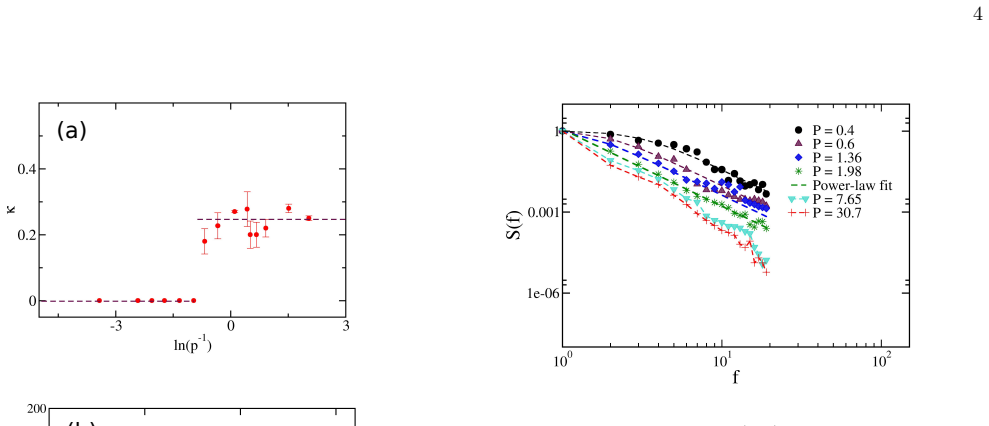
The central object is the angular power spectrum of the radial displacement field in thin spherical shells around the inflated particle, built from the transform $X(r,\phi,f)=(1/M)\sum_m d_r(r_m,\theta_m,\phi)e^{-if\theta_m}$ and its ensemble-averaged magnitude squared $S(r,f)=|\langle X\rangle|^2$. The physical mechanism is dipole screening: plastic events are quadrupolar Eshelby inclusions forming a field $Q_{\alpha\beta}(\mathbf{r})$, and their gradients define effective dipole charges $P_\alpha=\partial_\beta Q_{\alpha\beta}$, which add a $k^2\mathbf{d}$ term to the elasticity equation and break translational symmetry. The transition is read off by fitting $S(r,f)$ to a generalized Lorentzian $S_{GL}(r,f)=A/[1+(f/f^\dagger)^{2.85}]$; as the spectrum approaches a pure power law, $f^\dagger\to0$ and $\theta^\dagger=1/f^\dagger$ diverges. The observed screening parameter $\kappa\approx0.256$ is understood through the requirement that the screened solution sits near one of its discrete singular maxima, the second singularity ($\kappa\approx0.29$) being selected because the first would give a screening length too large for the system.
What would settle it
Measure $S(r,f)$ for the same packings at pressures just below $p_c$, but fit it without fixing the exponent 2.85; if the best-fit $f^\dagger$ approaches a positive constant rather than zero, the claimed critical divergence is an artifact of the fitting form. A second check is to repeat the inflation experiment in larger systems and see whether the fitted exponent $\mu$ stays near 1.66 and whether the divergence sharpens with system size, as a true critical point should.
Extended reading notes
Core claim
The paper establishes that the mechanical response of athermal amorphous packings to a central inflation is controlled by a critical pressure $p_c$. Above $p_c$, the classical Lamé equation $\mu\Delta\mathbf{d}+(\lambda+\mu)\nabla(\nabla\cdot\mathbf{d})=0$ describes the displacement field, which decays as $1/r^2$ in the bulk. Below $p_c$, quadrupolar plastic events (Eshelby inclusions) form gradients that act as effective dipoles $P_\alpha=\partial_\beta Q_{\alpha\beta}$, adding a screening term $k^2\mathbf{d}$ to the Lamé equation; the radial solution then takes the screened form involving spherical Bessel functions, with the screening parameter $\kappa$ jumping from zero to about $0.256$. The critical signature is the divergence of the angular correlation length $\theta^\dagger=1/f^\dagger$, extracted from the angular power spectrum $S(r,f)$, which scales as $\theta^\dagger\propto(p_c-p)^{-\mu}$ with $\mu\approx1.66$ and $p_c\approx2.9$ near the transition.
Load-bearing premise
Everything rests on the assumption that the angular fluctuation spectrum is really a generalized Lorentzian with exponent 2.85 and that a two-dimensional disk relation between excess contacts and screening length carries over to three-dimensional spheres; if either is not exact, the extracted correlation length may not genuinely diverge.
Editorial extensions
If this is right
- If the divergence is real, the high-pressure quasi-elastic phase and the intermediate anomalous phase are separated by a true critical point, not a smooth crossover.
- The classical Lamé equation fails below $p_c$; the screened equation with $k^2\mathbf{d}$ and Bessel-function solutions becomes the correct continuum description of the intermediate phase.
- The critical pressure can be predicted from the competition between plastic-avalanche size $\ell$ and screening length $\kappa^{-1}$, and the scaling argument yields $p_c\approx2.4$, consistent with the simulation estimates of 2.3 and 2.9.
- The framework gives a three-dimensional analogue of the hexatic phase: the intermediate phase keeps radial long-range correlations while losing angular correlations, with both translational and chiral symmetries broken.
Reading between the lines
- If the divergence survives larger systems, the exponent $\mu\approx1.66$ becomes a new, testable critical exponent of disordered solids, and comparing it across frictional, Hertzian, and differently prepared packings would reveal whether the transition is universal.
- Because the avalanche size $\ell$ depends on the interaction law while $\kappa^{-1}$ is mostly geometric, the same mechanism predicts that the critical pressure shifts with particle softness and friction even if the divergence itself persists; this is a concrete prediction beyond the paper's explicit claims.
- The combination of retained radial range and lost angular correlations suggests the transition may admit an effective lower-dimensional description, in which case $\mu$ might be connected to known correlation-length exponents of one-dimensional or planar models.
- A practical corollary, if the transition is genuine, is that a packing approaching $p_c$ from the elastic side becomes increasingly sensitive to small angular perturbations, which could serve as an early indicator of imminent plastic response in granular or colloidal systems.
Editorial analysis
A structured set of objections, weighed in public.
Referee Report
Summary. This Letter reports simulations of athermal, three-dimensional packings of Hertzian spheres subjected to inflation of a central sphere, and identifies three pressure regimes in the radial displacement response: exponential decay at pressures below jamming, quasi-elastic r^{-2} decay at high pressure, and an intermediate pressure regime in which the radial displacement changes sign and is fitted by a screened elastic solution with a screening parameter kappa (Eq. 7). The central claim is that the transition between the intermediate and quasi-elastic phases is critical, with an angular correlation length theta-dagger diverging as theta-dagger proportional to (p_c - p)^{-mu} with mu approximately 1.66 and p_c approximately 2.9 (Eq. 11).
Significance. If established, the existence of a dipole-induced transition in the three-dimensional mechanical response of amorphous solids would be conceptually significant, extending the analogy with two-dimensional topological transitions to a new setting. The qualitative observation of three distinct radial response forms, including the sign reversal in the intermediate phase, is a valuable empirical result. However, the central critical-scaling claim is not yet supported by the presented evidence: the divergence is extracted from a fitting form whose single parameter can produce an apparent divergence by construction, and the paper does not provide the statistical or finite-size analysis needed to distinguish a true divergence from a crossover. The paper's strengths are its direct simulation observations and the clear presentation of the three regimes; its weakness is the lack of any test of the assumed spectral shape or of the robustness of the extracted critical exponents.
major comments (4)
- The divergence in Eq. (11) is obtained by fitting S(r,f) to the generalized Lorentzian SGL(r,f) = A/(1 + (f/f-dagger)^2.85) with A = 1 + (1/f-dagger)^2.85, leaving f-dagger as the only free parameter. Because f is a discrete angular Fourier index, once f-dagger < 1 all nonzero integer modes lie in the tail, where SGL(f) is approximately f^{-2.85} and independent of f-dagger. In that regime f-dagger is determined only by the normalization ratio S(0)/S(1), so any growth of the zero-frequency peak relative to the first nonzero mode is automatically encoded as a shrinking f-dagger and hence a diverging theta-dagger = 1/f-dagger. The paper reports no test against a pure power law, a free spectral exponent, an exponential cutoff, or a dependence on shell radius r and outer radius r_out. Since Eq. (11) is the paper's main result, this is a load-bearing issue that must be addressed with alternative fits and a demonstration that the divergence is not an artifact of the assumed form.
- No error bars, number of independent configurations, or finite-size scaling analysis are reported for the angular correlation length theta-dagger(p). The text itself states that p_c depends on d_0, r_in, and r_out, and that the determination of p_c from the kappa jump is only approximate; the three estimates p_c = 2.3, 2.4, and 2.9 are not tightly pinned. The exponent mu = 1.66 is extracted in a log-log plot against p_c - p with p_c chosen from the same data. Without a quantitative characterization of the statistical uncertainty and a check of whether theta-dagger saturates with system size, the 'apparent critical divergence' is not distinguishable from a smooth crossover or a fitting artifact.
- The estimate p_c = 2.4 is not an independent prediction because it uses the measured value of the screening parameter kappa = 0.256 through the relation Delta Z = 6 kappa, and that relation is imported from Ref. [36], a study of two-dimensional frictionless disks. Applying a two-dimensional relation to three-dimensional Hertzian spheres requires a derivation or at least a justification that the numerical coefficient remains valid in 3D. Moreover, since kappa itself is fitted from the simulation data, the agreement among p_c = 2.3, 2.4, and 2.9 is a consistency check of scaling relations rather than a derivation of the critical pressure. The authors should either derive the Delta Z-kappa relation in three dimensions or present this estimate as a heuristic consistency argument rather than as a theoretical prediction.
- The choice of the second singularity of Eq. (7), kappa = 0.29, over the first, kappa = 0.145, is justified only by the statement that the first value is too small for the system size. This selection rule is not quantified: no criterion is given for what 'too small' means in terms of r_out, and no demonstration is provided that the second singularity is the relevant one for the observed packing. Because this selection underpins the theoretical interpretation of the intermediate phase and the associated p_c estimate, the selection mechanism needs a quantitative formulation or at least a systematic test against system-size variation.
minor comments (6)
- The caption contains a typo: 'Pnael a:' should be 'Panel a:'.
- The boundary-condition notation is garbled: '(.rin, theta, phi) = d0' should read 'd(r_in, theta, phi) = d0' (and similarly for r_out).
- The text reports kappa = 0.285 for the fit in Fig. 1(d) but later uses kappa = 0.256 as the measured average (Fig. 3 caption and the theoretical estimate section). The discrepancy between these two values should be explained or reconciled.
- The variable f in the Fourier transform is never defined as an integer angular mode. Since the transform is taken along a circle, this should be stated explicitly, as it is relevant for interpreting the fits in Eq. (10).
- The sentence 'this intermediate phase exists both in two and three dimensions' is asserted without a supporting reference or figure in this manuscript; it should be either substantiated or explicitly attributed to prior work.
- Eq. (12) states p ~ (phi - phi_J)^{3/2} ~ Delta Z^3; the relation Delta Z ~ p^{1/3} should be checked against the Hertzian-sphere literature, as the exponent for the excess coordination number in three dimensions may differ from the simple form assumed here.
Circularity Check
No significant circularity: the central divergence is a direct data fit, and the self-cited screening theory is tested against the simulations rather than assumed.
full rationale
The main result, Eq. (11), is obtained by fitting the simulated angular power spectrum S(r,f) to the generalized Lorentzian Eq. (10) and defining theta-dagger = 1/f-dagger. This is a data-analysis quantity, not a prediction derived by equating a fitted parameter to a claimed output: the divergence is an observed behavior of the fit parameter as p approaches p_c. The fixed tail exponent 2.85 and the discrete nature of the angular Fourier modes mean f-dagger is constrained mainly by the zero-frequency normalization; this is a robustness/correctness concern about whether the apparent divergence is an artifact of the chosen fitting form, but it is not circularity in the sense of a fitted parameter being renamed a prediction. The screening equation (5) and its solution (7) are imported from the authors' prior work, but the paper validates them by fitting Eq. (7) to the displacement profile (Fig. 1d, kappa = 0.285), so the self-citation is not the sole load-bearing support. The selection of kappa from singularities of (7) is attributed to Refs. [32,17], but the singularities are recomputed in Fig. 3b. The theoretical estimate of p_c uses the measured kappa = 0.256 together with the measured Delta Z(p) relation and the external relation Delta Z = 6 kappa from Ref. [36]; because kappa is measured in the anomalous phase, this is a consistency check rather than an independent derivation, and it is cross-checked against two other estimates (p_c = 2.3 and 2.9). The paper itself notes in the section on the nature of the transitions that the determination of p_c from the kappa data is only approximate and that p_c depends on d0, rin, and rout; these are acknowledged limitations that affect precision and robustness, not circularity. The jamming exponent nu = 0.8 is checked against established external results. Overall, the central critical-scaling claim is self-contained against the simulation data, and no step reduces to Eq. X = Eq. Y by construction or renames a fitted parameter as an independent prediction.
Assumptions & free parameters
free parameters (5)
- κ (screening parameter) =
≈ 0.285 (Fig. 1d), ≈ 0.256 (Fig. 3a)
- f† (angular correlation scale) =
decreases toward 0 as p approaches p_c
- Exponent 2.85 in Eq. (10) =
2.85 (fixed by hand)
- p_c (critical pressure) =
≈ 2.9 (Eq. 11), ≈ 2.3 (Fig. 3a), ≈ 2.4 (scaling)
- μ (critical exponent) =
≈ 1.66
assumptions (6)
- domain assumption The screened elastic equation Eq. (5) with a diagonal screening tensor Γ = k²δ is the correct continuum description of the displacement field.
- domain assumption Gradients of the quadrupolar plasticity field act as effective dipoles, P_α ≡ ∂_β Q_{αβ} (Eq. 4).
- standard math The pressure-coordination relation p ~ (φ - φ_J)^{3/2} ~ ΔZ^3 (Eq. 12).
- domain assumption The avalanche length satisfies Zℓ^{d-1} ~ ΔZℓ^d (Eq. 13), giving ℓ ~ p^{-1/3} (Eq. 14).
- domain assumption The relation ΔZ ≈ 6κ from Ref. [36], derived for 2D jammed disks, holds for 3D Hertzian spheres.
- ad hoc to paper The observed κ is set by one of the discrete singular values of Eq. (7), specifically the second one (κ ≈ 0.29), because the first is too small for the system size.
Cite this review
Pith. "Pith review of Dipole-Induced Transition in 3-Dimensions." pith.science (2026). https://pith.science/paper/KPTGXZ5J
@misc{pith2026250711179,
  author       = {Pith},
  title        = {Pith review of: Dipole-Induced Transition in 3-Dimensions},
  year         = {2026},
  howpublished = {\url{https://pith.science/paper/KPTGXZ5J}},
  note         = {Machine review of arXiv:2507.11179}
}
read the original abstract
The Kosterlitz-Thouless and the Hexatic phase transitions are celebrated examples of dipole (vortex, dislocation) induced transitions in condensed matter physics. For very clear reasons, these important ``topological" transitions are restricted to 2-dimensions. Here we present a genuine dipole-induced transition in the 3-dimensional response of (athermal) amorphous solids to applied strain. Similarly to the existence of a hexatic phase between normal solid and fluid, we identify an intermediate phase between a phase of normal elastic response at high pressure, and fluid matter at zero pressure. The mechanical response in the intermediate phase is accompanied by plasticity that is generically associated with ``non-affine" quadrupolar events seen in the resulting displacement field. Gradients of the quadrupolar fields act as dipole charges that screen elasticity, breaking both translational and Chiral symmetries. We highlight {\em angular} correlations that exhibit diverging correlation lengths at this transition and determine the critical scaling exponents.
Figures


Figures from the paper (3 more)


Reference graph
Works this paper leans on
-
[36]
W. G. Ellenbroek, M. van Hecke, and W. van Saarloos, Jammed frictionless disks: Connecting local and global response, Phys. Rev. E 80, 061307 (2009)
work page 2009
-
[1]
P. C. Hohenberg, Existence of long-range order in one and two dimensions, Physical Review 158, 383 (1967)
work page 1967
-
[2]
N. D. Mermin and H. Wagner, Absence of ferromag- netism or antiferromagnetism in one-or two-dimensional isotropic heisenberg models, Physical Review Letters 17, 1133 (1966)
1966
-
[3]
J. M. Kosterlitz, Kosterlitz–thouless physics: a review of key issues, Reports on Progress in Physics 79, 026001 (2016)
work page 2016
-
[4]
J. M. Kosterlitz and D. J. Thouless, Ordering, metasta- bility and phase transitions in two-dimensional systems, in Basic Notions Of Condensed Matter Physics (CRC Press, 2018) pp. 493–515
2018
-
[5]
D. R. Nelson and B. I. Halperin, Dislocation-mediated melting in two dimensions, Phys. Rev. B19, 2457 (1979)
1979
-
[6]
A. Lema ˆ ıtre, C. Mondal, M. Moshe, I. Procaccia, S. Roy, and K. Screiber-Re’em, Anomalous elasticity and plastic screening in amorphous solids, Phys. Rev. E 104, 024904 (2021)
work page 2021
-
[7]
B. P. Bhowmik, M. Moshe, and I. Procaccia, Direct mea- surement of dipoles in anomalous elasticity of amorphous solids, Phys. Rev. E 105, L043001 (2022)
work page 2022
Show all 36 references
-
[8]
Charan, M
H. Charan, M. Moshe, and I. Procaccia, Anomalous elas- ticity and emergent dipole screening in three-dimensional amorphous solids, Phys. Rev. E 107, 055005 (2023)
2023
-
[9]
Mondal, M
C. Mondal, M. Moshe, I. Procaccia, S. Roy, J. Shang, and J. Zhang, Experimental and numerical verification of anomalous screening theory in granular matter, Chaos, Solitons and Fractals 164, 112609 (2022)
2022
-
[10]
Kumar, M
A. Kumar, M. Moshe, I. Procaccia, and M. Singh, Anomalous elasticity in classical glass formers, Phys. Rev. E 106, 015001 (2022)
2022
-
[11]
Mondal, M
C. Mondal, M. Moshe, I. Procaccia, and S. Roy, Dipole screening in pure shear strain protocols of amorphous solids (2023), arXiv:2305.11253 [cond-mat.soft Phys.Rev. E, in press]
2023 arXiv
-
[12]
H. G. E. Hentschel, A. Pomyalov, I. Procaccia, and O. Szachter, Dynamic screening by plasticity in amor- phous solids, Phys. Rev. E 109, 044902 (2024)
2024
-
[13]
Karmakar, E
S. Karmakar, E. Lerner, and I. Procaccia, Athermal non- linear elastic constants of amorphous solids, Phys. Rev.E 82, 026105 (2010)
2010
-
[14]
H. G. E. Hentschel, S. Karmakar, E. Lerner, and I. Pro- caccia, Do athermal amorphous solids exist?, Phys. Rev.E 83, 061101 (2011)
2011
-
[15]
J. D. Eshelby, The determination of the elastic field of an ellipsoidal inclusion, and related problems, Proceed- ings of the Royal Society of London A: Mathematical, Physical and Engineering Sciences 241, 376 (1957)
1957
-
[16]
Cohen, A
Y. Cohen, A. Schiller, D. Wang, J. Dijksman, and M. Moshe, Odd dipole screening in disordered matter (2024), arXiv:2310.09942 [cond-mat.soft]
2024 arXiv
-
[17]
P. Kaur, I. Procaccia, and T. Samanta, Selection prin- ciple for the screening parameters in the mechanical re- sponse of amorphous solids, Phys. Rev. E 111, 015506 (2025)
2025
-
[18]
N. S. Livne, T. Samanta, A. Schiller, I. Procaccia, and M. Moshe, Continuum mechanics of differential growth in disordered granular matter (2024), arXiv:2408.13086 [cond-mat.soft]
2024 arXiv
-
[19]
Baule, F
A. Baule, F. Morone, H. J. Herrmann, and H. A. Makse, Edwards statistical mechanics for jammed granular mat- ter, Rev. Mod. Phys. 90, 015006 (2018)
2018
-
[20]
C. S. O’Hern, L. E. Silbert, A. J. Liu, and S. R. Nagel, Jamming at zero temperature and zero applied stress: The epitome of disorder, Phys. Rev. E68, 011306 (2003)
2003
-
[21]
H. A. Makse, D. L. Johnson, and L. M. Schwartz, Packing of compressible granular materials, Phys. Rev. Lett. 84, 4160 (2000)
2000
-
[22]
Chaudhuri, L
P. Chaudhuri, L. Berthier, and S. Sastry, Jamming tran- sitions in amorphous packings of frictionless spheres oc- cur over a continuous range of volume fractions, Phys. Rev. Lett. 104, 165701 (2010)
2010
-
[23]
Charbonneau, E
P. Charbonneau, E. I. Corwin, G. Parisi, and F. Zam- poni, Universal microstructure and mechanical stabil- ity of jammed packings, Phys. Rev. Lett. 109, 205501 (2012)
2012
-
[24]
P. K. Morse and E. I. Corwin, Geometric signatures of jamming in the mechanical vacuum, Phys. Rev. Lett. 112, 115701 (2014)
2014
-
[25]
C. S. O’Hern, S. A. Langer, A. J. Liu, and S. R. Nagel, Random packings of frictionless particles, Phys. Rev. Lett. 88, 075507 (2002)
2002
-
[26]
Heussinger and J.-L
C. Heussinger and J.-L. Barrat, Jamming transition as probed by quasistatic shear flow, Phys. Rev. Lett. 102, 218303 (2009)
2009
-
[27]
D. Pan, Y. Wang, H. Yoshino, J. Zhang, and Y. Jin, A review on shear jamming, Physics Reports 1038, 1 7 (2023), a review on shear jamming
2023
-
[28]
V ˚ agberg, D
D. V ˚ agberg, D. Valdez-Balderas, M. A. Moore, P. Olsson, and S. Teitel, Finite-size scaling at the jamming transi- tion: Corrections to scaling and the correlation-length critical exponent, Phys. Rev. E 83, 030303 (2011)
2011
-
[29]
J. D. Thompson and A. H. Clark, Critical scaling for yield is independent of distance to isostaticity, Phys. Rev. Res. 1, 012002 (2019)
2019
-
[30]
A. H. Clark, J. D. Thompson, M. D. Shattuck, N. T. Ouellette, and C. S. O’Hern, Critical scaling near the yielding transition in granular media, Phys. Rev. E 97, 062901 (2018)
2018
-
[31]
Y. Fu, Y. Jin, D. Pan, and I. Procaccia, Long-range an- gular correlations of particle displacements at a plastic- to-elastic transition in jammed amorphous solids (2024), arXiv:2410.04138 [cond-mat.soft]
2024 arXiv
-
[32]
Y. Jin, I. Procaccia, and T. Samanta, Intermediate phase between jammed and unjammed amorphous solids, Phys. Rev. E 109, 014902 (2024)
2024
-
[33]
M. Toda, R. Kubo, R. Kubo, M. Toda, N. Saito, N. Hashitsume, and N. Hashitsume, Statistical Physics II: Nonequilibrium Statistical Mechanics, Springer Se- ries in Solid-State Sciences (Springer Berlin Heidelberg, 2012)
2012
-
[34]
A. J. Liu and S. R. Nagel, The jamming transition and the marginally jammed solid, Annual Review of Con- densed Matter Physics 1, 347 (2010)
2010
-
[35]
Wyart, S
M. Wyart, S. R. Nagel, and T. A. Witten, Geometric ori- gin of excess low-frequency vibrational modes in weakly connected amorphous solids, Europhysics Letters 72, 486 (2005)
2005
Reviewed August 6, 2026 · model on record in the stance chip above.
Discussion (0). Continue with ORCID to comment.