REVIEW 3 major objections 5 minor 18 references
HoLa: B-Rep Generation using a Holistic Latent Representation
T0 review · 3 major / 5 minor · reviewed 2026-08-16 · deepseek-v4-flash
Pith's one-line read This paper introduces HoLa, a latent representation defined only over surface primitives that encodes an entire B-Rep model, and shows that a single diffusion model built on it generates valid CAD models at 82.68% on DeepCAD, nearly…
desk verdict A genuinely new B-Rep representation that mostly delivers; the validity gains are real and externally checked, but the intersection classifier's loss equations and missing positive-class metrics need fixing before the core mechanism is fully convincing. read the letter →
The pith
A machine-rendered reading of the paper's core claim, the machinery that carries it, and where it could break.
The reading
What carries the argument
The holistic latent (HoLa) space is a per-surface VAE latent, each surface latent having a small spatial resolution (2x2) and feature dimension 8 so that orientation information survives pooling. The load-bearing component is the neural intersection module, a cross-attention network applied to ordered pairs of surface latents that outputs (i) a binary intersection prediction and (ii) a curve feature for the shared intersection; a positional encoding of surface order makes the recovered half-curve orientation consistent, since swapping the surface pair reverses the curve direction. The decoder reconstructs surfaces from the surface latents and curves from the recovered curve features, and these are sewn into watertight B-Reps via a B-spline fitting and wire-loop post-process. A single latent diffusion model then generates or denoises the full surface-latent set conditioned on a 256-dimensional vector extracted from noise, images, point clouds, sketches, or text.
What would settle it
Run the trained intersection classifier on B-Reps with coplanar adjacent faces or open sheet bodies and check whether each ground-truth shared curve is recovered uniquely and whether the binary intersection predictions on positive pairs have high precision and recall; a low recall on intersecting surface pairs would show that topology is not fully recoverable from surface latents alone. A second, cleaner check is to measure the Euler characteristic of the wireframe graph of generated models: for watertight genus-g solids it must satisfy V - E + F = 2 - 2g, so systematic violations would refute the claim that topology is encoded consistently.
Extended reading notes
Core claim
The central claim is that the topological connection between two surfaces is intrinsically tied to the geometry of their intersecting curve, and therefore a full B-Rep can be encoded and decoded using surface latents alone. The paper builds a variational autoencoder whose encoder fuses surface and curve features through a graph neural network and self-attention into per-surface latent vectors; the decoder then applies a neural intersection module to each pair of surface latents, predicting whether they intersect and producing the feature of the shared half-curve from the pair. The loss combines surface and curve reconstruction, a binary intersection classification, and KL regularization. The authors report that this holistic latent supports a single latent diffusion model that, on the DeepCAD benchmark, produces 82.68% valid watertight B-Reps versus 47.74% for BRepGen and 50.82% for DeepCAD, with improved coverage and distributional metrics; on ABC the valid ratio is 60.46% versus 32.68% for BRepGen. The failures they document are inconsistent surface primitives that lead to inaccurate trimming and non-watertight bodies, plus noise from padding variable-length surface sets to a fixed maximum.
Load-bearing premise
Every curve in a solid model of the kind used here must be recoverable from exactly two supporting surface primitives; this holds for closed solids whose neighboring faces are not coplanar, but it fails for adjacent faces lying in the same plane, for open shells, for thin sheet shapes, and for edges where more than two faces meet, since two surfaces then do not define a unique shared curve.
Editorial extensions
If this is right
- One diffusion model replaces the separate surface, curve, and vertex generators of prior pipelines; changing the input modality only retrains the diffusion model, not the VAE.
- On the filtered DeepCAD benchmark, unconditional validity rises to 82.68% (versus 47.74% for BRepGen and 50.82% for DeepCAD), while coverage increases to 78.87% and MMD and JSD improve.
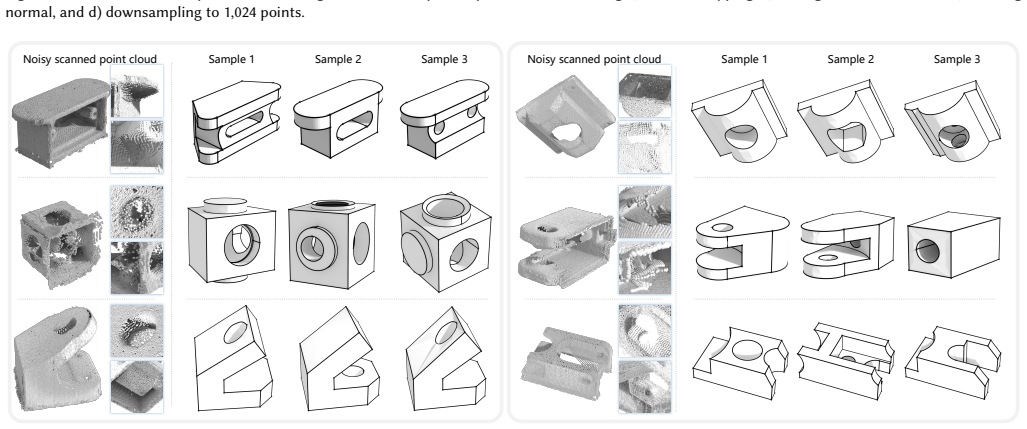
- Point-conditioned generation reaches 98.23% validity when 32 test-time samples are selected by Chamfer distance, and it outperforms fitting-based pipelines (HPNet+Point2CAD, SEDNet+Point2CAD) on topology F-scores.
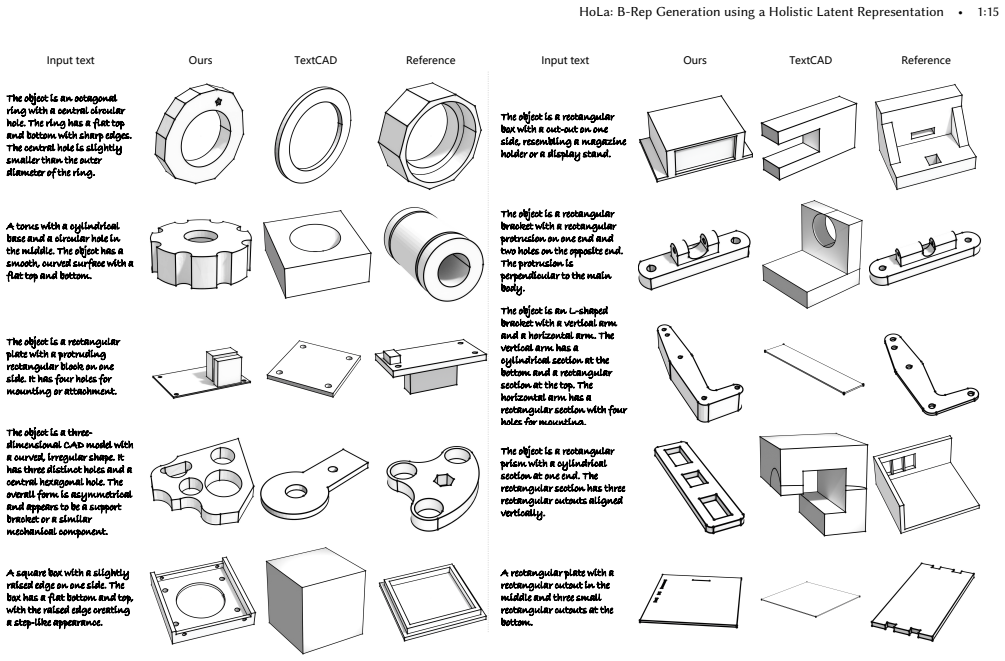
- The same latent handles text, single-view, multi-view, and sketch conditioning, with multi-view inputs giving the best Chamfer distance among image conditions.
- Ablations show that the spatial resolution of the surface latent and the half-curve orientation are necessary: removing them drops validity from 94.18% to 79.62% while degrading precision and recall.
Reading between the lines
- If the intersection-recoverability premise generalizes, the same pairwise-intersection inductive bias could be applied to assembly or joint representations, where each connection is also a lower-order geometric feature shared by exactly two components.
- A direct stress test would evaluate the intersection classifier separately on coplanar adjacent faces and on open shells; if curves there are not unique, the representation needs an explicit manifoldness guard rather than just the closed-solid cases in DeepCAD.
- Since validity is measured through OpenCascade's checker, part of the reported gain could be sensitive to the checker's tolerance; an independent topological audit of generated B-Reps (for example, the Euler characteristic of the wireframe graph) would pin down how much of the validity gap is topology consistency versus geometric fitting.
- The per-surface latent still carries a fixed maximum primitive count through padding; compressing the whole B-Rep to a single global latent, as the paper suggests as future work, would remove that noise source and may further improve validity.
Signed reviews
Editorial analysis
A structured set of objections, weighed in public.
Referee Report
Summary. The paper introduces HoLa, a holistic latent representation for B-Rep CAD models. The representation encodes a full B-Rep (surfaces, curves, vertices, and topological relations) into a latent space defined only over surface primitives. The central design is a neural intersection module that, given a pair of surface latents, predicts whether the surfaces intersect and recovers the geometry of the shared curve; curves, vertices, and topology are then decoded from these surface-pair predictions. On top of this VAE, the authors train a single latent diffusion model for unconditional generation and for conditional generation from point clouds, images, sketches, and text. On the DeepCAD dataset the method reports an unconditional validity of 82.68% versus 47.74% for BRepGen, and improved topology/geometry F-scores in point-conditioned generation. The paper also presents ablations, robustness experiments with imperfect point clouds, and qualitative results for text-, image-, and sketch-conditioned generation.
Significance. If the central claim holds, this is a substantial advance for B-Rep generation: replacing multi-step, primitive-by-primitive generation with a single unified latent space would reduce training complexity and improve generated model validity. The paper's evaluation has notable strengths: validity is checked externally via OpenCascade, the point-conditioned comparison uses disclosed protocol details, the single-run version of the method is reported alongside the multi-run version, and the ablations support the importance of the half-edge structure and spatial resolution in the latent. The claimed validity gain (82.68% vs 47.74%) is large and is supported by an external checker rather than only self-reported metrics. However, the load-bearing mechanism of the paper—the neural intersection module—is not directly evaluated in a way that establishes its precision/recall, and the training objective for this module is not written consistently in the paper. These gaps are fixable and do not invalidate the approach, but they must be addressed before the central claims can be accepted.
major comments (3)
- [Sec. 4.2, Eqs. (6)-(7)] The intersection-classifier loss is not well-formed as printed. T_SC is defined in Sec. 3 as the m-by-n surface-to-curve adjacency matrix, but in Eqs. (6)-(7) it is used as a label for a surface pair (i,j), and the double sum runs over n curves rather than over surface pairs. In addition, I_bc is defined as a classifier on R^16, yet it is called with two surface latent vectors (z_s^(i), z_s^(j)). As written, the objective is dimensionally inconsistent and the actual training target of the intersection classifier is unspecified. Please correct the loss by introducing an explicit surface-pair adjacency matrix (or deriving it from T_SC) and by defining the classifier input as the fused feature produced by the cross-attention module.
- [Sec. 5.5] The only direct evidence about the intersection classifier is the statement that intersection accuracy 'remains consistently high (99.99%)'. This number is uninterpretable without reporting precision and recall on the positive (intersecting) class, because intersecting pairs are rare among all surface pairs and a trivial always-negative classifier can achieve almost 100% accuracy on the natural distribution. The paper also does not state whether the 99.99% figure is computed on the balanced training distribution or on the natural inference distribution. Since the decoder's curve and topology recovery depends entirely on this classifier, please report the confusion matrix (or precision/recall) on both balanced and natural pair distributions, and, ideally, the effect of the classifier threshold on final topology F-scores and validity.
- [Sec. 1, Sec. 3] The central prior that 'any curve in a B-Rep must be the intersection between two surface primitives' is not valid for all B-Reps it is claimed to cover. Adjacent coplanar faces (smooth edges), tangent-surface contacts, open shells, and non-manifold configurations do not determine a unique shared curve from the two supporting surfaces alone. The paper does not restrict its claim to closed solids with transverse face intersections, nor does it quantify how often the test-set curves violate the premise. Please either narrow the representational claim to the closed-solid, non-coplanar, non-tangent setting, or provide a dataset-scale analysis: report the fraction of DeepCAD curves for which the two adjacent faces have distinct, non-tangent supporting surfaces, and report topology FE/EV recall separately on the curves that satisfy the premise versus those that do not.
minor comments (5)
- [Fig. 1 caption] The caption reports '84% vs. ≈50%' for unconditional validity, while the abstract and Table 1 report 82.68% vs 47.74%; please reconcile these numbers.
- [Sec. 5.2, Table 2] The Ours32 variant samples 32 models per input point cloud and selects by Chamfer distance to the input, which is a best-of-N test-time augmentation not available to the deterministic baselines. This is disclosed in the text, but the table would benefit from a footnote stating that the comparison is not single-sample-equivalent.
- [Sec. 5.3] The text-conditioned results are entirely qualitative; given that Text2CAD provides a baseline and a quantitative protocol, reporting at least one quantitative metric (e.g., the baseline's own evaluation measure) would strengthen the claim that the method produces 'more plausible models' from text.
- [Sec. 4.2, Eq. (6)] There appears to be a typographical error in the first term of Eq. (6), where 'I_bc(S_i(i), z(j)_s)' mixes a surface feature with a surface latent; this should be part of the correction to the well-formed objective described in the major comment, not a separate issue.
- [General] The paper does not state whether code or trained models will be released. Given the heavy training cost (about 1M iterations for the VAE and 1M for the LDM) and the importance of the exact intersection-module training protocol, a reproducibility statement would be valuable.
Circularity Check
No circular derivation; the central representation claim is externally benchmarked, with one non-load-bearing self-citation.
full rationale
The central claim—that a full B-Rep can be encoded into a surface-only latent because curve geometry and topology can be recovered from surface-pair latents—is not circular. The paper's prior (Sec. 1: 'any curve in a B-Rep must be the intersection between two surface primitives') is stated as a geometric observation, not as a result derived from the method. The latent is trained with reconstruction losses over surface and curve geometry plus a supervised intersection-classification loss (Eqs. 4-8), and generated B-Reps are validated externally against OpenCascade's BRep validity checker and against ground-truth Chamfer distances and topology F-scores (Secs. 5.1-5.2). The Ours32 test-time Chamfer selection is disclosed alongside the single-run Ours result, so the headline validity numbers are not hidden selection artifacts. The only same-group self-citation is NVDNet [Liu et al. 2024a], used as a comparison baseline in point-conditioned generation; it is not load-bearing for the representation or generation claims. Two correctness concerns are noted but are not circularity: (i) Sec. 5.5 reports intersection accuracy as 'consistently high (99.99%)' without positive-class precision/recall or the distribution on which it was computed; and (ii) Eqs. 6-7 index the inter-loss by the surface-to-curve matrix T_SC (m x n) while the classifier inputs are surface pairs, so the written loss is dimensionally inconsistent and the actual classifier objective is under-specified. These concerns weaken the empirical support for the topology-recovery premise, but they do not make the derivation reduce to its own inputs.
Assumptions & free parameters
free parameters (5)
- Loss weights w1, w2, w3 =
1, 1e-1, 1e-6
- Maximum number of surface primitives M =
Not stated explicitly; dataset filtered to 7 to 30 surfaces
- Evaluation distribution filter =
7 to 30 surfaces per model
- OpenCascade validity precision =
0.1
- Test-time sampling count for conditional generation =
1 for base, 32 for Ours32
assumptions (4)
- domain assumption Every curve in a B-Rep is the intersection of exactly two surface primitives, and its geometry is determined by those two surfaces.
- ad hoc to paper A neural intersection module can learn to recover curve geometry and intersection labels from pairs of surface latents.
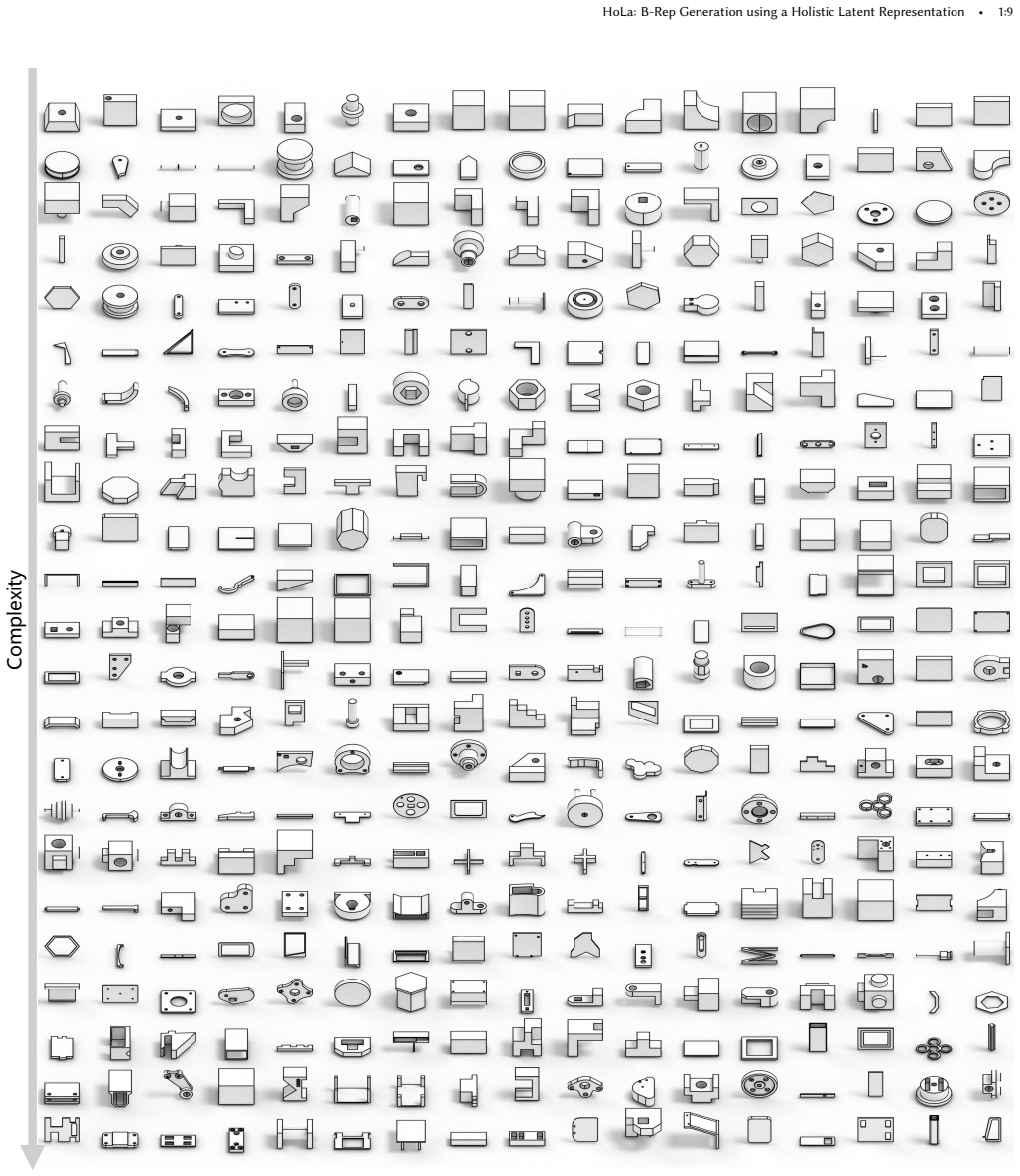
- domain assumption DeepCAD and ABC, after duplicate removal and the 7-to-30-surface filter, are representative B-Rep generation benchmarks.
- domain assumption OpenCascade's validity check at precision 0.1 is a fair external criterion and is applied identically to baselines.
invented entities (1)
-
HoLa holistic latent space with neural intersection recovery
independent evidence
Cite this review
Pith. "Pith review of HoLa: B-Rep Generation using a Holistic Latent Representation." pith.science (2026). https://pith.science/paper/KQ7BOP2Y
@misc{pith2026250414257,
  author       = {Pith},
  title        = {Pith review of: HoLa: B-Rep Generation using a Holistic Latent Representation},
  year         = {2026},
  howpublished = {\url{https://pith.science/paper/KQ7BOP2Y}},
  note         = {Machine review of arXiv:2504.14257}
}
abstract
We introduce a novel representation for learning and generating Computer-Aided Design (CAD) models in the form of $\textit{boundary representations}$ (B-Reps). Our representation unifies the continuous geometric properties of B-Rep primitives in different orders (e.g., surfaces and curves) and their discrete topological relations in a $\textit{holistic latent}$ (HoLa) space. This is based on the simple observation that the topological connection between two surfaces is intrinsically tied to the geometry of their intersecting curve. Such a prior allows us to reformulate topology learning in B-Reps as a geometric reconstruction problem in Euclidean space. Specifically, we eliminate the presence of curves, vertices, and all the topological connections in the latent space by learning to distinguish and derive curve geometries from a pair of surface primitives via a neural intersection network. To this end, our holistic latent space is only defined on surfaces but encodes a full B-Rep model, including the geometry of surfaces, curves, vertices, and their topological relations. Our compact and holistic latent space facilitates the design of a first diffusion-based generator to take on a large variety of inputs including point clouds, single/multi-view images, 2D sketches, and text prompts. Our method significantly reduces ambiguities, redundancies, and incoherences among the generated B-Rep primitives, as well as training complexities inherent in prior multi-step B-Rep learning pipelines, while achieving greatly improved validity rate over current state of the art: 82% vs. $\approx$50%.
Figures


Figures from the paper (23 more)







Reference graph
Works this paper leans on
-
[1]
Publication date: August 2025
2025
-
[4]
Advanced Engineering Informatics 56 (2023), 101970
A quantitative analysis of parametric CAD model complexity and its relationship to perceived modeling complexity. Advanced Engineering Informatics 56 (2023), 101970. Steven A. Coons
work page 2023
-
[7]
SolidGen: An Autoregressive Model for Direct B-rep Synthesis. Trans. on Machine Learning Research (2023). Pradeep Kumar Jayaraman, Aditya Sanghi, Joseph G. Lambourne, Karl D. D. Willis, Thomas Davies, Hooman Shayani, and Nigel J. W. Morris
work page 2023
-
[10]
Def: Deep Estimation of Sharp Geometric Features in 3D Shapes.ACM Trans. on Graphics (Proc. SIGGRAPH) 41, 4 (2022), 108:1–108:22. Chandrakana Nandi, Anat Caspi, Dan Grossman, and Zachary Tatlock
work page 2022
-
[11]
Functional programming for compiling and decompiling computer-aided design. Proc. ACM on Programming Languages 2 (2018), 99:1–99:31. OpenCascade
work page 2018
-
[12]
DINOv2: Learning Robust Visual Features without Supervision. Trans. on Machine Learning Research (2024). Charles Ruizhongtai Qi, Li Yi, Hao Su, and Leonidas J. Guibas
work page 2024
-
[13]
Computer Graphics Forum 42, 2 (2023), 545–568
Neurosymbolic Models for Computer Graphics. Computer Graphics Forum 42, 2 (2023), 545–568. Gopal Sharma, Rishabh Goyal, Difan Liu, Evangelos Kalogerakis, and Subhransu Maji
work page 2023
-
[14]
Computer Graphics Forum 41, 2 (2022), 641–676
Neural Fields in Visual Computing and Beyond. Computer Graphics Forum 41, 2 (2022), 641–676. Jingwei Xu, Chenyu Wang, Zibo Zhao, Wen Liu, Yi Ma, and Shenghua Gao. 2024b. CAD-MLLM: Unifying Multimodality-Conditioned CAD Generation With MLLM. arXiv:2411.04954 Xiang Xu, Pradeep Kumar Jayaraman, Joseph George Lambourne, Karl D. D. Willis, and Yasutaka Furukawa
arXiv 2022
Show all 18 references
-
[16]
arXiv:2408.01437 Fenggen Yu, Qimin Chen, Maham Tanveer, Ali Mahdavi Amiri, and Hao Zhang
Img2CAD: Reverse Engineering 3D CAD Models from Images through VLM-Assisted Conditional Factorization. arXiv:2408.01437 Fenggen Yu, Qimin Chen, Maham Tanveer, Ali Mahdavi Amiri, and Hao Zhang
-
[17]
ACM Trans
CLAY: A Controllable Large-scale Gener- ative Model for Creating High-quality 3D Assets. ACM Trans. on Graphics (Proc. SIGGRAPH) 43, 4 (2024), 120:1–120:20. Shengdi Zhou, Tianyi Tang, and Bin Zhou
2024
-
[202]
Xiang Xu, Joseph G
38443–38461. Xiang Xu, Joseph G. Lambourne, Pradeep Kumar Jayaraman, Zhengqing Wang, Karl D. D. Willis, and Yasutaka Furukawa. 2024a. BrepGen: A B-rep Generative Diffusion Model with Structured Latent Geometry. ACM Trans. on Graphics (Proc. SIGGRAPH) 43, 4 (2024), 119:1–119:14...
2024
-
[2003]
Tianrun Chen, Chunan Yu, Yuanqi Hu, Jing Li, Tao Xu, Runlong Cao, Lanyun Zhu, Ying Zang, Yong Zhang, Zejian Li, and Linyun Sun
On Visual Similarity Based 3D Model Retrieval.Computer Graphics Forum 22, 3 (2003), 223–232. Tianrun Chen, Chunan Yu, Yuanqi Hu, Jing Li, Tao Xu, Runlong Cao, Lanyun Zhu, Ying Zang, Yong Zhang, Zejian Li, and Linyun Sun
2003
-
[2018]
TOG 37, 6 (2018),
InverseCSG: automatic conversion of 3D models to CSG trees. TOG 37, 6 (2018),
2018
-
[2020]
ACM Trans
Sketch2CAD: sequential CAD modeling by sketching in context. ACM Trans. on Graphics (Proc. SIGGRAPH Asia) 39, 6 (2020), 164:1–164:14. Pu Li, Jianwei Guo, Xiaopeng Zhang, and Dong-Ming Yan. 2023a. SECAD-Net: Self- Supervised CAD Reconstruction by Learning Sketch-Extrude Operati...
2020
-
[2021]
ACM Trans
AutoMate: a dataset and learning approach for automatic mating of CAD assemblies. ACM Trans. on Graphics 40, 6 (2021), 227:1–227:18. Benjamin T. Jones, Michael Hu, Milin Kodnongbua, Vladimir G. Kim, and Adriana Schulz
2021
-
[2022]
ACM Trans
Com- plexGen: CAD reconstruction by B-rep chain complex generation. ACM Trans. on Graphics (Proc. SIGGRAPH) 41, 4 (2022), 129:1–129:18. Jonathan Ho, Ajay Jain, and Pieter Abbeel
2022
-
[2023]
HG- CAD: Hierarchical Graph Learning for Material Prediction and Recommendation in Computer-Aided Design. J. Computing and Information Science in Engineering 24, 1 (2023), 011007. Shaked Brody, Uri Alon, and Eran Yahav
2023
-
[2024]
arXiv:2410.03417 Zhiqin Chen, Andrea Tagliasacchi, and Hao Zhang
Img2CAD: Conditioned 3D CAD Model Generation from Single Image with Structured Visual Geometry. arXiv:2410.03417 Zhiqin Chen, Andrea Tagliasacchi, and Hao Zhang
Reviewed August 16, 2026 · model on record in the stance chip above.
Discussion (0). Continue with ORCID to comment.