REVIEW 2 major objections 5 minor 32 references
On The Eigenvalue Rigidity of the Laguerre Unitary Ensemble
T0 review · 2 major / 5 minor · reviewed 2026-07-14 · grok-4.5
Pith's one-line read Laguerre unitary eigenvalues fluctuate from their classical locations by at most order (log N)/N, and the bound is sharp.
desk verdict Solid optimal LUE rigidity via GMC, but a coefficient mismatch in Prop. 4.3 breaks the linear cancellation that feeds the exponential moments and thus the whole GMC argument. read the letter →
The pith
A machine-rendered reading of the paper's core claim, the machinery that carries it, and where it could break.
The reading
What carries the argument
The random measure dμ_N^γ = exp(γ h_N(x))/E[exp(γ h_N(x))] constructed from the centered eigenvalue counting function h_N; once this measure is shown to converge to the Gaussian multiplicative chaos of the limiting log-correlated field, the maximal size of h_N (and therefore the rigidity scale) follows from known GMC tail estimates.
What would settle it
Compute the maximal deviation max_j F'(κ_j)|λ_j−κ_j| for large-N samples of the standard Laguerre unitary ensemble (V(x)=2(x+1)); if for some fixed ε>0 the probability that this quantity exceeds (1+ε)log N/N fails to tend to zero, or falls below (1−ε)log N/N with positive probability, the claimed rigidity fails.
Extended reading notes
Core claim
For any ε>0 the probability that the maximum, over all indices j, of F'(κ_j)|λ_j−κ_j| lies between (1−ε)log N/N and (1+ε)log N/N tends to one as N tends to infinity, where λ_j are the ordered Laguerre eigenvalues, κ_j their classical locations under the equilibrium measure μ_L, and F its cumulative distribution function.
Load-bearing premise
The external potential must be real-analytic and one-cut regular with a growth condition at infinity, so that the equilibrium measure has a single interval of support with square-root vanishing at the soft edge and inverse-square-root blow-up at the hard edge.
Editorial analysis
A structured set of objections, weighed in public.
Referee Report
Summary. The paper proves an optimal global eigenvalue rigidity result for the Laguerre unitary ensemble (LUE) with a one-cut regular real-analytic potential V. The main claim (Theorem 1.2) is that for any ε>0, lim P((1-ε)log N/N < max_j F'(κ_j)|λ_j-κ_j| < (1+ε)log N/N)=1, where λ_j are the ordered eigenvalues and κ_j the classical percentiles of the equilibrium measure μ_L. The argument proceeds by constructing the random measure dμ_γ^N from the eigenvalue counting function h_N, verifying the GMC sufficient conditions of Claeys et al. [7] via asymptotics of the associated Hankel determinants (obtained by RH steepest-descent analysis in the separated, merging, and edge regimes), and then refining the bound near the hard and soft edges by an iterative argument.
Significance. If correct, the result places LUE on the same footing as CUE, GUE and JUE with respect to optimal O(log N/N) global rigidity, supporting the emerging universality picture for classical unitary ensembles. The technical contribution is a complete RH analysis of Hankel determinants with Fisher-Hartwig singularities for Laguerre-type weights, including new local parametrices near the hard edge and a careful refinement procedure that handles the singularity of F' at -1. The derivation is essentially parameter-free once the one-cut regular assumption is granted, and the reduction to the GMC framework of [7] is explicit.
major comments (2)
- Proposition 4.3 (hard-edge formula) writes the linear term as √2 γ N ∫_{-1}^x √((1-s)/(1+s)) ds. For the standard density ψ_V=1/π used throughout §4–5 this equals √2 γ N · π F(x). Equation (1.26)/(5.4) multiplies by exp(-√(2π) γ N F(x)), so the linear terms cancel if and only if the coefficient is √(2π) γ N F = (√(2π)/π) γ N ∫ √((1-s)/(1+s)) ds. Numerically √2 ≈ 1.414 while √(2π)/π ≈ 0.798; the two do not match. (Proposition 4.2 correctly uses the factor √(2π) N γ ∫ ψ_V ho.) Without cancellation the exponential moments are exp(Θ(N)), Proposition 5.1 fails, the GMC assumptions of [7] are not verified, and both Theorem 1.1 and the bulk part of Theorem 1.2 collapse. This is almost certainly a transcription error (copying a GUE coefficient), but as written the argument is inconsistent at the precise place that feeds the central claim. The soft-edge formula in the same proposition has the an
- Several intermediate statements that are load-bearing for the edge refinement (Lemmas 5.7, 5.8, 5.12 and the bulk-iteration Proposition 5.6) are declared “similar to [9]” and the proofs are omitted. While the hard-edge density singularity is of the same type as in the Jacobi case, the soft-edge refinement (Lemma 5.12 and Proposition 5.13) uses a different scaling (N^{-2/3} log log N) and a different Markov estimate; a self-contained sketch of at least the soft-edge argument is needed for the paper to be independently verifiable.
minor comments (5)
- Author affiliations and e-mail addresses appear swapped (first author listed with second author’s address and vice versa).
- In (1.8) the index is written λ_k while the maximum is over j; the same slip appears in a few other places.
- The four cases listed after (3.13) are labelled (I)–(IV) but the introductory sentence says “three cases”.
- Notation for the equilibrium density switches between ho, hõ and ψ_V ho without a single consistent definition; a short glossary would help.
- Several model RH problems in the appendix are stated with contours whose orientations are reversed relative to the classical literature; a one-sentence remark that existence still holds would remove ambiguity.
Circularity Check
No significant circularity: independent RH steepest-descent asymptotics for LUE Hankel determinants feed the GMC criterion of [7]; minor method-similarity citations to overlapping-author [9] are non-load-bearing.
-
self citation load bearing
[Prop. 4.2 and surrounding text (Sec. 4.2); also Lemmas 5.7–5.8, 5.12]
"Following the same method as in [7, Sec. 7.4-7.5] and [9, Sec. 4.2], we have the following asymptotics for the Hankel determinants in the merging regime. We state the results as the following proposition and omit the proofs."
The merging-regime asymptotics (and later edge-refinement lemmas) are asserted by direct appeal to the authors’ own prior JUE paper [9] (and to [7]) without re-deriving the estimates. The citation is not load-bearing for the final rigidity statement—the LUE-specific RH analysis and GMC verification are still performed—but it is a minor self-citation that short-circuits an independent check of those intermediate claims.
full rationale
The derivation chain is self-contained asymptotic analysis. The CLT of Charlier–Gharakhloo [6] supplies the log-correlated field h_N; the paper then constructs the associated Hankel determinants with Fisher–Hartwig jumps, performs a full Deift–Zhou steepest-descent analysis (global parametrix + local Airy/Bessel/Painlevé-V/confluent-hypergeometric parametrices) for the three regimes (separated, merging, hard/soft edge), extracts the exponential-moment asymptotics (Props. 4.1–4.3), verifies the sufficient conditions of Claeys–Fahs–Lambert–Webb [7, Ass. 2.5], obtains GMC convergence and the max of h_N (Thm. 1.1), and finally refines the edge estimates by iteration/contradiction to reach the optimal rigidity (Thm. 1.2). No parameter is fitted to data and then re-used as a “prediction”; no uniqueness theorem is imported from the authors’ own prior work to forbid alternatives; the model RH problems are classical. The only self-referential element is the repeated remark that certain intermediate estimates follow “by the same method as [7] and [9]” (with proofs omitted). Because [9] treats a different ensemble (JUE) and the present paper re-derives the LUE-specific local parametrices and differential identities, those citations are ordinary technique-sharing rather than load-bearing circularity. The coefficient discrepancy flagged by the skeptic is a possible transcription error affecting correctness, not a circular reduction of the claimed rigidity to its own inputs. Hence score 1.
Assumptions & free parameters
assumptions (4)
- domain assumption V is real-analytic on [-1,∞), one-cut regular, and satisfies lim V(x)/log x = +∞
- domain assumption Central limit theorem for linear statistics of LUE (Charlier-Gharakhloo [6, Cor. 2.2])
- standard math Sufficient conditions of Claeys et al. [7, Ass. 2.5] for GMC convergence
- standard math Existence and asymptotics of the model RH problems (Airy, Bessel, Painlevé V, confluent hypergeometric, hard-edge model)
Cite this review
Pith. "Pith review of On The Eigenvalue Rigidity of the Laguerre Unitary Ensemble." pith.science (2026). https://pith.science/paper/KQV6O3L7
@misc{pith2026260711547,
  author       = {Pith},
  title        = {Pith review of: On The Eigenvalue Rigidity of the Laguerre Unitary Ensemble},
  year         = {2026},
  howpublished = {\url{https://pith.science/paper/KQV6O3L7}},
  note         = {Machine review of arXiv:2607.11547}
}
read the original abstract
In this paper, we establish an optimal global rigidity estimate for the eigenvalues of the Laguerre unitary ensemble. Using the central limit theorem, we first construct a random measure via the eigenvalue counting function and then prove its convergence to a Gaussian multiplicative chaos measure, which yields the desired rigidity result. To prove this convergence, we apply a sufficient condition due to Claeys et al. [7] and carry out an asymptotic analysis of the corresponding exponential moments.
Figures


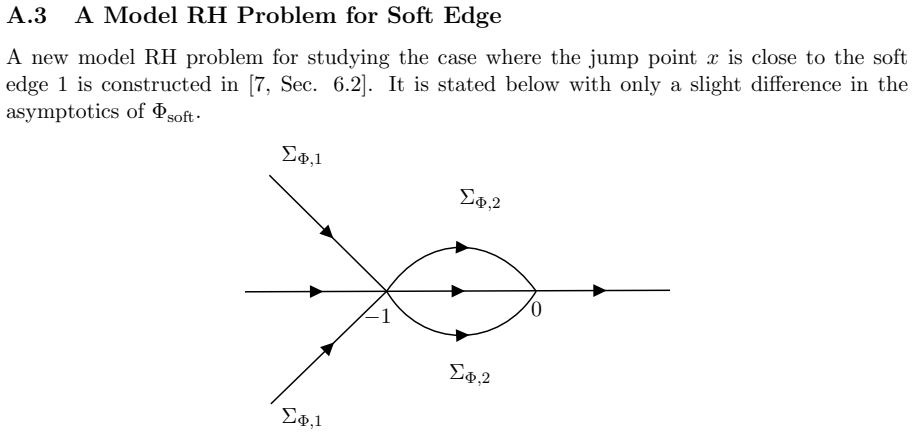
Figures from the paper (6 more)



Reference graph
Works this paper leans on
-
[7]
Claeys, B
T. Claeys, B. Fahs, G. Lambert and C. Webb, How much can the eigenvalues of a random Hermitian matrix fluctuate? Duke Math. J. 170 (2021), no. 9, 2085-2235
2021
-
[9]
D. Dai, C. Lu, On The Eigenvalue Rigidity of the Jacobi Unitary Ensemble. arXiv preprint arXiv:2511.18967, 2025. 39
arXiv 2025
-
[1]
Arguin, D
L.P. Arguin, D. Belius and P. Bourgade, Maximum of the characteristic polynomial of random unitary matrices, Comm. Math. Phys. 349 (2017), no. 2, 703–751
2017
-
[2]
Berestycki, C
N. Berestycki, C. Webb and M.D. Wong, Random Hermitian matrices and Gaussian mul- tiplicative chaos, Probab. Theory Related Fields 172 (2018), no. 1-2, 103–189
2018
-
[3]
Berezin and A.I
S. Berezin and A.I. Bufetov, On the rate of convergence in the central limit theorem for linear statistics of Gaussian, Laguerre, and Jacobi ensembles, Pure Appl. Funct. Anal.6 (2021), no. 1, 57-99
2021
-
[4]
Bourgade, P
P. Bourgade, P. Lopatto and O. Zeitouni, Optimal rigidity and maximum of the charac- teristic polynomial of Wigner matrices, Geom. Funct. Anal.35(2025), no. 1, 161–253
2025
-
[5]
Charlier, Asymptotics of Hankel determinants with a one-cut regular potential and Fisher-Hartwig singularities, Int
C. Charlier, Asymptotics of Hankel determinants with a one-cut regular potential and Fisher-Hartwig singularities, Int. Math. Res. Not. 2019 (2019), no. 24, 7515–7576
2019
-
[6]
Charlier and R
C. Charlier and R. Gharakhloo, Asymptotics of Hankel determinants with a Laguerre-type or Jacobi-type potential and Fisher-Hartwig singularities, Adv. Math. 383 (2021), 107672
2021
Show all 32 references
-
[8]
Claeys and I
T. Claeys and I. Krasovsky, Toeplitz determinants with merging singularities, Duke Math. J. 164 (2015), no. 15, 2897–2987
2015
-
[10]
Deift, Orthogonal Polynomials and Random Matrices: A Riemann-Hilbert Approach, Courant Lecture Notes, vol
P. Deift, Orthogonal Polynomials and Random Matrices: A Riemann-Hilbert Approach, Courant Lecture Notes, vol. 3, New York University, 1999
1999
-
[11]
Deift, T
P. Deift, T. Kriecherbauer, K.T.R. McLaughlin, S. Venakides and X. Zhou, Strong asymp- totics of orthogonal polynomials with respect to exponential weights. Comm. Pure Appl. Math. 52 (1999), no. 12, 1491-1552
1999
-
[12]
Dumitriu and E
I. Dumitriu and E. Paquette, Global fluctuations for linear statistics ofβ-Jacobi ensembles, Random Matrices Theory Appl, 1 (2012), no. 4, 1250013
2012
-
[13]
Duplantier, R
B. Duplantier, R. Rhodes, S. Sheffield and V. Vargas, Log-correlated Gaussian fields: an overview, Geometry, analysis and probability (2017), no. 310, 191–216
2017
-
[14]
Erd˝ os, B
L. Erd˝ os, B. Schlein and H.-T. Yau, Local semicircle law and complete delocalization for Wigner random matrices, Comm. Math. Phys. 287 (2009), no. 2, 641–655
2009
-
[15]
Erd˝ os, B
L. Erd˝ os, B. Schlein and H.-T. Yau, Semicircle law on short scales and delocalization of eigenvectors for Wigner random matrices, Ann. Probab. 37 (2009), no. 3, 815–852
2009
-
[16]
Erd˝ os, H.-T
L. Erd˝ os, H.-T. Yau and J. Yin, Bulk universality for generalized Wigner matrices, Probab. Theory Related Fields 154 (2012), no. 1-2, 341–407
2012
-
[17]
Erd˝ os, H.-T
L. Erd˝ os, H.-T. Yau and J. Yin, Rigidity of eigenvalues of generalized Wigner matrices, Adv. Math. 229 (2012), no. 3, 1435–1515
2012
-
[18]
Forrester, Log-gases and random matrices, Princeton University Press, Princeton, NJ, 2010
P.J. Forrester, Log-gases and random matrices, Princeton University Press, Princeton, NJ, 2010
2010
-
[19]
Its and I
A.R. Its and I. Krasovsky, Hankel determinant and orthogonal polynomials for the Gaussian weight with a jump, Contemporary Mathematics 458 (2008), 215-248
2008
-
[20]
Johansson, On fluctuations of eigenvalues of random Hermitian matrices, Duke Math
K. Johansson, On fluctuations of eigenvalues of random Hermitian matrices, Duke Math. J. 91 (1998), no. 1, 151-204
1998
-
[21]
Kahane, Sur le chaos multiplicatif, Ann
J.P. Kahane, Sur le chaos multiplicatif, Ann. Sci. Math. Qu´ ebec, 9 (1985), no. 2, 105-150
1985
-
[22]
J. P. Keating and M. D. Wong, On the critical-subcritical moments of moments of random characteristic polynomials: a GMC perspective, Comm. Math. Phys.394(2022), no. 3, 1247–1301
2022
-
[23]
Kivimae, Gaussian multiplicative chaos for Gaussian orthogonal and symplectic ensem- bles, Electron
P. Kivimae, Gaussian multiplicative chaos for Gaussian orthogonal and symplectic ensem- bles, Electron. J. Probab.29(2024), no. 22, 1–71
2024
-
[24]
Kuijlaars, K.T.R
A.B.J. Kuijlaars, K.T.R. McLaughlin, W. Van Assche and M. Vanlessen, The Riemann- Hilbert approach to strong asymptotics for orthogonal polynomials on [−1,1], Adv. Math. 188 (2004), no. 2, 337-398
2004
-
[25]
Lambert, D
G. Lambert, D. Ostrovsky and N. Simm, Subcritical multiplicative chaos for regularized counting statistics from random matrix theory, Comm. Math. Phys. 360 (2018), no. 1, 1–54
2018
-
[26]
Lambert, Maximum of the characteristic polynomial of the Ginibre ensemble, Comm
G. Lambert, Maximum of the characteristic polynomial of the Ginibre ensemble, Comm. Math. Phys.378(2020), no. 2, 943–985
2020
-
[27]
Nikula, E
M. Nikula, E. Saksman and C. Webb, Multiplicative chaos and the characteristic polyno- mial of the CUE: theL 1-phase, Trans. Amer. Math. Soc.373(2020), no. 6, 3905–3965. 40
2020
-
[28]
Olver, A.B
F.W.J. Olver, A.B. Olde Daalhuis, D.W. Lozier, B.I. Schneider, R.F. Boisvert, C.W. Clark, B.R. Miller, B.V. Saunders, H.S. Cohl and M.A. McClain, eds, NIST Digital Library of Mathematical Functions, https://dlmf.nist.gov/, Release 1.2.4 of 2025-03-15
2025
-
[29]
Paquette and O
E. Paquette and O. Zeitouni, The maximum of the CUE field, Int. Math. Res. Not. IMRN 16 (2018), 5028–5119
2018
-
[30]
Rhodes and V
R. Rhodes and V. Vargas, Gaussian multiplicative chaos and applications: a review. Probab. Surv. 11 (2014), 315–392
2014
-
[31]
Rhodes, Lecture notes on Gaussian multiplicative chaos and Liouville Quantum Gravity, (2016) arXiv preprint arXiv:1602.07323
R. Rhodes, Lecture notes on Gaussian multiplicative chaos and Liouville Quantum Gravity, (2016) arXiv preprint arXiv:1602.07323
2016 arXiv
-
[32]
Webb, The characteristic polynomial of a random unitary matrix and Gaussian multi- plicative chaos—theL 2-phase, Electron
C. Webb, The characteristic polynomial of a random unitary matrix and Gaussian multi- plicative chaos—theL 2-phase, Electron. J. Probab.20(2015), no. 104, 21 pp. 41
2015
Reviewed July 14, 2026 · model on record in the stance chip above.
Discussion (0). Continue with ORCID to comment.