Yangian Symmetry Escapes from the Fishnet
Pith reviewed 2026-05-21 17:49 UTC · model grok-4.3
The pith
Yangian symmetry holds classically in bi-scalar fishnet models but fails for generic quantum correlation functions.
A machine-rendered reading of the paper's core claim, the machinery that carries it, and where it could break.
Core claim
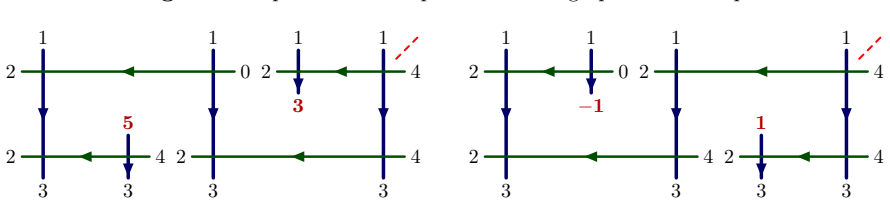
Yangian invariance is classically realised in the bi-scalar and supersymmetric fishnet models subject to specific evaluation parameter patterns. Curiously, Yangian invariance does not extend to generic quantum correlation functions in the bi-scalar model beyond the well-established classes of Yangian invariant correlators. Concrete counter-examples are given by sums of Feynman graphs and by bi-scalar graphs with octagon-shaped loops. This finding underlines that a non-zero dual Coxeter number represents an obstacle towards quantum Yangian symmetry and possibly also for complete integrability in planar QFT models.
What carries the argument
Yangian algebra realized on the classical action and equations of motion via chosen evaluation parameters, obstructed at the quantum level by the non-zero dual Coxeter number, with octagon-loop graphs serving as explicit counter-examples.
If this is right
- Only specific, well-established classes of correlators remain Yangian invariant at the quantum level.
- The non-zero dual Coxeter number blocks quantum Yangian symmetry in the bi-scalar model.
- Complete integrability may be obstructed in planar QFT models that share this feature.
- The supersymmetric fishnet variant is not shown to escape the same limitation.
Where Pith is reading between the lines
- Analogous obstructions may appear in other planar integrable models whose dual Coxeter number is non-zero.
- Searches for quantum corrections that could restore invariance become a natural next step.
- The result supplies a concrete diagnostic for testing candidate integrable deformations of four-dimensional theories.
Load-bearing premise
The evaluation-parameter patterns that produce classical Yangian symmetry do not survive into the quantum regime and no additional corrections cancel the effect of the non-zero dual Coxeter number.
What would settle it
Explicit computation of the action of the Yangian generators on a sum of bi-scalar Feynman graphs containing an octagon loop that returns a non-zero result instead of zero.
Figures




read the original abstract
We investigate Yangian symmetry for the equations of motion and the action of the classical bi-scalar and supersymmetric fishnet models in four spacetime dimensions, and we subsequently discuss its applicability to planar correlation functions. We argue that Yangian symmetry is classically realised in these models subject to specific evaluation parameter patterns. Curiously, Yangian invariance does not extend to generic quantum correlation functions in the bi-scalar model beyond the well-established classes of Yangian invariant correlators. We present several concrete counter-examples of bi-scalar correlators given by sums of Feynman graphs and of bi-scalar graphs with octagon-shaped loops. This finding underlines the notion that a non-zero dual Coxeter number represents an obstacle towards quantum Yangian symmetry and possibly also for complete integrability in planar QFT models.
Editorial analysis
A structured set of objections, weighed in public.
Referee Report
Summary. The paper investigates Yangian symmetry for the equations of motion and action of the classical bi-scalar and supersymmetric fishnet models in four dimensions. It argues that the symmetry is realized subject to specific evaluation parameter patterns. The central claim is that Yangian invariance does not extend to generic quantum correlation functions in the bi-scalar model, supported by explicit counterexamples consisting of sums of Feynman graphs and bi-scalar graphs with octagon-shaped loops. This is tied to the non-zero dual Coxeter number as an obstacle to quantum Yangian symmetry and possibly complete integrability in planar QFTs.
Significance. If the central claim holds, the result is significant for clarifying the boundaries of Yangian symmetry in quantum regimes of models with known classical integrability features. It supplies concrete graph-based evidence that classical symmetries under restricted parameters need not survive quantization. The manuscript earns credit for its explicit symmetry checks on the classical action and equations of motion together with the construction of specific counterexamples via Feynman-graph sums.
major comments (2)
- [§5] §5 (quantum correlators and counterexamples): the counterexamples drawn from sums of Feynman graphs and octagon-loop bi-scalar graphs must be evaluated at the same evaluation-parameter patterns that realize classical Yangian symmetry (as defined earlier in the classical analysis). Without explicit confirmation that these patterns are used, the observed non-invariance does not demonstrate that the symmetry 'escapes' the quantum theory; it may simply reflect a parameter choice outside the classically invariant sector.
- [§5] §5: the claim that Yangian invariance fails for generic quantum correlators rests on selected counterexamples rather than a general argument or exhaustive classification. While the explicit graphs are valuable, a load-bearing gap remains in extending the conclusion from these cases to the generic statement without additional justification or a broader set of examples.
minor comments (2)
- A compact summary table collecting the allowed evaluation-parameter patterns for the classical case would improve readability and make cross-reference to the quantum counterexamples easier.
- [Introduction] Notation for the dual Coxeter number and its role could be introduced with a short dedicated paragraph in the introduction for readers less familiar with the algebraic context.
Simulated Author's Rebuttal
We thank the referee for their thorough review and valuable comments on our manuscript. We have carefully considered the points raised regarding the quantum correlators and counterexamples in §5. Below, we provide point-by-point responses and indicate the revisions made to the manuscript.
read point-by-point responses
-
Referee: §5 (quantum correlators and counterexamples): the counterexamples drawn from sums of Feynman graphs and octagon-loop bi-scalar graphs must be evaluated at the same evaluation-parameter patterns that realize classical Yangian symmetry (as defined earlier in the classical analysis). Without explicit confirmation that these patterns are used, the observed non-invariance does not demonstrate that the symmetry 'escapes' the quantum theory; it may simply reflect a parameter choice outside the classically invariant sector.
Authors: We agree with the referee that it is crucial to use the same evaluation parameter patterns for the quantum counterexamples as those that preserve the classical Yangian symmetry. In the original manuscript, this was implicit in the construction of the examples, but we acknowledge that explicit confirmation is necessary. In the revised version, we have added a clear statement in §5 specifying that the counterexamples are computed with the restricted evaluation parameters identified in the classical analysis (specifically, the patterns that make the classical action and equations of motion Yangian invariant). This revision ensures that the non-invariance observed is a genuine quantum effect. revision: yes
-
Referee: §5: the claim that Yangian invariance fails for generic quantum correlators rests on selected counterexamples rather than a general argument or exhaustive classification. While the explicit graphs are valuable, a load-bearing gap remains in extending the conclusion from these cases to the generic statement without additional justification or a broader set of examples.
Authors: We appreciate this observation. Our conclusion that Yangian invariance does not extend to generic quantum correlators is indeed supported by explicit counterexamples rather than a general theorem. These counterexamples include sums of Feynman graphs and bi-scalar graphs with octagon-shaped loops, which are representative of the types of correlators that appear in the planar limit of the bi-scalar model. To strengthen the manuscript, we have revised §5 to include additional discussion explaining why the non-zero dual Coxeter number leads to the breaking of the symmetry in these generic cases, and why the known Yangian-invariant classes are special. While a complete classification of all possible correlators is beyond the scope of this work, we believe the provided examples and the underlying symmetry analysis provide sufficient evidence for the claim. revision: partial
Circularity Check
Explicit graph evaluations provide independent evidence; no reduction to inputs by construction.
full rationale
The paper conditions classical Yangian realization on specific evaluation parameter patterns and then presents direct counterexamples via explicit sums of Feynman graphs and bi-scalar graphs containing octagon loops to show that invariance fails for generic quantum correlators. These counterexamples are computed from the model Lagrangian and Feynman rules rather than being fitted or renamed from prior results. The dual-Coxeter-number obstruction is invoked as an explanatory remark but does not serve as a load-bearing derivation step that collapses the central claim into a self-citation or self-definition. No equation or argument reduces the claimed non-extension to its own inputs by construction; the derivation remains self-contained against external benchmarks.
Axiom & Free-Parameter Ledger
axioms (2)
- domain assumption Yangian algebra acts on the equations of motion and action of the fishnet models when evaluation parameters follow specific patterns.
- domain assumption Non-zero dual Coxeter number prevents extension of Yangian invariance to generic quantum correlators.
Lean theorems connected to this paper
-
IndisputableMonolith/Foundation/AlexanderDuality.leanalexander_duality_circle_linking unclear?
unclearRelation between the paper passage and the cited Recognition theorem.
Yangian invariance does not extend to generic quantum correlation functions... non-zero dual Coxeter number represents an obstacle
-
IndisputableMonolith/Foundation/ArithmeticFromLogic.leanLogicNat recovery and embed_strictMono unclear?
unclearRelation between the paper passage and the cited Recognition theorem.
evaluation parameters... quasi-periodicity Δs = +4... match the dual Coxeter number h* = 4-N
What do these tags mean?
- matches
- The paper's claim is directly supported by a theorem in the formal canon.
- supports
- The theorem supports part of the paper's argument, but the paper may add assumptions or extra steps.
- extends
- The paper goes beyond the formal theorem; the theorem is a base layer rather than the whole result.
- uses
- The paper appears to rely on the theorem as machinery.
- contradicts
- The paper's claim conflicts with a theorem or certificate in the canon.
- unclear
- Pith found a possible connection, but the passage is too broad, indirect, or ambiguous to say the theorem truly supports the claim.
Reference graph
Works this paper leans on
-
[1]
Review of AdS/CFT Integrability: An Overview
N. Beisert et al.,“Review of AdS/CFT Integrability: An Overview”, Lett. Math. Phys. 99, 3 (2012),arxiv:1012.3982.•D. Bombardelli, A. Cagnazzo, R. Frassek, F. Levkovich-Maslyuk, F. Loebbert, S. Negro, I. M. Sz´ ecs´ enyi, A. Sfondrini, S. J. van Tongeren and A. Torrielli,“An integrability primer for the gauge-gravity correspondence: An introduction”,J. Phy...
work page internal anchor Pith review Pith/arXiv arXiv 2012
-
[2]
High energy QCD as a completely integrable model
L. D. Faddeev and G. P. Korchemsky,“High-energy QCD as a completely integrable model”,Phys. Lett. B 342, 311 (1995),hep-th/9404173
work page internal anchor Pith review Pith/arXiv arXiv 1995
-
[3]
New integrable non-gauge 4D QFTs from strongly deformed planar N=4 SYM
¨O. G¨ urdo˘ gan and V. Kazakov,“New Integrable 4D Quantum Field Theories from Strongly Deformed Planar N=4 Supersymmetric Yang-Mills Theory”, Phys. Rev. Lett. 117, 201602 (2016),arxiv:1512.06704
work page internal anchor Pith review Pith/arXiv arXiv 2016
-
[4]
Chiral limit of N = 4 SYM and ABJM and integrable Feynman graphs
J. Caetano, ¨O. G¨ urdo˘ gan and V. Kazakov,“Chiral limit of N=4 SYM and ABJM and integrable Feynman graphs”,JHEP 1803, 077 (2018),arxiv:1612.05895
work page internal anchor Pith review Pith/arXiv arXiv 2018
-
[5]
Gauge-string duality for superconformal deformations of N=4 Super Yang-Mills theory
S. A. Frolov, R. Roiban and A. A. Tseytlin,“Gauge-string duality for superconformal deformations of N=4 super Yang-Mills theory”,JHEP 0507, 045 (2005),hep-th/0503192. •S. Frolov,“Lax pair for strings in Lunin-Maldacena background”, JHEP 0505, 069 (2005),hep-th/0503201.•S. A. Frolov, R. Roiban and A. A. Tseytlin, “Gauge-string duality for (non)supersymmetr...
work page internal anchor Pith review Pith/arXiv arXiv 2005
-
[6]
Yangian Symmetry for Bi-Scalar Loop Amplitudes
D. Chicherin, V. Kazakov, F. Loebbert, D. M¨ uller and D.-l. Zhong,“Yangian Symmetry for Bi-Scalar Loop Amplitudes”,JHEP 1805, 003 (2018),arxiv:1704.01967
work page internal anchor Pith review Pith/arXiv arXiv 2018
-
[7]
Integrability of Conformal Fishnet Theory
N. Gromov, V. Kazakov, G. Korchemsky, S. Negro and G. Sizov,“Integrability of Conformal Fishnet Theory”,JHEP 1801, 095 (2018),arxiv:1706.04167
work page internal anchor Pith review Pith/arXiv arXiv 2018
-
[8]
Yangian Symmetry for Fishnet Feynman Graphs
D. Chicherin, V. Kazakov, F. Loebbert, D. M¨ uller and D.-l. Zhong,“Yangian Symmetry for Fishnet Feynman Graphs”,Phys. Rev. D 96, 121901 (2017),arxiv:1708.00007
work page internal anchor Pith review Pith/arXiv arXiv 2017
-
[9]
‘Fishing-net’ diagrams as a completely integrable system
A. B. Zamolodchikov,“‘Fishing-net’ diagrams as a completely integrable system”, Phys. Lett. B 97, 63 (1980)
work page 1980
-
[10]
The One-Loop Spectral Problem of Strongly Twisted $\mathcal{N}$=4 Super Yang-Mills Theory
A. C. Ipsen, M. Staudacher and L. Zippelius,“The one-loop spectral problem of strongly twisted N=4 Super Yang-Mills theory”,JHEP 1904, 044 (2019),arxiv:1812.08794
work page internal anchor Pith review Pith/arXiv arXiv 1904
-
[11]
Quantum Spectral Curve of $\gamma$-twisted ${\cal N}=4$ SYM theory and fishnet CFT
V. Kazakov,“Quantum Spectral Curve ofγ-twisted N=4 SYM theory and fishnet CFT”, arxiv:1802.02160. 22Some parts of the curve may run in parallel, see the case 180 ◦ in Fig. 10. Here, one should assume that there remains a small strip of intermediate area which is not enclosed by the curve. 23
work page internal anchor Pith review Pith/arXiv arXiv
-
[12]
Hopf algebras and the quantum Yang–Baxter equation
V. G. Drinfel’d,“Hopf algebras and the quantum Yang–Baxter equation”, Sov. Math. Dokl. 32, 254 (1985).•V. G. Drinfel’d,“Quantum groups”, J. Sov. Math. 41, 898 (1988)
work page 1985
-
[13]
Integrable Feynman graphs and Yangian symmetry on the loom
V. Kazakov, F. Levkovich-Maslyuk and V. Mishnyakov,“Integrable Feynman graphs and Yangian symmetry on the loom”,JHEP 2506, 104 (2025),arxiv:2304.04654
-
[14]
Nonlocal Symmetries of Planar Feynman Integrals
F. Loebbert, L. R¨ uenaufer and S. F. Stawinski,“Nonlocal Symmetries of Planar Feynman Integrals”,Phys. Rev. Lett. 135, 151603 (2025),arxiv:2505.05550
-
[15]
F. Loebbert and J. Miczajka,“Massive Fishnets”,JHEP 2012, 197 (2020), arxiv:2008.11739.•D. Chicherin and G. P. Korchemsky,“The SAGEX review on scattering amplitudes Chapter 9: Integrability of amplitudes in fishnet theories”, J. Phys. A 55, 443010 (2022),arxiv:2203.13020
-
[16]
Yangian Bootstrap for Conformal Feynman Integrals
F. Loebbert, D. M¨ uller and H. M¨ unkler,“Yangian Bootstrap for Conformal Feynman Integrals”,Phys. Rev. D 101, 066006 (2020),arxiv:1912.05561.•L. Corcoran, F. Loebbert, J. Miczajka and M. Staudacher,“Minkowski Box from Yangian Bootstrap”, JHEP 2104, 160 (2021),arxiv:2012.07852
-
[17]
Yangian Symmetry and Integrability of Planar N=4 Super-Yang-Mills Theory
N. Beisert, A. Garus and M. Rosso,“Yangian Symmetry and Integrability of Planar N=4 Supersymmetric Yang-Mills Theory”,Phys. Rev. Lett. 118, 141603 (2017), arxiv:1701.09162
work page internal anchor Pith review Pith/arXiv arXiv 2017
-
[18]
Yangian Symmetry for the Action of Planar N=4 Super Yang-Mills and N=6 Super Chern-Simons Theories
N. Beisert, A. Garus and M. Rosso,“Yangian Symmetry for the Action of Planar N=4 Super Yang-Mills and N=6 Super Chern-Simons Theories”, Phys. Rev. D 98, 046006 (2018),arxiv:1803.06310
work page internal anchor Pith review Pith/arXiv arXiv 2018
-
[19]
Yangian Algebra and Correlation Functions in Planar Gauge Theories
N. Beisert and A. Garus,“Yangian Algebra and Correlation Functions in Planar Gauge Theories”,SciPost Phys. 5, 018 (2018),arxiv:1804.09110
work page internal anchor Pith review Pith/arXiv arXiv 2018
-
[20]
Untwisting the symmetries of $\beta$-deformed Super-Yang--Mills
A. Garus,“Untwisting the symmetries ofβ-deformed Super-Yang–Mills”, JHEP 1710, 007 (2017),arxiv:1707.04128
work page internal anchor Pith review Pith/arXiv arXiv 2017
-
[21]
Yangian form-alism for planar gauge theories
N. Beisert and B. K¨ onig,“Yangian form-alism for planar gauge theories”, J. Math. Phys. 66, 062301 (2025),arxiv:2411.16176
-
[22]
Yangian symmetry of scattering amplitudes in N=4 super Yang-Mills theory
J. M. Drummond, J. M. Henn and J. Plefka,“Yangian symmetry of scattering amplitudes in N=4 super Yang-Mills theory”,JHEP 0905, 046 (2009),arxiv:0902.2987
work page internal anchor Pith review Pith/arXiv arXiv 2009
-
[23]
Integrable fishnet fromγ-deformed N=2 quivers
A. Pittelli and M. Preti,“Integrable fishnet fromγ-deformed N=2 quivers”, Phys. Lett. B 798, 134971 (2019),arxiv:1906.03680
-
[24]
On a CFT limit of planar $\gamma_i$-deformed $\mathcal{N}=4$ SYM theory
C. Sieg and M. Wilhelm,“On a CFT limit of planarγ i-deformed N=4 SYM theory”, Phys. Lett. B 756, 118 (2016),arxiv:1602.05817.•D. Grabner, N. Gromov, V. Kazakov and G. Korchemsky,“Stronglyγ-Deformed N=4 Supersymmetric Yang-Mills Theory as an Integrable Conformal Field Theory”,Phys. Rev. Lett. 120, 111601 (2018), arxiv:1711.04786
work page internal anchor Pith review Pith/arXiv arXiv 2016
-
[25]
Structure Constants and Integrable Bootstrap in Planar N=4 SYM Theory
B. Basso, S. Komatsu and P. Vieira,“Structure Constants and Integrable Bootstrap in Planar N=4 SYM Theory”,arxiv:1505.06745.•B. Basso, J. Caetano and T. Fleury, “Hexagons and Correlators in the Fishnet Theory”,JHEP 1911, 172 (2019), arxiv:1812.09794.•E. Olivucci,“Hexagonalization of Fishnet integrals. Part I. Mirror excitations”,JHEP 2111, 204 (2021),arxi...
work page internal anchor Pith review Pith/arXiv arXiv 1911
discussion (0)
Sign in with ORCID, Apple, or X to comment. Anyone can read and Pith papers without signing in.