REVIEW 4 major objections 6 minor 34 references
SynthGenNet: a self-supervised approach for test-time generalization using synthetic multi-source domain mixing of street view images
T0 review · 4 major / 6 minor · reviewed 2026-08-05 · deepseek-v4-flash
Pith's one-line read SynthGenNet claims a self-supervised teacher-student architecture that trains on two synthetic street-view datasets and adapts to unseen real street scenes by pseudo-label distillation, reaching 49.79% mIoU on IDD and 48.33% on Cityscapes.
desk verdict The headline IDD score can't be taken at face value: the method trains on unlabeled target images, making it UDA rather than test-time generalization, and the paper never specifies the target split. read the letter →
The pith
A machine-rendered reading of the paper's core claim, the machinery that carries it, and where it could break.
The reading
What carries the argument
ClassMix++ is the central mixing object: it takes two labeled synthetic images, selects half the semantic classes present in one image's ground truth, builds a binary mask from those classes, and pastes the selected pixels over the second image, yielding a mixed image and a mixed label map. GMC loss computes cross-entropy between a model's prediction on a randomly masked image and the source ground truth, enforcing spatial coherence without pseudo-label noise. PLGCL samples class-specific patches from teacher pseudo-labeled target images, encodes them, and applies an InfoNCE-style contrastive loss so patches of the same class are pulled together across domains.
What would settle it
Evaluate the trained student on a held-out target split whose images were never seen during student training, and compare those scores with the reported 48.33% and 49.79% mIoU. Also run an ablation in which the student is trained without any target images; if the held-out mIoU drops substantially, the test-time generalization claim fails.
Extended reading notes
Core claim
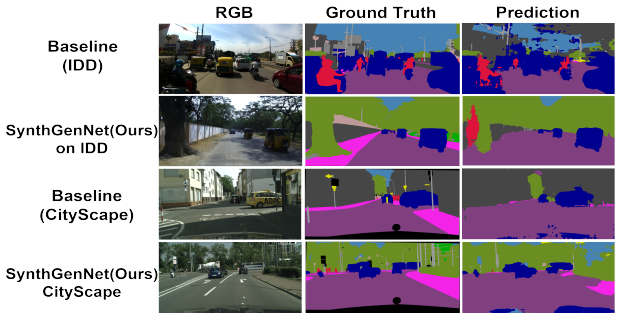
The central claim is that multi-source synthetic training plus self-supervised target adaptation beats single-source synthetic training for real-world street segmentation. SynthGenNet combines three mechanisms: ClassMix++ blends two labeled synthetic images using ground-truth class masks; GMC loss trains the teacher to predict full labels from randomly masked source images using source ground truth rather than noisy target pseudo-labels; and PLGCL applies pseudo-label guided contrastive learning to the student's patch embeddings. With a ResNet-50 backbone the student reports 48.33% mIoU on Cityscapes and 49.79% on IDD, both above the single-source baselines it compares against.
Load-bearing premise
The load-bearing premise is that the unlabeled target-domain images used to train the student network are disjoint from the images used to compute the reported mIoU; the paper does not specify this split.
Editorial extensions
If this is right
- If the reported numbers hold, street-scene segmentation can be improved for unstructured environments without collecting labeled real data, lowering the cost barrier for autonomous-driving support in developing-country cities.
- The recipe is concrete: train a teacher on mixed synthetic labels, generate pseudo-labels for unlabeled target images, and distill them into a student with contrastive patch alignment.
- Each component contributes: the teacher experiments show ClassMix++ and GMC loss raise mIoU from single-source levels on the mixed source set.
- The gains are not tightly coupled to one backbone; the student performs better on IDD with ResNet-50 than with ResNet-101, though Cityscapes improves with ResNet-101.
Reading between the lines
- An implication the paper leaves implicit: because unlabeled target images are used during student training, the protocol is closer to transductive or unsupervised domain adaptation than to strict test-time generalization; the reported numbers should be read with that protocol in mind.
- The multi-source mixing idea could be pushed further: testing ClassMix++ with more than two sources and randomized class subsets would show whether source diversity, rather than the specific mixing rule, drives the gain.
- Because GMC uses clean source ground truth, its contribution could be isolated by injecting controlled label noise into the source annotations; a large performance drop would indicate the loss mainly benefits from clean labels rather than from masking mechanics.
Editorial analysis
A structured set of objections, weighed in public.
Referee Report
Summary. The paper proposes SynthGenNet, a teacher–student architecture for semantic segmentation that aims at test-time domain generalization from synthetic multi-source data (GTA5 and Synthia) to real street scenes (Cityscapes and IDD). The teacher is trained on synthetic data with a proposed ClassMix++ mixing strategy and a Grounded Mask Consistency (GMC) loss; the student is then trained on unlabeled target-domain images using teacher pseudo-labels and a Pseudo-Label Guided Contrastive Learning (PLGCL) loss. The authors report 48.33 mIoU on Cityscapes and 49.79 mIoU on IDD with ResNet-50, claiming state-of-the-art performance relative to single-source methods.
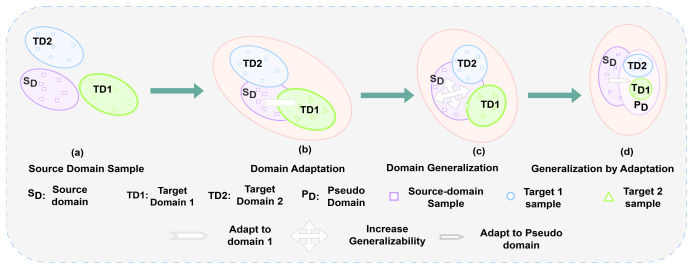
Significance. The underlying idea—combining multiple synthetic sources with class-mix augmentation, masked ground-truth consistency, and contrastive patch learning—is reasonable and potentially useful for sim-to-real segmentation in unstructured scenes. The paper also explicitly motivates the 'Generalization by Adaptation' setting. However, as the manuscript stands, the central performance claim is not supported: the method's access to unlabeled target-domain data is not documented at the level needed to rule out leakage, and the baselines in Table 6 are not protocol-matched. The malformed PLGCL ablation and internal numerical inconsistencies further reduce confidence. No code or full experimental specification is provided, so the results cannot be independently checked.
major comments (4)
- [§4.2, Fig. 2, §3.3] The student network is explicitly trained on target-domain images (Fig. 2: 'Pseudo-labels ... on target domain images'; §3.3 uses an unlabeled set I_U; §4.2 trains the student for 5 epochs), but no target-data split is specified. If the Cityscapes/IDD validation images used in Table 6 are included in this unlabeled set, the reported 49.79/48.33 mIoU values measure transductive fitting rather than generalization. The paper's own §2 states that DG, unlike UDA, does not use target-domain data during training; the method therefore contradicts its DG framing unless a disjoint target partition and an explicit adaptation protocol are supplied. This is load-bearing for the headline claim.
- [§5.2, Table 6] The comparison in Table 6 is not protocol-matched. SynthGenNet uses unlabeled target-domain images for student training, while TLDR is listed as trained on GTA5 only and Empirical Generalization on Cityscape only; the caption claims all training is on GTA5 and Synthia, which is false for the baselines. The custom baseline uses GTA5+Synthia but no target adaptation. Thus the improvements (48.33 vs 30.57 on Cityscapes; 49.79 vs 48.7 on IDD) cannot be attributed to ClassMix++/GMC/PLGCL; they may reflect the additional target-domain adaptation signal and the extra source domain. The authors need to compare with UDA/GA methods that use the same source and target data and to report complete results for both target datasets.
- [§5.4, Table 5] The PLGCL ablation does not support the claimed benefit. Table 5 is malformed: the columns do not include a contrastive-loss weight, although §5.4 discusses weights of 1.0 (contrastive) and 0.5 (cross-entropy); the three data rows (41.51, 49.79, 31.57) are not labeled by dataset or by weight. The text states 49.79 for IDD, but the table appears to reuse the ResNet-50 IDD number without context. In addition, the total student loss (weighted combination of segmentation CE and L_PLGCL) is never defined. This makes the PLGCL contribution impossible to evaluate.
- [§3.1, Algorithm 1] Algorithm 1 is the standard ClassMix procedure: take two labeled images, argmax their ground-truth labels, select half of the classes present in A, build a binary mask, and mix images and labels. No mechanism specific to 'multi-source' mixing (e.g., use of domain labels, source identity, or more than two images) is described. The novelty of 'ClassMix++' beyond applying ClassMix to a merged GTA5+Synthia pool is therefore not established. If an additional design choice is intended, it should be stated explicitly and ablated.
minor comments (6)
- [Abstract, §5.2, Table 4, Table 6] The abstract says '50% mIoU' while the reported IDD value is 49.79. Also, Table 4 reports ResNet-101 IDD mIoU as 46.63 while Table 6 reports 46.33. These numbers should be made consistent.
- [Tables 2 and 3] The rows are labeled 'MIC Loss' although §3.2 and §5.3 describe GMC loss. The mIoU values are given as decimals (0.41) while §5.3 quotes percentages (41.88); use one convention throughout.
- [§4.2, §3.2, §3.3] Several hyperparameters needed for reproducibility are missing: the student network's learning rate, the GMC mask ratio r and patch size b, the PLGCL patch-sampling neighborhood parameter n, and the values of λ and ζ in Eq. (11).
- [Eq. (10)–(11)] The 'closed-form upper bound' is not derived; the Gaussian assumption is introduced ad hoc, and the relationship of λ and ζ to the original InfoNCE loss is unexplained.
- [Algorithm 1] Line 3 contains a typo: 'SA(i,j,c 0)' should be 'SA(i,j,c)'. Figure and table captions also need proofreading.
- [§3.3, §4.2] The paper should state whether the teacher is updated by EMA during student training. If it is, the pseudo-labels become a function of the student's own predictions and the resulting self-training feedback loop should be discussed; if it is frozen, this should be stated explicitly.
Circularity Check
No significant circularity: the reported results are empirical and the components are derived from external, cited methods; the main concern is an underspecified evaluation protocol, not a circular derivation.
full rationale
The paper does not contain a derivation chain in which a claimed prediction reduces to its own inputs by construction. ClassMix++ (Algorithm 1) mixes labeled synthetic source images, and the mixed labels are defined directly from source ground truth—this is a standard augmentation, not a circular prediction. GMC loss (Eq. 3) is cross-entropy between a masked prediction and source ground truth, again a supervised objective with no dependence on the reported target mIoU. PLGCL (Eq. 11) is adopted from the cited external work [8] and uses teacher pseudo-labels; it is an auxiliary contrastive loss, not a fitted parameter that is then renamed as a prediction. The teacher here is trained on labeled source data with GMC, and there is no statement that the teacher is an EMA of the student in the proposed method; the EMA description in Section 2 belongs to the cited MIC method, so the pseudo-label feedback loop suggested by the reader is not established in the text. The paper also contains no load-bearing self-citation: references are to external prior work (MIC, ClassMix, PLGCL, TLDR, etc.). The most salient weakness is a protocol ambiguity: the student is described as being trained 'on target domain images' (Figure 2) while the paper calls the setting 'test-time generalization' and evaluates on validation sets. If the student training target images overlap with the evaluation validation images, then the reported mIoU would be leaked and the claim would be unsupported. However, the paper never states that the validation images were used during student training, and standard UDA practice uses a disjoint target training split. This is an underspecified evaluation protocol / potential leakage risk, not a circular derivation that can be exhibited from the paper's equations. Therefore no circularity step meets the required evidentiary bar, and the appropriate score is 0.
Assumptions & free parameters
free parameters (5)
- contrastive loss weight =
1.0
- cross-entropy loss weight =
0.5
- temperature τ in InfoNCE loss =
not specified
- λ and ζ in the refined PLGCL loss =
not specified
- GMC mask ratio r and patch size b =
not specified
assumptions (3)
- domain assumption Teacher pseudo-labels on target images provide a reliable learning signal for the student.
- domain assumption Unstructured urban scenes in India can be modeled by mixing GTA5 and SYNTHIA images.
- ad hoc to paper Use of unlabeled target-domain images during training is a form of test-time generalization.
Cite this review
Pith. "Pith review of SynthGenNet: a self-supervised approach for test-time generalization using synthetic multi-source domain mixing of street view images." pith.science (2026). https://pith.science/paper/KS7JMD5V
@misc{pith2026250902287,
  author       = {Pith},
  title        = {Pith review of: SynthGenNet: a self-supervised approach for test-time generalization using synthetic multi-source domain mixing of street view images},
  year         = {2026},
  howpublished = {\url{https://pith.science/paper/KS7JMD5V}},
  note         = {Machine review of arXiv:2509.02287}
}
read the original abstract
Unstructured urban environments present unique challenges for scene understanding and generalization due to their complex and diverse layouts. We introduce SynthGenNet, a self-supervised student-teacher architecture designed to enable robust test-time domain generalization using synthetic multi-source imagery. Our contributions include the novel ClassMix++ algorithm, which blends labeled data from various synthetic sources while maintaining semantic integrity, enhancing model adaptability. We further employ Grounded Mask Consistency Loss (GMC), which leverages source ground truth to improve cross-domain prediction consistency and feature alignment. The Pseudo-Label Guided Contrastive Learning (PLGCL) mechanism is integrated into the student network to facilitate domain-invariant feature learning through iterative knowledge distillation from the teacher network. This self-supervised strategy improves prediction accuracy, addresses real-world variability, bridges the sim-to-real domain gap, and reliance on labeled target data, even in complex urban areas. Outcomes show our model outperforms the state-of-the-art (relying on single source) by achieving 50% Mean Intersection-Over-Union (mIoU) value on real-world datasets like Indian Driving Dataset (IDD).
Figures


Figures from the paper (2 more)

Reference graph
Works this paper leans on
-
[1]
Danping Liu and Dong Zhang. Semantic segmen- tation of autonomous driving scenes based on multi- scale adaptive attention.Neuroscience-driven Visual Representation, page 97, 2024
work page 2024
-
[2]
Peiyan Jia et al. Semantic segmentation of deep learningremotesensingimagesbasedonbandcombi- nation principle: Application in urban planning and land use. Computer Communications, 217:97–106, 2024. 8
work page 2024
-
[3]
Q. Bi, S. You, and T. Gevers. Learning content- enhanced mask transformer for domain general- ized urban-scene segmentation. In Proceedings of the AAAI Conference on Artificial Intelligence, vol- ume 38, pages 819–827, March 2024
work page 2024
-
[4]
Global and local texture random- ization for synthetic-to-real semantic segmentation
Duo Peng, Yinjie Lei, Lingqiao Liu, Pingping Zhang, and Jun Liu. Global and local texture random- ization for synthetic-to-real semantic segmentation. IEEE Transactions on Image Processing, 30:6594– 6608, 2021
work page 2021
-
[5]
Cutmix: Regularization strategy to train strongclas- sifiers with localizable features
Sangdoo Yun, Dongyoon Han, Seong Joon Oh, Sanghyuk Chun, Junsuk Choe, and Youngjoon Yoo. Cutmix: Regularization strategy to train strongclas- sifiers with localizable features. InProceedings of the IEEE/CVF international conference on computer vi- sion, pages 6023–6032, 2019
work page 2019
-
[6]
Classmix: Segmentation-based data augmentation for semi-supervised learning
Viktor Olsson et al. Classmix: Segmentation-based data augmentation for semi-supervised learning. In Proceedings of the IEEE/CVF Winter Conference on Applications of Computer Vision, 2021
work page 2021
-
[7]
Mic: Masked image consistency for context-enhanced domain adaptation
Lukas Hoyer, Dengxin Dai, Haoran Wang, and Luc Van Gool. Mic: Masked image consistency for context-enhanced domain adaptation. InProceedings of the IEEE/CVF conference on computer vision and pattern recognition, pages 11721–11732, 2023
work page 2023
-
[8]
Pseudo-label guided contrastive learning for semi-supervised med- ical image segmentation
Hritam Basak and Zhaozheng Yin. Pseudo-label guided contrastive learning for semi-supervised med- ical image segmentation. In Proceedings of the IEEE/CVF Conference on Computer Vision and Pattern Recognition, 2023
work page 2023
Show all 34 references
-
[9]
Contrastive learning and self- training for unsupervised domain adaptation in se- mantic segmentation
Robert A Marsden, Alexander Bartler, Mario Döbler, and Bin Yang. Contrastive learning and self- training for unsupervised domain adaptation in se- mantic segmentation. In 2022 International Joint Conference on Neural Networks (IJCNN), pages 1–
2022
-
[10]
Learning variational neighbor labels for test-time domain generalization
Sameer Ambekar, Zehao Xiao, Jiayi Shen, Xiantong Zhen, and Cees GM Snoek. Learning variational neighbor labels for test-time domain generalization. arXiv preprint arXiv:2307.04033, 2023
2023 arXiv
-
[11]
Daformer: Improving network architectures and training strategies for domain-adaptive semantic seg- mentation
Lukas Hoyer, Dengxin Dai, and Luc Van Gool. Daformer: Improving network architectures and training strategies for domain-adaptive semantic seg- mentation. In Proceedings of the IEEE/CVF con- ference on computer vision and pattern recognition, pages 9924–9935, 2022
2022
-
[12]
Hrda: Context-aware high-resolution domain-adaptive se- mantic segmentation
Lukas Hoyer, Dengxin Dai, and Luc Van Gool. Hrda: Context-aware high-resolution domain-adaptive se- mantic segmentation. In European conference on computer vision, pages 372–391. Springer, 2022
2022
-
[13]
Prompt-based distribution alignment for un- supervised domain adaptation
Shuanghao Bai, Min Zhang, Wanqi Zhou, Siteng Huang, Zhirong Luan, Donglin Wang, and Badong Chen. Prompt-based distribution alignment for un- supervised domain adaptation. In Proceedings of the AAAI Conference on Artificial Intelligence, vol- ume 38, pages 729–737, 2024
2024
-
[14]
Feature alignment and restoration for do- main generalization and adaptation.arXiv preprint arXiv:2006.12009, 2020
Xin Jin, Cuiling Lan, Wenjun Zeng, and Zhibo Chen. Feature alignment and restoration for do- main generalization and adaptation.arXiv preprint arXiv:2006.12009, 2020
2006 arXiv
-
[15]
Domain generalization with adversarial feature learning
Haoliang Li, Sinno Jialin Pan, Shiqi Wang, and Alex C Kot. Domain generalization with adversarial feature learning. In Proceedings of the IEEE con- ference on computer vision and pattern recognition, pages 5400–5409, 2018
2018
-
[16]
Adversarial feature alignment: Balancing robustness and accuracy in deep learning via adversarial training.arXiv preprint arXiv:2402.12187, 2024
Leo Hyun Park, Jaeuk Kim, Myung Gyo Oh, Jae- woo Park, and Taekyoung Kwon. Adversarial feature alignment: Balancing robustness and accuracy in deep learning via adversarial training.arXiv preprint arXiv:2402.12187, 2024
2024 arXiv
-
[17]
Unsuperviseddomainadaptationthroughself- supervision
Yu Sun, Eric Tzeng, Trevor Darrell, and Alexei A Efros. Unsuperviseddomainadaptationthroughself- supervision. arXiv preprint arXiv:1909.11825, 2019
1909 arXiv
-
[18]
Unsupervised batch- norm adaptation (ubna): A domain adaptation method for semantic segmentation without using source domain representations
Marvin Klingner, Jan-Aike Termöhlen, Jacob Rit- terbach, and Tim Fingscheidt. Unsupervised batch- norm adaptation (ubna): A domain adaptation method for semantic segmentation without using source domain representations. InProceedings of the IEEE/CVF Winter Conference on Applic...
2022
-
[19]
Domain generalization with small data
Kecheng Chen et al. Domain generalization with small data. International Journal of Computer Vi- sion, pages 1–19, 2024
2024
-
[20]
Domaingeneralizationbylearningand removing domain-specific features
YuDingetal. Domaingeneralizationbylearningand removing domain-specific features. In Advances in Neural Information Processing Systems, volume 35, pages 24226–24239, 2022
2022
-
[21]
Feature stylization and domain- aware contrastive learning for domain generalization
Seogkyu Jeon et al. Feature stylization and domain- aware contrastive learning for domain generalization. In Proceedings of the 29th ACM International Con- ference on Multimedia, 2021
2021
-
[22]
Domain generalization through meta-learning: a survey
Arsham Gholamzadeh Khoee, Yinan Yu, and Robert Feldt. Domain generalization through meta-learning: a survey. Artificial Intelligence Review, 57(10):285, 2024
2024
-
[23]
Multi- ple domain-adversarial ensemble learning for domain generalization
Ze-Yu Mi, Kun Long, and Yu-Bin Yang. Multi- ple domain-adversarial ensemble learning for domain generalization. In ICASSP 2023-2023 IEEE Inter- national Conference on Acoustics, Speech and Signal Processing (ICASSP), pages 1–5. IEEE, 2023. 9
2023
-
[24]
Schwonberg, F
M. Schwonberg, F. El Bouazati, N.M. Schmidt, and H. Gottschalk. Augmentation-based domain general- ization for semantic segmentation. In2023 IEEE In- telligent Vehicles Symposium (IV), pages 1–8. IEEE, June 2023
2023
-
[25]
Style-hallucinated dual consis- tency learning for domain generalized semantic seg- mentation
Yuyang Zhao, Zhun Zhong, Na Zhao, Nicu Sebe, and Gim Hee Lee. Style-hallucinated dual consis- tency learning for domain generalized semantic seg- mentation. In European Conference on Computer Vision, pages 535–552, Cham, 2022. Springer Nature Switzerland
2022
-
[26]
Cbda: Contrastive-based data aug- mentation for domain generalization
Ziyi Jiang et al. Cbda: Contrastive-based data aug- mentation for domain generalization. IEEE Trans- actions on Computational Social Systems, 2024
2024
-
[27]
Style blind domain generalized semantic segmentation via covariance alignment and semantic consistence contrastive learning
Woo-Jin Ahn et al. Style blind domain generalized semantic segmentation via covariance alignment and semantic consistence contrastive learning. In Pro- ceedings of the IEEE/CVF Conference on Computer Vision and Pattern Recognition, 2024
2024
-
[28]
Deep residual learning for image recog- nition
Kaiming He, Xiangyu Zhang, Shaoqing Ren, and Jian Sun. Deep residual learning for image recog- nition. In Proceedings of the IEEE conference on computer vision and pattern recognition, pages 770– 778, 2016
2016
-
[29]
Representation learning with contrastive predictive coding
Aaron van den Oord, Yazhe Li, and Oriol Vinyals. Representation learning with contrastive predictive coding. arXiv preprint arXiv:1807.03748, 2018
2018 arXiv
-
[30]
Richter et al
Stephan R. Richter et al. Playing for data: Ground truth from computer games. In Computer Vi- sion–ECCV 2016: 14th European Conference, Ams- terdam, The Netherlands, October 11-14, 2016, Pro- ceedings, Part II. Springer International Publishing, 2016
2016
-
[31]
The synthia dataset: A large col- lectionofsyntheticimagesforsemanticsegmentation of urban scenes
German Ros et al. The synthia dataset: A large col- lectionofsyntheticimagesforsemanticsegmentation of urban scenes. InProceedings of the IEEE Confer- ence on Computer Vision and Pattern Recognition, 2016
2016
-
[32]
The cityscapes dataset for se- mantic urban scene understanding
Marius Cordts et al. The cityscapes dataset for se- mantic urban scene understanding. InProceedings of the IEEE Conference on Computer Vision and Pat- tern Recognition, 2016
2016
-
[33]
Idd: A dataset for exploring problems ofautonomous navigation in unconstrained environments
Girish Varma et al. Idd: A dataset for exploring problems ofautonomous navigation in unconstrained environments. In 2019 IEEE Winter Conference on Applications of Computer Vision (WACV). IEEE, 2019
2019
-
[34]
Piva, Daan De Geus, and Gijs Dubbel- man
Fabrizio J. Piva, Daan De Geus, and Gijs Dubbel- man. Empirical generalization study: Unsupervised domain adaptation vs. domain generalization meth- ods for semantic segmentation in the wild. InPro- ceedings of the IEEE/CVF Winter Conference on Applications of Computer Vision,...
2023
Reviewed August 5, 2026 · model on record in the stance chip above.
Discussion (0). Continue with ORCID to comment.