REVIEW 4 major objections 4 minor 58 references
Spin selective non-van der Waal electride nature in manganese under ambient pressure
T0 review · 4 major / 4 minor · reviewed 2026-08-12 · deepseek-v4-flash
Pith's one-line read Elemental manganese, in each of its three ambient-pressure crystal phases, is claimed to be a non-van der Waals electride with spin-selective interstitial anionic electrons.
desk verdict Plausible but not yet proven: the first explicit claim that elemental Mn is an ambient-pressure electride, undermined by a non-conserving charge partition and large lattice errors. read the letter →
The pith
A machine-rendered reading of the paper's core claim, the machinery that carries it, and where it could break.
The reading
What carries the argument
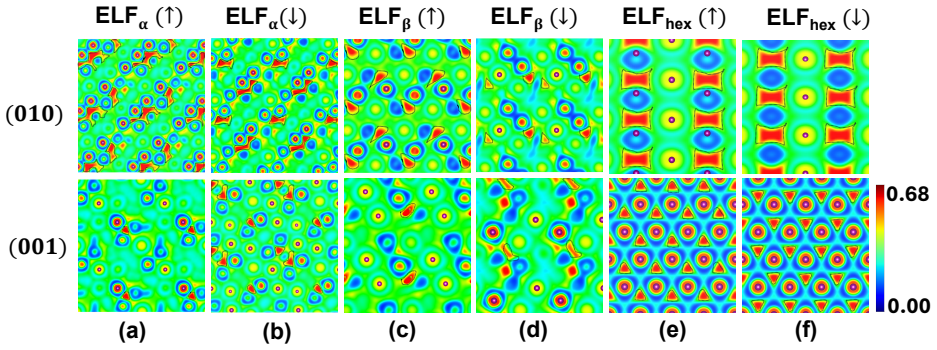
The central object is the spin-resolved electron localization function (ELF), $\mathrm{ELF}_\uparrow$ and $\mathrm{ELF}_\downarrow$, computed from the Kohn–Sham kinetic-energy density. The ELF maps where same-spin electrons are locally scarce in kinetic energy, and its non-nuclear maxima define the interstitial anionic-electron (IAE) basins; these basins are then populated by pseudo-atoms (empty spheres), whose charge is quantified both by Bader zero-flux partitioning and by self-consistent spherical integration within adjusted Wigner–Seitz radii. The identity that carries the argument is that ELF maxima located away from both nuclei and Mn–Mn bonding regions, together with a negative effective charge on those basins and finite IAE density of states at the Fermi level, constitute the electride signature.
What would settle it
If the electride claim is right, the spin-resolved ELF maxima and IAE basins must persist when the structure is re-optimized with a functional that reproduces the experimental lattice constants (for example HSE06, SCAN, or PBE with van der Waals corrections) and when the collinear antiferromagnetic order is replaced by a non-collinear or experimentally constrained spin texture. A calculation that removes the 6–7% lattice overestimate and finds no non-nuclear ELF maxima or IAE Bader charges above about $0.3e$ would falsify the central claim; alternatively, a high-resolution X-ray diffraction or Compton-profile experiment that sees no non-nuclear electron-density maxima at the predicted IAE sites would falsify it directly.
Extended reading notes
Core claim
The central claim is that elemental Mn under ambient pressure is a non-van der Waals electride, meaning an ionic solid in which the anions are cavity-trapped electrons rather than atomic species. The authors identify, in $\alpha$-, $\beta$-, and hex-Mn, zero-dimensional interstitial anionic-electron (IAE) sites at crystallographically defined voids, resolved separately in the spin-up and spin-down ELF channels. The effective charge transfer into each IAE basin is about $-1.645e$, $-1.477e$, and $-1.083e$ from two independent charge-partitioning schemes, and the IAE-projected density of states is finite at the Fermi level, so the interstitial electrons participate in the metallic low-energy electronic structure. The paper further distinguishes the electride electrons from the magnetism: the IAEs are almost spin-compensated (local moments below $0.2\,\mu_B$), whereas the antiferromagnetic ground state is carried by Mn local moments of about $\pm 3.8$–$3.9\,\mu_B$. The conclusion is that Mn simultaneously is a native magnetic electride and an antiferromagnet, with the two behaviors arising from distinct electron populations.
Load-bearing premise
The computational model, whose lattice parameters for $\alpha$- and $\beta$-Mn are 6–7% larger than experiment, is treated as reliable enough for the electron-localization and charge-transfer values that define the electride classification.
Editorial extensions
If this is right
- A pure d-block metal can be a native electride, so electrides are not limited to compounds and intermetallics.
- The interstitial electrons are electronically active: their states cross the Fermi level, so conduction and electride behavior coexist in the same material.
- Because the IAE moments are an order of magnitude smaller than the Mn moments, the electride state and the antiferromagnetic order rest on different electron populations, opening a route to polarize the interstitial electrons without destroying the magnetic order.
- The charge transfer scales inversely with the nearest-neighbor Mn–Mn bond length, linking the electride character to the geometric openness of the host lattice.
- Each of the three phases has a distinct interstitial charge, giving a phase-dependent knob for electride strength in the same element.
Reading between the lines
- If the same spin-resolved ELF analysis were applied to other elemental metals with large lattice voids, some may also qualify as native electrides, which would expand the electride family beyond compounds.
- The paper does not report work functions, but known electrides have low work functions; measuring the work function of alpha-Mn would be a cheap indirect test of the claim.
- The collinear antiferromagnetic order is not fully specified; recomputing the ELF and Bader charges with non-collinear magnetism or the full experimental spin structure would test the robustness of the IAE picture.
- The negative charges of about one electron per void are large enough that a high-resolution X-ray diffraction measurement of the electron density, looking for non-nuclear maxima, could confirm or rule out the predicted interstitial anionic electrons.
Editorial analysis
A structured set of objections, weighed in public.
Referee Report
Summary. The paper reports first-principles PBE+U calculations on three ambient-pressure phases of elemental manganese (α-, β-, and hexagonal Mn) and claims that all three are non-van der Waals electrides with spin-selective interstitial anionic electrons. The evidence presented includes spin-resolved ELF maps, charge-transfer values from spherical PAW-sphere integration and from Bader analysis, projected DOS/IDOS around the Fermi level, and AFM-versus-FM energy comparisons. The abstract's load-bearing quantitative claim is that each interstitial basin carries roughly -1.645e, -1.477e, and -1.083e in α-, β-, and hex-Mn, respectively.
Significance. If the claim is correct, classifying elemental manganese as a native magnetic electride under ambient conditions would be a notable result with implications for interstitial-electron chemistry, spintronics, and the search for electrides in transition metals. The paper has useful strengths: it considers three polymorphs, decomposes the ELF into spin channels, provides explicit AFM/FM energy differences consistent with experiment for α- and β-Mn, and attempts to cross-check charge transfers with two partitioning schemes and with IDOS. However, the central quantitative evidence for IAE charge is not currently reliable because the main spherical partition does not conserve electron number and because the IAE sites are defined by the same ELF maxima that are then used as evidence; the Bader and DOS analyses are performed with pseudo-atoms placed at exactly those positions. Until a charge-conserving, pseudo-atom-free topological analysis is provided, the electride classification rests on an inadequately supported descriptor.
major comments (4)
- [Charge transfer analysis, Eq. (3), Table 2] The spherical-integration charge partition in Table 2 does not conserve electron number. For α-Mn, 58 Mn atoms with Q_eff = +0.953e account for +55.274e of charge loss, while 16 IAE spheres with -1.645e account for only 26.32e of charge gain; the integrated spherical charges sum to roughly 841e against 870 valence electrons, leaving about 29e in unassigned space. The same non-conservation, although smaller, occurs for β- and hex-Mn. Therefore the headline values of -1.645e, -1.477e, and -1.083e per IAE are not well-defined charge transfers; they depend on the chosen sphere radii and cannot by themselves carry the electride classification. Please replace or supplement this analysis with a space-filling, charge-conserving partition, or explicitly report the sphere radii and demonstrate that the missing charge does not affect the conclusion.
- [Electron Localization Function; Charge transfer analysis; Ground state magnetic order] The identification of IAE sites is circular in its current form: the interstitial pseudo-atoms are placed at the maxima of the spin-resolved ELF, the same ELF maxima are then cited as evidence for non-nuclear anionic electrons, and the Bader and DOS analyses are performed with those pseudo-atoms present. A direct and necessary test is to perform a topological QTAIM analysis of the total charge density without inserting any empty spheres, to determine whether true non-nuclear (3,-3) critical points exist and whether their zero-flux basins contain substantial charge. Without this pseudo-atom-free analysis, the reported IAE Bader charges cannot be distinguished from an artifact of placing empty spheres at ELF-selected positions.
- [Crystal structures, Table 1] The optimized AFM lattice parameter for α-Mn is 9.561 Å versus the experimental 8.91 Å, an overestimate of about 7.3%, and for β-Mn it is 6.670 Å versus 6.30 Å, an overestimate of about 5.9%, yet the text states these are in good agreement. Because the ELF, charge-transfer, and DOS results are all computed at these substantially expanded geometries, the quantitative electride descriptors may be affected. Please test the robustness of the central claim by repeating the key analyses at the experimental lattice constants or using a functional/U value that reproduces the experimental volumes, and show that the IAE topology and charges are stable.
- [Electronic Band structure and density of states, Table 3] The IDOS-derived populations are described as being in close agreement with the SC-VASP charges, but Table 3 gives IAE ΔN+ values of 1.558e, 1.422e, and 1.030e for α-, β-, and hex-Mn, whereas Table 2 lists Q_SC_tot of 1.645e, 1.477e, and 1.083e. The discrepancies are 5-9%, which is not close agreement, and both quantities are obtained from the same pseudo-atom spheres. Please reconcile the two sets of numbers or clarify the source of the discrepancy.
minor comments (4)
- [Computational Methods, paragraph on Wigner-Seitz radii] The procedure for deriving the Wigner-Seitz radii from Bader volumes is not described; please provide the exact algorithm or a reference, and report all R_WS values for both Mn and IAE positions so that the spherical charge results are reproducible.
- [Title and figures] There are numerous typographical errors, including 'non-van der Waal' in the title, 'caluclated' in the caption of Fig. 2, and garbled axis labels in Fig. 5; the manuscript should be carefully proofread.
- [Electron Localization Function, Figs. 3 and 4] The ELF iso-surface threshold of 0.68 is described as a 'convenient maximum visualization threshold'; the number and shape of IAE regions can be threshold-dependent, so please show how the identified IAE positions and charges vary with the threshold or otherwise justify the chosen value.
- [Data and Code Availability] The data availability statement says most data are in the main text and SI, but VASP is a commercial package; please deposit input files (POSCAR/CONTCAR, INCAR, KPOINTS) and analysis scripts (for Bader and IDOS) in an open repository so that the results can be reproduced.
Circularity Check
The IAE positions are defined by ELF maxima, and the same ELF-seeded pseudo-atoms are then used for the spherical charges, Bader basins, and DOS projections that are presented as independent confirmation; the headline -1.645e charge is a non-conserving spherical integral whose sign is fixed by definition.
-
self definitional
[Computational Methods / Charge transfer analysis, Eq. (3) and following text]
"because an IAE is a non-nuclear interstitial electron population rather than an atomic orbital state, its charge was obtained directly from the integrated electron density, Q_IAE_tot = ∫_Ω_IAE ρ(r)d^3r, where Ω_IAE is the chosen interstitial integration volume, defined as the spherical region centered at the IAE localization site. Here, NVE = 15 for Mn and NVE = 0 for the IAE. Consequently, positive and negative values of Q_eff(i) represent net charge depletion and accumulation, respectively."
For an IAE, NVE = 0, so Eq. (3) reduces to Q_eff(IAE) = -∫_Ω ρ(r)d^3r. Any nonzero electron density inside the sphere therefore reports as a negative 'effective charge transfer'; the sign is imposed by the definition, and the magnitude is set by the spherical integration volume centered at the ELF maximum whose validity is the claim under test. The partition is also non-conserving: in α-Mn, 58×(+0.953) + 16×(-1.645) ≈ +29 e, so the headline values do not represent a balanced charge transfer and are not a well-defined basin charge.
-
self citation load bearing
[Results and Discussion, Charge transfer analysis (paragraph after Table 2)]
"In particular, the ELF-defined interstitial sites provide an essential reference for identifying and characterizing the IAE basins, especially because interstitial electrons do not possess conventional atomic orbital assignments.7,24"
The Bader analysis is announced as 'an independent validation' of the charge-transfer picture, yet its interstitial basins are defined by pseudo-atoms placed at 'the ELF-defined interstitial sites.' The only authority offered for this ELF-to-basin identification is refs 7 and 24, which are the authors' own prior electride papers. Thus the claimed independent confirmation rests on a self-citation chain, and no pseudo-atom-free QTAIM critical-point analysis is provided to show the basins are genuine non-nuclear attractors rather than artifacts of the seeded empty spheres.
1 more flagged steps
-
fitted input called prediction
[Results and Discussion, Electronic Band structure and density of states (Table 3 and following text)]
"The effective charge transfers obtained from the PAW-sphere charge integration are in close agreement with those estimated independently from the orbital-resolved IDOS integrated up to the Fermi level, demonstrating consistent charge redistribution from the Mn framework toward the interstitial regions."
The IDOS populations are projections of the charge density inside the same PAW spheres placed at the same ELF-defined pseudo-atoms, integrated only up to E_F; the SC-VASP charge is the same density integrated over the same sphere. Reporting 'close agreement' between these two quantities as independent confirmation counts the same construction twice. Likewise, the spin-resolved ELF-up/ELF-down populations in Table 3 come from pseudo-atoms deliberately placed in each spin-ELF maximum, so the apparent spin-selective IAE populations are built in by the placement.
full rationale
The paper carries out genuine first-principles structure and magnetism calculations (PBE+U, AFM versus FM energy comparisons, band structures), and the raw ELF maps are standard descriptors; those parts are not circular. The circularity is confined to the electride-specific quantitative chain. The IAE positions are defined as ELF maxima; empty pseudo-atom spheres are placed at those maxima; and the SC-VASP spherical charge (Eq. 3), the Bader basins, and the IAE-projected DOS are all evaluated with those same seeded positions. Since Q_eff(IAE) = NVE - Q_tot = -∫_Ω ρ d^3r with NVE = 0, any density in the chosen sphere produces a negative 'charge transfer,' so the sign of the headline -1.645e/-1.477e/-1.083e values is definitional, not measured. The spherical partition is non-conserving (α-Mn leaves about +29 e unassigned), so the value is an integration-sphere-dependent number, not a rigorous charge transfer. The Bader run is called independent, but it is seeded with the same ELF-defined pseudo-atoms, and the 'essential reference' for the IAE basins is itself justified by the authors' prior work (refs 7 and 24). The IDOS populations are projections onto the same PAW spheres up to E_F, so their agreement with the total-sphere charges is a self-consistency check, not an independent validation. These defects make the quantitative electride claim partially reducible to its own inputs. The correct fix is a pseudo-atom-free QTAIM analysis (non-nuclear attractors and charge within the zero-flux basin) or a plane-averaged interstitial charge measure, plus external validation of Ueff by experiment rather than only HSE06. Score 6 rather than 8 because the underlying DFT calculation and the ELF maps are real and the qualitative claim may survive such a test; it is the presented 'consistent evidence' chain that is circular.
Assumptions & free parameters
free parameters (3)
- Ueff (Hubbard parameter) =
2.0 eV
- ELF iso-surface threshold =
0.68
- Wigner-Seitz radii for Mn and empty spheres =
alpha: 1.466/1.170 A; beta: 1.457/1.159 A; hex: 1.156/1.068 A
assumptions (4)
- domain assumption DFT+U with Ueff=2.0 eV and the PAW-PBE method gives a sufficiently accurate ground-state electronic density for the three Mn phases.
- domain assumption ELF maxima at interstitial positions indicate anionic electrons (electride states) in a metallic host.
- domain assumption The assumed collinear antiferromagnetic order (not described in the text) is the true ground-state magnetic ordering of alpha- and beta-Mn.
- ad hoc to paper Empty spheres (pseudo-atoms) placed at ELF maxima provide a faithful representation of the interstitial electron density.
invented entities (1)
-
Interstitial anionic electron (IAE) pseudo-atoms
Cite this review
Pith. "Pith review of Spin selective non-van der Waal electride nature in manganese under ambient pressure." pith.science (2026). https://pith.science/paper/KSNS6MFJ
@misc{pith2026260807856,
  author       = {Pith},
  title        = {Pith review of: Spin selective non-van der Waal electride nature in manganese under ambient pressure},
  year         = {2026},
  howpublished = {\url{https://pith.science/paper/KSNS6MFJ}},
  note         = {Machine review of arXiv:2608.07856}
}
abstract
Electrides are an unusual class of ionic materials in which electrons localized in non-nuclear, interstitial regions act as anions within the crystal lattice. Here, we employ first-principles quantum mechanical calculations to investigate the structural, electronic, magnetic, and electride characteristics of elemental manganese (Mn) at an ambient pressure (0 GPa), focusing on its three crystalline phases: cubic ($\alpha$)-Mn ($I\bar{4}3m,no.217$), cubic ($\beta$)-Mn ($P4_132, no.213$), and hexagonal ($hex$)-Mn ($P6_3/mmc, no.194$). Our calculations reveal pronounced interstitial-electron character in all three phases, accompanied by spin-selective electron localization function (ELF), establishing elemental Mn as a non-van der Waals electride system. Bader charge analysis indicates substantial electron redistribution from the Mn host framework toward the interstitial anionic-electron (IAE) regions, with an effective charge transfer of approximately $-1.645e$, $-1.477e$, and $-1.083e$ per interstitial basin in $\alpha$-Mn, $\beta$-Mn, and $hex$-Mn, respectively. The electride character is further supported by the electronic density of states, where the IAE-associated states exhibit finite contributions near the Fermi level ($E_F$) and coexist with Mn-derived states, demonstrating their direct participation in the low-energy electronic structure. The combined electron localization function (ELF), effective charge transfer, and electron population due to IAE at $E_F$ therefore provide consistent evidence for interstitial anionic electrons in elemental Mn. To the best of our knowledge, this work provides the first systematic identification of spin-selective electride character in elemental Mn at ambient pressure, highlighting the possibility of exploiting its interstitial-electron states for unconventional electronic and magnetic functionalities.
Figures


Figures from the paper (4 more)


Reference graph
Works this paper leans on
-
[1]
Accounts of chemical research , volume=
Electrides: early examples of quantum confinement , author=. Accounts of chemical research , volume=. 2009 , publisher=
work page 2009
-
[2]
Journal of the American Chemical Society , volume=
Structures and large NLO responses of new electrides: Li-doped fluorocarbon chain , author=. Journal of the American Chemical Society , volume=. 2007 , publisher=
work page 2007
-
[3]
Journal of the American Chemical Society , volume=
Chemically stable low-dimensional electrides in transition metal-rich monochalcogenides: theoretical and experimental explorations , author=. Journal of the American Chemical Society , volume=. 2022 , publisher=
work page 2022
-
[4]
Nature communications , volume=
Ferromagnetic quasi-atomic electrons in two-dimensional electride , author=. Nature communications , volume=. 2020 , publisher=
work page 2020
-
[5]
Nature Nanotechnology , volume=
Non-oxidized bare copper nanoparticles with surface excess electrons in air , author=. Nature Nanotechnology , volume=. 2022 , publisher=
work page 2022
-
[6]
Quantum electron liquid and its possible phase transition , author=. Nature Materials , volume=. 2022 , publisher=
work page 2022
-
[7]
Nature Communications , volume=
Topological Fermi-arc surface state covered by floating electrons on a two-dimensional electride , author=. Nature Communications , volume=. 2024 , publisher=
work page 2024
-
[8]
Materials Today Physics , volume=
Van der Waals electride: Toward intrinsic two-dimensional ferromagnetism of spin-polarized anionic electrons , author=. Materials Today Physics , volume=. 2021 , publisher=
work page 2021
Show all 58 references
-
[9]
, author=
Work Function of a Room-Temperature, Stable Electride [Ca 24 Al 28 O 64] 4+(e-) 4. , author=. ChemInform , volume=. 2008 , publisher=
2008
-
[10]
Science , volume=
Electrons as anions , author=. Science , volume=. 2003 , publisher=
2003
-
[11]
Journal of the American Chemical Society , volume=
First electride crystal structure , author=. Journal of the American Chemical Society , volume=. 1986 , publisher=
1986
-
[12]
Science , volume=
Electrides: ionic salts with electrons as the anions , author=. Science , volume=. 1990 , publisher=
1990
-
[13]
Journal of Materials Chemistry C , volume=
Electrides: a review , author=. Journal of Materials Chemistry C , volume=. 2020 , publisher=
2020
-
[14]
Accounts of Chemical Research , volume=
Van der Waals electrides , author=. Accounts of Chemical Research , volume=. 2024 , publisher=
2024
-
[15]
Unveiling the nature of 2D boron at atomic scale , author=
-
[16]
arXiv preprint arXiv:2601.21077 , year=
Accelerated Inorganic Electrides Discovery by Generative Models and Hierarchical Screening , author=. arXiv preprint arXiv:2601.21077 , year=
-
[17]
Nature , volume=
Dicalcium nitride as a two-dimensional electride with an anionic electron layer , author=. Nature , volume=. 2013 , publisher=
2013
-
[18]
Journal of the American Chemical Society , volume=
Experimental demonstration of an electride as a 2D material , author=. Journal of the American Chemical Society , volume=. 2016 , publisher=
2016
-
[19]
Materials Horizons , volume=
Signature of low-dimensional quasi-F centers in zirconium-rich electrides , author=. Materials Horizons , volume=. 2024 , publisher=
2024
-
[20]
Molecular Simulation , volume=
M2X (M= Li, Na; X= F, Cl): the smallest superalkali clusters with significant NLO responses and electride characteristics , author=. Molecular Simulation , volume=. 2016 , publisher=
2016
-
[21]
The Journal of Physical Chemistry , volume=
Magnetic susceptibilities and electron paramagnetic resonance spectra of a ceside and an electride , author=. The Journal of Physical Chemistry , volume=. 1984 , publisher=
1984
-
[22]
2]) e , author=
Optical Spectra and Conductivities of Thin Films of the Electride K+ (cryptand [2.2. 2]) e , author=. The Journal of Physical Chemistry B , volume=. 1998 , publisher=
1998
-
[23]
Two-dimensional [CaCl]+
Meng, Weizhen and Zhang, Xiaoming and Liu, Ying and Dai, Xuefang and Gao, Hongli and Liu, Guodong , journal=. Two-dimensional [CaCl]+. 2021 , publisher=
2021
-
[24]
Physical Chemistry Chemical Physics , volume=
Ultralow work function of the electride Sr3CrN3 , author=. Physical Chemistry Chemical Physics , volume=. 2022 , publisher=
2022
-
[25]
Chemistry of materials , volume=
Thermionic emission from cold electride films , author=. Chemistry of materials , volume=. 2000 , publisher=
2000
-
[26]
Chemical Science , volume=
Two dimensional inorganic electride-promoted electron transfer efficiency in transfer hydrogenation of alkynes and alkenes , author=. Chemical Science , volume=. 2015 , publisher=
2015
-
[27]
Chemical Reviews , volume=
Advances in materials and applications of inorganic electrides , author=. Chemical Reviews , volume=. 2021 , publisher=
2021
-
[28]
The Journal of Physical Chemistry C , volume=
Prediction of stoner-type magnetism in low-dimensional electrides , author=. The Journal of Physical Chemistry C , volume=. 2019 , publisher=
2019
-
[29]
RSC advances , volume=
Theoretical study of substituent effects on electride characteristics and the nonlinear optical properties of Li@ calix [4] pyrrole , author=. RSC advances , volume=. 2019 , publisher=
2019
-
[30]
Advanced Science , volume=
Electride-Induced Electronic Modulation of Ruthenium Catalyst for Highly Efficient Alkaline Hydrogen Evolution , author=. Advanced Science , volume=. 2026 , publisher=
2026
-
[31]
2026 , publisher=
Novel phosphonate-based metal-organic frameworks: from design to application , author=. 2026 , publisher=
2026
-
[32]
Journal of Physics: Condensed Matter , volume=
The electronic and magnetic structures of alpha-and beta-manganese , author=. Journal of Physics: Condensed Matter , volume=
-
[33]
Physical Review B , volume=
Atomic structures and magnetic behavior of Mn clusters , author=. Physical Review B , volume=. 2002 , publisher=
2002
-
[34]
journal of the physical society of japan , volume=
Site Split of Antiferromagnetic -Mn Revealed by 55Mn Nuclear Magnetic Resonance , author=. journal of the physical society of japan , volume=. 2022 , publisher=
2022
-
[35]
Journal of Magnetism and Magnetic Materials , volume=
Electrical resistivity measurements of single crystalline -Mn under high pressure , author=. Journal of Magnetism and Magnetic Materials , volume=. 2007 , publisher=
2007
-
[36]
Journal of Physics and Chemistry of Solids , pages=
Confinement of quasi-atomic structures in Ti2N and Ti3N2 MXene Electrides , author=. Journal of Physics and Chemistry of Solids , pages=. 2026 , publisher=
2026
-
[37]
Advanced Science , volume=
Electride Formation of HCP-Iron at High Pressure: Unraveling the Origin of the Superionic State of Iron-Rich Compounds in Rocky Planets , author=. Advanced Science , volume=. 2024 , publisher=
2024
-
[38]
npj Quantum Materials , volume=
Electride and superconductivity behaviors in Mn5Si3-type intermetallics , author=. npj Quantum Materials , volume=. 2017 , publisher=
2017
-
[39]
Accounts of chemical research , volume=
High pressure electrides: a predictive chemical and physical theory , author=. Accounts of chemical research , volume=. 2014 , publisher=
2014
-
[40]
Chemistry of Materials , volume=
Two-dimensional transition-metal electride Y2C , author=. Chemistry of Materials , volume=. 2014 , publisher=
2014
-
[41]
Properties of Complex Inorganic Solids , pages=
The vienna ab-initio simulation program VASP: An efficient and versatile tool for studying the structural, dynamic, and electronic properties of materials , author=. Properties of Complex Inorganic Solids , pages=. 1997 , publisher=
1997
-
[42]
Journal of computational chemistry , volume=
Ab-initio simulations of materials using VASP: Density-functional theory and beyond , author=. Journal of computational chemistry , volume=. 2008 , publisher=
2008
-
[43]
Journal of Molecular Structure: THEOCHEM , volume=
Performance of the Vienna ab initio simulation package (VASP) in chemical applications , author=. Journal of Molecular Structure: THEOCHEM , volume=. 2003 , publisher=
2003
-
[44]
Journal of Physics: Condensed Matter , volume=
A grid-based Bader analysis algorithm without lattice bias , author=. Journal of Physics: Condensed Matter , volume=
-
[45]
Journal of computational chemistry , volume=
Improved grid-based algorithm for Bader charge allocation , author=. Journal of computational chemistry , volume=. 2007 , publisher=
2007
-
[46]
Computational Materials Science , volume=
A fast and robust algorithm for Bader decomposition of charge density , author=. Computational Materials Science , volume=. 2006 , publisher=
2006
-
[47]
The Journal of chemical physics , volume=
Accurate and efficient algorithm for Bader charge integration , author=. The Journal of chemical physics , volume=. 2011 , publisher=
2011
-
[48]
Applied Crystallography , volume=
VESTA 3 for three-dimensional visualization of crystal, volumetric and morphology data , author=. Applied Crystallography , volume=. 2011 , publisher=
2011
-
[49]
Physical Review B , volume=
Correlation effects in the ground-state charge density of Mott insulating NiO: A comparison of ab initio calculations and high-energy electron diffraction measurements , author=. Physical Review B , volume=. 2000 , publisher=
2000
-
[50]
Scientific reports , volume=
Correlation versus hybridization gap in CaMn 2 Bi 2 , author=. Scientific reports , volume=. 2023 , publisher=
2023
-
[51]
Nature communications , volume=
Polarization screening-induced magnetic phase gradients at complex oxide interfaces , author=. Nature communications , volume=. 2015 , publisher=
2015
-
[52]
APL materials , volume=
Commentary: The Materials Project: A materials genome approach to accelerating materials innovation , author=. APL materials , volume=. 2013 , publisher=
2013
-
[53]
Understanding the complex metallic element Mn. II. Geometric frustration in -Mn, phase stability, and phase transitions , author=. Physical review B , volume=. 2003 , publisher=
2003
-
[54]
The Journal of chemical physics , volume=
A simple measure of electron localization in atomic and molecular systems , author=. The Journal of chemical physics , volume=. 1990 , publisher=
1990
-
[55]
Chemical physics letters , volume=
Determination of the electron localization function from electron density , author=. Chemical physics letters , volume=. 2002 , publisher=
2002
-
[56]
Physical Review , volume=
Antiferromagnetic structure of -manganese and a magnetic structure study of -manganese , author=. Physical Review , volume=. 1956 , publisher=
1956
-
[57]
npj Quantum Materials , volume=
Mixed-cation driven magnetic interaction of interstitial electrons for ferrimagnetic two-dimensional electride , author=. npj Quantum Materials , volume=. 2021 , publisher=
2021
-
[58]
ACS omega , volume=
Tunable Magnetic Order in Fe-Mg Codoped Montmorillonite Nanoclay Interfaced with Amino Acids , author=. ACS omega , volume=. 2025 , publisher=
2025
Reviewed August 12, 2026 · model on record in the stance chip above.
Discussion (0). Continue with ORCID to comment.