Effective dynamics of the Sinkhorn algorithm in the regime of low entropy regularization
Pith reviewed 2026-07-02 08:03 UTC · model grok-4.3
The pith
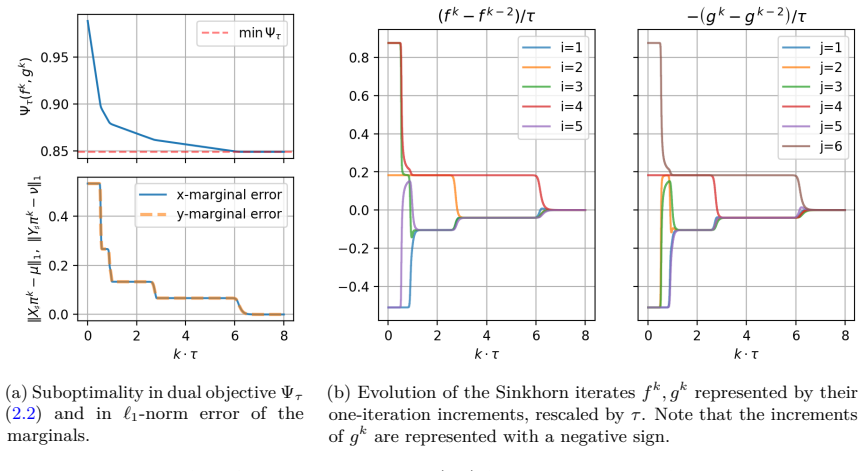
As the regularization parameter approaches zero the Sinkhorn iterates converge under time rescaling t equals tau times k to a limiting dynamics that solves the unregularized problem in finite time.
A machine-rendered reading of the paper's core claim, the machinery that carries it, and where it could break.
Core claim
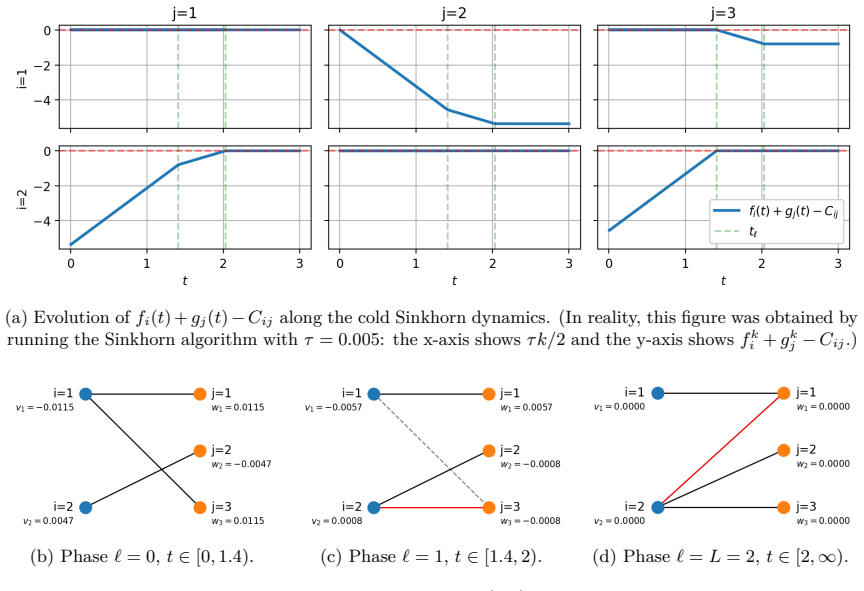
As tau approaches zero the Sinkhorn iterates converge, under the time rescaling t equals tau times k, to the cold Sinkhorn dynamics. This dynamics is a dual optimization flow for the unregularized optimal transport problem, possesses properties analogous to the simplex algorithm, and reaches an unregularized solution in finite time, thereby guaranteeing that Sinkhorn itself attains tilde O of tau dual suboptimality after order tau to the minus one iterations.
What carries the argument
The cold Sinkhorn dynamics obtained as the tau to zero limit of the rescaled Sinkhorn iteration map t equals tau times k.
If this is right
- The cold Sinkhorn dynamics converges in finite time to an exact solution of the unregularized problem.
- Sinkhorn therefore attains tilde O of tau dual suboptimality after only order tau to the minus one iterations.
- The limiting flow is a dual optimization dynamics with properties analogous to those of the simplex algorithm.
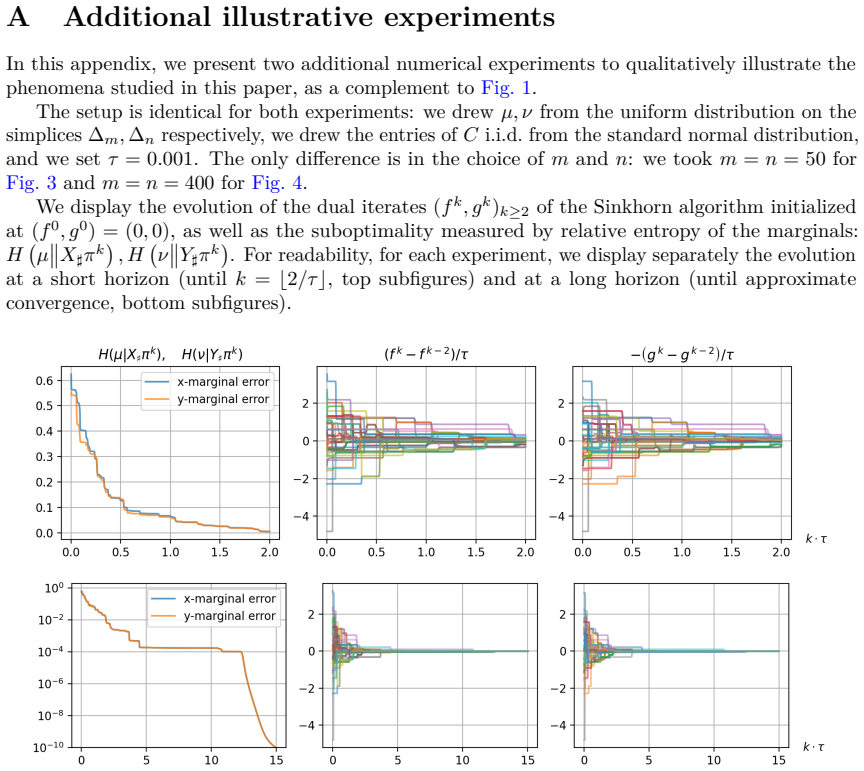
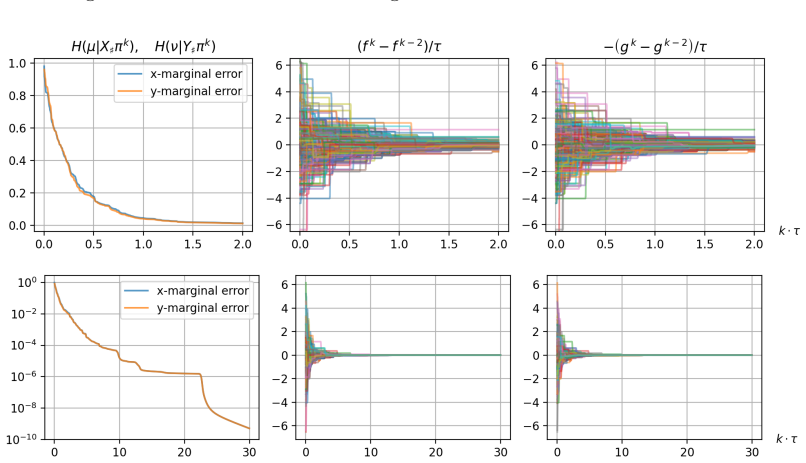
- Dual variables evolve approximately piecewise linearly and primal variables exhibit saddle-to-saddle transitions.
Where Pith is reading between the lines
- The finite-time termination may explain observed practical speed of Sinkhorn even when tau is only moderately small.
- Direct discretization of the cold Sinkhorn vector field could yield new first-order methods that avoid entropy regularization altogether.
- Similar rescaling arguments may apply to other entropic or barrier methods on polytopes.
Load-bearing premise
The optimal transport problem is defined over finite discrete sets and the limiting continuous-time behavior appears under the time rescaling t equals tau times k as tau approaches zero.
What would settle it
A direct numerical check on a finite discrete optimal transport instance: if after k equals C over tau iterations the dual suboptimality remains larger than C prime times tau for any fixed constants C and C prime, the claimed finite-time convergence of the limiting dynamics is false.
Figures
read the original abstract
The Sinkhorn algorithm is the de facto standard method for numerically solving entropy-regularized optimal transport problems over finite sets. In this work, we investigate a phenomenon arising when Sinkhorn is applied with a small regularization parameter $\tau$: the evolution of the dual variables (the logarithm of the scaling factors) is approximately piecewise-linear, while the primal variables (the approximate transport plans) exhibit a saddle-to-saddle type behavior. We prove that as $\tau \to 0$, the Sinkhorn iterates indeed converge to a continuous-time curve consistent with these observations, when time is rescaled as $t = \tau k$, and we characterize the limiting "cold Sinkhorn" dynamics explicitly. In particular, we show that it acts as a dual optimization dynamics for the unregularized problem with properties analogous to the simplex algorithm. Notably, this dynamics converges in finite time to an unregularized solution, implying a novel guarantee for the Sinkhorn algorithm itself: it achieves $\tilde{O}(\tau)$ dual suboptimality in $k = O(\tau^{-1})$ iterations, instead of $k = O(\tau^{-2})$ as existing analyses would suggest.
Editorial analysis
A structured set of objections, weighed in public.
Referee Report
Summary. The paper studies the Sinkhorn algorithm for entropy-regularized OT on finite discrete sets in the low-regularization regime τ → 0. It proves that, under the rescaling t = τ k, the dual iterates converge to an explicit continuous-time 'cold Sinkhorn' vector field that performs dual optimization on the unregularized problem and behaves analogously to the simplex method. The limiting dynamics reaches an exact unregularized solution in finite rescaled time, which is used to derive the improved guarantee that Sinkhorn attains Õ(τ) dual suboptimality after only O(τ^{-1}) iterations rather than the O(τ^{-2}) rate from prior analyses.
Significance. If the convergence theorem and finite-time termination of the cold dynamics hold under the stated hypotheses, the work supplies a tighter, non-asymptotic complexity result for Sinkhorn together with a new dynamical-systems interpretation that links the algorithm to the simplex method. The explicit characterization of the limit and the resulting iteration bound would be a substantive contribution to the analysis of regularized OT solvers.
major comments (1)
- [section on convergence of iterates / abstract] The headline complexity claim (Õ(τ) dual gap after k = O(τ^{-1}) iterations) rests on the cold Sinkhorn dynamics reaching an exact optimum in finite rescaled time T* independent of τ. The abstract and the description of the limiting dynamics do not record any non-degeneracy hypothesis (unique optimal support, strict complementarity, or generic position of the cost matrix). If the convergence proof in the section on convergence of iterates implicitly relies on such conditions, the uniform O(τ^{-1}) bound fails on degenerate instances where the flow can linger near faces of the dual polytope for arbitrarily long time.
minor comments (1)
- Notation for the rescaled time variable t = τ k and the limiting vector field should be introduced once and used consistently; currently the abstract and the main text appear to switch between discrete and continuous descriptions without a single displayed equation defining the cold dynamics.
Simulated Author's Rebuttal
We thank the referee for the careful reading and for highlighting the need to clarify the hypotheses underlying the finite-time convergence claim. We address the major comment below.
read point-by-point responses
-
Referee: [section on convergence of iterates / abstract] The headline complexity claim (Õ(τ) dual gap after k = O(τ^{-1}) iterations) rests on the cold Sinkhorn dynamics reaching an exact optimum in finite rescaled time T* independent of τ. The abstract and the description of the limiting dynamics do not record any non-degeneracy hypothesis (unique optimal support, strict complementarity, or generic position of the cost matrix). If the convergence proof in the section on convergence of iterates implicitly relies on such conditions, the uniform O(τ^{-1}) bound fails on degenerate instances where the flow can linger near faces of the dual polytope for arbitrarily long time.
Authors: The convergence theorem for the cold Sinkhorn dynamics (Theorem 3.4 and the subsequent finite-time termination argument in Section 4) is proved for arbitrary cost matrices on finite discrete sets and does not invoke unique optimal support, strict complementarity, or generic position. The vector field is constructed so that, once a face of the dual polytope is reached, the dynamics follows the reduced linear program on that face and exits in finite time by the same argument used for the simplex method in the non-degenerate case; the exit time remains bounded by a constant depending only on the dimension and the minimal positive entry of the cost matrix (which is fixed). Consequently the rescaled termination time T* is independent of τ even when the optimum is degenerate. We will nevertheless add an explicit sentence to the abstract and to the statement of the main complexity corollary stating that the O(τ^{-1}) iteration bound holds for every cost matrix, thereby removing any ambiguity. revision_made = yes revision: yes
Circularity Check
No circularity in asymptotic limit derivation
full rationale
The paper derives the limiting cold Sinkhorn dynamics as an explicit continuous-time ODE obtained by rescaling time t = τk and taking τ → 0. The finite-time convergence of this ODE to an exact unregularized optimum is a property established for the derived vector field on the dual feasible set, not presupposed by construction or by fitting parameters to the target rate. No self-citations, ansatzes smuggled via prior work, or re-labeling of fitted quantities appear in the abstract or described proof structure. The claimed complexity improvement follows directly from the proven finite-time hitting time of the limit dynamics rather than from any definitional equivalence.
Axiom & Free-Parameter Ledger
axioms (1)
- domain assumption Optimal transport problems are considered over finite discrete sets.
Reference graph
Works this paper leans on
-
[1]
Annals of Operations Research , volume=
Limit points of the iterative scaling procedure , author=. Annals of Operations Research , volume=. 2014 , publisher=
2014
-
[2]
International conference on artificial intelligence and statistics , pages=
Stochastic algorithms for entropy-regularized optimal transport problems , author=. International conference on artificial intelligence and statistics , pages=. 2018 , organization=
2018
-
[3]
Advances in neural information processing systems , volume=
Near-linear time approximation algorithms for optimal transport via Sinkhorn iteration , author=. Advances in neural information processing systems , volume=
-
[4]
Massively scalable Sinkhorn distances via the Nystr
Altschuler, Jason and Bach, Francis and Rudi, Alessandro and Niles-Weed, Jonathan , journal=. Massively scalable Sinkhorn distances via the Nystr
-
[5]
SIAM Journal on Mathematical Analysis , volume=
Asymptotics for semidiscrete entropic optimal transport , author=. SIAM Journal on Mathematical Analysis , volume=. 2022 , publisher=
2022
-
[6]
Advances in Neural Information Processing Systems , volume=
Mirror descent with relative smoothness in measure spaces, with application to Sinkhorn and EM , author=. Advances in Neural Information Processing Systems , volume=
-
[7]
International Conference on Machine Learning , pages=
Mirror Sinkhorn: fast online optimization on transport polytopes , author=. International Conference on Machine Learning , pages=. 2023 , organization=
2023
-
[8]
arXiv preprint arXiv:2111.01666 , year=
Regularized unbalanced optimal transport as entropy minimization with respect to branching brownian motion , author=. arXiv preprint arXiv:2111.01666 , year=
-
[9]
Annales de la Facult\'e des sciences de Toulouse : Math\'ematiques , pages =
Aymeric Baradat and Elias Ventre , title =. Annales de la Facult\'e des sciences de Toulouse : Math\'ematiques , pages =. 2024 , publisher =. doi:10.5802/afst.1800 , language =
-
[10]
Bernoulli , volume=
Stability and sample complexity of divergence regularized optimal transport , author=. Bernoulli , volume=. 2025 , publisher=
2025
-
[11]
SIAM Journal on Scientific Computing , volume=
Iterative Bregman projections for regularized transportation problems , author=. SIAM Journal on Scientific Computing , volume=. 2015 , publisher=
2015
-
[12]
The Sinkhorn algorithm, parabolic optimal transport and geometric Monge--Amp
Berman, Robert J , journal=. The Sinkhorn algorithm, parabolic optimal transport and geometric Monge--Amp. 2020 , publisher=
2020
-
[13]
doi:10.1016/j.rico.2024.100383 , url =
New Auction Algorithms for the Assignment Problem and Extensions , author =. doi:10.1016/j.rico.2024.100383 , url =
-
[14]
Journal of the ACM , volume=
Near-Linear Runtime for a Classical Matrix Preconditioning Algorithm , author=. Journal of the ACM , volume=. 2026 , publisher=
2026
-
[15]
arXiv preprint arXiv:2505.18005 , year=
Distances for Markov chains from sample streams , author=. arXiv preprint arXiv:2505.18005 , year=
-
[16]
SIAM Journal on Optimization , volume=
On the linear convergence of the multimarginal Sinkhorn algorithm , author=. SIAM Journal on Optimization , volume=. 2022 , publisher=
2022
-
[17]
SIAM Journal on Mathematics of Data Science , volume=
Accelerated Bregman primal-dual methods applied to optimal transport and Wasserstein barycenter problems , author=. SIAM Journal on Mathematics of Data Science , volume=. 2022 , publisher=
2022
-
[18]
SIAM Journal on Applied Mathematics , volume=
Entropic and displacement interpolation: a computational approach using the Hilbert metric , author=. SIAM Journal on Applied Mathematics , volume=. 2016 , publisher=
2016
-
[19]
Provably convergent schr
Chen, Yu and Deng, Wei and Fang, Shikai and Li, Fengpei and Yang, Nicole Tianjiao and Zhang, Yikai and Rasul, Kashif and Zhe, Shandian and Schneider, Anderson and Nevmyvaka, Yuriy , booktitle=. Provably convergent schr. 2023 , organization=
2023
-
[20]
arXiv preprint arXiv:2412.09235 , year=
A semiconcavity approach to stability of entropic plans and exponential convergence of Sinkhorn's algorithm , author=. arXiv preprint arXiv:2412.09235 , year=
-
[21]
Advances in Neural Information Processing Systems , volume=
Computational guarantees for doubly entropic Wasserstein barycenters via damped Sinkhorn iterations , author=. Advances in Neural Information Processing Systems , volume=
-
[22]
arXiv preprint arXiv:2408.11620 , year=
Annealed sinkhorn for optimal transport: convergence, regularization path and debiasing , author=. arXiv preprint arXiv:2408.11620 , year=
-
[23]
Mathematical Programming , volume=
Sharper exponential convergence rates for Sinkhorn’s algorithm in continuous settings , author=. Mathematical Programming , volume=. 2026 , publisher=
2026
-
[24]
Mathematical Programming , volume=
Asymptotic analysis of the exponential penalty trajectory in linear programming , author=. Mathematical Programming , volume=. 1994 , publisher=
1994
-
[25]
Quantitative contraction rates for Sinkhorn's algorithm: beyond bounded costs and compact marginals
Quantitative contraction rates for Sinkhorn algorithm: beyond bounded costs and compact marginals , author=. arXiv preprint arXiv:2304.04451 , year=
work page internal anchor Pith review Pith/arXiv arXiv
-
[26]
Weak semiconvexity estimates for Schr
Conforti, Giovanni , journal=. Weak semiconvexity estimates for Schr. 2024 , publisher=
2024
-
[27]
SIAM Review , volume=
Semidual regularized optimal transport , author=. SIAM Review , volume=. 2018 , publisher=
2018
-
[28]
Wasserstein Mirror Gradient Flow as the limit of the Sinkhorn Algorithm
Wasserstein mirror gradient flow as the limit of the Sinkhorn algorithm , author=. arXiv preprint arXiv:2307.16421 , year=
work page internal anchor Pith review Pith/arXiv arXiv
-
[29]
International Conference on Artificial Intelligence and Statistics , pages=
Nearly tight convergence bounds for semi-discrete entropic optimal transport , author=. International Conference on Artificial Intelligence and Statistics , pages=. 2022 , organization=
2022
-
[30]
International conference on machine learning , pages=
Computational optimal transport: Complexity by accelerated gradient descent is better than by Sinkhorn’s algorithm , author=. International conference on machine learning , pages=. 2018 , organization=
2018
-
[31]
SIAM Journal on Mathematical Analysis , volume=
Quantitative stability of regularized optimal transport and convergence of sinkhorn's algorithm , author=. SIAM Journal on Mathematical Analysis , volume=. 2022 , publisher=
2022
-
[32]
arXiv preprint arXiv:2502.20264 , year=
Exponential convergence of general iterative proportional fitting procedures , author=. arXiv preprint arXiv:2502.20264 , year=
-
[33]
Mathematical Proceedings of the Cambridge Philosophical Society , volume=
An elementary proof of the Birkhoff-Hopf theorem , author=. Mathematical Proceedings of the Cambridge Philosophical Society , volume=. 1995 , organization=
1995
-
[34]
Linear Algebra and its applications , volume=
On the scaling of multidimensional matrices , author=. Linear Algebra and its applications , volume=. 1989 , publisher=
1989
-
[35]
arXiv preprint arXiv:2301.11235 , year=
Handbook of convergence theorems for (stochastic) gradient methods , author=. arXiv preprint arXiv:2301.11235 , year=
-
[36]
Advances in neural information processing systems , volume=
Stochastic optimization for large-scale optimal transport , author=. Advances in neural information processing systems , volume=
-
[37]
International Conference on Artificial Intelligence and Statistics , pages=
Learning generative models with sinkhorn divergences , author=. International Conference on Artificial Intelligence and Statistics , pages=. 2018 , organization=
2018
-
[38]
Mathematics of Operations Research , year=
On the convergence rate of Sinkhorn’s algorithm , author=. Mathematics of Operations Research , year=
-
[39]
, author=
Non-asymptotic convergence bounds for Sinkhorn iterates and their gradients: a coupling approach. , author=. The Thirty Sixth Annual Conference on Learning Theory , pages=. 2023 , organization=
2023
-
[40]
arXiv preprint arXiv:2504.11133 , year=
Hessian stability and convergence rates for entropic and Sinkhorn potentials via semiconcavity , author=. arXiv preprint arXiv:2504.11133 , year=
-
[41]
IEEE Transactions on Information Theory , volume=
A Bregman proximal perspective on classical and quantum Blahut-Arimoto algorithms , author=. IEEE Transactions on Information Theory , volume=. 2024 , publisher=
2024
-
[42]
Journal of machine learning research , volume=
On the convergence of projected alternating maximization for equitable and optimal transport , author=. Journal of machine learning research , volume=
-
[43]
A review of matrix scaling and Sinkhorn's normal form for matrices and positive maps
A review of matrix scaling and Sinkhorn's normal form for matrices and positive maps , author=. arXiv preprint arXiv:1609.06349 , year=
work page internal anchor Pith review Pith/arXiv arXiv
-
[44]
Mathematical Programming , volume=
On the complexity of general matrix scaling and entropy minimization via the RAS algorithm , author=. Mathematical Programming , volume=. 2008 , publisher=
2008
-
[45]
International Conference on Artificial Intelligence and Statistics , pages=
Sinkhorn flow as mirror flow: A continuous-time framework for generalizing the sinkhorn algorithm , author=. International Conference on Artificial Intelligence and Statistics , pages=. 2024 , organization=
2024
-
[46]
arXiv preprint arXiv:2307.08507 , year=
Efficient and accurate optimal transport with mirror descent and conjugate gradients , author=. arXiv preprint arXiv:2307.08507 , year=
-
[47]
Computer Methods in Applied Mechanics and Engineering , volume=
Efficient numerical strategies for entropy-regularized semi-discrete optimal transport , author=. Computer Methods in Applied Mechanics and Engineering , volume=. 2026 , publisher=
2026
-
[48]
arXiv preprint arXiv:2311.17296 , year=
Mirror duality in convex optimization , author=. arXiv preprint arXiv:2311.17296 , year=
-
[49]
SIAM Journal on Matrix Analysis and Applications , volume=
The Sinkhorn--Knopp algorithm: convergence and applications , author=. SIAM Journal on Matrix Analysis and Applications , volume=. 2008 , publisher=
2008
-
[50]
Neural networks , volume=
The invisible hand algorithm: Solving the assignment problem with statistical physics , author=. Neural networks , volume=. 1994 , publisher=
1994
-
[51]
arXiv preprint arXiv:2101.01704 , year=
The method of Bregman projections in deterministic and stochastic convex feasibility problems , author=. arXiv preprint arXiv:2101.01704 , year=
-
[52]
International Conference on Machine Learning , pages=
Batch Greenkhorn algorithm for entropic-regularized multimarginal optimal transport: Linear rate of convergence and iteration complexity , author=. International Conference on Machine Learning , pages=. 2022 , organization=
2022
-
[53]
Applied Mathematics & Optimization , volume=
A gradient descent perspective on Sinkhorn , author=. Applied Mathematics & Optimization , volume=. 2021 , publisher=
2021
-
[54]
arXiv preprint arXiv:2305.04917 , year=
Gradient descent with a general cost , author=. arXiv preprint arXiv:2305.04917 , year=
-
[55]
Optimization Letters , volume=
A note on overrelaxation in the Sinkhorn algorithm , author=. Optimization Letters , volume=. 2022 , publisher=
2022
-
[56]
2012 , publisher=
Nonlinear Perron-Frobenius Theory , author=. 2012 , publisher=
2012
-
[57]
SIAM Journal on Optimization , volume=
Fast computation of optimal transport via entropy-regularized extragradient methods , author=. SIAM Journal on Optimization , volume=. 2025 , publisher=
2025
-
[58]
arXiv preprint arXiv:2202.10042 , year=
Fast Sinkhorn I: An O (N) algorithm for the Wasserstein-1 metric , author=. arXiv preprint arXiv:2202.10042 , year=
-
[59]
Journal of Machine Learning Research , volume=
Importance sparsification for Sinkhorn algorithm , author=. Journal of Machine Learning Research , volume=
-
[60]
Journal of Machine Learning Research , volume=
On the efficiency of entropic regularized algorithms for optimal transport , author=. Journal of Machine Learning Research , volume=
-
[61]
Advances in neural information processing systems , volume=
Sinkhorn barycenters with free support via frank-wolfe algorithm , author=. Advances in neural information processing systems , volume=
-
[62]
International Conference on Artificial Intelligence and Statistics , pages=
Improved rate of first order algorithms for entropic optimal transport , author=. International Conference on Artificial Intelligence and Statistics , pages=. 2023 , organization=
2023
-
[63]
arXiv preprint arXiv:2305.14939 , year=
Improved complexity analysis of the Sinkhorn and Greenkhorn algorithms for optimal transport , author=. arXiv preprint arXiv:2305.14939 , year=
-
[64]
An optimal transport approach for the Schr
Marino, Simone Di and Gerolin, Augusto , journal=. An optimal transport approach for the Schr. 2020 , publisher=
2020
-
[65]
arXiv preprint arXiv:2007.00976 , year=
Optimal transport losses and Sinkhorn algorithm with general convex regularization , author=. arXiv preprint arXiv:2007.00976 , year=
-
[66]
Information theory workshop , pages=
Information geometric formulation and interpretation of accelerated Blahut-Arimoto-type algorithms , author=. Information theory workshop , pages=. 2004 , organization=
2004
-
[67]
Advances in Neural Information Processing Systems , volume=
Online Sinkhorn: Optimal transport distances from sample streams , author=. Advances in Neural Information Processing Systems , volume=
-
[68]
arXiv preprint arXiv:1909.06918 , year=
Sinkhorn algorithm as a special case of stochastic mirror descent , author=. arXiv preprint arXiv:1909.06918 , year=
-
[69]
Proceedings of the 2009 IEEE International Conference on Acoustics, Speech and Signal Processing , pages=
Geometrical interpretation and improvements of the Blahut-Arimoto's algorithm , author=. Proceedings of the 2009 IEEE International Conference on Acoustics, Speech and Signal Processing , pages=
2009
-
[70]
Mathematics of Operations Research , volume=
Linear convergence of random dual coordinate descent on nonpolyhedral convex problems , author=. Mathematics of Operations Research , volume=. 2022 , publisher=
2022
-
[71]
arXiv preprint arXiv:2202.03618 , year=
On the convergence of gradient extrapolation methods for unbalanced optimal transport , author=. arXiv preprint arXiv:2202.03618 , year=
-
[72]
Streaming Sliced Optimal Transport
Streaming sliced optimal transport , author=. arXiv preprint arXiv:2505.06835 , year=
work page internal anchor Pith review Pith/arXiv arXiv
-
[73]
Lecture notes, Columbia University , volume=
Introduction to entropic optimal transport , author=. Lecture notes, Columbia University , volume=
-
[74]
Foundations and Trends
Computational optimal transport with applications to data sciences , author=. Foundations and Trends. 2019 , publisher=
2019
-
[75]
arXiv preprint arXiv:2505.06589 , year=
Optimal transport for machine learners , author=. arXiv preprint arXiv:2505.06589 , year=
-
[76]
International Conference on Machine Learning , pages=
On unbalanced optimal transport: An analysis of Sinkhorn algorithm , author=. International Conference on Machine Learning , pages=. 2020 , organization=
2020
-
[77]
International Conference on Machine Learning , pages=
Minimax estimation of discontinuous optimal transport maps: The semi-discrete case , author=. International Conference on Machine Learning , pages=. 2023 , organization=
2023
-
[78]
International Conference on Machine Learning , pages=
Multisample Flow Matching: Straightening Flows with Minibatch Couplings , author=. International Conference on Machine Learning , pages=. 2023 , organization=
2023
-
[79]
Operations Research , year=
On Sinkhorn’s algorithm and choice modeling , author=. Operations Research , year=
-
[80]
International Conference on Artificial Intelligence and Statistics , pages=
Explicit regularization of stochastic gradient methods through duality , author=. International Conference on Artificial Intelligence and Statistics , pages=. 2021 , organization=
2021
discussion (0)
Sign in with ORCID, Apple, or X to comment. Anyone can read and Pith papers without signing in.