REVIEW 3 major objections 5 minor 1 cited by
Distributional Diffusion Models with Scoring Rules
T0 review · 3 major / 5 minor · reviewed 2026-08-09 · deepseek-v4-flash
Pith's one-line read This paper proposes to accelerate diffusion sampling by training the denoiser to generate from the full posterior of clean data given noisy data, via a generalized energy score, instead of predicting only the conditional mean.
desk verdict A clean, useful diffusion training loss that learns the full posterior and helps at few steps, with an overclaimed abstract and a core mechanism only directly validated in 2D. read the letter →
The pith
A machine-rendered reading of the paper's core claim, the machinery that carries it, and where it could break.
The reading
What carries the argument
The load-bearing object is the conditional generalized energy score, S_{λ,β}(p, y) = (λ/2)E_{p⊗p}[||X−X'||^β] − E_p[||X−y||^β], a proper scoring rule that scores a predicted distribution p against an observed y and is strictly proper for λ=1 and β∈(0,2), meaning the true posterior uniquely maximizes it. The training loss integrates this score over noise levels and samples, and the two hyperparameters have concrete roles: β sets the distance metric — with β→2 the score degenerates to the squared-error regression loss and with small β it behaves like a heavy-tailed energy distance — while λ trades off the score's two terms, with λ=1 enforcing full posterior fidelity and λ<1 deliberately underestimating the posterior variance by the factor f(λ,β) = ($2λ^{{−2/(2−β)}}$ − 1)^{−1} (Proposition 4.1). At inference, the intractable reverse transition p(x_s|x_t) = ∫ p(x_s|x_0,x_t) p(x_0|x_t) dx_0 is approximated by a single Monte Carlo draw: sample x̂_0 = x̂θ(t, x_t, ξ) and plug it into the closed-form Gaussian conditional p(x_s|x̂_0, x_t) of Eq. (4), which is the only change to the standard DDIM sampler.
What would settle it
On a target whose reverse posterior is genuinely multimodal at an intermediate noise level — for example a two-Gaussian mixture in 10 dimensions whose modes are separated by many times σ at t=0.5 — sample x̂_0 = x̂θ(t, x_t, ξ) for a fixed x_t and many ξ, and compare the empirical distribution of the draws with the exact p(x_0|x_t): if the draws systematically miss a mode that carries substantial posterior mass, the single-sample plug-in provably loses probability mass, and the few-step gains would not survive on such targets.
Extended reading notes
Core claim
The paper's central claim is that the failure of diffusion models at few sampling steps is caused by the Dirac approximation of the posterior p_{0|t}(x_0|x_t): replacing the full posterior by a point mass at the conditional mean E[X_0|X_t=x_t] is only justified in the infinite-step limit. To remove that approximation, the paper replaces the regression loss with a conditional generalized energy score S_{λ,β}(p^θ_{0|t}(·|x_t), x_0) = (λ/2) E_{p^θ⊗p^θ}[||X−X'||^β] − E_{p^θ}[||X−x_0||^β], which is strictly proper for λ=1 and β∈(0,2) and which reduces to the classical regression loss as β→2, λ→0. The trained generator x̂θ(t, x_t, ξ) then supplies samples from the learned posterior, and Algorithm 2 uses one such sample in the Gaussian conditional p(x_s|x̂_0, x_t) to step the reverse process on a coarse grid. Empirically, the paper finds that distributional models with λ=1, β<2 achieve the best FID and robot success rates when the number of denoising steps is low, that λ<1 increasingly wins as the step count grows, and that even λ=0 with β<2 matches or slightly beats the classical squared-error loss.
Load-bearing premise
Everything hinges on Algorithm 2's single-sample plug-in: the intractable reverse transition is replaced by one random draw from the learned posterior x̂θ(t, x_t, ξ), and the paper provides no error bound for this replacement when the true posterior is not Gaussian, so the method's correctness depends on the learned posterior being accurate pointwise in x and t and on one draw being representative.
Editorial extensions
If this is right
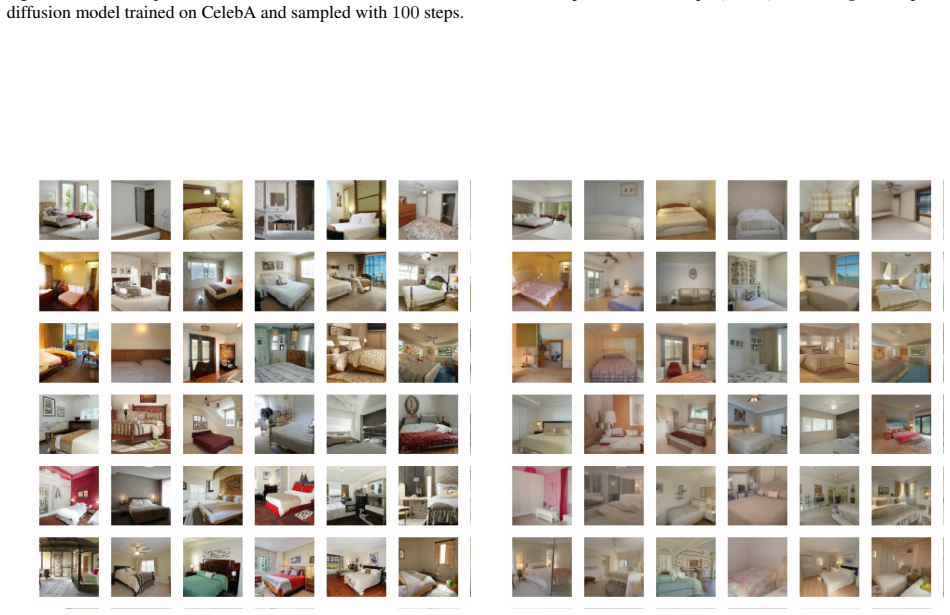
- At low step counts (up to about 10 denoising steps), distributional models with λ=1 and β<2 improve FID on CIFAR-10, CelebA, LSUN Bedrooms, and latent CelebA-HQ, and raise robot-task success rates on the Libero suites, relative to classical diffusion at the same step count.
- As the number of sampling steps grows, the optimal λ falls toward 0: the strictly-proper distributional loss (λ=1, β<2) accumulates sampling noise and underperforms, while intermediate λ still matches or beats the classical model.
- Even with λ=0, choosing β<2 (a fractional-power distance instead of squared error) matches or slightly beats the classical regression loss, suggesting the squared-error target itself is not optimal.
- Kernel scoring rules based on inverse-multiquadratic and RBF kernels reproduce the energy-score behavior, so the method is not tied to the specific choice of distance.
- Trained from scratch without a teacher, the method is competitive with multi-step distillation at 8 or more function evaluations and beats DPM-solver++ beyond 8 evaluations, while requiring no distillation stage.
Reading between the lines
- I would expect the single-sample plug-in in Algorithm 2 to be the first thing to improve: drawing several ξ per reverse step and averaging the resulting Gaussian conditionals gives a multi-sample estimate of p(x_s|x_t) whose variance the paper's own SNR analysis predicts to fall with m, at roughly linear extra sampling cost.
- The empirical pattern that optimal β decreases with fewer steps suggests a time-dependent schedule — small β early in the reverse process, β→2 late — might dominate any fixed (λ, β) sweep, and is directly testable on the paper's benchmarks.
- Because the method needs no teacher, stacking it under distillation should compound: the student would be trained on transitions that already carry posterior spread rather than on Dirac approximations, potentially removing the distillation step's usual reliance on many teacher steps.
- The exponential kernel works despite failing the paper's diffusion-compatibility condition, so that condition is evidently sufficient but not necessary; if so, the search space for useful scoring rules is wider than the paper's theory covers.
Editorial analysis
A structured set of objections, weighed in public.
Referee Report
Summary. This paper proposes Distributional Diffusion Models, a modification of DDIM-style diffusion training in which the conditional-mean denoiser is replaced by a generative network x̂θ(t, xt, ξ) trained with a generalized energy score or, alternatively, with kernel scoring rules (IMQ, RBF, exponential). The loss interpolates between the classical diffusion regression loss (λ→0, β→2) and a strictly proper conditional energy score (λ=1, β<2). At sampling time (Algorithm 2), each coarse reverse step draws one sample from the learned pθ_{0|t}(·|xt) and plugs it into the Gaussian conditional p(xs|x0, xt) of Eq. (4), thereby approximating the intractable integral in Eq. (5). The theory comprises a closed-form analysis of the Gaussian case under the generalized energy score (Prop 4.1), a signal-to-noise comparison of conditional versus joint scoring rules (Prop 4.2), and a diffusion-compatibility result for IMQ and RBF kernels (Prop 4.3). Experiments cover a 2D Gaussian mixture, conditional and unconditional image generation (CIFAR-10, CelebA, LSUN Bedrooms, latent CelebA-HQ), and the Libero robot-manipulation benchmark, with comparisons against DDIM-style diffusion, DPM-Solver++, and moment-matching distillation. The central claims are that distributional models outperform classical diffusion models at small numbers of sampling steps and that λ<1 trades variance fidelity against sample quality at larger step counts.
Significance. If the claims hold, the main contribution is a simple, non-adversarial training objective that unifies the standard diffusion loss and a distributional loss, with consistent few-step FID improvements in the 8-15 NFE range across all four image benchmarks (e.g., CIFAR-10 conditional: 3.21 vs 7.53 at NFE=8; latent CelebA-HQ: 8.15 vs 11.89 at NFE=10), and analogous gains on the Libero robotics suites at 2-16 steps. Strengths worth crediting: the appendix contains full proofs of the propositions; Proposition 4.1 yields a closed-form, parameter-free variance factor f(λ,β) whose predicted covariance evolution is verified in Figure 1; the experimental documentation is unusually complete (pseudocode in Appendix G, architecture and sweep details in Appendix I, hardware cost table in Section J); and the paper reports an honest failure on ImageNet 64x64 (Section K.2) as well as an explicit attribution of a related idea to a personal communication.
major comments (3)
- [Abstract; Section 6.2 ('Main takeaways'); Tables 4-5 in Section K.3] The abstract's claim that the method 'consistently outperform[s] standard diffusion models at few discretization steps' is contradicted by the paper's own results at the coarsest step counts. In Table 4 (CelebA, conditional), the Distributional FID at NFE=2 is 81.79 versus 62.85 for the Diffusion baseline, and in Table 5 (LSUN Bedrooms, unconditional), the Distributional FID at NFE=4 is 69.90 versus 41.57. The 'consistently outperform' statement is defensible only for NFE in the range 8-15, where the advantage holds on all four benchmarks (e.g., CIFAR-10: 3.21 vs 7.53 at NFE=8; latent CelebA-HQ: 8.15 vs 11.89 at NFE=10). The abstract and the 'Main takeaways' paragraph of Section 6.2 need to be reworded to state the regime of the improvement and to acknowledge the NFE=2 and NFE=4 exceptions.
- [Section 3 (Eq. (5), Algorithm 2); Section 4.1; Section 6.1 (Figures 3-4)] The paper's central mechanistic claim, namely that coarse-step sampling works because x̂θ(t, xt, ξ) faithfully approximates the posterior p_{0|t} and because a single draw from it is an adequate substitute for the integral in Eq. (5), is validated only in the 2D Gaussian-mixture experiment (Figures 3 and 4). Algorithm 2 replaces the integral in Eq. (5) with one Monte Carlo draw from pθ_{0|t}, and no error bound is provided for this plug-in when the posterior is non-Gaussian, nor for error accumulation over a multi-step coarse chain; Proposition 4.1 and Proposition C.7 cover only the Gaussian-target/Gaussian-learner case. Two confounds make the image and robotics results uninformative about the mechanism: the distributional generator has additional noise channels relative to the standard denoiser, and Algorithm 2 samples a fresh ξ at every reverse step, so the sampler is stochastic even when the churn parameter is ε=0. The β=2, λ=0 control curves in Figures 5 and 6 control for the architecture but not for the ξ-sampling effect or for posterior fidelity. I recommend a targeted test of the mechanism in a non-toy setting, for example comparing statistics of x̂θ(t, xt, ·) against a reference posterior estimate on held-out noisy latent codes, or ablating the per-step ξ resampling.
- [Section 6.2; Figure 7; Appendix I.2] The comparison protocol selects distributional hyperparameters on the evaluation metric, which makes the reported curves an optimistic envelope rather than a fixed model. Section 6.2 states that for the 'β<2' curves, 'we select a parameter β given one fixed λ which minimizes the FID,' and Figure 7 reports the pair (λ, β) that minimizes FID separately for each number of diffusion steps; checkpoints are likewise chosen by FID on a 2048-sample subset (Appendix I.2). The Diffusion baseline is a single fixed model, so the main comparison pits one baseline against a per-step oracle-selected family. This matters because the gains at NFE=8-15 are of the same order as the sensitivity to (λ, β): the CIFAR-10 grid at 10 steps spans FIDs from 3.6 to 7.7 (Figure 10), an interval that comfortably contains the diffusion baseline's 5.67. The detailed heatmaps in Section K.2 partially mitigate this, but the main-text curves and the abstract claim still inherit the selection. I ask the authors to report at least one curve with a fixed (λ, β) per dataset and to disclose how the entries of Tables 3-6 were selected, per NFE or per dataset.
minor comments (5)
- [Appendix E, Proposition E.1] The proof of Proposition E.1 states the intermediate limit lim_{n→∞} [2c_n^{1/2} − 2c_n(‖x−x′‖² + c_n)^{−1/2}] = ‖x−x′‖² and concludes f(c) = 2c for the inverse multiquadratic kernel, but the displayed expression actually tends to 0 as c_n → ∞; the correct compatible rescaling is f(c) = 2c^{3/2}, and for the RBF kernel the proof's own limit uses 2c_n² so the conclusion 'f(c) = 2c' should read f(c) = 2c². Proposition 4.3 in the main text asserts only existence of such an f, so the qualitative claim survives, but the appendix's explicit constants are wrong and need correction.
- [Appendix C, Lemma C.2 and Proposition C.1] Lemma C.2's proof states that fβ(c) = E‖X−c‖^β is 'strictly concave' for β∈(0,1) and concludes that lim_{t→∞} fβ(tc⋆) = −∞. Neither statement is correct on R^d for d≥2: the radial function ‖x‖^β is not concave there, and fβ grows like ‖c‖^β. The claimed minimizer property (0 is a minimizer for symmetric Gaussian X) is plausible but requires a different argument, so the proof of Proposition C.1's μ⋆=μ conclusion rests on an invalid step. In addition, the statement of Proposition C.1 writes σ⋆ = (2λ^{−2/(2−β)} − 1)^{−1}σ² where the derivation gives σ²⋆, a dimensional slip.
- [Section K.2, inverse-multiquadratic paragraph] The paragraph following Figure 16 states that 'when number of diffusion steps increases, the region with the best FIDs moves from λ≈0 to λ≈1,' but the heatmap in Figure 16 and the corresponding sentence in the exponential-kernel paragraph state the opposite, namely that the best λ decreases as the step count grows, consistent with Figure 7. The sentence appears to have the trend reversed and should be corrected.
- [Appendix I.1; Section K.2] Two documentation issues: (i) Appendix I.1 refers to 'Figure 2, right' for the squared-MMD evaluation, but Figure 2 displays the SNR comparison of Section 4.2 and the MMD panel is Figure 3; (ii) Section K.2 reports that experiments on ImageNet 64×64 'were unable to obtain satisfactory results' and defers scaling to follow-up work, an honest and important limitation that should appear in the main text or Discussion since it qualifies the generality of the method beyond the datasets tested.
- [Figures 5-6, 9, 19; Tables 3-6] The main FID and success-rate curves are shown without error bars, and Tables 3-6 report only 3-seed means with no standard deviations, even where adjacent entries differ by less than 0.3 FID units (e.g., CIFAR-10 at NFE=8: 3.21 vs 3.13 for Distributional vs Distillation). Reporting dispersion would materially help the reader assess the significance of the headline few-step comparison.
Circularity Check
The derivation is self-contained; the loss, theory, and experiments stand independently, with no circular reduction.
full rationale
The paper's central derivation chain is not circular. The training loss (13) is a conditional generalized energy score built from known proper scoring rules, and the theoretical results (Prop. 4.1, 4.2, 4.3) are proven from explicit assumptions (Gaussian target, U-statistics asymptotics, kernel Taylor expansions) rather than from the empirical outcomes. The sampling procedure (Alg. 2) exactly plugs the learned conditional distribution into the DDIM posterior conditional in Eq. (4)-(5), and the mean/variance updates are independently derived in Appendix F from an SDE perspective. No fitted parameter is renamed as a prediction: the choice of λ and β per dataset and step count is standard hyperparameter selection on a validation FID subset, and the claim that low-step distributional models with λ=1, β<2 outperform diffusion models is an empirical result that could have failed. Self-citations, such as Shi et al. (2024) for a standard marginal-preservation property and Galashov et al. (2025) as related work, are auxiliary and not load-bearing for the main claims. The admitted ImageNet scaling limitation is an honest reporting of a negative result and does not indicate that any derivation reduces to its inputs. Overall, the paper's theoretical claims stand independently of its experiments, and the experiments are externally benchmarked against FID and task success rates, so no significant circularity is present.
Assumptions & free parameters
free parameters (5)
- lambda (score trade-off) =
0, 0.1, 0.5, or 1.0, selected per dataset and step count
- beta (energy distance exponent) =
0.0001 to 2.0, selected per dataset and step count
- loss weighting bias b =
one of -2, -1, 0, 1, 2
- churn parameter epsilon =
swept in {0, 0.25, 0.5, 0.75, 1.0}
- population size m =
4 for images, 16 for robotics
assumptions (5)
- domain assumption The forward process satisfies X_t = alpha_t X_0 + sigma_t Z with alpha_0 = sigma_1 = 1 and alpha_1 = sigma_0 = 0 (Eq. 2).
- domain assumption The transition p(x_s|x_0,x_t) is Gaussian with the mean and covariance given in Eq. (4).
- ad hoc to paper A single Monte Carlo draw from p_theta_{0|t} per reverse step is a sufficiently accurate estimate of the integral in Eq. (5).
- domain assumption The network x_hat_theta(t, x_t, xi), with xi concatenated as extra channels, can represent the true posterior p_{0|t} well.
- domain assumption FID is an appropriate measure of sample quality for the comparisons.
Cite this review
Pith. "Pith review of Distributional Diffusion Models with Scoring Rules." pith.science (2026). https://pith.science/paper/KT6DH7YV
@misc{pith2026250202483,
  author       = {Pith},
  title        = {Pith review of: Distributional Diffusion Models with Scoring Rules},
  year         = {2026},
  howpublished = {\url{https://pith.science/paper/KT6DH7YV}},
  note         = {Machine review of arXiv:2502.02483}
}
read the original abstract
Diffusion models generate high-quality synthetic data. They operate by defining a continuous-time forward process which gradually adds Gaussian noise to data until fully corrupted. The corresponding reverse process progressively "denoises" a Gaussian sample into a sample from the data distribution. However, generating high-quality outputs requires many discretization steps to obtain a faithful approximation of the reverse process. This is expensive and has motivated the development of many acceleration methods. We propose to accomplish sample generation by learning the posterior {\em distribution} of clean data samples given their noisy versions, instead of only the mean of this distribution. This allows us to sample from the probability transitions of the reverse process on a coarse time scale, significantly accelerating inference with minimal degradation of the quality of the output. This is accomplished by replacing the standard regression loss used to estimate conditional means with a scoring rule. We validate our method on image and robot trajectory generation, where we consistently outperform standard diffusion models at few discretization steps.
Figures


Figures from the paper (23 more)




Forward citations
Cited by 1 Pith paper
-
Generative Modeling via Kernelized Stochastic Interpolants
The drift of a stochastic interpolant is estimated by solving a P×P linear system from feature gradients, enabling training-free generation and training-free combination of pretrained generative models.
Reference graph
Works this paper leans on
-
[1]
write newline
" write newline "" before.all 'output.state := FUNCTION n.dashify 't := "" t empty not t #1 #1 substring "-" = t #1 #2 substring "--" = not "--" * t #2 global.max substring 't := t #1 #1 substring "-" = "-" * t #2 global.max substring 't := while if t #1 #1 substring * t #2 global.max substring 't := if while FUNCTION format.date year duplicate empty "emp...
-
[2]
Fast inference in denoising diffusion models via MMD finetuning
Aiello, E., Valsesia, D., and Magli, E. Fast inference in denoising diffusion models via MMD finetuning. IEEE Access, 12: 0 106912--106923, 2024. doi:10.1109/ACCESS.2024.3436698
-
[3]
Albergo, M. S., Boffi, N. M., and Vanden-Eijnden, E. Stochastic interpolants: A unifying framework for flows and diffusions. arXiv preprint arXiv:2303.08797, 2023
arXiv 2023
-
[4]
Estimating the optimal covariance with imperfect mean in diffusion probabilistic models
Bao, F., Li, C., Sun, J., Zhu, J., and Zhang, B. Estimating the optimal covariance with imperfect mean in diffusion probabilistic models. In International Conference on Machine Learning, 2022 a
2022
-
[5]
Analytic- DPM : an analytic estimate of the optimal reverse variance in diffusion probabilistic models
Bao, F., Li, C., Zhu, J., and Zhang, B. Analytic- DPM : an analytic estimate of the optimal reverse variance in diffusion probabilistic models. In International Conference on Learning Representations, 2022 b
2022
-
[6]
G., Danihelka, I., Dabney, W., Mohamed, S., Lakshminarayanan, B., Hoyer, S., and Munos, R
Bellemare, M. G., Danihelka, I., Dabney, W., Mohamed, S., Lakshminarayanan, B., Hoyer, S., and Munos, R. The C ramer distance as a solution to biased W asserstein gradients. arXiv preprint arXiv:1705.10743, 2017
arXiv 2017
-
[7]
and Thomas-Agnan , C
Berlinet, A. and Thomas-Agnan , C. Reproducing Kernel Hilbert Spaces in Probability and Statistics. Kluwer, 2004
2004
-
[8]
J., Arbel, M., and Gretton, A
Bi \'n kowski, M., Sutherland, D. J., Arbel, M., and Gretton, A. Demystifying MMD GAN s. In International Conference on Learning Representations, 2018
2018
Show all 86 references
-
[9]
K., and Nowozin, S
Bouchacourt, D., Mudigonda, P. K., and Nowozin, S. Disco nets: Dissimilarity coefficients networks. In Advances in Neural Information Processing Systems, 2016
2016
-
[10]
Chen, H., Ren, Y., Ying, L., and Rotskoff, G. M. Accelerating diffusion models with parallel sampling: Inference at sub-linear time complexity. In Advances in Neural Information Processing Systems, 2024 a
2024
-
[11]
Generative machine learning methods for multivariate ensemble postprocessing
Chen, J., Janke, T., Steinke, F., and Lerch, S. Generative machine learning methods for multivariate ensemble postprocessing. The Annals of Applied Statistics, 18 0 (1): 0 159--183, 2024 b
2024
-
[12]
J., Norouzi, M., and Chan, W
Chen, N., Zhang, Y., Zen, H., Weiss, R. J., Norouzi, M., and Chan, W. WaveGrad : Estimating gradients for waveform generation. In International Conference on Learning Representations, 2021
2021
-
[13]
Conditional GAN for enhancing diffusion models in efficient and authentic global gesture generation from audios
Cheng, Y., Liang, M., Huang, S., Han, G., Ning, J., and Liu, W. Conditional GAN for enhancing diffusion models in efficient and authentic global gesture generation from audios. arXiv preprint arXiv:2410.20359, 2024
2024 arXiv
-
[14]
Diffusion policy: Visuomotor policy learning via action diffusion
Chi, C., Xu, Z., Feng, S., Cousineau, E., Du, Y., Burchfiel, B., Tedrake, R., and Song, S. Diffusion policy: Visuomotor policy learning via action diffusion. International Journal of Robotics Research, 2023
2023
-
[15]
BERT :pre-training of deep bidirectional transformers for language understanding
Devlin, J., Chang, M.-W., Lee, K., and Toutanova, K. BERT :pre-training of deep bidirectional transformers for language understanding. arXiv preprint arXiv:1810.04805, 2018
2018 arXiv
-
[16]
The paradox of diffusion distillation, 2024
Dieleman, S. The paradox of diffusion distillation, 2024. URL https://sander.ai/2024/02/28/paradox.html
2024
-
[17]
K., Roy, D
Dziugaite, G. K., Roy, D. M., and Ghahramani, Z. Training generative neural networks via maximum mean discrepancy optimization. In Uncertainty in Artificial Intelligence, 2015
2015
-
[18]
Unifying GAN s and score-based diffusion as generative particle models
Franceschi, J.-Y., Gartrell, M., Dos Santos, L., Issenhuth, T., de B \'e zenac, E., Chen, M., and Rakotomamonjy, A. Unifying GAN s and score-based diffusion as generative particle models. Advances in Neural Information Processing Systems, 2024
2024
-
[19]
Fukumizu, K., Gretton, A., Sch\" o lkopf, B., and Sriperumbudur, B. K. Characteristic kernels on groups and semigroups. In Advances in Neural Information Processing Systems, 2008
2008
-
[20]
Deep MMD gradient flow without adversarial training
Galashov, A., de Bortoli, V., and Gretton, A. Deep MMD gradient flow without adversarial training. In International Conference on Learning Representations, 2025
2025
-
[21]
D., Murphy, K
Gao, R., Hoogeboom, E., Heek, J., Bortoli, V. D., Murphy, K. P., and Salimans, T. Diffusion meets flow matching: Two sides of the same coin. 2024. URL https://diffusionflow.github.io/
2024
-
[22]
and Raftery, A
Gneiting, T. and Raftery, A. E. Strictly proper scoring rules, prediction, and estimation. Journal of the American Statistical Association, 102 0 (477): 0 359--378, 2007
2007
-
[23]
Generative adversarial nets
Goodfellow, I., Pouget-Abadie, J., Mirza, M., Xu, B., Warde-Farley, D., Ozair, S., Courville, A., and Bengio, Y. Generative adversarial nets. Advances in Neural Information Processing Systems, 2014
2014
-
[24]
Introduction to RKHS , and some simple kernel algorithms
Gretton, A. Introduction to RKHS , and some simple kernel algorithms. Advanced Topics in Machine Learning lecture, University College London, 2013
2013
-
[25]
M., Rasch, M
Gretton, A., Borgwardt, K. M., Rasch, M. J., Sch \"o lkopf, B., and Smola, A. A kernel two-sample test. Journal of Machine Learning Research, 13 0 (1): 0 723--773, 2012
2012
-
[26]
A spectral energy distance for parallel speech synthesis
Gritsenko, A., Salimans, T., van den Berg, R., Snoek, J., and Kalchbrenner, N. A spectral energy distance for parallel speech synthesis. In Advances in Neural Information Processing Systems, 2020
2020
-
[27]
Deep residual learning for image recognition
He, K., Zhang, X., Ren, S., and Sun, J. Deep residual learning for image recognition. In Proceedings of the IEEE conference on Computer Vision and Pattern Recognition, 2016
2016
-
[28]
GAN s trained by a two time-scale update rule converge to a local N ash equilibrium
Heusel, M., Ramsauer, H., Unterthiner, T., Nessler, B., and Hochreiter, S. GAN s trained by a two time-scale update rule converge to a local N ash equilibrium. In Advances in Neural Information Processing Systems, 2017
2017
-
[29]
Denoising diffusion probabilistic models
Ho, J., Jain, A., and Abbeel, P. Denoising diffusion probabilistic models. In Advances in Neural Information Processing Systems, 2020
2020
-
[30]
Ho, J., Salimans, T., Gritsenko, A., Chan, W., Norouzi, M., and Fleet, D. J. Video diffusion models. In Advances in Neural Information Processing Systems, 2022
2022
-
[31]
simple diffusion: End-to-end diffusion for high resolution images
Hoogeboom, E., Heek, J., and Salimans, T. simple diffusion: End-to-end diffusion for high resolution images. In International Conference on Machine Learning, 2023
2023
-
[32]
Flow generator matching
Huang, Z., Geng, Z., Luo, W., and Qi, G.-j. Flow generator matching. arXiv preprint arXiv:2410.19310, 2024
2024 arXiv
-
[33]
Hutchinson, M. F. A stochastic estimator of the trace of the influence matrix for L aplacian smoothing splines. Communications in Statistics-Simulation and Computation, 18 0 (3): 0 1059--1076, 1989
1989
-
[34]
Non-adversarial training of neural SDE s with signature kernel scores
Issa, Z., Horvath, B., Lemercier, M., and Salvi, C. Non-adversarial training of neural SDE s with signature kernel scores. In Advances in Neural Information Processing Systems, 2024
2024
-
[35]
Gotta go fast when generating data with score-based models
Jolicoeur-Martineau, A., Li, K., Pich \'e -Taillefer, R., Kachman, T., and Mitliagkas, I. Gotta go fast when generating data with score-based models. arXiv preprint arXiv:2105.14080, 2021
2021 arXiv
-
[36]
Elucidating the design space of diffusion-based generative models
Karras, T., Aittala, M., Aila, T., and Laine, S. Elucidating the design space of diffusion-based generative models. In Advances in Neural Information Processing Systems, 2022
2022
-
[37]
Variational diffusion models
Kingma, D., Salimans, T., Poole, B., and Ho, J. Variational diffusion models. Advances in Neural Information Processing Systems, 2021
2021
-
[38]
Mmd gan: Towards deeper understanding of moment matching network
Li, C.-L., Chang, W.-C., Cheng, Y., Yang, Y., and Poczos, B. Mmd gan: Towards deeper understanding of moment matching network. In Advances in Neural Information Processing Systems, 2017
2017
-
[39]
Generative moment matching networks
Li, Y., Swersky, K., and Zemel, R. Generative moment matching networks. In International Conference on Machine Learning, 2015
2015
-
[40]
T., Ben-Hamu, H., Nickel, M., and Le, M
Lipman, Y., Chen, R. T., Ben-Hamu, H., Nickel, M., and Le, M. Flow matching for generative modeling. In International Conference on Learning Representations, 2023
2023
-
[41]
Libero: Benchmarking knowledge transfer for lifelong robot learning
Liu, B., Zhu, Y., Gao, C., Feng, Y., Liu, Q., Zhu, Y., and Stone, P. Libero: Benchmarking knowledge transfer for lifelong robot learning. In Advances in Neural Information Processing Systems, 2024
2024
-
[42]
On the two-sample statistic approach to generative adversarial networks
Liu, L. On the two-sample statistic approach to generative adversarial networks. Master's thesis, University of Princeton Senior Thesis, April 2017. URL http://arks.princeton.edu/ark:/88435/dsp0179408079v
2017
-
[43]
Flow straight and fast: Learning to generate and transfer data with rectified flow
Liu, X., Gong, C., et al. Flow straight and fast: Learning to generate and transfer data with rectified flow. In International Conference on Learning Representations, 2023
2023
-
[44]
DPM -solver++: Fast solver for guided sampling of diffusion probabilistic models
Lu, C., Zhou, Y., Bao, F., Chen, J., Li, C., and Zhu, J. DPM -solver++: Fast solver for guided sampling of diffusion probabilistic models. arXiv preprint arXiv:2211.01095, 2022
2022 arXiv
-
[45]
and Luhman, T
Luhman, E. and Luhman, T. Knowledge distillation in iterative generative models for improved sampling speed. arXiv preprint arXiv:2101.02388, 2021
2021 arXiv
-
[46]
A comprehensive survey on knowledge distillation of diffusion models
Luo, W. A comprehensive survey on knowledge distillation of diffusion models. arXiv preprint arXiv:2304.04262, 2023
2023 arXiv
-
[47]
On distillation of guided diffusion models
Meng, C., Rombach, R., Gao, R., Kingma, D., Ermon, S., Ho, J., and Salimans, T. On distillation of guided diffusion models. In Proceedings of the IEEE/CVF Conference on Computer Vision and Pattern Recognition, 2023
2023
-
[48]
Nichol, A. Q. and Dhariwal, P. Improved denoising diffusion probabilistic models. In International Conference on Machine Learning, 2021
2021
-
[49]
Z., Li, Y., and Barber, D
Ou, Z., Zhang, M., Zhang, A., Xiao, T. Z., Li, Y., and Barber, D. Diffusion model with optimal covariance matching. arXiv preprint arXiv:2406.10808, 2024
2024 arXiv
-
[50]
A., Dueben, P., and Dutta, R
Pacchiardi, L., Adewoyin, R. A., Dueben, P., and Dutta, R. Probabilistic forecasting with generative networks via scoring rule minimization. Journal of Machine Learning Research, 25 0 (45): 0 1--64, 2024
2024
-
[51]
T., and Mildenhall, B
Poole, B., Jain, A., Barron, J. T., and Mildenhall, B. Dreamfusion: Text-to-3d using 2d diffusion. In International Conference on Learning Representations, 2023
2023
-
[52]
Rizzo, M. L. and Sz \'e kely, G. J. Energy distance. Wiley Interdisciplinary Reviews: Computational Statistics, 8 0 (1): 0 27--38, 2016
2016
-
[53]
High-resolution image synthesis with latent diffusion models
Rombach, R., Blattmann, A., Lorenz, D., Esser, P., and Ommer, B. High-resolution image synthesis with latent diffusion models. In Proceedings of the IEEE/CVF conference on Computer Vision and Pattern Recognition, 2022
2022
-
[54]
U-net: Convolutional networks for biomedical image segmentation
Ronneberger, O., Fischer, P., and Brox, T. U-net: Convolutional networks for biomedical image segmentation. In Medical image computing and computer-assisted intervention--MICCAI 2015: 18th international conference, Munich, Germany, October 5-9, 2015, proceedings, part III 18, ...
2015
-
[55]
Learning diffusion priors from observations by expectation maximization
Rozet, F., Andry, G., Lanusse, F., and Louppe, G. Learning diffusion priors from observations by expectation maximization. In Advances in Neural Information Processing Systems, 2024
2024
-
[56]
C., and Fei-Fei, L
Russakovsky, O., Deng, J., Su, H., Krause, J., Satheesh, S., Ma, S., Huang, Z., Karpathy, A., Khosla, A., Bernstein, M., Berg, A. C., and Fei-Fei, L. ImageNet Large Scale Visual Recognition Challenge . International Journal of Computer Vision (IJCV), 115 0 (3): 0 211--252, 201...
2015 doi
-
[57]
Palette: Image-to-image diffusion models
Saharia, C., Chan, W., Chang, H., Lee, C., Ho, J., Salimans, T., Fleet, D., and Norouzi, M. Palette: Image-to-image diffusion models. In ACM SIGGRAPH, 2022 a
2022
-
[58]
L., Ghasemipour, K., Gontijo Lopes, R., Karagol Ayan, B., and Salimans, T
Saharia, C., Chan, W., Saxena, S., Li, L., Whang, J., Denton, E. L., Ghasemipour, K., Gontijo Lopes, R., Karagol Ayan, B., and Salimans, T. Photorealistic text-to-image diffusion models with deep language understanding. Advances in Neural Information Processing Systems, 2022 b
2022
-
[59]
and Ho, J
Salimans, T. and Ho, J. Progressive distillation for fast sampling of diffusion models. In International Conference on Learning Representations, 2022
2022
-
[60]
Improving GAN s using optimal transport
Salimans, T., Zhang, H., Radford, A., and Metaxas, D. Improving GAN s using optimal transport. In International Conference on Learning Representations, 2018
2018
-
[61]
Multistep distillation of diffusion models via moment matching
Salimans, T., Mensink, T., Heek, J., and Hoogeboom, E. Multistep distillation of diffusion models via moment matching. In Advances in Neural Information Processing Systems, 2024
2024
-
[62]
Adversarial diffusion distillation
Sauer, A., Lorenz, D., Blattmann, A., and Rombach, R. Adversarial diffusion distillation. In European Conference on Computer Vision, pp.\ 87--103. Springer, 2025
2025
-
[63]
Equivalence of distance-based and RKHS -based statistics in hypothesis testing
Sejdinovic, D., Sriperumbudur, B., Gretton, A., and Fukumizu, K. Equivalence of distance-based and RKHS -based statistics in hypothesis testing. The Annals of Statistics, pp.\ 2263--2291, 2013
2013
-
[64]
Serfling, R. J. Approximation Theorems of Mathematical Statistics. John Wiley & Sons, 2009
2009
-
[65]
and Meinshausen, N
Shen, X. and Meinshausen, N. Engression: extrapolation through the lens of distributional regression. Journal of the Royal Statistical Society Series B: Statistical Methodology, 2024
2024
-
[66]
Reverse M arkov learning: Multi-step generative models for complex distributions
Shen, X., Meinshausen, N., and Zhang, T. Reverse M arkov learning: Multi-step generative models for complex distributions. arXiv preprint arXiv:2502.13747, 2025
2025 arXiv
-
[67]
Diffusion S chr \"o dinger bridge matching
Shi, Y., De Bortoli, V., Campbell, A., and Doucet, A. Diffusion S chr \"o dinger bridge matching. In Advances in Neural Information Processing Systems, 2024
2024
-
[68]
Parallel sampling of diffusion models
Shih, A., Belkhale, S., Ermon, S., Sadigh, D., and Anari, N. Parallel sampling of diffusion models. In Advances in Neural Information Processing Systems, 2023
2023
-
[69]
S., Schiff, Y., and Kuleshov, V
Si, P., Chen, Z., Sahoo, S. S., Schiff, Y., and Kuleshov, V. Semi-autoregressive energy flows: exploring likelihood-free training of normalizing flows. In International Conference on Machine Learning, 2023
2023
-
[70]
Deep unsupervised learning using nonequilibrium thermodynamics
Sohl-Dickstein, J., Weiss, E., Maheswaranathan, N., and Ganguli, S. Deep unsupervised learning using nonequilibrium thermodynamics. In International Conference on Machine Learning, 2015
2015
-
[71]
Denoising diffusion implicit models
Song, J., Meng, C., and Ermon, S. Denoising diffusion implicit models. In International Conference on Learning Representations, 2021 a
2021
-
[72]
and Ermon, S
Song, Y. and Ermon, S. Generative modeling by estimating gradients of the data distribution. In Advances in Neural Information Processing Systems, 2019
2019
-
[73]
P., Kumar, A., Ermon, S., and Poole, B
Song, Y., Sohl-Dickstein, J., Kingma, D. P., Kumar, A., Ermon, S., and Poole, B. Score-based generative modeling through stochastic differential equations. In International Conference on Learning Representations, 2021 b
2021
-
[74]
Consistency models
Song, Y., Dhariwal, P., Chen, M., and Sutskever, I. Consistency models. In International Conference on Machine Learning, 2023
2023
-
[75]
K., Gretton, A., Fukumizu, K., Lanckriet, G
Sriperumbudur, B. K., Gretton, A., Fukumizu, K., Lanckriet, G. R. G., and Sch \"o lkopf, B. Hilbert space embeddings and metrics on probability measures. Journal of Machine Learning Research, 11: 0 1517--1561, 2010
2010
-
[76]
K., Fukumizu, K., and Lanckriet, G
Sriperumbudur, B. K., Fukumizu, K., and Lanckriet, G. R. G. Universality, characteristic kernels and RKHS embedding of measures. Journal of Machine Learning Research, 12: 0 2389--2410, 2011
2011
-
[77]
and Christmann, A
Steinwart, I. and Christmann, A. Support Vector Machines. Information Science and Statistics. Springer, 2008
2008
-
[78]
Sz \'e kely, G. J. and Rizzo, M. L. Energy statistics: A class of statistics based on distances. Journal of Statistical Planning and Inference, 143 0 (8): 0 1249--1272, 2013
2013
-
[79]
Coulomb GAN s: Provably optimal N ash equilibria via potential fields
Unterthiner, Nessler, Seward, Klambauer, Heusel, Ramsauer, and Hochreiter. Coulomb GAN s: Provably optimal N ash equilibria via potential fields. In International Conference on Learning Representations, 2018
2018
-
[80]
Neural discrete representation learning
van den Oord, A., Vinyals, O., and Kavukcuoglu, K. Neural discrete representation learning. In Advances in Neural Information Processing Systems, 2017
2017
-
[81]
N., Kondor, R., and Borgwardt, K
Vishwanathan, S., Schraudolph, N. N., Kondor, R., and Borgwardt, K. M. Graph kernels. Journal of Machine Learning Research, 11 0 (40): 0 1201--1242, 2010
2010
-
[82]
Tackling the generative learning trilemma with denoising diffusion GAN s
Xiao, Z., Kreis, K., and Vahdat, A. Tackling the generative learning trilemma with denoising diffusion GAN s. In International Conference on Learning Representations, 2022
2022
-
[83]
Xu, Y., Tong, S., and Jaakkola, T. S. Stable target field for reduced variance score estimation in diffusion models. In International Conference on Learning Representations, 2023
2023
-
[84]
UFO gen: You forward once large scale text-to-image generation via diffusion GAN s
Xu, Y., Zhao, Y., Xiao, Z., and Hou, T. UFO gen: You forward once large scale text-to-image generation via diffusion GAN s. In Proceedings of the IEEE/CVF Conference on Computer Vision and Pattern Recognition, pp.\ 8196--8206, 2024
2024
-
[85]
Z., Tompson, J., Driess, D., Florence, P., Ghasemipour, K., Finn, C., and Wahid, A
Zhao, T. Z., Tompson, J., Driess, D., Florence, P., Ghasemipour, K., Finn, C., and Wahid, A. ALOHA unleashed: A simple recipe for robot dexterity. arXiv preprint arXiv:2410.13126, 2024
2024 arXiv
-
[86]
DPM -solver-v3: Improved diffusion ODE solver with empirical model statistics
Zheng, K., Lu, C., Chen, J., and Zhu, J. DPM -solver-v3: Improved diffusion ODE solver with empirical model statistics. In Advances in Neural Information Processing Systems, 2023
2023
Reviewed August 9, 2026 · model on record in the stance chip above.
Discussion (0). Continue with ORCID to comment.