REVIEW 2 major objections 5 minor 44 references
Protograph LDPC Code Design for Asynchronous Random Access
T0 review · 2 major / 5 minor · reviewed 2026-08-14 · deepseek-v4-flash
Pith's one-line read Designing LDPC codes to protect the edges of a codeword boosts asynchronous random-access traffic by about 17%.
desk verdict Solid engineering paper with a genuine finite-length validation, but the headline 17% gain at PLR 10^-2 is contradicted by the body's 11% — fix that before quoting. read the letter →
The pith
A machine-rendered reading of the paper's core claim, the machinery that carries it, and where it could break.
The reading
What carries the argument
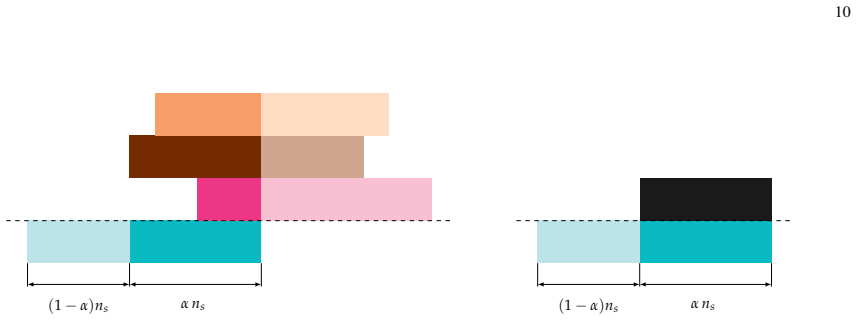
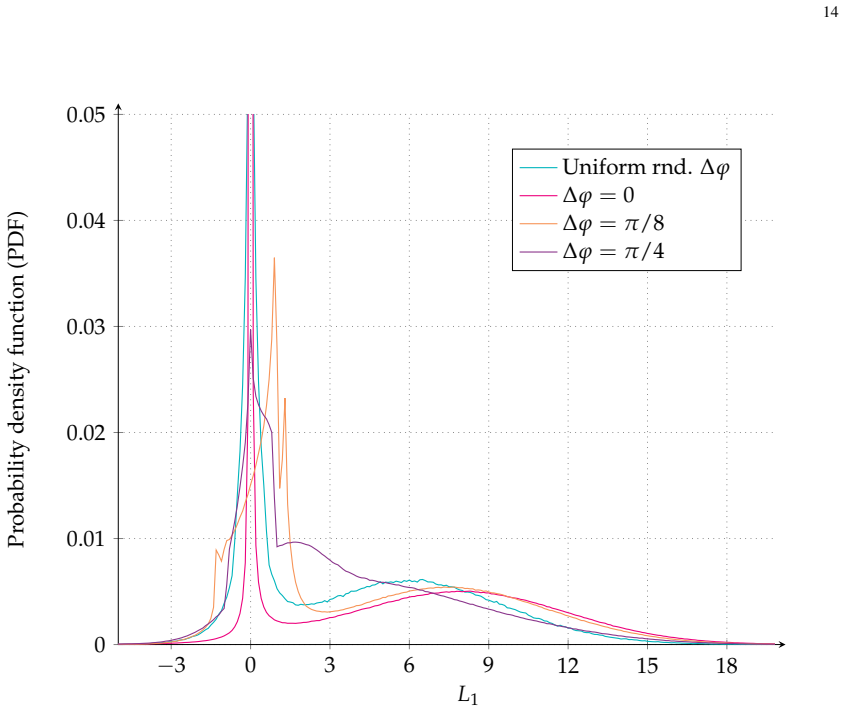
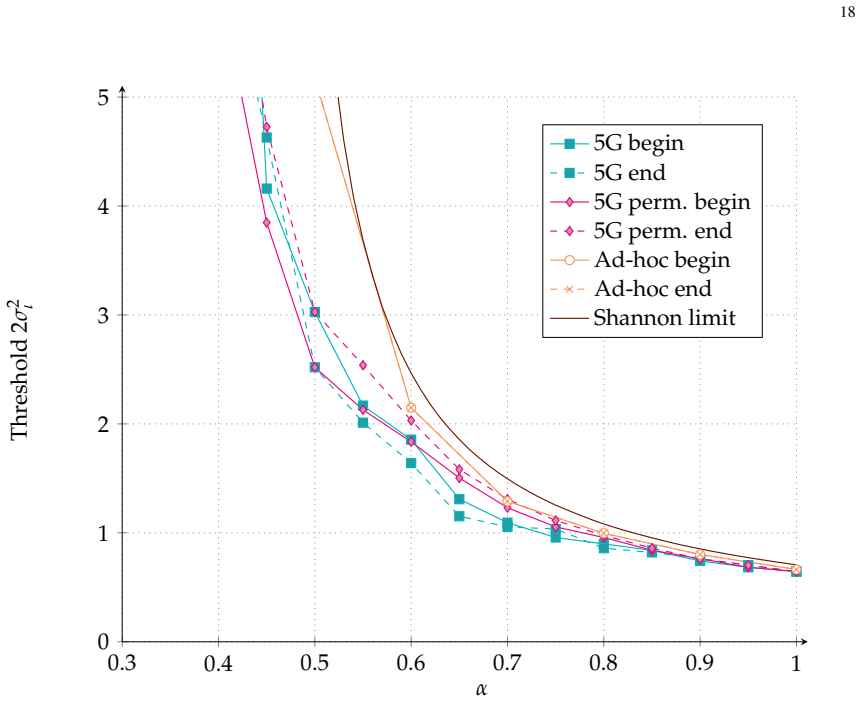
The central object is the protograph base matrix $\mathbf{B}_A$, a small integer matrix whose entries count connections between variable-node and check-node types; lifting it produces a finite LDPC code. The design imposes a reversal symmetry, $b_{(m_b-i-1),(n_b-p_b-j-1)} = b_{i,j}$, so the code protects the beginning and end of a codeword equally. The search uses a multi-target gain function $g = \prod_\ell \sigma^2_{\iota,th}(\alpha^{(\ell)},b) / \sigma^2_{\iota,o}(\alpha^{(\ell)}) \cdot \sigma^2_{\iota,th}(\alpha^{(\ell)},e) / \sigma^2_{\iota,o}(\alpha^{(\ell)})$, evaluated with EXIT (extrinsic information transfer) analysis under the surrogate Gaussian block-interference model at two overlap fractions $\alpha^{(0)}=6/10$ and $\alpha^{(1)}=9/10$, with differential evolution exploring candidate base matrices. The same gain function is used to column-permute the 5G baseline matrix for fair comparison. The paper then replaces the surrogate channel with a decoding-region abstraction and finally with full finite-length physical-layer simulation.
What would settle it
Run the same asynchronous random-access simulation but with a traffic scenario engineered so that a large fraction of replicas (say half) are sandwiched between two interferers, so interference corrupts both the beginning and the end. If the ad-hoc code's supported-load advantage over the 5G code at PLR $10^{-2}$ falls to zero or reverses, the edge-only interference premise is the active ingredient.
Extended reading notes
Core claim
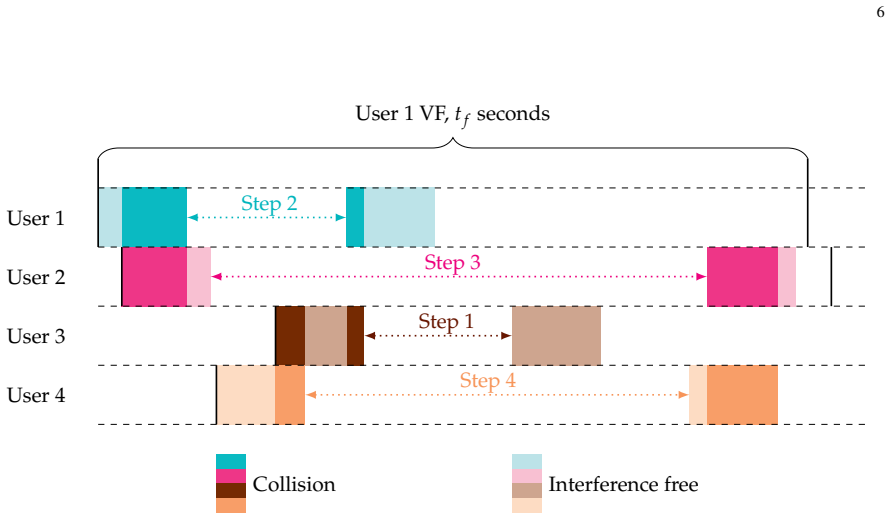
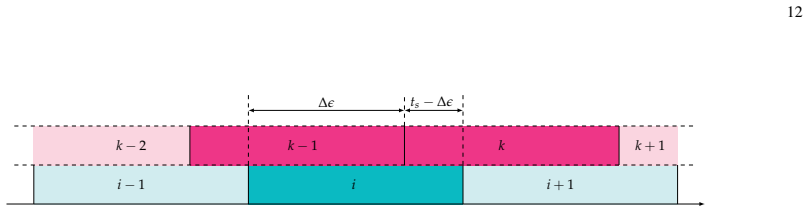
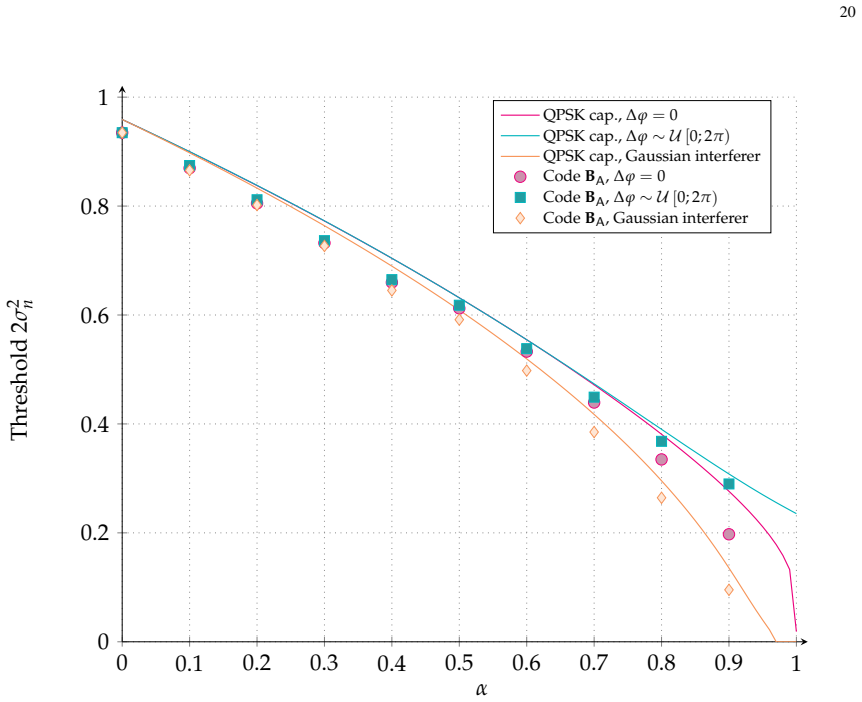
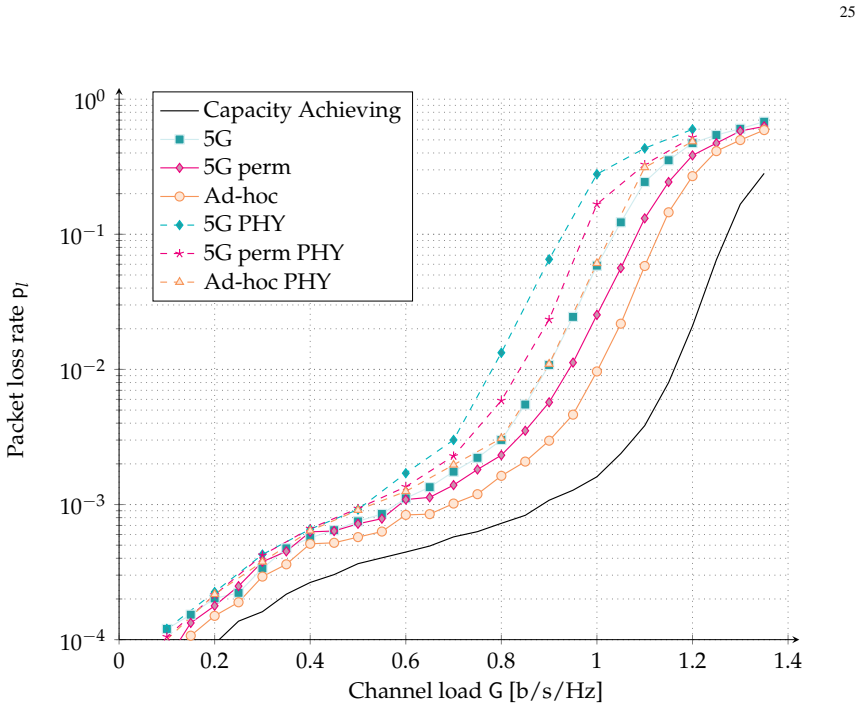
The central discovery is that an LDPC code whose base matrix is symmetric under reversal, so that the beginning and end of a codeword receive equal and strong protection, can decode replicas that a 5G eMBB LDPC code misses in asynchronous random access. The paper models a collision as a block of constant Gaussian interference covering a fraction $\alpha$ of the codeword, and optimizes the protograph through differential evolution with a gain function built from EXIT thresholds at two values of $\alpha$. The resulting ad-hoc base matrix $\mathbf{B}_A$ tracks the outage-capacity Shannon limit over the whole range of $\alpha$, whereas the 5G base matrix is asymmetric and performs much worse when the interferer hits the unprotected edge; a column-permuted 5G matrix improves but does not match it. Finite-length $(960,480)$ physical-layer simulations of the full asynchronous random-access protocol with successive interference cancellation confirm the ranking and show that the abstracted model overestimates the supported channel load by about 10%.
Load-bearing premise
The design assumes collisions are dominated by two-packet overlaps that corrupt only one edge of a codeword, so protecting the two edges symmetrically is enough.
Editorial extensions
If this is right
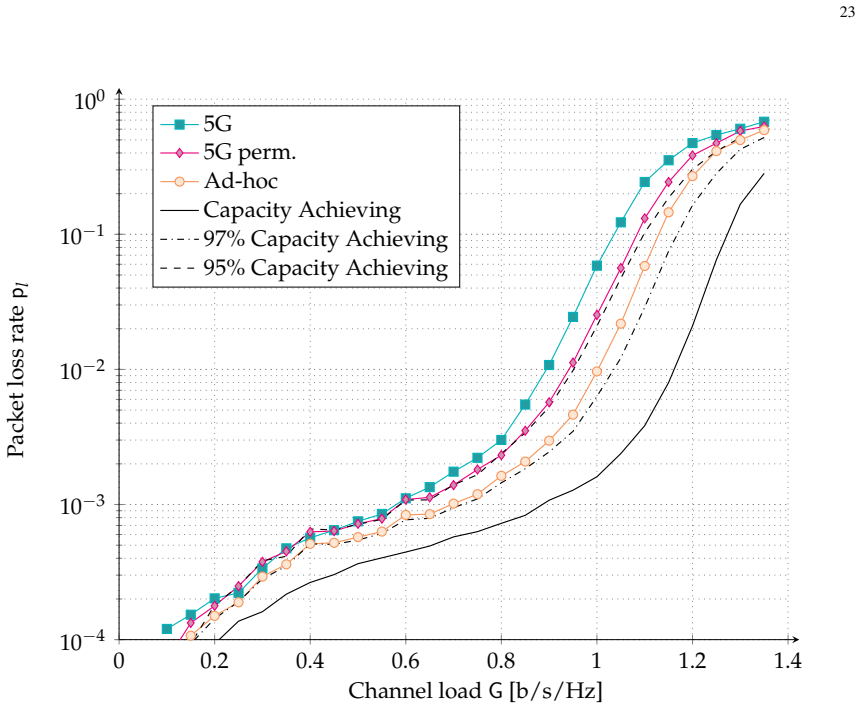
- At a target packet loss rate, the physical layer can accept a higher channel load: about 0.1 b/s/Hz more than a 5G eMBB code, corresponding to roughly 11% at PLR $10^{-2}$ and 17% at PLR $10^{-3}$ in the detailed results.
- The ranking of codes established with the abstracted physical layer survives finite-length simulation: the ad-hoc design beats both the 5G and the permuted 5G designs, while the abstraction overestimates absolute supported load by about 10%.
- A 5G eMBB LDPC base matrix can be improved for asynchronous random access by permuting its columns to place stronger variable nodes at the edges, but this does not close the gap to the ad-hoc design.
- Because a small reduction in error-correction capability causes a large PLR degradation in the random-access scheme (a 95%-of-capacity code performs like the permuted 5G code), code design deserves the same attention as the access protocol itself.
Reading between the lines
- Beyond the paper's claims, the same edge-protection principle should transfer to other asynchronous protocols with two replicas or partial overlaps: a testable prediction is that optimizing for a heavier mix of three-packet collisions would move the optimal protection profile inward from the two edges.
- The binary protected/unprotected surrogate channel is a coarse proxy; one could design codes against the actual distribution of overlap fractions $\alpha$ seen in simulation, which might capture part of the remaining gap to the capacity-achieving bound.
- If successive interference cancellation is non-ideal and leaves residual power, the edge-protecting code is plausibly more robust than a generic code, because residual interference appears exactly where the code is strongest; this could be tested by simulating imperfect cancellation.
- The discrepancy between the abstract's 17% at PLR $10^{-2}$ and the body's 11% at that operating point suggests the advantage is operating-point dependent; a full waterfall comparison would clarify where the design should be deployed.
Signed reviews
Editorial analysis
A structured set of objections, weighed in public.
Referee Report
Summary. The paper studies physical-layer code design for an uncoordinated asynchronous random-access protocol with two replicas per packet and successive interference cancellation (SIC). It observes that asynchronous collisions typically affect only the beginning or end of a codeword, proposes a surrogate block-interference channel with Gaussian interference over a fraction alpha of the codeword, and uses EXIT/density-evolution-based optimization with a symmetry constraint on the protograph base matrix so that both packet edges are equally protected. It reports an ad-hoc protograph ensemble, compares its thresholds with a 5G raptor-like protograph and a column-permuted version, and evaluates all three in two settings: an abstracted physical layer using decoding regions, and a full finite-length physical-layer simulation of (960, 480) LDPC codes. The paper claims gains of about 17% in supported traffic at PLR 10^-2 relative to off-the-shelf 5G codes and notes that the abstracted model overestimates performance by about 10%.
Significance. The paper has clear strengths: the base matrices are given explicitly, the design principle is simple and transferable, and the inclusion of both a threshold-based abstraction and a full finite-length physical-layer simulation is valuable. The full-PHY simulation is an important independent check that avoids circularity in the threshold-based design loop. If the quantitative claims are corrected and the PHY results are reported with error bars or run counts, the paper makes a useful contribution to practical asynchronous random-access design. As it stands, the headline gain figure is not consistently supported by the reported data.
major comments (2)
- [Abstract, Section V, and Section IV-A3/Figure 8] The abstract and the conclusions state gains of "around 17% at a packet loss rate of 10^-2", but Section IV-A3 reports exactly the opposite mapping: at PLR 10^-2 the supported load rises from 0.9 to 1.0 b/s/Hz, which is an 11% gain, while the 17% gain corresponds to PLR 10^-3 (0.6 to 0.7 b/s/Hz). This is not a stylistic point: the central quantitative claim of the paper is misreported by about six percentage points at the stated operating point. Please correct the abstract and conclusions to match Figure 8, or explicitly re-define what is meant by the reported gain.
- [Section IV-B/Figure 9] The finite-length physical-layer results are the main independent validation of the design, but the paper reports no run counts, confidence intervals, or error bars for the PLR curves, and it does not state the percentage gain at PLR 10^-2 for the PHY curves. Since the abstract's 17% claim is traced to abstracted curves that the paper itself says overestimate performance by about 10% in supported load, the actual PHY gain at 10^-2 may be materially different from 17% and may be within simulation noise. Please report the number of simulated packets/users, error bars or a standard-error analysis, and the explicit load values and gains from Figure 9 at both PLR 10^-2 and 10^-3.
minor comments (5)
- [Section III-D1/Equation (6)] The decision to ignore packets with interference at both ends is justified by a qualitative SIC argument; a quantitative breakdown of collision types from the simulated traffic (for example, the fraction of replicas with beginning-only, end-only, and both-end interference as a function of G) would make the design rationale easier to check.
- [Figure 6 and Section III-D] Please state explicitly that the threshold curves for the ad-hoc base matrix are the result of the same optimization objective used to select that matrix, so that Figure 6 is a design/tuning result rather than an out-of-sample prediction; the independent confirmation is provided by Figure 9.
- [Throughout] There are numerous typos and small language errors, including "correseponds" in the captions of Figures 6 and 8, "Gaussain" and "intererfer" in Section III-E, "asnychronous" in the acknowledgments, and "photograph" for "protograph" in Section III-A; these should be corrected in a final pass.
- [Section IV-A3] The sentence "For a fixed channel load operating point, the gain is even more remarkable" is not backed by a specific number; either remove it or give the operating point and the resulting gain.
- [Equations (3), (7), and (9)] The notation for noise and interference powers is not consistently per-dimension: Equation (3) uses 1/(2 sigma_n^2) inside the capacity expression, while Equation (9) writes per-dimension powers as sigma_n^2 + j/2. Please make the per-dimension convention explicit throughout to avoid confusion.
Circularity Check
No load-bearing circularity; the threshold-based abstraction reuses the design objective, but the finite-length physical-layer simulation independently supports the central claim.
-
fitted input called prediction
[Section IV-A2 (decoding region D''); design objective in Section III-D1, Eq. (7)]
"Then, the decoding region in (10) can be restated as D′′ = { σ(2) p ∈ Rnb + | IAPP(j)→ 1 ∀j ∈ {0,..., nb − 1}}."
The ad-hoc base matrix BA is produced by differential evolution maximizing the gain function g = ∏_ℓ [σ^2_{ι,th}(α(ℓ),b)/σ^2_{ι,o}(α(ℓ))]·[σ^2_{ι,th}(α(ℓ),e)/σ^2_{ι,o}(α(ℓ))], i.e., it is selected to maximize iterative-decoding thresholds. The abstracted-PHY success criterion D′′ is the same object: decoding is successful only if the mutual-information quantity I_APP(j) → 1 for all variable-node types. Figure 8 therefore reports a PLR that is the direct consequence of the threshold objective used to choose the code; the ad-hoc code winning on this metric is partly by construction, not an independent prediction.
full rationale
The paper's central contribution—that edge-symmetric protograph codes designed for a block-interference surrogate channel improve supported load under asynchronous random access—is not circular: the full finite-length physical-layer simulation in Section IV-B uses standard BP decoding and actual QPSK collision waveforms, not the threshold criterion from the design optimization, and it reproduces the ad-hoc advantage. The only mild circularity is that the abstracted-physical-layer results (Figure 8) reuse the same iterative-decoding-threshold convergence (I_APP→1) that the differential-evolution objective (Eq. 7) maximizes; those results are therefore a consistency check rather than an independent validation. No load-bearing self-citation chain is present: the earlier conference paper [30] is explicitly extended rather than invoked as authority, and [27] is used only for a standard block-interference modeling assumption. The abstract/body discrepancy (abstract: 17% at PLR 10^-2; body: 11% at 10^-2 and 17% at 10^-3) is a reporting inconsistency falling under correctness, not circularity.
Assumptions & free parameters
free parameters (3)
- α optimization targets (ad-hoc design) =
0.6 and 0.9
- α optimization targets (5G permutation) =
0.6 and 0.8 (12/20 and 16/20)
- Operating point Es/N0 and rate =
6 dB, Rc=1/2
assumptions (4)
- domain assumption Two-user collisions place interference only at the beginning or end of a packet, so edge protection suffices for code design.
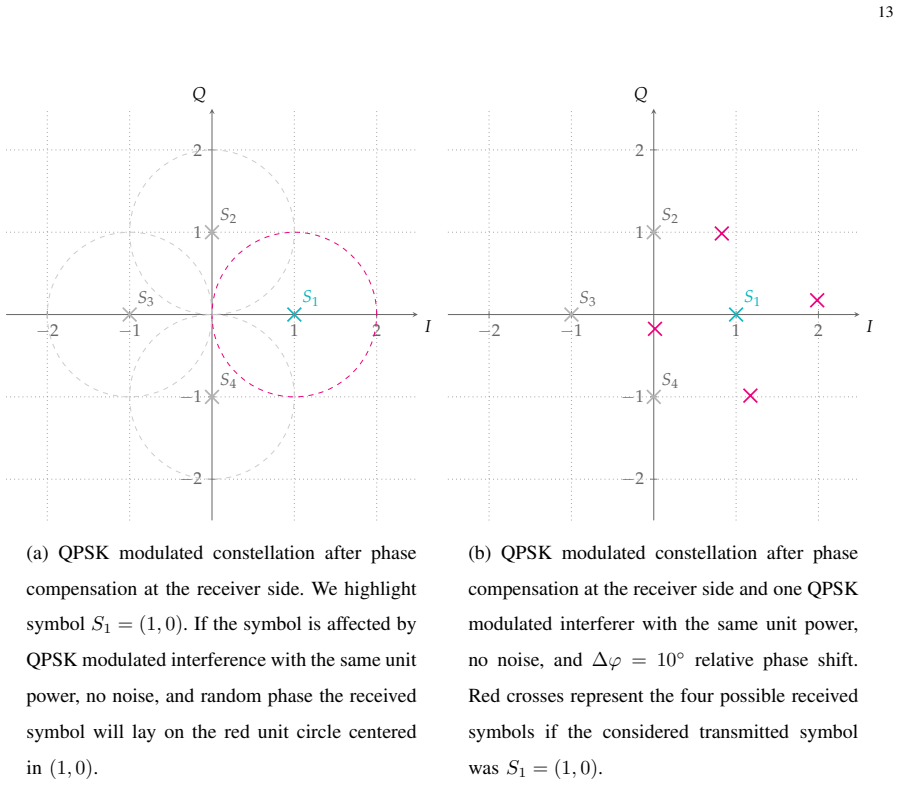
- domain assumption Aggregate interference can be treated as complex Gaussian noise with constant power over an α fraction of the codeword.
- standard math EXIT analysis and density evolution thresholds for infinite-length ensembles predict relative performance of finite-length codes.
- domain assumption Ideal detection, ideal channel estimation, perfect power control, and ideal SIC are assumed throughout.
Cite this review
Pith. "Pith review of Protograph LDPC Code Design for Asynchronous Random Access." pith.science (2026). https://pith.science/paper/KTE76S4U
@misc{pith2026190801607,
  author       = {Pith},
  title        = {Pith review of: Protograph LDPC Code Design for Asynchronous Random Access},
  year         = {2026},
  howpublished = {\url{https://pith.science/paper/KTE76S4U}},
  note         = {Machine review of arXiv:1908.01607}
}
read the original abstract
This work addresses the physical layer channel code design for an uncoordinated, frame- and slot-asynchronous random access protocol. Starting from the observation that collisions between two users yield very specific interference patterns, we define a surrogate channel model and propose different protograph low-density parity-check code designs. The proposed codes are both tested in a setup where the physical layer is abstracted, as well as on a more realistic channel model, where finite-length physical layer simulations of the entire asynchronous random access scheme, including decoding are carried out. We find that the abstracted physical layer model overestimates the performance when short blocks are considered. Additionally, the optimized codes show gains in supported channel traffic - a measure of the number of terminals that can be concurrently accommodated on the channel - of around 17% at a packet loss rate of 10^{-2} w.r.t. off-the-shelf codes.
Figures
Figures from the paper (7 more)
Reference graph
Works this paper leans on
-
[1]
Scenario for 5G mobile and wireless communications: the vision of the METIS project,
A. Osseiran, F. Boccardi, V . Braun, K. Kusume, P. Marsch, M. Maternia, O. Queseth, M. Schellmann, H. Schotten, H. Taoka, H. Tullberg, M. A. Uusitalo, B. Timus, and M. Fallgren, “Scenario for 5G mobile and wireless communications: the vision of the METIS project,” IEEE Commun. Mag. , vol. 52, no. 5, pp. 26–35, may 2014. August 6, 2019 DRAFT 27
work page 2014
-
[2]
TR 21.915 v1.1.0, Release 15 Description,
3GPP, “TR 21.915 v1.1.0, Release 15 Description,” 2019
work page 2019
-
[3]
A. Laya, L. Alonso, and J. Alonso-Zarate, “Is the Random Access Channel of LTE and LTE-A Suitable for M2M Communications? A Survey of Alternatives,” IEEE Commun. Surveys Tuts. , vol. 16, no. 1, pp. 4–16, First Quarter 2014
work page 2014
-
[4]
The ALOHA system: Another alternative for computer communications,
N. Abramson, “The ALOHA system: Another alternative for computer communications,” in Proc. Fall Joint Computer Conf. (AFIPS), vol. 37, Montvale, N. J., nov 1970, pp. 281–285
work page 1970
-
[5]
ALOHA packet system with and without slots and capture,
L. G. Roberts, “ALOHA packet system with and without slots and capture,” Proc. SIGCOMM Computer Commun. Review, vol. 5, no. 2, pp. 28–42, apr 1975
work page 1975
-
[6]
E. Casini, R. De Gaudenzi, and O. Del Rio Herrero, “Contention resolution diversity slotted ALOHA (CRDSA): An enhanced random access scheme for satellite access packet networks,” IEEE Trans. Wireless Commun., vol. 6, no. 4, 2007
work page 2007
-
[7]
Graph-Based Analysis and Optimization of Contention Resolution Diversity Slotted ALOHA,
G. Liva, “Graph-Based Analysis and Optimization of Contention Resolution Diversity Slotted ALOHA,” IEEE Trans. Commun., vol. 59, no. 2, pp. 477–487, feb 2011
work page 2011
-
[8]
Coded Slotted ALOHA: A Graph-Based Method for Uncoordinated Multiple Access,
E. Paolini, G. Liva, and M. Chiani, “Coded Slotted ALOHA: A Graph-Based Method for Uncoordinated Multiple Access,” IEEE Trans. Inf. Theory , vol. 61, no. 12, pp. 6815–6832, oct 2015
work page 2015
Show all 44 references
-
[9]
On Frame Asynchronous Coded Slotted ALOHA: Asymptotic, Finite Length, and Delay Analysis,
E. Sandgren, A. Graell i Amat, and F. Br ¨annstr¨om, “On Frame Asynchronous Coded Slotted ALOHA: Asymptotic, Finite Length, and Delay Analysis,” IEEE Trans. Commun. , vol. 65, no. 2, pp. 691–703, feb 2017
2017
-
[10]
ALOHA Random Access that Operates as a Rateless Code,
C. Stefanovic and P. Popovski, “ALOHA Random Access that Operates as a Rateless Code,” IEEE Trans. Commun., vol. 61, no. 11, pp. 4653–4662, nov 2013
2013
-
[11]
High-Throughput Random Access Using Successive Interference Cancellation in a Tree Algorithm,
Y . Yu and G. B. Giannakis, “High-Throughput Random Access Using Successive Interference Cancellation in a Tree Algorithm,” IEEE Trans. Inf. Theory , vol. 53, no. 12, pp. 4628–4639, dec 2007
2007
-
[12]
Collision-Resolution Algorithm and Random-Access Communication,
J. L. Massey, “Collision-Resolution Algorithm and Random-Access Communication,” Multi-User Communication Systems, vol. Editor G. Longo, pp. 73–137, 1981
1981
-
[13]
A perspective on Multiaccess Channels,
R. Gallager, “A perspective on Multiaccess Channels,” IEEE Trans. Inf. Theory , vol. 31, no. 2, pp. 124–142, mar 1985
1985
-
[14]
Improved Low-Density Parity-Check Codes Using Irregular Graphs,
M. Luby, M. Mitzenmacher, A. Shokrollahi, and D. A. Spielman, “Improved Low-Density Parity-Check Codes Using Irregular Graphs,” IEEE Trans. Inf. Theory , vol. 47, no. 2, pp. 585–598, feb 2001
2001
-
[15]
Design of Capacity-Approaching Irregular Low-Density Parity- Check Codes,
T. J. Richardson, A. Shokrollahi, and R. L. Urbanke, “Design of Capacity-Approaching Irregular Low-Density Parity- Check Codes,” IEEE Trans. Inf. Theory , vol. 47, no. 2, pp. 619–637, feb 2001
2001
-
[16]
Error Floor Analysis of Coded Slotted ALOHA Over Packet Erasure Channels,
M. Ivanov, F. Br ¨annstr¨om, A. Graell i Amat, and P. Popovski, “Error Floor Analysis of Coded Slotted ALOHA Over Packet Erasure Channels,” IEEE Commun. Lett. , vol. 19, no. 3, pp. 419–422, mar 2015
2015
-
[17]
Finite-length analysis of irregular repetition slotted aloha in the waterfall region,
A. Graell i Amat and G. Liva, “Finite-length analysis of irregular repetition slotted aloha in the waterfall region,” IEEE Communications Letters , vol. 22, no. 5, pp. 886–889, 2018
2018
-
[18]
Iterative Collision Resolution for Slotted ALOHA: An Optimal Uncoordinated Transmission Policy,
K. R. Narayanan and H. D. Pfister, “Iterative Collision Resolution for Slotted ALOHA: An Optimal Uncoordinated Transmission Policy,” inProc. 7th Int. Symp. on Turbo Codes and Iterative Information Processing (ISTC), Gothenburg, Sweden, aug 2012, pp. 136–139
2012
-
[19]
A Perspecitve on Massive Random-Access,
Y . Polyanskiy, “A Perspecitve on Massive Random-Access,” in Proc. IEEE Intl. Symp. Information Theory (ISIT) , Aachen, Germany, jun 2017, pp. 2523–2527
2017
-
[20]
Random Access Channel Coding in the Finite Blocklength Regime,
M. Effros, V . Kostina, and R. C. Yavas, “Random Access Channel Coding in the Finite Blocklength Regime,” in Proc. IEEE Intl. Symp. Information Theory (ISIT) , Vail, CO, USA, jun 2018
2018
-
[21]
Low Complexity Scheme for the Random Access Gaussian Channel,
O. Ordentlich and Y . Polyanskiy, “Low Complexity Scheme for the Random Access Gaussian Channel,” in Proc. IEEE Intl. Symp. Information Theory (ISIT) , Aachen, Germany, jun 2017, pp. 2528–2532
2017
-
[22]
A User-Indipendent Serial Interference Cancellation August 6, 2019 DRAFT 28 Based Coding Scheme for the Unsourced Random Access Gaussian Channel,
A. Vem, K. R. Narayanan, J. Cheng, and J.-F. Chamberland, “A User-Indipendent Serial Interference Cancellation August 6, 2019 DRAFT 28 Based Coding Scheme for the Unsourced Random Access Gaussian Channel,” in Proc. IEEE Inf. Theory Work. (ITW), Kaohsiung, Taiwan, nov 2017, pp. 121–125
2019
-
[23]
CHIRRUP: a Practical Algorithm for Unsourced Multiple Access,
R. Calderbank and A. Thompson, “CHIRRUP: a Practical Algorithm for Unsourced Multiple Access,” Available on arxiv.org, 2018
2018
-
[24]
A Coded Compressed Sensing Scheme for Uncoordi- nated Multiple Access,
V . K. Amalladinne, J.-F. Chamberland, and K. R. Narayanan, “A Coded Compressed Sensing Scheme for Uncoordi- nated Multiple Access,” Available on arxiv.org, 2018
2018
-
[25]
Performance Enhancements for Asynchronous Random Access Protocols over Satellite,
C. Kissling, “Performance Enhancements for Asynchronous Random Access Protocols over Satellite,” in Proc. IEEE Int. Conf. on Commun. (ICC) , Kyoto, Japan, jun 2011, pp. 1–6
2011
-
[26]
Asynchronous Contention Resolution Diversity ALOHA: Making CRDSA Truly Asynchronous,
R. De Gaudenzi, O. del Rio Herrero, G. Acar, and E. G. Barrabes, “Asynchronous Contention Resolution Diversity ALOHA: Making CRDSA Truly Asynchronous,” IEEE Trans. Wireless Commun. , vol. 13, no. 11, pp. 6193–6206, nov 2014
2014
-
[27]
Enhancing Contention Resolution ALOHA using Combining Techniques,
F. Clazzer, C. Kissling, and M. Marchese, “Enhancing Contention Resolution ALOHA using Combining Techniques,” IEEE Trans. Commun. , vol. 66, no. 6, pp. 2576–2587, jun 2018
2018
-
[28]
Asymptotic analysis of contention resolution ALOHA with replica concatenation,
T. Akyildiz, U. Demirhan, and T. M. Duman, “Asymptotic analysis of contention resolution ALOHA with replica concatenation,” in 2019 IEEE International Conference on Communications (ICC) , Shangai, China, May 2019, pp. 1–6
2019
-
[29]
LDPC code performance and optimum code rate for contention resolution diversity ALOHA,
C. Kissling and F. Clazzer, “LDPC code performance and optimum code rate for contention resolution diversity ALOHA,” in IEEE Global Communications Conference (GLOBECOM) , Atlanta, GA, USA, Dec 2013, pp. 2932– 2938
2013
-
[30]
LDPC code design for asynchronous random access,
B. Matuz, F. Clazzer, S. J. Johnson, S. Jayasooriya, and M. Shirvanimoghaddam, “LDPC code design for asynchronous random access,” in 2018 IEEE 10th International Symposium on Turbo Codes Iterative Information Processing (ISTC), Hong Kong, Dec 2018, pp. 1–5
2018
-
[31]
On linear unequal error protection codes,
B. Masnick and J. Wolf, “On linear unequal error protection codes,” IEEE Trans. Inf. Theory , vol. 13, no. 4, pp. 600–607, oct 1967
1967
-
[32]
Parallel Concatenated Codes with Unequal Error Protection,
G. Caire and E. Biglieri, “Parallel Concatenated Codes with Unequal Error Protection,” IEEE Trans. Commun., vol. 46, no. 5, pp. 565–567, may 1998
1998
-
[33]
Analysis of Coding on Non-Ergodic Block fading Channels,
J. J. Boutros, A. Guillen i Fabregas, and E. Calvanese, “Analysis of Coding on Non-Ergodic Block fading Channels,” in Proc. 2005 Allerton Conf. on Communication, Control and Computing , 2005
2005
-
[34]
Low-Density Parity-Check Codes for Nonergodic Block-Fading Channels,
J. J. Boutros, A. Guillen i Fabregas, E. Biglieri, and G. Zemor, “Low-Density Parity-Check Codes for Nonergodic Block-Fading Channels,” IEEE Trans. Inf. Theory , vol. 56, no. 9, pp. 4286–4300, sep 2010
2010
-
[35]
Noncoherent Frame Synchronization,
M. Chiani, “Noncoherent Frame Synchronization,” IEEE Trans. Commun., vol. 58, no. 5, pp. 1536–1545, may 2010
2010
-
[36]
Detection and Combining Techniques for Asynchronous Random Access with Time Diversity,
F. Clazzer, F. L ´azaro, G. Liva, and M. Marchese, “Detection and Combining Techniques for Asynchronous Random Access with Time Diversity,” in Proc. 11th Int. ITG Conf. on Systems, Commun. and Coding (SCC) , Hamburg, Germany, feb 2017, pp. 1–6
2017
-
[37]
Mengali and A
U. Mengali and A. N. D’Andrea, Synchronization Techniques for Digital Receivers . Springer Science+Business Media, 1997
1997
-
[38]
Low-density parity-check (LDPC) codes constructed from protographs,
J. Thorpe, “Low-density parity-check (LDPC) codes constructed from protographs,” NASA JPL, Pasadena, CA, USA, IPN Progress Report 42-154, aug 2003
2003
-
[39]
Design of Non-Precoded Protograph-Based LDPC Codes,
H. Uchikawa, “Design of Non-Precoded Protograph-Based LDPC Codes,” in IEEE International Symposium on Information Theory, Honolulu, HI, USA, jun 2014, pp. 2779–2783
2014
-
[40]
Protograph LDPC Codes Design Based on EXIT Analysis,
G. Liva and M. Chiani, “Protograph LDPC Codes Design Based on EXIT Analysis,” in Proc. IEEE Global Commun. Conf. (GLOBECOM), nov 2007, pp. 3250–3254
2007
-
[41]
Channels with Block Interference,
R. J. McEliece and W. E. Stark, “Channels with Block Interference,” IEEE Trans. Inf. Theory , vol. IT-30, no. 1, pp. 44–53, jan 1984. August 6, 2019 DRAFT 29
1984
-
[42]
Protograph-based Raptor-like LDPC codes for rate compatibility with short blocklengths,
T. Y . Chen, D. Divsalar, J. Wang, and R. D. Wesel, “Protograph-based Raptor-like LDPC codes for rate compatibility with short blocklengths,” in Proc. IEEE Global Commun. Conf. (GLOBECOM) , Houston, TX, USA, dec 2011, pp. 1–6
2011
-
[43]
R1-1706970 LDPC design for eMBB data,
Huawei and HiSilicon, “R1-1706970 LDPC design for eMBB data,” 2017, RAN1 #89
2017
-
[44]
Unequal Diversity LDPC Codes for Relay Channels,
P. Pulini, G. Liva, and M. Chiani, “Unequal Diversity LDPC Codes for Relay Channels,” IEEE Trans. Wireless Commun., vol. 12, no. 11, pp. 5646–5655, nov 2013. August 6, 2019 DRAFT
2013
Reviewed August 14, 2026 · model on record in the stance chip above.
Discussion (0). Continue with ORCID to comment.