REVIEW 4 major objections 5 minor 34 references
A position-parallel reranker that generates dynamic retrieval indices, trains with capacity-constrained optimal transport, and decodes with global hard matching consistently beats autoregressive and non-autoregressive baselines offline and
Reviewed by Pith at T0; open to challenge. T0 means a machine referee read the full paper against a public rubric. the ladder, T0–T4 →
A parallel non-autoregressive reranker that trains with capacity-constrained optimal transport and decodes with global hard matching improves slate recommendation quality and serving efficiency.
T0 review reviewed 2026-08-01 challenge →
load-bearing objection A genuinely novel NAR reranking framework with plausible gains, but the reward surrogate in Eq. (13) is unanalyzed and the empirical reporting needs more transparency. the 4 major comments →
DIRECTOR: Dynamic Index-based Recommendation with Transport-Optimized Retrieval
The pith
A machine-rendered reading of the paper's core claim, the machinery that carries it, and where it could break.
The reading
Core claim
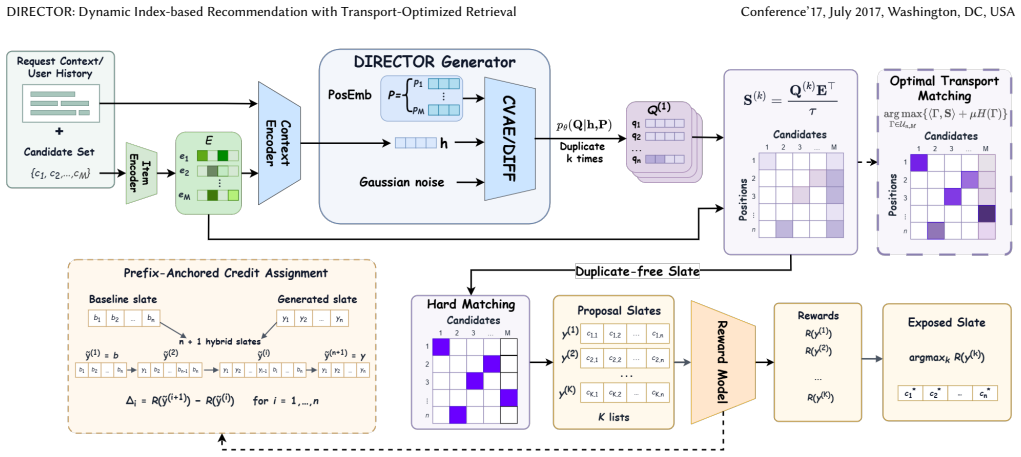
The paper's central claim is that position-parallel generation and global slate coordination are not in conflict. DIRECTOR produces one continuous retrieval index per output position, conditioned on the request and the candidate pool; candidate items live in the same latent space. A similarity matrix between indices and candidates is resolved by a one-shot rectangular assignment, so every position is filled and no item repeats. During training, an entropy-regularized, capacity-constrained optimal transport plan replaces the hard assignment, providing smooth gradients that expose competition among positions for each candidate. A fixed, non-differentiable list-wise evaluator then guides the ge
What carries the argument
The central object is the dynamic retrieval index matrix Q: n continuous vectors, one per output position, sampled from a conditional generative model (CVAE or diffusion) given the request context and candidate embeddings. It is trained by reconstructing target index matrices and by two coupling mechanisms: (1) the capacity-constrained entropy-regularized optimal transport plan Γ*, whose shared column constraints force positions to compete for candidate capacity, and (2) the global hard matching decoder D(Q,E), a rectangular assignment solved by shortest-augmenting paths, which turns the similarity matrix into a duplicate-free slate without iterative transport. The third piece is prefix-anch
Load-bearing premise
The paper's empirical bet is that the soft-transport training signal and the Eq. (13) position-credit surrogate guide the hard-matching decoder onto high-utility slates — a surrogate without proven bias control — and that the reported online CPU reduction, based on confidential measurements, is accurate.
What would settle it
Train DIRECTOR on a fixed offline benchmark replacing the Eq. (13) surrogate with the score-function (REINFORCE) estimator of the same expected-reward objective, using identical proposals and evaluator. If the REINFORCE version matches or exceeds DIRECTOR's NDCG, the surrogate is not necessary. If it falls short, compare gradient cosines: compute the expected gradient of Eq. (13) and the true expected-reward gradient over a batch; a persistently negative cosine would indicate the surrogate pushes against the stated objective.
If this is right
- If the central claim is correct, the standard autoregressive decoding chain in reranking is not necessary for state-of-the-art performance: a parallel generator with a global assignment decoder matches or beats it under the same proposal budget.
- The capacity-constrained transport surrogate gives a principled way to smooth the hard assignment during training, with a provable gap bound (Theorem 5.3) to the inference objective, so the same framework extends to other assignment-constrained generation tasks.
- The prefix-anchored credit decomposition converts an opaque scalar evaluator into position-level learning signals without requiring the evaluator's gradients, which widens the class of usable reward models in industrial systems.
- The finite-proposal coverage result implies that the generator's exploration is not blocked by prefix truncation; increasing the proposal count K yields a coverage probability that depends only on the generator's support mass, not on beam survival.
- Because both CVAE and diffusion instantiations perform similarly, the method's gains are attributable to the index-plus-transport-plus-matching design rather than to a specific latent generative model.
Where Pith is reading between the lines
- Editorial extension: the prefix-anchored path is order-dependent — credits depend on the order in which positions are rewired. A natural test is to average credits over several random position orders, which may reduce variance and change which positions get credit; if that changes the final slate quality, the current fixed order is an unexamined design choice.
- Editorial extension: the same soft-transport training signal could handle practical constraints beyond distinctness (diversity, budget, fairness quotas) by adding linear constraints to the assignment polytope; the paper's theory only covers the distinctness polytope.
- Editorial extension: the gap bound μ n log M suggests an annealing schedule for μ during training — start large for smooth gradients and shrink toward the hard objective; the paper selects a fixed μ on validation, so a schedule might improve the trade-off.
- Editorial extension: the strict positivity of the soft transport plan means every candidate receives some mass; one could use the plan's marginals as an exploration bonus for the generator, turning the conflict-aware signal into a natural exploration strategy.
Editorial analysis
A structured set of objections, weighed in public.
Referee Report
Summary. The paper proposes DIRECTOR, a non-autoregressive reranking framework for the Generator–Evaluator paradigm. Instead of generating items one by one, DIRECTOR samples a matrix of continuous, request-conditioned 'dynamic retrieval indices' for all positions in parallel, maps candidates into the same latent space, and decodes a duplicate-free slate via global hard assignment on the similarity matrix. During training, an entropy-regularized, capacity-constrained optimal transport plan provides conflict-aware supervision, and a 'prefix-anchored credit assignment' mechanism converts a scalar list-wise reward into position-specific learning signals. The paper reports theoretical results on the assignment polytope, the soft-transport surrogate gap, and finite-proposal coverage, and evaluates on ML-1M, Amazon-Books, RecFlow, and a seven-day online A/B test at Kuaishou, claiming consistent offline improvements and a +0.519% VV lift with 66.7% lower CPU consumption.
Significance. If the claims hold, the work offers a practical parallel alternative to autoregressive reranking, achieving global slate coordination without sequential decoding. The theoretical components are largely standard—the assignment relaxation and entropy-regularized OT gap bounds are correctly derived—but they are clearly stated and useful. The empirical evaluation spans public and industrial datasets, includes ablations, and reports an online deployment, which is a strength. However, the central reward-guided optimization surrogate lacks formal justification, and several experimental details that would support the headline claims are missing. The paper is a plausible contribution to the G-E reranking literature, but it needs additional analysis and reporting before it can be accepted.
major comments (4)
- [Section 4.3, Eq. (13)] The surrogate loss L_CA is not connected to the expected-reward objective J(θ) in Eq. (6). The hard decoder D(·) is deterministic, so the slate policy is π_θ(y) = P_{Q∼pθ}[D(Q,E)=y]. The score-function gradient of J(θ) is E[(R(D(Q))−b)∇ log p_θ(Q)], not Σ_i Δ_i ∇ log Γ*_{μ,i,a_i}. The paper provides no bias or consistency analysis of this surrogate; Section 5.2 analyzes the similarity-score gap between hard and soft assignment, but not the expected-reward surrogate. This is load-bearing because the claimed ability to align the generator with an opaque list-wise evaluator rests on Eq. (13). Please provide a formal derivation of what objective L_CA optimizes, an analysis of its bias relative to J(θ), or an explicit statement that it is a heuristic with supporting empirical or theoretical conditions under which it is expected to be effective.
- [Section 6.1.4 and Table 3] The text states that each offline experiment is repeated with five random seeds and results are averaged, but no standard deviations or confidence intervals are reported. The claim that DIRECTOR 'consistently outperforms' baselines cannot be assessed for statistical significance without such information, especially for metrics where the differences are small (e.g., 2.02% on RecFlow Recall@6). Please report means with standard deviations, error bars, or paired significance tests.
- [Section B.7 and Table 4] The online efficiency comparison reports a 66.7% CPU reduction, but the production baseline architecture, beam configuration, absolute machine count, and resource-accounting procedure are not disclosed. The paper says only 'NTP-based AR online baseline generator equipped with beam search' without further detail. While confidentiality is understandable, the claimed reduction cannot be verified or reproduced. Please disclose as much as possible—e.g., model size, beam width, hardware type, and a precise definition of the CPU consumption metric—or clearly frame the finding as a case-study observation rather than a general efficiency claim.
- [Section 3.2 / B.3] The protocol for fair comparison among Generator–Evaluator methods is under-specified. The paper states that all G-E methods use the same proposal budget K=20 and that each baseline produces proposals with its 'native stochastic generation procedure and decoding mechanism.' However, for AR baselines it is not clear whether proposals are obtained by sampling or by beam search, nor how the beam width relates to K. The complexity analysis in Section 5.4 assumes beam width B=K for AR, but the experimental protocol does not specify this. Please clarify the exact decoding configuration used for each baseline, as this directly affects the fairness of the comparison.
minor comments (5)
- [Throughout] The manuscript contains LaTeX template artifacts that should be removed: 'Conference’17', '©2018', 'Received 20 February 2007', and the ACM copyright block at the top. These are inconsistent with the current submission.
- [Eq. (13)] The additive constant ε inside the logarithm is not defined. Specify that it is a small positive numerical stabilizer, and state its value if relevant.
- [Section 5.2, Theorem 5.2] The heading 'Uniqeness' is misspelled; should be 'Uniqueness'.
- [References] Several references are incomplete or inconsistent. For example, [4] lacks page numbers, [17] and [30] lack full page ranges, and [23] is missing the volume. Please ensure all references follow the ACM style consistently.
- [Section B.5] The sentence 'The code will be released upon acceptance' is useful but should be accompanied by a reproducibility appendix or a link to an anonymized repository, as is common for this venue.
Circularity Check
No significant circularity: DIRECTOR's derivation is self-contained; theoretical results are proved in-appendix and empirical claims rest on external labels/objectives.
full rationale
Walking the derivation chain, every load-bearing component is defined and proved within the paper rather than imported from a fitted value or from a self-citation. The generative policy is trained with L_Index (Eq. 9/10), L_Match (Eq. 14), and L_CA (Eq. 13); the transport plan Γ*_μ is the unique optimizer of Eq. (12), and Theorems 5.1-5.3 and Propositions 5.4/A.1 are proved in the appendix from standard convexity/total-unimodularity/entropy arguments, with external citations only for Sinkhorn and assignment algorithms [3,4,5]. The reward signal in Eq. (13) is an explicitly stated surrogate built on the telescoping identity Σ Δ_i = R(y)-R(b); it is not claimed to be the REINFORCE estimator of Eq. (6), so any misalignment is a correctness/risk concern rather than a definitional equivalence. The only self-referential element is the use of the same frozen evaluator for reward-guided training and final proposal selection (App. B.5), which is a standard G-E design choice; because the reported offline metrics are ground-truth labels and the online VV is an external business objective, the headline result does not reduce by construction to the training signal. Self-citations ([15], [29], [30]) are to a dataset and to related-work methods and are not load-bearing. No circular step identified.
Axiom & Free-Parameter Ledger
free parameters (7)
- temperature tau =
not reported (selected on validation)
- entropy coefficient mu =
not reported
- loss weight alpha (LMatch) =
not reported
- loss weight lambda (LCA) =
not reported
- CVAE KL weight beta =
not reported
- latent dimension and diffusion schedule/T_diff =
not reported
- proposal budget K =
20
axioms (6)
- standard math Assignment polytope U_n,M equals convex hull of binary assignment matrices A_n,M.
- standard math Entropy-regularized OT with capacity constraints has a unique strictly positive solution representable by KKT conditions.
- domain assumption The fixed evaluator R_phi returns a scalar for any slate and can score the n+1 hybrid slates in the prefix-anchored path.
- domain assumption Item utility and position intent can be represented in a shared linear latent space such that q_i^T e_j / tau ranks candidates appropriately.
- domain assumption The generative models (CVAE/diffusion) can approximate the conditional distribution of target index matrices.
- domain assumption Offline BPR-MF candidate pools and RecFlow labels are representative of real reranking distributions.
invented entities (1)
-
Dynamic retrieval index matrix Q
no independent evidence
Cite this review
Pith. "Pith review of DIRECTOR: Dynamic Index-based Recommendation with Transport-Optimized Retrieval." pith.science (2026). https://pith.science/paper/KTPZ57SB
@misc{pith2026260726418,
  author       = {Pith},
  title        = {Pith review of: DIRECTOR: Dynamic Index-based Recommendation with Transport-Optimized Retrieval},
  year         = {2026},
  howpublished = {\url{https://pith.science/paper/KTPZ57SB}},
  note         = {Machine review of arXiv:2607.26418}
}
read the original abstract
Reranking is a combinatorial decision problem that aims to select and order a high-utility slate from a request-specific candidate set. A major line of generative rerankers adopts autoregressive (AR) models, which construct the slate one position at a time to capture inter-position dependencies. However, under practical greedy or bounded-width decoding, prefix-based search may prematurely prune globally promising permutations and incurs inherently sequential latency, restricting the effective search space under a fixed serving budget. Non-autoregressive (NAR) alternatives alleviate this efficiency bottleneck through position-parallel prediction, but naive position-wise factorization treats different positions too independently, leading to insufficient cross-position coordination and potentially duplicate or conflicting item selections. To retain parallel efficiency while introducing global structural coordination, we propose Dynamic Index-based RECommendation with Transport-Optimized Retrieval (DIRECTOR), a transport-guided parallel reranking framework. DIRECTOR maps candidate items into a continuous latent space and generates request-conditioned dynamic retrieval indices for all target positions in parallel. During training, it uses entropy-regularized OT to provide conflict-aware supervision; at inference, it directly performs global hard matching on similarity matrix, producing duplicate-free slates without iterative transport. To further align the generator with an opaque list-wise evaluator that returns only a scalar utility, we introduce a prefix-anchored credit assignment mechanism that converts the global reward into position-specific training signals. Extensive offline and online experiments demonstrate that DIRECTOR consistently outperforms strong reranking baselines, achieving significant improvement in large-scale industrial recommendation scenarios.
Figures
Reference graph
Works this paper leans on
-
[1]
Qingyao Ai, Keping Bi, Jiafeng Guo, and W. Bruce Croft. 2018. Learning a Deep Listwise Context Model for Ranking Refinement. InThe 41st International ACM SIGIR Conference on Research & Development in Information Retrieval, SIGIR 2018, Ann Arbor, MI, USA, July 08-12, 2018, Kevyn Collins-Thompson, Qiaozhu Mei, Brian D. Davison, Yiqun Liu, and Emine Yilmaz (...
arXiv 2018
-
[2]
Irwan Bello, Sayali Kulkarni, Sagar Jain, Craig Boutilier, Ed Huai-hsin Chi, Elad Eban, Xiyang Luo, Alan Mackey, and Ofer Meshi. 2018. Seq2Slate: Re-ranking and Slate Optimization with RNNs.CoRRabs/1810.02019 (2018). arXiv:1810.02019 http://arxiv.org/abs/1810.02019
Pith/arXiv arXiv 2018
-
[3]
Jean-David Benamou, Guillaume Carlier, Marco Cuturi, Luca Nenna, and Gabriel Peyré. 2015. Iterative Bregman Projections for Regularized Transportation Prob- lems.SIAM J. Sci. Comput.37, 2 (2015). doi:10.1137/141000439
-
[4]
David Frederic Crouse. 2016. On implementing 2D rectangular assignment algorithms.IEEE Trans. Aerosp. Electron. Syst.52, 4 (2016), 1679–1696. doi:10. 1109/TAES.2016.140952
arXiv 2016
-
[5]
Marco Cuturi. 2013. Sinkhorn Distances: Lightspeed Computation of Opti- mal Transport. InAdvances in Neural Information Processing Systems 26: 27th Annual Conference on Neural Information Processing Systems 2013. Proceed- ings of a meeting held December 5-8, 2013, Lake Tahoe, Nevada, United States, Christopher J. C. Burges, Léon Bottou, Zoubin Ghahramani,...
2013
-
[6]
Yufei Feng, Yu Gong, Fei Sun, Qingwen Liu, and Wenwu Ou. 2021. Revisit Recommender System in the Permutation Prospective.CoRRabs/2102.12057 (2021). arXiv:2102.12057 https://arxiv.org/abs/2102.12057
Pith/arXiv arXiv 2021
-
[7]
Yufei Feng, Binbin Hu, Yu Gong, Fei Sun, Qingwen Liu, and Wenwu Ou. 2021. GRN: Generative Rerank Network for Context-wise Recommendation.CoRR abs/2104.00860 (2021). arXiv:2104.00860 https://arxiv.org/abs/2104.00860
Pith/arXiv arXiv 2021
-
[8]
Xudong Gong, Qinlin Feng, Yuan Zhang, Jiangling Qin, Weijie Ding, Biao Li, Peng Jiang, and Kun Gai. 2022. Real-time Short Video Recommendation on Mobile Devices. InProceedings of the 31st ACM International Conference on Information & Knowledge Management, Atlanta, GA, USA, October 17-21, 2022, Mohammad Al Hasan and Li Xiong (Eds.). ACM, 3103–3112. doi:10....
arXiv 2022
-
[9]
F. Maxwell Harper and Joseph A. Konstan. 2016. The MovieLens Datasets: History and Context.ACM Trans. Interact. Intell. Syst.5, 4 (2016), 19:1–19:19. doi:10.1145/2827872
doi:10.1145/2827872 2016
-
[10]
Ruining He and Julian J. McAuley. 2016. Ups and Downs: Modeling the Visual Evolution of Fashion Trends with One-Class Collaborative Filtering. InProceed- ings of the 25th International Conference on World Wide Web, WWW 2016, Montreal, Canada, April 11 - 15, 2016, Jacqueline Bourdeau, Jim Hendler, Roger Nkambou, Ian Horrocks, and Ben Y. Zhao (Eds.). ACM, 5...
arXiv 2016
-
[11]
Mann, and Danilo J
Ray Jiang, Sven Gowal, Yuqiu Qian, Timothy A. Mann, and Danilo J. Rezende. 2019. Beyond Greedy Ranking: Slate Optimization via List-CVAE. In7th International Conference on Learning Representations, ICLR 2019, New Orleans, LA, USA, May 6-9, 2019. OpenReview.net. https://openreview.net/forum?id=r1xX42R5Fm
2019
-
[12]
Diederik P. Kingma and Jimmy Ba. 2015. Adam: A Method for Stochastic Opti- mization. In3rd International Conference on Learning Representations, ICLR 2015, San Diego, CA, USA, May 7-9, 2015, Conference Track Proceedings, Yoshua Bengio and Yann LeCun (Eds.). http://arxiv.org/abs/1412.6980
Pith/arXiv arXiv 2015
-
[13]
Yi Li, Jieming Zhu, Weiwen Liu, Liangcai Su, Guohao Cai, Qi Zhang, Ruiming Tang, Xi Xiao, and Xiuqiang He. 2022. PEAR: Personalized Re-ranking with Contextualized Transformer for Recommendation. InCompanion of The Web Conference 2022, Virtual Event / Lyon, France, April 25 - 29, 2022, Frédérique Laforest, Raphaël Troncy, Elena Simperl, Deepak Agarwal, Ari...
arXiv 2022
-
[14]
Xiao Lin, Xiaokai Chen, Chenyang Wang, Hantao Shu, Linfeng Song, Biao Li, and Peng Jiang. 2024. Discrete Conditional Diffusion for Reranking in Rec- ommendation. InCompanion Proceedings of the ACM on Web Conference 2024, WWW 2024, Singapore, Singapore, May 13-17, 2024, Tat-Seng Chua, Chong-Wah Ngo, Roy Ka-Wei Lee, Ravi Kumar, and Hady W. Lauw (Eds.). ACM,...
arXiv 2024
-
[15]
Qi Liu, Kai Zheng, Rui Huang, Wuchao Li, Kuo Cai, Yuan Chai, Yanan Niu, Yiqun Hui, Bing Han, Na Mou, Hongning Wang, Wentian Bao, Yunen Yu, Guorui Zhou, Han Li, Yang Song, Defu Lian, and Kun Gai. 2025. RecFlow: An Industrial Full Flow Recommendation Dataset. InThe Thirteenth International Conference on Learning Representations, ICLR 2025, Singapore, April ...
2025
-
[16]
McAuley, Dong Zheng, Peng Jiang, and Kun Gai
Shuchang Liu, Qingpeng Cai, Zhankui He, Bowen Sun, Julian J. McAuley, Dong Zheng, Peng Jiang, and Kun Gai. 2023. Generative Flow Network for Listwise Recommendation. InProceedings of the 29th ACM SIGKDD Conference on Knowl- edge Discovery and Data Mining, KDD 2023, Long Beach, CA, USA, August 6- 10, 2023, Ambuj K. Singh, Yizhou Sun, Leman Akoglu, Dimitrio...
arXiv 2023
-
[17]
Yue Meng, Cheng Guo, Yi Cao, Tong Liu, and Bo Zheng. 2025. A Generative Re-ranking Model for List-level Multi-objective Optimization at Taobao. InPro- ceedings of the 48th International ACM SIGIR Conference on Research and Develop- ment in Information Retrieval, SIGIR 2025, Padua, Italy, July 13-18, 2025, Nicola Ferro, Maria Maistro, Gabriella Pasi, Omar ...
arXiv 2025
-
[18]
Liang Pang, Jun Xu, Qingyao Ai, Yanyan Lan, Xueqi Cheng, and Jirong Wen
-
[19]
Changhua Pei, Yi Zhang, Yongfeng Zhang, Fei Sun, Xiao Lin, Hanxiao Sun, Jian Wu, Peng Jiang, Junfeng Ge, Wenwu Ou, and Dan Pei. 2019. Personalized re-ranking for recommendation. InProceedings of the 13th ACM Conference on Recommender Systems, RecSys 2019, Copenhagen, Denmark, September 16-20, 2019, Toine Bogers, Alan Said, Peter Brusilovsky, and Domonkos ...
arXiv 2019
-
[20]
Yuxin Ren, Qiya Yang, Yichun Wu, Wei Xu, Yalong Wang, and Zhiqiang Zhang
-
[21]
Steffen Rendle, Christoph Freudenthaler, Zeno Gantner, and Lars Schmidt-Thieme
-
[22]
Xiaowen Shi, Fan Yang, Ze Wang, Xiaoxu Wu, Muzhi Guan, Guogang Liao, Yongkang Wang, Xingxing Wang, and Dong Wang. 2023. PIER: Permutation-Level Interest-Based End-to-End Re-ranking Framework in E-commerce. InProceedings of the 29th ACM SIGKDD Conference on Knowledge Discovery and Data Mining, KDD 2023, Long Beach, CA, USA, August 6-10, 2023, Ambuj K. Sing...
arXiv 2023
-
[23]
Mukund Sundararajan, Ankur Taly, and Qiqi Yan. 2017. Axiomatic Attribution for Deep Networks. InProceedings of the 34th International Conference on Machine Learning, ICML 2017, Sydney, NSW, Australia, 6-11 August 2017 (Proceedings of Machine Learning Research, Vol. 70), Doina Precup and Yee Whye Teh (Eds.). PMLR, 3319–3328. http://proceedings.mlr.press/v7...
2017
-
[24]
Jianxiong Wei, Anxiang Zeng, Yueqiu Wu, Peng Guo, Qingsong Hua, and Qingpeng Cai. 2020. Generator and Critic: A Deep Reinforcement Learning Approach for Slate Re-ranking in E-commerce.CoRRabs/2005.12206 (2020). arXiv:2005.12206 https://arxiv.org/abs/2005.12206
Pith/arXiv arXiv 2020
-
[25]
Sam Wiseman and Alexander M. Rush. 2016. Sequence-to-Sequence Learning as Beam-Search Optimization. InProceedings of the 2016 Conference on Empirical Methods in Natural Language Processing, EMNLP 2016, Austin, Texas, USA, No- vember 1-4, 2016, Jian Su, Xavier Carreras, and Kevin Duh (Eds.). The Association for Computational Linguistics, 1296–1306. doi:10....
-
[26]
Wolpert and Kagan Tumer
David H. Wolpert and Kagan Tumer. 2001. Optimal Payoff Functions for Mem- bers of Collectives.Adv. Complex Syst.4, 2-3 (2001), 265–280. doi:10.1142/ S0219525901000188
2001
-
[27]
Yunjia Xi, Weiwen Liu, Jieming Zhu, Xilong Zhao, Xinyi Dai, Ruiming Tang, Weinan Zhang, Rui Zhang, and Yong Yu. 2022. Multi-Level Interaction Reranking with User Behavior History. InSIGIR ’22: The 45th International ACM SIGIR Conference on Research and Development in Information Retrieval, Madrid, Spain, July 11 - 15, 2022, Enrique Amigó, Pablo Castells, ...
arXiv 2022
-
[28]
Junwei Xu, Zhibo Xiao, Chuxin Chen, Chengyu Lai, Qijie Shen, Jiuning Lin, Dimin Wang, Jialin Zhu, and Xiao-Ping Zhang. 2026. OMGRec: One-time Matching- based Generative Rerank with Permutation-level Modeling in E-commerce. In Proceedings of the ACM Web Conference 2026, WWW 2026, Dubai, United Arab Emirates, originally scheduled for April 13-17, 2026, resc...
arXiv 2026
-
[29]
Hailan Yang, Zhenyu Qi, Shuchang Liu, Xiaoyu Yang, Xiaobei Wang, Xiang Li, Lantao Hu, Han Li, and Kun Gai. 2025. Comprehensive List Generation for Multi-Generator Reranking. InProceedings of the 48th International ACM SIGIR Conference on Research and Development in Information Retrieval, SIGIR 2025, Padua, Italy, July 13-18, 2025, Nicola Ferro, Maria Mais...
arXiv 2025
-
[30]
Chao Zhang, Shuai Lin, ChengLei Dai, Ye Qian, Fan Mingyang, Yi Zhang, Yi Wang, and Jingwei Zhuo. 2026. Dual-Rerank: Fusing Causality and Utility for Industrial Generative Reranking.arXiv preprint arXiv:2604.07420(2026). Conference’17, July 2017, Washington, DC, USA Pu et al
Pith/arXiv arXiv 2026
-
[31]
Xin Zhao, Jiaxin Li, Zhiwei Fang, Yuchen Guo, Jinyuan Zhao, Jie He, Wenlong Chen, Changping Peng, and Guiguang Ding. 2024. JDRec: Practical Actor-Critic Framework for Online Combinatorial Recommender System. InProceedings of the 23rd International Conference on Autonomous Agents and Multiagent Sys- tems, AAMAS 2024, Auckland, New Zealand, May 6-10, 2024, ...
arXiv 2024
-
[2009]
InUAI 2009, Proceedings of the Twenty-Fifth Conference on Uncertainty in Artificial Intelligence, Montreal, QC, Canada, June 18-21, 2009, Jeff A
BPR: Bayesian Personalized Ranking from Implicit Feedback. InUAI 2009, Proceedings of the Twenty-Fifth Conference on Uncertainty in Artificial Intelligence, Montreal, QC, Canada, June 18-21, 2009, Jeff A. Bilmes and Andrew Y. Ng (Eds.). AUAI Press, 452–461. https://www.auai.org/uai2009/papers/UAI2009_0139_ 48141db02b9f0b02bc7158819ebfa2c7.pdf
2009
-
[2020]
SetRank: Learning a Permutation-Invariant Ranking Model for Information Retrieval. InProceedings of the 43rd International ACM SIGIR conference on research and development in Information Retrieval, SIGIR 2020, Virtual Event, China, July 25- 30, 2020, Jimmy X. Huang, Yi Chang, Xueqi Cheng, Jaap Kamps, Vanessa Murdock, Ji-Rong Wen, and Yiqun Liu (Eds.). ACM...
arXiv 2020
-
[2024]
Non-autoregressive Generative Models for Reranking Recommendation. InProceedings of the 30th ACM SIGKDD Conference on Knowledge Discovery and Data Mining, KDD 2024, Barcelona, Spain, August 25-29, 2024, Ricardo Baeza-Yates and Francesco Bonchi (Eds.). ACM, 5625–5634. doi:10.1145/3637528.3671645
arXiv 2024
This paper was first reviewed by deepseek-v4-flash on August 1, 2026.
discussion (0)
Sign in with ORCID, Apple, or X to comment. Anyone can read and Pith papers without signing in.