Beyond Aesthetics: Quantifying Information Loss in Turbid Scenes
Pith reviewed 2026-06-26 01:27 UTC · model grok-4.3
The pith
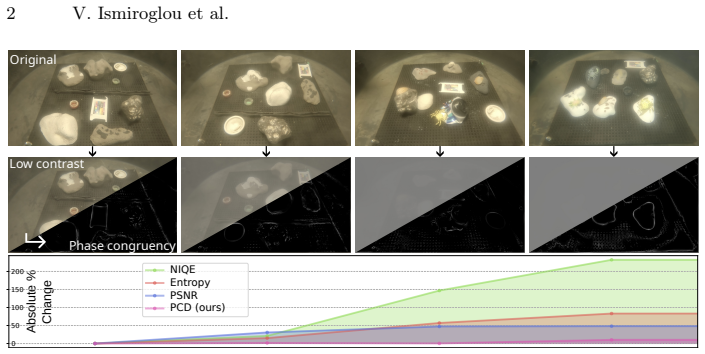
PCD, derived from phase congruency maps, correlates strongly with instance segmentation performance in turbid underwater scenes while standard metrics do not.
A machine-rendered reading of the paper's core claim, the machinery that carries it, and where it could break.
Core claim
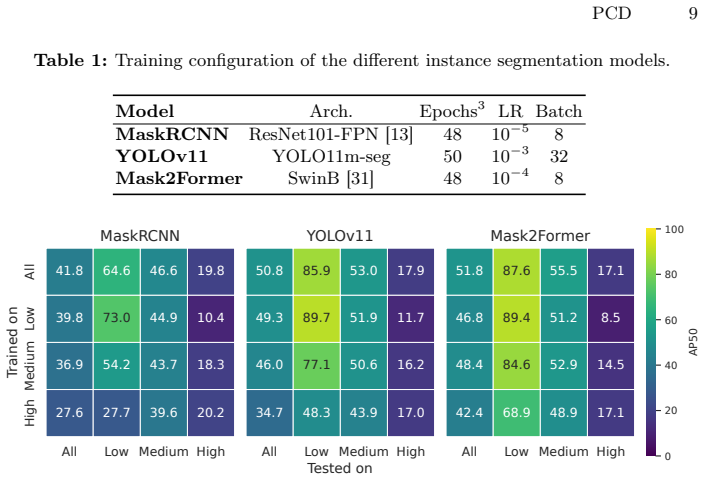
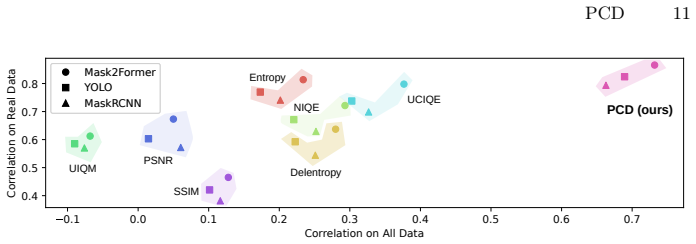
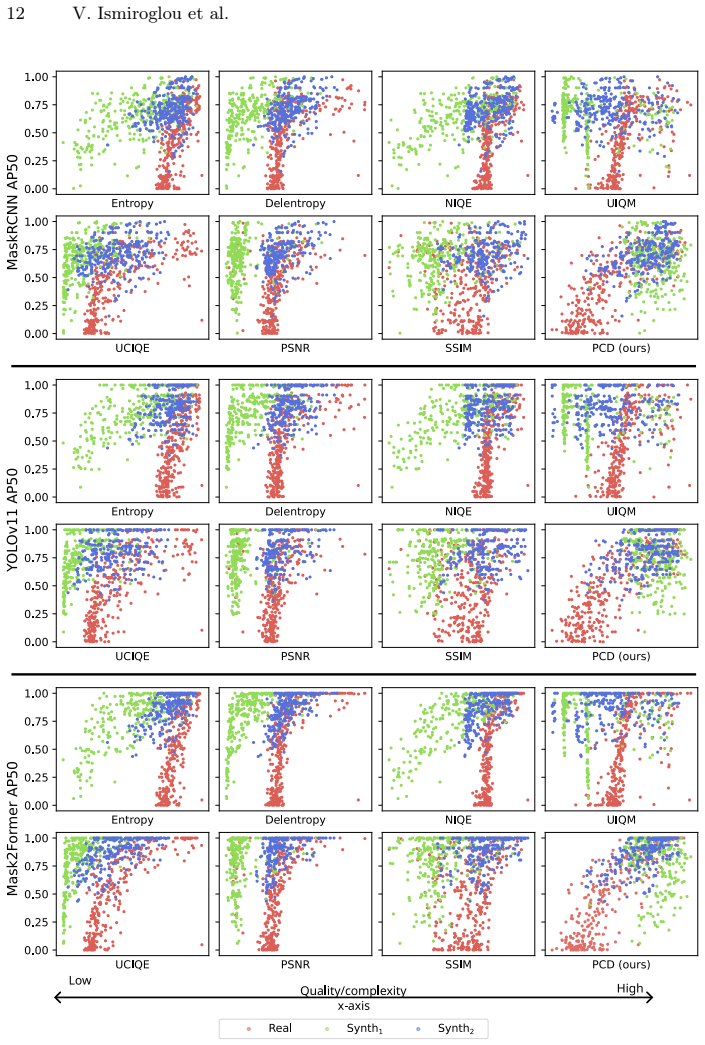
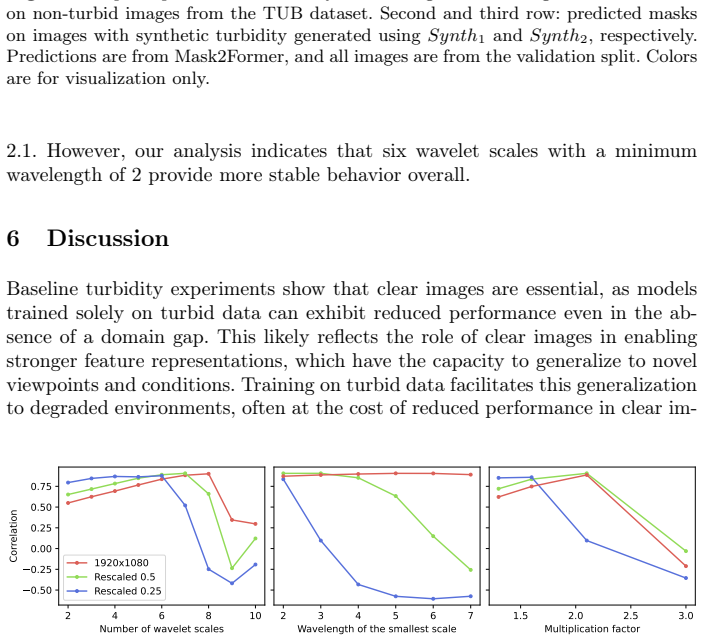
PCD correlates strongly with the performance of instance segmentation models on both real and synthetic turbid images, whereas common metrics in the field show weak to no correlation at all.
What carries the argument
PCD, a metric derived from phase congruency maps that remains invariant to contrast and quantifies loss of structural information.
If this is right
- Segmentation accuracy under turbidity can be estimated from PCD alone without executing the models.
- Synthetic turbidity generation methods can be validated by checking whether their PCD-to-performance curves match those observed on real data.
- Underwater vision pipelines can be ranked for robustness using PCD as a proxy for expected information loss.
- Contrast normalization alone is insufficient to restore performance; preserving the structures measured by phase congruency is required.
Where Pith is reading between the lines
- PCD could be used to select or augment training images that preserve structural content rather than merely increasing contrast.
- Analogous phase-congruency measures might quantify information loss in other scattering environments such as atmospheric haze or medical imaging through tissue.
- The TUB dataset supplies a benchmark for training models that adapt explicitly to measured levels of structural degradation.
Load-bearing premise
Phase congruency maps computed on real turbid images isolate structural information loss in a manner that stays unchanged by contrast variations and that this loss directly accounts for drops in downstream model accuracy.
What would settle it
A new collection of turbid images in which PCD values fail to predict segmentation accuracy across multiple models would disprove the reported correlation.
Figures
read the original abstract
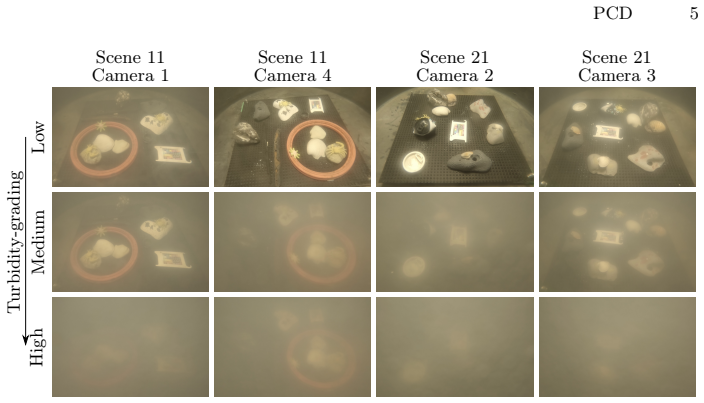
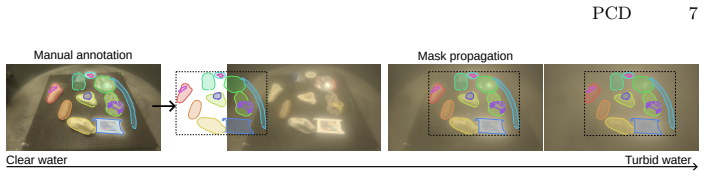
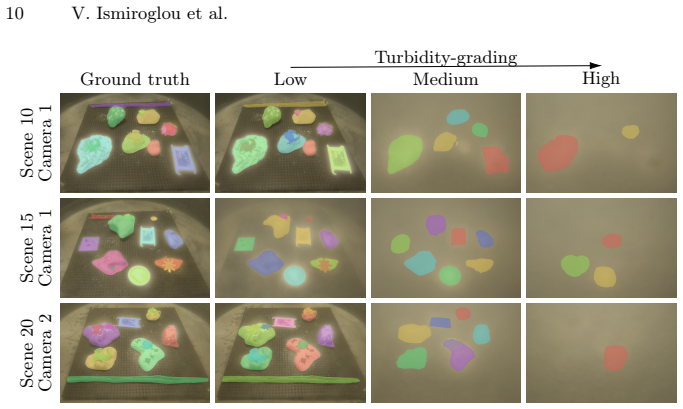
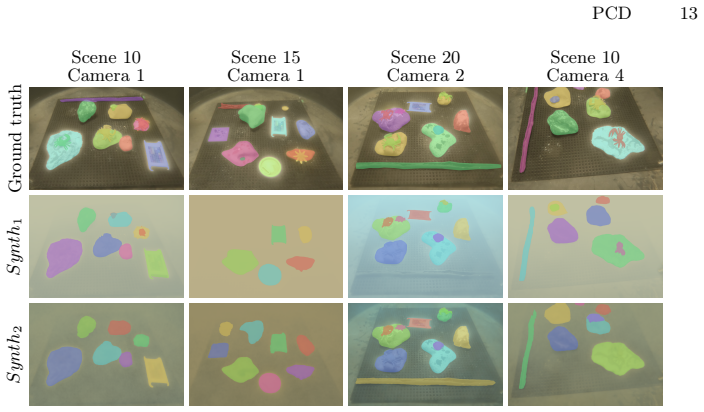
Visibility in underwater environments degrades rapidly under turbid conditions, yet the effects on computer-vision models remain unclear. This issue is compounded by reliance on synthetic turbidity datasets, which may misrepresent real-world information loss. To address this gap, we introduce the Turbid Underwater Baseline (TUB) dataset, comprising 1,320 images captured under extreme turbidity and over 16,000 high-confidence ground-truth segmentation masks. We additionally propose PCD, a metric derived from phase congruency maps that is invariant to contrast and aims to capture the loss of structural information in real turbidity. We show that PCD correlates strongly with the performance of instance segmentation models on both real and synthetic turbid images, whereas common metrics in the field show weak to no correlation at all. The dataset and relevant code can be found on the project page: https://vap.aau.dk/pcd
Editorial analysis
A structured set of objections, weighed in public.
Referee Report
Summary. The paper introduces the Turbid Underwater Baseline (TUB) dataset of 1,320 real extreme-turbidity underwater images together with >16,000 high-confidence instance-segmentation masks. It defines PCD, a metric extracted from phase-congruency maps, asserts that PCD is contrast-invariant, and claims that PCD exhibits strong correlation with instance-segmentation model performance on both real and synthetic turbid images while conventional metrics (SSIM, PSNR, etc.) show weak or null correlation.
Significance. If the reported correlations prove robust after proper controls, the work supplies a practical, task-relevant measure of structural information loss under turbidity that could guide underwater vision research beyond purely aesthetic image-quality metrics; the public release of the dataset and code strengthens the contribution.
major comments (2)
- [Abstract and §4] Abstract and §4 (Results): the central claim that PCD 'correlates strongly' while other metrics do not is stated without any numerical values, confidence intervals, correlation coefficients, or description of the exact procedure (Pearson/Spearman, number of models, train/test split). This absence prevents verification of the empirical result that is load-bearing for the paper's contribution.
- [§3 and §4.2] §3 (PCD definition) and §4.2 (Invariance experiments): the assertion that PCD is invariant to contrast while specifically tracking turbidity-induced structural loss lacks an explicit control experiment that applies pure contrast scaling (no added scattering) to clear images and reports PCD stability. Without this ablation the observed superiority over SSIM/PSNR could be explained by PCD's residual contrast sensitivity rather than unique structural capture.
minor comments (2)
- [§2] Clarify in §2 how the 16,000 masks were generated and what 'high-confidence' threshold was applied.
- [§4] Add error bars or statistical significance tests to all correlation plots in §4.
Simulated Author's Rebuttal
We thank the referee for the constructive comments that highlight areas where the manuscript can be strengthened for clarity and rigor. We address each major comment below and indicate the revisions we will make.
read point-by-point responses
-
Referee: [Abstract and §4] Abstract and §4 (Results): the central claim that PCD 'correlates strongly' while other metrics do not is stated without any numerical values, confidence intervals, correlation coefficients, or description of the exact procedure (Pearson/Spearman, number of models, train/test split). This absence prevents verification of the empirical result that is load-bearing for the paper's contribution.
Authors: We agree that the absence of specific numerical values and procedural details in the abstract and §4 limits verifiability. In the revised manuscript we will report the exact correlation coefficients (Pearson and/or Spearman), associated confidence intervals, the number of models evaluated, the train/test split details, and the precise statistical procedure used to establish the correlations between PCD (and baseline metrics) and instance-segmentation performance. revision: yes
-
Referee: [§3 and §4.2] §3 (PCD definition) and §4.2 (Invariance experiments): the assertion that PCD is invariant to contrast while specifically tracking turbidity-induced structural loss lacks an explicit control experiment that applies pure contrast scaling (no added scattering) to clear images and reports PCD stability. Without this ablation the observed superiority over SSIM/PSNR could be explained by PCD's residual contrast sensitivity rather than unique structural capture.
Authors: The referee correctly identifies that an explicit control for pure contrast scaling is missing. We will add a dedicated ablation experiment in the revised §4.2 that applies monotonic contrast scaling (without any scattering) to a set of clear images and reports the resulting PCD values to demonstrate stability, thereby isolating contrast invariance from turbidity-induced structural degradation. revision: yes
Circularity Check
No circularity: PCD is an independent empirical metric with no reduction to fitted inputs or self-referential definitions.
full rationale
The paper defines PCD explicitly as a metric computed from phase-congruency maps (an established external technique) and reports its correlation with segmentation performance as an empirical observation on the new TUB dataset. No equations, parameter fits, or self-citations are shown that would make the reported correlation or invariance claim reduce to the input data by construction. The derivation chain is therefore self-contained and externally falsifiable.
Axiom & Free-Parameter Ledger
Reference graph
Works this paper leans on
-
[1]
In: 2018 IEEE/CVF Conference on Computer Vision and Pattern Recognition
Akkaynak, D., Treibitz, T.: A Revised Underwater Image Formation Model. In: 2018 IEEE/CVF Conference on Computer Vision and Pattern Recognition. pp. 6723–6732 (Jun 2018).https://doi.org/10.1109/CVPR.2018.00703,https:// ieeexplore.ieee.org/document/8578801
-
[2]
Deep Underwater Image Enhancement
Anwar, S., Li, C., Porikli, F.: Deep Underwater Image Enhancement (Jul 2018). https://doi.org/10.48550/arXiv.1807.03528,http://arxiv.org/abs/1807. 03528, arXiv:1807.03528 [cs]
work page internal anchor Pith review Pith/arXiv arXiv doi:10.48550/arxiv.1807.03528 2018
-
[3]
48550/arXiv.2302.12288,http://arxiv.org/abs/2302.12288, arXiv:2302.12288 [cs]
Bhat, S.F., Birkl, R., Wofk, D., Wonka, P., Müller, M.: ZoeDepth: Zero-shot Trans- fer by Combining Relative and Metric Depth (Feb 2023).https://doi.org/10. 48550/arXiv.2302.12288,http://arxiv.org/abs/2302.12288, arXiv:2302.12288 [cs]
Pith/arXiv arXiv 2023
-
[4]
Cheng, B., Misra, I., Schwing, A.G., Kirillov, A., Girdhar, R.: Masked-attention Mask Transformer for Universal Image Segmentation (Jun 2022).https : / / doi.org/10.48550/arXiv.2112.01527,http://arxiv.org/abs/2112.01527, arXiv:2112.01527 [cs]
-
[5]
Desai, C., Benur, S., Patil, U., Mudenagudi, U.: RSUIGM: Realistic Synthetic Underwater Image Generation with Image Formation Model. ACM Trans. Multi- media Comput. Commun. Appl.21(1), 10:1–10:22 (Dec 2024).https://doi.org/ 10.1145/3656473,https://doi.org/10.1145/3656473
-
[6]
Duarte, A., Codevilla, F., Gaya, J.D.O., Botelho, S.S.C.: A dataset to evaluate underwater image restoration methods. In: OCEANS 2016 - Shanghai. pp. 1– 6 (Apr 2016).https://doi.org/10.1109/OCEANSAP.2016.7485524,https:// ieeexplore.ieee.org/abstract/document/7485524
-
[7]
In: 2018 IEEE International Conference on Robotics and Automation (ICRA)
Fabbri, C., Islam, M.J., Sattar, J.: Enhancing Underwater Imagery Using Gener- ative Adversarial Networks. In: 2018 IEEE International Conference on Robotics and Automation (ICRA). pp. 7159–7165 (May 2018).https://doi.org/10.1109/ ICRA.2018.8460552,https://ieeexplore.ieee.org/document/8460552
arXiv 2018
-
[8]
In: 2023 International Conference on Digital Image Computing: Techniques and Applications (DICTA)
Fathy, M.E., Mohamed, S.A., Awad, M.I., Munim, H.E.A.E.: SubmergeStyleGAN: Synthetic Underwater Data Generation with Style Transfer for Domain Adapta- tion. In: 2023 International Conference on Digital Image Computing: Techniques and Applications (DICTA). pp. 546–553 (Nov 2023).https://doi.org/10.1109/ DICTA60407.2023.00081,https://ieeexplore.ieee.org/doc...
arXiv 2023
-
[9]
Susceptibility of widely diverse influenza A viruses to PB2 polymerase inhibitor pimodivir
Fu, C., Liu, R., Fan, X., Chen, P., Fu, H., Yuan, W., Zhu, M., Luo, Z.: Re- thinking general underwater object detection: Datasets, challenges, and solu- tions. Neurocomputing517, 243–256 (Jan 2023).https://doi.org/10.1016/j. neucom.2022.10.039,https://www.sciencedirect.com/science/article/pii/ S0925231222013169
work page doi:10.1016/j 2023
-
[10]
González-Sabbagh, S.P., Robles-Kelly, A.: A Survey on Underwater Computer Vi- sion. ACM Comput. Surv.55(13s), 268:1–268:39 (Jul 2023).https://doi.org/ 10.1145/3578516,https://dl.acm.org/doi/10.1145/3578516 16 V. Ismiroglou et al
-
[11]
Haralick, R.M., Shanmugam, K., Dinstein, I.: Textural Features for Image Clas- sification. IEEE Transactions on Systems, Man, and CyberneticsSMC-3(6), 610–621 (Nov 1973).https://doi.org/10.1109/TSMC.1973.4309314,https: //ieeexplore.ieee.org/document/4309314
-
[12]
He, K., Gkioxari, G., Dollár, P., Girshick, R.: Mask R-CNN (Jan 2018).https: //doi.org/10.48550/arXiv.1703.06870,http://arxiv.org/abs/1703.06870, arXiv:1703.06870 [cs]
work page internal anchor Pith review Pith/arXiv arXiv doi:10.48550/arxiv.1703.06870 2018
-
[13]
He, K., Zhang, X., Ren, S., Sun, J.: Deep Residual Learning for Image Recognition (Dec 2015).https://doi.org/10.48550/arXiv.1512.03385,http://arxiv.org/ abs/1512.03385, arXiv:1512.03385 [cs]
work page internal anchor Pith review Pith/arXiv arXiv doi:10.48550/arxiv.1512.03385 2015
-
[14]
Horé, A., Ziou, D.: Image Quality Metrics: PSNR vs. SSIM. In: 2010 20th Inter- national Conference on Pattern Recognition. pp. 2366–2369 (Aug 2010).https: //doi.org/10.1109/ICPR.2010.579,https://ieeexplore- ieee- org.zorac. aub.aau.dk/document/5596999, iSSN: 1051-4651
-
[15]
IEEE Access8, 122078–122091 (2020).https://doi.org/10.1109/ACCESS.2020.3006359,https://ieeexplore
Hou, G., Zhao, X., Pan, Z., Yang, H., Tan, L., Li, J.: Benchmarking Underwater Image Enhancement and Restoration, and Beyond. IEEE Access8, 122078–122091 (2020).https://doi.org/10.1109/ACCESS.2020.3006359,https://ieeexplore. ieee.org/document/9130676, conference Name: IEEE Access
-
[16]
Journal of Marine Science and Engineering10(2) (Feb 2022).https://doi.org/10.3390/ jmse10020241,https://www.mdpi.com/2077-1312/10/2/241
Hu, K., Weng, C., Zhang, Y., Jin, J., Xia, Q.: An Overview of Underwater Vision Enhancement: From Traditional Methods to Recent Deep Learning. Journal of Marine Science and Engineering10(2) (Feb 2022).https://doi.org/10.3390/ jmse10020241,https://www.mdpi.com/2077-1312/10/2/241
2022
-
[17]
Islam, M.J., Xia, Y., Sattar, J.: Fast Underwater Image Enhancement for Improved Visual Perception. IEEE Robotics and Automation Letters5(2), 3227–3234 (Apr 2020).https://doi.org/10.1109/LRA.2020.2974710,https://ieeexplore. ieee.org/document/9001231
-
[18]
In: In Proceedings of the IEEE/CVF International Conference on Computer Vision Workshops (2025)
Ismiroglou, V., Pedersen, M., Bengtson, S.H., Aakerberg, A., Moeslund, T.B.: Sea- ing Through Scattered Rays: Revisiting the Image Formation Model for Realistic Underwater Image Generation. In: In Proceedings of the IEEE/CVF International Conference on Computer Vision Workshops (2025)
2025
-
[19]
Jaffe, J.: Computer modeling and the design of optimal underwater imaging sys- tems. IEEE Journal of Oceanic Engineering15(2), 101–111 (Apr 1990).https: //doi.org/10.1109/48.50695,https://ieeexplore-ieee-org.zorac.aub.aau. dk/document/50695
-
[20]
Jahanbakht,M.,RahimiAzghadi,M.,Waltham,N.J.:Semi-supervisedandweakly- supervised deep neural networks and dataset for fish detection in turbid under- water videos. Ecological Informatics78, 102303 (Dec 2023).https://doi.org/ 10.1016/j.ecoinf.2023.102303,https://www.sciencedirect.com/science/ article/pii/S1574954123003321
-
[21]
Computer-Aided Civil and Infrastructure Engineer- ing39(2), 281–299 (2024).https : / / doi
Jiao, P., Ye, X., Zhang, C., Li, W., Wang, H.: Vision-based real-time marine and offshore structural health monitoring system using un- derwater robots. Computer-Aided Civil and Infrastructure Engineer- ing39(2), 281–299 (2024).https : / / doi . org / 10 . 1111 / mice . 12993, https://onlinelibrary.wiley.com/doi/abs/10.1111/mice.12993, _eprint: https://on...
-
[22]
com/ultralytics/ultralytics, original-date: 2022-09-11T16:39:45Z
Jocher, G., Qiu, J., Chaurasia, A.: Ultralytics YOLO (Jan 2023),https://github. com/ultralytics/ultralytics, original-date: 2022-09-11T16:39:45Z
2023
-
[23]
Kovesi, P.: Phase congruency: A low-level image invariant. Psychological Research 64(2), 136–148 (Dec 2000).https://doi.org/10.1007/s004260000024,https: //doi.org/10.1007/s004260000024 PCD 17
-
[24]
Reflections on Shannon Information: In search of a natural information-entropy for images
Larkin, K.G.: Reflections on Shannon Information: In search of a natural information-entropy for images (Sep 2016).https://doi.org/10.48550/arXiv. 1609.01117,http://arxiv.org/abs/1609.01117, arXiv:1609.01117 [cs]
work page internal anchor Pith review Pith/arXiv arXiv doi:10.48550/arxiv 2016
-
[25]
Li, C., Guo, C., Ren, W., Cong, R., Hou, J., Kwong, S., Tao, D.: An Underwater ImageEnhancementBenchmarkDatasetandBeyond.IEEETransactionsonImage Processing29, 4376–4389 (2020).https://doi.org/10.1109/TIP.2019.2955241, https://ieeexplore.ieee.org/document/8917818
-
[26]
IEEE Access6, 54241–54257 (2018).https://doi.org/10.1109/ACCESS.2018
Li, N., Zheng, Z., Zhang, S., Yu, Z., Zheng, H., Zheng, B.: The Synthesis of Un- paired Underwater Images Using a Multistyle Generative Adversarial Network. IEEE Access6, 54241–54257 (2018).https://doi.org/10.1109/ACCESS.2018. 2870854,https://ieeexplore.ieee.org/abstract/document/8467323
-
[27]
Liu, C., Wang, Z., Wang, S., Tang, T., Tao, Y., Yang, C., Li, H., Liu, X., Fan, X.: A New Dataset, Poisson GAN and AquaNet for Underwater Object Grabbing. IEEE TransactionsonCircuitsandSystemsforVideoTechnology32(5),2831–2844(May 2022).https://doi.org/10.1109/TCSVT.2021.3100059,http://arxiv.org/abs/ 2003.01446, arXiv:2003.01446 [cs]
-
[28]
Liu, L., Liu, B., Huang, H., Bovik, A.C.: No-reference image quality assessment based on spatial and spectral entropies. Signal Processing: Image Communication 29(8), 856–863 (Sep 2014).https://doi.org/10.1016/j.image.2014.06.006, http://pure.bit.edu.cn/en/publications/no- reference- image- quality- assessment-based-on-spatial-and-spectr/
-
[29]
Liu, R., Fan, X., Zhu, M., Hou, M., Luo, Z.: Real-world Underwater Enhancement: Challenges, Benchmarks, and Solutions (Mar 2019).https://doi.org/10.48550/ arXiv.1901.05320,http://arxiv.org/abs/1901.05320, arXiv:1901.05320 [cs]
Pith/arXiv arXiv 2019
-
[30]
Information13(4), 187 (Apr 2022).https://doi.org/10.3390/ info13040187,https://www.mdpi.com/2078-2489/13/4/187
Liu, Y., Xu, H., Zhang, B., Sun, K., Yang, J., Li, B., Li, C., Quan, X.: Model-Based Underwater Image Simulation and Learning-Based Underwater Image Enhance- ment Method. Information13(4), 187 (Apr 2022).https://doi.org/10.3390/ info13040187,https://www.mdpi.com/2078-2489/13/4/187
2022
-
[31]
Swin Transformer: Hierarchical Vision Transformer using Shifted Windows
Liu, Z., Lin, Y., Cao, Y., Hu, H., Wei, Y., Zhang, Z., Lin, S., Guo, B.: Swin Transformer: Hierarchical Vision Transformer using Shifted Windows (Aug 2021). https://doi.org/10.48550/arXiv.2103.14030,http://arxiv.org/abs/2103. 14030, arXiv:2103.14030 [cs]
work page internal anchor Pith review Pith/arXiv arXiv doi:10.48550/arxiv.2103.14030 2021
-
[32]
Lucas, E., Awad, A., Geglio, A., Moradi, S., Saleem, A., Havens, T., Galloway, A., Paheding, S.: Underwater Image Enhancement and Object Detection: Are Poor Object Detection Results On Enhanced Images Due to Missing Human Labels? In: In Proceedings of the Winter Conference on Applications of Computer Vision Workshops (2025)
2025
-
[33]
In: Ocean Optics VI
McGlamery, B.L.: A Computer Model For Underwater Camera Systems. In: Ocean Optics VI. vol. 0208, pp. 221–231. SPIE (Mar 1980).https://doi.org/10.1117/ 12.958279,https://www.spiedigitallibrary.org/conference- proceedings- of-spie/0208/0000/A-Computer-Model-For-Underwater-Camera-Systems/10. 1117/12.958279.full
1980
-
[34]
Mittal, A., Moorthy, A.K., Bovik, A.C.: No-Reference Image Quality Assessment in the Spatial Domain. IEEE Transactions on Image Processing21(12), 4695–4708 (Dec 2012).https://doi.org/10.1109/TIP.2012.2214050,http://ieeexplore. ieee.org/document/6272356/
-
[35]
Mittal, A., Soundararajan, R., Bovik, A.C.: Making a “Completely Blind” Image Quality Analyzer. IEEE Signal Processing Letters20(3), 209–212 (Mar 2013). https://doi.org/10.1109/LSP.2012.2227726,http://ieeexplore.ieee.org/ document/6353522/ 18 V. Ismiroglou et al
-
[36]
Academic (Jan 1994), journal Abbreviation: Academic Press Publication Title: Academic Press
Mobley, C.: Light and Water: Radiative Transfer in Natural Waters. Academic (Jan 1994), journal Abbreviation: Academic Press Publication Title: Academic Press
1994
-
[37]
Moorthy, A.K., Bovik, A.C.: Blind Image Quality Assessment: From Natural Scene Statistics to Perceptual Quality. IEEE Transactions on Image Processing20(12), 3350–3364 (Dec 2011).https://doi.org/10.1109/TIP.2011.2147325,https: //ieeexplore.ieee.org/document/5756237/
-
[38]
Morrone, M.C., Ross, J., Burr, D.C., Owens, R.: Mach bands are phase depen- dent. Nature324, 250–253 (Nov 1986).https://doi.org/10.1038/324250a0, https://ui.adsabs.harvard.edu/abs/1986Natur.324..250M, aDS Bibcode: 1986Natur.324..250M
-
[39]
Multimedia Tools and Applications84(22), 24839–24858 (Jul 2025).https : / / doi
Naveen, P.: Advancements in underwater imaging through machine learning: Tech- niques, challenges, and applications. Multimedia Tools and Applications84(22), 24839–24858 (Jul 2025).https : / / doi . org / 10 . 1007 / s11042 - 024 - 20091 - 4, https://doi.org/10.1007/s11042-024-20091-4
-
[40]
Oppenheim, A., Lim, J.: The importance of phase in signals. Proceedings of the IEEE69(5), 529–541 (May 1981).https://doi.org/10.1109/PROC.1981.12022, https://ieeexplore.ieee.org/document/1456290
-
[41]
Panetta, K., Gao, C., Agaian, S.: Human-Visual-System-Inspired Underwater Im- age Quality Measures. IEEE Journal of Oceanic Engineering41(3), 541–551 (Jul 2016).https://doi.org/10.1109/JOE.2015.2469915,https://ieeexplore- ieee-org.zorac.aub.aau.dk/document/7305804
-
[42]
In: Proceed- ings of the IEEE/CVF Conference on Computer Vision and Pattern Recogni- tion (CVPR) Workshops
Pedersen, M., Bruslund Haurum, J., Gade, R., Moeslund, T.B.: Detection of Ma- rine Animals in a New Underwater Dataset with Varying Visibility. In: Proceed- ings of the IEEE/CVF Conference on Computer Vision and Pattern Recogni- tion (CVPR) Workshops. pp. 18–26 (2019),https://openaccess.thecvf.com/ content_CVPRW_2019/html/AAMVEM/Pedersen_Detection_of_Mari...
2019
-
[43]
Rahane, A.A., Subramanian, A.: Measures of Complexity for Large Scale Im- age Datasets. In: 2020 International Conference on Artificial Intelligence in In- formation and Communication (ICAIIC). pp. 282–287 (Feb 2020).https://doi. org/10.1109/ICAIIC48513.2020.9065274,http://arxiv.org/abs/2008.04431, arXiv:2008.04431 [cs]
-
[44]
Raveendran, S., Patil, M.D., Birajdar, G.K.: Underwater image enhancement: a comprehensive review, recent trends, challenges and applications. Artificial Intel- ligence Review54(7), 5413–5467 (Oct 2021).https://doi.org/10.1007/s10462- 021-10025-z,https://doi.org/10.1007/s10462-021-10025-z
-
[45]
IEEE Signal Processing Letters17(6), 583–586 (Jun 2010)
Saad, M.A., Bovik, A.C., Charrier, C.: A DCT Statistics-Based Blind Im- age Quality Index. IEEE Signal Processing Letters17(6), 583–586 (Jun 2010). https://doi.org/10.1109/LSP.2010.2045550,https://ieeexplore.ieee.org/ document/5430991/
-
[46]
IEEE Transactions on Image Processing15(2), 430–444 (Feb 2006).https://doi.org/10.1109/TIP
Sheikh, H., Bovik, A.: Image information and visual quality. IEEE Transactions on Image Processing15(2), 430–444 (Feb 2006).https://doi.org/10.1109/TIP. 2005.859378,https://ieeexplore.ieee.org/document/1576816/
work page doi:10.1109/tip 2006
-
[47]
Applied Optics54(17), 5392–5401 (Jun 2015).https://doi.org/10.1364/AO.54
Solonenko, M.G., Mobley, C.D.: Inherent optical properties of Jerlov water types. Applied Optics54(17), 5392–5401 (Jun 2015).https://doi.org/10.1364/AO.54. 005392,https://opg.optica.org/ao/abstract.cfm?uri=ao-54-17-5392
-
[48]
Sun, W., Hou, S., Wu, G., Zhang, J., Zhang, Y., Jiang, H.: Turbid image tack- ling framework towards underwater concrete bridge detection based on distance control and deep learning. Advanced Engineering Informatics62, 102723 (Oct 2024).https://doi.org/10.1016/j.aei.2024.102723,https://linkinghub. elsevier.com/retrieve/pii/S1474034624003719 PCD 19
-
[49]
In: 2018 IEEE/RSJ International Conference on Intelligent Robots and Systems (IROS)
Álvarez Tuñón, O., Rodríguez, A., Jardón, A., Balaguer, C.: Underwater Robot Navigation for Maintenance and Inspection of Flooded Mine Shafts. In: 2018 IEEE/RSJ International Conference on Intelligent Robots and Systems (IROS). pp. 1482–1487 (Oct 2018).https : / / doi . org / 10 . 1109 / IROS . 2018 . 8594445, https://ieeexplore.ieee.org/document/8594445/...
arXiv 2018
-
[50]
In: 2019 IEEE International Conference on Image Processing (ICIP)
Ueda, T., Yamada, K., Tanaka, Y.: Underwater Image Synthesis from RGB-D Im- ages and its Application to Deep Underwater Image Restoration. In: 2019 IEEE International Conference on Image Processing (ICIP). pp. 2115–2119 (Sep 2019). https://doi.org/10.1109/ICIP.2019.8803195,https://ieeexplore.ieee. org/document/8803195/
-
[51]
ArXiv (Sep 2019),https : / / www
Wang, N., Zhou, Y., Han, F., Zhu, H., Zheng, Y.: UWGAN: Un- derwater GAN for Real-world Underwater Color Restoration and De- hazing. ArXiv (Sep 2019),https : / / www . semanticscholar . org / paper / ad8fbe003c65c15429ffa1a81fbd311f9bbae777
2019
-
[52]
Wang, Y., Guo, J., He, W., Gao, H., Yue, H., Zhang, Z., Li, C.: Is Underwater Im- age Enhancement All Object Detectors Need? IEEE Journal of Oceanic Engineer- ing49(2), 606–621 (Apr 2024).https://doi.org/10.1109/JOE.2023.3302888, https://ieeexplore.ieee.org/document/10376393/
-
[53]
Wu, Y., Kirillov, A., Massa, F., Lo, W.Y., Girshick, R.: Detectron2.https:// github.com/facebookresearch/detectron2(2019)
2019
-
[54]
Xu, S., Zhang, M., Song, W., Mei, H., He, Q., Liotta, A.: A systematic review and analysis of deep learning-based underwater object detection. Neurocomputing 527, 204–232 (Mar 2023).https://doi.org/10.1016/j.neucom.2023.01.056, https://linkinghub.elsevier.com/retrieve/pii/S0925231223000656
-
[55]
IEEE Transactions on Image Processing24(12), 6062–6071 (Dec 2015)
Yang, M., Sowmya, A.: An Underwater Color Image Quality Evaluation Met- ric. IEEE Transactions on Image Processing24(12), 6062–6071 (Dec 2015). https://doi.org/10.1109/TIP.2015.2491020,https://ieeexplore.ieee.org/ document/7300447
-
[56]
Yuan, X., Guo, L., Luo, C., Zhou, X., Yu, C.: A Survey of Target Detection and Recognition Methods in Underwater Turbid Areas. Applied Sciences12(10) (May 2022).https://doi.org/10.3390/app12104898,https://www.mdpi.com/2076- 3417/12/10/4898
discussion (0)
Sign in with ORCID, Apple, or X to comment. Anyone can read and Pith papers without signing in.