REVIEW 4 major objections 4 minor 34 references
No Fear of the Dark: Image Retrieval under Varying Illumination Conditions
T0 review · 4 major / 4 minor · reviewed 2026-08-14 · deepseek-v4-flash
Pith's one-line read This paper establishes that photometric normalization before CNN descriptor extraction is enough to make image retrieval work under severe day-to-night illumination changes while preserving daylight retrieval performance.
desk verdict Useful preprocessing study with a clean comparison, but the new Tokyo protocol strips out viewpoint variation, so the strong retrieval claim is only partly supported. read the letter →
The pith
A machine-rendered reading of the paper's core claim, the machinery that carries it, and where it could break.
The reading
What carries the argument
The central mechanism is a photometric normalisation stage prepended to a VGG-GeM embedding network. Hand-crafted versions transform the LAB lightness channel by gamma correction, histogram equalisation, or CLAHE; the learned version is a U-Net that takes the RGB image plus a histogram-matched target lightness channel as input and outputs a normalised RGB image. The combined system is trained in a Siamese manner with a contrastive loss on hard-positive pairs, first pretraining the normalisation network on pixel-aligned multi-exposure images and then fine-tuning on the newly constructed day/night pairs of Retrieval-SfM-N/D. The pair construction uses ball approximations of visible 3D points, requiring intersection over union above 0.55 and camera-axis difference below 45 degrees, to find geometrically similar views with large illumination differences.
What would settle it
Take a random sample of, say, 200 pairs from Retrieval-SfM-N/D and manually check whether the same surfaces are actually visible in both images; if a large fraction are not true same-view pairs, retrain on corrected pairs and see whether the Tokyo 24/7 gains persist. Alternatively, evaluate the same normalisation methods on an independent day/night retrieval benchmark with verified ground truth and compare mAP scores.
Extended reading notes
Core claim
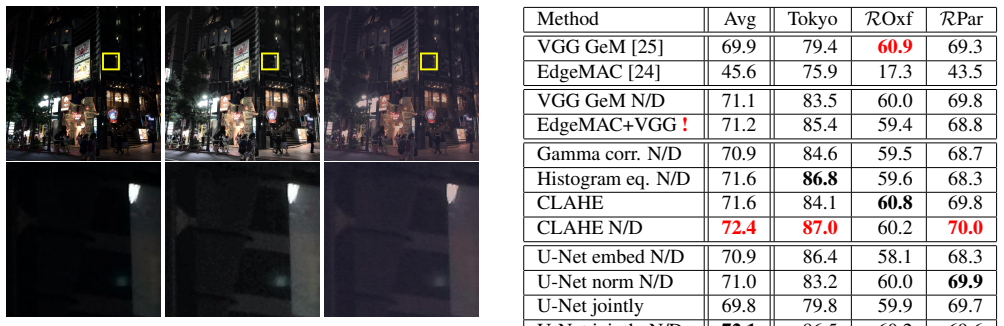
The paper's central claim is that a photometric normalisation stage placed before CNN descriptor extraction makes image retrieval robust to severe illumination changes while preserving daytime performance. On a new evaluation protocol built from the Tokyo 24/7 images, every normalisation method examined beats the same-dimensionality VGG GeM and EdgeMAC baselines by a large margin: the best methods, CLAHE N/D and U-Net jointly N/D, reach Tokyo mAP scores of 87.0 and 86.5 against a 79.4 VGG GeM baseline, while Revisited Oxford and Paris Medium scores stay within about one point of the baseline. The learned U-Net normalisation matches but does not beat simple CLAHE, which the paper reads as evidence that once the input is properly normalised, the embedding network can extract the same discriminative information. Fine-tuning on the new day/night pairs helps both with and without normalisation, but the normalisation stage is what delivers the largest illumination robustness gains.
Load-bearing premise
The whole day/night training signal rests on the newly built Retrieval-SfM-N/D pairs, which are accepted when the overlap of ball approximations of visible 3D points exceeds 0.55 and camera axes differ by at most 45 degrees; if many of these pairs do not actually show the same scene surface, the reported gains from N/D fine-tuning could come from something else.
Editorial extensions
If this is right
- On the proposed Tokyo 24/7 protocol, adding CLAHE or learned U-Net normalisation raises mAP from 79.4 (VGG GeM) to 87.0 or 86.5, a large gain at the same descriptor dimensionality.
- Fine-tuning on the new Retrieval-SfM-N/D day/night pairs improves retrieval even without normalisation, but normalisation remains necessary for the largest gains.
- Daylight retrieval performance is largely preserved: ROxf/RPar Medium scores for CLAHE N/D (60.2/70.0) and U-Net jointly N/D (60.2/69.6) sit close to the VGG GeM baseline (60.9/69.3).
- Combining normalisation with an EdgeMAC+VGG ensemble improves results further, and day-night query pairs are the ones that benefit most from the method.
Reading between the lines
- Since the learned U-Net matches but does not beat CLAHE, the results suggest the bottleneck for illumination-robust retrieval is not the form of the normalisation but the existence of a normalisation stage at all; cheap hand-crafted normalisation may be sufficient in practice.
- A natural extension the authors do not run is pretraining the normalisation on other aligned multi-exposure data and fine-tuning on day/night pairs from other 3D reconstructions, which would test whether the gains transfer to city-scale or indoor scenes.
- Because the method operates at the preprocessing level, it could be plugged into any CNN descriptor or downstream task such as place recognition or low-light person re-identification, not only the VGG-GeM retrieval pipeline tested here.
Signed reviews
Editorial analysis
A structured set of objections, weighed in public.
Referee Report
Summary. The paper proposes photometric normalization as a preprocessing step before CNN descriptor extraction for image retrieval under changing illumination. Three hand-crafted normalizations (gamma correction, histogram equalization, and CLAHE) and a learned U-Net-based normalization are evaluated, with the latter pre-trained on multi-exposure images (See-in-the-Dark) and fine-tuned with a contrastive loss against a VGG-GeM embedding network. A new day/night training dataset, Retrieval-SfM-N/D, is automatically constructed from 3D reconstructions using a ball approximation of co-visible surfaces. Experiments on a newly defined Tokyo 24/7 protocol, plus revisited Oxford and Paris (Medium), show that normalization improves mAP under illumination change, with CLAHE and the learned U-Net performing similarly, while preserving daylight retrieval performance.
Significance. If the results are robust, the paper's contribution is practically valuable: a simple, cheap preprocessing step yields substantial gains for day/night retrieval without hurting standard benchmarks. The experimental design is clear and controlled (same embedding network, three fine-tuning setups, three benchmarks), and the release of the day/night training pairs is a useful resource. The finding that hand-crafted CLAHE matches a learned normalization is also an important and honest observation. However, the central claim is broader than what the new Tokyo 24/7 protocol actually measures, and several methodological details need strengthening before the generality of the claim can be accepted.
major comments (4)
- [Section 5.1] The new Tokyo 24/7 protocol excludes same-location different-direction images from the evaluation, so every positive pair is a near-duplicate viewpoint that differs only in illumination. Tables 1 and 3 therefore measure illumination-invariant matching rather than image retrieval under joint viewpoint and illumination change. The original Tokyo 24/7 benchmark [32] includes viewpoint variation through phone-camera queries against StreetView panoramas and rendered virtual views. The abstract and Section 5.3(i) state the claim more generally as "image retrieval under varying illumination conditions." Please either evaluate on the original protocol, add a viewpoint-varying day/night retrieval experiment, or clearly re-scope the claim to same-viewpoint illumination invariance.
- [Section 4.1] The construction of Retrieval-SfM-N/D relies on a ball approximation of the visible surface with IoU threshold 0.55 and a 45-degree camera-angle limit, but the paper reports no manual verification or sensitivity analysis of these thresholds. The assertion "without obvious false positives" is not supported by quantitative evidence. Because the paper credits the new dataset with the gains described in Section 5.3(ii), the authors should provide validation, such as a sample of inspected pairs or a sensitivity study of the IoU and angle thresholds.
- [Section 3.1] The CLAHE clip limit is fixed at 4 and the text states that this "consistently yielded the best results," which suggests the parameter was selected on the evaluation benchmarks. Since CLAHE N/D is one of the top-performing methods in Table 1, the authors should describe a validation protocol (e.g., a hold-out set) or report how the main results vary with the clip limit.
- [Tables 1-3] All reported results are single runs without error bars or statistical tests. The differences between top methods are small (average mAP 72.4 for CLAHE N/D vs. 72.1 for U-Net jointly N/D vs. 72.9 for Edg+CLAHE N/D in Table 1), yet the discussion in Section 5.3 claims similarities and orderings. Multiple runs or significance statements are needed at least for the headline comparisons that drive the conclusions.
minor comments (4)
- [Section 5.3(i)] The claim that all image normalization methods outperform the baselines "by a large margin" on Tokyo 24/7 is not true for U-Net jointly (79.8) versus VGG GeM (79.4); this statement should be qualified.
- [Table 1 caption] The caption contains a typo: "joinlty" should be "jointly."
- [Section 3.2.1] The sentence "the increase was from 4.1GB, 5hrs to 11.6GB, 11hrs" is unclear; please specify whether these are GPU memory and training time, and for which exact setup.
- [Section 4.1] The text says "20 thousand illumination-hard-positive image pairs" but does not state whether these are unique pairs, how they are split between training and validation, or whether anchors overlap with the Retrieval-SfM positives; please clarify.
Circularity Check
No circularity: the normalization gains are evaluated on external benchmarks and are not constructed from the evaluation targets.
full rationale
The paper's central claim is an empirical comparison: photometric normalization (CLAHE or a U-Net) is prepended to a fixed VGG-GeM embedding and evaluated on Tokyo 24/7, revisited Oxford, and revisited Paris. Neither the hand-crafted normalization nor the learned U-Net is defined in terms of the retrieval scores, and no quantity fitted to the test benchmarks is renamed as a prediction. The fine-tuning procedure, baselines, whitening, and evaluation protocols are taken from cited prior work or from standard practice; the authors' own previous papers are cited as sources of descriptors and training recipes, not as an unverified uniqueness argument. The newly constructed Retrieval-SfM-N/D dataset is used only for training, and its effect is explicitly separated from the normalization effect: the CLAHE row without N/D already outperforms VGG GeM on Tokyo 24/7 (84.1 vs 79.4). The only notable caveat is Section 5.1's new Tokyo 24/7 protocol, which defines positives as same-location same-direction images and excludes same-location different-direction images; this narrows the evaluation to illumination change without viewpoint variation. That is a benchmark-scope and generalization concern, not circular reasoning: the protocol does not enter the method's derivation or training objective. The chosen CLAHE clip limit is standard hyperparameter selection rather than a fitted-input-called-prediction step. No equation, fitted parameter, or cited theorem is used to force the reported outcome, so the derivation chain is self-contained with respect to circularity.
Assumptions & free parameters
free parameters (4)
- CLAHE clip limit =
4
- Ball IoU threshold for day/night positive pairs =
0.55
- Maximum camera angle for positive pairs =
45 degrees
- Illumination difference trimmed mean drop =
lightest/darkest 40% dropped
assumptions (4)
- domain assumption Pre-trained VGG GeM embeddings from [25] provide a valid descriptor space for retrieval and can be fine-tuned with contrastive loss.
- domain assumption Exposure-level alignment in the See-in-the-Dark dataset transfers to day/night appearance variation for arbitrary scenes.
- ad hoc to paper Ball approximation of visible scene surface with IoU > 0.55 identifies true co-visible image pairs.
- domain assumption Hard negative mining and contrastive loss as in [25] are sufficient to train retrieval models.
Cite this review
Pith. "Pith review of No Fear of the Dark: Image Retrieval under Varying Illumination Conditions." pith.science (2026). https://pith.science/paper/KTZUMPBT
@misc{pith2026190808999,
  author       = {Pith},
  title        = {Pith review of: No Fear of the Dark: Image Retrieval under Varying Illumination Conditions},
  year         = {2026},
  howpublished = {\url{https://pith.science/paper/KTZUMPBT}},
  note         = {Machine review of arXiv:1908.08999}
}
read the original abstract
Image retrieval under varying illumination conditions, such as day and night images, is addressed by image preprocessing, both hand-crafted and learned. Prior to extracting image descriptors by a convolutional neural network, images are photometrically normalised in order to reduce the descriptor sensitivity to illumination changes. We propose a learnable normalisation based on the U-Net architecture, which is trained on a combination of single-camera multi-exposure images and a newly constructed collection of similar views of landmarks during day and night. We experimentally show that both hand-crafted normalisation based on local histogram equalisation and the learnable normalisation outperform standard approaches in varying illumination conditions, while staying on par with the state-of-the-art methods on daylight illumination benchmarks, such as Oxford or Paris datasets.
Figures


Figures from the paper (4 more)



Reference graph
Works this paper leans on
-
[32]
24/7 place recognition by view synthesis
Akihiko Torii, Relja Arandjelovi ´c, Josef Sivic, Masatoshi Okutomi, and Tomas Pajdla. 24/7 place recognition by view synthesis. In CVPR, 2015
work page 2015
-
[1]
NetVLAD: CNN architecture for weakly supervised place recognition
Relja Arandjelovi ´c, Petr Gronat, Akihiko Torii, Tomas Pa- jdla, and Josef Sivic. NetVLAD: CNN architecture for weakly supervised place recognition. In CVPR, 2016
work page 2016
-
[2]
Efficient indexing of billion-scale datasets of deep descriptors
Artem Babenko and Victor Lempitsky. Efficient indexing of billion-scale datasets of deep descriptors. In CVPR, 2016
work page 2016
-
[3]
Chen Chen, Qifeng Chen, Jia Xu, and Vladlen Koltun. Learning to see in the dark. CVPR, 2018
work page 2018
-
[4]
Geometric hashing with local affine frames
Ond ˇrej Chum and Jiˇr´ı Matas. Geometric hashing with local affine frames. In CVPR, 2006
work page 2006
-
[5]
Deep image retrieval: Learning global representations for image search
Albert Gordo, Jon Almazan, Jerome Revaud, and Diane Lar- lus. Deep image retrieval: Learning global representations for image search. In ECCV, 2016
work page 2016
-
[6]
Image-to-image translation with conditional adver- sarial networks
Phillip Isola, Jun-Yan Zhu, Tinghui Zhou, and Alexei A Efros. Image-to-image translation with conditional adver- sarial networks. arxiv, 2016
work page 2016
-
[7]
Ham- ming embedding and weak geometric consistency for large scale image search
Herve J ´egou, Matthijs Douze, and Cordelia Schmid. Ham- ming embedding and weak geometric consistency for large scale image search. In ECCV, 2008
work page 2008
Show all 34 references
-
[8]
Product quantization for nearest neighbor search
Herv ´e J´egou, Matthijs Douze, and Cordelia Schmid. Product quantization for nearest neighbor search. PAMI, 33(1):117– 128, 2011
2011
-
[9]
Aggregating local descriptors into a compact image representation
Herv ´e J´egou, Matthijs Douze, Cordelia Schmid, and Patrick P´erez. Aggregating local descriptors into a compact image representation. In CVPR, 2010
2010
-
[10]
Billion- scale similarity search with GPUs
Jeff Johnson, Matthijs Douze, and Herv ´e J ´egou. Billion- scale similarity search with GPUs. arXiv preprint arXiv:1702.08734, 2017
2017 arXiv
-
[11]
Geometric hashing: A general and efficient model-based recognition scheme
Yehezkel Lamdan and Haim Wolfson. Geometric hashing: A general and efficient model-based recognition scheme. In ICCV, pages 238 – 249, 1988
1988
-
[12]
David G. Lowe. Distinctive image features from scale- invariant keypoints. ICCV, 60(2):91–110, 2004
2004
-
[13]
Robust wide baseline stereo from maximally stable ex- tremal regions
Jiri Matas, Ond ˇrej Chum, Martin Urban, and Tomas Pa- jdla. Robust wide baseline stereo from maximally stable ex- tremal regions. In BMVC, volume 1, pages 384–393. BMV A, September 2002
2002
-
[14]
Scale & affine invariant interest point detectors
Krystian Mikolajczyk and Cordelia Schmid. Scale & affine invariant interest point detectors. IJCV, 1(60):63–86, 2004
2004
-
[15]
Image re- trieval for online browsing in large image collections
Andrej Mikulik, Ond ˇrej Chum, and Ji ˇr´ı Matas. Image re- trieval for online browsing in large image collections. In SISAP, 8199, pages 3–15, 2013
2013
-
[16]
Efficient image detail mining
Andrej Mikul ´ık, Filip Radenovi ´c, Ond ˇrej Chum, and Ji ˇr´ı Matas. Efficient image detail mining. In ACCV, 2014
2014
-
[17]
Working hard to know your neighbor’s mar- gins: Local descriptor learning loss
Anastasiya Mishchuk, Dmytro Mishkin, Filip Radenovi ´c, and Jiˇri Matas. Working hard to know your neighbor’s mar- gins: Local descriptor learning loss. In NIPS, 2017
2017
-
[18]
Scalable recognition with a vocabulary tree
David Nist ´er and Henrik Stew ´enius. Scalable recognition with a vocabulary tree. In CVPR, 2006
2006
-
[19]
Efficient rep- resentation of local geometry for large scale object retrieval
Michal Perdoch, Ond ˇrej Chum, and Jiˇr´ı Matas. Efficient rep- resentation of local geometry for large scale object retrieval. In CVPR, 2009
2009
-
[20]
Large-scale image retrieval with compressed fisher vectors
Florent Perronnin, Yan Liu, Jorge Sanchez, and Herv ´e Poirier. Large-scale image retrieval with compressed fisher vectors. In CVPR, 2010
2010
-
[21]
Object retrieval with large vocabularies and fast spatial matching
James Philbin, Ond ˇrej Chum, Michael Isard, Josef Sivic, and Andrew Zisserman. Object retrieval with large vocabularies and fast spatial matching. In CVPR, 2007
2007
-
[22]
Revisiting Oxford and Paris: Large-scale image retrieval benchmarking
Filip Radenovi ´c, Ahmet Iscen, Giorgos Tolias, Yannis Avrithis, and Ond ˇrej Chum. Revisiting Oxford and Paris: Large-scale image retrieval benchmarking. In CVPR, 2018
2018
-
[23]
Sch ¨onberger, Dinghuang Ji, Jan-Michael Frahm, Ond ˇrej Chum, and Ji ˇr´ı Matas
Filip Radenovi ´c, Johannes L. Sch ¨onberger, Dinghuang Ji, Jan-Michael Frahm, Ond ˇrej Chum, and Ji ˇr´ı Matas. From dusk till dawn: Modeling in the dark. In CVPR, 2016
2016
-
[24]
Deep shape matching
Filip Radenovic, Giorgos Tolias, and Ond ˇrej Chum. Deep shape matching. In ECCV, 2018
2018
-
[25]
Fine- tuning CNN image retrieval with no human annotation
Filip Radenovi ´c, Giorgos Tolias, and Ond ˇrej Chum. Fine- tuning CNN image retrieval with no human annotation. TPAMI, 2018
2018
-
[26]
U- net: Convolutional networks for biomedical image segmen- tation
Olaf Ronneberger, Philipp Fischer, and Thomas Brox. U- net: Convolutional networks for biomedical image segmen- tation. In International Conference on Medical image com- puting and computer-assisted intervention , pages 234–241. Springer, 2015
2015
-
[27]
Very deep convo- lutional networks for large-scale image recognition
Karen Simonyan and Andrew Zisserman. Very deep convo- lutional networks for large-scale image recognition. InICLR, 2014
2014
-
[28]
Video google: A text retrieval approach to object matching in videos
Josef Sivic and Andrew Zisserman. Video google: A text retrieval approach to object matching in videos. In ICCV, pages 1470 – 1477, 2003
2003
-
[29]
Gunderson, and Julien Pilet
Henrik Stew ´enius, Steinar H. Gunderson, and Julien Pilet. Size matters: exhaustive geometric verification for image re- trieval. In ECCV, pages 674–687. Springer, 2012
2012
-
[30]
Computer Vision: Algorithms and Appli- cations
Richard Szeliski. Computer Vision: Algorithms and Appli- cations. Texts in Computer Science. Springer London, 2010
2010
-
[31]
L2-net: Deep learn- ing of discriminative patch descriptor in Euclidean space
Yurun Tian, Bin Fan, and Fuchao Wu. L2-net: Deep learn- ing of discriminative patch descriptor in Euclidean space. In CVPR, 2017
2017
-
[33]
Tilde: A temporally invariant learned detector
Yannick Verdie, Kwang Moo Yi, Pascal Fua, and Vincent Lepetit. Tilde: A temporally invariant learned detector. In CVPR, 2015
2015
-
[34]
LIFT: Learned invariant feature transform
Kwang Moo Yi, Eduard Trulls, Vincent Lepetit, and Pascal Fua. LIFT: Learned invariant feature transform. In ECCV, pages 467–483, 2016
2016
Reviewed August 14, 2026 · model on record in the stance chip above.
Discussion (0). Continue with ORCID to comment.