A Neutral-Atom Quantum Compiler with Application-Specific Layout and Hub-Assisted Shuttling
Pith reviewed 2026-06-29 06:50 UTC · model grok-4.3
The pith
Hub traps enable practical compilation of constrained neutral-atom circuits by replacing SWAP routing with shuttling.
A machine-rendered reading of the paper's core claim, the machinery that carries it, and where it could break.
Core claim
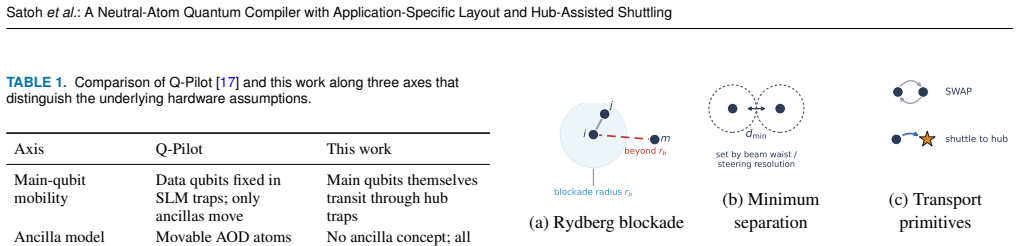
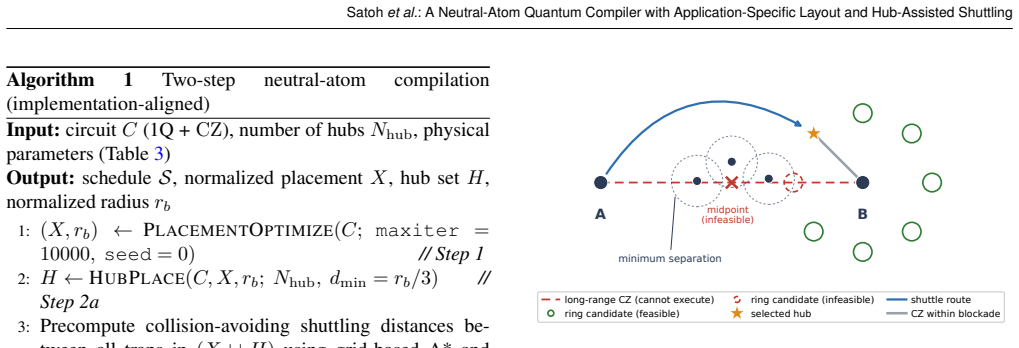
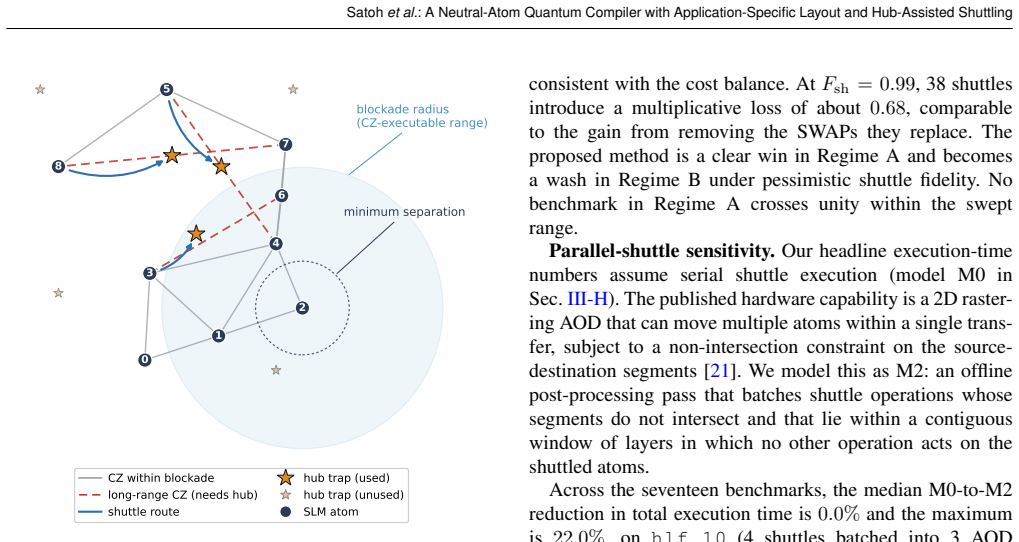
Hub traps—dynamically placed empty traps that serve as transit waypoints—combined with a per-gate choice between SWAP-based routing and hub-mediated shuttling, allow compilation of arbitrary-connectivity NISQ circuits onto single-zone neutral-atom hardware under finite interaction range and minimum-separation constraints; the resulting schedules contain no SWAP gates and produce fidelity-proxy improvements concentrated on routing-dominated benchmarks.
What carries the argument
Hub traps: a small number of dynamically placed empty traps used as transit waypoints, together with a per-gate rule that selects between SWAP routing and hub-mediated shuttling.
If this is right
- Circuits that the SWAP-only pipeline cannot schedule now compile in seconds to minutes.
- Every completed circuit contains no SWAP gates.
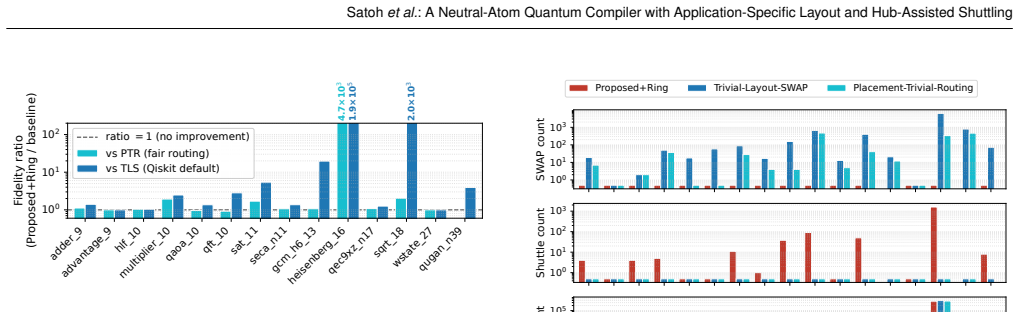
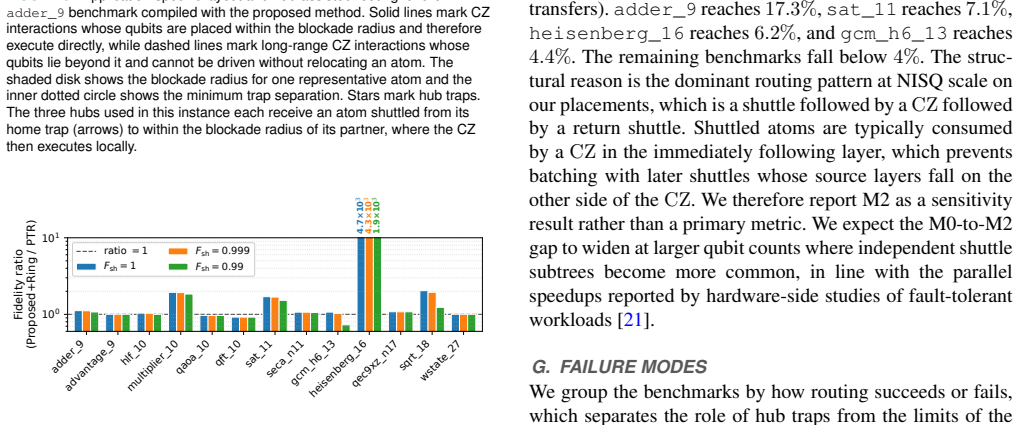
- The fidelity proxy improves by up to three orders of magnitude on the most routing-dominated circuit.
- Gains are confined to routing-dominated circuits and absent on routing-free ones.
- The reported improvement arises primarily from the elimination of SWAP overhead.
Where Pith is reading between the lines
- Device designs that support rapid addition of temporary trap sites could directly benefit from the shuttling approach.
- Grouping future benchmarks by interaction-graph density would isolate routing performance more clearly.
- Direct hardware tests of the analytic time and fidelity estimates would confirm whether the proxy gains appear in measured error rates.
Load-bearing premise
Analytic estimates of execution time and the per-layer fidelity proxy are faithful predictors of actual hardware performance, and post-hoc separation of benchmarks by interaction-graph structure does not introduce selection bias.
What would settle it
Executing the compiled schedules on physical neutral-atom hardware and measuring whether observed runtimes and error rates match the predicted execution times and fidelity-proxy values.
Figures

read the original abstract
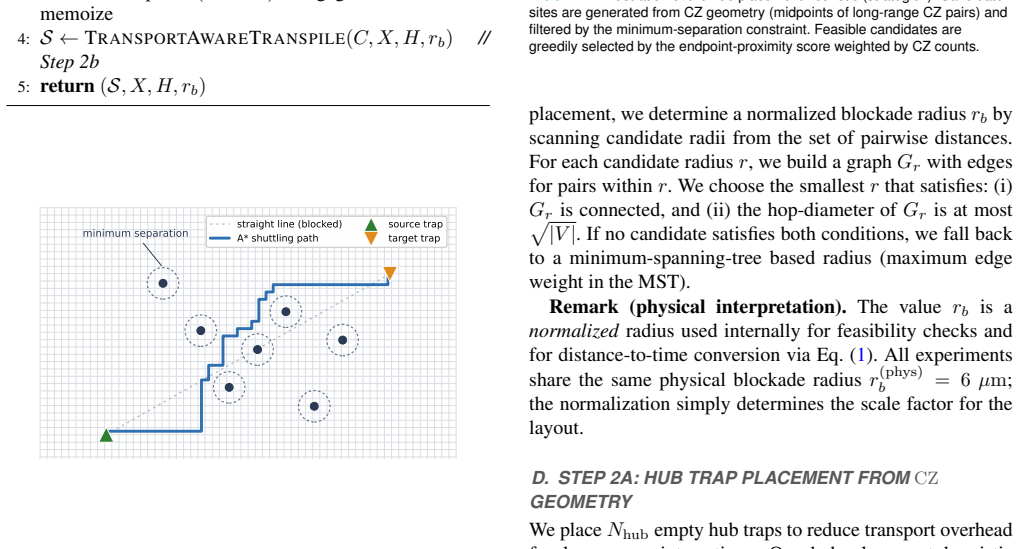
Compiling arbitrary-connectivity NISQ circuits onto monolithic single-zone neutral-atom devices is constrained by a finite interaction range and a minimum separation between simultaneously addressable sites. Under the minimum-separation constraint, the SWAP-only configuration of our pipeline does not return a schedule within a practical time budget on a range of circuits, including circuits as small as nine qubits. We address this with hub traps, a small number of dynamically placed empty traps that serve as transit waypoints, together with a per-gate rule that chooses between SWAP-based routing and hub-mediated shuttling. We evaluate the compiler on seventeen benchmarks using analytic estimates of execution time and a per-layer fidelity proxy, comparing against a placement-matched baseline and against ablations of our own pipeline. Hub traps make these otherwise-unsolved circuits compile in seconds to minutes and remove SWAP gates entirely on every completed circuit, so their role is to enable routing rather than only to optimize fidelity. The benefit is concentrated on routing-dominated circuits and is absent on routing-free ones, which we separate by the structure of the interaction graph. On the most routing-dominated circuit the fidelity proxy improves by up to three orders of magnitude over the placement-matched baseline. The gain comes primarily from eliminating SWAP overhead, as the absolute fidelities there remain low.
Editorial analysis
A structured set of objections, weighed in public.
Referee Report
Summary. The manuscript introduces hub traps—dynamically placed empty traps serving as transit waypoints—together with a per-gate routing rule that selects between SWAP-based movement and hub-mediated shuttling, to compile arbitrary-connectivity NISQ circuits onto monolithic neutral-atom arrays under finite interaction range and minimum-separation constraints. On 17 benchmarks the approach succeeds where a SWAP-only pipeline times out, eliminates all SWAP gates, and yields up to three-order-of-magnitude gains in a per-layer fidelity proxy (concentrated on routing-dominated circuits identified post-hoc by interaction-graph structure) relative to a placement-matched baseline, using only analytic execution-time formulas and the proxy.
Significance. If the analytic time estimates and per-layer fidelity proxy are shown to track actual hardware infidelity under shuttling, the work would be significant for neutral-atom compilation: it converts an otherwise intractable routing problem into a solvable one by architectural augmentation rather than by fidelity tuning alone, and supplies a concrete, benchmarked demonstration that hub-assisted shuttling removes SWAP overhead entirely on completed instances.
major comments (2)
- [Evaluation section (benchmarks and metrics)] The quantitative headline result (up to three-order fidelity-proxy improvement on the most routing-dominated circuit) rests entirely on an unvalidated per-layer proxy whose exact error sources, shuttling-overhead modeling, and correlation with measured infidelity are not cross-checked against hardware runs or density-matrix simulation; this modeling assumption is load-bearing for the central claim that hub traps enable routing rather than merely optimize fidelity.
- [Evaluation section (benchmark classification)] The post-hoc partition of the 17 benchmarks into routing-dominated versus routing-free sets is performed solely by interaction-graph structure; because the paper does not demonstrate that this partition is uncorrelated with other circuit properties (qubit count, gate density, depth), the reported concentration of benefit on routing-dominated circuits may be inflated by selection bias.
minor comments (1)
- [Abstract] The abstract refers to the 'per-layer fidelity proxy' without a one-sentence definition or pointer to its equation; adding this would improve immediate readability for readers outside the subfield.
Simulated Author's Rebuttal
We thank the referee for the detailed and constructive report. We address each major comment below, providing clarifications on the modeling choices and benchmark analysis while acknowledging limitations that cannot be addressed without new experimental data.
read point-by-point responses
-
Referee: [Evaluation section (benchmarks and metrics)] The quantitative headline result (up to three-order fidelity-proxy improvement on the most routing-dominated circuit) rests entirely on an unvalidated per-layer proxy whose exact error sources, shuttling-overhead modeling, and correlation with measured infidelity are not cross-checked against hardware runs or density-matrix simulation; this modeling assumption is load-bearing for the central claim that hub traps enable routing rather than merely optimize fidelity.
Authors: We agree that the per-layer fidelity proxy is central to the quantitative claims and has not been validated against hardware measurements or density-matrix simulations. The proxy is derived from standard neutral-atom error models (gate infidelity, decoherence during shuttling, and movement time estimates) using the analytic execution-time formulas already described. Its primary role in the manuscript is to quantify the benefit of eliminating SWAP gates on completed instances, rather than to claim absolute hardware fidelity. We will revise the evaluation section to include an expanded discussion of the proxy's assumptions, explicit formulas for shuttling overhead, and a clearer statement that hardware validation remains future work. This addresses the load-bearing concern by tempering the interpretation of the numerical gains. revision: partial
-
Referee: [Evaluation section (benchmark classification)] The post-hoc partition of the 17 benchmarks into routing-dominated versus routing-free sets is performed solely by interaction-graph structure; because the paper does not demonstrate that this partition is uncorrelated with other circuit properties (qubit count, gate density, depth), the reported concentration of benefit on routing-dominated circuits may be inflated by selection bias.
Authors: The classification is defined directly from the interaction graph: a circuit is labeled routing-dominated if it contains two-qubit gates whose required atom separation exceeds the fixed interaction range, necessitating either SWAPs or shuttling. This criterion is independent of qubit count, depth, or gate density by construction. The 17 benchmarks were selected from standard suites and already span qubit numbers from 9 to 20+ and varying depths; the observed pattern (benefit only on graphs with long-range edges, zero benefit on local graphs) holds across this range. We will add a supplementary table listing per-benchmark qubit count, depth, and edge-length statistics alongside the classification to allow readers to assess any residual correlations. revision: partial
- Cross-validation of the fidelity proxy against actual hardware infidelity or density-matrix simulations, which would require new experiments or large-scale simulations not present in the current manuscript.
Circularity Check
No significant circularity; compiler outputs and benchmark comparisons are independent of internal definitions
full rationale
The paper introduces hub traps and a per-gate routing rule as a new mechanism, then directly measures compilation success, SWAP elimination, and a per-layer fidelity proxy on 17 external benchmarks against a placement-matched baseline and internal ablations. No equations define a quantity in terms of itself, no fitted parameters are relabeled as predictions, and no self-citations supply load-bearing uniqueness theorems. The separation into routing-dominated vs. routing-free circuits follows explicitly from interaction-graph structure, and all quantitative claims rest on these explicit runs rather than reducing to the method's own inputs by construction. The derivation chain is therefore self-contained.
Axiom & Free-Parameter Ledger
axioms (2)
- domain assumption Finite interaction range between atoms
- domain assumption Minimum separation between simultaneously addressable sites
invented entities (1)
-
hub traps
no independent evidence
Reference graph
Works this paper leans on
-
[1]
An atom-by-atom assembler of defect-free arbitrary two-dimensional atomic arrays,
D. Barredo, S. de Léséleuc, V . Lienhard, T. Lahaye, and A. Browaeys, “An atom-by-atom assembler of defect-free arbitrary two-dimensional atomic arrays,”Science, vol. 354, no. 6315, pp. 1021–1023, 2016
2016
-
[2]
Quantum computing in the NISQ era and beyond,
J. Preskill, “Quantum computing in the NISQ era and beyond,”Quantum, vol. 2, p. 79, 2018
2018
-
[3]
A quantum processor based on coherent transport of entangled atom arrays,
D. Bluvstein, H. Levine, G. Semeghini, T. T. Wang, S. Ebadi, M. Kali- nowski, A. Keesling, N. Maskara, H. Pichler, M. Greiner, V . Vuleti ´c, and M. D. Lukin, “A quantum processor based on coherent transport of entangled atom arrays,”Nature, vol. 604, no. 7906, pp. 451–456, 2022
2022
-
[4]
Graphine: Enhanced neutral atom quan- tum computing using application-specific rydberg atom arrangement,
T. Patel, D. Silver, and D. Tiwari, “Graphine: Enhanced neutral atom quan- tum computing using application-specific rydberg atom arrangement,” in Proceedings of SC23: International Conference for High Performance Computing, Networking, Storage and Analysis, 2023, pp. 61:1–61:15
2023
-
[5]
D. Silver, T. Patel, and D. Tiwari, “Qompose: A technique to select optimal algorithm-specific layout for neutral atom quantum architectures,”arXiv preprint arXiv:2409.19820, 2024
-
[6]
Parallax: A compiler for neutral atom quantum computers under hardware constraints,
J. Ludmir and T. Patel, “Parallax: A compiler for neutral atom quantum computers under hardware constraints,” inProceedings of the Interna- tional Conference for High Performance Computing, Networking, Storage, and Analysis (SC), 2024, pp. 1–17, code and benchmarks: https://github. com/positivetechnologylab/Parallax; archived at https://doi.org/10.5281/ z...
2024
-
[7]
Atomique: A quantum compiler for reconfigurable neutral atom arrays,
H. Wang, P. Liu, D. B. Tan, Y . Liu, J. Gu, D. Z. Pan, J. Cong, U. A. Acar, and S. Han, “Atomique: A quantum compiler for reconfigurable neutral atom arrays,” inProceedings of the 51st Annual International Symposium on Computer Architecture (ISCA), 2024, pp. 293–309
2024
-
[8]
Compiling quantum circuits for dynamically field-programmable neutral atoms array proces- sors,
D. B. Tan, D. Bluvstein, M. D. Lukin, and J. Cong, “Compiling quantum circuits for dynamically field-programmable neutral atoms array proces- sors,”Quantum, vol. 8, p. 1281, 2024
2024
-
[9]
Tackling the qubit mapping problem for NISQ- era quantum devices,
G. Li, Y . Ding, and Y . Xie, “Tackling the qubit mapping problem for NISQ- era quantum devices,” inProceedings of the Twenty-Fourth International Conference on Architectural Support for Programming Languages and Operating Systems (ASPLOS), 2019, pp. 1001–1014
2019
-
[10]
Circuit transformations for quantum architectures,
A. M. Childs, E. Schoute, and C. M. Unsal, “Circuit transformations for quantum architectures,” in14th Conference on the Theory of Quantum Computation, Communication and Cryptography (TQC 2019), ser. Leibniz International Proceedings in Informatics (LIPIcs), vol. 135. Schloss Dagstuhl–Leibniz-Zentrum für Informatik, 2019, pp. 3:1–3:24
2019
-
[11]
Quantum information with Rydberg atoms,
M. Saffman, T. G. Walker, and K. Mølmer, “Quantum information with Rydberg atoms,”Reviews of Modern Physics, vol. 82, no. 3, pp. 2313– 2363, 2010
2010
-
[12]
Parallel implementation of high-fidelity multiqubit gates with neutral atoms,
H. Levine, A. Keesling, G. Semeghini, A. Omran, T. T. Wang, S. Ebadi, H. Bernien, M. Greiner, V . Vuleti´c, H. Pichler, and M. D. Lukin, “Parallel implementation of high-fidelity multiqubit gates with neutral atoms,” Physical Review Letters, vol. 123, no. 17, p. 170503, 2019. 11 Satohet al.: A Neutral-Atom Quantum Compiler with Application-Specific Layout...
2019
-
[13]
Quan- tum computing with neutral atoms,
L. Henriet, L. Beguin, A. Signoles, T. Lahaye, A. Browaeyset al., “Quan- tum computing with neutral atoms,”arXiv preprint arXiv:2006.12326, 2020
-
[14]
Neutral atom quantum computing hardware: An industrial end-user perspective,
K. Winterspergeret al., “Neutral atom quantum computing hardware: An industrial end-user perspective,”arXiv preprint arXiv:2304.14360, 2023
-
[15]
Geyser: A compilation framework for quantum computing with neutral atoms,
T. Patel, D. Silver, and D. Tiwari, “Geyser: A compilation framework for quantum computing with neutral atoms,” inProceedings of the 49th Annual International Symposium on Computer Architecture (ISCA), 2022, pp. 383–395
2022
-
[16]
PowerMove: Optimizing compilation for neutral atom quantum computers with zoned architecture,
J. Ruan, X. Fang, H. Zhang, A. Li, T. Humble, and Y . Ding, “PowerMove: Optimizing compilation for neutral atom quantum computers with zoned architecture,” inProceedings of the 30th ACM International Conference on Architectural Support for Programming Languages and Operating Systems (ASPLOS), Volume 3, 2025
2025
-
[17]
Q- Pilot: Field-programmable qubit array compilation with flying ancillas,
H. Wang, D. B. Tan, P. Liu, Y . Liu, J. Gu, J. Cong, and S. Han, “Q- Pilot: Field-programmable qubit array compilation with flying ancillas,” inProceedings of the 61st ACM/IEEE Design Automation Conference (DAC), 2024
2024
-
[18]
Dasatom: A divide-and-shuttle atom approach to quantum circuit transformation,
Y . Huang, D. Gao, S. Ying, and S. Li, “Dasatom: A divide-and-shuttle atom approach to quantum circuit transformation,”IEEE Transactions on Computer-Aided Design of Integrated Circuits and Systems, vol. 44, no. 8, pp. 2966–2978, 2025
2025
-
[19]
A. Javadi-Abhari, M. Treinish, K. Krsulich, C. J. Wood, J. Lishman, J. Gacon, S. Martiel, P. D. Nation, L. S. Bishop, A. W. Cross, B. R. Johnson, and J. M. Gambetta, “Quantum computing with Qiskit,”arXiv preprint arXiv:2405.08810, 2024
work page internal anchor Pith review Pith/arXiv arXiv 2024
-
[20]
Lightsabre: A lightweight and enhanced sabre algorithm,
H. Zou, M. Treinish, K. Hartman, A. Ivrii, and J. Lishman, “LightSABRE: A lightweight and enhanced SABRE algorithm,”arXiv preprint arXiv:2409.08368, 2024
-
[21]
Logical quantum processor based on reconfigurable atom arrays,
D. Bluvstein, S. J. Evered, A. A. Geim, S. H. Li, H. Zhou, T. Manovitz, S. Ebadi, M. Cain, M. Kalinowski, D. Hangleiter, J. P. Bonilla Ataides, N. Maskara, I. Cong, X. Gao, P. Sales Rodriguez, T. Karolyshyn, G. Se- meghini, M. J. Gullans, M. Greiner, V . Vuleti´c, and M. D. Lukin, “Logical quantum processor based on reconfigurable atom arrays,”Nature, vol...
2024
- [22]
discussion (0)
Sign in with ORCID, Apple, or X to comment. Anyone can read and Pith papers without signing in.