Vortex Harmonic Spinors on the Nappi-Witten Space
Pith reviewed 2026-05-10 19:43 UTC · model grok-4.3
The pith
Vortex configurations on Riemann surfaces lift to harmonic spinors on the Nappi-Witten space and induce Abelian magnetic zero-modes on Minkowski spacetime.
A machine-rendered reading of the paper's core claim, the machinery that carries it, and where it could break.
Core claim
Vortex configurations lift naturally to the Nappi-Witten space, producing explicit solutions of a twisted Dirac equation. Using the conformal flatness of the Nappi-Witten metric, these solutions induce harmonic spinors on four-dimensional Minkowski space. This yields a geometric construction of Abelian magnetic zero-modes on flat Minkowski spacetime from vortex data.
What carries the argument
The lift of vortex solutions from flat Riemann surfaces to the Nappi-Witten space that solves a twisted Dirac equation, followed by projection to Minkowski space via the metric's conformal flatness.
If this is right
- Any known vortex solution on a flat Riemann surface supplies an explicit solution of the twisted Dirac equation on the Nappi-Witten space.
- The same data produces harmonic spinors on four-dimensional Minkowski space after the conformal projection.
- Abelian magnetic zero-modes on flat space are thereby generated directly from two-dimensional vortex data.
- The construction applies uniformly to all vortex configurations without extra assumptions on the profile.
Where Pith is reading between the lines
- The same lifting procedure could be attempted on other central extensions of Euclidean groups to obtain zero-modes in backgrounds with different signatures or curvatures.
- It may translate known vortex statistics from condensed-matter models into explicit fermion zero-mode counts in four-dimensional gauge theories.
- Plugging in concrete vortex profiles, such as radially symmetric ones with unit winding, would give closed-form expressions for the resulting Minkowski spinors that can be checked numerically.
Load-bearing premise
The conformal flatness of the Nappi-Witten metric allows the lifted solutions to induce harmonic spinors on four-dimensional Minkowski space.
What would settle it
A direct calculation showing that the projected spinor fails to satisfy the Dirac equation on Minkowski space for a standard vortex profile would disprove the claimed induction of harmonic spinors and zero-modes.
Figures
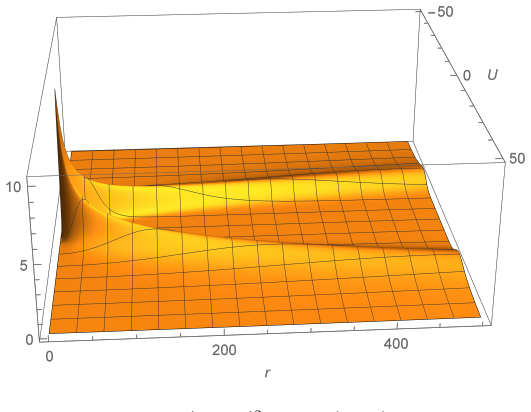
read the original abstract
We establish a correspondence between vortex equations on flat Riemann surfaces and harmonic spinors on the Nappi--Witten space, the group manifold of a central extension of the Euclidean group $SE(2)$. Vortex configurations lift naturally to this setting, producing explicit solutions of a twisted Dirac equation. Using the conformal flatness of the Nappi--Witten metric, these solutions induce harmonic spinors on four-dimensional Minkowski space. This yields a geometric construction of Abelian magnetic zero-modes on flat Minkowski spacetime from vortex data.
Editorial analysis
A structured set of objections, weighed in public.
Referee Report
Summary. The paper establishes a correspondence between vortex equations on flat Riemann surfaces and harmonic spinors on the Nappi-Witten space (the group manifold of a central extension of SE(2)). Vortex configurations lift to explicit solutions of a twisted Dirac equation on this space. Using the conformal flatness of the Nappi-Witten metric, these solutions induce harmonic spinors on four-dimensional Minkowski space, yielding a geometric construction of Abelian magnetic zero-modes on flat Minkowski spacetime from vortex data.
Significance. If the central derivations hold, the work supplies a geometric lifting procedure that produces explicit solutions for Abelian magnetic zero-modes on Minkowski space directly from 2D vortex data. The explicit character of the lifted solutions and the use of the Nappi-Witten geometry as an intermediate step constitute a concrete strength, offering a potential new route to construct zero-modes without ad-hoc fitting parameters.
major comments (1)
- The induction step via conformal flatness is load-bearing for the central claim that the lifted solutions become genuine kernel elements of the Abelian magnetic Dirac operator on Minkowski space. The manuscript invokes conformal flatness of the Nappi-Witten metric but does not derive the precise transformation of the twisted Dirac operator (including the pullback of the twisting 1-form and the spinor rescaling factor) to confirm it maps exactly onto the flat-space magnetic Dirac operator. Without this explicit verification, the zero-mode property does not automatically descend from the Nappi-Witten solutions.
Simulated Author's Rebuttal
We thank the referee for the positive assessment of our work and for the constructive major comment. We address the point below and have revised the manuscript accordingly.
read point-by-point responses
-
Referee: The induction step via conformal flatness is load-bearing for the central claim that the lifted solutions become genuine kernel elements of the Abelian magnetic Dirac operator on Minkowski space. The manuscript invokes conformal flatness of the Nappi-Witten metric but does not derive the precise transformation of the twisted Dirac operator (including the pullback of the twisting 1-form and the spinor rescaling factor) to confirm it maps exactly onto the flat-space magnetic Dirac operator. Without this explicit verification, the zero-mode property does not automatically descend from the Nappi-Witten solutions.
Authors: We agree that the manuscript would benefit from an explicit derivation of the transformation rules. In the revised version we have added a new subsection (now Section 4.2) together with supporting calculations in Appendix B. There we compute the conformal factor relating the Nappi-Witten metric to flat Minkowski space, determine the pullback of the twisting 1-form induced by the vortex data, and derive the precise rescaling of the spinor sections. The calculation shows that the twisted Dirac operator on the Nappi-Witten space is mapped to the Abelian magnetic Dirac operator on Minkowski space, so that the kernel elements descend directly. The added material makes the induction step fully rigorous. revision: yes
Circularity Check
No circularity: geometric lifting and conformal flatness yield independent construction
full rationale
The paper's chain proceeds by lifting 2D vortex solutions to a twisted Dirac equation on the Nappi-Witten group manifold, then invoking the known conformal flatness of its metric to induce 4D Minkowski harmonic spinors. No step reduces by definition to its inputs, no parameters are fitted and relabeled as predictions, and no load-bearing uniqueness theorem or ansatz is imported via self-citation. The abstract and described construction rest on standard differential-geometric operations whose validity can be checked independently of the target result.
Axiom & Free-Parameter Ledger
axioms (1)
- domain assumption The Nappi-Witten metric is conformally flat
Lean theorems connected to this paper
-
IndisputableMonolith/Foundation/AlexanderDuality.leanalexander_duality_circle_linking unclear?
unclearRelation between the paper passage and the cited Recognition theorem.
Using the conformal flatness of the Nappi–Witten metric, these solutions induce harmonic spinors on four-dimensional Minkowski space.
-
IndisputableMonolith/Foundation/RealityFromDistinction.leanreality_from_one_distinction unclear?
unclearRelation between the paper passage and the cited Recognition theorem.
Vortex configurations lift naturally to this setting, producing explicit solutions of a twisted Dirac equation.
What do these tags mean?
- matches
- The paper's claim is directly supported by a theorem in the formal canon.
- supports
- The theorem supports part of the paper's argument, but the paper may add assumptions or extra steps.
- extends
- The paper goes beyond the formal theorem; the theorem is a base layer rather than the whole result.
- uses
- The paper appears to rely on the theorem as machinery.
- contradicts
- The paper's claim conflicts with a theorem or certificate in the canon.
- unclear
- Pith found a possible connection, but the passage is too broad, indirect, or ambiguous to say the theorem truly supports the claim.
discussion (0)
Sign in with ORCID, Apple, or X to comment. Anyone can read and Pith papers without signing in.