REVIEW 4 major objections 4 minor 5 cited by
Six newly studied fast blue optical transients share a dense, common environment, pointing to a massive star merging with a compact object as their likely origin.
Reviewed by Pith at T0; open to challenge. T0 means a machine referee read the full paper against a public rubric. the ladder, T0–T4 →
T0 review · deepseek-v4-flash
2026-08-03 07:49 UTC pith:KUHHA5F6
load-bearing objection A genuinely useful sample paper with a plausible but model-dependent central claim; referee it, but the abstract overstates what the radio modeling actually supports. the 4 major comments →
Multiwavelength Analysis of Six Luminous Fast Blue Optical Transients
The pith
A machine-rendered reading of the paper's core claim, the machinery that carries it, and where it could break.
Core claim
The central claim is that LFBOTs show a high degree of uniformity in their radio behavior: peaks at t_rest ≈ 50–100 d, peak luminosities around 10^38–10^40 erg/s, and similar spectral evolution, consistent with synchrotron emission from a shock moving at 0.1–0.3c through a dense medium with electron densities of 10^3–10^4 cm^-3. The authors argue that this uniformity implies a similar circumburst medium across events, which in turn favors progenitor models that produce a consistent, dense environment shortly before the explosion—most naturally the merger of a massive star with a compact object. They present AT2024aehp as an exception: its optical plateau and delayed radio brightening by over
What carries the argument
The key tool is a synchrotron self-absorption model that relates the radio spectral energy distribution's peak frequency, peak flux density, and time since explosion to the shock radius, magnetic field, average velocity, and circumburst density, under assumptions of spherical symmetry, non-relativistic motion, energy equipartition, a fixed electron power-law index, and a fixed filling factor. This model converts the observed radio light curves into the conclusion that LFBOTs expand into dense, wind-like media with similar density profiles. The paper complements this with host-galaxy photometry and spectroscopy, using stellar population synthesis fitting to derive host stellar masses and star
Load-bearing premise
The conclusion that LFBOTs share a similar circumburst medium depends entirely on the adopted synchrotron model's assumptions—spherical, non-relativistic, equipartition shock with a fixed electron index and filling factor—and the paper itself notes that some epochs have Γβ > 0.5 and observed spectral slopes inconsistent with the assumed ν^-1 behavior.
What would settle it
A well-sampled LFBOT whose 10 GHz radio light curve peaks significantly outside 50–100 days or outside the 10^38–10^40 erg/s luminosity range, while still showing the classic fast blue optical signature, would break the uniformity the paper takes as evidence for a common circumburst medium. Alternatively, multi-frequency radio SEDs that consistently show an optically thin spectral index far from the assumed ν^-1 would invalidate the density and speed estimates, removing the basis for the common-CSM claim.
If this is right
- If LFBOTs indeed share a common dense circumburst medium, future radio monitoring should continue to find 10 GHz peaks at tens to a hundred days and luminosities clustered near 10^39 erg/s, allowing the 'common channel' hypothesis to be tested with larger samples.
- The merger-progenitor scenario predicts a specific mass-loss history immediately before the explosion; deep X-ray and UV precursor searches timed close to the optical peak could distinguish it from alternatives such as tidal disruption events.
- The outlier AT2024aehp implies that some fast blue optical transients may be a bridge to tidal disruption events; longer-term optical and radio follow-up of new LFBOTs will determine how common plateau and late-rebrightening behavior is.
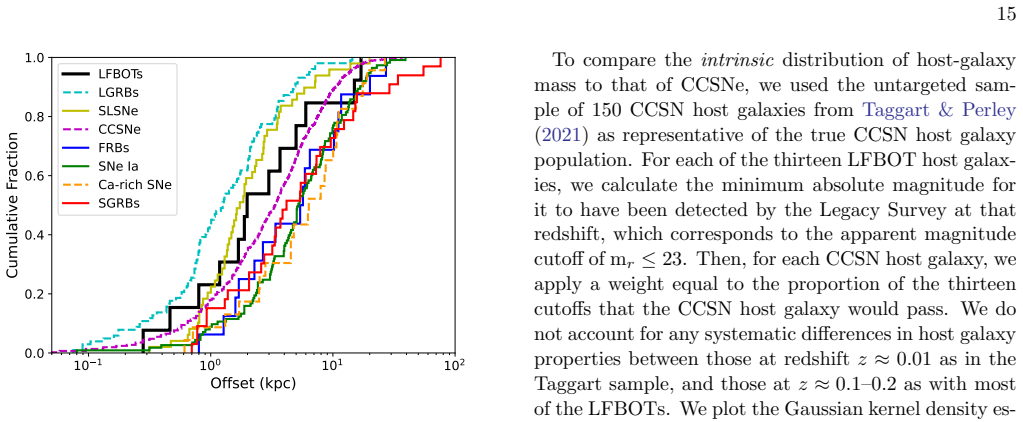
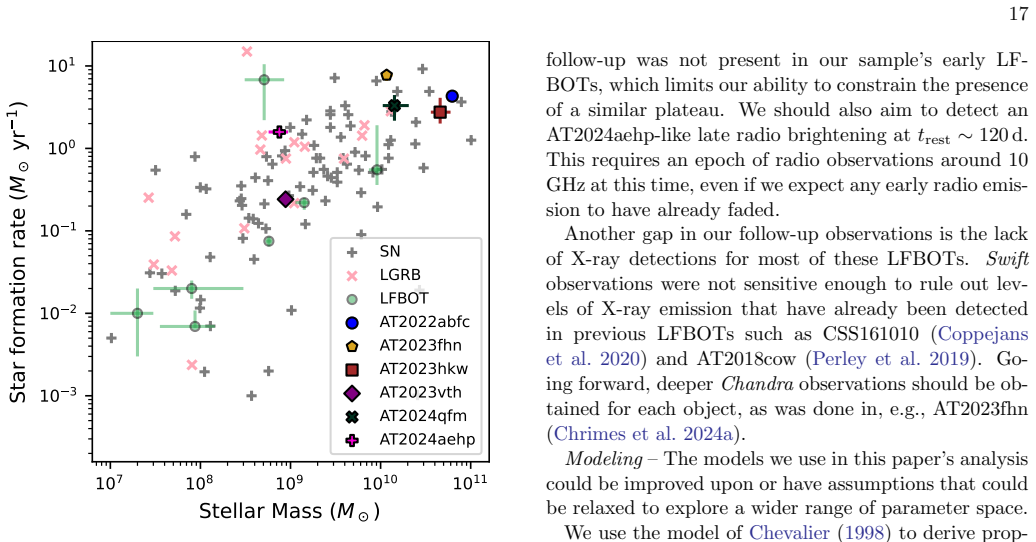
- The host-galaxy properties—star-forming galaxies of 10^9–10^11 solar masses, with offsets intermediate between core-collapse supernovae and long gamma-ray bursts—provide a new statistical benchmark for progenitor models.
- The paper's finding that host-galaxy masses appear consistent with both core-collapse supernovae and superluminous supernova hosts, after accounting for selection bias, suggests LFBOTs do not require an extreme dwarf-galaxy environment.
Where Pith is reading between the lines
- The uniformity conclusion rests on the same model for every event; if the true shock is more relativistic or contains significant thermal electrons, the derived densities and the apparent CSM similarity could be partly a modeling artifact rather than a property of the progenitors.
- A selection effect may be inflating the apparent uniformity: only LFBOTs with radio emission luminous enough to be detected and followed are included, and the sample is still small enough that one or two outliers would not be surprising.
- If the merger scenario is right, LFBOT rates should track star formation and be enhanced in regions of massive binary production; measuring the volumetric rate and spatial distribution with the next generation of optical surveys will provide a direct test.
- The apparent AT2024aehp–TDE resemblance suggests that classifying transients purely on fast optical evolution and radio detection may lump together distinct physical origins; a systematic search for optical plateaus in all future LFBOTs could reveal the true diversity.
Editorial analysis
A structured set of objections, weighed in public.
Referee Report
Summary. The paper presents multiwavelength (optical, X-ray, radio/mm) observations of six ZTF-selected LFBOTs, increasing the published sample by about 50%. Five of the six show 10 GHz radio light curves that peak near t_rest ≈ 50–100 d with peak luminosities 10^38–10^40 erg/s, while AT2024aehp shows an unusual optical plateau and late-time radio brightening. Using the Chevalier (1998) synchrotron self-absorption formalism, the authors convert radio SED fits into shock radius, velocity, energy, CSM density, and wind parameter, and combine these with host-galaxy offsets and prospector-based host properties. They conclude that the broadly uniform radio behavior implies a similar circumburst medium, favoring a progenitor channel in which mass is lost shortly before the terminal event, such as a massive star merging with a compact object.
Significance. If the inference holds, this is an important result: a sample of six new LFBOTs with homogeneous multiwavelength coverage, plus one clear outlier in AT2024aehp, would substantially strengthen the case for a common progenitor channel. The host-galaxy offset and mass/SFR analyses are useful additions, and the eROSITA precursor search is a thoughtful new constraint. The paper is also candid about model limitations, which is commendable. However, the central quantitative claim — that similar radio light curves imply a similar dense CSM and hence a merger progenitor — is built on model assumptions that the paper's own fits violate, and the abstract's summary numbers are inconsistent with the tables. The qualitative uniformity of the radio light curves is valuable, but the common-CSM conclusion is not yet established.
major comments (4)
- [Abstract; Table 9; §4.1] The abstract states a fast (v = 0.1–0.3c) shock in a dense medium with n_e ≈ 10^3–10^4 cm^-3. Table 9 gives fitted velocities of v/c = 0.57 ± 0.05 (AT2023fhn, 73 d), 0.38 ± 0.02, 0.32 ± 0.03, 0.53 ± 0.04, and 0.16 ± 0.02. Two fitted epochs exceed 0.5c, and §5.2 acknowledges Γβ > 0.5. The fitted n_e values in Table 9 range from 22 to ~3100 cm^-3 (0.022 to 3.1 in units of 10^3 cm^-3), while §4.1 states “10–100 cm^-3 at radii of 10^17 cm.” The abstract is therefore not a fair summary of the quantitative results, and the paper’s own numbers are internally inconsistent.
- [§4.1, Eq. (7); Table 8] Equation (7) assumes an electron power-law index p = 3, which gives an optically thin slope a2 = −(p−1)/2 = −1. The fitted slopes in Table 8 are a2 = −0.69 ± 0.08, −0.87 ± 0.08, −1.06 ± 0.06, −0.55 ± 0.04, and −0.67 ± 0.09. Three of these are discrepant at >3σ from −1, and the unweighted mean is about −0.77. Because the Chevalier (1998) inversion in Eqs. (2)–(6) uses p = 3 to relate ν_p and F_p to R, B, n_e, and E, the derived densities and speeds are not secure when the data reject p = 3. A sensitivity analysis over p (and over ϵ_e, ϵ_B, f) is needed before claiming that the CSM densities are similar across events.
- [§4.1, Eqs. (2)–(6); Table 9; §5.2] The model assumes a spherical, nonrelativistic shock. Table 9 lists v/c = 0.57 and 0.53 for AT2023fhn at 73 d and AT2023vth at 110 d, respectively, corresponding to Γβ > 0.5; §5.2 admits this. In this regime the Chevalier (1998) scalings used for R, B, n_e, and E are not quantitatively valid. The paper cites relativistic corrections (Margalit & Quataert 2024; Ferguson & Margalit 2025) but does not apply them. Thus the derived CSM densities, and any statement that the CSM is “similar” across events, currently rest on assumptions that the data themselves violate.
- [§5.1; Abstract; §6] The central inference — “consistent radio behavior implies a similar circumburst medium” — is presented as a conclusion in the abstract and summary. The observational support is a qualitative similarity of 10 GHz light curves in a sample selected for radio/X-ray detection. The mapping from those light curves to CSM density is precisely the model-dependent step criticized above; different combinations of p, ϵ_e, ϵ_B, f, and geometry could produce similar observed curves from different CSM densities. To support the merger-progenitor preference, the authors should either demonstrate that the inferred CSM parameters are robust across the allowed parameter space, or explicitly weaken the conclusion to “consistent with” a common CSM rather than “implies.”
minor comments (4)
- [Title] The title contains a typo: “F ast Blue” should be “Fast Blue”.
- [Figure 7 caption] The caption gives the wind velocity unit as “1000 km s^-2”; this should be “km s^-1”.
- [§2.4.3; Table 6] For AT2024aehp, the text says the NOEMA observation was taken “>100 d after optical discovery,” while Table 6 gives t_obs = 155 d and t_rest ≈ 127 d. Please make the reference epoch explicit and consistent.
- [Eq. (1)] The factor +2.5 log10(1+z) in the absolute-magnitude conversion is not a general k-correction unless a specific spectral slope is assumed. Please state the assumed SED slope or use a proper k-correction.
Circularity Check
No significant circularity: the central inference rests on independent radio light-curve data plus a standard, externally published model inversion, not on a reduction to its own inputs.
full rationale
The paper's central claim—that similar 10 GHz radio light curves among optically selected LFBOTs imply a similar circumburst medium—is not circular. The peak frequency νp and peak flux Fp are empirical fit parameters to observed SEDs (Eq. 7), not quantities defined in terms of the conclusions. Equations 2–6 are standard Chevalier (1998) synchrotron self-absorption inversions with clearly stated external assumptions (equipartition ϵe=ϵB=1/3, filling factor f=0.5, electron index p=3, spherical nonrelativistic shock, wind-like density profile). These assumptions are model inputs, not the target inference. The uniformity of the 10 GHz light curves is an independent observational result: the paper explicitly acknowledges the detection-selection effect (radio must be luminous enough to detect) but did not require a specific peak time or brightening behavior, so the observed t_rest≈50–100 d peaks and 10^39–10^40 erg s^-1 luminosities are not constructed by the selection. The t^-5/3 fit to AT2024aehp (Fig. 12) is presented as a comparison to TDEs, not as a predicted relation. The paper's own Section 5.2 candidly flags violations of the model assumptions (Γβ>0.5 for some epochs, optically thin slopes inconsistent with ν^-1), which are correctness risks and model-dependence concerns, not circularity. Self-citations to prior LFBOT papers set parameter conventions (e.g., f=0.5, p=3), but these are standard values traceable to independent literature (Chevalier & Fransson 2006; Soderberg et al. 2010a) and do not carry the load of the central conclusion. No target result is used as an input, no fitted parameter is renamed as a prediction, and no uniqueness claim is imported from the authors' own prior work. The derivation is self-contained with respect to circularity.
Axiom & Free-Parameter Ledger
free parameters (6)
- Filling factor f =
0.5
- Equipartition fractions ϵ_e = ϵ_B =
1/3
- Electron power-law index p and optically thin slope a2 =
p=3 assumed; fitted a2 varies from -0.55 to -1.06
- Per-epoch SED peak frequency ν_p and flux F_p =
e.g., AT2023fhn 71–77 d: νp=4.0 GHz, Fp=232 μJy; 5 fits in Table 8
- Broken power-law smoothness s and optically thick slope a1 =
s=1, a1=5/2
- prospector host-galaxy stellar mass, SFR, age, dust τ =
Table 2 values: log M/M☉ = 8.9–10.8
axioms (6)
- domain assumption Chevalier (1998) synchrotron self-absorption equations apply to the radio SED
- domain assumption Shock is spherical, nonrelativistic, and in energy equipartition
- domain assumption CSM is a spherical stellar wind with Ṁ/v_w = 4π m_p R² n_e
- domain assumption Swift non-detections correspond to a power-law spectrum with photon index Γ=2
- domain assumption Host galaxy SEDs are described by FSPS with Chabrier IMF, Calzetti dust, and parametric SFH; metallicity follows Gallazzi et al. mass-metallicity relation
- domain assumption Flat ΛCDM with H0=67.4 km/s/Mpc and Ωm=0.315
read the original abstract
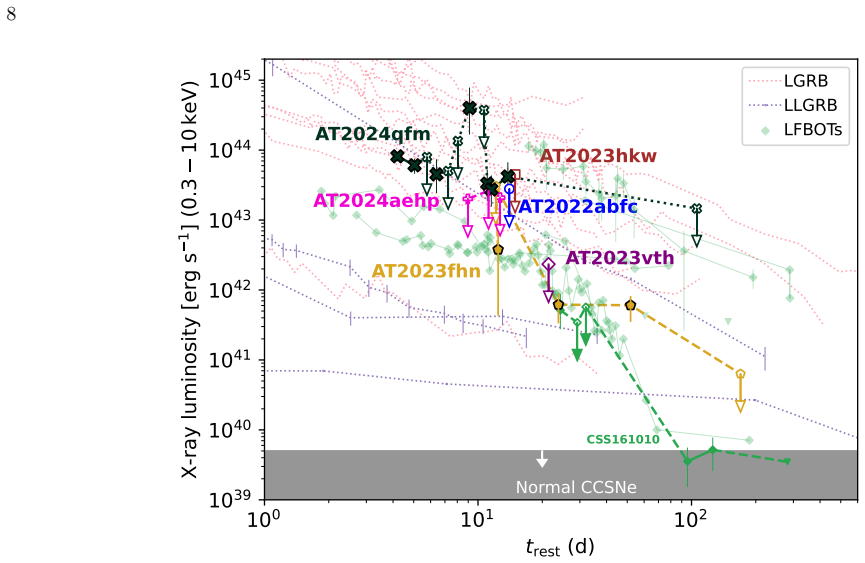
We present multiwavelength observations and analysis of six luminous fast blue optical transients (LFBOTs) discovered in Zwicky Transient Facility (ZTF) survey data. We identified these LFBOTs from their fast light-curve evolution ($t_{1/2}\leq 12 $d), blue colors at peak brightness ($g-r\leq-0.5 $mag), a visible host galaxy, high optical luminosity ($M_g<-20$), and an X-ray or radio detection. With the exception of AT2024aehp (ZTF24abygbss), these transients exhibit peaks in their $10\,$GHz radio light curves at $t_{\text{rest}} \approx 50-100$ d, with peak radio luminosities ranging from $10^{38}-10^{40}$ erg s$^{-1}$. Modeling the radio emission as synchrotron radiation indicates a fast ($v=0.1-0.3c$) shock in a dense ($n_e\approx10^{3}-10^{4}$ cm$^{-3}$) medium. The X-ray emission varies by $\approx2$ orders of magnitude in luminosity ($10^{42}-10^{44}$ erg s$^{-1}$) at $t_{\text{rest}}\sim20 $d. Analysis of the host-galaxy photometry and spectroscopy for each transient shows that they are predominantly nonnuclear (a few kpc offset) with star-forming host galaxies of stellar masses $10^{9}-10^{11} ,M_\odot$. Unlike all other LFBOTs to date, AT2024aehp exhibited a luminous ($M<-19 $mag) plateau in the optical light curve; spectra during this plateau phase showed a featureless blue continuum. The $6-15$ GHz radio emission of AT2024aehp brightened by over an order of magnitude from $t_{\text{rest}} \approx70 $d to $t_{\mathrm{rest}} \approx130 $d. The mostly consistent radio behavior between optically selected LFBOTs implies a similar circumburst medium, leading us to prefer a progenitor scenario in which mass is lost in a consistent way shortly prior to the terminal event, such as a massive star merging with a compact object.
Figures







Forward citations
Cited by 5 Pith papers
-
Implications of the UV/optical Plateau of AT2018cow
A wind-and-irradiation disk model fits the AT2018cow UV plateau with accretor masses from 1.4 to ~100 solar masses, removing the need for a >200 solar-mass black hole.
-
Compact Objects Merging with Stars as an Origin of Ultra-Long Gamma-Ray Bursts and Luminous Fast Blue Optical Transients
SN 2011kl is broadly consistent with an LFBOT light-curve model and ULGRB hosts match LFBOT/LGRB environments, supporting a shared He-CO merger progenitor for a subset of both classes.
-
The Environments of Luminous Fast Blue Optical Transients: Evidence for a Compact Object and Wolf-Rayet Star Merger Origin
LFBOT hosts are star-forming and moderately metal-poor, with many events offset from bright light, favoring a compact-object–Wolf-Rayet merger origin over TDEs or standard CCSNe.
-
Radio Emission from Fast Blue Optical Transients Powered by Trans-relativistic Shocks in Confined Circumstellar Material
A synchrotron forward-shock model with confined broken-power-law CSM explains FBOT radio diversity via shock transition out of the dense shell, yielding trans-relativistic velocities of 0.1-0.5c and high but brief mas...
-
Constraints on Late-Time Flaring from Luminous Fast Blue Optical Transients using the Transiting Exoplanet Survey Satellite and the Zwicky Transient Facility
TESS and ZTF observations of 12 LFBOTs yield no late-time flares after SSO attribution, constraining central engine lifetimes to hundreds of days or less.
Reference graph
Works this paper leans on
-
[1]
Andreoni, I., Coughlin, M. W., Kool, E. C., et al. 2021, ApJ, 918, 63, doi: 10.3847/1538-4357/ac0bc7 Bellm, E. C., Kulkarni, S. R., Graham, M. J., et al. 2019, PASP, 131, 018002, doi: 10.1088/1538-3873/aaecbe Berger, E., Kulkarni, S. R., Pooley, G., et al. 2003, Nature, 426, 154, doi: 10.1038/nature01998 Bhandari, S., Heintz, K. E., Aggarwal, K., et al. 2...
-
[10]
Ho 29 T able 4.Optical Spectroscopy Object UTC Datet obs (days) Redshift Telescope/Inst
34 GN-2024B-Q-128; PI A. Ho 29 T able 4.Optical Spectroscopy Object UTC Datet obs (days) Redshift Telescope/Inst. Lines Detected AT2022abfc 20221201 10 0.212 Gemini-S/GMOS Ca H&K, Mg I AT2023fhn 20230419 7 0.24 Gemini-S/GMOS Hα, [N II] AT2023fhn 20230420 8 0.24 P200/DBSP Hα AT2023fhn 20230426 14 0.24 Keck-I/LRIS Hα, [N II], [S II] AT2023hkw 20230512 12 0....
2020
-
[11]
(2025) and did not report a flux error or RMS
∗∗This measurement was obtained from Shoval et al. (2025) and did not report a flux error or RMS. 33 T able 7.Host-Galaxy Photometry ObjectGALEXLegacy/Pan-STARRSNEOWISE FUV NUVg r i z w1w2w3 AT2022abfc — 21.550 19.057 18.124 17.698 17.464 17.356 17.568 15.875 AT2023fhn — 20.913 19.452 18.912 18.606 18.566 18.796 18.755 — AT2023hkw — 21.898 20.706 19.669 —...
2025
-
[21]
Ho 33 Project ID VLA/23B-138; PI A
The fast fading and possible high peak luminosity from the photometric redshift of the host galaxy (SDSSz ph = 0.17±0.09) motivated us to trigger follow-up observa- 31 https://www.wis-tns.org/ 32 GN-2024B-Q-128; PI A. Ho 33 Project ID VLA/23B-138; PI A. Ho tions. We acquired spectroscopy of the candidate using GMOS on Gemini South on December 23, 2024
2024
-
[31]
by the Automatic Learning for the Rapid Classification of Events (ALeRCE) broker (Forster et al. 2024). On August 1, a redshift ofz= 0.2270 was deter- mined by Gillanders et al. (2024) and an X-ray detection was reported by Margutti et al. (2024). On August 2, we obtained a long-slit spectrum of AT 2024qfm with GMOS on Gemini-North under a ToO program 32 ...
2024
-
[34]
We reported the rapid evolution and high luminosity (Sevilla et al
The spectrum shows narrow Hα, [NII], and [SII] emission lines that correspond toz= 0.170. We reported the rapid evolution and high luminosity (Sevilla et al. 2024). Radio and X-ray observations initially resulted in non- detections, and the optical light curve flattened out in a way uncharacteristic of LFBOTs (Schroeder et al. 2025). A subsequent radio ep...
2024
-
[2010]
Numerical Modeling of Relativistic Effects in Synchrotron-Emitting Shocks
Drout, M. R., Chornock, R., Soderberg, A. M., et al. 2014, ApJ, 794, 23, doi: 10.1088/0004-637X/794/1/23 Duev, D. A., Mahabal, A., Masci, F. J., et al. 2019, MNRAS, 489, 3582, doi: 10.1093/mnras/stz2357 Evans, C. R., & Kochanek, C. S. 1989, ApJL, 346, L13, doi: 10.1086/185567 Faber, S. M., Phillips, A. C., Kibrick, R. I., et al. 2003, in Society of Photo-...
work page internal anchor Pith review Pith/arXiv arXiv doi:10.48550/arxiv.2509.16313 2014
-
[2019]
The Fritz mar- shal uses the open-source software packageSkyPortal (Coughlin et al
to coordinate detection, analysis, and follow-up observations of transients. The Fritz mar- shal uses the open-source software packageSkyPortal (Coughlin et al. 2023). A.1.AT2022abfc/ZTF22abvrxkk AT2022abfc was first detected by ZTF on November 21, 2022 (MJD = 59904.344; Fremling 2022). ZTF non- detections prior to the first observation and ZTF detec- tio...
2023
-
[2023]
The blue colors, fast fading, high luminos- ity, and detected emission throughout the electromag- netic spectrum confirmed it as an LFBOT
and the VLA (10 GHz) on June 15 (Ho 2023a). The blue colors, fast fading, high luminos- ity, and detected emission throughout the electromag- netic spectrum confirmed it as an LFBOT. TheChandra X-ray detections and a subset of this transient’s VLA ra- dio observations are already published by Chrimes et al. (2024a). A.3.AT2023hkw/ZTF23aaimsja ZTF first de...
2023
-
[2024]
and ZTFReST (Andreoni et al. 2021). The rapid fad- ing was publicly reported by Fastfinder (Fulton et al. 2024). The transient itself was reported to the Tran- sient Name Server (TNS
2021
discussion (0)
Sign in with ORCID, Apple, or X to comment. Anyone can read and Pith papers without signing in.