OmniBioTwin: A System-of-Twinned-Systems Framework for Health Digital Twins
Pith reviewed 2026-06-27 11:20 UTC · model grok-4.3
The pith
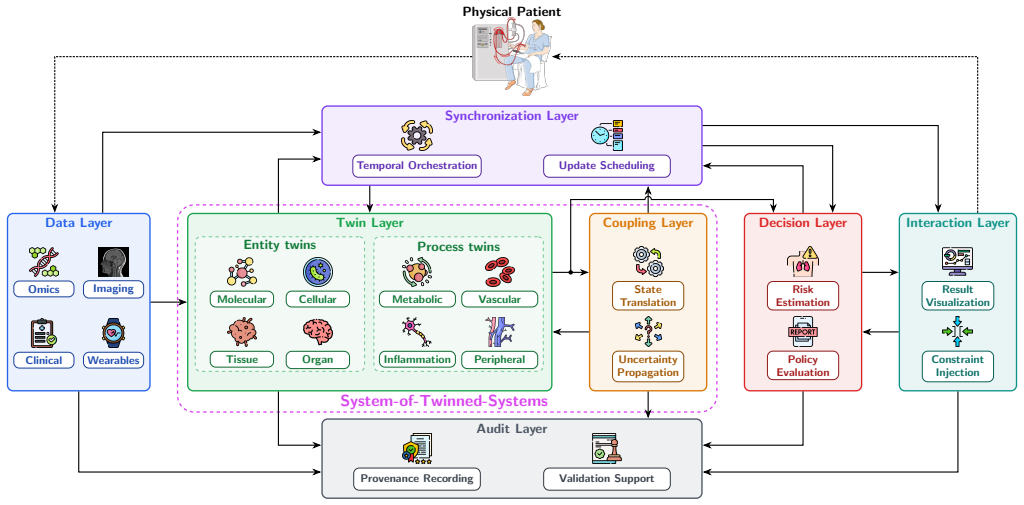
Health digital twins are structured as modular systems coupled by explicit operators across seven layers.
A machine-rendered reading of the paper's core claim, the machinery that carries it, and where it could break.
Core claim
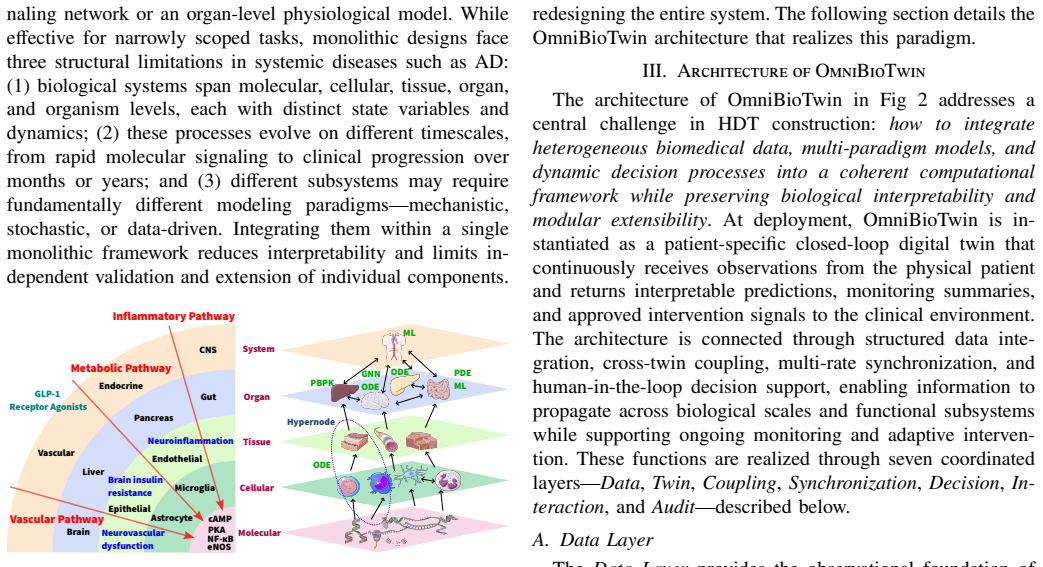
The central claim is that health digital twins can be organized as modular computational entities coupled through explicit interaction operators within a multi-layer network architecture comprising seven coordinated layers, enabling the composition of twins at molecular, cellular, and organ levels, as shown in the GLP-1 signaling pathways example for Alzheimer's disease.
What carries the argument
The System-of-Twinned-Systems (SoTS) framework that organizes HDTs as modular entities coupled via explicit interaction operators in a seven-layer architecture.
If this is right
- Modular twins at different biological scales can be composed and coupled in a unified system.
- Cross-scale coupling is achieved through explicit interaction operators.
- The seven layers handle data integration, autonomous modeling, synchronization, and decision support.
- Human-in-the-loop decision support is integrated into the architecture.
- The approach is demonstrated for GLP-1 signaling in Alzheimer's disease.
Where Pith is reading between the lines
- Existing single-organ or single-task twins could be integrated into larger multiscale systems using this framework.
- The coupling mechanism might generalize to other biological pathways beyond the demonstrated example.
- Modularity could facilitate updates or replacements of individual scale-specific models without rebuilding the entire twin.
Load-bearing premise
Modular computational entities for different biological scales can be coupled through explicit interaction operators without loss of fidelity or introduction of unmanageable inconsistencies.
What would settle it
A test case where coupling the modular twins across scales produces predictions that diverge from or are less accurate than those from a monolithic multiscale model.
Figures
read the original abstract
Health digital twins (HDTs) promise patient-specific modeling and decision support but current approaches remain structurally fragmented: monolithic models that address a single organ or task lack cross-scale fidelity, while system-level twins lack generalizable architectural frameworks. We propose OmniBioTwin, a System-of-Twinned-Systems (SoTS) framework that organizes HDTs as modular computational entities coupled through explicit interaction operators within a multi-layer network architecture. The framework comprises seven coordinated layers - spanning data integration, autonomous twin modeling, cross-scale coupling, temporal synchronization, and human-in-the-loop decision support. We demonstrate OmniBioTwin by instantiating a multiscale twin for glucagon-like peptide-1 (GLP-1) signaling pathways in Alzheimer's disease, illustrating how molecular, cellular, and organ-level twins can be composed and coupled within a unified system.
Editorial analysis
A structured set of objections, weighed in public.
Referee Report
Summary. The manuscript proposes OmniBioTwin, a System-of-Twinned-Systems (SoTS) framework that organizes health digital twins (HDTs) as modular computational entities coupled through explicit interaction operators in a seven-layer network architecture spanning data integration, autonomous twin modeling, cross-scale coupling, temporal synchronization, and human-in-the-loop decision support. The framework is demonstrated by instantiating a multiscale twin for GLP-1 signaling pathways in Alzheimer's disease to show composition of molecular, cellular, and organ-level twins.
Significance. If the claimed cross-scale coupling can be realized with preserved fidelity, the SoTS architecture would provide a generalizable alternative to monolithic or fragmented HDTs, potentially enabling reproducible multiscale modeling. The modular design and explicit operator concept are strengths that could support future machine-checked or validated implementations, but the absence of any quantitative validation or concrete mechanisms in the current manuscript limits the result to a high-level architectural proposal.
major comments (2)
- [Abstract] Abstract (GLP-1 demonstration paragraph): the assertion that molecular, cellular, and organ-level twins 'can be composed and coupled within a unified system' via explicit interaction operators is load-bearing for the central claim, yet the manuscript supplies no operator definitions, consistency conditions, error-propagation analysis, or accuracy metrics to substantiate that coupling occurs without loss of fidelity or unmanageable inconsistencies.
- [Framework description] Framework description (seven coordinated layers): the cross-scale coupling layer is presented as coordinating modular entities, but no equations, algorithms, or interface specifications are given for the interaction operators, making it impossible to evaluate whether the architecture avoids the inconsistencies flagged in the weakest assumption.
minor comments (1)
- [Abstract] The abstract and demonstration would benefit from a brief table or diagram enumerating the seven layers and their primary functions to improve readability.
Simulated Author's Rebuttal
We thank the referee for the constructive comments on our manuscript proposing the OmniBioTwin System-of-Twinned-Systems framework. We address each major comment point by point below.
read point-by-point responses
-
Referee: [Abstract] Abstract (GLP-1 demonstration paragraph): the assertion that molecular, cellular, and organ-level twins 'can be composed and coupled within a unified system' via explicit interaction operators is load-bearing for the central claim, yet the manuscript supplies no operator definitions, consistency conditions, error-propagation analysis, or accuracy metrics to substantiate that coupling occurs without loss of fidelity or unmanageable inconsistencies.
Authors: The manuscript positions OmniBioTwin as a high-level architectural framework for composing modular health digital twins. The GLP-1 example is illustrative of how the seven-layer structure could support cross-scale composition in principle, rather than a fully implemented coupling with quantitative metrics. We agree the abstract phrasing implies more concrete realization than is provided. We will revise the abstract to clarify the illustrative nature of the demonstration and the conceptual status of the interaction operators. revision: partial
-
Referee: [Framework description] Framework description (seven coordinated layers): the cross-scale coupling layer is presented as coordinating modular entities, but no equations, algorithms, or interface specifications are given for the interaction operators, making it impossible to evaluate whether the architecture avoids the inconsistencies flagged in the weakest assumption.
Authors: The framework description deliberately remains at the architectural level to define the role of explicit interaction operators within the coordinated layers without committing to particular modeling formalisms. Introducing specific equations or algorithms would require selecting concrete implementations, which would narrow the generalizability the SoTS approach is designed to preserve. Detailed operator specifications are left for future applied work building on this framework. revision: no
Circularity Check
No derivation chain or quantitative predictions present; architectural proposal is self-contained
full rationale
The manuscript proposes a seven-layer System-of-Twinned-Systems framework for health digital twins and illustrates it via a GLP-1 signaling instantiation for Alzheimer's disease. No equations, fitted parameters, predictions of new quantities, or self-citations appear in the provided text. The central claim is an organizational architecture whose description does not reduce to any input by construction, fitted data, or prior author results. This is the normal case for a framework paper and yields no circularity.
Axiom & Free-Parameter Ledger
axioms (1)
- domain assumption Health digital twins can be decomposed into modular computational entities that retain fidelity when coupled across molecular, cellular, and organ scales via explicit operators.
invented entities (1)
-
System-of-Twinned-Systems (SoTS)
no independent evidence
Reference graph
Works this paper leans on
-
[1]
Digital twins for health: a scoping review,
E. Katsoulakis, Q. Wang, H. Wu, L. Shahriyari, R. Fletcher, J. Liu, L. Achenie, H. Liu, P. Jackson, Y . Xiao,et al., “Digital twins for health: a scoping review,”NPJ digital medicine, vol. 7, no. 1, p. 77, 2024
2024
-
[2]
Willcox, D
K. Willcox, D. Bingham, C. Chung, J. Chung, C. Cruz-Neira, C. Grant, J. Kinter, R. Leung, P. Moin, L. Ohno-Machado,et al.,Foundational re- search gaps and future directions for digital twins. National Academies Press Washington, DC, USA, 2023
2023
-
[3]
The health digital twin to tackle cardiovascular disease–a review of an emerging interdisciplinary field,
G. Coorey, G. A. Figtree, D. F. Fletcher, V . J. Snelson, S. T. Vernon, D. Winlaw, S. M. Grieve, A. McEwan, J. Y . H. Yang, P. Qian,et al., “The health digital twin to tackle cardiovascular disease–a review of an emerging interdisciplinary field,”NPJ digital medicine, vol. 5, no. 1, p. 126, 2022
2022
-
[4]
Integrating mechanism-based modeling with biomedical imaging to build practical digital twins for clinical oncology,
C. Wu, G. Lorenzo, D. A. Hormuth, E. A. Lima, K. P. Slavkova, J. C. DiCarlo, J. Virostko, C. M. Phillips, D. Patt, C. Chung,et al., “Integrating mechanism-based modeling with biomedical imaging to build practical digital twins for clinical oncology,”Biophysics reviews, vol. 3, no. 2, 2022
2022
-
[5]
Immune digital twins for complex human pathologies: applications, limitations, and challenges,
A. Niarakis, R. Laubenbacher, G. An, Y . Ilan, J. Fisher, Å. Flobak, K. Reiche, M. Rodr´ıguez Mart´ınez, L. Geris, L. Ladeira,et al., “Immune digital twins for complex human pathologies: applications, limitations, and challenges,”NPJ systems biology and applications, vol. 10, no. 1, p. 141, 2024
2024
-
[6]
Digital twin paradigm in diabetes prediction and management,
D. B. Olawade, R. C. Owhonda, J. O. Alabi, E. Egbon, R. I. A. Daniel, and O. J. Bello, “Digital twin paradigm in diabetes prediction and management,”Diabetes research and clinical practice, p. 113075, 2025
2025
-
[7]
Systems of twinned systems: A systematic literature review,
F. Adesanya, K. C. Silva, V . V . G. Neto, and I. David, “Systems of twinned systems: A systematic literature review,”arXiv preprint arXiv:2505.19916, 2025
arXiv 2025
-
[8]
Generative artificial intelligence empowers digital twins in drug discovery and clinical trials,
M. Bordukova, N. Makarov, R. Rodriguez-Esteban, F. Schmich, and M. P. Menden, “Generative artificial intelligence empowers digital twins in drug discovery and clinical trials,”Expert opinion on drug discovery, vol. 19, no. 1, pp. 33–42, 2024
2024
-
[9]
Survey and perspective on verification, validation, and uncertainty quantification of digital twins for precision medicine,
K. Sel, A. Hawkins-Daarud, A. Chaudhuri, D. Osman, A. Bahai, D. Pay- darfar, K. Willcox, C. Chung, and R. Jafari, “Survey and perspective on verification, validation, and uncertainty quantification of digital twins for precision medicine,”npj Digital Medicine, vol. 8, no. 1, p. 40, 2025
2025
-
[10]
Challenges and opportunities for digital twins in precision medicine from a complex systems perspective,
M. De Domenico, L. Allegri, G. Caldarelli, V . d’Andrea, B. Di Camillo, L. M. Rocha, J. Rozum, R. Sbarbati, and F. Zambelli, “Challenges and opportunities for digital twins in precision medicine from a complex systems perspective,”npj Digital Medicine, vol. 8, no. 1, p. 37, 2025
2025
-
[11]
Utilization of precision medicine digital twins for drug discovery in alzheimer’s disease,
Y . Ren, A. A. Pieper, and F. Cheng, “Utilization of precision medicine digital twins for drug discovery in alzheimer’s disease,”Neurotherapeu- tics, vol. 22, no. 3, p. e00553, 2025
2025
-
[12]
Amyloid-βand tau–a toxic pas de deux in alzheimer’s disease,
L. M. Ittner and J. G ¨otz, “Amyloid-βand tau–a toxic pas de deux in alzheimer’s disease,”Nature Reviews Neuroscience, vol. 12, no. 2, pp. 67–72, 2011
2011
-
[13]
Amyloid-βand tau: the trigger and bullet in alzheimer disease pathogenesis,
G. S. Bloom, “Amyloid-βand tau: the trigger and bullet in alzheimer disease pathogenesis,”JAMA neurology, vol. 71, no. 4, pp. 505–508, 2014
2014
-
[14]
Precision medicine in human heart modeling: Perspectives, challenges, and opportunities,
M. Peirlinck, F. S. Costabal, J. Yao, J. Guccione, S. Tripathy, Y . Wang, D. Ozturk, P. Segars, T. Morrison, S. Levine,et al., “Precision medicine in human heart modeling: Perspectives, challenges, and opportunities,” Biomechanics and modeling in mechanobiology, vol. 20, no. 3, pp. 803– 831, 2021
2021
-
[15]
Build- ing digital twins of the human immune system: toward a roadmap,
R. Laubenbacher, A. Niarakis, T. Helikar, G. An, B. Shapiro, R. S. Malik-Sheriff, T. Sego, A. Knapp, P. Macklin, and J. A. Glazier, “Build- ing digital twins of the human immune system: toward a roadmap,”NPJ digital medicine, vol. 5, no. 1, p. 64, 2022
2022
-
[16]
Digital twins and artificial intelligence in metabolic disease research,
C. Mosquera-Lopez and P. G. Jacobs, “Digital twins and artificial intelligence in metabolic disease research,”Trends in Endocrinology& Metabolism, vol. 35, no. 6, pp. 549–557, 2024
2024
-
[17]
Multilayer networks,
M. Kivel ¨a, A. Arenas, M. Barthelemy, J. P. Gleeson, Y . Moreno, and M. A. Porter, “Multilayer networks,”Journal of complex networks, vol. 2, no. 3, pp. 203–271, 2014
2014
-
[18]
Demonstrated brain insulin resistance in alzheimer’s disease patients is associated with igf-1 resistance, irs-1 dysregulation, and cognitive decline,
K. Talbot, H.-Y . Wang, H. Kazi, L.-Y . Han, K. P. Bakshi, A. Stucky, R. L. Fuino, K. R. Kawaguchi, A. J. Samoyedny, R. S. Wilson,et al., “Demonstrated brain insulin resistance in alzheimer’s disease patients is associated with igf-1 resistance, irs-1 dysregulation, and cognitive decline,”The Journal of clinical investigation, vol. 122, no. 4, pp. 1316– 1...
2012
-
[19]
An anti-diabetes agent protects the mouse brain from defective insulin signaling caused by alzheimer’s disease–associated aβoligomers,
T. R. Bomfim, L. Forny-Germano, L. B. Sathler, J. Brito-Moreira, J.- C. Houzel, H. Decker, M. A. Silverman, H. Kazi, H. M. Melo, P. L. McClean,et al., “An anti-diabetes agent protects the mouse brain from defective insulin signaling caused by alzheimer’s disease–associated aβoligomers,”The Journal of clinical investigation, vol. 122, no. 4, pp. 1339–1353, 2012
2012
-
[20]
Central effects of glp-1: new opportunities for treatments of neurodegenerative diseases,
C. H ¨olscher, “Central effects of glp-1: new opportunities for treatments of neurodegenerative diseases,”Journal of Endocrinology, vol. 221, no. 1, pp. T31–T41, 2014
2014
-
[21]
Exendin-4 promotes the membrane trafficking of the ampa receptor glur1 subunit and adam10 in the mouse neocortex,
N. Ohtake, M. Saito, M. Eto, and K. Seki, “Exendin-4 promotes the membrane trafficking of the ampa receptor glur1 subunit and adam10 in the mouse neocortex,”Regulatory peptides, vol. 190, pp. 1–11, 2014
2014
-
[22]
The diabetes drug liraglutide prevents degenerative processes in a mouse model of alzheimer’s disease,
P. L. McClean, V . Parthsarathy, E. Faivre, and C. H¨olscher, “The diabetes drug liraglutide prevents degenerative processes in a mouse model of alzheimer’s disease,”Journal of Neuroscience, vol. 31, no. 17, pp. 6587– 6594, 2011
2011
-
[23]
Glp-1 receptor agonists downregulate aberrant gnt-iii expression in alzheimer’s disease models through the akt/gsk-3β/β-catenin signaling,
Y . Wang, S. Chen, Z. Xu, S. Chen, W. Yao, and X. Gao, “Glp-1 receptor agonists downregulate aberrant gnt-iii expression in alzheimer’s disease models through the akt/gsk-3β/β-catenin signaling,”Neuropharmacol- ogy, vol. 131, pp. 190–199, 2018
2018
-
[24]
Brain endothelial cells regulate glucagon-like peptide 1 entry into the brain via a receptor-mediated process,
Z. Fu, L. Gong, J. Liu, J. Wu, E. J. Barrett, K. W. Aylor, and Z. Liu, “Brain endothelial cells regulate glucagon-like peptide 1 entry into the brain via a receptor-mediated process,”Frontiers in physiology, vol. 11, p. 555, 2020
2020
-
[25]
Multiscale networks in alzheimer’s disease iden- tify brain hypometabolism as central across biological scales,
E. Lara-Simon, J. D. Gispert, J. Garcia-Ojalvo, P. Villoslada, and A. D. N. Initiative, “Multiscale networks in alzheimer’s disease iden- tify brain hypometabolism as central across biological scales,”PLOS Computational Biology, vol. 21, no. 10, p. e1013583, 2025
2025
-
[26]
Evolving alzheimer’s disease clinical practice: Updated diagnostic criteria, fluid biomarkers, and special considerations for anti-amyloid therapies,
H. W. Roh, Y . Y . Chang, K. Y . Kim, S. Y . Jeon, S.-M. Wang, E. Kim, J.- N. Bae, and S.-H. Ryu, “Evolving alzheimer’s disease clinical practice: Updated diagnostic criteria, fluid biomarkers, and special considerations for anti-amyloid therapies,”Psychiatry Investigation, vol. 23, no. 2, p. 183, 2026
2026
-
[27]
The alzheimer’s association global biomarker standardization consortium (gbsc) plasma phospho-tau round robin study,
N. J. Ashton, A. Keshavan, W. S. Brum, U. Andreasson, B. Arslan, M. Droescher, S. Barghorn, J. Vanbrabant, C. Lambrechts, M. Van Loo, et al., “The alzheimer’s association global biomarker standardization consortium (gbsc) plasma phospho-tau round robin study,”Alzheimer’s &Dementia, vol. 21, no. 2, p. e14508, 2025
2025
-
[28]
Glial fibrillary acidic protein in alzheimer’s disease: a narrative review,
F. Leipp, J. Vialaret, P. Mohaupt, S. Coppens, A. Jaffuel, A.-C. Niehoff, S. Lehmann, and C. Hirtz, “Glial fibrillary acidic protein in alzheimer’s disease: a narrative review,”Brain Communications, vol. 6, no. 6, p. fcae396, 2024
2024
-
[29]
New landscape of the diagnosis of alzheimer’s disease,
G. B. Frisoni, O. Hansson, E. Nichols, V . Garibotto, S. E. Schindler, W. M. van der Flier, F. Jessen, N. Villain, E. M. Arenaza-Urquijo, L. Crivelli,et al., “New landscape of the diagnosis of alzheimer’s disease,”The Lancet, vol. 406, no. 10510, pp. 1389–1407, 2025
2025
-
[30]
Influence of tau on neurotoxicity and cerebral vasculature impairment associated with alzheimer’s disease,
M. A. Rather, A. Khan, S. Jahan, A. J. Siddiqui, and L. Wang, “Influence of tau on neurotoxicity and cerebral vasculature impairment associated with alzheimer’s disease,”Neuroscience, vol. 552, pp. 1–13, 2024
2024
-
[31]
Amyloid-beta pathology increases synaptic engulfment by glia in feline cognitive dysfunction syndrome: A naturally occurring model of alzheimer’s disease,
R. I. McGeachan, L. Ewbank, M. Watt, L. Sordo, A. Malbon, M. K. F. Salamat, M. Tzioras, J. M. De Frias, J. Tulloch, F. Houston,et al., “Amyloid-beta pathology increases synaptic engulfment by glia in feline cognitive dysfunction syndrome: A naturally occurring model of alzheimer’s disease,”European Journal of Neuroscience, vol. 62, no. 3, p. e70180, 2025
2025
-
[32]
Mi- croglia and astrocytes in alzheimer’s disease: significance and summary of recent advances,
Q. Deng, C. Wu, E. Parker, T. C.-Y . Liu, R. Duan, and L. Yang, “Mi- croglia and astrocytes in alzheimer’s disease: significance and summary of recent advances,”Aging and disease, vol. 15, no. 4, p. 1537, 2024
2024
-
[33]
Association between structural connectivity and generalized cognitive spectrum in alzheimer’s disease,
A. Lombardi, N. Amoroso, D. Diacono, A. Monaco, G. Logroscino, R. De Blasi, R. Bellotti, and S. Tangaro, “Association between structural connectivity and generalized cognitive spectrum in alzheimer’s disease,” Brain sciences, vol. 10, no. 11, p. 879, 2020
2020
-
[34]
A multiomics approach to heterogeneity in alzheimer’s disease: focused review and roadmap,
A. Badhwar, G. P. McFall, S. Sapkota, S. E. Black, H. Chertkow, S. Duchesne, M. Masellis, L. Li, R. A. Dixon, and P. Bellec, “A multiomics approach to heterogeneity in alzheimer’s disease: focused review and roadmap,”Brain, vol. 143, no. 5, pp. 1315–1331, 2020
2020
-
[35]
A single-cell and spatial rna-seq database for alzheimer’s disease (ssread),
C. Wang, D. Acosta, M. McNutt, J. Bian, A. Ma, H. Fu, and Q. Ma, “A single-cell and spatial rna-seq database for alzheimer’s disease (ssread),” Nature Communications, vol. 15, no. 1, p. 4710, 2024
2024
-
[36]
The alzheimer’s disease neuroimaging initiative (adni): Mri methods,
C. R. Jack Jr, M. A. Bernstein, N. C. Fox, P. Thompson, G. Alexander, D. Harvey, B. Borowski, P. J. Britson, J. L. Whitwell, C. Ward,et al., “The alzheimer’s disease neuroimaging initiative (adni): Mri methods,” Journal of Magnetic Resonance Imaging: An Official Journal of the International Society for Magnetic Resonance in Medicine, vol. 27, no. 4, pp. 6...
2008
discussion (0)
Sign in with ORCID, Apple, or X to comment. Anyone can read and Pith papers without signing in.