REVIEW 5 major objections 5 minor 30 references
DiffMVR: Diffusion-based Automated Multi-Guidance Video Restoration
T0 review · 5 major / 5 minor · reviewed 2026-08-12 · deepseek-v4-flash
Pith's one-line read This paper claims that a diffusion inpainting model guided by two adaptive reference images—a mirrored frame and the most recent unobstructed frame—restores occluded moving faces better than existing image and video inpainting methods on…
desk verdict Coherent dual-guidance diffusion pipeline for video inpainting, but the SOTA claim is undercut by the paper's own Table 2 and missing baselines. read the letter →
The pith
A machine-rendered reading of the paper's core claim, the machinery that carries it, and where it could break.
The reading
What carries the argument
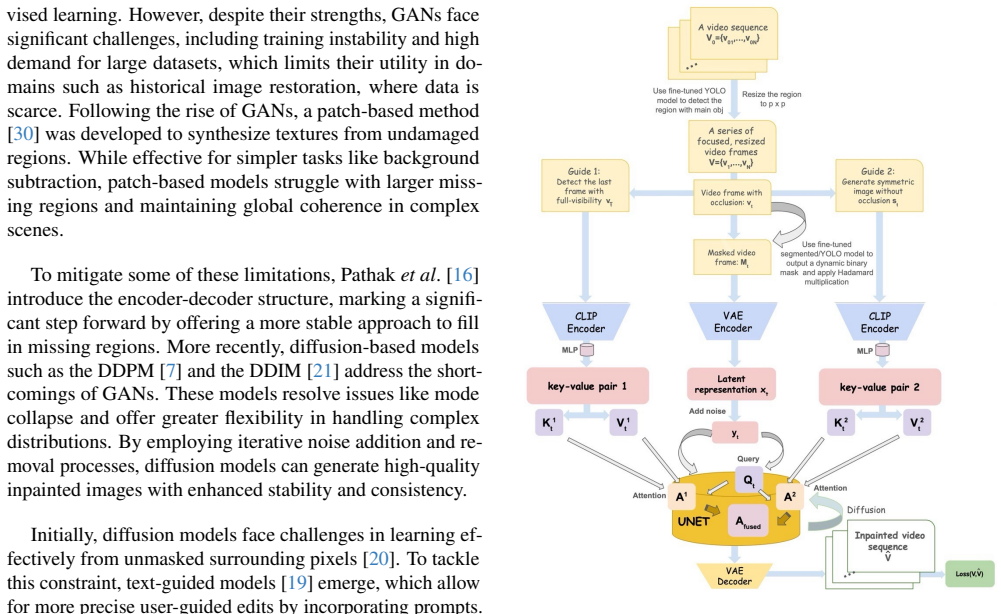
The central mechanism is dynamic dual-image guidance fused inside the diffusion U-Net. For each masked frame $v_t$, the pipeline builds two reference images: a symmetric image $s_t$ obtained by mirroring the visible half of the frame across a facial-landmark symmetry axis, and a past unobstructed frame $\bar{v}_t$ found by a fine-tuned object detector scanning earlier frames. Each reference is encoded by a pre-trained image encoder into key–value pairs; the noisy latent of the masked frame provides the query. At every U-Net layer the two attention maps $A^1_t$ and $A^2_t$ are combined as $A^{\mathrm{fused}}_t = \alpha_1 A^1_t + \alpha_2 A^2_t$ with learned weights. The denoising objective is augmented by a motion-consistency loss $L_{\mathrm{motion}} = \frac{2}{N}\sum_{t=1}^{N-1}\|y_{t,T}-y_{t-1,T}\|_2^2$ that keeps neighboring noisy latents close during diffusion.
What would settle it
Take a video in which the face is covered continuously for the entire clip, so no unobstructed past frame exists, and compare the full model with a version that receives only the symmetric guide. If the full model does not collapse to the single-symmetry ablation's FVD and temporal-consistency levels, the claimed temporal-guidance advantage is not doing the work; if it does collapse, the method's applicability is bounded by how quickly an unobstructed frame appears.
Extended reading notes
Core claim
On its own terms, the paper claims that a video inpainting pipeline can restore occluded moving faces better than existing image and video methods if it conditions denoising on two automatically chosen reference images instead of one: a symmetric image formed by mirroring the visible half of the face, and the most recent fully visible past frame. These two references are encoded separately, their key–value pairs are attended to by the noisy latent of the masked frame, and the two attention maps are combined with weighted coefficients inside each U-Net layer. A motion-consistency loss on neighboring noisy latents is added to the denoising objective. On the Baby dataset and the out-of-distribution HandOverFace dataset, DiffMVR reports the best FID, SSIM, TC, and FVD scores across all compared image and video baselines, with the ablation showing that dropping either guidance image or the motion loss substantially worsens the metrics.
Load-bearing premise
For every occluded frame, a recent earlier frame must exist in which the object is fully visible and correctly detected; when occlusions persist longer than that, the temporal guide is absent and the method degrades to the much weaker symmetry-only guide.
Editorial extensions
If this is right
- For each masked frame, the pipeline selects the most recent fully visible frame automatically, so no per-video manual annotation of reference frames is needed.
- The fused-attention design lets one noisy latent query two references at once, so adding a new guidance source is a matter of adding another key–value pair.
- The motion-consistency loss explicitly ties neighboring noisy latents, which is what the reported temporal-consistency and video-quality gains are attributed to.
- Segmented occlusion masks yield better restorations than bounding-box masks, suggesting the method benefits from precise mask boundaries.
- Because the method is evaluated on both an in-distribution infant video set and an out-of-distribution hand-over-face set, the guidance design is claimed to generalize beyond the training domain.
Reading between the lines
- Beyond the paper, the dual-guidance recipe should transfer to other near-symmetric objects with a reliable clean past reference, such as occluded hands or road signs, but the symmetry prior will need adjustment for shapes that are not bilaterally symmetric.
- Beyond the paper, sustained occlusions longer than the detector's search window are an untested regime; adding a bidirectional search over future frames or a long-term memory module would be a natural extension and would decide whether temporal guidance can survive long occlusions.
- Beyond the paper, the temporal consistency metric rewards inter-frame similarity, so part of the reported gain may come from the motion loss smoothing frames rather than from recovering true dynamics; a downstream action- or expression-recognition test would separate visual smoothness from semantic correctness.
Editorial analysis
A structured set of objections, weighed in public.
Referee Report
Summary. The paper proposes DiffMVR, a diffusion-based video inpainting model for restoring occluded facial regions in dynamic videos, motivated by infant pain monitoring in healthcare. The method automatically generates two guidance images per masked frame: a symmetric mirror of the visible portion of the current frame and the most recent past frame in which the object (the face) is fully visible. These are CLIP-encoded and fused through weighted cross-attention in a stable-diffusion U-Net, and a motion-consistency loss between adjacent noisy latents is added to the denoising loss. The model is evaluated on a proprietary IRB-approved Baby dataset and the HOF dataset against image inpainting baselines (LaMa, Stabilityai, Runwayml and fine-tuned variants) and video inpainting baselines (FGVI, PVI), with quantitative metrics FID, SSIM, TC, and FVD, plus qualitative comparisons and ablation studies.
Significance. If the empirical claims were fully supported, the dual-guidance idea—combining symmetric structural guidance with temporal reference from a past unobstructed frame—would be a useful contribution to video inpainting for occlusion restoration, an underexplored direction relative to object-removal-oriented video inpainting. The paper contains several strengths: a clearly described pipeline, component-wise ablations, honest qualitative examples that include failure cases, and the stated intention to release code. However, the central state-of-the-art claim is currently not established because the reported numbers contradict it, the most relevant diffusion-based video inpainting baselines are cited but not compared, and no statistical reliability of the small metric margins is provided. The significance of the work therefore remains conditional on a substantially strengthened evaluation.
major comments (5)
- [§4.4.2, Table 2; §5 Conclusions] The paper's internal quantitative results contradict the central claim that DiffMVR "surpasses all baseline models in both visual quality and quantitative metrics." In Table 2, DiffMVR's video-level FID on the Baby dataset with segmented masks is 2.095 versus PVI's 2.062 (DiffMVR worse by 1.6%), and with bounding boxes it is 2.119 versus PVI's 2.105 (worse by 0.7%). The text in §4.4.2 states that "DiffMVR achieves the best scores for both segmented masks and bounding boxes," which is not true for FID. The authors should either correct the claim, explain why FID is not decisive, or re-run the evaluation with consistent conclusions.
- [§2, §4.2] The paper cites AVID [28], MotionAura [22], and First Frame Filling [9] as diffusion-based video inpainting models but never benchmarks against them. Since the paper claims "state-of-the-art" performance and "consistently outperforms" inpainting models, a head-to-head comparison with the most relevant diffusion video inpainting baselines is necessary. Without these comparisons, the state-of-the-art claim is asserted rather than demonstrated. Adding these baselines or explicitly tempering the claim is required.
- [§4.3, §4.4.1, Table 1] There is an inconsistency between the description of the HOF dataset and the metrics reported for it. Section 4.4.1 states that HOF comprises 302 images, but Table 1 reports a TC (temporal consistency) score for HOF. TC is a video-level metric that requires frame sequences; it cannot be computed on still images. The authors should clarify whether HOF includes videos and, if it does not, remove the TC column for HOF or explain how TC was computed on images. This affects the generalization claim built on the HOF results.
- [§4.4, Tables 1–2] No error bars, confidence intervals, or significance tests are reported for any quantitative result. Several margins over the second-best baseline are very small (e.g., FVD 48.05 vs. 48.92, TC 0.338 vs. 0.339 on segmented masks), and on video-level FID DiffMVR is worse than PVI. Without multiple runs, cross-validation folds, or statistical tests, these differences cannot be distinguished from noise. The authors should add variance estimates or significance testing, or at minimum discuss the sensitivity of the rankings to these small margins.
- [§3.2, §4.6, Table 3] The method depends on the availability of a recent past frame in which the object is fully visible (found by a fine-tuned YOLOv8 model), but the paper never quantifies how often this condition is satisfied in the Baby dataset or in realistic monitoring scenarios. The ablation in Table 3 shows that using only the symmetric guidance leads to a large drop in performance (FID 2.57 vs. 2.10, SSIM 0.75 vs. 0.91, FVD 59.51 vs. 48.05), so the headline results are contingent on this assumption. The authors should report the frequency of missing past unobstructed frames and provide an explicit fallback strategy or an analysis of performance in such cases.
minor comments (5)
- [§3.3, Eq. (3)] The motion-consistency loss is written as a sum over t=1 to N-1 of ||y_{t,T} - y_{t-1,T}||^2, which references the undefined term y_{0,T}. The summation should presumably start at t=2 (or y_{t-1,T} should be y_{t+1,T}); please correct the index.
- [§4.6.2, Table 4 caption] The table caption uses the phrase "pervasive ablation test"; this appears to be a typo for "comprehensive ablation test." Also, the row labeled "Gap" is not clearly defined in the caption; please explain what the numerical gap values represent.
- [§4.5, Figure 2] Figure 2 is presented as showing both good and bad results on the HOF dataset, which is honest, but the figure caption does not describe what failure modes appear in the bad examples. Adding a brief description would help the reader interpret the qualitative evaluation.
- [References] The paper refers to an Appendix for metric definitions and additional qualitative results, but no appendix is included in the submitted version. Please include the appendix or remove the references to it.
- [§1, §4.1] The paper states practical implications for real-time applications, but no inference time, computational cost, or throughput measurements are reported. Adding such numbers would support the real-time claim.
Circularity Check
No significant circularity: the method is trained and evaluated on held-out data against external baselines, and the only self-citation is motivational, not load-bearing.
full rationale
The paper does not contain a derivation that reduces to its own inputs. The dual-guidance mechanism uses the visible half of the current frame (symmetric image) and a previous unobstructed frame as conditioning, but the target is the occluded region, so this is a legitimate feature rather than a circular definition. The diffusion loss and motion-consistency loss are standard training objectives, not fitted parameters renamed as predictions. The quantitative comparison is performed on held-out Baby and HOF test sets against external baselines such as LaMa, FGVI, PVI, and fine-tuned Stable Diffusion variants, which provides independent empirical support. The only self-citation is reference [5], a co-authored clinical pain-assessment paper used to motivate the healthcare application; it does not support any technical claim in the pipeline. The paper's internal inconsistency (Table 2 shows DiffMVR's video-level FID is worse than PVI on both mask types) and the omission of cited baselines such as AVID and MotionAura are correctness and benchmarking weaknesses, not circularity. Therefore the appropriate circularity finding is no significant circularity.
Assumptions & free parameters
free parameters (3)
- lambda (loss weighting) =
not reported
- alpha1, alpha2 (attention fusion weights) =
not reported
- Training hyperparameters (learning rate, batch size, number of steps, noise schedule) =
not reported
assumptions (5)
- domain assumption Stable Diffusion v1.5 latent diffusion model provides a suitable generative prior for video frames.
- domain assumption CLIP image embeddings are adequate representations for fine-grained facial guidance.
- ad hoc to paper Facial symmetry about a detected axis is a valid structural prior for occluded faces.
- ad hoc to paper Minimizing L2 distance between adjacent noisy latents promotes temporal coherence without distorting motion.
- domain assumption For every masked frame, a recent past frame exists where the object is fully visible and detectable.
Cite this review
Pith. "Pith review of DiffMVR: Diffusion-based Automated Multi-Guidance Video Restoration." pith.science (2026). https://pith.science/paper/KUMMJP5D
@misc{pith2026241118745,
  author       = {Pith},
  title        = {Pith review of: DiffMVR: Diffusion-based Automated Multi-Guidance Video Restoration},
  year         = {2026},
  howpublished = {\url{https://pith.science/paper/KUMMJP5D}},
  note         = {Machine review of arXiv:2411.18745}
}
read the original abstract
In this work, we address a challenge in video inpainting: reconstructing occluded regions in dynamic, real-world scenarios. Motivated by the need for continuous human motion monitoring in healthcare settings, where facial features are frequently obscured, we propose a diffusion-based video-level inpainting model, DiffMVR. Our approach introduces a dynamic dual-guided image prompting system, leveraging adaptive reference frames to guide the inpainting process. This enables the model to capture both fine-grained details and smooth transitions between video frames, offering precise control over inpainting direction and significantly improving restoration accuracy in challenging, dynamic environments. DiffMVR represents a significant advancement in the field of diffusion-based inpainting, with practical implications for real-time applications in various dynamic settings.
Figures


Reference graph
Works this paper leans on
-
[28]
Avid: Any-length video inpainting with diffusion model
Zhixing Zhang, Bichen Wu, Xiaoyan Wang, Yaqiao Luo, Luxin Zhang, Yinan Zhao, Peter Vajda, Dimitris Metaxas, and Licheng Yu. Avid: Any-length video inpainting with diffusion model. arXiv preprint arXiv:2312.03816, 2024
arXiv 2024
-
[22]
MotionAura: Generating High-Quality and Motion Consistent Videos using Discrete Diffusion
Onkar Susladkar, Jishu Sen Gupta, Chirag Sehgal, Sparsh Mittal, and Rekha Singhal. Motionaura: Generating high- quality and motion consistent videos using discrete diffusion. arXiv:2410.07659, 2024
work page Pith review arXiv 2024
-
[9]
Video diffusion models are strong video inpainters
Minhyeok Lee, Suhwan Cho, Chajin Shin, Jungho Lee, Sunghun Yang, and Sangyoun Lee. Video diffusion models are strong video inpainters. arXiv preprint arXiv:2408.11402, 2024
arXiv 2024
-
[1]
3d pano inpainting: Building a vr environment from a single input panorama
Shivam Asija, Edward Du, Nam Nguyen, Stefanie Zollmann, and Jonathan Ventura. 3d pano inpainting: Building a vr environment from a single input panorama. 2024 IEEE Con- ference on Virtual Reality and 3D User Interfaces Abstracts and Workshops (VRW), pages 1019–1020, 2024
work page 2024
-
[2]
Hands segmentation is all you need
Guglielmo Camporese. Hands segmentation is all you need. https://github.com/guglielmocamporese, 2021
work page 2021
-
[3]
Analysis of hand segmentation on challenging hand over face scenario
Sakher Ghanem, Ashiq Imran, and Vassilis Athitsos. Analysis of hand segmentation on challenging hand over face scenario. In Proceedings of the 12th ACM International Conference on PErvasive Technologies Related to Assistive Environments, page 236–242, 2019
work page 2019
-
[4]
Ian Goodfellow, Jean Pouget-Abadie, Mehdi Mirza, Bing Xu, David Warde-Farley, Sherjil Ozair, Aaron Courville, and Y . Bengio. Generative adversarial networks. Advances in Neural Information Processing Systems, 3, 2014
work page 2014
-
[5]
Anderson, Caroline Arbour, Patrick J
Keela Herr, Alison R. Anderson, Caroline Arbour, Patrick J. Coyne, Elizabeth Ely, C´eline G´elinas, and Renee C.B. Man- worren. Pain assessment in the patient unable to self-report: Clinical practice recommendations in support of the aspmn 2024 position statement. Pain Management Nursing, 2024
work page 2024
Show all 30 references
-
[6]
Gans trained by a two time-scale update rule converge to a local nash equilibrium
Martin Heusel, Hubert Ramsauer, Thomas Unterthiner, Bern- hard Nessler, and Sepp Hochreiter. Gans trained by a two time-scale update rule converge to a local nash equilibrium. Advances in Neural Information Processing Systems, 2017
2017
-
[7]
Denoising diffu- sion probabilistic models
Jonathan Ho, Ajay Jain, and Pieter Abbeel. Denoising diffu- sion probabilistic models. In Advances in Neural Information Processing Systems, volume 33, pages 6840–6851, 2020
2020
-
[8]
Learning blind video temporal consistency
Wei-Sheng Lai, Jia-Bin Huang, Oliver Wang, Eli Shechtman, Ersin Yumer, and Ming-Hsuan Yang. Learning blind video temporal consistency. In European Conference on Computer Vision, 2018
2018
-
[10]
Copy-and-paste networks for deep video inpainting
Sungho Lee, Seoung Wug Oh, Daeyeun Won, and Seon Joo Kim. Copy-and-paste networks for deep video inpainting. In 2019 IEEE/CVF International Conference on Computer Vision (ICCV), pages 4412–4420, 2019
2019
-
[11]
Short-term and long-term context aggregation net- work for video inpainting
Ang Li, Shanshan Zhao, Xingjun Ma, Mingming Gong, Jianzhong Qi, Rui Zhang, Dacheng Tao, and Ramamohanarao Kotagiri. Short-term and long-term context aggregation net- work for video inpainting. arXiv preprint arXiv:2009.05721, 2020
2009 arXiv
-
[12]
Towards an end-to-end framework for flow-guided video inpainting
Zhen Li, Cheng-Ze Lu, Jianhua Qin, Chun-Le Guo, and Ming-Ming Cheng. Towards an end-to-end framework for flow-guided video inpainting. In Proceedings of the 2022 IEEE/CVF Conference on Computer Vision and Pattern Recognition (CVPR), 2022
2022
-
[13]
Reda, Kevin J
Guilin Liu, Fitsum A. Reda, Kevin J. Shih, Ting-Chun Wang, Andrew Tao, and Bryan Catanzaro. Image inpainting for irregular holes using partial convolutions. Proceedings of the European Conference on Computer Vision (ECCV), 2018
2018
-
[14]
Ddm-lag: A diffusion-based decision-making model for autonomous vehicles with lagrangian safety enhancement
Jiaqi Liu, Peng Hang, Xiaocong Zhao, Jianqiang Wang, and Jian Sun. Ddm-lag: A diffusion-based decision-making model for autonomous vehicles with lagrangian safety enhancement. arXiv preprint arXiv:2401.03629, 2024
2024 arXiv
-
[15]
Internal video inpainting by implicit long-range propagation
Hao Ouyang, Tengfei Wang, and Qifeng Chen. Internal video inpainting by implicit long-range propagation. 2021 IEEE/CVF International Conference on Computer Vision (ICCV), pages 14559–14568, 2021
2021
-
[16]
Deepak Pathak, Philipp Kr ¨ahenb¨uhl, Jeff Donahue, Trevor Darrell, and Alexei A. Efros. Context encoders: Feature learn- ing by inpainting. In 2016 IEEE Conference on Computer Vision and Pattern Recognition (CVPR), pages 2536–2544, 2016
2016
-
[17]
Learning transferable visual models from natural language supervision
Alec Radford, Jong Wook Kim, Chris Hallacy, Aditya Ramesh, Gabriel Goh, Sandhini Agarwal, Girish Sastry, Amanda Askell, Pamela Mishkin, Jack Clark, Gretchen Krueger, and Ilya Sutskever. Learning transferable visual models from natural language supervision. In International Con...
2021
-
[18]
Gener- ating diverse high-fidelity images with vq-vae-2
Ali Razavi, A¨aron van den Oord, and Oriol Vinyals. Gener- ating diverse high-fidelity images with vq-vae-2. In Neural Information Processing Systems, 2019
2019
-
[19]
High-resolution image synthesis with latent diffusion models
Robin Rombach, Andreas Blattmann, Dominik Lorenz, Patrick Esser, and Bj ¨orn Ommer. High-resolution image synthesis with latent diffusion models. In Proceedings of the IEEE/CVF Conference on Computer Vision and Pattern Recognition (CVPR), pages 10684–10695, 2022
2022
-
[20]
Palette: Image-to-image diffusion models
Chitwan Saharia, William Chan, Huiwen Chang, Chris Lee, Jonathan Ho, Tim Salimans, David Fleet, and Mohammad Norouzi. Palette: Image-to-image diffusion models. In ACM SIGGRAPH 2022 Conference Proceedings, 2022
2022
-
[21]
Denoising diffusion implicit models
Jiaming Song, Chenlin Meng, and Stefano Ermon. Denoising diffusion implicit models. arXiv preprint arXiv:2010.02502, 2020
2010 arXiv
-
[23]
Lempitsky
Roman Suvorov, Elizaveta Logacheva, Anton Mashikhin, Anastasia Remizova, Arsenii Ashukha, Aleksei Silvestrov, Naejin Kong, Harshith Goka, Kiwoong Park, and Victor S. Lempitsky. Resolution-robust large mask inpainting with fourier convolutions. 2022 IEEE/CVF Winter Conference o...
2022
-
[24]
A comprehensive review of yolo architectures in computer vision: From yolov1 to yolov8 and yolo-nas
Juan Terven, Diana-Margarita C´ordova-Esparza, and Julio- Alejandro Romero-Gonz´alez. A comprehensive review of yolo architectures in computer vision: From yolov1 to yolov8 and yolo-nas. Machine Learning and Knowledge Extraction, 5(4):1680–1716, 2023
2023
-
[25]
To- wards accurate generative models of video: A new metric & challenges
Thomas Unterthiner, Sjoerd van Steenkiste, Karol Kurach, Raphael Marinier, Marcin Michalski, and Sylvain Gelly. To- wards accurate generative models of video: A new metric & challenges. arXiv:1812.01717, 2019
2019 arXiv
-
[26]
Bovik, Hamid R
Zhou Wang, Alan C. Bovik, Hamid R. Sheikh, and Eero P. Simoncelli. Image quality assessment: From error visibility to structural similarity. IEEE Transactions on Image Processing, 13(4):600–612, 2004
2004
-
[27]
Diffusion models for medical anomaly detection
Julia Wolleb, Florentin Bieder, Robin Sandk ¨uhler, and Philippe Claude Cattin. Diffusion models for medical anomaly detection. In International Conference on Medi- cal Image Computing and Computer-Assisted Intervention, 2022
2022
-
[29]
Shangchen Zhou, Chongyi Li, Kelvin C. K. Chan, and Chen Change Loy. Propainter: Improving propagation and transformer for video inpainting. arXiv preprint arXiv:2309.03897, 2023
2023 arXiv
-
[30]
Patch-based texture synthesis for image inpainting
Tao Zhou, Brian David Johnson, and Rui Li. Patch-based texture synthesis for image inpainting. arXiv preprint arXiv:1605.01576, 2016
2016 arXiv
Reviewed August 12, 2026 · model on record in the stance chip above.
Discussion (0). Continue with ORCID to comment.