REVIEW 3 major objections 4 minor 21 references
Towards Secure and Decentralized Sharing of IoT Data
T0 review · 3 major / 4 minor · reviewed 2026-08-14 · deepseek-v4-flash
Pith's one-line read The paper claims a smart contract can act as the policy decision point for IoT data access, making policy changes and access requests publicly auditable.
desk verdict The framework idea is coherent, but the paper's own Listing 5 fails to implement the claimed payment and access-control logic, which is a load-bearing flaw. read the letter →
The pith
A machine-rendered reading of the paper's core claim, the machinery that carries it, and where it could break.
The reading
What carries the argument
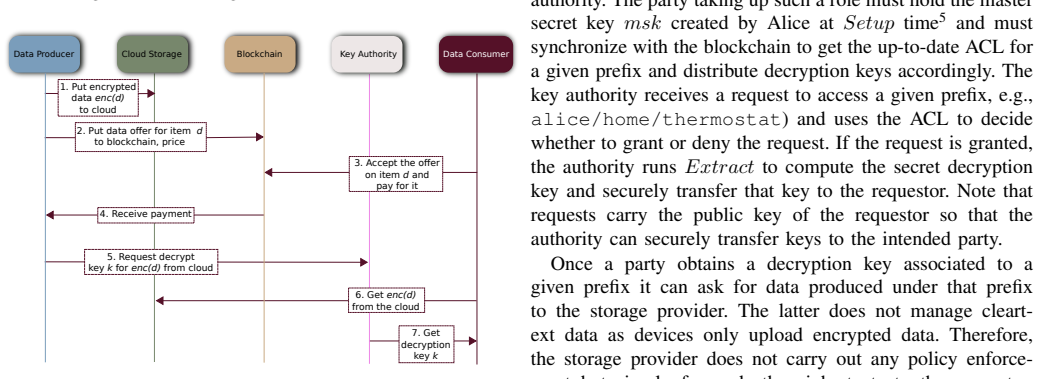
The central object is the data-marketplace smart contract running on the blockchain, paired with prefix encryption. The smart contract implements four functions—verify metadata, add metadata, create offer, and accept offer—and bookkeeps IOU payment accounts; it is what makes access decisions and ACL updates append-only and auditable. Prefix encryption, a flavor of hierarchical identity-based encryption where a key for identity ID decrypts ciphertexts under any identity having ID as a prefix, lets one decryption key cover an entire subtree of devices and minimizes requests to the key authority. The blockchain's consensus engine supplies the trust assumption that no single party can override this logic.
What would settle it
Instrument the ordering service to silently drop a paid acceptOffer transaction, then check whether the consumer can still obtain the decryption key or plaintext from the cloud; if unauthorized access occurs, the paper's auditable-decision claim fails.
Extended reading notes
Core claim
The central claim is that the blockchain can take over the access-control decision from a centralized IoT broker. In Sash, a smart contract handles access-control policies and evaluates access requests: it checks the data owner's offer, the consumer's identity and payment through IOU accounts, and updates the ACL by adding the consumer's identity. Because these updates happen through blockchain transactions, policy changes and access decisions are correctly managed, publicly verifiable, and auditable. In the extended scheme, access control is cryptography-enforced with prefix encryption: a key authority holds the master secret and issues a key for a requested prefix only if the blockchain ACL authorizes that consumer, so the storage provider never handles plaintext. The paper argues that this decentralizes the trust placed in a single IoT platform while introducing moderate, predictable overhead.
Load-bearing premise
Everything rests on the blockchain network itself being an honest, available decision maker; if the party or parties controlling transaction ordering can drop or reorder requests, or if an adversary holds a majority of voting power, the ACL and key-distribution guarantees no longer hold.
Editorial extensions
If this is right
- If the smart contract is the policy decision point, the centralized IoT broker no longer needs to be trusted to interpret policies; it can only enforce the contract's decisions.
- Every policy change, offer acceptance, and payment becomes part of the ledger, giving data owners and regulators a tamper-evident audit trail.
- Because payment is integrated into the accept-offer transaction, data producers are remunerated by design rather than through a separate billing mechanism.
- Prefix encryption means a consumer authorized for a prefix such as alice/home can decrypt all sensors under that prefix with one key, so key-distribution traffic stays low as the device fleet grows.
- A malicious or compromised storage provider can at worst deny service or leak ciphertexts, not plaintext, in the prefix-encryption instantiation.
Reading between the lines
- If the scheme is deployed at scale, the identity manager that issues blockchain membership identities becomes a higher-value target than the storage provider, because membership is what gates both offers and key requests.
- The HIBE hierarchy implies that compromise of a device-level key only exposes that subtree, but compromise of the master secret exposes all device data under it; the paper does not analyze master-key rotation, so a natural extension is a formal revocation and re-encryption protocol.
- A testable extension is to replace the IOU bookkeeping with atomic on-chain settlement, so acceptance, payment transfer, and ACL update happen in one transaction; this would let a fair-exchange property be proven rather than assumed.
- The same smart-contract decision point could mediate cross-domain search indexing, where multiple IoT domains must agree on policies without trusting one another; the paper names this as future work, and the architecture would need a global policy contract on top of the per-domain offering.
Signed reviews
Editorial analysis
A structured set of objections, weighed in public.
Referee Report
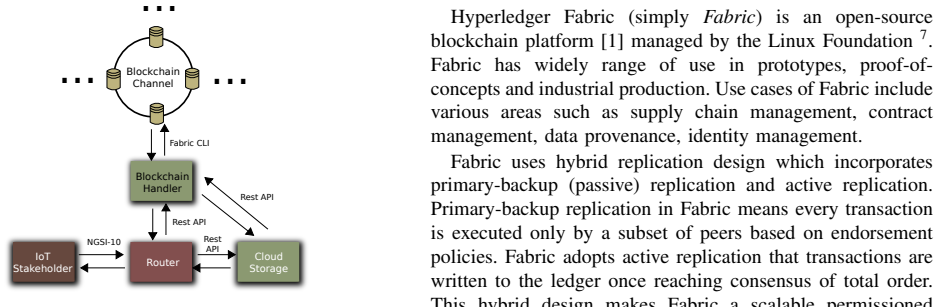
Summary. This paper presents Sash, a framework for decentralized IoT data sharing that places the policy decision point on a Hyperledger Fabric blockchain. Data is stored off-chain, access-control policies are stored in a smart contract, and access requests are evaluated on-chain so that policy changes and access decisions are auditable. The framework also includes a data marketplace with IOU accounts for remunerating data producers, and a second scheme that uses prefix encryption to enforce access control cryptographically. The authors prototype Sash by integrating FIWARE with Hyperledger Fabric and report commit and fetch latencies for file sizes up to 20 MB.
Significance. If the design were sound, Sash would be a useful step toward eliminating the single-point-of-trust IoT broker and making access-control decisions publicly verifiable. The paper composes standard building blocks (blockchain, smart contracts, prefix encryption) and reports a concrete prototype with performance measurements, which are positive features. However, the central smart-contract pseudocode contains an internal error that breaks the claimed payment and access-control functionality; the security analysis is informal; and the evaluation lacks baselines and error bars. The contribution is therefore promising but not yet substantiated.
major comments (3)
- [IV-B, Listing 5] In Listing 5, the acceptOffer function never persists the computed IOU balance: after value = cvalue + offer.value (or the subtraction branch), no map.Set stores value under the IOU key. Furthermore, the final map.Set(key, append(offer.mdata.ACL, user.ID)) writes the updated ACL to the IOU key, because key was reassigned to the IOU key in the preceding conditional branches, rather than to the data item's ACL key. As a result, the smart contract as presented does not record payment and does not grant the consumer access to the data, directly contradicting the claims in Section IV-A that the smart contract bookkeeps trade information via IOU accounts and in Section IV-D that only parties that have paid the price gain access. This is a load-bearing internal inconsistency that affects the core functionality of the proposed system.
- [IV-D] The security analysis in Section IV-D is informal and does not provide a concrete adversarial model for Hyperledger Fabric. The blanket assumption that the network satisfies 'the standard safety conditions particular to the underlying blockchain technology' is not appropriate for a permissioned Fabric deployment, where security depends on endorsement policies, the ordering service (here implemented with Kafka), and the trust assumptions on individual peers. Without specifying these, the claims that access decisions are publicly verifiable and that a misbehaving cloud provider can be held accountable are not substantiated. This is especially important because the ACL-based scheme relies on the cloud provider faithfully enforcing access decisions; the threat model does not state whether the cloud is assumed honest-but-curious or malicious in that scheme.
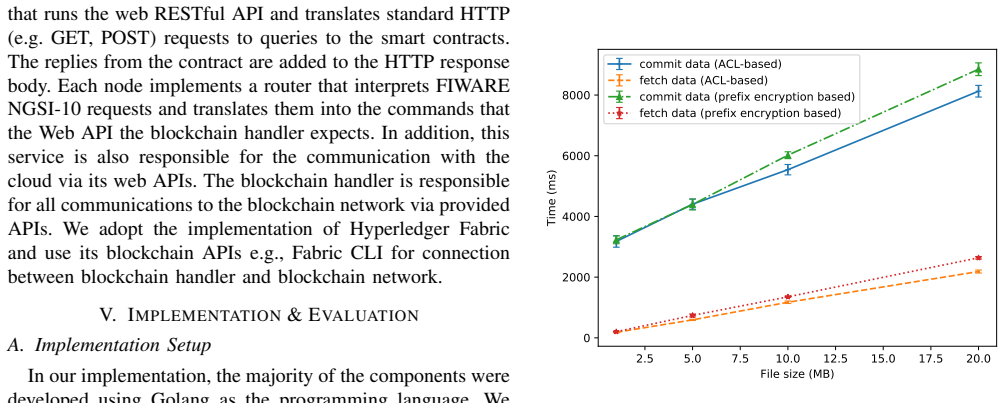
- [V-B] The performance evaluation reports results for only four data sizes, with no error bars, confidence intervals, or number of runs, and no baseline comparison against a centralized or non-blockchain approach. The statement that the time increases 'in a quasi linear fraction' is not quantified, and the comparison between the ACL-based and prefix-encryption schemes does not separate the latency introduced by the key authority. The evaluation therefore does not fully support the paper's claim of tolerable overhead in realistic deployment settings.
minor comments (4)
- [Abstract and throughout] The name 'FIWARE' is inconsistently typeset as 'FIW ARE' or 'FIW ARE' in several places, including the abstract; please use the standard spelling consistently.
- [V-B] The text discusses the effect of key depth in prefix encryption but Figure 4 does not show key-depth results; please add a plot or clarify that the conclusion is based on tests not displayed.
- [VII] The concluding remark that Sash is 'the first' framework of its kind is not established by the related-work comparison; please temper this claim or provide explicit evidence.
- [III-A] The problem statement says existing solutions 'require owners to handle policy updates,' but the distinction between the owner performing updates and the blockchain performing updates should be stated more precisely to avoid appearing to dismiss prior work that also automates policy management.
Circularity Check
No circularity: Sash composes standard blockchain, smart-contract, and prefix-encryption primitives; the main issues are evaluation scope and contract-correctness, not circular reasoning.
full rationale
I walked the paper's derivation chain and found no step in which an output quantity is defined in terms of itself, a fitted parameter is renamed as a prediction, or a load-bearing conclusion rests on a self-citation. Sash is a systems-design paper: it composes a permissioned blockchain (Hyperledger Fabric), smart contracts for a data marketplace, off-chain storage, ACLs, and prefix encryption. There is no fitted quantity whose value is later "predicted"; the performance evaluation measures the authors' own prototype, which is a benchmarking soundness concern but not circularity. The security claims in Section IV-D explicitly rely on the stated standard blockchain safety assumptions and on the trust model in Section III-B; those assumptions may be informal or incomplete, but they are not an instance of the paper importing its conclusion through its premises. The only in-scope anomaly I found is a potential internal correctness bug in Listing 5: after computing `value = cvalue +/- offer.value`, the function never stores `value` back into the IOU account, and later calls `map.Set(key, append(offer.mdata.ACL, user.ID))` while `key` still names the IOU entry. This means the presented contract does not appear to persist the payment balance or update the intended data ACL, and it never verifies that the consumer has actually paid. That is a substantive flaw in the artifact as written, but it is a correctness and implementation defect, not a circularity: the design claims are not true by construction; if anything, the code falls short of the claimed behavior. No circularity score is warranted, so I assign 0.
Assumptions & free parameters
assumptions (5)
- domain assumption The underlying blockchain satisfies standard safety conditions, e.g., in PoW the adversary cannot control the majority of computing power.
- standard math Prefix encryption (an HIBE variant) satisfies the IND-ID-CCA security notion from Boneh et al. [3].
- domain assumption IoT data is naturally organized in a hierarchy so that prefix encryption provides fine-grained access without many keys.
- domain assumption The storage provider acts as an honest policy enforcement point in the ACL scheme, and the key authority is trusted or fully distributed in the prefix-encryption scheme.
- domain assumption IOU accounts can be settled off-chain using standard payment methods.
Cite this review
Pith. "Pith review of Towards Secure and Decentralized Sharing of IoT Data." pith.science (2026). https://pith.science/paper/KVBAB3XN
@misc{pith2026190809015,
  author       = {Pith},
  title        = {Pith review of: Towards Secure and Decentralized Sharing of IoT Data},
  year         = {2026},
  howpublished = {\url{https://pith.science/paper/KVBAB3XN}},
  note         = {Machine review of arXiv:1908.09015}
}
read the original abstract
The Internet of Things (IoT) bears unprecedented security and scalability challenges due to the magnitude of data produced and exchanged by IoT devices and platforms. Some of those challenges are currently being addressed by coupling IoT applications with blockchains. However, current blockchain-backed IoT systems simply use the blockchain to store access control policies, thereby underutilizing the power of blockchain technology. In this paper, we propose a new framework named Sash that couples IoT platforms with blockchain that provides a number of advantages compared to state of the art. In Sash, the blockchain is used to store access control policies and take access control decisions. Therefore, both changes to policies and access requests are correctly enforced and publicly auditable. Further, we devise a ``data marketplace'' by leveraging the ability of blockchains to handle financial transaction and providing ``by design'' remuneration to data producers. Finally, we exploit a special flavor of identity-based encryption to cater for cryptography-enforced access control while minimizing the overhead to distribute decryption keys. We prototype Sash by using the FIWARE open source IoT platform and the Hyperledger Fabric framework as the blockchain back-end. We also evaluate the performance of our prototype and show that it incurs tolerable overhead in realistic deployment settings.
Figures

Figures from the paper (1 more)
Reference graph
Works this paper leans on
-
[1]
E. Androulaki, A. Barger, V . Bortnikov, C. Cachin, K. Christidis, A. De Caro, D. Enyeart, C. Ferris, G. Laventman, Y . Manevich, S. Muralidharan, C. Murthy, B. Nguyen, M. Sethi, G. Singh, K. Smith, A. Sorniotti, C. Stathakopoulou, M. Vukoli´c, S. W. Cocco, and J. Yellick. Hyperledger fabric: A distributed operating system for permissioned blockchains. In...
work page 2018
-
[2]
D. Boneh, X. Boyen, and E.-J. Goh. Hierarchical identity based encryp- tion with constant size ciphertext. In Proceedings of the 24th Annual International Conference on Theory and Applications of Cryptographic Techniques, EUROCRYPT’05, pages 440–456, Berlin, Heidelberg, 2005. Springer-Verlag
work page 2005
- [3]
-
[4]
D. Chatzopoulos, S. Gujar, B. Faltings, and P. Hui. Privacy Preserving and Cost Optimal Mobile Crowdsensing using Smart Contracts on Blockchain. ArXiv e-prints, Aug. 2018
work page 2018
-
[5]
K. Christidis and M. Devetsikiotis. Blockchains and smart contracts for the internet of things. IEEE Access, 4:2292–2303, 2016
work page 2016
-
[6]
C. Esposito, A. D. Santis, G. Tortora, H. Chang, and K. R. Choo. Blockchain: A panacea for healthcare cloud-based data security and privacy? IEEE Cloud Computing , 5(1):31–37, Jan./Feb. 2018
work page 2018
-
[7]
S. Hu, C. Cai, Q. Wang, C. Wang, X. Luo, and K. Ren. Searching an encrypted cloud meets blockchain: A decentralized, reliable and fair realization. In IEEE INFOCOM 2018 - IEEE Conference on Computer Communications, pages 792–800, April 2018
work page 2018
-
[8]
N. Kaaniche and M. Laurent. A blockchain-based data usage auditing architecture with enhanced privacy and availability. In 2017 IEEE 16th International Symposium on Network Computing and Applications (NCA), pages 1–5, Oct 2017
work page 2017
Show all 21 references
-
[9]
Kokoris-Kogias, E
E. Kokoris-Kogias, E. C. Alp, S. D. Siby, N. Gailly, L. Gasser, P. Jovanovic, E. Syta, and B. Ford. Calypso: Auditable sharing of private data over blockchains. Cryptology ePrint Archive, Report 2018/209,
2018
-
[10]
Laurent, N
M. Laurent, N. Kaaniche, C.-Y . Le, and M. V . Plaetse. An access control scheme based on blockchain technology. 2018
2018
-
[11]
A. Lei, H. Cruickshank, Y . Cao, C. P. Anyigor Ogah, P. Asuquo, and Z. Sun. Blockchain-based dynamic key management for heterogeneous intelligent transportation systems. PP, 08 2017
2017
-
[12]
Z. Li, J. Kang, R. Yu, D. Ye, Q. Deng, and Y . Zhang. Consortium blockchain for secure energy trading in industrial internet of things. IEEE Transactions on Industrial Informatics , 14(8):3690–3700, Aug 2018
2018
-
[13]
Liang, S
G. Liang, S. R. Weller, F. Luo, J. Zhao, and Z. Y . Dong. Distributed blockchain-based data protection framework for modern power systems against cyber attacks. IEEE Transactions on Smart Grid , pages 1–1, 2018
2018
-
[14]
Mylrea and S
M. Mylrea and S. N. G. Gourisetti. Blockchain for smart grid resilience: Exchanging distributed energy at speed, scale and security. In 2017 Resilience Week (RWS), pages 18–23, Sep. 2017
2017
-
[15]
J. Pan, J. Wang, A. Hester, I. Alqerm, Y . Liu, and Y . Zhao. EdgeChain: An Edge-IoT Framework and Prototype Based on Blockchain and Smart Contracts. ArXiv e-prints, June 2018
2018
-
[16]
C. Qiu, F. R. Yu, F. Xu, H. Yao, and C. Zhao. Blockchain-based distributed software-defined vehicular networks via deep q-learning. In Proceedings of the 8th ACM Symposium on Design and Analysis of Intelligent Vehicular Networks and Applications, DIV ANet’18, pages 8– 14, New Y...
2018
-
[17]
Shafagh, L
H. Shafagh, L. Burkhalter, A. Hithnawi, and S. Duquennoy. Towards blockchain-based auditable storage and sharing of iot data. In Proceed- ings of the 2017 on Cloud Computing Security Workshop , CCSW ’17, pages 45–50, New York, NY , USA, 2017. ACM
2017
-
[18]
Shrestha and J
A. Shrestha and J. Vassileva. Blockchain-Based Research Data Sharing Framework for Incentivizing the Data Owners, pages 259–266. 06 2018
2018
-
[19]
Suliman, Z
A. Suliman, Z. Husain, M. Abououf, M. Alblooshi, and K. Salah. Monetization of iot data using smart contracts. IET Networks , 8:32– 37(5), January 2019
2019
-
[20]
Yakubov, W
A. Yakubov, W. M. Shbair, A. Wallbom, D. Sanda, and R. State. A blockchain-based pki management framework. In NOMS 2018 - 2018 IEEE/IFIP Network Operations and Management Symposium , pages 1– 6, April 2018
2018
-
[2018]
https://eprint.iacr.org/2018/209
2018
Reviewed August 14, 2026 · model on record in the stance chip above.
Discussion (0). Continue with ORCID to comment.