Quantum algorithms for equational reasoning
Pith reviewed 2026-05-21 22:56 UTC · model grok-4.3
The pith
A quantum Hamiltonian encodes all equivalent expressions as its ground state superposition to solve equational reasoning tasks.
A machine-rendered reading of the paper's core claim, the machinery that carries it, and where it could break.
Core claim
We introduce quantum normal form reduction, a framework in which an efficiently implementable quantum Hamiltonian has a ground state that encodes the complete set of equivalent expressions in quantum superposition. Manipulating these states directly addresses core tasks in equational reasoning such as verification, counting, and property identification.
What carries the argument
The efficiently implementable quantum Hamiltonian whose ground state is the superposition of all expressions in an equivalence class.
If this is right
- Equivalence verification reduces to preparing the ground state and checking membership or overlap.
- Counting the number of equivalent expressions becomes a matter of estimating the support size of the superposition state.
- Structural properties of equivalence classes can be read out by measurements on the prepared quantum state.
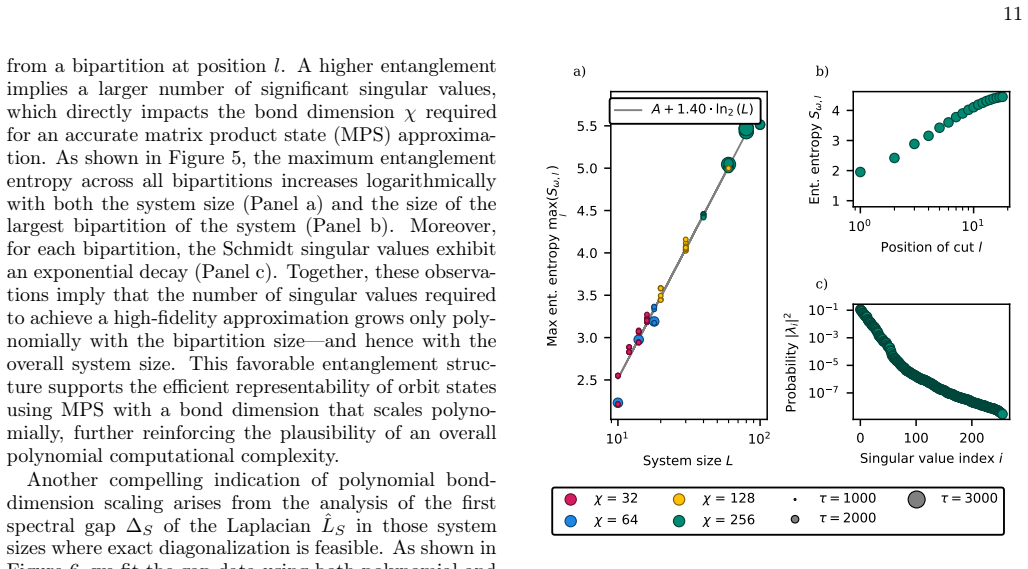
- Tensor network methods can simulate the quantum approach for very large instances on classical hardware.
Where Pith is reading between the lines
- Similar Hamiltonian constructions might apply to other combinatorial explosion problems in symbolic computation.
- The approach could be extended to find minimal representatives or normal forms directly in the quantum state.
- Connections to quantum simulation of algebraic structures may emerge in computational group theory applications.
Load-bearing premise
An efficiently implementable Hamiltonian exists whose ground state exactly encodes the full equivalence class of expressions.
What would settle it
Construct the Hamiltonian for a small equational system and check whether the ground state superposition contains precisely the expected set of equivalent expressions and no others.
Figures




read the original abstract
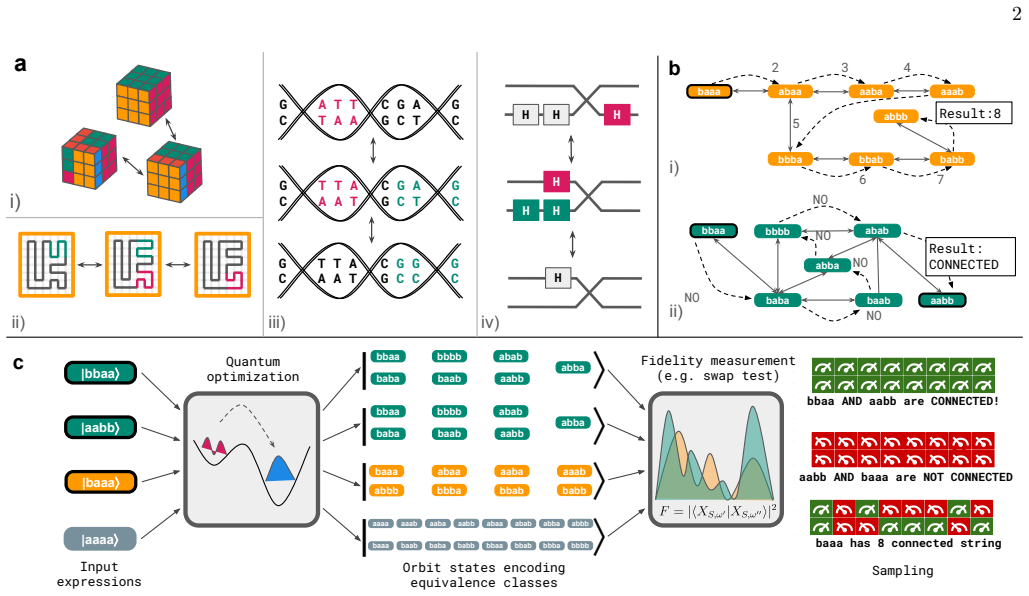
As a cornerstone of automated reasoning, equational reasoning finds equivalences between symbolic expressions and fuels advances across scientific disciplines. Yet, its potential remains limited by the exponential growth of equivalent expressions with increasing problem size. We introduce quantum normal form reduction, a quantum computational framework designed to address this challenge. We construct an efficiently implementable quantum Hamiltonian whose ground state encodes all equivalent expressions in a quantum superposition. By preparing and manipulating these states, we tackle fundamental problems in equational reasoning, including verifying and counting equivalent expressions and identifying structural properties of equivalence classes. We demonstrate a quantum-inspired version of the algorithm, using tensor networks to solve instances involving up to 10^28 equivalent expressions, far beyond the reach of classical graph exploration. This framework opens the path for quantum symbolic computation in areas from circuit design to data compression, computational group theory, linguistics, and macromolecular modeling, unlocking previously inaccessible problems.
Editorial analysis
A structured set of objections, weighed in public.
Referee Report
Summary. The manuscript introduces quantum normal form reduction, a quantum framework for equational reasoning. It constructs an efficiently implementable quantum Hamiltonian whose ground state encodes all equivalent expressions under given rules in superposition. This enables quantum algorithms for verifying equivalence, counting equivalent expressions, and analyzing class properties. A tensor-network implementation is demonstrated on instances with up to 10^28 equivalent expressions.
Significance. If the Hamiltonian construction and efficient implementability hold, the work could enable quantum methods for symbolic computation tasks limited by exponential classical scaling, with applications in circuit design, group theory, linguistics, and modeling. The tensor-network demonstration for extremely large instances is a concrete strength showing reach beyond classical graph methods.
major comments (1)
- Hamiltonian construction (main text, quantum normal form reduction section): the central claim of an efficiently implementable Hamiltonian whose ground state exactly superposes the full equivalence class lacks an explicit form, locality analysis, or proof that terms remain poly-time describable without exponential size for general rules; this is load-bearing for the efficient quantum advantage and must be expanded with a concrete derivation or complexity bound to address potential hidden oracles or non-local penalties.
Simulated Author's Rebuttal
We thank the referee for their constructive review and for recognizing the potential of the quantum framework for equational reasoning. We address the major comment below and will incorporate additional details in the revised manuscript to strengthen the exposition.
read point-by-point responses
-
Referee: Hamiltonian construction (main text, quantum normal form reduction section): the central claim of an efficiently implementable Hamiltonian whose ground state exactly superposes the full equivalence class lacks an explicit form, locality analysis, or proof that terms remain poly-time describable without exponential size for general rules; this is load-bearing for the efficient quantum advantage and must be expanded with a concrete derivation or complexity bound to address potential hidden oracles or non-local penalties.
Authors: We agree that a more explicit derivation would strengthen the central claim. In the revised manuscript we will expand the quantum normal form reduction section with a concrete construction of the Hamiltonian as a sum of local penalty terms, each directly encoding one application of a given equational rule on the expression tree. We will include a locality analysis establishing that every term acts on a number of qubits bounded by the fixed arity of the operators appearing in the rule set. We will also add a complexity argument showing that, for any fixed rule set, the full Hamiltonian description remains polynomial in the size of the input expression and does not require exponential resources or hidden oracles; all terms are generated explicitly from the input rules and the chosen encoding of expressions. These additions will clarify the efficient implementability without altering the original claims. revision: yes
Circularity Check
No circularity in novel Hamiltonian construction for equational reasoning
full rationale
The paper presents a first-principles construction of a quantum Hamiltonian whose ground state encodes equivalence classes of symbolic expressions, without any fitted parameters, self-definitional loops, or load-bearing self-citations that reduce the central claim to prior inputs. The framework is introduced as a new quantum-inspired method for verifying, counting, and analyzing equivalences, with a tensor-network demonstration serving as an independent practical validation for large instances rather than a re-derivation. No equations or steps in the provided abstract and context reduce the result to its own assumptions by construction; the derivation remains self-contained as an algorithmic proposal.
Axiom & Free-Parameter Ledger
axioms (1)
- standard math Standard assumptions of quantum mechanics and Hamiltonian simulation apply to the constructed operator.
invented entities (1)
-
Quantum normal form reduction Hamiltonian
no independent evidence
Reference graph
Works this paper leans on
-
[1]
J. W. Klop, Marc Bezem, and R. C. De Vrijer,Term Rewriting Systems (Cambridge University Press, USA, 2001)
work page 2001
-
[2]
Franz Baader and Tobias Nipkow,Term rewriting and all that (Cambridge university press, 1998)
work page 1998
-
[3]
Equations and rewrite rules: A survey,
Gérard Huet and Derek C. Oppen, “Equations and rewrite rules: A survey,” inFormal Language Theory, edited by RONALD V. BOOK (Academic Press, 1980) pp. 349–405
work page 1980
-
[4]
Equational reasoning and term rewriting systems,
David A Plaisted, “Equational reasoning and term rewriting systems,” Handbook of logic in artificial in- telligence and logic programming1, 273–364 (1993)
work page 1993
-
[5]
Charles C. Sims,Computation with Finitely Presented Groups, Encyclopedia of Mathematics and its Applica- tions (Cambridge University Press, 1994)
work page 1994
-
[6]
David Lawrence Johnson,Presentations of groups, 15 (Cambridge university press, 1997)
work page 1997
-
[7]
Refutational theorem proving using term- rewriting systems,
Jieh Hsiang, “Refutational theorem proving using term- rewriting systems,” Artificial Intelligence25, 255–300 (1985)
work page 1985
-
[8]
A complete equa- tional theory for quantum circuits,
Alexandre Clément, Nicolas Heurtel, Shane Mansfield, Simon Perdrix, and Benoît Valiron, “A complete equa- tional theory for quantum circuits,” in2023 38th Annual ACM/IEEE Symposium on Logic in Computer Science (LICS) (2023) pp. 1–13
work page 2023
-
[9]
Minimal equational theories for quantum circuits,
Alexandre Clément, Noé Delorme, and Simon Perdrix, “Minimal equational theories for quantum circuits,” in Proceedings of the 39th Annual ACM/IEEE Symposium on Logic in Computer Science, LICS ’24 (Association for Computing Machinery, New York, NY, USA, 2024)
work page 2024
-
[10]
Rapid solution of logi- cal equivalence problems by quantum computation al- gorithm,
Mohammed Zidan, Salem F Hegazy, Mahmoud Abdel- Aty, and Salah SA Obayya, “Rapid solution of logi- cal equivalence problems by quantum computation al- gorithm,” Applied Soft Computing132, 109844 (2023)
work page 2023
-
[11]
Equivalence checking of reversible circuits,
Robert Wille, Daniel Große, D. Michael Miller, and Rolf Drechsler, “Equivalence checking of reversible circuits,” in2009 39th International Symposium on Multiple-Valued Logic(2009) pp. 324–330
work page 2009
-
[12]
Advanced equiva- lencecheckingforquantumcircuits,
Lukas Burgholzer and Robert Wille, “Advanced equiva- lencecheckingforquantumcircuits,” IEEETransactions on Computer-Aided Design of Integrated Circuits and Systems 40, 1810–1824 (2020)
work page 2020
-
[13]
Equivalence checking of quantum circuits with the zx- calculus,
Tom Peham, Lukas Burgholzer, and Robert Wille, “Equivalence checking of quantum circuits with the zx- calculus,” IEEE Journal on Emerging and Selected Top- ics in Circuits and Systems12, 662–675 (2022)
work page 2022
-
[14]
Ludwig Schmid, David F Locher, Manuel Rispler, Se- bastian Blatt, Johannes Zeiher, Markus Müller, and Robert Wille, “Computational capabilities and com- piler development for neutral atom quantum proces- sors—connecting tool developers and hardware ex- perts,” Quantum Science and Technology9, 033001 (2024)
work page 2024
-
[15]
Quantum cir- cuit compilation with quantum computers,
Davide Rattacaso, Daniel Jaschke, Marco Ballarin, Ilaria Siloi, and Simone Montangero, “Quantum cir- cuit compilation with quantum computers,” (2024), arXiv:2408.00077 [quant-ph]
-
[16]
Scalable pattern matching in computation graphs,
Luca Mondada and Pablo Andrés-Martínez, “Scalable pattern matching in computation graphs,” (2024), arXiv:2402.13065 [cs.DS]
-
[17]
t|ket〉: a retargetable compiler for NISQ devices,
Seyon Sivarajah, Silas Dilkes, Alexander Cowtan, Will Simmons, Alec Edgington, and Ross Duncan, “t|ket〉: a retargetable compiler for NISQ devices,” Quantum Sci- ence and Technology6, 014003 (2020)
work page 2020
-
[18]
Quan- tum circuit transformation based on simulated an- nealing and heuristic search,
Xiangzhen Zhou, Sanjiang Li, and Yuan Feng, “Quan- tum circuit transformation based on simulated an- nealing and heuristic search,” IEEE Transactions on Computer-Aided Design of Integrated Circuits and Sys- tems 39, 4683–4694 (2020)
work page 2020
-
[19]
Quantum circuit optimiza- tion with deep reinforcement learning,
Thomas Fösel, Murphy Yuezhen Niu, Florian Mar- quardt, and Li Li, “Quantum circuit optimiza- tion with deep reinforcement learning,” (2021), 14 arXiv:2103.07585
-
[20]
Optimal compi- lation of parametrised quantum circuits,
John van de Wetering, Richie Yeung, Tuomas Laakkonen, and Aleks Kissinger, “Optimal compi- lation of parametrised quantum circuits,” (2025), arXiv:2401.12877 [quant-ph]
-
[21]
Noam Chomsky, Syntactic structures (Mouton de Gruyter, 2002)
work page 2002
-
[22]
Hopcroft, Rajeev Motwani, and Jeffrey D
John E. Hopcroft, Rajeev Motwani, and Jeffrey D. Ull- man, Introduction to Automata Theory, Languages, and Computation (3rd Edition)(Addison-Wesley Longman Publishing Co., Inc., USA, 2006)
work page 2006
-
[23]
Natural lan- guagesandcontext-freelanguages,
Geoffrey K. Pullum and Gerald Gazdar, “Natural lan- guagesandcontext-freelanguages,” LinguisticsandPhi- losophy 4, 471–504 (1982)
work page 1982
-
[24]
Alfred V. Aho, Monica S. Lam, Ravi Sethi, and Jef- frey D. Ullman,Compilers: Principles, Techniques, and Tools (2nd Edition)(Addison-WesleyLongmanPublish- ing Co., Inc., USA, 2006)
work page 2006
-
[25]
Grammar-based codes: a new class of universal lossless source codes,
J.C. Kieffer and En-Hui Yang, “Grammar-based codes: a new class of universal lossless source codes,” IEEE Transactions on Information Theory 46, 737–754 (2000)
work page 2000
-
[26]
David B. Searls, “The language of genes,” Nature420, 211–217 (2002)
work page 2002
-
[27]
A primer in macromolecular linguis- tics,
David B Searls, “A primer in macromolecular linguis- tics,” Biopolymers99, 203–217 (2013)
work page 2013
-
[28]
Enumeration of Hamiltonian circuits in rectangular grids,
Robert Stoyan and Volker Strehl, “Enumeration of Hamiltonian circuits in rectangular grids,” Journal of Combinatorial Mathematics and Combinatorial Com- puting 21, 109–128 (1996)
work page 1996
-
[29]
William W. Boone, “The word problem,” Proceedings of theNationalAcademyofSciences 44,1061–1065(1958)
work page 1958
-
[30]
John L. Britton, “The word problem,” Annals of Math- ematics 77, 16–32 (1963)
work page 1963
-
[31]
The equivalence problem for deterministic pushdown automata is decidable,
Géraud Sénizergues, “The equivalence problem for deterministic pushdown automata is decidable,” in Automata, Languages and Programming , edited by Pierpaolo Degano, Roberto Gorrieri, and Alberto Marchetti-Spaccamela (Springer Berlin Heidelberg, Berlin, Heidelberg, 1997) pp. 671–681
work page 1997
-
[32]
Enumeration of Hamiltonian cycles in some grid graphs,
Olga Bodroza-Pantic, Bojana Pantic, Ilija Pantic, and Marija Bodroza-Solarov, “Enumeration of Hamiltonian cycles in some grid graphs,” MATCH Commun. Math. Comput. Chem70, 181–204 (2013)
work page 2013
-
[33]
Carlo Vanderzande,Lattice Models of Polymers, Cam- bridge Lecture Notes in Physics (Cambridge University Press, 1998)
work page 1998
-
[34]
Simulating physics with cellular automata,
Gérard Y. Vichniac, “Simulating physics with cellular automata,” Physica D: Nonlinear Phenomena10, 96– 116 (1984)
work page 1984
-
[35]
Determinants of ge- netic diversity,
Hans Ellegren and Nicolas Galtier, “Determinants of ge- netic diversity,” Nature Reviews Genetics17, 422–433 (2016)
work page 2016
-
[36]
Entropy and information ap- proaches to genetic diversity and its expression: Ge- nomic geography,
William B. Sherwin, “Entropy and information ap- proaches to genetic diversity and its expression: Ge- nomic geography,” Entropy12, 1765–1798 (2010)
work page 2010
-
[37]
Recursive unsolvability of a problem of thue,
Emil L Post, “Recursive unsolvability of a problem of thue,” The Journal of Symbolic Logic12, 1–11 (1947)
work page 1947
-
[38]
Algorithmic unsolvability of the word problem in group theory,
P. S. Novikov, “Algorithmic unsolvability of the word problem in group theory,” Journal of Symbolic Logic 23, 50–52 (1958)
work page 1958
-
[39]
Michael A. Nielsen and Isaac L. Chuang, Quantum Computation and Quantum Information: 10th Anniver- sary Edition, 10th ed. (Cambridge University Press, USA, 2011)
work page 2011
-
[40]
T. D. Ladd, F. Jelezko, R. Laflamme, Y. Nakamura, C. Monroe, and J. L. O’Brien, “Quantum computers,” Nature 464, 45–53 (2010)
work page 2010
-
[41]
Quantum algorithms: an overview,
Ashley Montanaro, “Quantum algorithms: an overview,” npj Quantum Information2, 15023 (2016)
work page 2016
-
[42]
Simple word problems in universal algebras,
D. E. Knuth and P. B. Bendix, “Simple word problems in universal algebras,” inAutomation of Reasoning: 2: Classical Papers on Computational Logic 1967–1970, edited by Jörg H. Siekmann and Graham Wrightson (Springer Berlin Heidelberg, Berlin, Heidelberg, 1983) pp. 342–376
work page 1967
-
[43]
F. R. K. Chung, Spectral Graph Theory (American Mathematical Society, 1997)
work page 1997
-
[44]
Quantum annealing in the transverse Ising model,
Tadashi Kadowaki and Hidetoshi Nishimori, “Quantum annealing in the transverse Ising model,” Physical Re- view E58, 5355–5363 (1998)
work page 1998
-
[45]
A quantum adiabatic evolution algorithm applied to random instances of an NP-complete problem,
Edward Farhi, Jeffrey Goldstone, Sam Gutmann, Joshua Lapan, Andrew Lundgren, and Daniel Preda, “A quantum adiabatic evolution algorithm applied to random instances of an NP-complete problem,” Science 292, 472–475 (2001)
work page 2001
-
[46]
Theory of quantum annealing of an Ising spin glass,
Giuseppe E. Santoro, Roman Martonak, Erio Tosatti, and Roberto Car, “Theory of quantum annealing of an Ising spin glass,” Science295, 2427–2430 (2002)
work page 2002
-
[47]
Per- spectives of quantum annealing: methods and imple- mentations,
Philipp Hauke, Helmut G Katzgraber, Wolfgang Lech- ner, Hidetoshi Nishimori, and William D Oliver, “Per- spectives of quantum annealing: methods and imple- mentations,” Reports on Progress in Physics83, 054401 (2020)
work page 2020
-
[48]
Adiabatic quan- tum computation,
Tameem Albash and Daniel A. Lidar, “Adiabatic quan- tum computation,” Reviews of Modern Physics 90, 015002 (2018)
work page 2018
-
[49]
Quantum Computation by Adiabatic Evolution
Edward Farhi, Jeffrey Goldstone, Sam Gutmann, and Michael Sipser, “Quantum computation by adiabatic evolution,” (2000), arXiv:quant-ph/0001106
work page internal anchor Pith review Pith/arXiv arXiv 2000
-
[50]
Quantum optimal con- trol theory,
J Werschnik and E K U Gross, “Quantum optimal con- trol theory,” J. Phys. B: At. Mol. Opt. Phys.40, R175– R211 (2007)
work page 2007
-
[51]
Control of quantum phenomena: past, present and future,
Constantin Brif, Raj Chakrabarti, and Herschel Rab- itz, “Control of quantum phenomena: past, present and future,” New Journal of Physics12, 075008 (2010)
work page 2010
-
[52]
Quantum control theory and applications: a survey,
D. Dong and I.R. Petersen, “Quantum control theory and applications: a survey,” IET Control Theory & Ap- plications 4, 2651–2671 (2010)
work page 2010
-
[53]
Optimal control technique for many-body quantum dynamics,
Patrick Doria, Tommaso Calarco, and Simone Mon- tangero, “Optimal control technique for many-body quantum dynamics,” Physical Review Letters 106, 190501 (2011)
work page 2011
-
[54]
Chopped random-basis quantum opti- mization,
Tommaso Caneva, Tommaso Calarco, and Simone Montangero, “Chopped random-basis quantum opti- mization,” Phys. Rev. A84, 022326 (2011)
work page 2011
-
[55]
Information theoretical analysis of quantum optimal control,
S. Lloyd and S. Montangero, “Information theoretical analysis of quantum optimal control,” Physical Review Letters 113 (2014)
work page 2014
-
[56]
Christiane P. Koch, Ugo Boscain, Tommaso Calarco, Gunther Dirr, Stefan Filipp, Steffen J. Glaser, Ron- nie Kosloff, Simone Montangero, Thomas Schulte- Herbrüggen, Dominique Sugny, and Frank K. Wil- helm, “Quantum optimal control in quantum technolo- gies. strategic report on current status, visions and goals for research in europe,” EPJ Quantum Technology...
work page 2022
-
[57]
A Quantum Approximate Optimization Algorithm
Edward Farhi, Jeffrey Goldstone, and Sam Gut- mann, “A quantum approximate optimization algo- rithm,” (2014), arXiv:1411.4028
work page internal anchor Pith review Pith/arXiv arXiv 2014
-
[58]
Quantumapproximateoptimization algorithm for maxcut: A fermionic view,
Zhihui Wang, Stuart Hadfield, Zhang Jiang, and EleanorG.Rieffel,“Quantumapproximateoptimization algorithm for maxcut: A fermionic view,” Phys. Rev. A 97, 022304 (2018)
work page 2018
-
[59]
Quantum supremacy through the quantum approx- imate optimization algorithm
Edward Farhi and Aram W Harrow, “Quantum supremacythroughthequantumapproximateoptimiza- tion algorithm,” (2019), arXiv:1602.07674
-
[60]
Leo Zhou, Sheng-Tao Wang, Soonwon Choi, Hannes Pichler, and Mikhail D. Lukin, “Quantum approximate optimization algorithm: Performance, mechanism, and implementationonnear-termdevices,” Phys.Rev.X 10, 021067 (2020)
work page 2020
-
[61]
A review on quantum approximate optimiza- tion algorithm and its variants,
Kostas Blekos, Dean Brand, Andrea Ceschini, Chiao- Hui Chou, Rui-Hao Li, Komal Pandya, and Alessandro Summer, “A review on quantum approximate optimiza- tion algorithm and its variants,” Physics Reports1068, 1–66 (2024)
work page 2024
-
[62]
Variational ansatz- based quantum simulation of imaginary time evolution,
Sam McArdle, Tyson Jones, Suguru Endo, Ying Li, Si- mon C Benjamin, and Xiao Yuan, “Variational ansatz- based quantum simulation of imaginary time evolution,” npj Quantum Information5, 75 (2019)
work page 2019
-
[63]
Mario Motta, Chong Sun, Adrian T. K. Tan, Matthew J. O’Rourke, Erika Ye, Austin J. Minnich, Fernando G. S. L. Brandão, and Garnet Kin-Lic Chan, “Determining eigenstates and thermal states on a quan- tum computer using quantum imaginary time evolu- tion,” Nature Physics16, 205–210 (2020)
work page 2020
-
[64]
Digital quantum simulation of open quantum systems using quantum imaginary–time evolu- tion,
Hirsh Kamakari, Shi-Ning Sun, Mario Motta, and Austin J. Minnich, “Digital quantum simulation of open quantum systems using quantum imaginary–time evolu- tion,” PRX Quantum3, 010320 (2022)
work page 2022
-
[65]
Challenges and opportunities in quantum optimization,
Amira Abbas, Andris Ambainis, Brandon Augustino, Andreas Bärtschi, Harry Buhrman, Carleton Coffrin, Giorgio Cortiana, Vedran Dunjko, Daniel J. Egger, Bruce G. Elmegreen, Nicola Franco, Filippo Fratini, Bryce Fuller, Julien Gacon, Constantin Gonciulea, Sander Gribling, Swati Gupta, Stuart Hadfield, Raoul Heese, Gerhard Kircher, Thomas Kleinert, Thorsten Ko...
work page 2024
-
[66]
Harry Buhrman, Richard Cleve, John Watrous, and Ronald de Wolf, “Quantum fingerprinting,” Phys. Rev. Lett. 87, 167902 (2001)
work page 2001
-
[67]
Unifying time evolution and optimization with matrix product states,
Jutho Haegeman, Christian Lubich, Ivan Oseledets, Bart Vandereycken, and Frank Verstraete, “Unifying time evolution and optimization with matrix product states,” Phys. Rev. B94, 165116 (2016)
work page 2016
-
[68]
The density-matrix renormalization group,
U. Schollwöck, “The density-matrix renormalization group,” Rev. Mod. Phys.77, 259–315 (2005)
work page 2005
-
[69]
The density-matrix renormalization group in the age of matrix product states,
Ulrich Schollwöck, “The density-matrix renormalization group in the age of matrix product states,” Annals of Physics326, 96–192 (2011), january 2011 Special Issue
work page 2011
-
[70]
Román Orús, “A practical introduction to tensor net- works: Matrix product states and projected entangled pair states,” Annals of Physics349, 117–158 (2014)
work page 2014
-
[71]
Tensor network algorithms: A route map,
Mari Carmen Bañuls, “Tensor network algorithms: A route map,” Annual Review of Condensed Matter Physics 14, 173–191 (2023)
work page 2023
-
[72]
Simone Montangero, Introduction to Tensor Network Methods (Springer, 2018)
work page 2018
-
[73]
The tensor networks anthology: Simulation techniques for many-body quantum lattice systems,
PietroSilvi, FerdinandTschirsich, MatthiasGerster, Jo- hannes Jünemann, Daniel Jaschke, Matteo Rizzi, and Simone Montangero, “The tensor networks anthology: Simulation techniques for many-body quantum lattice systems,” SciPost Phys. Lect. Notes , 8 (2019)
work page 2019
-
[74]
Tensor network states and geometry,
G. Evenbly and G. Vidal, “Tensor network states and geometry,” Journal of Statistical Physics145, 891–918 (2011)
work page 2011
-
[75]
Parent Hamiltonian reconstruction via inverse quantum annealing,
Davide Rattacaso, Gianluca Passarelli, Angelo Russo- manno, Procolo Lucignano, Giuseppe E. Santoro, and Rosario Fazio, “Parent Hamiltonian reconstruction via inverse quantum annealing,” Phys. Rev. Lett. 132, 160401 (2024)
work page 2024
-
[76]
Entanglement-guided search for parent Hamiltonians,
X. Turkeshi, T. Mendes-Santos, G. Giudici, and M. Dalmonte, “Entanglement-guided search for parent Hamiltonians,” Phys. Rev. Lett.122, 150606 (2019)
work page 2019
-
[77]
Frustration free gapless Hamiltonians for matrix product states,
C. Fernández-González, N. Schuch, M. M. Wolf, J. I. Cirac, and D. Pérez-García, “Frustration free gapless Hamiltonians for matrix product states,” Communica- tions in Mathematical Physics333, 299–333 (2015)
work page 2015
-
[78]
Erik Torrontegui, Sara Ibáñez, Sofia Martínez-Garaot, Michele Modugno, Adolfo del Campo, David Guéry- Odelin, Andreas Ruschhaupt, Xi Chen, and Juan Gon- zalo Muga, “Shortcuts to adiabaticity,” inAdvances in Atomic, Molecular, and Optical Physics(Elsevier, 2013) p. 117–169
work page 2013
-
[79]
Shortcuts to adiabaticity by coun- terdiabatic driving,
Adolfo del Campo, “Shortcuts to adiabaticity by coun- terdiabatic driving,” Physical Review Letters 111 (2013), 10.1103/physrevlett.111.100502
-
[80]
Shortcuts to adiabaticity: Concepts, methods, and appli- cations
D. Guéry-Odelin, A. Ruschhaupt, A. Kiely, E. Tor- rontegui, S. Martínez-Garaot, and J.G. Muga, “Short- cuts to adiabaticity: Concepts, methods, and ap- plications,” Reviews of Modern Physics 91 (2019), 10.1103/revmodphys.91.045001
discussion (0)
Sign in with ORCID, Apple, or X to comment. Anyone can read and Pith papers without signing in.