REVIEW 5 major objections 5 minor 45 references
Hybrid Quantum-Classical Inverse Design of Metasurfaces for Tailored Narrow Band Absorption
T0 review · 5 major / 5 minor · reviewed 2026-08-06 · deepseek-v4-flash
Pith's one-line read Hybrid quantum-classical GAN claims 10x faster metasurface design.
desk verdict A plausible application of an existing QGAN architecture to metasurface inverse design, undermined by internally inconsistent efficiency claims and no controlled baseline comparison. read the letter →
The pith
A machine-rendered reading of the paper's core claim, the machinery that carries it, and where it could break.
The reading
What carries the argument
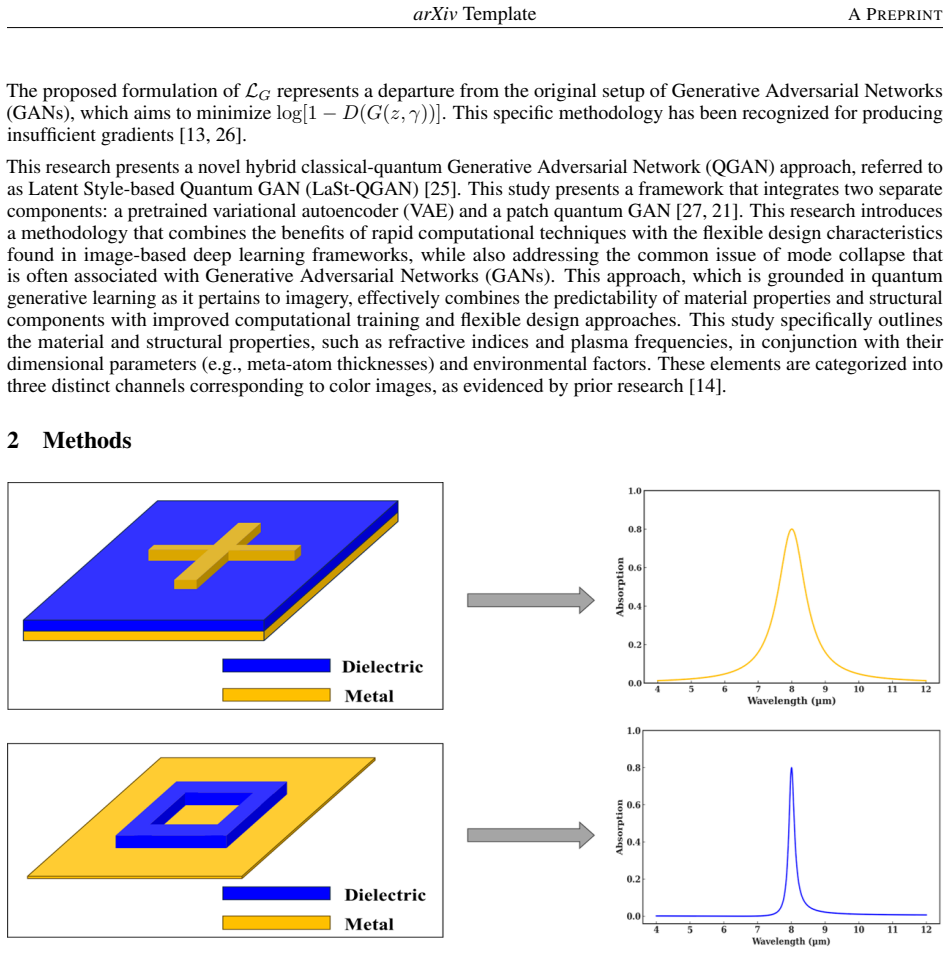
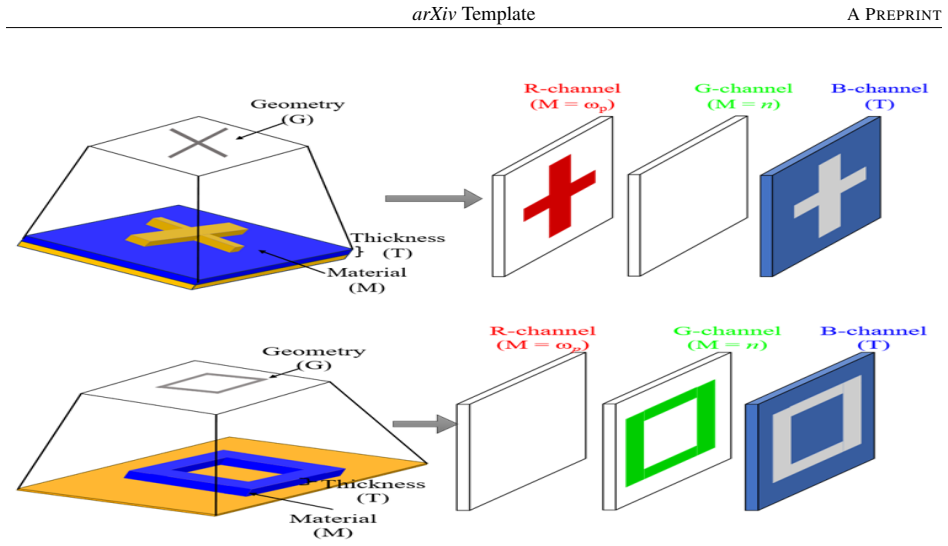
The load-bearing mechanism is a latent-space quantum GAN built around a variational autoencoder. The autoencoder (either a $\beta$-VAE or an importance-weighted autoencoder) compresses $64 \times 64 \times 3$ RGB-encoded metasurface images—red channel for plasma frequency, green for refractive index, blue for dielectric thickness—into a low-dimensional latent vector. The quantum generator is a style-based variational circuit in which the concatenation of latent noise $z$ and a conditional vector $\gamma$ (four Fano parameters fitted to the target absorption spectrum) is mapped by an affine transform into rotation angles for $RY$ gates, interlaced with circular CNOT entanglement, and read out through Pauli-Z expectation values. A classical fully connected discriminator distinguishes real from generated latent codes. This compression is what lets a small NISQ-scale circuit handle a design problem that would otherwise require pixel-space generation.
What would settle it
Train the classical GAN of Yeung et al. on the same 500-design subset, with the same Fano-parameter conditioning, data split, and GPU hardware, and compare its runtime and MSE with LaSt-QGAN's; if the classical GAN reaches an MSE near $10^{-4}$ in about 2.5 hours, the reported quantum advantage disappears.
Extended reading notes
Core claim
The central claim is that LaSt-QGAN outperforms the classical GAN of Yeung et al. across all reported performance metrics: training time falls from 25 hours to 2.5 hours, the mean squared error falls from $10^{-3}$ to $10^{-4}$, and the required training set falls from 20,000 to 500 distinct metasurface layouts. The paper also claims that the quantum generator produces asymmetric, freeform unit-cell geometries whose Fano resonances reach Q-factors of order $10^4$, while the training data only reaches order $10^3$; this extrapolation is attributed to symmetry breaking that suppresses radiative losses. A material look-up table is used to replace predicted optical constants with conventional materials, and the re-simulated designs retain about 95% precision relative to the original predictions.
Load-bearing premise
The reported 10x and 40x improvements assume that the 500-design subset of the Yeung et al. database and the published GAN baseline are directly comparable, using identical design targets, data splits, and hardware; the paper does not state the subset sampling rule or show that the baseline was re-run under the same conditions.
Editorial extensions
If this is right
- If the reported metrics hold, inverse design of absorbing metasurfaces would need 40x fewer training samples, cutting the costly electromagnetic simulation burden for dataset construction.
- The 10x reduction in training time would make iterative design loops practical on a single GPU rather than a large compute cluster.
- Generating Q-factors beyond the training range suggests the model can explore high-Q design regions whose sharp resonances are useful for sensing, filtering, and thermal emission.
- Substituting predicted materials with near-matching conventional ones, while retaining 95% spectral precision, brings the generated designs one step closer to fabrication.
Reading between the lines
- The comparison is made against a published classical baseline, not against a classical GAN re-trained on the same 500-sample subset under identical conditions; rerunning the baseline this way would isolate whether the speedup comes from the quantum generator or from the smaller, curated dataset.
- Because the conditional vector uses only four Fano parameters, the same architecture could plausibly be retargeted to other spectral line shapes, such as Lorentzian absorbers or multi-peak filters, by swapping the conditioning features.
- The high-Q extrapolation is a simulation-level claim; fabricating and measuring one of the generated freeform designs would test whether real devices reach Q-factors near $10^4$ or stay at the level of the training data.
Editorial analysis
A structured set of objections, weighed in public.
Referee Report
Summary. The paper proposes LaSt-QGAN, a hybrid quantum-classical generative model that combines a variational autoencoder (VAE) with a quantum GAN for inverse design of metasurfaces with tailored narrow-band absorption. The method is tested on MIM and hybrid dielectric metasurface unit cells encoded as RGB images, with a limited dataset of 500 layouts drawn from the multiclass dataset of Yeung et al. [14,31]. The central claims are a 10x reduction in training time, a 40x reduction in the number of training samples, and an order-of-magnitude lower MSE compared with the classical GAN baseline of [14], plus extrapolation to Q-factors of order 10^4 from training data with Q-factors of order 10^3. Validation is performed with COMSOL simulations of the generated designs, and a material look-up table is used to substitute predicted material properties with real alternatives.
Significance. If the claimed improvements were established by controlled comparison, the paper would be significant: it would demonstrate that a hybrid quantum-classical generator can match or exceed a classical GAN in a practical inverse-design task while using far fewer training samples, and it would provide a concrete example of a quantum model extrapolating beyond its training distribution. The use of an external simulation tool (COMSOL) to validate generated designs is a strength, as is the material substitution step for manufacturability. However, the quantitative claims are currently not well supported because the baseline is not re-run under matched conditions and the reported metrics lack statistical grounding, so the significance for quantum advantage in photonics remains unproven.
major comments (5)
- [Conclusions vs. Table 1] The stated training-time improvements are internally inconsistent. Table 1 reports 2.5 h versus 25 h (a 10x reduction), and the abstract and first paragraph of the Conclusions state a 10x/'one-tenth' reduction, but the final sentence of Sec. 4 says 'achieving a 40% reduction in training time without compromising accuracy.' A 40% reduction (1.67x) cannot be reconciled with a 10x reduction. This is a load-bearing inconsistency because the headline claim of the paper is the computational speedup.
- [Table 1 and Sec. 2 (dataset)] The comparison in Table 1 is not controlled. The GAN baseline metrics (25 h, 10^-3 MSE, 20,000 samples) are taken directly from [14], but the present work uses only 500 layouts from seven shape types drawn from [14,31], with no description of the sampling rule. No evidence is provided that the classical GAN was re-trained on the same 500-design subset, the same conditional targets, the same train/validation split, or the same DGX-1 hardware. Without such a matched comparison, the 10x/40x improvements cannot be attributed to the hybrid quantum-classical method; they may simply reflect the smaller dataset or a faster GPU.
- [Sec. 2 (training-time accounting)] The reported 2.5 h training time does not account for all components of the pipeline. The quantum generator is executed on a PennyLane simulator running on an A100 GPU, so the measured time includes classical simulation overhead of the quantum circuits. In addition, the VAE is pre-trained on the image dataset, and that pretraining cost is not reported. It is therefore unclear whether 'training time' refers only to the QGAN stage or to the full LaSt-QGAN pipeline, and whether the 25 h figure from [14] includes comparable pretraining or data-generation steps.
- [Table 1 and Sec. 3 (statistical support)] All performance metrics (MSE 10^-4 versus 10^-3, runtime 2.5 h versus 25 h) are point values without error bars, confidence intervals, or multiple seeded runs. GAN and QGAN training are stochastic, and single-run comparisons are insufficient to support the claim that LaSt-QGAN 'significantly outperforms' the classical GAN across all key metrics. At a minimum, repeated runs with different random seeds should be reported.
- [Sec. 3 and Fig. 9 (Q-factor extrapolation)] The claim that the model generates Q-factors of order 10^4 while the training data has Q-factors up to 10^3 is supported by only four examples in Fig. 9, with no error bars or sensitivity analysis. Since high-Q resonances are sensitive to geometric tolerances, it would be useful to know how robust these generated designs are to small perturbations in the predicted geometries and whether the four examples are representative or exceptional. This is a secondary but relevant part of the abstract's central claim.
minor comments (5)
- [Throughout] The model name is inconsistent: 'LaSt-QGAN' in the abstract, 'La-St QGAN' and 'LaSt-QGAN' in Sec. 3. Please standardize.
- [Sec. 2] The DGX-1 description states 'a single A100 (Volta) GPU'; the NVIDIA A100 is based on the Ampere architecture, not Volta. Please correct.
- [Eq. (1)] The notation 'Ex− →pdata' is typeset incorrectly; the arrow and subscript should be formatted as a standard expectation over the data distribution.
- [Sec. 2 (dataset description)] The sentence describing the dataset says 'structures presented in this study were derived from seven unique shape types, as outlined in [14,31]' but does not state the sampling rule (e.g., random, stratified, or hand-picked). This is relevant to the reproducibility of the 500-design subset.
- [Sec. 3 (material substitution)] The '95% precision' claim for the material look-up table is not defined; please state the metric used (e.g., spectral overlap, normalized RMSE) and how it is computed.
Circularity Check
No significant circularity: the inverse-design outputs are verified by external COMSOL simulation, and the high-Q claim is a conditional-target realization rather than a reduction to training inputs.
full rationale
The central derivation chain is empirical rather than definitional. Metasurface layouts are RGB-encoded, projected into a VAE latent space, and a QGAN generator conditioned on Fano-fitted target spectra outputs unit-cell geometries. Those geometries are then independently re-simulated in COMSOL, and the simulated absorption spectra are compared with the target spectra. This validation is external to the GAN training loss, so the claimed 'prediction' of absorption responses is not equivalent to the training inputs by construction. The high-Q claim is the closest thing to a circular-looking statement: Q-factor is related to the fitted Fano parameters (resonance frequency and linewidth) that form the conditional vector, so saying the model 'generates Q-factor up to 10^4' means it can realize out-of-distribution high-Q target spectra, not that it discovers them without being told. Since the resulting geometries are still verified by COMSOL simulation, this is a legitimate conditional inverse-design test rather than a reduction. The architecture is credited to an external prior work [25], not to the current authors, and no load-bearing self-citation or uniqueness theorem is invoked. Table 1's comparison with Yeung et al. [14] is a fairness concern because the baseline was not re-run on the same 500-layout subset, and the Conclusions contain an internal inconsistency ('reduces training time by one-tenth' versus '40% reduction in training time'), but these are reporting and benchmarking weaknesses, not circular reasoning. Accordingly, no circular step meets the evidentiary bar of being equivalent to its input by definition.
Assumptions & free parameters
free parameters (4)
- beta (VAE regularization weight) =
2
- IWAE importance samples =
5
- quantum generator initialization range =
[-0.01, 0.01]
- number of qubits and layers =
not stated
assumptions (5)
- domain assumption Fano equation adequately represents the absorption spectra used for conditioning
- domain assumption COMSOL simulations accurately model the fabricated metasurface response
- domain assumption The 500-sample subset of the Yeung et al. dataset is representative of the full design space
- domain assumption The VAE latent space preserves the information needed for inverse design
- domain assumption The classical GAN baseline in [14] is comparable to the proposed model
Cite this review
Pith. "Pith review of Hybrid Quantum-Classical Inverse Design of Metasurfaces for Tailored Narrow Band Absorption." pith.science (2026). https://pith.science/paper/KVWBPHB5
@misc{pith2026250718127,
  author       = {Pith},
  title        = {Pith review of: Hybrid Quantum-Classical Inverse Design of Metasurfaces for Tailored Narrow Band Absorption},
  year         = {2026},
  howpublished = {\url{https://pith.science/paper/KVWBPHB5}},
  note         = {Machine review of arXiv:2507.18127}
}
abstract
The inverse design of metasurfaces poses a considerable challenge because of the intricate interdependencies that exist between structural characteristics and electromagnetic responses. Traditional optimization methods require significant computational resources and frequently do not produce the most effective solutions. This study presents a hybrid quantum-classical machine learning approach known as Latent Style-based Quantum GAN (LaSt-QGAN). This method integrates a Variational Autoencoder (VAE) with a Quantum Generative Adversarial Network (QGAN) to enhance the optimization of metasurface designs aimed at achieving narrow-band absorption and unidirectionality. The proposed method results in a reduction of training time by 10X and a decrease in data requirements by 40X when compared to traditional GAN-based approaches. The produced metasurface designs demonstrate a high fidelity in relation to the target absorption spectra compared to the classical GAN based methods. Additionally, the integration of a material look-up table facilitates manufacturability by allowing for the substitution of predicted material properties with viable alternatives, all while preserving performance accuracy. Moreover the model is able to generate Q-factor upto the order of $10^4$, while the training dataset has Q-factor upto the order of $10^3$.
Figures

Figures from the paper (6 more)


Reference graph
Works this paper leans on
-
[14]
Christopher Yeung, Ryan Tsai, Benjamin Pham, Brian King, Yusaku Kawagoe, David Ho, Julia Liang, Mark W. Knight, and Aaswath P. Raman. Global inverse design across multiple photonic structure classes using generative deep learning. Advanced Optical Materials, 9(20):2100548, 2021
work page 2021
-
[1]
Flat optics with designer metasurfaces
Nanfang Yu and Federico Capasso. Flat optics with designer metasurfaces. Nature materials, 13(2):139–150, 2014
work page 2014
-
[2]
Planar photonics with metasurfaces
Alexander V Kildishev, Alexandra Boltasseva, and Vladimir M Shalaev. Planar photonics with metasurfaces. Science, 339(6125):1232009, 2013
2013
-
[3]
Recent advances in planar optics: from plasmonic to dielectric metasurfaces
Patrice Genevet, Federico Capasso, Francesco Aieta, Mohammadreza Khorasaninejad, and Robert Devlin. Recent advances in planar optics: from plasmonic to dielectric metasurfaces. Optica, 4(1):139–152, 2017
work page 2017
-
[4]
Computational scaling in inverse photonic design through factorization caching
Ahmet Onur Dasdemir, Victor Minden, and Emir Salih Magden. Computational scaling in inverse photonic design through factorization caching. Applied Physics Letters, 123(22):221106, 2023
work page 2023
-
[5]
Inverse design in nanophotonics
Sean Molesky, Zeyu Lin, Alexander Y Piggott, Weng Cho Chew Jin, Jelena Vuckovi´c, and Alejandro W Rodriguez. Inverse design in nanophotonics. Nature Photonics, 12:659–670, 2018
work page 2018
-
[6]
Global optimization of dielectric metasurfaces using a physics-driven neural network
Jicheng Jiang and Jonathan A Fan. Global optimization of dielectric metasurfaces using a physics-driven neural network. Nano letters, 19(8):5366–5372, 2019
work page 2019
-
[7]
Training deep neural networks for the inverse design of nanophotonic structures
Deyu Liu, Yichen Tan, Ehsan Khoram, and Zongfu Yu. Training deep neural networks for the inverse design of nanophotonic structures. ACS Photonics, 5(4):1365–1369, 2018
work page 2018
Show all 45 references
-
[8]
Deep learning enabled inverse design in nanophotonics
Sunae So, Trevon Badloe, Jaebum Noh, Jorge Bravo-Abad, and Junsuk Rho. Deep learning enabled inverse design in nanophotonics. Nanophotonics, 9(5):1041–1057, 2020. 11 arXiv Template A PREPRINT
2020
-
[9]
Inverse molecular design using machine learning: Genera- tive models for matter engineering
Benjamin Sanchez-Lengeling and Alán Aspuru-Guzik. Inverse molecular design using machine learning: Genera- tive models for matter engineering. Science, 361(6400):360–365, 2018
2018
-
[10]
Kun-Hua Tu, Hejin Huang, Sangho Lee, Wonmoo Lee, Zehao Sun, Alfredo Alexander-Katz, and Caroline A. Ross. Machine learning predictions of block copolymer self-assembly. Advanced Materials, 32(52):2005713, 2020
2020
-
[11]
Deep-learning-enabled fast optical identification and characterization of 2d materials.Advanced Materials, 32(29), 2020
Bingnan Han et al. Deep-learning-enabled fast optical identification and characterization of 2d materials.Advanced Materials, 32(29), 2020
2020
-
[12]
Simultaneous inverse design of materials and structures via deep learning: Demonstration of dipole resonance engineering using core–shell nanoparticles
Sunae So, Jungho Mun, and Junsuk Rho. Simultaneous inverse design of materials and structures via deep learning: Demonstration of dipole resonance engineering using core–shell nanoparticles. ACS Applied Materials & Interfaces, 11(27):24264–24268, 2019
2019
-
[13]
Adversarial autoencoders,
Alireza Makhzani, Jonathon Shlens, Navdeep Jaitly, Ian Goodfellow, and Brendan Frey. Adversarial autoencoders,
-
[15]
Mode collapse in generative adversarial networks: An overview
Youssef Kossale, Mohammed Airaj, and Aziz Darouichi. Mode collapse in generative adversarial networks: An overview. In 2022 8th International Conference on Optimization and Applications (ICOA) , pages 1–6, 2022
2022
-
[16]
Challenges and opportunities in quantum machine learning
Marco Cerezo, Guillaume Verdon, Hsin-Yuan Huang, et al. Challenges and opportunities in quantum machine learning. Nature Computational Science, 2:567–576, 2022
2022
-
[17]
Unsupervised semantic-preserving adversarial hashing for image search
Cheng Deng et al. Unsupervised semantic-preserving adversarial hashing for image search. IEEE Transactions on Image Processing, 28:4032–4044, 2019
2019
-
[18]
Quantum Computing in the NISQ Era and Beyond
John Preskill. Quantum Computing in the NISQ Era and Beyond. Quantum, 2:79, 2018
2018
-
[19]
Quantum generative adversarial learning
Seth Lloyd and Christian Weedbrook. Quantum generative adversarial learning. Physical Review Letters , 121(4):040502, 2018
2018
-
[20]
Quantum generative adversarial networks
Pierre-Luc Dallaire-Demers and Nathan Killoran. Quantum generative adversarial networks. Physical Review A, 98(1):012324, 2018
2018
-
[21]
Experimental Quantum Generative Adversarial Networks for Image Generation
He-Liang Huang, Yuxuan Du, Ming Gong, Youwei Zhao, Yulin Wu, Chaoyue Wang, Shaowei Li, Futian Liang, Jin Lin, Yu Xu, Rui Yang, Tongliang Liu, Min-Hsiu Hsieh, Hui Deng, Hao Rong, Cheng-Zhi Peng, Chao-Yang Lu, Yu-Ao Chen, Dacheng Tao, Xiaobo Zhu, and Jian-Wei Pan. Experimental Q...
2021
-
[22]
West, Sarah M
Shu Lok Tsang, Maxwell T. West, Sarah M. Erfani, and Muhammad Usman. Hybrid quantum–classical generative adversarial network for high-resolution image generation. IEEE Transactions on Quantum Engineering, 4:1–19, 2023
2023
-
[23]
Stein, Betis Baheri, Daniel Chen, Ying Mao, Qiang Guan, Ang Li, Bo Fang, and Shuai Xu
Samuel A. Stein, Betis Baheri, Daniel Chen, Ying Mao, Qiang Guan, Ang Li, Bo Fang, and Shuai Xu. Qugan: A quantum state fidelity based generative adversarial network. In 2021 IEEE International Conference on Quantum Computing and Engineering (QCE) , pages 71–81, 2021
2021
-
[24]
Variational quantum generators: Generative adversarial quantum machine learning for continuous distributions
Jonathan Romero and Alán Aspuru-Guzik. Variational quantum generators: Generative adversarial quantum machine learning for continuous distributions. Advanced Quantum Technologies, 4(1):2000003, 2021
2021
-
[25]
Latent style-based quantum gan for high-quality image generation, 2024
Su Yeon Chang, Supanut Thanasilp, Bertrand Le Saux, Sofia Vallecorsa, and Michele Grossi. Latent style-based quantum gan for high-quality image generation, 2024. Preprint at https://arxiv.org/abs/2406.02668
2024 arXiv
-
[26]
DCGAN Tutorial – PyTorch Tutorials
Nathan Inkawhich. DCGAN Tutorial – PyTorch Tutorials. https://pytorch.org/tutorials/beginner/ dcgan_faces_tutorial.html, 2022. Accessed: May 2022
2022
- [27]
-
[28]
X. Liu, T. Tyler, T. Starr, A. F. Starr, N. M. Jokerst, and W. J. Padilla. Taming the blackbody with infrared metamaterials as selective thermal emitters. Phys. Rev. Lett., 107(4):045901, 2011
2011
-
[29]
Neutens, P
P. Neutens, P. Van Dorpe, I. De Vlaminck, L. Lagae, and G. Borghs. Electrical detection of confined plasmonic resonances in metallic waveguides. Nat. Photonics, 3:283–286, 2009
2009
-
[30]
S. Chen, Z. Chen, J. Liu, J. Cheng, Y . Zhou, L. Xiao, and K. Chen. Ultra-narrow band mid-infrared perfect absorber based on hybrid dielectric metasurface. Nanomaterials, 9(10):1350, 2019
2019
-
[31]
Multiclass Metasurface Inverse Design
Raman-Lab-UCLA. Multiclass Metasurface Inverse Design. https://github.com/Raman-Lab-UCLA/ Multiclass_Metasurface_InverseDesign/tree/main, 2024. Accessed: May 2022. 12 arXiv Template A PREPRINT
2024
-
[32]
Fano resonances in photonics
Mikhail Limonov, Mikhail Rybin, Alexander Poddubny, and Yuri Kivshar. Fano resonances in photonics. Nature Photonics, 11:543–554, 2017
2017
-
[33]
COMSOL Multiphysics® v
COMSOL AB, Stockholm, Sweden. COMSOL Multiphysics® v. 6.2, 2023. Accessed: 2024-05-29
2023
-
[34]
beta-V AE: Learning Basic Visual Concepts with a Constrained Variational Framework
Irina Higgins, Loic Matthey, Arka Pal, Christopher Burgess, Xavier Glorot, Matthew Botvinick, Shakir Mohamed, and Alexander Lerchner. beta-V AE: Learning Basic Visual Concepts with a Constrained Variational Framework. In International Conference on Learning Representations , p...
2017
-
[35]
Importance Weighted Autoencoders, 2015
Yuri Burda, Roger Grosse, and Ruslan Salakhutdinov. Importance Weighted Autoencoders, 2015. Preprint at https://arxiv.org/abs/1509.00519
2015 arXiv
-
[36]
Pytorch: An imperative style, high-performance deep learning library
Adam Paszke, Sam Gross, Francisco Massa, Adam Lerer, James Bradbury, Gregory Chanan, Trevor Killeen, Zeming Lin, Natalia Gimelshein, Luca Antiga, Alban Desmaison, Andreas Kopf, Edward Yang, Zachary DeVito, Martin Raison, Alykhan Tejani, Sasank Chilamkurthy, Benoit Steiner, Lu ...
2019
-
[37]
Pennylane: Automatic differentiation of hybrid quantum-classical computations, 2018
Ville Bergholm et al. Pennylane: Automatic differentiation of hybrid quantum-classical computations, 2018. Preprint at https://arxiv.org/abs/1811.04968
2018 arXiv
-
[38]
Grabowska, and Stefano Carrazza
Carlos Bravo-Prieto, Jacopo Baglio, Marco Cè, Anthony Francis, Dorota M. Grabowska, and Stefano Carrazza. Style-based quantum generative adversarial networks for monte carlo events. Quantum, 6:777, 2022
2022
-
[39]
Variational quantum algorithms
Marco Cerezo et al. Variational quantum algorithms. Nature Reviews Physics, 3(9):625–644, 2021
2021
-
[40]
Love, Alán Aspuru- Guzik, and Jeremy L
Alberto Peruzzo, Jarrod McClean, Peter Shadbolt, Man-Hong Yung, Xiao-Qi Zhou, Peter J. Love, Alán Aspuru- Guzik, and Jeremy L. O’Brien. A variational eigenvalue solver on a photonic quantum processor. Nature Communications, 5:4213, 2014
2014
-
[41]
Classical and quantum algorithms for orthogonal neural networks, 2021
Iordanis Kerenidis, Jonas Landman, and Natansh Mathur. Classical and quantum algorithms for orthogonal neural networks, 2021. Preprint at https://arxiv.org/abs/2106.07198
2021 arXiv
-
[42]
Reluplex made more practical: Leaky ReLU
Jin Xu, Zishan Li, Bowen Du, Miaomiao Zhang, and Jing Liu. Reluplex made more practical: Leaky ReLU. In 2020 IEEE Symposium on Computers and Communications (ISCC) , pages 1–7, 2020
2020
-
[43]
Approximation by superpositions of a sigmoidal function
George Cybenko. Approximation by superpositions of a sigmoidal function. Mathematics of Control, Signals and Systems, 2:303–314, 1989
1989
-
[44]
M. N. Polyanskiy. Refractive index database. https://refractiveindex.info, 2024. (accessed: Aug 2024). 13
2024
-
[2015]
Preprint at https://arxiv.org/abs/1511.05644
Reviewed August 6, 2026 · model on record in the stance chip above.
Discussion (0). Sign in to comment.