REVIEW 4 major objections 7 minor 34 references
FAM Diffusion: Frequency and Attention Modulation for High-Resolution Image Generation with Stable Diffusion
T0 review · 4 major / 7 minor · reviewed 2026-08-12 · deepseek-v4-flash
Pith's one-line read FAM diffusion claims a training-free way to generate high-resolution images from Stable Diffusion by mixing in frequency and attention information from a low-resolution draft.
desk verdict A genuinely useful training-free high-resolution generation method whose frequency-modulation core is well supported, but the attention-modulation module's payoff is asserted more than demonstrated. read the letter →
The pith
A machine-rendered reading of the paper's core claim, the machinery that carries it, and where it could break.
The reading
What carries the argument
The central object is the Frequency Modulation (FM) equation (4), a time-varying high-pass filter $K(t)$ that is rectangular in the shifted Fourier domain. At each denoising step it keeps the high-frequency coefficients of the high-resolution latent and replaces low-frequency coefficients with those of the forward-diffused, upsampled native latent; equivalently, it adds a non-learnable convolutional layer with a global receptive field (Eq. 5). The second object is Attention Modulation (AM), which replaces each up-block self-attention matrix $M^m$ with a weighted average of the upsampled native attention matrix and the high-resolution one (Eq. 7, with $\lambda = 0.7$), transferring semantic layout from the low-resolution pass.
What would settle it
Generate the same prompt at 3x with the frequency mask cutoff swept from 0.2 to 0.8 and with Attention Modulation disabled; if the output quality barely changes or a texture-heavy scene (for example, a wall of bricks) still shows repetition, the claim that the low-frequency band of the diffused native latent carries the necessary structure fails. A sharper test: corrupt the low-frequency band of the native latent with noise. If the output remains structurally clean, FM is not actually using that band.
Extended reading notes
Core claim
Starting from a native-resolution output, the method runs forward diffusion to obtain diffused latents, then in each high-resolution denoising step mixes the low-frequency Fourier coefficients of the diffused native latent with the high-frequency coefficients of the current high-resolution latent (Eq. 4), and blends high-resolution self-attention maps with upsampled native attention maps in up-block layers (Eq. 7). The paper's claim is that this two-part modulation, FM for global structure and AM for local texture, is sufficient to keep pretrained latent diffusion models coherent far outside their training resolution, with negligible latency cost.
Load-bearing premise
The method assumes that a hand-chosen, time-varying rectangular cutoff in the Fourier domain reliably separates global structure from detail for every prompt and scale, and that upsampled native-resolution attention maps remain semantically valid guides for high-resolution textures.
Editorial extensions
If this is right
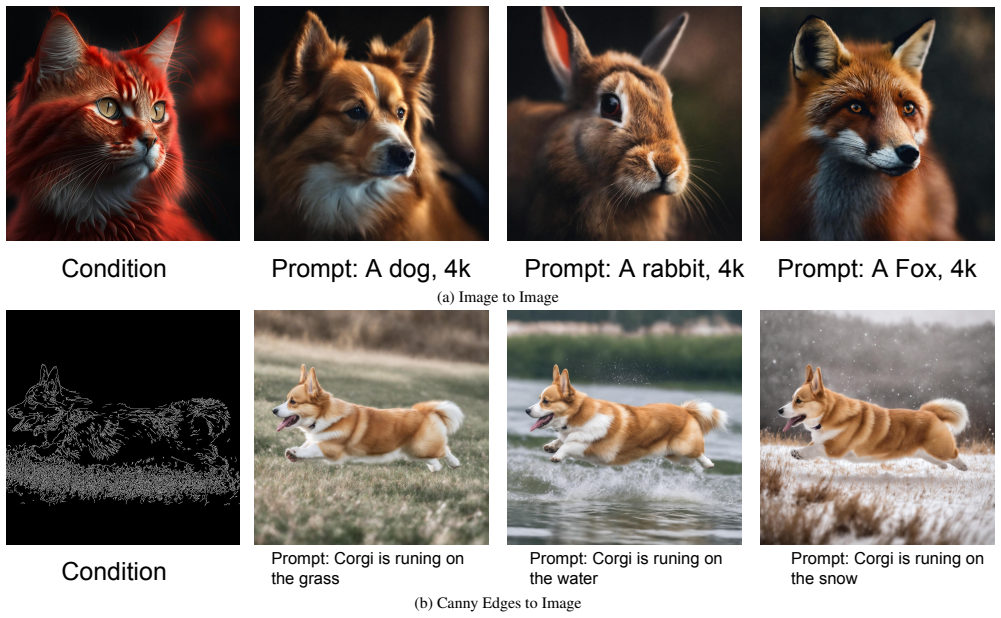
- Any latent diffusion model can be used at 2x to 4x training resolution without retraining or architectural changes, simply by wrapping it in the two modulations.
- The method integrates into single-pass models like HiDiffusion, preserving their low latency while improving quality, so it can serve as a general upscaling layer for efficient high-resolution generation.
- Structural artifacts such as object repetition are reduced because the low-frequency band of the native draft anchors the global layout, while the denoiser retains control over high-frequency detail.
- Local texture inconsistencies are reduced because attention maps from the native resolution encode which image regions are semantically related, and these relationships are transferred to the high-resolution pass.
- The latency overhead is small (0.2 to 0.7 minutes at 2x to 4x), making the method practical for interactive and batch applications.
Reading between the lines
- Because FM injects a global receptive field at inference time, the same principle could plausibly be applied to other grid- or sequence-based generative models beyond image LDMs (for example, video or 3D generation), though the paper does not test this.
- The rectangular Fourier mask and its cutoff scale $c = 0.5$ are hand-chosen; a natural extension the paper does not explore is adapting these per prompt, resolution, or base model, which could improve robustness across content types.
- AM is applied only to self-attention in up-blocks; combining it with cross-attention or applying it at multiple up-blocks might yield further texture gains, but the paper only evaluates the single-layer setting.
- The method's reliance on a native-resolution draft means generation becomes two-pass; for very large scales this could be extended to a hierarchical multi-pass version, at the cost of latency, which the paper does not address.
Editorial analysis
A structured set of objections, weighed in public.
Referee Report
Summary. This paper proposes FAM Diffusion, a training-free method for generating images at resolutions higher than a pretrained latent diffusion model's training resolution. The method combines two inference-time modules: a Frequency Modulation (FM) module that mixes low-frequency Fourier components of an upsampled native-resolution diffused latent into the high-resolution denoising trajectory, and an Attention Modulation (AM) module that blends attention maps from the native-resolution denoising pass into selected layers of the high-resolution pass. The authors claim that FAM Diffusion integrates seamlessly into any latent diffusion model, requires no additional training, achieves state-of-the-art FIDc, KIDc, and CLIP scores at 2x, 3x, and 4x resolutions, and adds negligible latency compared with direct high-resolution inference. The paper includes a derivation of the time-domain equivalent of frequency modulation, qualitative results, and ablations on SDXL and other Stable Diffusion variants.
Significance. If the results hold, this is a practically valuable contribution: it offers a simple, one-pass, training-free alternative to patch-based high-resolution generation methods, with a plausible frequency-domain mechanism for preserving global structure and an attention-based mechanism for local texture consistency. The derivation in Appendix B.1 is a strength, as is the broad experimental coverage across backbones, aspect ratios, and the ControlNet integration. The main significance is currently limited by the lack of quantitative evidence isolating the AM module, the ambiguous evaluation protocol vis-a-vis baseline subsets, and the absence of sensitivity analysis for the hand-defined frequency mask.
major comments (4)
- [§3.3, §4.3 (Fig. 3, Table 1)] The paper's central contribution is the pair of FM and AM modules, but no quantitative experiment isolates the contribution of AM. Table 1 compares the full FAM method against external baselines, while the ablation in Sec. 4.3 is qualitative (Fig. 3d vs 3e) and Fig. 4 is a single attention visualization. This leaves open the possibility that the reported gains come entirely from FM and that AM is neutral or harmful on average. Please add a quantitative ablation comparing FM-only with FM+AM on the same evaluation split, reporting FIDc, KIDc, and CLIP, ideally with multiple seeds.
- [§4.1 (Evaluation set) and Table 1] The paper states that it randomly samples 10K images and 1K captions from LAION-5B, but it does not state whether the baseline numbers in Table 1 are recomputed on this same subset or taken from prior publications. Because FID and KID depend on the real-image reference set, comparisons across different subsets are not meaningful. Please specify the re-evaluation protocol; if baselines were not rerun, either rerun them on the same split or use the exact splits from the cited papers, and provide the random seed and caption list for reproducibility.
- [§3.2, Eq. (11), Appendix B.1] The time-varying rectangular Fourier mask K(t) with a fixed cutoff scale c=0.5 is a crucial, hand-designed component. The paper does not analyze sensitivity to c or to the mask shape, despite claiming that the method is backbone- and resolution-agnostic. This is load-bearing for the generality claim. Please provide an ablation over c (e.g., 0.25, 0.5, 0.75) and, if possible, justify the rectangular low-pass assumption in latent space, for example by visualizing the effective frequency bands at several timesteps.
- [§4.2, Table 1] The claim that 'FAM diffusion achieves the best overall performance on FIDc, KIDc, and CLIP Score in all cases' is not strictly supported by Table 1 as printed. At 3x, HiDiffusion+FAM has CLIP 32.26 versus SDXL+FAM's 32.25, and the KIDc values are tied at 0.010. Please clarify the intended comparison (e.g., FAM applied to the best base model versus all rows containing FAM) and report all metrics with a consistent number of significant digits so that ties are not ambiguous.
minor comments (7)
- [Appendix B.2] The text says 'We empirically set λ used in Eq (6) to 0.7', but Eq. (6) defines softmax attention and contains no λ; the parameter appears in Eq. (7). The cross-reference should be corrected.
- [§3.2] The text says 'guidance from the denoised latent ~zt becomes more significant as t→0', but ~zt denotes the diffused latent from the forward process, not the denoised latent; please align the terminology with Eq. (4).
- [Figure 3 caption] Panel (e) is labeled 'FM-AM' while the text refers to it as 'AM' or the combination; use a consistent name such as 'FM+AM'.
- [§4.1] The evaluation reports point estimates without seeds or confidence intervals; given the stochasticity of diffusion sampling, please include seeds or report the variance across multiple runs for the main table.
- [Table 1] The KIDc values have inconsistent decimal places (e.g., 0.010 versus 0.0084), which makes ties and small differences hard to interpret; standardize the formatting.
- [Related Work] There is a typo: 'natire resolution' should be 'native resolution'.
- [References] References [11] and [12] are the same work (ECCV and arXiv versions); consider citing one consistently to avoid duplication.
Circularity Check
No significant circularity: the FM and AM modules are empirical inference-time mechanisms, and the paper's claims rest on ablations and comparisons rather than on equations that encode their own conclusions.
full rationale
The paper's derivation chain is self-contained. The FM module (Eq. 4) is defined as a frequency-domain mixing operation, and the time-domain reformulation (Eq. 5) is a mathematical equivalence derived from that definition, not a prediction imported from the result. The claim that FM improves global consistency is an empirical claim supported by the FM-only ablation in Fig. 3d, and it is not entailed by the formula alone. Similarly, AM (Eq. 7) defines a convex combination of an upsampled native attention matrix and the high-resolution attention matrix; whether this improves local texture consistency is an empirical question, tested qualitatively in Figs. 3e and 4. No parameter is fitted to a subset of data and then reported as a prediction of a closely related quantity: the hyperparameters c = 0.5 and lambda = 0.7 are set by hand in Appendix B, and the layer choice for AM is selected by experimentation. This is a generalization or overfitting concern, not circularity. The diffuse-denoise and attention-swapping machinery is imported from prior work by other authors [3, 8, 27, 4, 5, 13], so no load-bearing self-citation chain is present. No equation reduces to its input, and the central claim is an empirical performance comparison against external baselines on LAION-5B. Hence there is no significant circularity.
Assumptions & free parameters
free parameters (3)
- cutoff scale c =
0.5
- attention mixing weight lambda =
0.7
- AM layer selection =
up-blocks (up block 0 preferred)
assumptions (4)
- domain assumption Low-frequency Fourier components encode global structure; high frequencies encode detail
- domain assumption Test-time diffuse-denoise: forward-diffusing an upsampled native latent and denoising yields a valid high-res sample
- domain assumption Attention maps from the native-resolution denoising process remain semantically meaningful after spatial upsampling and can regularize high-res attention
- domain assumption UNet up-blocks preserve layout information better than other blocks
Cite this review
Pith. "Pith review of FAM Diffusion: Frequency and Attention Modulation for High-Resolution Image Generation with Stable Diffusion." pith.science (2026). https://pith.science/paper/KW6URBVF
@misc{pith2026241118552,
  author       = {Pith},
  title        = {Pith review of: FAM Diffusion: Frequency and Attention Modulation for High-Resolution Image Generation with Stable Diffusion},
  year         = {2026},
  howpublished = {\url{https://pith.science/paper/KW6URBVF}},
  note         = {Machine review of arXiv:2411.18552}
}
read the original abstract
Diffusion models are proficient at generating high-quality images. They are however effective only when operating at the resolution used during training. Inference at a scaled resolution leads to repetitive patterns and structural distortions. Retraining at higher resolutions quickly becomes prohibitive. Thus, methods enabling pre-existing diffusion models to operate at flexible test-time resolutions are highly desirable. Previous works suffer from frequent artifacts and often introduce large latency overheads. We propose two simple modules that combine to solve these issues. We introduce a Frequency Modulation (FM) module that leverages the Fourier domain to improve the global structure consistency, and an Attention Modulation (AM) module which improves the consistency of local texture patterns, a problem largely ignored in prior works. Our method, coined Fam diffusion, can seamlessly integrate into any latent diffusion model and requires no additional training. Extensive qualitative results highlight the effectiveness of our method in addressing structural and local artifacts, while quantitative results show state-of-the-art performance. Also, our method avoids redundant inference tricks for improved consistency such as patch-based or progressive generation, leading to negligible latency overheads.
Figures


Figures from the paper (8 more)


Reference graph
Works this paper leans on
-
[1]
MultiDiffusion: fusing diffusion paths for controlled image generation
Omer Bar-Tal, Lior Yariv, Yaron Lipman, and Tali Dekel. MultiDiffusion: fusing diffusion paths for controlled image generation. In International Conference on Machine Learn- ing, 2023. 1, 2
work page 2023
-
[2]
Mikołaj Bi ´nkowski, Danica J Sutherland, Michael Arbel, and Arthur Gretton. Demystifying MMD GANs. International Conference on Learning Representations, 2018. 5
work page 2018
-
[3]
DemoFusion: Democratising high- resolution image generation with no $$$
Ruoyi Du, Dongliang Chang, Timothy Hospedales, Yi-Zhe Song, and Zhanyu Ma. DemoFusion: Democratising high- resolution image generation with no $$$. In IEEE Confer- ence on Computer Vision and Pattern Recognition, 2024. 1, 2, 3, 4, 5, 6, 13
work page 2024
-
[4]
Photoswap: Personalized subject swapping in images
Jing Gu, Yilin Wang, Nanxuan Zhao, Tsu-Jui Fu, Wei Xiong, Qing Liu, Zhifei Zhang, He Zhang, Jianming Zhang, Hyun- Joon Jung, and Xin Eric Wang. Photoswap: Personalized subject swapping in images. Neural Information Processing Systems, 2023. 5
work page 2023
-
[5]
SwapAnything: Enabling arbitrary ob- ject swapping in personalized image editing
Jing Gu, Nanxuan Zhao, Wei Xiong, Qing Liu, Zhifei Zhang, He Zhang, Jianming Zhang, HyunJoon Jung, Yilin Wang, and Xin Eric Wang. SwapAnything: Enabling arbitrary ob- ject swapping in personalized image editing. European Con- ference on Computer Vision, 2024. 5
work page 2024
-
[6]
Latent video diffusion models for high-fidelity long video generation
Yingqing He, Tianyu Yang, Yong Zhang, Ying Shan, and Qifeng Chen. Latent video diffusion models for high-fidelity long video generation. arXiv preprint arXiv:2211.13221 ,
-
[7]
Scalecrafter: Tuning-free higher- resolution visual generation with diffusion models
Yingqing He, Shaoshu Yang, Haoxin Chen, Xiaodong Cun, Menghan Xia, Yong Zhang, Xintao Wang, Ran He, Qifeng Chen, and Ying Shan. Scalecrafter: Tuning-free higher- resolution visual generation with diffusion models. In In- ternational Conference on Learning Representations , 2024. 1, 2, 3, 5
work page 2024
-
[8]
Prompt-to-prompt im- age editing with cross attention control
Amir Hertz, Ron Mokady, Jay Tenenbaum, Kfir Aberman, Yael Pritch, and Daniel Cohen-Or. Prompt-to-prompt im- age editing with cross attention control. arXiv preprint arXiv:2208.01626, 2022. 1, 3
arXiv 2022
Show all 34 references
-
[9]
GANs trained by a two time-scale update rule converge to a local Nash equi- librium
Martin Heusel, Hubert Ramsauer, Thomas Unterthiner, Bernhard Nessler, and Sepp Hochreiter. GANs trained by a two time-scale update rule converge to a local Nash equi- librium. Neural Information Processing Systems, 2017. 5
2017
-
[10]
Denoising diffu- sion probabilistic models
Jonathan Ho, Ajay Jain, and Pieter Abbeel. Denoising diffu- sion probabilistic models. In Neural Information Processing Systems, 2020. 2
2020
-
[11]
FouriScale: A frequency perspective on training-free high-resolution im- age synthesis
Linjiang Huang, Rongyao Fang, Aiping Zhang, Guanglu Song, Si Liu, Yu Liu, and Hongsheng Li. FouriScale: A frequency perspective on training-free high-resolution im- age synthesis. In European Conference on Computer Vision,
-
[12]
FouriScale: A frequency perspective on training-free high-resolution image synthesis
Linjiang Huang, Rongyao Fang, Aiping Zhang, Guanglu Song, Si Liu, Yu Liu, and Hongsheng Li. FouriScale: A frequency perspective on training-free high-resolution image synthesis. arXiv preprint arXiv:2403.12963, 2024. 2, 6, 13
2024 arXiv
-
[13]
Visual style prompting with swapping self- attention
Jaeseok Jeong, Junho Kim, Yunjey Choi, Gayoung Lee, and Youngjung Uh. Visual style prompting with swapping self- attention. arXiv preprint arXiv:2402.12974, 2024. 5
2024 arXiv
-
[14]
SyncDiffusion: Coherent montage via synchronized joint diffusions
Yuseung Lee, Kunho Kim, Hyunjin Kim, and Minhyuk Sung. SyncDiffusion: Coherent montage via synchronized joint diffusions. In Neural Information Processing Systems,
-
[15]
AccDiffusion: An accurate method for higher-resolution im- age generation
Zhihang Lin, Mingbao Lin, Zhao Meng, and Rongrong Ji. AccDiffusion: An accurate method for higher-resolution im- age generation. In European Conference on Computer Vi- sion, 2024. 1, 2, 3, 5, 6, 13
2024
-
[16]
HiPrompt: Tuning- free higher-resolution generation with hierarchical MLLM prompts
Xinyu Liu, Yingqing He, Lanqing Guo, Xiang Li, Bu Jin, Peng Li, Yan Li, Chi-Min Chan, Qifeng Chen, Wei Xue, Wenhan Luo, Qifeng Liu, and Yike Guo. HiPrompt: Tuning- free higher-resolution generation with hierarchical MLLM prompts. arXiv preprint arXiv:2409.02919, 2024. 2
2024 arXiv
-
[17]
Theory of edge detection
David Marr and Ellen Hildreth. Theory of edge detection. Proceedings of the Royal Society of London. Series B. Bio- logical Sciences, 207(1167):187–217, 1980. 3
1980
-
[18]
You only need one step: Fast super-resolution with stable diffusion via scale distillation
Mehdi Noroozi, Isma Hadji, Brais Martinez, Adrian Bulat, and Georgios Tzimiropoulos. You only need one step: Fast super-resolution with stable diffusion via scale distillation. European Conference on Computer Vision, 2024. 1
2024
-
[19]
SDXL: Improving latent diffusion models for high-resolution image synthesis
Dustin Podell, Zion English, Kyle Lacey, Andreas Blattmann, Tim Dockhorn, Jonas M ¨uller, Joe Penna, and Robin Rombach. SDXL: Improving latent diffusion models for high-resolution image synthesis. In International Con- ference on Learning Representations, 2024. 2, 5, 6, 13
2024
-
[20]
Dreamfusion: Text-to-3D using 2D diffusion
Ben Poole, Ajay Jain, Jonathan T Barron, and Ben Milden- hall. Dreamfusion: Text-to-3D using 2D diffusion. arXiv preprint arXiv:2209.14988, 2022. 1
2022 arXiv
-
[21]
Learning transferable visual models from natural language supervi- sion
Alec Radford, Jong Wook Kim, Chris Hallacy, Aditya Ramesh, Gabriel Goh, Sandhini Agarwal, Girish Sastry, Amanda Askell, Pamela Mishkin, Jack Clark, et al. Learning transferable visual models from natural language supervi- sion. In International conference on machine learning, ...
2021
-
[22]
High-resolution image syn- thesis with latent diffusion models
Robin Rombach, Andreas Blattmann, Dominik Lorenz, Patrick Esser, and Bj¨orn Ommer. High-resolution image syn- thesis with latent diffusion models. In IEEE Conference on Computer Vision and Pattern Recognition, 2022. 1, 2, 3, 5
2022
-
[23]
DreamBooth: Fine tuning text-to-image diffusion models for subject-driven generation
Nataniel Ruiz, Yuanzhen Li, Varun Jampani, Yael Pritch, Michael Rubinstein, and Kfir Aberman. DreamBooth: Fine tuning text-to-image diffusion models for subject-driven generation. In IEEE Conference on Computer Vision and Pattern Recognition, 2023. 1
2023
-
[24]
LAION-5B: An open large-scale dataset for training next generation image-text models
Christoph Schuhmann, Romain Beaumont, Richard Vencu, Cade W Gordon, Ross Wightman, Mehdi Cherti, Theo Coombes, Aarush Katta, Clayton Mullis, Mitchell Worts- man, Patrick Schramowski, Srivatsa R Kundurthy, Katherine Crowson, Ludwig Schmidt, Robert Kaczmarczyk, and Jenia Jitsev....
2022
-
[25]
ResMaster: Mastering high- resolution image generation via structural and fine-grained guidance
Shuwei Shi, Wenbo Li, Yuechen Zhang, Jingwen He, Biao Gong, and Yinqiang Zheng. ResMaster: Mastering high- resolution image generation via structural and fine-grained guidance. arXiv preprint arXiv:2406.16476, 2024. 2
2024 arXiv
-
[26]
FreeU: Free lunch in diffusion U-Net
Chenyang Si, Ziqi Huang, Yuming Jiang, and Ziwei Liu. FreeU: Free lunch in diffusion U-Net. In IEEE Conference 9 on Computer Vision and Pattern Recognition, 2024. 6, 7, 8, 13, 14
2024
-
[27]
Denois- ing diffusion implicit models
Jiaming Song, Chenlin Meng, and Stefano Ermon. Denois- ing diffusion implicit models. In International Conference on Learning Representations, 2021. 1, 3
2021
-
[28]
Foundations of vision, 1995
BA Wandell. Foundations of vision, 1995. 3
1995
-
[29]
Single image, any face: Generalisable 3D face gen- eration
Wenqing Wang, Haosen Yang, Josef Kittler, and Xiatian Zhu. Single image, any face: Generalisable 3D face gen- eration. arXiv preprint arXiv:2409.16990, 2024. 1
2024
-
[30]
Tune-a-video: One-shot tuning of image diffusion models for text-to-video generation
Jay Zhangjie Wu, Yixiao Ge, Xintao Wang, Stan Weixian Lei, Yuchao Gu, Yufei Shi, Wynne Hsu, Ying Shan, Xiaohu Qie, and Mike Zheng Shou. Tune-a-video: One-shot tuning of image diffusion models for text-to-video generation. In IEEE International Conference on Computer Vision, 2023. 1
2023
-
[31]
Learning in the frequency domain
Kai Xu, Minghai Qin, Fei Sun, Yuhao Wang, Yen-Kuang Chen, and Fengbo Ren. Learning in the frequency domain. In IEEE Conference on Computer Vision and Pattern Recog- nition, 2020. 3
2020
-
[32]
Designing a practical degradation model for deep blind image super-resolution
Kai Zhang, Jingyun Liang, Luc Van Gool, and Radu Timo- fte. Designing a practical degradation model for deep blind image super-resolution. In IEEE International Conference on Computer Vision, 2021. 8
2021
-
[33]
Adding conditional control to text-to-image diffusion models
Lvmin Zhang, Anyi Rao, and Maneesh Agrawala. Adding conditional control to text-to-image diffusion models. In IEEE International Conference on Computer Vision , 2023. 1, 12, 17
2023
-
[34]
HiDiffusion: Unlocking higher- resolution creativity and efficiency in pretrained diffusion models
Shen Zhang, Zhaowei Chen, Zhenyu Zhao, Yuhao Chen, Yao Tang, and Jiajun Liang. HiDiffusion: Unlocking higher- resolution creativity and efficiency in pretrained diffusion models. In European Conference on Computer Vision, 2024. 1, 2, 3, 4, 5, 6, 8, 13 10 A. Appendix To complem...
2024
Reviewed August 12, 2026 · model on record in the stance chip above.
Discussion (0). Continue with ORCID to comment.