REVIEW 3 major objections 4 minor 19 references
Representation in Peer Selection: A Liquid Democracy Perspective
T0 review · 3 major / 4 minor · reviewed 2026-08-15 · deepseek-v4-flash
Pith's one-line read From single-chain trust in delegation graphs, this paper shows that the strongest proportional-representation axioms become satisfiable and polynomial-time computable on liquid profiles.
desk verdict A genuinely useful paper whose main tractability result currently rests on a circular proof; the axiomatic core is solid and the fix looks straightforward. read the letter →
The pith
A machine-rendered reading of the paper's core claim, the machinery that carries it, and where it could break.
The reading
What carries the argument
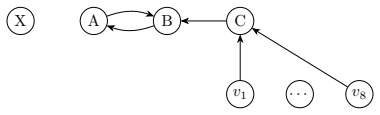
The central object is the liquid profile: an approval profile over a set of peers for which there exists a delegation graph with exactly one outgoing edge per vertex, such that each voter approves exactly the vertices reachable from them under the graph's transitive closure. The property that carries the argument is hierarchy: a rule is hierarchical if, whenever it elects a non-sink vertex, it also elects every vertex that vertex reaches (Proposition 14), and this structure is what lets the paper transfer guarantees from graph structure to axioms and rules. The named new rule, Liquid d'Hondt, works directly on the graph, electing at each step the candidate maximizing the quotient $\frac{|down(c)|}{|up(c) \cap W_t| + 1}$, where $down(c)$ is the set of voters who reach $c$ and $up(c)$ is the set of candidates $c$ reaches; Theorem 12's identification of this rule with PAV and seq-PAV is the step that turns a hard global optimization into a greedy, polynomial-time computation.
What would settle it
Enumerate all liquid profiles on small voter sets—all functional delegation graphs on, say, up to eight vertices, with committee sizes up to three—and compute, under one fixed tie-breaking order, the committees returned by Liquid d'Hondt, sequential PAV, and PAV; a single profile where the three outcomes differ would refute the central equivalence of Theorem 12 and with it the polynomial-time claim for PAV, and because the claim is a finite statement about exactly this class of graphs, exhaustive search would settle it.
Extended reading notes
Core claim
On liquid profiles, the paper argues, the obstacles that make proportional representation hard in general committee elections disappear. Its central theorem is that strong EJR, strong EJR+, individual representation, and liquid representation are all equivalent in this domain (Theorem 6), so committees in which every member of every cohesive group is fully represented always exist—whereas in general multiwinner elections these axioms are typically unsatisfiable. The load-bearing identity is Theorem 12, which equates Liquid d'Hondt—a rule applying d'Hondt apportionment quotients directly to the delegation graph—with sequential PAV and with PAV itself, making PAV polynomial-time computable on liquid profiles. Since PAV and MES satisfy sEJR (Theorem 15) and MES additionally satisfies committee monotonicity (Theorem 19), the paper concludes that liquid profiles support concrete rule recommendations: Cutoff-seq-CC when diversity in the spirit of strong JR is the goal, Hierarchical Justified Cohesive Rule when the stronger proportionality guarantee is wanted, with any standard proportional rule used to complete the committee.
Load-bearing premise
The load-bearing premise is that every voter designates exactly one trusted agent and that the voter's ballot lists precisely the people reachable through that single chain of trust; if voters approve anyone outside the chain, split their trust among several proxies, or stop trusting after one step, the paper's guarantees are not claimed to hold—and the authors acknowledge this modeling choice as a limitation in their Conclusion.
Editorial extensions
If this is right
- PAV, the proportionality standard that is NP-hard to compute in general committee elections, becomes polynomial-time computable on liquid profiles because its outcome coincides with its sequential variant and with Liquid d'Hondt (Theorem 12).
- Committees satisfying strong EJR—unsatisfiable in the general setting—always exist on liquid profiles and are returned by PAV, MES, and Sequential Phragmén, all in polynomial time (Theorems 6, 15 and 17).
- Because LR, sEJR, sEJR+, and IR coincide on liquid profiles (Theorem 6), the decision problem of whether an IR committee exists—NP-hard in general—becomes polynomial-time there, and so does verification of EJR (Proposition 7).
- MES, which fails committee monotonicity in general, is committee monotonic on liquid profiles, where it reduces to a budgeted approval-voting procedure (Theorems 18 and 19).
- The two new characterizing rules, Cutoff-seq-CC and HJCR, identify the minimal committees that any sJR- or sEJR-satisfying rule must elect, so a designer can secure the guarantee first and complete the committee with any standard rule (Theorems 11 and 20).
Reading between the lines
- If the Theorem 12 collapse—Liquid d'Hondt, seq-PAV, and PAV agreeing on every liquid profile—extends to delegation graphs where a voter splits trust among several proxies or where trust decays with distance (the viscous-democracy variants the authors list as future work), greedy graph-based rules would deliver PAV-grade proportionality well beyond the single-chain case; this is an extension the pa
- The kite-graph characterization of liquid profiles that are also laminar (Proposition 4) hints at a wider domain restriction: delegation networks that are disjoint unions of kites might inherit the strong-EJR guarantees even when the full liquid assumption fails, a hypothesis one could test by running HJCR and MES on such graphs.
- For deployed liquid-democracy systems, where ballots pile up at the top of delegation trees, the hierarchical rules amount to a formal justification of the common practice of letting the most-delegated peer of a component represent the whole branch; the theorems say that practice is not a heuristic but the exact shape of the proportional-optimum committee.
- The independence of core stability from strong JR (Theorem 9) means an outcome can be core-stable while leaving a component's most-trusted sink unelected, which sits uneasily with the delegation semantics; in my reading, the open question the authors flag—whether core-stable committees exist on liquid profiles at all—becomes most interesting when restricted to hierarchical committees.
Signed reviews
Editorial analysis
A structured set of objections, weighed in public.
Referee Report
Summary. The paper introduces 'liquid profiles,' a domain restriction for approval-based committee elections in which voters are nodes of a functional delegation graph and approve exactly the transitive closure of their delegation path. It positions this class relative to laminar and party-list profiles, characterizes several representation axioms (sJR, LR, sEJR, sEJR+, IR), and studies the behavior of CC, seq-CC, PAV, seq-PAV, MES, Sequential Phragmén, GJCR, and newly introduced LDH, Cutoff-seq-CC, Budgeted AV, and HJCR on this domain. The headline claim is that on liquid profiles PAV, seq-PAV, and LDH coincide, making PAV polynomial-time computable, and that multiple rules satisfy the strong sEJR guarantee.
Significance. If the main theorems are correct, the paper makes a useful contribution: it identifies a structured domain with strong proportionality guarantees, shows a collapse of several otherwise distinct axioms, and gives concrete rule recommendations. The computational results for PAV and the axiom characterizations are interesting, and the paper includes detailed proofs in the appendix plus clear summaries of the axiomatic landscape. The central equivalence result, however, is currently not proven because of a circular argument, so the main payoff (polynomial-time PAV with sEJR) rests on unproven statements. The paper deserves a major revision rather than rejection, because the underlying claims are plausible and the gaps appear repairable.
major comments (3)
- [Appendix: Proof of Theorem 12] The proof of Theorem 12 is circular. The first half asserts without proof that seq-PAV 'will select a candidate c′ that is a sink or is a direct predecessor of an already selected vertex of W' — which is exactly the hierarchical property formalized later as Proposition 14 — and the second half invokes Proposition 14 to conclude that both the seq-PAV and PAV outcomes are unions of weakly connected components. The proof of Proposition 14 for LDH, in turn, reads 'For convenience, we will prove the statement for seq-PAV, which is equivalent to LDH,' which is precisely the equivalence that Theorem 12 is proving. Consequently, none of LDH=seq-PAV, Proposition 14 for LDH/seq-PAV, and the PAV half is established by the current text.
- [Appendix: Proposition 14 and Theorem 12] Proposition 14, as stated, covers only Liquid d'Hondt, Phragmén, and MES; it does not state that PAV is hierarchical, yet the proof of Theorem 12 applies Proposition 14 to the PAV outcome W′ as well. The text therefore uses a lemma for a claim about a rule the lemma does not mention. A separate argument for the hierarchical structure of PAV outcomes on liquid profiles is required before the swap argument in the second half of the proof can go through.
- [Theorem 15] The proof of Theorem 15 (PAV and MES satisfy sEJR) depends on the same unresolved hierarchical property for PAV: it asserts that the elections under these rules form connected components with all vertices in up(c) elected, and for PAV this is only justified through the unproven equivalences and hierarchical claims discussed above. Thus, unless the proof of Theorem 12 is repaired, the sEJR guarantee for PAV is not currently established, and the paper's claim that PAV is polynomial-time computable while satisfying strong-EJR is unsupported.
minor comments (4)
- [Proof of Observation 3] The proof of Observation 3 contains a duplicated and apparently misplaced third paragraph: after giving the intended two examples, it repeats an example for the first statement and contains the typo 'for a self look' instead of 'form a self-loop.' This should be cleaned up.
- [Proof of Theorem 11] The proof of Theorem 11 concludes that the two solutions are 'equivalent,' but the stated characterization requires the outcome of any sJR rule to be a superset of Cutoff-seq-CC's outcome under some tie-breaking. The argument should be made precise for sink cycles, where two rules may pick different vertices of the same cycle.
- [Proof of Proposition 1] The polynomial-time membership test in Proposition 1 is presented as a sketch. Please specify the bottom-up forest reconstruction from the SCC decomposition in detail, including how the algorithm enforces the out-degree-one constraint and handles multiple bottom SCCs, so the reader can verify correctness.
- [References] Several references are listed as forthcoming with no archive or DOI, including Brill et al. (2026), Papasotiropoulos et al. (2026), and Faliszewski et al. (2026). Please update these with stable pointers or note their availability.
Circularity Check
Theorem 12's proof of LDH ≡ seq-PAV ≡ PAV cycles through Proposition 14: the hierarchical property is assumed unproved in the first half, then derived from the very equivalence in the second half.
-
other
[Technical Appendix, Proof of Theorem 12 (first half: LDH ≡ seq-PAV)]
"Regarding seq-PAV, we first note that it will select a candidate c′ that is a sink or is a direct predecessor of an already selected vertex of W."
This 'note' is exactly the hierarchical property that Proposition 14 is supposed to supply. But Proposition 14's proof for LDH begins 'For convenience, we will prove the statement for seq-PAV, which is equivalent to LDH', i.e. it assumes the first half of Theorem 12. The first half of Theorem 12 therefore derives LDH ≡ seq-PAV from an unproved hierarchicality assertion that is later established only by assuming LDH ≡ seq-PAV. The derivation chain runs in a circle.
-
other
[Technical Appendix, Proof of Theorem 12 (second half: seq-PAV ≡ PAV)]
"Observe that, by Proposition 14, both W and W′ form a set of weakly connected components."
The swap argument proving seq-PAV ≡ PAV rests on hierarchicality of both W (seq-PAV output) and W′ (PAV output). Proposition 14 proves hierarchicality of LDH via its equivalence to seq-PAV (the first half of this theorem) and of Phragmén and MES; it never independently proves hierarchicality of PAV. Attributing hierarchicality to PAV here therefore presupposes the equivalence seq-PAV ≡ PAV that is being proved. Proposition 14 itself is also not independent of Theorem 12, since its LDH part uses the theorem being proved.
1 more flagged steps
-
other
[Technical Appendix, Proof of Theorem 15 (PAV and MES satisfy sEJR)]
"Note that the results of the elections under those rules, i.e., PAV(E), and MES(E), form connected components in G, where for each elected non-sink vertex c, all vertices in up(c) are also elected."
For PAV this structural claim is not established by Proposition 14 independently: PAV is not among the rules listed there. It would have to follow from Theorem 12's equivalence PAV ≡ seq-PAV together with hierarchicality of seq-PAV, but that equivalence is exactly what the cyclic proof of Theorem 12 fails to ground. Consequently the PAV half of Theorem 15 inherits the circular dependency rather than providing independent support.
full rationale
The paper's main new computational claim is that PAV, seq-PAV and LDH coincide on liquid profiles and hence PAV becomes polynomial-time tractable (Theorem 12). The written proof of that theorem is not well-founded. In the first half, the proof states without proof that seq-PAV always next selects a sink or a direct predecessor of an already selected winner; this is the 'hierarchical' property formalized as Proposition 14. In the second half, the proof invokes Proposition 14 to assert that both the seq-PAV and PAV committees consist of weakly connected components. But Proposition 14's LDH case says 'For convenience, we will prove the statement for seq-PAV, which is equivalent to LDH' — assuming exactly the LDH ≡ seq-PAV equivalence from the first half of Theorem 12 — and Proposition 14 never covers PAV directly. Thus Theorem 12's proof depends on Proposition 14, while Proposition 14's LDH case depends on Theorem 12. Theorem 15's PAV half inherits this cycle, since it uses the same unestablished PAV-hierarchicality claim. The circularity is confined to the proof as written; the statements are plausibly repairable (extract hierarchicality of seq-PAV as a standalone lemma and prove hierarchicality of PAV directly from PAV optimality), and large parts of the paper — the liquid-profile domain results, the axiom collapse of Theorem 6, and the MES/Phragmén results — are independent and non-circular. No fitted parameter is relabeled as a prediction, and no self-citation carries a load-bearing argument. Score 6 reflects that the central equivalence theorem is not currently demonstrated because its proof cycles, even though the surrounding axiomatic contributions do not.
Assumptions & free parameters
assumptions (5)
- domain assumption Delegation graph is a functional graph: each voter has out-degree exactly 1.
- domain assumption Approval set of voter v equals the set of vertices reachable from v (transitive closure of the delegation function).
- domain assumption Peer selection setting: candidates coincide with voters (C=V).
- standard math Known multiwinner results: PAV satisfies EJR, sequential Phragmén satisfies PJR, EJR+/IR definitions and hardness results.
- standard math Tie-breaking order over candidates is fixed.
invented entities (5)
-
Liquid profile domain restriction
-
LR (Liquid Representation) axiom
-
sEJR and sEJR+ axioms
-
Liquid d'Hondt rule
-
HJCR and Cutoff-seq-CC rules
Cite this review
Pith. "Pith review of Representation in Peer Selection: A Liquid Democracy Perspective." pith.science (2026). https://pith.science/paper/KWDACWAK
@misc{pith2026260813085,
  author       = {Pith},
  title        = {Pith review of: Representation in Peer Selection: A Liquid Democracy Perspective},
  year         = {2026},
  howpublished = {\url{https://pith.science/paper/KWDACWAK}},
  note         = {Machine review of arXiv:2608.13085}
}
read the original abstract
We study the peer selection problem in which a group of peers must select a fixed-size committee from among themselves. To this end, we introduce a class of approval-based preference profiles, inspired by delegation graphs in liquid democracy and the transitivity of trust therein, which we call ``liquid profiles''. Under this new domain restriction, each voter designates a single trusted agent and, in turn, approves all those trusted by that individual. After establishing relationships to standard restricted preference profiles and examining computational properties of liquid profiles, we focus on understanding how novel and established proportionality axioms behave in this domain and how they relate to one another. Then, we study their satisfaction under various voting rules, including new ones that are directly inspired by the structure of liquid profiles. Our findings reveal that particularly strong proportionality guarantees are attainable in this new domain, showing promise for applications to real-world peer selection problems via transitive delegations.
Figures


Figures from the paper (3 more)


Reference graph
Works this paper leans on
-
[4]
Markus Brill, Jean-François Laslier, and Piotr Skowron
Individual Representation in Approval-Based Committee Voting.Social Choice and Welfare64, 1 (2025), 69–96. Markus Brill, Jean-François Laslier, and Piotr Skowron
work page 2025
-
[7]
Edith Elkind, Martin Lackner, and Dominik Peters
Properties of Multiwinner Voting Rules.Social Choice and Welfare(2017), 599–632. Edith Elkind, Martin Lackner, and Dominik Peters
work page 2017
-
[9]
Paul Gölz, Anson Kahng, Simon Mackenzie, and Ariel D Procaccia
Multiwinner Voting: A New Challenge for Social Choice Theory.Trends in Computational Social Choice2017 (2017), 27–47. Paul Gölz, Anson Kahng, Simon Mackenzie, and Ariel D Procaccia
work page 2017
-
[11]
Martin Lackner and Piotr Skowron
Liquid Democracy: An Algorithmic Perspective.Journal of Artificial Intelligence Research70 (2021), 1223–1252. Martin Lackner and Piotr Skowron
work page 2021
-
[14]
Georgios Papasotiropoulos, Oskar Skibski, Piotr Skowron, and Tomasz Wąs
Liquid Democracy: An Annotated Reading List.ACM SIGecom Exchanges22, 2 (2025), 130–135. Georgios Papasotiropoulos, Oskar Skibski, Piotr Skowron, and Tomasz Wąs
work page 2025
-
[15]
InProceedings of the ACM Conference on Economics and Computation
Proportionality and the Limits of Welfarism. InProceedings of the ACM Conference on Economics and Computation. 793–794. ArielDProcaccia, JeffreySRosenschein, andAvivZohar.2008. OntheComplexityofAchievingProportionalRepresentation. Social Choice and Welfare30, 3 (2008), 353–362. Simon Rey, Felicia Schmidt, and Jan Maly
work page 2008
-
[17]
Challenges, Experiments, and Computational Solutions in Peer Review.Commun. ACM65, 6 (2022), 76–87. Walter D. Wallis, Edy Tri Baskoro, Mirka Miller, and Slamin
work page 2022
-
[19]
InProceedings of the AAAI conference on Artificial Intelligence
Power in Liquid Democracy. InProceedings of the AAAI conference on Artificial Intelligence. 5822–5830. 14 Technical Appendix Proof of Proposition 1 Take a preference profileA(V,C ). We will show a procedure to check ifA(V,C )is liquid. We will assume that it holds C =V, otherwiseA would not be liquid. First, take a directed graphG∗ = (V,R∗), where a voter...
work page 2009
Show all 19 references
-
[1983]
Thomas H
Representative Deliberations and Representative Decisions: Proportional Representation and the Borda Rule.American Political Science Review77, 3 (1983), 718–733. Thomas H. Cormen, Charles E. Leiserson, Ronald L. Rivest, and Clifford Stein. 2009.Introduction to Algorithms, 3rd ...
1983
-
[2000]
Yuzhe Zhang and Davide Grossi
Edge-Magic Total Labelings.Australasian Journal of Combinatorics22 (2000), 177–190. Yuzhe Zhang and Davide Grossi
2000
-
[2011]
Viscous Democracy for Social Networks. Commun. ACM54, 6 (2011), 129–137. Felix Brandt, Vincent Conitzer, Ulle Endriss, Jérôme Lang, and Ariel D Procaccia. 2016.Handbook of Computational Social Choice. Cambridge University Press. Markus Brill
2011
-
[2017]
Haris Aziz, Patrick Lederer, Dominik Peters, Jannik Peters, and Angus Ritossa
Justified Representation in Approval-Based Committee Voting.Social Choice and Welfare48, 2 (2017), 461–485. Haris Aziz, Patrick Lederer, Dominik Peters, Jannik Peters, and Angus Ritossa
2017
-
[2018]
Journal of Theoretical Politics30, 3 (2018), 358–382
Multiwinner Approval Rules as Apportionment Methods. Journal of Theoretical Politics30, 3 (2018), 358–382. Markus Brill and Jannik Peters
2018
-
[2020]
Martin Lackner and Piotr Skowron
Utilitarian Welfare and Representation Guarantees of Approval-Based Multiwinner Rules.Artificial Intelligence288 (2020), 103366. Martin Lackner and Piotr Skowron. 2022.Multi-Winner Voting with Approval Preferences. Springer. Omer Lev, Harper Lyon, and Nicholas Mattei
2020
-
[2021]
ACM Transactions on Economics and Computation9, 4 (2021), 1–39
The Fluid Mechanics of Liquid Democracy. ACM Transactions on Economics and Computation9, 4 (2021), 1–39. Davide Grossi, Andreas Nitsche, and Georgios Papasotiropoulos
2021
-
[2022]
Piotr Faliszewski, Łukasz Janeczko, Andrzej Kaczmarczyk, Grzegorz Lisowski, and Grzegorz Pierczyński
Preference Restrictions in Computational Social Choice: A Survey.arXiv preprint arXiv:2205.09092(2022). Piotr Faliszewski, Łukasz Janeczko, Andrzej Kaczmarczyk, Grzegorz Lisowski, and Grzegorz Pierczyński
2022 arXiv
-
[2023]
Luis Sánchez-Fernández, Edith Elkind, Martin Lackner, Norberto Fernández, Jesús Fisteus, Pablo Basanta Val, and Piotr Skowron
The (Computational) Social Choice Take on Indivisible Participatory Budgeting.arXiv preprint arXiv:2303.00621(2023). Luis Sánchez-Fernández, Edith Elkind, Martin Lackner, Norberto Fernández, Jesús Fisteus, Pablo Basanta Val, and Piotr Skowron
2023 arXiv
-
[2024]
Georgios Papasotiropoulos and Ulrike Schmidt-Kraepelin
Impartial Peer Selection: An Annotated Reading List.ACM SIGecom Exchanges22, 1 (2024), 113–117. Georgios Papasotiropoulos and Ulrike Schmidt-Kraepelin
2024
-
[2025]
InProceedings of the ACM Conference on Economics and Computation
Committee Monotonicity and Pro- portional Representation for Ranked Preferences. InProceedings of the ACM Conference on Economics and Computation. 896–896. Jan Behrens, Axel Kistner, Andreas Nitsche, and Björn Swierczek. 2014.The Principles of LiquidFeedback. Interaktive Demok...
2014
Reviewed August 15, 2026 · model on record in the stance chip above.
Discussion (0). Continue with ORCID to comment.