REVIEW 4 major objections 4 minor 7 references
Falls Prediction in eldery people using Gated Recurrent Units
T0 review · 4 major / 4 minor · reviewed 2026-08-14 · deepseek-v4-flash
Pith's one-line read A two-layer bidirectional GRU network trained on heart rate and mean blood pressure can flag an impending syncope roughly ten minutes ahead of the clinical marker with about 90% accuracy, the paper reports.
desk verdict A plausible new application of GRUs to syncope prediction, but the headline 10-minute lead time and 90% accuracy are not supported by the evaluation protocol as written. read the letter →
The pith
A machine-rendered reading of the paper's core claim, the machinery that carries it, and where it could break.
The reading
What carries the argument
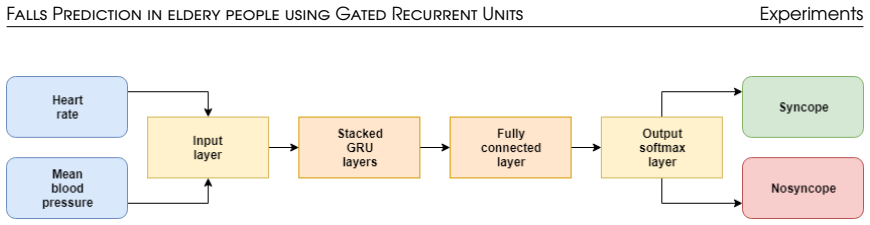
A bidirectional Gated Recurrent Unit (GRU) layer, which is a recurrent network that reads the input sequence both forward and backward so each output state carries context from both directions. The paper uses it as a classifier over fixed-size history windows of the two signals, with a softmax output and a tunable threshold. The supporting machinery includes the cleaning pipeline: studentization, median filtering with window size 31, iterative outlier removal and interpolation, min-max normalization to [-1, 1], and random class balancing of the roughly 6:1 no-syncope-to-syncope ratio. The backward pass is the main architectural difference between the vanilla GRU models, which produced false negatives, and the successful bidirectional ones.
What would settle it
Run the identical experiment but split the data by patient identifier so every person appears in only one set; if accuracy and F1 fall well below 0.895 and 0.905, or the ten-minute lead time vanishes, the original numbers are inflated by within-patient leakage rather than reflecting generalisable syncope prediction.
Extended reading notes
Core claim
The central claim is that bidirectional GRUs outperform unidirectional ones for syncope prediction on this dataset: the best configuration, two GRU layers with 100 units each, achieved F1 = 0.905 and accuracy 0.895 with a per-model optimized output threshold, whereas a single-layer 200-unit vanilla GRU reached F1 0.872 and accuracy 0.868. The authors state that this bidirectional model enabled detection of a forthcoming fall approximately ten minutes before the event. They emphasize sensitivity, noting that lower thresholds improve recall and reaction time while reducing accuracy, and that the two-layer bidirectional model is reported to be largely insensitive to threshold changes except at extreme values.
Load-bearing premise
The load-bearing premise is that the train/test split keeps distinct patients apart; if several recordings from the same patient appear in both training and test sets, the high accuracy could come from memorising that person's signal patterns rather than from a generalisable warning signal, and the paper does not say whether such a separation was made.
Editorial extensions
If this is right
- A two-layer bidirectional GRU using only heart rate and mean blood pressure can serve as the core of a bedside or wearable monitor that warns staff about ten minutes before a patient is likely to faint.
- Because lower thresholds improve recall at the expense of accuracy, the model can be tuned toward sensitivity, ensuring that patients who are going to faint are almost always flagged even if false alarms rise.
- The reported threshold robustness of the best bidirectional model means deployment does not require fine per-patient threshold calibration.
- The ten-minute lead time is measured against a manually placed marker, so the practical alarm window for a caregiver is the same size as the detection lead reported.
- The small input size and the cited compression to FPGA-based IoT devices suggest the model could run on low-power hardware worn by the patient.
Reading between the lines
- A natural next experiment the paper does not report is a patient-level split: hold out all recordings from some patients, train on the rest, and measure the drop in accuracy. Given several correlated measurements per patient, this is the test that would tell whether the network learns syncope physiology or individual baseline patterns.
- The ten-minute lead is relative to the clinician's manual marker, not to the physiological onset of the faint. If marker placement is imprecise, the true physiological lead time could be longer or shorter, and quantifying that uncertainty would change how much reaction time the system actually buys.
- Since the model uses only two physiological channels at a low sampling rate, the same architecture could be tested on other prediction horizons, such as five or fifteen minutes, by moving the classification window relative to the marker, which would map the usable warning envelope.
Signed reviews
Editorial analysis
A structured set of objections, weighed in public.
Referee Report
Summary. The paper proposes Gated Recurrent Unit (GRU) models, in both vanilla and bidirectional variants, for predicting syncope (fainting) episodes from heart rate and mean blood pressure time series recorded during rehabilitation examinations. The authors describe a preprocessing pipeline for the nearly 700 raw signal files, a class-balancing step to handle the 6:1 non-syncope-to-syncope ratio, and a Bayesian hyperparameter optimization procedure. The best reported configuration, a bidirectional GRU with two layers of 100 units each, achieves an F1 score of 0.905 and an accuracy of 0.895 on the test set. The abstract and conclusions further claim that the model can detect a forthcoming fall approximately ten minutes before the manually marked syncope event.
Significance. If the reported performance is reproducible under a rigorous evaluation protocol, this would be a clinically useful proof-of-concept for wearable monitoring of elderly patients during rehabilitation. The paper is one of the earlier attempts to apply recurrent neural networks to syncope prediction from physiological signals, and the comparison between vanilla and bidirectional GRUs adds some empirical value. However, the central claims of ten-minute lead time and 90% accuracy currently rest on an evaluation protocol that is not fully specified. The paper provides no machine-checked proofs or code release, but it does describe the data cleaning and model architecture in enough detail to be replicable if the data-access conditions are met. The main value of the manuscript at this stage is as a preliminary demonstration, not as a validated clinical tool.
major comments (4)
- [Section 4.1 and Table 2] Section 4.1 lists 'output threshold' among the seven parameters tuned by Bayesian optimization, and Table 2 reports values as 'best optimized threshold.' The paper never states that this threshold was selected on a validation set that was independent of the test set. If threshold selection used test labels, the reported F1 of 0.905 and accuracy of 0.895 are optimistically biased. Please specify the exact selection protocol (e.g., a holdout validation split or nested cross-validation) and, if test labels were used, re-report results with a threshold chosen without test information.
- [Section 2 (dataset split)] Section 2 states that 'for each patient, several measurements were performed, which upon further investigation turned out to be strongly correlated,' but the subsequent split into 154 training and 38 test series is described at the series level, not the patient level. If records from the same patient appear in both training and test partitions, the model can memorize patient-specific signal patterns rather than generalize to unseen individuals. The authors must partition by patient identity or otherwise demonstrate that within-patient correlation does not inflate the reported results.
- [Section 5 and Figure 5] The abstract and Section 5 claim detection of a forthcoming fall approximately ten minutes before the manual marker, but no quantitative lead-time analysis is provided. No histogram, summary statistic, or confidence interval for detection-to-marker time is reported, and Figure 5 (right) appears to be a qualitative threshold-dependence plot. Please define the detection time precisely and report its distribution on the test set, along with the number of events for which the model fired at least ten minutes before the marker.
- [Tables 1 and 2, Section 4.3] All results in Tables 1 and 2 appear to stem from a single run per configuration, with no error bars or cross-validation. Since the test set contains only 38 series, the reported accuracy of 0.895 has a wide confidence interval. Please provide run-to-run variability (e.g., multiple restarts or bootstrap confidence intervals) to support the headline accuracy.
minor comments (4)
- [Title and Section 5] The title misspells 'elderly' as 'eldery,' and Section 5 writes 'wearable divides' instead of 'wearable devices.'
- [Section 2] In the paragraph describing signal gaps, 'the mBP and HR started' should read 'mBP and HR started' or 'the mBP and HR signals started.'
- [Section 4.2] The phrase 'fixedthreshold = 0.7' is missing a space, and the caption of Figure 3 refers to 'line charts' while the figure appears to show partial dependence plots; please align the terminology.
- [General] The manuscript is very short and labeled as a 'Concept paper'; this label and the terse presentation make it difficult for readers to reproduce the experiments. Expanding the evaluation section, especially around the definition of detection time and the handling of multiple measurements per patient, would improve the paper's clarity.
Circularity Check
No circularity: the GRU prediction is an empirical supervised-learning result, not a quantity derived from its own target.
full rationale
The paper's claimed result—that a bidirectional GRU flags syncope roughly ten minutes before a manual marker with about 90% accuracy—is obtained by training on labeled cardiological time series and evaluating on held-out series. There is no definitional chain in which an input is defined in terms of the output: the heart-rate and mean-blood-pressure inputs, the manual syncope label, the categorical cross-entropy loss, and the F1/accuracy metrics are separate objects. The only author self-citations ([1] master's thesis, [7] FPGA compression) are not load-bearing for the prediction claim. The protocol concerns raised by the skeptical reader—possible output-threshold selection on the test set (Section 4.1 lists the threshold among optimized hyperparameters) and lack of a stated patient-disjoint split despite correlated per-patient measurements—are evaluation-leakage or generalization risks, not circularity. Even if confirmed, optimizing a decision threshold or training on near-duplicate records inflates scores but does not make the reported accuracy equivalent by construction to the training labels, and the paper contains no equation-level reduction of the predicted lead time to a fitted constant. Therefore the circularity score is 0.
Assumptions & free parameters
free parameters (3)
- Output decision threshold =
Not reported as a single number; optimized per model
- Outlier removal threshold =
Not reported; described as decreasing with each iteration
- Balancing random selection =
Not reported (random seed unknown)
assumptions (3)
- domain assumption Heart rate and mean blood pressure contain information that precedes a syncope event by at least ten minutes
- domain assumption The manual syncope marker is a reliable and unbiased ground truth for event timing
- domain assumption Time series are independent observations, so a random split does not leak patient-specific information
Cite this review
Pith. "Pith review of Falls Prediction in eldery people using Gated Recurrent Units." pith.science (2026). https://pith.science/paper/KWIQ33YV
@misc{pith2026190801050,
  author       = {Pith},
  title        = {Pith review of: Falls Prediction in eldery people using Gated Recurrent Units},
  year         = {2026},
  howpublished = {\url{https://pith.science/paper/KWIQ33YV}},
  note         = {Machine review of arXiv:1908.01050}
}
read the original abstract
Falls prevention, especially in older people, becomes an increasingly important topic in the times of aging societies. In this work, we present Gated Recurrent Unit-based neural networks models designed for predicting falls (syncope). The cardiovascular systems signals used in the study come from Gravitational Physiology, Aging and Medicine Research Unit, Institute of Physiology, Medical University of Graz. We used two of the collected signals, heart rate, and mean blood pressure. By using bidirectional GRU model, it was possible to predict the syncope occurrence approximately ten minutes before the manual marker.
Figures


Figures from the paper (2 more)


Reference graph
Works this paper leans on
-
[1]
Fallspredictionwithrecurrentneuralnetworks
MarcinRadzio. Fallspredictionwithrecurrentneuralnetworks. Master’sthesis,AGHUniver- sity of Science and Technology, 2019. 7 Falls Prediction in eldery people using Gated Recurrent Units References
work page 2019
-
[2]
Nicolás Martínez-Velilla, Alvaro Casas-Herrero, Fabrício Zambom-Ferraresi, Nacho Suárez, Javier Alonso-Renedo, Koldo Cambra Contín, Mikel López-Sáez de Asteasu, Nuria Fernan- dez Echeverria, María Gonzalo Lázaro, and Mikel Izquierdo. Functional and cognitive im- pairment prevention through early physical activity for geriatric hospitalized patients: study...
-
[3]
NicolásMartínez-Velilla,AlvaroCasas-Herrero,FabricioZambom-Ferraresi,MikelLópez-Sáez de Asteasu, Alejandro Lucia, Arkaitz Galbete, Agurne García-Baztán, Javier Alonso-Renedo, Belen González-Glaría, María Gonzalo-Lázaro, Itziar Apezteguía Iráizoz, Marta Gutiérrez- Valencia, Leocadio Rodríguez-Mañas, and Mikel Izquierdo. Effect of Exercise Intervention on Fu...
-
[4]
Ramesh Rajagopalan, Irene Litvan, and Tzyy-Ping Jung. Fall prediction and prevention sys- tems: Recent trends, challenges, and future research directions.Sensors, 17(11), 2017. ISSN 1424-8220. doi: 10.3390/s17112509
-
[5]
Bilal A. Mateen, Matthias Bussas, Catherine Doogan, Denise Waller, Alessia Saverino, Franz J. Király,andE.DianePlayford. Machinelearninginfallsprediction;Acognition-basedpredictor of falls for the acute neurological in-patient population.CoRR, abs/1607.07751, 2016
work page Pith review arXiv 2016
-
[6]
Ahmed Nait Aicha, Gwenn Englebienne, Kimberley S. Van Schooten, Mirjam Pijnappels, and BenKröse.Deeplearningtopredictfallsinolderadultsbasedondaily-lifetrunkaccelerometry. Sensors, 18(5), 2018. ISSN 1424-8220. doi: 10.3390/s18051654
-
[7]
Maciej Wielgosz and Michał Karwatowski. Mapping neural networks to FPGA-based IoT de- vices for ultra-low latency processing.Sensors, 19(13), 2019. ISSN 1424-8220. doi: 10.3390/ s19132981. 8
work page 2019
Reviewed August 14, 2026 · model on record in the stance chip above.
Discussion (0). Continue with ORCID to comment.