REVIEW 4 major objections 5 minor 44 references
On the Expressive Power of Subgraph Graph Neural Networks for Graphs with Bounded Cycles
T0 review · 4 major / 5 minor · reviewed 2026-08-09 · deepseek-v4-flash
Pith's one-line read k-hop subgraph GNNs can approximate any continuous invariant or equivariant function on graphs whose cycles are no longer than 2k+1.
desk verdict The k=1 separation theorem is a genuine contribution; the k≥2 extension has a real proof gap in Theorem 3.5, so the main universal approximation claim for k≥2 is not established as written. read the letter →
The pith
A machine-rendered reading of the paper's core claim, the machinery that carries it, and where it could break.
The reading
What carries the argument
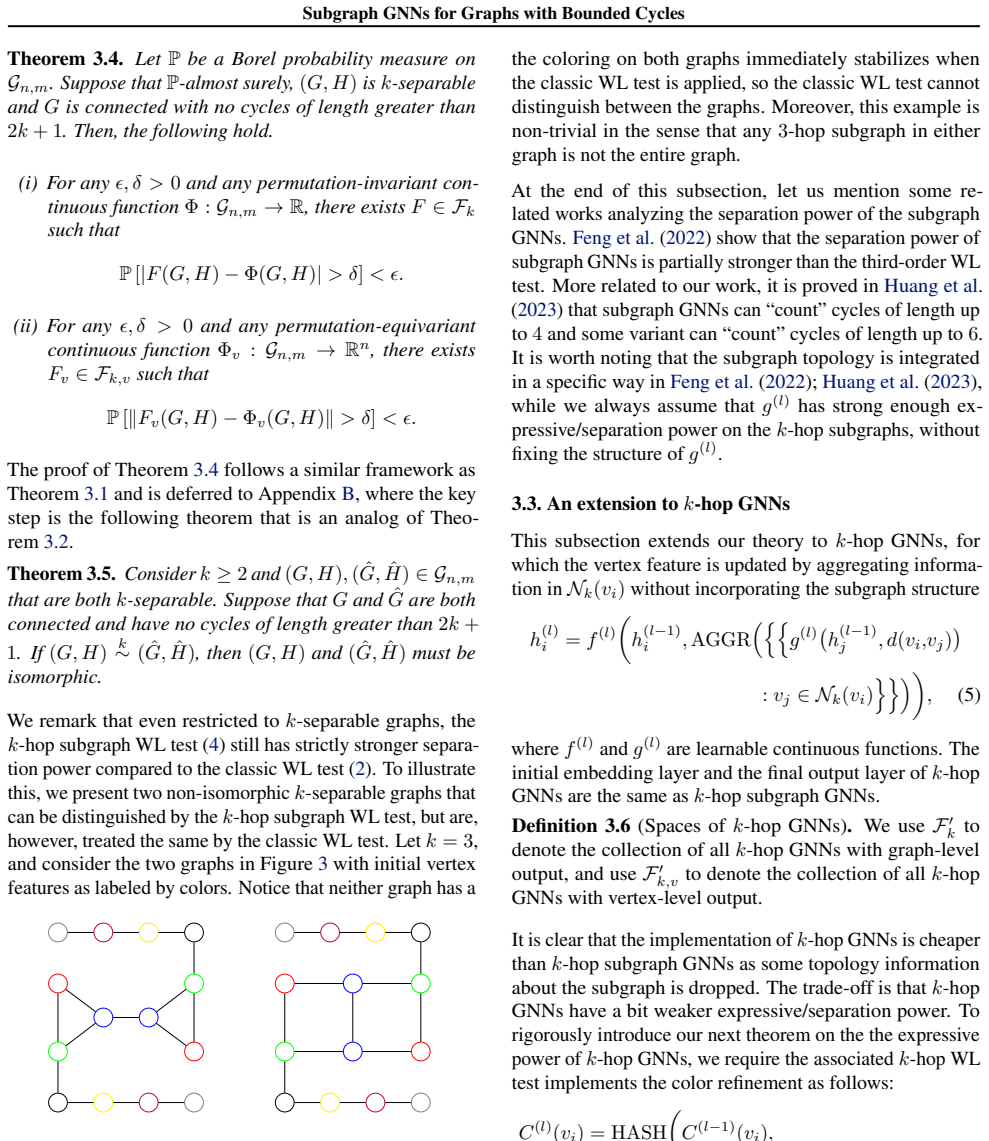
The machinery is the k-hop subgraph Weisfeiler-Lehman test, which recolors each vertex by the isomorphism type of the rooted subgraph spanned by all vertices within distance k of it. Theorem 2.5 equates its separation power with that of k-hop subgraph GNNs, so proving universal approximation reduces to proving that the test distinguishes all graphs in the class. The proof of that separation statement works by induction: start with two matched vertices of equal stabilized color, extend the partial isomorphism one vertex at a time using the rooted subgraphs of matched boundary vertices, and use Lemma B.1 to rule out hidden edges connecting the new k-hop neighborhood to the previously matched part. The k-separability condition is what makes boundary vertices uniquely identifiable by color during this extension.
What would settle it
Enumerate small connected graphs and look for two non-isomorphic graphs that both have no cycle longer than 2k+1 and are k-separable but receive identical color multisets from the k-hop subgraph WL test; the theorem asserts no such pair exists, so finding one would refute it directly. A softer empirical check is to train a k-hop subgraph GNN on graphs whose longest cycle is L and see whether accuracy on a cycle-sensitive function saturates exactly once 2k+1 >= L.
Extended reading notes
Core claim
The paper's central claim is that k-hop subgraph GNNs are universal approximators on connected graphs with bounded cycle length: under the k-separability condition, for any continuous permutation-invariant (graph-level) or permutation-equivariant (vertex-level) function and any tolerances epsilon and delta, there is a k-hop subgraph GNN whose output differs from the target by more than delta only on a set of probability less than epsilon, provided the graphs have no cycles longer than 2k+1. For k=1 the result is unconditional and covers every connected graph whose only cycles are triangles. The separating statement underneath is Theorem 3.5: two connected, k-separable graphs with no cycles longer than 2k+1 that are indistinguishable by the k-hop subgraph WL test must be isomorphic. An analogous theorem for plain k-hop GNNs without subgraph structure gives the same approximation guarantee under k-strong separability for graphs with no cycles longer than 2k-1.
Load-bearing premise
The argument depends on k-separability, meaning that every vertex at distance exactly k from a common root receives a distinct stabilized color in the k-hop subgraph WL test, which fails for symmetric graphs like paths; the authors state they do not know whether this condition can be removed, and the unconditional k=1 result does not generalize automatically.
Editorial extensions
If this is right
- Choose k as the smallest integer with 2k+1 at least the longest cycle in the data: a k-hop subgraph GNN then has, in principle, enough expressive power to approximate any continuous invariant or equivariant property of those graphs.
- A 1-hop subgraph GNN is already universal on connected graphs whose only cycles are triangles, with no k-separability assumption.
- Dropping subgraph structure costs one hop: a plain k-hop GNN reaches the same universal approximation guarantee only for graphs whose cycles are at most 2k-1, and needs a stronger strong-separability condition.
- Graph-level and vertex-level functions are covered together: both the permutation-invariant and permutation-equivariant approximation statements hold under the same cycle bound.
- In the ZINC experiments, performance rises as k increases to about half the dominant cycle length and saturates beyond it, with k=infinity slightly worse, matching the theoretical prediction that extra aggregation distance adds no expressive benefit once the cycle bound is met.
Reading between the lines
- The open k-separability question likely has a softer resolution: instead of all distance-k vertices having distinct colors, a condition on the stabilizer of the color partition (for example, a regular color-class structure) may suffice for the inductive extension, which would bring paths and other symmetric graphs back under the theorem.
- The cycle bound suggests a cheap practical diagnostic for any graph dataset: compute the longest cycle, set k to the smallest value satisfying 2k+1 >= L (or 2k-1 >= L for plain k-hop GNNs), and stop increasing k there; the ZINC experiments are consistent with this plateau behavior.
- The same radius-versus-diameter logic should transfer to distance-aware transformers and other architectures that mask attention to a k-hop neighborhood, predicting a similar performance cliff when the mask radius falls below half the longest cycle.
Editorial analysis
A structured set of objections, weighed in public.
Referee Report
Summary. The paper studies k-hop subgraph GNNs, which update a vertex representation from the subgraph induced by all vertices within distance k, together with an associated k-hop subgraph WL test. The main theoretical claim is that, under a k-separability condition (Definition 3.3), k-hop subgraph GNNs can approximate any permutation-invariant or permutation-equivariant continuous function on connected graphs whose cycles all have length at most 2k+1 (Theorems 3.4 and 3.5), with an unconditional version for k=1 (Theorems 3.1 and 3.2). An analogous result is stated for k-hop GNNs that do not use the subgraph structure, under a stronger k-strong separability condition and the bound 2k-1 on cycle length (Theorems 3.8 and 3.9). The proofs proceed by Stone-Weierstrass separation arguments and by inductively constructing isomorphisms from WL color equivalence. The paper also reports ZINC experiments with a k-hop Graphormer, observing improved MAE as k increases to about 3, which the authors interpret as confirming the predicted relation between aggregation distance and cycle length.
Significance. If the main theorems were fully established, the paper would give a clean design heuristic: the aggregation radius k controls the longest cycle that a subgraph GNN can resolve. This would generalize the known tree result of Bamberger (2022) to bounded-cycle graphs and would provide a nontrivial universal approximation theorem for a widely used class of architectures. The paper is careful to state assumptions and to acknowledge that k-separability might not be removable. The inductive separation proofs in the appendices do real work beyond a direct citation of the tree result. However, the significance is substantially tempered by three issues: the k-separability and k-strong separability assumptions are ad hoc and exclude many graphs that satisfy the cycle bound; the central equivalence theorem (Theorem 2.5) is stated without proof; and the proof of the key separation theorem for k>=2 (Theorem 3.5) has a gap in the edge-preservation argument. The ZINC experiments are suggestive but do not test the k-separability assumptions, so the abstract's claim that the experiments validate the theory is stronger than what the evidence supports.
major comments (4)
- [Appendix B, proof of Theorem 3.5] The inductive extension of f is not established. The proof asserts that f takes Nk(S1) ∩ Nk(v1) to Nk(S2) ∩ Nk(v2), and in Case 2 it claims that equality of the multisets of neighbor colors of w1 and w2, combined with k-separability, implies that u1w1 is an edge iff u2w2 is an edge. This inference is invalid as written: multiset equality only gives a neighbor x2 of w2 whose color equals that of u1, and x2 may have distance less than k from v2, where k-separability imposes no uniqueness. Nothing in the paragraph rules out x2 ≠ u2. The assertion about the image of the intersection is also in need of proof, because the rooted isomorphism Nk(v1) ≅ Nk(v2) need not agree with the color-based extension f on vertices whose colors repeat inside the ball. Since Theorem 3.5 is the load-bearing step for Theorem 3.4, this gap must be repaired, either by strengthening the induction hypothesis or by supplying the missing uniqueness argument.
- [Section 2.3, Theorem 2.5] Theorem 2.5, which equates the separation power of k-hop subgraph GNNs with that of the k-hop subgraph WL test, is stated without proof and is used at every Stone-Weierstrass step, including the proofs of Theorems 3.1(i), 3.1(ii), and, through Theorem 3.5, Theorem 3.4. The statement that the proof follows the lines of Theorem 4.2 of Chen et al. (2023) is not a substitute for a proof or a precise derivation, since the update in (4) is a rooted-subgraph WL refinement rather than the setting of that reference. This is a central equivalence: it is exactly what converts WL indistinguishability into GNN separation for the Stone-Weierstrass argument. Please include a full proof in an appendix or provide an exact statement of the cited theorem together with a detailed adaptation.
- [Definitions 3.3 and 3.7; Theorems 3.4 and 3.8] The k-separability and k-strong separability conditions are not implied by the bounded-cycle hypothesis and exclude many graphs that satisfy the cycle bound. For example, a path with constant initial features is not k-separable for any k>=2, and a symmetric cycle is not k-strongly separable. The limitation paragraph in Section 5 does acknowledge that removal of k-separability is open, but the abstract and introduction phrase the result as applying to graphs with bounded cycles. The paper should state the scope precisely in the abstract and should quantify how restrictive k-separability is; otherwise the phrase 'under appropriate assumptions' does not convey that the main theorem may have very limited applicability. The k-strong separability condition for Theorem 3.8 is even more restrictive, since all pairs of vertices within distance 2k must have distinct stabilized colors.
- [Section 4, experiments] The experiments are presented as validating the theory, but the ZINC graphs are not shown to satisfy k-separability or k-strong separability, and the k-hop Graphormer is not shown to realize the separation power of the k-hop subgraph WL test used in Theorems 3.4 and 3.5. The observed MAE improvement around k=3 is consistent with the heuristic that the receptive field should cover the longest observed cycles, but it does not test the theorems' assumptions or their quantitative predictions. Please temper the claim of validation in the abstract and Section 4.3, or add synthetic experiments designed to satisfy and to violate k-separability under controlled cycle lengths.
minor comments (5)
- [Abstract and Section 1] The phrase 'without cycles of length greater than 2k+1' is correct but can be read as excluding the value 2k+1; consider writing 'all cycles of length at most 2k+1' for readability.
- [Algorithm 1] The loop is written 'while l = 1,2,...,L' but should be 'for l = 1,2,...,L'; also, the iteration limit L in Algorithm 1 is not explicitly identified with the quantifier 'for any L>0' in Definition 2.4.
- [Definition 3.3] The definition of k-separability refers to 'when the k-hop subgraph WL test terminates with stabilized colors and without hash collisions'; this should be formalized, since termination and stabilization depend on the hash function and the initial features.
- [Table 1 and Section 4.3] The text says the 1-hop Graphormer has MAE 'similar in scale' to traditional 1-hop GNNs, but Table 1 reports 0.459 for the former versus 0.088 for GIN; the difference is a factor of about five, so the wording should be adjusted.
- [Appendix B, notation] The notation Nk(S) is defined in Appendix B but is used in the main text only informally; moving this definition to Section 2 would improve readability.
Circularity Check
No significant circularity: the bounded-cycle approximation theorems are derived from WL separation, not from fitted inputs or self-referential definitions.
full rationale
The central claim is derived rather than fitted. Theorem 3.4 follows from a Stone-Weierstrass separation argument: Theorems 3.2 and 3.5 show that the k-hop subgraph WL test is complete on the stated bounded-cycle graph classes, and Theorem 2.5 converts WL separation into GNN approximation power. No parameter is fitted to the ZINC data and then renamed a prediction; the experiments are post hoc empirical validation, not evidence that the theorem is an input. The k-separability assumption in Definition 3.3 is a domain restriction stated in terms of WL colors, but it is not the target predicate 'all non-isomorphic graphs in the class are distinguished by the k-hop WL test'; assuming it does not make Theorem 3.5's conclusion an input by construction. The only self-citation is the omitted proof of Theorem 2.5, which refers to Theorem 4.2 of Chen et al. (2023) for the standard GNN/WL equivalence; that prior result is parameter-free, its assumptions do not include the present bounded-cycle theorem, and it is a standard equivalence rather than the paper's central claim, so it constitutes independent support rather than circularity. A possible gap in the edge-preservation step of the Theorem 3.5 proof would be a correctness concern, not a circularity, and for that reason it is not counted here. Overall, the paper is self-contained against external benchmarks and does not exhibit a circular derivation chain.
Assumptions & free parameters
free parameters (1)
- k (aggregation distance in ZINC experiments) =
k=3 to 4 chosen from test MAE sweep
assumptions (5)
- standard math Stone-Weierstrass theorem, including the equivariant version of Azizian and Lelarge
- domain assumption k-hop subgraph WL stabilization and collision-free hashing
- ad hoc to paper k-separability for k at least 2
- ad hoc to paper k-strong separability for k-hop GNNs
- domain assumption g^(l) has enough separation power on rooted k-hop subgraphs
Cite this review
Pith. "Pith review of On the Expressive Power of Subgraph Graph Neural Networks for Graphs with Bounded Cycles." pith.science (2026). https://pith.science/paper/KWV3SORY
@misc{pith2026250203703,
  author       = {Pith},
  title        = {Pith review of: On the Expressive Power of Subgraph Graph Neural Networks for Graphs with Bounded Cycles},
  year         = {2026},
  howpublished = {\url{https://pith.science/paper/KWV3SORY}},
  note         = {Machine review of arXiv:2502.03703}
}
abstract
Graph neural networks (GNNs) have been widely used in graph-related contexts. It is known that the separation power of GNNs is equivalent to that of the Weisfeiler-Lehman (WL) test; hence, GNNs are imperfect at identifying all non-isomorphic graphs, which severely limits their expressive power. This work investigates $k$-hop subgraph GNNs that aggregate information from neighbors with distances up to $k$ and incorporate the subgraph structure. We prove that under appropriate assumptions, the $k$-hop subgraph GNNs can approximate any permutation-invariant/equivariant continuous function over graphs without cycles of length greater than $2k+1$ within any error tolerance. We also provide an extension to $k$-hop GNNs without incorporating the subgraph structure. Our numerical experiments on established benchmarks and novel architectures validate our theory on the relationship between the information aggregation distance and the cycle size.
Figures


Figures from the paper (3 more)


Reference graph
Works this paper leans on
-
[1]
write newline
" write newline "" before.all 'output.state := FUNCTION n.dashify 't := "" t empty not t #1 #1 substring "-" = t #1 #2 substring "--" = not "--" * t #2 global.max substring 't := t #1 #1 substring "-" = "-" * t #2 global.max substring 't := while if t #1 #1 substring * t #2 global.max substring 't := if while FUNCTION format.date year duplicate empty "emp...
-
[2]
Azizian, W. and Lelarge, M. Expressive power of invariant and equivariant graph neural networks. In International Conference on Learning Representations, 2021
work page 2021
-
[3]
A topological characterisation of Weisfeiler-Leman equivalence classes
Bamberger, J. A topological characterisation of Weisfeiler-Leman equivalence classes. In Topological, Algebraic and Geometric Learning Workshops 2022, pp.\ 17--27. PMLR, 2022
work page 2022
-
[4]
Equivariant Subgraph Aggregation Networks
Bevilacqua, B., Frasca, F., Lim, D., Srinivasan, B., Cai, C., Balamurugan, G., Bronstein, M. M., and Maron, H. Equivariant subgraph aggregation networks. arXiv preprint arXiv:2110.02910, 2021
work page Pith review arXiv 2021
-
[5]
An optimal lower bound on the number of variables for graph identification
Cai, J.-Y., F \"u rer, M., and Immerman, N. An optimal lower bound on the number of variables for graph identification. Combinatorica, 12 0 (4): 0 389--410, 1992
work page 1992
-
[6]
On representing linear programs by graph neural networks
Chen, Z., Liu, J., Wang, X., Lu, J., and Yin, W. On representing linear programs by graph neural networks. In The Eleventh International Conference on Learning Representations , 2023
work page 2023
-
[7]
W., Jin, W., Rogers, L., Jamison, T
Coley, C. W., Jin, W., Rogers, L., Jamison, T. F., Jaakkola, T., Green, W. H., Barzilay, R., and Jensen, K. F. A graph-convolutional neural network model for the prediction of chemical reactivity. Chemical Science, 10: 0 370 -- 377, 2018. URL https://api.semanticscholar.org/CorpusID:59943695
work page 2018
-
[8]
P., Joshi, C
Dwivedi, V. P., Joshi, C. K., Luu, A. T., Laurent, T., Bengio, Y., and Bresson, X. Benchmarking graph neural networks. Journal of Machine Learning Research, 24 0 (43): 0 1--48, 2023
2023
Show all 44 references
-
[9]
How powerful are k-hop message passing graph neural networks
Feng, J., Chen, Y., Li, F., Sarkar, A., and Zhang, M. How powerful are k-hop message passing graph neural networks. Advances in Neural Information Processing Systems, 35: 0 4776--4790, 2022
2022
-
[10]
Understanding and extending subgraph GNN s by rethinking their symmetries
Frasca, F., Bevilacqua, B., Bronstein, M., and Maron, H. Understanding and extending subgraph GNN s by rethinking their symmetries. Advances in Neural Information Processing Systems, 35: 0 31376--31390, 2022
2022
-
[11]
Fung, V., Zhang, J., Juarez, E., and Sumpter, B. G. Benchmarking graph neural networks for materials chemistry. npj Computational Materials, 7: 0 1--8, 2021. URL https://api.semanticscholar.org/CorpusID:234207025
2021
-
[12]
Exact combinatorial optimization with graph convolutional neural networks
Gasse, M., Ch \'e telat, D., Ferroni, N., Charlin, L., and Lodi, A. Exact combinatorial optimization with graph convolutional neural networks. Advances in neural information processing systems, 32, 2019
2019
-
[13]
The expressive power of k th-order invariant graph networks
Geerts, F. The expressive power of k th-order invariant graph networks. arXiv preprint arXiv:2007.12035, 2020 a
2007 arXiv
-
[14]
Walk message passing neural networks and second-order graph neural networks
Geerts, F. Walk message passing neural networks and second-order graph neural networks. arXiv preprint arXiv:2006.09499, 2020 b
2006 arXiv
-
[15]
and Reutter, J
Geerts, F. and Reutter, J. L. Expressiveness and approximation properties of graph neural networks. In International Conference on Learning Representations, 2022
2022
-
[16]
S., Riley, P
Gilmer, J., Schoenholz, S. S., Riley, P. F., Vinyals, O., and Dahl, G. E. Neural message passing for quantum chemistry. In International Conference on Machine Learning, 2017. URL https://api.semanticscholar.org/CorpusID:9665943
2017
-
[17]
N., Duvenaud, D., Hern \'a ndez-Lobato, J
G \'o mez-Bombarelli, R., Wei, J. N., Duvenaud, D., Hern \'a ndez-Lobato, J. M., S \'a nchez-Lengeling, B., Sheberla, D., Aguilera-Iparraguirre, J., Hirzel, T. D., Adams, R. P., and Aspuru-Guzik, A. Automatic chemical design using a data-driven continuous representation of mol...
2018
-
[18]
L., Ying, R., and Leskovec, J
Hamilton, W. L., Ying, R., and Leskovec, J. Inductive representation learning on large graphs. In Proceedings of the 31st International Conference on Neural Information Processing Systems, volume 30, pp.\ 1025--1035, 2017
2017
-
[19]
An overview on the application of graph neural networks in wireless networks
He, S., Xiong, S., Ou, Y., Zhang, J., Wang, J., Huang, Y., and Zhang, Y. An overview on the application of graph neural networks in wireless networks. IEEE Open Journal of the Communications Society, 2: 0 2547--2565, 2021
2021
-
[20]
Boosting the cycle counting power of graph neural networks with I ^2 - GNN s
Huang, Y., Peng, X., Ma, J., and Zhang, M. Boosting the cycle counting power of graph neural networks with I ^2 - GNN s. In The Eleventh International Conference on Learning Representations, 2023
2023
-
[21]
Kipf, T. N. and Welling, M. Semi-supervised classification with graph convolutional networks. arXiv preprint arXiv:1609.02907, 2016
2016 arXiv
-
[22]
Lee, M., Yu, G., Dai, H., and Li, G. Y. Graph neural networks meet wireless communications: M otivation, applications, and future directions. IEEE Wireless Communications, 29 0 (5): 0 12--19, 2022
2022
-
[23]
R., Wang, Y., and Wang, Y
Liao, W., Bak-Jensen, B., Pillai, J. R., Wang, Y., and Wang, Y. A review of graph neural networks and their applications in power systems. Journal of Modern Power Systems and Clean Energy, 10 0 (2): 0 345--360, 2021
2021
-
[24]
Provably powerful graph networks
Maron, H., Ben-Hamu, H., Serviansky, H., and Lipman, Y. Provably powerful graph networks. Advances in neural information processing systems, 32, 2019
2019
-
[25]
L., Lenssen, J
Morris, C., Ritzert, M., Fey, M., Hamilton, W. L., Lenssen, J. E., Rattan, G., and Grohe, M. Weisfeiler and L eman go neural: Higher-order graph neural networks. In Proceedings of the AAAI conference on artificial intelligence, volume 33, pp.\ 4602--4609, 2019
2019
-
[26]
Weisfeiler and Leman go sparse: T owards scalable higher-order graph embeddings
Morris, C., Rattan, G., and Mutzel, P. Weisfeiler and Leman go sparse: T owards scalable higher-order graph embeddings. Advances in Neural Information Processing Systems, 33: 0 21824--21840, 2020
2020
-
[27]
Graph neural networks for materials science and chemistry
Reiser, P., Neubert, M., Eberhard, A., Torresi, L., Zhou, C., Shao, C., Metni, H., van Hoesel, C., Schopmans, H., Sommer, T., and Friederich, P. Graph neural networks for materials science and chemistry. Communications Materials, 3, 2022. URL https://api.semanticscholar.org/Co...
2022
-
[28]
C., Hagenbuchner, M., and Monfardini, G
Scarselli, F., Gori, M., Tsoi, A. C., Hagenbuchner, M., and Monfardini, G. The graph neural network model. IEEE transactions on neural networks, 20 0 (1): 0 61--80, 2008
2008
-
[29]
Graph neural networks in particle physics
Shlomi, J., Battaglia, P., and Vlimant, J.-R. Graph neural networks in particle physics. Machine Learning: Science and Technology, 2 0 (2): 0 021001, 2020
2020
-
[30]
Graph attention networks
Veli c kovi \'c , P., Cucurull, G., Casanova, A., Romero, A., Lio, P., and Bengio, Y. Graph attention networks. arXiv preprint arXiv:1710.10903, 2017
2017 arXiv
-
[31]
Graph attention networks
Veli c kovi \'c , P., Cucurull, G., Casanova, A., Romero, A., Li \`o , P., and Bengio, Y. Graph attention networks. In International Conference on Learning Representations, 2018
2018
-
[32]
A review on graph neural network methods in financial applications
Wang, J., Zhang, S., Xiao, Y., and Song, R. A review on graph neural network methods in financial applications. arXiv preprint arXiv:2111.15367, 2021
2021 arXiv
-
[33]
and Leman, A
Weisfeiler, B. and Leman, A. The reduction of a graph to canonical form and the algebra which appears therein. NTI, Series, 2 0 (9): 0 12--16, 1968
1968
-
[34]
Wildman, S. A. and Crippen, G. M. Prediction of physicochemical parameters by atomic contributions. Journal of chemical information and computer sciences, 39 0 (5): 0 868--873, 1999
1999
-
[35]
Wu, Z., Pan, S., Chen, F., Long, G., Zhang, C., and Philip, S. Y. A comprehensive survey on graph neural networks. IEEE transactions on neural networks and learning systems, 32 0 (1): 0 4--24, 2020
2020
-
[36]
How powerful are graph neural networks? arXiv preprint arXiv:1810.00826, 2018
Xu, K., Hu, W., Leskovec, J., and Jegelka, S. How powerful are graph neural networks? arXiv preprint arXiv:1810.00826, 2018
2018 arXiv
-
[37]
How powerful are graph neural networks? In International Conference on Learning Representations, 2019
Xu, K., Hu, W., Leskovec, J., and Jegelka, S. How powerful are graph neural networks? In International Conference on Learning Representations, 2019
2019
-
[38]
Do transformers really perform badly for graph representation? Advances in neural information processing systems, 34: 0 28877--28888, 2021
Ying, C., Cai, T., Luo, S., Zheng, S., Ke, G., He, D., Shen, Y., and Liu, T.-Y. Do transformers really perform badly for graph representation? Advances in neural information processing systems, 34: 0 28877--28888, 2021
2021
-
[39]
Rethinking the expressive power of GNN s via graph biconnectivity
Zhang, B., Luo, S., Wang, L., and He, D. Rethinking the expressive power of GNN s via graph biconnectivity. arXiv preprint arXiv:2301.09505, 2023
2023 arXiv
-
[40]
and Li, P
Zhang, M. and Li, P. Nested graph neural networks. Advances in Neural Information Processing Systems, 34: 0 15734--15747, 2021
2021
-
[41]
Graph neural networks and their current applications in bioinformatics
Zhang, X.-M., Liang, L., Liu, L., and Tang, M.-J. Graph neural networks and their current applications in bioinformatics. Frontiers in genetics, 12: 0 690049, 2021
2021
-
[42]
From stars to subgraphs: U plifting any GNN with local structure awareness
Zhao, L., Jin, W., Akoglu, L., and Shah, N. From stars to subgraphs: U plifting any GNN with local structure awareness. arXiv preprint arXiv:2110.03753, 2021
2021 arXiv
-
[43]
A practical, progressively-expressive GNN
Zhao, L., Shah, N., and Akoglu, L. A practical, progressively-expressive GNN . Advances in Neural Information Processing Systems, 35: 0 34106--34120, 2022
2022
-
[44]
Graph neural networks: A review of methods and applications
Zhou, J., Cui, G., Hu, S., Zhang, Z., Yang, C., Liu, Z., Wang, L., Li, C., and Sun, M. Graph neural networks: A review of methods and applications. AI Open, 1: 0 57--81, 2020
2020
Reviewed August 9, 2026 · model on record in the stance chip above.
Discussion (0). Continue with ORCID to comment.