REVIEW 4 major objections 6 minor 51 references
Aligned Contrastive Loss for Long-Tailed Recognition
T0 review · 4 major / 6 minor · reviewed 2026-08-07 · deepseek-v4-flash
Pith's one-line read The paper shows that supervised contrastive learning's pairwise gradient structure repels easy same-class positives under multi-view training, and that removing this conflict with an aligned contrastive loss sets new state-of-the-art…
desk verdict A sensible loss tweak with modest gains, but the theory that motivates it has a real gap that the authors have not closed. read the letter →
The pith
A machine-rendered reading of the paper's core claim, the machinery that carries it, and where it could break.
The reading
What carries the argument
The central object is the pairwise gradient decomposition of SCL, specifically the sign of $\nabla = 1/|P(i)| - q(i,k)$ in Eq. (7). A positive $\nabla$ means the positive sample $z_k$ is pulled toward the anchor $z_i$; a negative $\nabla$ means it is pushed away. Near convergence, the paper approximates the contrastive denominator by $|P(i)|\exp(z_i \cdot \bar{z}_p/\tau)$, so samples closer to the anchor than the class center produce negative $\nabla$. ACL removes the conflicting terms by writing the loss with the effective positive alone in the denominator, adding an exponentially moving class center as an additional positive, and weighting negatives by inverse class frequency. This construction guarantees that every positive gradient is attractive.
What would settle it
Log the per-positive gradient sign $\nabla$ from Eq. (7) during SCL training on ImageNet-LT with 4 views: if late in training there are not systematically more negative $\nabla$ values for positives closer to the anchor than the class center, the conflict mechanism is not what the paper says. A second check is an ablation that removes only the non-effective positives from the denominator while leaving class centers and inverse-frequency reweighting unchanged; if accuracy does not fall toward the SCL level, conflict removal is not the operative component.
Extended reading notes
Core claim
The central claim is that SCL's performance ceiling under multi-view training in long-tailed settings is caused by an internal gradient conflict, not by insufficient data or augmentation. In SCL, each positive pair is treated as a classification task, so every non-effective positive appearing in the denominator is pushed away from the anchor while the effective positive is pulled in. Near convergence, samples closer to the anchor than the class center (easy positives) experience repulsion, and the number of such conflicted pairs scales quadratically with class frequency, so head classes suffer most. ACL removes this by keeping only the effective positive in the denominator, which makes every positive gradient attractive, and combines this with inverse-frequency negative weighting and distribution-aware multi-view sampling. The paper reports that these changes produce consistent gains over the multi-view Balanced Softmax baseline and new state-of-the-art accuracies on four long-tailed benchmarks.
Load-bearing premise
The load-bearing premise is that, late in training, features of each class are concentrated enough around a class center that the denominator approximation in Eq. (8) holds; if intra-class features stay spread out, the sign analysis of the gradient and the claim that easy-positive repulsion is the main culprit no longer follow.
Editorial extensions
If this is right
- SCL should not be combined blindly with multi-view augmentation on long-tailed data: the paper shows SCL actually decreases many-shot accuracy relative to the multi-view Balanced Softmax baseline, and ACL recovers and exceeds it.
- ACL's guaranteed non-negative attraction for every positive makes the number of views a tunable dial; the paper finds gains continue through 4 views and then plateau.
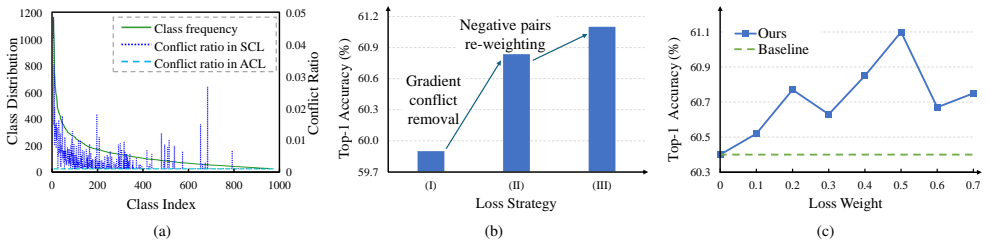
- The method sets new top-1 accuracy records: 61.1% on ImageNet-LT (ResNeXt-50), 75.6% on iNaturalist 2018, and 42.4% on Places-LT, with consistent gains over GPaCo on CIFAR-100-LT at imbalance factors 100, 50, and 10.
- The loss weight $\alpha$ trades head-class accuracy for tail-class accuracy, so practitioners can adjust it to favor rare classes without changing the data distribution.
- These results are reached with 90 to 200 training epochs, while the compared PaCo and GPaCo numbers use 400 epochs, so ACL is not buying accuracy with extra compute.
Reading between the lines
- Because the conflict is proportional to class frequency, the same denominator fix should transfer to other contrastive losses with multiple positives, including parametric class-center variants, where learnable centers may generate the same repulsion among positives.
- The paper's conflict-ratio monitoring could serve as a diagnostic for any contrastive loss: on long-tailed data the ratio should rise with class frequency in SCL and drop to near zero in ACL; using it to debug new losses is a natural extension.
- If conflict removal is truly the mechanism, then a minimal variant of ACL that only deletes non-effective positives from the denominator, with no class center or negative reweighting, should recover most of the gain over SCL; the paper's ablation shows conflict removal is the largest component, but a direct isolation run would make the causal claim crisp.
- Inverse-frequency negative reweighting is a plug-in that could improve contrastive fine-tuning of pretrained models on imbalanced downstream data, though the paper only points at this direction in its discussion of vision-language models.
Editorial analysis
A structured set of objections, weighed in public.
Referee Report
Summary. The paper proposes an Aligned Contrastive Loss (ACL) for long-tailed recognition, motivated by a gradient analysis of supervised contrastive learning (SCL). The analysis in Section 3.3 identifies that SCL's pairwise losses produce repulsive gradients toward non-effective positives that are closer to the anchor than the class center, a conflict that is claimed to intensify as the number of augmented views grows. ACL removes non-effective positives from the denominator, adds a class center as an additional positive, and re-weights negative pairs by inverse class frequency. The method is evaluated on CIFAR-100-LT, ImageNet-LT, iNaturalist 2018, and Places-LT, reporting state-of-the-art top-1 accuracy, with gains of 0.7 to 2.2 points over the GPaCo baseline and 0.7 to 1.2 points over the multi-view training baseline.
Significance. If the theoretical claims were fully established, this would be a useful contribution to understanding multi-view contrastive learning in long-tailed settings. The pairwise gradient derivation in Eqs. (3)-(5) is self-contained and appears correct, and the paper's design-to-validation loop is not circular. The proposed loss is simple and yields consistent, albeit modest, improvements across four benchmarks. However, the central causal claim that ACL's gains come from eliminating repulsion of easy positives rests on an unverified approximation in Eq. (8), and the ablation in Fig. 4b does not isolate conflict removal from the concurrent addition of class centers. The empirical evidence is also weakened by single-run results without variance estimates. The paper's significance is therefore moderate, and the theoretical narrative requires substantial strengthening.
major comments (4)
- [Section 3.3, Eq. (8)] The approximation in Eq. (8) is not valid. The paper replaces the log-sum-exp over positive similarities with |P(i)| times the exponential of the mean similarity, but log-sum-exp is dominated by the maximum similarity, not the arithmetic mean. Consequently, the sign of the gradient for a positive k is not reliably determined by whether z_i·z_k exceeds z_i·z̄_p; a positive that is closer than the class center can still have q(i,k) < 1/|P(i)|, while only the single maximum-similarity positive is likely to be repelled. If the clusters are so tight that the approximation holds, then all positive similarities are nearly equal and ∇ approximately vanishes, which would erase the repulsion story. The empirical conflict-ratio monitoring in Fig. 4a counts conflicts under the paper's own definition without checking whether the sign predicted by Eq. (8) matches the actual softmax gradient. This leaves the causal attribution of ACL's gains to conflict removal unestablished.
- [Section 5, Fig. 4b] The ablation comparing SCL (I), conflict-removal without re-weighting (II), and full ACL (III) is confounded. Model (II) simultaneously removes non-effective positives from the denominator and adds the class center c to the positive set, so the accuracy gain from (I) to (II) may be driven by the class-center attraction term rather than by conflict removal. To support the claim that conflict removal is the mechanism, please include ablations that add the class center to SCL without modifying the denominator, or that remove the class center from ACL.
- [Section 6.3, Table 3] The PaCo row reports Many=68.0, Medium=70.0, Few=56.4, All=58.2. The Medium accuracy exceeding the Many-shot accuracy is implausible, and the All value is inconsistent with the group-wise numbers. This appears to be a misalignment or typographical error that affects the claim that ACL surpasses PaCo in every group. The table should be corrected and the comparisons re-verified.
- [Section 6.2, Table 8] The empirical results appear to come from single runs without error bars or variance estimates, yet the text describes the improvements as significant. The gains of ACL over the multi-view baseline are 0.7, 0.7, 1.0, and 1.2 percentage points across the four datasets, which is within typical run-to-run variability for these benchmarks. Please report results over multiple seeds and provide a sensitivity analysis for the hyperparameters α, view counts, and negative weights; currently only α sensitivity is shown in Fig. 4c and Table 7.
minor comments (6)
- [Section 3.3, Eq. (8)] The notation z̄_p is not defined precisely; please state whether it is the arithmetic mean of positive features in the current mini-batch and over which positive set it is computed.
- [Section 5, Eq. (12)] The subscript k is used inconsistently between Eqs. (11) and (12); in Eq. (11) the index p denotes the positive sample, so q(i,k) should be q(i,p) or the definition must be aligned.
- [Section 6.2] The sentence 'We trained the models with SGD and a batch size of 128' appears twice, and the phrase 'we trained the models with SGD' is redundant; please remove the duplicate.
- [Section 6.4, Table 5] Please specify whether the number of views in Table 5 refers to uniform views across all classes or the distribution-aware allocation; the baseline's view assignment is not explicit in the table.
- [Section 6.4] The sentence 'Further details are provided in the appendix' refers to an appendix that is not present in the manuscript, which should be included or the reference removed.
- [Table 2] The footnote '(*: models trained under 400 epochs)' is ambiguous; please clarify the training epochs for each method, especially for ACL compared to the 400-epoch baselines.
Circularity Check
No significant circularity: SCL gradient analysis is derived from the loss definition, and ACL is an externally tested design.
full rationale
The paper's central derivation chain is self-contained rather than circular. Section 3.3 starts from the SCL loss in Eq. (1) and computes gradients in Eqs. (3)-(6), which are exact consequences of the loss definition; the conflict diagnosis (positive versus negative gradient sign) is then used to motivate a new loss, ACL in Eq. (9), whose positive-sample gradient in Eq. (11) is attractive by construction. This is a standard theory-to-design loop: the 'elimination of conflicting gradients' is a design property of ACL, while the claims that matter empirically—state-of-the-art top-1 accuracy on ImageNet-LT, iNaturalist 2018, Places-LT, and CIFAR-100-LT, and improvements over GPaCo—are measured against external benchmarks and are not implied by the loss formula. Hyperparameters α and the per-group view counts are tuned on validation data but do not enter the theoretical derivation, so no fitted input is renamed as a prediction. The self-citations to PaCo/GPaCo [9,10] are used only as baselines and training-settings references, not as justification for any theorem or uniqueness claim. The only notable weakness is the validity of the mean-field approximation in Eq. (8), where log-sum-exp is replaced by |P(i)| e^{zi·z̄p/τ}; that is a mathematical-rigor concern about the analysis, not a reduction of the paper's results to its own assumptions, so it does not constitute circularity.
Assumptions & free parameters
free parameters (4)
- loss weight alpha =
0.1 (CIFAR-LT), 0.5 (others)
- views per group =
2 (many-shot), 3 (medium-shot), 4 (few-shot)
- negative weight w_n =
unspecified (inversely proportional to class frequency)
- class-center EMA momentum =
unspecified
assumptions (3)
- domain assumption At convergence, class features collapse to a simplex equiangular tight frame and logits between inter-class features approach zero.
- domain assumption Easy positives (samples closer to the anchor than the class center) carry representative semantics and are worth attracting.
- domain assumption Inverse-frequency weighting of negatives equalizes attraction and repulsion gradients across classes.
Cite this review
Pith. "Pith review of Aligned Contrastive Loss for Long-Tailed Recognition." pith.science (2026). https://pith.science/paper/KWVOV7OL
@misc{pith2026250601071,
  author       = {Pith},
  title        = {Pith review of: Aligned Contrastive Loss for Long-Tailed Recognition},
  year         = {2026},
  howpublished = {\url{https://pith.science/paper/KWVOV7OL}},
  note         = {Machine review of arXiv:2506.01071}
}
read the original abstract
In this paper, we propose an Aligned Contrastive Learning (ACL) algorithm to address the long-tailed recognition problem. Our findings indicate that while multi-view training boosts the performance, contrastive learning does not consistently enhance model generalization as the number of views increases. Through theoretical gradient analysis of supervised contrastive learning (SCL), we identify gradient conflicts, and imbalanced attraction and repulsion gradients between positive and negative pairs as the underlying issues. Our ACL algorithm is designed to eliminate these problems and demonstrates strong performance across multiple benchmarks. We validate the effectiveness of ACL through experiments on long-tailed CIFAR, ImageNet, Places, and iNaturalist datasets. Results show that ACL achieves new state-of-the-art performance.
Figures


Figures from the paper (2 more)

Reference graph
Works this paper leans on
-
[1]
Mateusz Buda, Atsuto Maki, and Maciej A Mazurowski. A systematic study of the class imbalance problem in convo- lutional neural networks.Neural networks, 106:249–259,
-
[2]
Jonathon Byrd and Zachary Lipton. What is the effect of im- portance weighting in deep learning? InInternational con- ference on machine learning, pages 872–881. PMLR, 2019. 2
work page 2019
-
[3]
Mathilde Caron, Ishan Misra, Julien Mairal, Priya Goyal, Pi- otr Bojanowski, and Armand Joulin. Unsupervised learning of visual features by contrasting cluster assignments.Ad- vances in neural information processing systems, 33:9912– 9924, 2020. 1, 3, 4, 5, 6
work page 2020
-
[4]
A simple framework for contrastive learning of visual representations
Ting Chen, Simon Kornblith, Mohammad Norouzi, and Ge- offrey Hinton. A simple framework for contrastive learning of visual representations. InInternational conference on ma- chine learning, pages 1597–1607. PMLR, 2020. 3
2020
-
[5]
Ting Chen, Simon Kornblith, Kevin Swersky, Mohammad Norouzi, and Geoffrey E Hinton. Big self-supervised mod- els are strong semi-supervised learners.Advances in neural information processing systems, 33:22243–22255, 2020. 1, 3, 4
work page 2020
-
[6]
Exploring simple siamese rep- resentation learning
Xinlei Chen and Kaiming He. Exploring simple siamese rep- resentation learning. InProceedings of the IEEE/CVF con- ference on computer vision and pattern recognition, pages 15750–15758, 2021. 3
2021
-
[7]
An empirical study of training self-supervised vision transformers
Xinlei Chen, Saining Xie, and Kaiming He. An empirical study of training self-supervised vision transformers. InPro- ceedings of the IEEE/CVF international conference on com- puter vision, pages 9640–9649, 2021. 1, 3, 4
work page 2021
-
[8]
Autoaugment: Learning aug- mentation policies from data
Ekin D Cubuk, Barret Zoph, Dandelion Mane, Vijay Va- sudevan, and Quoc V Le. Autoaugment: Learning aug- mentation policies from data. arxiv 2018.arXiv preprint arXiv:1805.09501, 2, 1805. 5
arXiv 2018
Show all 51 references
-
[9]
Parametric contrastive learning
Jiequan Cui, Zhisheng Zhong, Shu Liu, Bei Yu, and Ji- aya Jia. Parametric contrastive learning. InProceedings of the IEEE/CVF international conference on computer vision, pages 715–724, 2021. 1, 2, 3, 5, 6, 7
2021
-
[10]
Generalized parametric contrastive learn- ing.IEEE Transactions on Pattern Analysis and Machine Intelligence, 2023
Jiequan Cui, Zhisheng Zhong, Zhuotao Tian, Shu Liu, Bei Yu, and Jiaya Jia. Generalized parametric contrastive learn- ing.IEEE Transactions on Pattern Analysis and Machine Intelligence, 2023. 1, 2, 3, 5, 6, 7
2023
-
[11]
Class-balanced loss based on effective number of samples
Yin Cui, Menglin Jia, Tsung-Yi Lin, Yang Song, and Serge Belongie. Class-balanced loss based on effective number of samples. InProceedings of the IEEE/CVF conference on computer vision and pattern recognition, pages 9268–9277,
-
[12]
Improved regular- ization of convolutional neural networks with cutout.arXiv preprint arXiv:1708.04552, 2017
Terrance DeVries and Graham W Taylor. Improved regular- ization of convolutional neural networks with cutout.arXiv preprint arXiv:1708.04552, 2017. 5
2017 arXiv
-
[13]
Chris Drummond, Robert C Holte, et al. C4. 5, class im- balance, and cost sensitivity: why under-sampling beats over-sampling. InWorkshop on learning from imbalanced datasets II, pages 1–8, 2003. 2
2003
-
[14]
Prob- abilistic contrastive learning for long-tailed visual recogni- tion.IEEE Transactions on Pattern Analysis and Machine Intelligence, 2024
Chaoqun Du, Yulin Wang, Shiji Song, and Gao Huang. Prob- abilistic contrastive learning for long-tailed visual recogni- tion.IEEE Transactions on Pattern Analysis and Machine Intelligence, 2024. 1, 3, 5, 6, 7
2024
-
[15]
Drawing multiple augmentation sam- ples per image during training efficiently decreases test error
Stanislav Fort, Andrew Brock, Razvan Pascanu, Soham De, and Samuel L Smith. Drawing multiple augmentation sam- ples per image during training efficiently decreases test error. arXiv preprint arXiv:2105.13343, 2021. 1, 3
2021 arXiv
-
[16]
Bootstrap your own latent-a new approach to self-supervised learning.Advances in neural information processing systems, 33:21271–21284, 2020
Jean-Bastien Grill, Florian Strub, Florent Altch ´e, Corentin Tallec, Pierre Richemond, Elena Buchatskaya, Carl Doersch, Bernardo Avila Pires, Zhaohan Guo, Mohammad Ghesh- laghi Azar, et al. Bootstrap your own latent-a new approach to self-supervised learning.Advances in neura...
2020
-
[17]
Deep residual learning for image recognition
Kaiming He, Xiangyu Zhang, Shaoqing Ren, and Jian Sun. Deep residual learning for image recognition. InProceed- ings of the IEEE conference on computer vision and pattern recognition, pages 770–778, 2016. 6
2016
-
[18]
Momentum contrast for unsupervised visual rep- resentation learning
Kaiming He, Haoqi Fan, Yuxin Wu, Saining Xie, and Ross Girshick. Momentum contrast for unsupervised visual rep- resentation learning. InProceedings of the IEEE/CVF con- ference on computer vision and pattern recognition, pages 9729–9738, 2020. 3
2020
-
[19]
Disentangling label dis- tribution for long-tailed visual recognition
Youngkyu Hong, Seungju Han, Kwanghee Choi, Seokjun Seo, Beomsu Kim, and Buru Chang. Disentangling label dis- tribution for long-tailed visual recognition. InProceedings of the IEEE/CVF conference on computer vision and pattern recognition, pages 6626–6636, 2021. 6
2021
-
[20]
Subclass-balancing contrastive learning for long- tailed recognition
Chengkai Hou, Jieyu Zhang, Haonan Wang, and Tianyi Zhou. Subclass-balancing contrastive learning for long- tailed recognition. InProceedings of the IEEE/CVF Inter- national Conference on Computer Vision, pages 5395–5407,
-
[21]
Learning deep representation for imbalanced classifi- cation
Chen Huang, Yining Li, Chen Change Loy, and Xiaoou Tang. Learning deep representation for imbalanced classifi- cation. InProceedings of the IEEE conference on computer vision and pattern recognition, pages 5375–5384, 2016. 2
2016
-
[22]
Decou- pling representation and classifier for long-tailed recogni- tion.arXiv preprint arXiv:1910.09217, 2019
Bingyi Kang, Saining Xie, Marcus Rohrbach, Zhicheng Yan, Albert Gordo, Jiashi Feng, and Yannis Kalantidis. Decou- pling representation and classifier for long-tailed recogni- tion.arXiv preprint arXiv:1910.09217, 2019. 2, 6
1910 arXiv
-
[23]
Exploring balanced feature spaces for representation learn- ing
Bingyi Kang, Yu Li, Sa Xie, Zehuan Yuan, and Jiashi Feng. Exploring balanced feature spaces for representation learn- ing. InInternational Conference on Learning Representa- tions, 2020. 3, 7
2020
-
[24]
Cost-sensitive learn- ing of deep feature representations from imbalanced data
Salman H Khan, Munawar Hayat, Mohammed Bennamoun, Ferdous A Sohel, and Roberto Togneri. Cost-sensitive learn- ing of deep feature representations from imbalanced data. IEEE transactions on neural networks and learning systems, 29(8):3573–3587, 2017. 2
2017
-
[25]
Supervised contrastive learning.Advances in neural information processing systems, 33:18661–18673,
Prannay Khosla, Piotr Teterwak, Chen Wang, Aaron Sarna, Yonglong Tian, Phillip Isola, Aaron Maschinot, Ce Liu, and Dilip Krishnan. Supervised contrastive learning.Advances in neural information processing systems, 33:18661–18673,
-
[26]
Targeted su- pervised contrastive learning for long-tailed recognition
Tianhong Li, Peng Cao, Yuan Yuan, Lijie Fan, Yuzhe Yang, Rogerio S Feris, Piotr Indyk, and Dina Katabi. Targeted su- pervised contrastive learning for long-tailed recognition. In Proceedings of the IEEE/CVF Conference on Computer Vi- sion and Pattern Recognition, pages 6918–69...
2022
-
[27]
Inducing neural collapse in deep long- tailed learning
Xuantong Liu, Jianfeng Zhang, Tianyang Hu, He Cao, Yuan Yao, and Lujia Pan. Inducing neural collapse in deep long- tailed learning. InInternational Conference on Artificial In- telligence and Statistics, pages 11534–11544. PMLR, 2023. 4
2023
-
[28]
Large-scale long-tailed recognition in an open world
Ziwei Liu, Zhongqi Miao, Xiaohang Zhan, Jiayun Wang, Boqing Gong, and Stella X Yu. Large-scale long-tailed recognition in an open world. InProceedings of the IEEE/CVF conference on computer vision and pattern recognition, pages 2537–2546, 2019. 5
2019
-
[29]
Long-tail learning via logit adjustment.arXiv preprint arXiv:2007.07314, 2020
Aditya Krishna Menon, Sadeep Jayasumana, Ankit Singh Rawat, Himanshu Jain, Andreas Veit, and Sanjiv Kumar. Long-tail learning via logit adjustment.arXiv preprint arXiv:2007.07314, 2020. 1, 2
2007 arXiv
-
[30]
Decoupled training for long-tailed classification with stochastic representations
Giung Nam, Sunguk Jang, and Juho Lee. Decoupled training for long-tailed classification with stochastic representations. arXiv preprint arXiv:2304.09426, 2023. 2
2023 arXiv
-
[31]
Repre- sentation learning with contrastive predictive coding.arXiv preprint arXiv:1807.03748, 2018
Aaron van den Oord, Yazhe Li, and Oriol Vinyals. Repre- sentation learning with contrastive predictive coding.arXiv preprint arXiv:1807.03748, 2018. 1
2018 arXiv
-
[32]
Dynamic sampling in convolutional neural networks for imbalanced data classification
Samira Pouyanfar, Yudong Tao, Anup Mohan, Haiman Tian, Ahmed S Kaseb, Kent Gauen, Ryan Dailey, Sarah Aghajan- zadeh, Yung-Hsiang Lu, Shu-Ching Chen, et al. Dynamic sampling in convolutional neural networks for imbalanced data classification. In2018 IEEE conference on multime- ...
-
[33]
Balanced meta-softmax for long-tailed visual recog- nition.Advances in neural information processing systems, 33:4175–4186, 2020
Jiawei Ren, Cunjun Yu, Xiao Ma, Haiyu Zhao, Shuai Yi, et al. Balanced meta-softmax for long-tailed visual recog- nition.Advances in neural information processing systems, 33:4175–4186, 2020. 1, 2, 4, 5, 6, 7
2020
-
[34]
Relay back- propagation for effective learning of deep convolutional neu- ral networks
Li Shen, Zhouchen Lin, and Qingming Huang. Relay back- propagation for effective learning of deep convolutional neu- ral networks. InComputer Vision–ECCV 2016: 14th Eu- ropean Conference, Amsterdam, The Netherlands, October 11–14, 2016, Proceedings, Part VII 14, pages 467–482....
2016
-
[35]
Meta-weight-net: Learning an explicit mapping for sample weighting.Advances in neu- ral information processing systems, 32, 2019
Jun Shu, Qi Xie, Lixuan Yi, Qian Zhao, Sanping Zhou, Zongben Xu, and Deyu Meng. Meta-weight-net: Learning an explicit mapping for sample weighting.Advances in neu- ral information processing systems, 32, 2019. 2
2019
-
[36]
Long-tailed recognition by mutual information maximization between latent features and ground-truth labels.arXiv preprint arXiv:2305.01160,
Min-Kook Suh and Seung-Woo Seo. Long-tailed recognition by mutual information maximization between latent features and ground-truth labels.arXiv preprint arXiv:2305.01160,
-
[37]
Long- tailed classification by keeping the good and removing the bad momentum causal effect.Advances in Neural Informa- tion Processing Systems, 33:1513–1524, 2020
Kaihua Tang, Jianqiang Huang, and Hanwang Zhang. Long- tailed classification by keeping the good and removing the bad momentum causal effect.Advances in Neural Informa- tion Processing Systems, 33:1513–1524, 2020. 6
2020
-
[38]
The inaturalist species classification and de- tection dataset
Grant Van Horn, Oisin Mac Aodha, Yang Song, Yin Cui, Chen Sun, Alex Shepard, Hartwig Adam, Pietro Perona, and Serge Belongie. The inaturalist species classification and de- tection dataset. InProceedings of the IEEE conference on computer vision and pattern recognition, pages ...
-
[39]
Contrastive learning based hybrid networks for long- tailed image classification
Peng Wang, Kai Han, Xiu-Shen Wei, Lei Zhang, and Lei Wang. Contrastive learning based hybrid networks for long- tailed image classification. InProceedings of the IEEE/CVF conference on computer vision and pattern recognition, pages 943–952, 2021. 1
2021
-
[40]
Learn- ing to model the tail.Advances in neural information pro- cessing systems, 30, 2017
Yu-Xiong Wang, Deva Ramanan, and Martial Hebert. Learn- ing to model the tail.Advances in neural information pro- cessing systems, 30, 2017. 2
2017
-
[41]
Aggregated residual transformations for deep neural networks
Saining Xie, Ross Girshick, Piotr Doll ´ar, Zhuowen Tu, and Kaiming He. Aggregated residual transformations for deep neural networks. InProceedings of the IEEE conference on computer vision and pattern recognition, pages 1492–1500,
-
[42]
Decoupled contrastive learning for long-tailed recognition
Shiyu Xuan and Shiliang Zhang. Decoupled contrastive learning for long-tailed recognition. InProceedings of the AAAI Conference on Artificial Intelligence, pages 6396– 6403, 2024. 6
2024
-
[43]
Yibo Yang, Shixiang Chen, Xiangtai Li, Liang Xie, Zhouchen Lin, and Dacheng Tao. Inducing neural collapse in imbalanced learning: Do we really need a learnable clas- sifier at the end of deep neural network?Advances in Neural Information Processing Systems, 35:37991–38002, 2022. 4
2022
-
[44]
Fairness-aware contrastive learning with partially annotated sensitive attributes
Fengda Zhang, Kun Kuang, Long Chen, Yuxuan Liu, Chao Wu, and Jun Xiao. Fairness-aware contrastive learning with partially annotated sensitive attributes. InThe Eleventh In- ternational Conference on Learning Representations, 2022. 3
2022
-
[45]
Distribution alignment: A unified frame- work for long-tail visual recognition
Songyang Zhang, Zeming Li, Shipeng Yan, Xuming He, and Jian Sun. Distribution alignment: A unified frame- work for long-tail visual recognition. InProceedings of the IEEE/CVF conference on computer vision and pattern recognition, pages 2361–2370, 2021. 6
2021
-
[46]
Deep long-tailed learning: A survey.IEEE Transactions on Pattern Analysis and Machine Intelligence, 45(9):10795–10816, 2023
Yifan Zhang, Bingyi Kang, Bryan Hooi, Shuicheng Yan, and Jiashi Feng. Deep long-tailed learning: A survey.IEEE Transactions on Pattern Analysis and Machine Intelligence, 45(9):10795–10816, 2023. 2, 3
2023
-
[47]
Im- proving calibration for long-tailed recognition
Zhisheng Zhong, Jiequan Cui, Shu Liu, and Jiaya Jia. Im- proving calibration for long-tailed recognition. InProceed- ings of the IEEE/CVF conference on computer vision and pattern recognition, pages 16489–16498, 2021. 6, 7
2021
-
[48]
Places: A 10 million image database for scene recognition.IEEE transactions on pattern analysis and machine intelligence, 40(6):1452–1464, 2017
Bolei Zhou, Agata Lapedriza, Aditya Khosla, Aude Oliva, and Antonio Torralba. Places: A 10 million image database for scene recognition.IEEE transactions on pattern analysis and machine intelligence, 40(6):1452–1464, 2017. 5
2017
-
[49]
Bbn: Bilateral-branch network with cumulative learn- ing for long-tailed visual recognition
Boyan Zhou, Quan Cui, Xiu-Shen Wei, and Zhao-Min Chen. Bbn: Bilateral-branch network with cumulative learn- ing for long-tailed visual recognition. InProceedings of the IEEE/CVF conference on computer vision and pattern recognition, pages 9719–9728, 2020. 2, 6, 7
2020
-
[50]
Generalized logit adjustment: Calibrating fine-tuned models by removing label bias in foundation models.Advances in Neural Information Processing Systems, 36, 2024
Beier Zhu, Kaihua Tang, Qianru Sun, and Hanwang Zhang. Generalized logit adjustment: Calibrating fine-tuned models by removing label bias in foundation models.Advances in Neural Information Processing Systems, 36, 2024. 2
2024
-
[51]
Balanced contrastive learn- ing for long-tailed visual recognition
Jianggang Zhu, Zheng Wang, Jingjing Chen, Yi-Ping Phoebe Chen, and Yu-Gang Jiang. Balanced contrastive learn- ing for long-tailed visual recognition. InProceedings of the IEEE/CVF Conference on Computer Vision and Pattern Recognition, pages 6908–6917, 2022. 1, 2, 3, 5, 6, 7
2022
Reviewed August 7, 2026 · model on record in the stance chip above.
Discussion (0). Sign in to comment.