Exact Hidden Paths in Noisy High Dimensional Path Spaces
Pith reviewed 2026-05-22 05:09 UTC · model grok-4.3
The pith
Exact recovery of hidden trajectories is possible from incomplete noisy projections in high dimensional discrete path spaces when using large observable vectors.
A machine-rendered reading of the paper's core claim, the machinery that carries it, and where it could break.
Core claim
The central claim is that exact hidden path recovery can be formalized in noisy high dimensional discrete path spaces where the hidden object is a planted discrete path whose transitions may include macro steps, microscopic perturbations, and discrete noise, with public information represented by large observable vectors that allow recovery of the precise sequence without being bounded by the amount of public data. Approximate reconstruction and exact recovery are fundamentally different tasks, and multiple recovery notions can be defined including planted exact recovery, arbitrary witness recovery, canonical recovery, quotient recovery, and recovery of derived encodings.
What carries the argument
The planted discrete path whose transitions include macro steps, microscopic perturbations, and discrete noise, serving as the hidden object to be recovered exactly from the large observable vectors.
If this is right
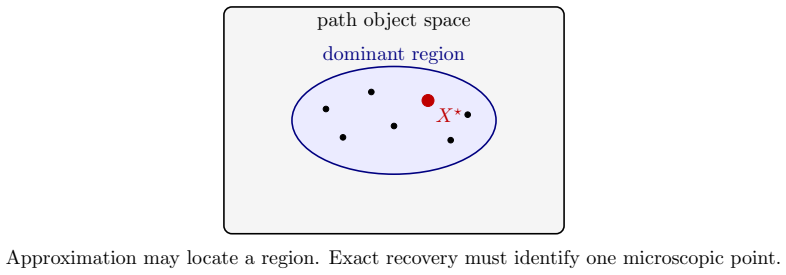
- Approximate reconstruction of dominant regions or coarse geometry does not recover the precise microscopic sequence that defines the hidden path.
- Multiple distinct recovery notions exist, such as planted exact recovery, quotient recovery, and recovery of derived encodings.
- Attack surfaces for any future construction include linearization attacks, lattice-style recovery, dynamic programming, meet-in-the-middle methods, SAT and SMT solvers, and generic quantum search.
- Using short hash digests would inherently limit the recovery problem to the digest size, whereas large observable vectors avoid this bound.
Where Pith is reading between the lines
- The framework could serve as a starting point for designing cryptographic primitives whose security rests on the hardness of exact path recovery rather than on traditional number-theoretic problems.
- Small-scale computational tests with controlled noise levels could directly measure the transition between approximate and exact recovery regimes.
- The approach may connect to inverse problems in statistical physics where path-based models are inverted rather than summed.
Load-bearing premise
Large observable vectors can provide enough information to allow exact recovery of the microscopic path sequence without the problem being fundamentally bounded by the amount of public data.
What would settle it
A concrete calculation or small-instance experiment in which exact recovery of the full microscopic sequence fails for all observable vector sizes once noise or dimension exceeds a specific threshold.
Figures




read the original abstract
We introduce a mathematical and cryptographic framework for exact recovery of noisy hidden paths in high dimensional discrete path spaces. The work is inspired by the path integral viewpoint, where global quantities arise from contributions over many possible trajectories. Instead of approximating a global path sum, we study the inverse problem of recovering one exact hidden trajectory from incomplete, noisy, projected, and aggregated observables. The hidden object is a planted discrete path whose transitions may include macro steps, microscopic perturbations, and discrete noise. Public information is represented by large observable vectors rather than short hash digests, since excessive compression would bound the effective recovery problem by the digest size. We formalize several recovery notions, including planted exact recovery, arbitrary witness recovery, canonical recovery, quotient recovery, and recovery of derived encodings. The main distinction is that approximate reconstruction and exact recovery are fundamentally different tasks. A method may reveal coarse geometry or dominant regions without recovering the precise microscopic sequence defining the hidden path. We also discuss attack surfaces relevant to future cryptographic use, including linearization, lattice style recovery, dynamic programming, meet in the middle attacks, SAT and SMT formulations, approximation followed by rounding, witness collisions, and generic quantum search. This work does not claim a complete post quantum cryptosystem. It provides a formal framework for studying exact hidden path recovery as a possible foundation for future cryptographic constructions
Editorial analysis
A structured set of objections, weighed in public.
Referee Report
Summary. The paper introduces a mathematical and cryptographic framework for exact recovery of noisy hidden paths in high dimensional discrete path spaces. It is inspired by the path integral viewpoint but focuses on the inverse problem of recovering one exact hidden trajectory from incomplete, noisy, projected, and aggregated observables represented by large observable vectors. The work formalizes recovery notions including planted exact recovery, arbitrary witness recovery, canonical recovery, quotient recovery, and recovery of derived encodings, while distinguishing approximate reconstruction from exact recovery. It also outlines attack surfaces such as linearization, lattice-style recovery, dynamic programming, meet-in-the-middle, SAT/SMT, approximation-plus-rounding, witness collisions, and generic quantum search. The manuscript explicitly states that it does not claim a complete post-quantum cryptosystem but provides a formal framework for studying exact hidden path recovery as a foundation for future constructions.
Significance. If the distinctions between approximate and exact recovery can be made rigorous and the attack surfaces operationalized, the framework could help guide the design of cryptographic primitives whose security relies on the hardness of microscopic path recovery in high-dimensional noisy spaces. The deliberate use of large observable vectors (rather than short digests) to avoid information-theoretic bounds is a coherent design choice consistent with the stated scope. The paper's primary contribution is conceptual and definitional; its long-term significance will depend on whether follow-up work supplies the missing formalizations, examples, or hardness results.
major comments (1)
- Abstract and overall manuscript: the central claim is that a 'formal framework' is provided for recovery notions and attack surfaces, yet the text contains no explicit mathematical definitions, axioms, equations, or theorems that operationalize planted exact recovery, quotient recovery, or the listed attack surfaces. Without these, it is not possible to verify internal consistency or assess whether the framework is load-bearing for future cryptographic constructions.
minor comments (2)
- The distinction between 'approximate reconstruction' and 'exact recovery' is stated clearly in the abstract but would benefit from a short illustrative example (even a low-dimensional toy case) to make the difference concrete for readers.
- Terms such as 'macro steps, microscopic perturbations, and discrete noise' are introduced without immediate definitions or references; adding a dedicated preliminary section with notation would improve readability.
Simulated Author's Rebuttal
We thank the referee for the careful reading and constructive feedback on our manuscript. We address the major comment below and will strengthen the formal aspects of the framework in revision.
read point-by-point responses
-
Referee: Abstract and overall manuscript: the central claim is that a 'formal framework' is provided for recovery notions and attack surfaces, yet the text contains no explicit mathematical definitions, axioms, equations, or theorems that operationalize planted exact recovery, quotient recovery, or the listed attack surfaces. Without these, it is not possible to verify internal consistency or assess whether the framework is load-bearing for future cryptographic constructions.
Authors: We acknowledge the validity of this observation. The current manuscript introduces the framework at a conceptual and definitional level, outlining recovery notions and attack surfaces in descriptive terms without supplying explicit mathematical definitions, axioms, or theorems. This approach was chosen to establish the high-level distinctions (e.g., between approximate reconstruction and exact recovery) and to identify relevant attack surfaces for future work. However, to make the notions operational, internally consistent, and suitable as a foundation for cryptographic constructions, we agree that more rigorous formalization is required. In the revised version we will add: (i) precise mathematical definitions for planted exact recovery, arbitrary witness recovery, canonical recovery, quotient recovery, and recovery of derived encodings; (ii) basic propositions or characterizations that relate these notions; and (iii) structured descriptions or pseudocode outlines for the listed attack surfaces (linearization, lattice-style recovery, dynamic programming, meet-in-the-middle, SAT/SMT, approximation-plus-rounding, witness collisions, and quantum search) to render them more concrete. These additions will allow verification of consistency and better evaluation of the framework's load-bearing capacity. We continue to view the work as a starting point rather than a complete theory. revision: yes
Circularity Check
No significant circularity identified
full rationale
The paper introduces a conceptual framework for formalizing recovery notions and attack surfaces in noisy high-dimensional path spaces but advances no mathematical derivations, predictions, or first-principles results. It explicitly states that it does not claim a complete post-quantum cryptosystem and instead provides definitions and discussion points as a possible foundation for future constructions. The distinction between approximate and exact recovery, along with the choice of large observable vectors, is presented as a deliberate scoping decision rather than a derived claim. No equations, fitted parameters, or self-citation chains appear in the provided text that would reduce any asserted result to its own inputs by construction.
Axiom & Free-Parameter Ledger
axioms (1)
- domain assumption Large observable vectors suffice for exact microscopic path recovery without being limited by digest size.
Reference graph
Works this paper leans on
-
[1]
Richard P. Feynman. Space time approach to non relativistic quantum mechanics.Reviews of Modern Physics, 20(2):367–387, 1948
work page 1948
-
[2]
Richard P. Feynman and Albert R. Hibbs.Quantum Mechanics and Path Integrals. McGraw Hill, 1965
work page 1965
-
[3]
Schulman.Techniques and Applications of Path Integration
Lawrence S. Schulman.Techniques and Applications of Path Integration. John Wiley and Sons, 1981
work page 1981
-
[4]
World Scientific, fifth edition, 2009
Hagen Kleinert.Path Integrals in Quantum Mechanics, Statistics, Polymer Physics, and Financial Markets. World Scientific, fifth edition, 2009
work page 2009
-
[5]
Cand` es, Justin Romberg, and Terence Tao
Emmanuel J. Cand` es, Justin Romberg, and Terence Tao. Robust uncertainty principles: Exact signal reconstruction from highly incomplete frequency information.IEEE Transactions on Information Theory, 52(2):489–509, 2006
work page 2006
-
[6]
David L. Donoho. Compressed sensing.IEEE Transactions on Information Theory, 52(4):1289– 1306, 2006. 46
work page 2006
-
[7]
On lattices, learning with errors, random linear codes, and cryptography
Oded Regev. On lattices, learning with errors, random linear codes, and cryptography. In Proceedings of the 37th Annual ACM Symposium on Theory of Computing, pages 84–93, 2005
work page 2005
-
[8]
Daniele Micciancio and Oded Regev. Lattice based cryptography. InPost Quantum Cryptogra- phy, pages 147–191. Springer, 2009
work page 2009
-
[9]
Cambridge University Press, 2018
Roman Vershynin.High Dimensional Probability: An Introduction with Applications in Data Science. Cambridge University Press, 2018
work page 2018
-
[10]
Lov K. Grover. A fast quantum mechanical algorithm for database search. InProceedings of the Twenty Eighth Annual ACM Symposium on Theory of Computing, pages 212–219, 1996
work page 1996
-
[11]
Peter W. Shor. Polynomial time algorithms for prime factorization and discrete logarithms on a quantum computer.SIAM Journal on Computing, 26(5):1484–1509, 1997
work page 1997
-
[12]
Thomas M. Cover and Joy A. Thomas.Elements of Information Theory. Wiley, second edition, 2006
work page 2006
-
[13]
Cambridge University Press, 2001
Oded Goldreich.Foundations of Cryptography, Volume 1: Basic Tools. Cambridge University Press, 2001
work page 2001
-
[14]
Chapman and Hall CRC, second edition, 2014
Jonathan Katz and Yehuda Lindell.Introduction to Modern Cryptography. Chapman and Hall CRC, second edition, 2014
work page 2014
-
[15]
Whitfield Diffie and Martin E. Hellman. New directions in cryptography.IEEE Transactions on Information Theory, 22(6):644–654, 1976
work page 1976
-
[16]
Ralph C. Merkle. Secure communications over insecure channels.Communications of the ACM, 21(4):294–299, 1978. 47
work page 1978
discussion (0)
Sign in with ORCID, Apple, or X to comment. Anyone can read and Pith papers without signing in.