REVIEW 4 major objections 4 minor 18 references
Object-RPE: Dense 3D Reconstruction and Pose Estimation with Convolutional Neural Networks for Warehouse Robots
T0 review · 4 major / 4 minor · reviewed 2026-08-14 · deepseek-v4-flash
Pith's one-line read Fusing pose predictions from many viewpoints makes 6D object pose estimation more accurate than single-frame methods.
desk verdict Modest but honest: semantic-map rendering plus EKF fusion gives consistent pose AUC gains, though missing error bars and the static-scene assumption keep the claims provisional. read the letter →
The pith
A machine-rendered reading of the paper's core claim, the machinery that carries it, and where it could break.
The reading
What carries the argument
The load-bearing object is the instance-aware surfel map built by fusing Mask R-CNN segmentation into a dense SLAM system, together with an extended Kalman filter that fuses per-frame pose estimates in the world frame. The map does two jobs: it supplies cleaner projected masks, depth, and color for the per-frame pose network, and it provides camera poses that transfer each per-frame estimate into a common global frame. The filter uses a constant-pose motion model, with measurement noise covariance set to the mean distance from segmented object points to the 3D model at the estimated pose, so estimates that fit the object model better are trusted more.
What would settle it
Move one object slowly while scanning it and compare the fused output to single-frame DenseFusion on the same frames: the constant-pose assumption is violated, and if fused poses are no better than or worse than the single-frame baseline, the multi-view fusion claim fails. A second check is to inject increasing synthetic drift into the estimated camera poses and observe whether the fusion gains shrink as drift grows.
Extended reading notes
Core claim
The central discovery is that a temporally consistent instance-aware 3D map improves 6D pose estimation in two separable ways that add up. First, when per-frame masks are replaced by masks reprojected from the accumulated semantic surfel map, segmentation is cleaner and the single-view pose network becomes more accurate. Second, the per-frame pose estimates, transferred into a global frame, can be fused with an extended Kalman filter under a constant-pose motion model, and this fusion step contributes the largest remaining accuracy jump: from 94.1 to 95.9 mean ADD-S AUC on YCB-Video and from 66.1 to 69.7 on the warehouse dataset. The ablation results also show that projected masks alone improve the single-frame baseline, with smaller additional gains from projected depth and color.
Load-bearing premise
The scene stays perfectly still while the camera moves, and the dense SLAM system's camera tracking stays accurate enough that per-frame pose guesses can be transferred into one shared world frame; if either fails, the Kalman filter averages incompatible poses.
Editorial extensions
If this is right
- Using map-reprojected masks instead of raw network masks improves the single-frame pose baseline on both datasets, so any single-view pose estimator may gain from coupling to a semantic map.
- The Kalman fusion step alone lifts mean ADD-S AUC from 94.1 to 95.9 on YCB-Video and from 66.1 to 69.7 on the warehouse dataset, making multi-view fusion the largest contributor to the reported gain.
- The system also reconstructs surfaces more accurately than the underlying dense SLAM system (5.3 vs 6.1 mm mean error on YCB, 7.0 vs 8.0 mm on warehouse), because object surfels are kept active instead of being deactivated after a timeout.
- The current pipeline runs at roughly 500 ms per frame due to instance segmentation, so real-time warehouse operation would require a faster segmentation front end.
Reading between the lines
- The same extended Kalman filter design could be paired with any per-frame 6D pose network, not only the one used here; the ablations suggest the fusion stage, rather than the feature extractor, is the main source of the multi-view gain.
- A cleaner way to isolate the fusion gain would be to feed identical projected masks, depth, and color to both single-frame and fused variants while holding network weights and camera poses fixed; the current comparison mixes reconstruction improvements with pose fusion.
- Because the warehouse dataset was recorded with motion-capture ground truth and includes graspable, low-texture, and symmetric objects, it could serve as a practical benchmark for future multi-view pose-fusion work, even though the paper does not explicitly propose it as one.
- Replacing the constant-pose motion model with a constant-velocity model in the filter would be the natural extension toward the moving-object scenarios the paper lists as future work.
Signed reviews
Editorial analysis
A structured set of objections, weighed in public.
Referee Report
Summary. The paper presents Object-RPE, a perception pipeline for warehouse robots that couples Mask R-CNN instance segmentation, ElasticFusion-based dense semantic mapping, DenseFusion single-view 6D pose estimation, and an extended Kalman filter (EKF) that fuses pose measurements from multiple viewpoints. The pipeline is evaluated on YCB-Video and on a newly collected warehouse object dataset with motion-capture ground truth. The reported results show consistent improvements in surface reconstruction error and in ADD-S AUC over single-frame DenseFusion and over staged ablations that progressively add projected masks, projected depth, and projected color. The central claim is that multi-view fusion of CNN-based pose predictions, mediated by an instance-aware semantic map, improves 6D pose accuracy under clutter and occlusion.
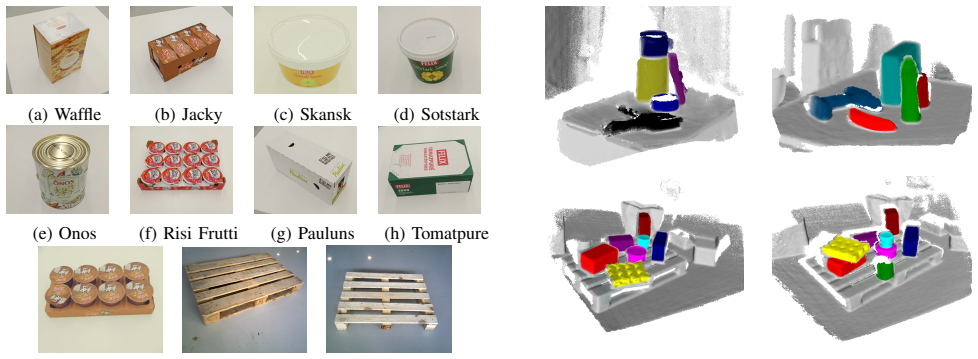
Significance. If the results hold, the paper demonstrates a practical and reproducible gain from multi-view pose fusion: the Object-RPE column improves over the best ablated baseline on every object in both Table I (mean AUC 95.9 vs. 94.1) and Table II (69.7 vs. 66.1). The release of code, video, and a new warehouse dataset with motion-capture ground truth are concrete contributions, and the staged ablations (DF-PM, DF-PM-PD, DF-PM-PD-PC) usefully isolate the sources of improvement. However, the EKF fusion step, which accounts for a substantial part of the reported gain, rests on a zero-process-noise constant-pose model and a measurement covariance derived from the same pose estimate being filtered; these issues need to be addressed before the multi-view claim can be considered fully supported.
major comments (4)
- [Section III-B, Eqs. (5)-(6)] The constant-pose motion model has no process noise, so the predicted covariance is unchanged at each step and the Kalman gain K_t tends to zero as P_t decreases monotonically. Consequently, the filter eventually stops incorporating new measurements and can never forget a consistent bias. The paper explicitly assumes a static scene, but it provides no ablation varying camera-pose accuracy or scene dynamics, so the reported fusion gains (95.9 vs. 94.1 in Table I and 69.7 vs. 66.1 in Table II) are not isolated from tracking errors or small object motions. Please add experiments with synthetic camera-pose noise or with moving objects, or add process noise to the motion model and justify its magnitude.
- [Section III-B, Eq. (10)] The measurement covariance R_t is set to the average distance of segmented object points to the model transformed by the estimated pose, i.e., a fit residual of the very estimate that the filter is about to update. Because the same pose estimate is used to compute both the measurement and its assumed uncertainty, the filter is likely overconfident and the reported AUC gains may partly reflect this circular noise model rather than genuine multi-view information. Please justify this choice, compare against a fixed or calibrated covariance, or report results with an independent noise estimate.
- [Section III-B, Eqs. (4)-(9)] The EKF update is not fully specified: the pose composition operators ⊕ and ⊖ are not defined, and the initialization of the state vector and covariance P_0 is not given. In addition, the minimal Euler-angle representation (φ, ϕ, ψ) has singularities and is not a standard choice for Kalman filtering over rotations. These details are load-bearing because the central contribution is the fusion of pose estimates; without a precise definition of how rotations are composed and how the filter is initialized, the experiments are not fully reproducible.
- [Tables I and II] The pose results are reported as single numbers without error bars, confidence intervals, or significance tests across training runs or random seeds. Given that the reported improvements are on the order of a few AUC points and the network training involves stochastic optimization, the reader cannot assess whether the differences are stable. Please report mean and variance over at least three training seeds for the main baselines and the proposed method.
minor comments (4)
- [Throughout] There are several typos and inconsistent terms, including 'Instace-aware' in Section III-A, 'DensFusion' in Section IV-C, 'intance-aware' in the Introduction, 'addtion' in Section IV-A, and 'on on the warehouse objects' in the Table II caption. Please proofread the manuscript thoroughly.
- [Section III-A] The relationship between the binary mask threshold of 0.5 from Mask R-CNN and the non-background probability interval 0.4 < p_o < 0.5 used in the segmentation improvement step is not fully explained. Clarify how p_o is obtained from the soft mask and why the two thresholds are consistent.
- [Section III-A] The parameters n = 10 and σ_object = 10 are stated without sensitivity analysis. Even if these values are reasonable, the robustness of the reconstruction results to these choices should be briefly discussed or ablated.
- [Section II] The related work on semantic mapping mentions [4], [5], [6], [7] but does not clearly position the proposed instance-aware mapping relative to Fusion++ [6] or MaskFusion [7], both of which also address object-level semantic reconstruction. A short comparison of representational choices (surfels vs. volumes) and capabilities (moving objects) would help the reader.
Circularity Check
No significant circularity: the pose improvement is measured against external ground truth, and the EKF fuses independent per-frame CNN pose measurements rather than fitted targets.
full rationale
The paper's central claim is empirical and externally benchmarked. Per-frame object poses are produced by DenseFusion on masks, depth, and color rendered from the semantic map, then transformed to a global frame using ElasticFusion camera poses and fused via an EKF under a constant-pose model (Eqs. 5-9). The EKF measurement z_t is an independent per-frame CNN pose estimate, not a fitted target pose. Evaluation uses the YCB-Video dataset and a motion-capture-supervised warehouse dataset with ADD-S AUC against ground-truth models, so the reported improvements (95.9 vs. 94.1 for the full ablation chain and 69.7 vs. 66.1 on the warehouse set) are not derived by construction from the inputs. The authors cite their own prior work [4], but the mapping and fusion equations (Eqs. 1-3 and 5-10) are described in the present paper and are not replaced by an unverified self-citation. The constant-pose/no-process-noise EKF and the use of the fit residual as R_t in Eq. (10) are heuristic modeling choices and a robustness concern, not a circular reduction of the claimed prediction. No self-definitional, fitted-as-prediction, or imported-uniqueness step was found.
Assumptions & free parameters
free parameters (4)
- n_frame_window =
10
- sigma_object =
10
- overlap_threshold_U =
0.3
- non_background_probability_lower_bound =
0.4
assumptions (5)
- domain assumption ElasticFusion camera tracking provides sufficiently accurate global camera poses to transform per-frame DenseFusion pose estimates into a common global frame.
- domain assumption The scene is static while the reconstruction is being built, so the object pose follows a constant motion model in the EKF.
- domain assumption DenseFusion pose estimates are approximately unbiased Gaussian measurements with isotropic covariance for the EKF.
- domain assumption Pretrained DenseFusion and Mask R-CNN models transfer to warehouse objects after training on the provided video splits.
- domain assumption Ground-truth poses from motion capture and LabelFusion are accurate enough to serve as evaluation reference.
Cite this review
Pith. "Pith review of Object-RPE: Dense 3D Reconstruction and Pose Estimation with Convolutional Neural Networks for Warehouse Robots." pith.science (2026). https://pith.science/paper/KXMFEZIZ
@misc{pith2026190808601,
  author       = {Pith},
  title        = {Pith review of: Object-RPE: Dense 3D Reconstruction and Pose Estimation with Convolutional Neural Networks for Warehouse Robots},
  year         = {2026},
  howpublished = {\url{https://pith.science/paper/KXMFEZIZ}},
  note         = {Machine review of arXiv:1908.08601}
}
read the original abstract
We present an approach for recognizing all objects in a scene and estimating their full pose from an accurate 3D instance-aware semantic reconstruction using an RGB-D camera. Our framework couples convolutional neural networks (CNNs) and a state-of-the-art dense Simultaneous Localisation and Mapping (SLAM) system, ElasticFusion, to achieve both high-quality semantic reconstruction as well as robust 6D pose estimation for relevant objects. While the main trend in CNN-based 6D pose estimation has been to infer object's position and orientation from single views of the scene, our approach explores performing pose estimation from multiple viewpoints, under the conjecture that combining multiple predictions can improve the robustness of an object detection system. The resulting system is capable of producing high-quality object-aware semantic reconstructions of room-sized environments, as well as accurately detecting objects and their 6D poses. The developed method has been verified through experimental validation on the YCB-Video dataset and a newly collected warehouse object dataset. Experimental results confirmed that the proposed system achieves improvements over state-of-the-art methods in terms of surface reconstruction and object pose prediction. Our code and video are available at https://sites.google.com/view/object-rpe.
Figures


Figures from the paper (1 more)

Reference graph
Works this paper leans on
-
[1]
Kinectfusion: Real-time dense surface mapping and tracking,
R. A. Newcombe, S. Izadi, O. Hilliges, D. Molyneaux, D. Kim, A. J. Davison, P. Kohi, J. Shotton, S. Hodges, and A. Fitzgibbon, “Kinectfusion: Real-time dense surface mapping and tracking,” in Mixed and augmented reality (ISMAR), 2011 10th IEEE international symposium on . IEEE, 2011, pp. 127–136
work page 2011
-
[2]
Robust odometry estimation for RGB-D cameras,
C. Kerl, J. Sturm, and D. Cremers, “Robust odometry estimation for RGB-D cameras,” in 2013 IEEE International Conference on Robotics and Automation . IEEE, 2013, pp. 3748–3754
work page 2013
-
[3]
Elasticfusion: Real-time dense slam and light source estimation,
T. Whelan, R. F. Salas-Moreno, B. Glocker, A. J. Davison, and S. Leutenegger, “Elasticfusion: Real-time dense slam and light source estimation,” The International Journal of Robotics Research , vol. 35, no. 14, pp. 1697–1716, 2016
2016
-
[4]
High-quality Instance-aware Semantic 3D Map Using RGB-D Camera
D.-C. Hoang, T. Stoyanov, and A. J. Lilienthal, “High-quality instance- aware semantic 3d map using RGB-D camera,” arXiv preprint arXiv:1903.10782, 2019
work page Pith review arXiv 1903
-
[5]
Meaningful maps with object-oriented semantic mapping,
N. S ¨underhauf, T. T. Pham, Y . Latif, M. Milford, and I. Reid, “Meaningful maps with object-oriented semantic mapping,” in 2017 IEEE/RSJ International Conference on Intelligent Robots and Systems (IROS). IEEE, 2017, pp. 5079–5085
work page 2017
-
[6]
Fusion++: Volumetric Object-Level SLAM
J. McCormac, R. Clark, M. Bloesch, A. J. Davison, and S. Leuteneg- ger, “Fusion++: V olumetric object-level SLAM,” arXiv preprint arXiv:1808.08378, 2018
work page Pith review arXiv 2018
-
[7]
Maskfusion: Real-time recognition, track- ing and reconstruction of multiple moving objects,
M. R ¨unz and L. Agapito, “Maskfusion: Real-time recognition, track- ing and reconstruction of multiple moving objects,” arXiv preprint arXiv:1804.09194, 2018
arXiv 2018
-
[8]
S. Fuchs, S. Haddadin, M. Keller, S. Parusel, A. Kolb, and M. Suppa, “Cooperative bin-picking with time-of-flight camera and impedance controlled DLR lightweight robot III,” in 2010 IEEE/RSJ International Conference on Intelligent Robots and Systems . IEEE, 2010, pp. 4862– 4867
work page 2010
Show all 18 references
-
[9]
Coarse filters for shape matching,
J. Corney, H. Rea, D. Clark, J. Pritchard, M. Breaks, and R. MacLeod, “Coarse filters for shape matching,” IEEE Computer Graphics and Applications, vol. 22, no. 3, pp. 65–74, 2002
2002
-
[10]
Automatic pose estimation for range images on the GPU,
M. Germann, M. D. Breitenstein, I. K. Park, and H. Pfister, “Automatic pose estimation for range images on the GPU,” in Sixth International Conference on 3-D Digital Imaging and Modeling (3DIM 2007) . IEEE, 2007, pp. 81–90
2007
-
[11]
Posecnn: A convolutional neural network for 6D object pose estimation in cluttered scenes,
Y . Xiang, T. Schmidt, V . Narayanan, and D. Fox, “Posecnn: A convolutional neural network for 6D object pose estimation in cluttered scenes,” arXiv preprint arXiv:1711.00199 , 2017
2017 arXiv
-
[12]
Real-time seamless single shot 6D object pose prediction,
B. Tekin, S. N. Sinha, and P. Fua, “Real-time seamless single shot 6D object pose prediction,” in Proceedings of the IEEE Conference on Computer Vision and Pattern Recognition , 2018, pp. 292–301
2018
-
[13]
Densefusion: 6D object pose estimation by iterative dense fusion,
C. Wang, D. Xu, Y . Zhu, R. Mart ´ın-Mart´ın, C. Lu, L. Fei-Fei, and S. Savarese, “Densefusion: 6D object pose estimation by iterative dense fusion,” arXiv preprint arXiv:1901.04780 , 2019
1901 arXiv
-
[14]
Mask R-CNN,
K. He, G. Gkioxari, P. Doll ´ar, and R. Girshick, “Mask R-CNN,” in Proceedings of the IEEE international conference on computer vision , 2017, pp. 2961–2969
2017
-
[15]
Fully convolutional networks for semantic segmentation,
J. Long, E. Shelhamer, and T. Darrell, “Fully convolutional networks for semantic segmentation,” in Proceedings of the IEEE conference on computer vision and pattern recognition , 2015, pp. 3431–3440
2015
-
[16]
Dense 3d semantic mapping of indoor scenes from rgb-d images,
A. Hermans, G. Floros, and B. Leibe, “Dense 3d semantic mapping of indoor scenes from rgb-d images,” in Robotics and Automation (ICRA), 2014 IEEE International Conference on . IEEE, 2014, pp. 2631–2638
2014
-
[17]
Adam: A method for stochastic optimiza- tion,
D. P. Kingma and J. Ba, “Adam: A method for stochastic optimiza- tion,” arXiv preprint arXiv:1412.6980 , 2014
2014 arXiv
-
[18]
Label fusion: A pipeline for generating ground truth labels for real rgbd data of cluttered scenes,
P. Marion, P. R. Florence, L. Manuelli, and R. Tedrake, “Label fusion: A pipeline for generating ground truth labels for real rgbd data of cluttered scenes,” in 2018 IEEE International Conference on Robotics and Automation (ICRA) . IEEE, 2018, pp. 1–8
2018
Reviewed August 14, 2026 · model on record in the stance chip above.
Discussion (0). Continue with ORCID to comment.