REVIEW 3 major objections 7 minor 42 references
An Optimisation Framework for Unsupervised Environment Design
T0 review · 3 major / 7 minor · reviewed 2026-08-07 · deepseek-v4-flash
Pith's one-line read Unsupervised environment design is reformulated as a nonconvex-strongly-concave game with the first provable convergence guarantee for zero-sum scores, and the practical variant outperforms prior methods on three benchmarks.
desk verdict A genuine step forward for UED theory and practice, but the regret convergence guarantee needs a deterministic-dynamics assumption before it covers what it claims. read the letter →
The pith
A machine-rendered reading of the paper's core claim, the machinery that carries it, and where it could break.
The reading
What carries the argument
The central object is the entropy-regularised expected-score objective $f(x,y) = y^T s(\pi_x,\Lambda) + \alpha H(y)$, whose entropy term enforces strong concavity in the adversary's distribution $y$ and keeps training levels diverse. The argument runs through two-timescale stochastic gradient descent-ascent, with the agent learning slowly ($\eta_x = \Theta(\alpha^2/\ell^3)$) and the adversary faster ($\eta_y = \Theta(1/\ell)$), and uses the strong-concavity to apply a known best-iterate convergence theorem for nonconvex-strongly-concave minimax problems. The generalised learnability score $s(\pi_x,\lambda) = \sigma_\lambda \mathcal{N}(\mu_\lambda|\mu,\sigma^2)$ (level-return standard deviation weighted by a Gaussian in the mean return) is the practical device that lets the method apply to non-binary environments.
What would settle it
Run Algorithm 1 with its exact theoretical configuration (static level set, REINFORCE estimator, regret score) on a two-level gridworld whose optimal returns are known, and record the norm $\|\nabla_x \max_y f(x,y)\|$ at each iteration; if it does not fall below $\epsilon$ within the iteration bound of Theorem 5.1, the convergence theorem is refuted.
Extended reading notes
Core claim
The central discovery is a reformulation and a convergence theorem. The UED objective is written as $f(x,y) = y^T s(\pi_x, \Lambda) + \alpha H(y)$, where $y$ is a categorical distribution over a finite level set $\Lambda$, $s$ is the score vector (e.g., negative return or regret), and $H$ is the entropy. Because the entropy term makes $f$ $\alpha$-strongly concave in $y$, the game becomes nonconvex-strongly-concave. With a $\zeta$-greedy, $L$-Lipschitz, $K$-smooth policy, the paper proves that the best iterate $x^*$ returned by two-timescale stochastic gradient descent-ascent satisfies $\|\nabla_x \max_y f(x^*, y)\| < \epsilon$ in $O(\Delta \ell^3/(\alpha^2 \epsilon^2) + 2\ell^3/(\alpha \epsilon^4))$ iterations (Theorem 5.1). The resulting point is an $\epsilon$-approximate first-order Nash equilibrium. The paper also proposes a generalised learnability score $s(\pi_x,\lambda) = \sigma_\lambda \mathcal{N}(\mu_\lambda|\mu,\sigma^2)$ that extends the binary-outcome learnability of prior work to arbitrary deterministic environments.
Load-bearing premise
The load-bearing premise is that the simplified setting analysed in Theorem 5.1—static finite level set, REINFORCE gradient estimator, and zero-sum score—represents real UED well enough that the convergence guarantee transfers to the practical method; Section 6 of the paper concedes the practical algorithm instead uses PPO, a dynamic buffer, and general-sum score functions.
Editorial extensions
If this is right
- Zero-sum UED (regret or negative return) now has a polynomial iteration bound to reach an $\epsilon$-first-order-Nash point, so future analyses can assume convergence rather than only assert properties conditional on it.
- The entropy-regularised adversary yields an explicit distribution over levels, so the level sampler is directly optimisable by gradients instead of heuristics.
- The generalised learnability score extends sample-for-learnability to any deterministic RL environment, removing the binary-outcome restriction of prior work.
- The two-timescale rate separation gives practical guidance: the adversary's learning rate should dominate the agent's, and the temperature $\alpha$ controls exploration of the level space.
- If the framework holds, UED becomes a principled component of robust RL pipelines with a certificate of local optimality, rather than an ad-hoc curriculum heuristic.
Reading between the lines
- The entropy regularisation trick is general: any objective that is linear in a distribution over tasks could be regularised the same way, so the framework likely extends beyond UED to curriculum learning and dataset selection.
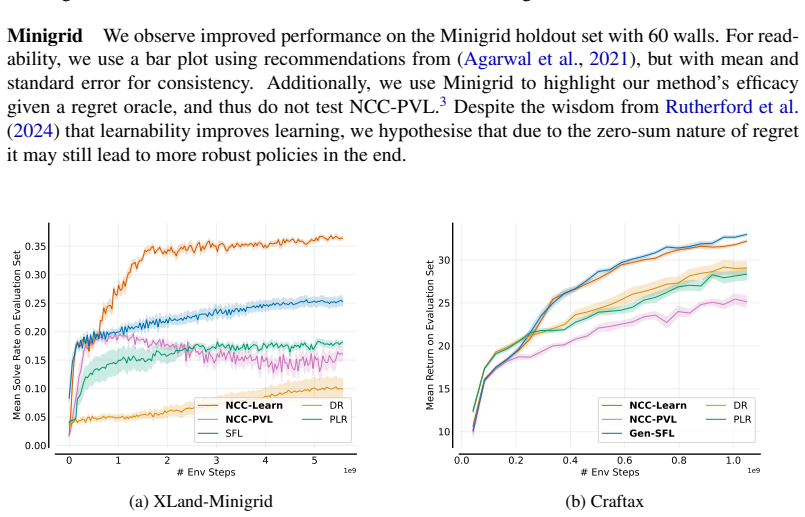
- Because the theorem covers only Algorithm 1, the practical NCC's empirical wins on XLand-Minigrid and Craftax are not yet backed by the convergence proof; bridging that gap may require analysing PPO-like updates or general-sum score functions.
- The generalised learnability score's Gaussian weighting over mean returns could suppress levels with unusually low or high mean return even when they are learnable; a controlled comparison on environments with skewed return distributions would test this.
Editorial analysis
A structured set of objections, weighed in public.
Referee Report
Summary. The paper reformulates UED as a nonconvex-strongly-concave minimax game by adding entropy regularization to the adversary's level distribution over a finite static level set. It proposes Algorithm 1, a two-timescale stochastic gradient descent-ascent method, and proves (Theorem 5.1) an epsilon-stationary best-iterate convergence guarantee under Assumptions 1 and 2, using Proposition 1 for variance and smoothness bounds and invoking Lin et al. (2020). The paper then introduces a practical variant, NCC (Algorithm 2), using PPO, a dynamic level buffer, and a generalized learnability score, and reports experiments on Minigrid, XLand-Minigrid, and Craftax showing improvements over PLR, DR, and SFL baselines.
Significance. If the convergence theorem were sound, it would provide UED's first rigorous convergence guarantee for a zero-sum formulation, a meaningful advance over prior saddle-point-existence arguments. The paper is transparent about the gap between Algorithm 1 and the practical NCC, and the empirical study covers standard benchmarks with 10 seeds and includes robustness (alpha-CVaR) evaluations. The generalized learnability score is a useful practical contribution. However, the theorem's applicability to regret in stochastic environments is currently not established.
major comments (3)
- [Section 5.1, Eq. (10), Proposition 1] The regret estimator is not unbiased. Regret is defined in Section 2.3 as J(pi*_lambda, lambda) - J(pi_x, lambda), where J is expected discounted return. The estimator \hat s(pi_x, lambda_i) = max_tau R(tau, lambda_i) - (1/M) sum_j R(tau_ij, lambda_i) has expectation E[max_tau R(tau, lambda)] - J(pi_x, lambda), which equals regret only if E[max_tau R] = J(pi*_lambda, lambda). This equality fails under stochastic transitions, which Assumption 1 does not exclude, because the maximum over trajectories is a maximum of sampled returns rather than the optimal expected value; with finite M it also fails in deterministic environments unless the max is an exact oracle over all trajectories. Since Lin et al. (2020) requires unbiased stochastic gradients, Theorem 5.1 as stated does not cover the zero-sum regret objective. Please add an explicit deterministic-environment assumption (or an exact optimal-return oracle), state the resulting scope, or replace the estimator with an unbiased one.
- [Section 5.1, Assumption 2] A hard zeta-greedy policy is piecewise constant and not K-smooth, yet the proof of Proposition 1 relies on bounds such as ||nabla_x log pi_x|| <= L/zeta and ||nabla^2_x log pi_x|| <= K/zeta + L^2/zeta^2, which require differentiability and Lipschitz/smoothness of the policy. Please restate Assumption 2 as, for example, a smooth stochastic policy whose action probabilities are bounded below by zeta (a 'zeta-soft' policy), and verify that all bounds in Appendix A hold under that definition.
- [Sections 4.2, 6, Algorithm 2] The practical NCC violates the theorem's assumptions (PPO instead of REINFORCE, dynamic buffer, any score function, any optimizer), as Table 1 acknowledges. Section 6.2 further concedes that general-sum score functions such as learnability have no convergence guarantees. Consequently, the 'provably convergent' claim attaches only to Algorithm 1; the abstract's phrase 'providing stronger theoretical guarantees for practical settings' and the Section 1 statement 'a gradient-based algorithm that is provably convergent' should be scoped explicitly to Algorithm 1 to avoid overclaiming. This is a presentation/scope issue, but it is load-bearing for how readers interpret the empirical results.
minor comments (7)
- [Abstract] The abstract says 'outperforming prior methods in a number of environments', but the cover-page summary says 'two of three environments'; Figure 3 shows NCC-Learn and Gen-SFL comparable in Craftax, so please make the abstract consistent with the actual results.
- [Section 2.4, Eq. (11)] The generalization of learnability in Eq. (11) uses the level-wise standard deviation sigma_lambda, while the text says 'standard error values'; please align the terminology with the formula.
- [Algorithm 2] The call \hat G(x_t, y_t; s, \tilde s) is underspecified because Eq. (10) defines \hat G with arguments (x, y) only; it is unclear whether the merged score vector \tilde s or the batch score vector s is used in the adversary update.
- [Appendix B.1] The note 'We write details for the dynamic buffer in maroon' is not visible in the provided manuscript; please use a different cue, such as a labeled comment or a separate paragraph.
- [Table 1] In the row 'Score Function Only zero-sum (i.e. Regret and −J)', the 'i.e.' should be 'e.g.', since regret and negative return are examples of zero-sum scores, not an exhaustive list.
- [Section 5.1, Algorithm 1] The 'Best-iterate policy parameters x*' returned by Algorithm 1 lacks a selection criterion; Lin et al.'s guarantee is existential over iterates, so please state how the best iterate is identified or acknowledge that the guarantee is not constructive.
- [Section 6.2] The sentence 'We note that the baselines ... also lack convergence guarantees' is a fair caveat but should not be phrased as a justification; the absence of guarantees in baselines does not address the lack of guarantees for general-sum NCC.
Circularity Check
No circularity: the convergence guarantee is imported from an external theorem, and no fitted input is relabeled as a prediction.
full rationale
The paper's central result, Theorem 5.1, is an application of Lin et al. (2020, Theorem 4.5) to a newly constructed entropy-regularized minimax objective. The entropy term is explicitly added to make the objective strongly concave in the adversary's strategy, and Proposition 1 proves the needed variance, Lipschitzness, and smoothness bounds from Assumptions 1 and 2 rather than assuming them. The score functions used in the objective (negative return and regret) are defined independently of the empirical evaluation metrics, and the generalized learnability score is constructed as a variance-like heuristic, not fitted to the paper's experimental outcomes. Self-citations to prior UED work (Dennis et al., Jiang et al., Rutherford et al.) are contextual motivation and baseline descriptions, not load-bearing for the proof; the proof's external dependency is Lin et al. and standard policy-gradient results. The paper also explicitly discloses that the practical NCC algorithm breaks the theoretical assumptions (Section 6 and Table 1), which is an honest limitation rather than a circular move. Any concern about the regret estimator's unbiasedness in stochastic environments is a correctness or assumption-satisfaction issue, not a case of the derivation reducing to its own inputs.
Assumptions & free parameters
free parameters (4)
- alpha (entropy temperature) =
0.05 for Minigrid and Craftax, annealed as alpha divided by the cube root of t+1 in Craftax; 0 for XLand-Minigrid
- eta_x and eta_y (learning rates) =
eta_x 0.001/0.0001/0.0001 and eta_y 0.1/0.01/0.01 for Minigrid/XLand/Craftax
- Level buffer sizes |Lambda|, |Lambda'|, batch |lambda| =
|Lambda|=4000 on all; |Lambda'|=256/8192/0; |lambda|=256/8192/1024
- xi (simplex truncation)
assumptions (6)
- standard math Lin et al. (2020) Theorem 4.5: two-timescale stochastic GDA finds an epsilon-stationary point for nonconvex-strongly-concave objectives
- domain assumption Assumption 1: finite level count N, finite horizon T, bounded state/reward spaces
- domain assumption Assumption 2: zeta-greedy L-Lipschitz K-smooth policy and xi-truncated simplex
- domain assumption Zero-sum score condition (s = -J or Reg) for the guarantee
- ad hoc to paper Entropy regularization alpha H(y) is added by the authors
- ad hoc to paper Generalized learnability heuristic s = sigma_lambda N(mu_lambda | mu, sigma^2)
Cite this review
Pith. "Pith review of An Optimisation Framework for Unsupervised Environment Design." pith.science (2026). https://pith.science/paper/KXU3KZWP
@misc{pith2026250520659,
  author       = {Pith},
  title        = {Pith review of: An Optimisation Framework for Unsupervised Environment Design},
  year         = {2026},
  howpublished = {\url{https://pith.science/paper/KXU3KZWP}},
  note         = {Machine review of arXiv:2505.20659}
}
read the original abstract
For reinforcement learning agents to be deployed in high-risk settings, they must achieve a high level of robustness to unfamiliar scenarios. One method for improving robustness is unsupervised environment design (UED), a suite of methods aiming to maximise an agent's generalisability across configurations of an environment. In this work, we study UED from an optimisation perspective, providing stronger theoretical guarantees for practical settings than prior work. Whereas previous methods relied on guarantees if they reach convergence, our framework employs a nonconvex-strongly-concave objective for which we provide a provably convergent algorithm in the zero-sum setting. We empirically verify the efficacy of our method, outperforming prior methods in a number of environments with varying difficulties.
Figures


Figures from the paper (7 more)


Reference graph
Works this paper leans on
-
[1]
Deep reinforcement learning at the edge of the statistical precipice
Rishabh Agarwal, Max Schwarzer, Pablo Samuel Castro, Aaron Courville, and Marc G Bellemare. Deep reinforcement learning at the edge of the statistical precipice. Advances in Neural Information Processing Systems, 2021
work page 2021
-
[2]
Clutr: curriculum learning via unsupervised task representation learning
Abdus Salam Azad, Izzeddin Gur, Jasper Emhoff, Nathaniel Alexis, Aleksandra Faust, Pieter Abbeel, and Ion Stoica. Clutr: curriculum learning via unsupervised task representation learning. In Proceedings of the 40th International Conference on Machine Learning, ICML'23. JMLR.org, 2023
work page 2023
-
[3]
Refining minimax regret for unsupervised environment design
Michael Beukman, Samuel Coward, Michael Matthews, Mattie Fellows, Minqi Jiang, Michael Dennis, and Jakob Foerster. Refining minimax regret for unsupervised environment design. In Proceedings of the 41st International Conference on Machine Learning, ICML'24. JMLR.org, 2024
work page 2024
-
[4]
JAX : composable transformations of P ython+ N um P y programs, 2018
James Bradbury, Roy Frostig, Peter Hawkins, Matthew James Johnson, Chris Leary, Dougal Maclaurin, George Necula, Adam Paszke, Jake Vander P las, Skye Wanderman- M ilne, and Qiao Zhang. JAX : composable transformations of P ython+ N um P y programs, 2018. URL http://github.com/jax-ml/jax
2018
-
[5]
Yang Cai, Argyris Oikonomou, and Weiqiang Zheng. Accelerated algorithms for constrained nonconvex-nonconcave min-max optimization and comonotone inclusion. In Ruslan Salakhutdinov, Zico Kolter, Katherine Heller, Adrian Weller, Nuria Oliver, Jonathan Scarlett, and Felix Berkenkamp (eds.), Proceedings of the 41st International Conference on Machine Learning...
work page 2024
-
[6]
Maxime Chevalier-Boisvert, Bolun Dai, Mark Towers, Rodrigo Perez-Vicente, Lucas Willems, Salem Lahlou, Suman Pal, Pablo Samuel Castro, and J Terry. Minigrid & miniworld: Modular & customizable reinforcement learning environments for goal-oriented tasks. In A. Oh, T. Naumann, A. Globerson, K. Saenko, M. Hardt, and S. Levine (eds.), Advances in Neur...
work page 2023
-
[7]
Adversarial environment design via regret-guided diffusion models
Hojun Chung, Junseo Lee, Minsoo Kim, Dohyeong Kim, and Songhwai Oh. Adversarial environment design via regret-guided diffusion models. In A. Globerson, L. Mackey, D. Belgrave, A. Fan, U. Paquet, J. Tomczak, and C. Zhang (eds.), Advances in Neural Information Processing Systems, volume 37, pp.\ 63715--63746. Curran Associates, Inc., 2024. URL https://proce...
work page 2024
-
[8]
Jaxued: A simple and useable ued library in jax, 2024
Samuel Coward, Michael Beukman, and Jakob Foerster. Jaxued: A simple and useable ued library in jax, 2024. URL https://arxiv.org/abs/2403.13091
arXiv 2024
Show all 42 references
-
[9]
Last-iterate convergence: Zero-sum games and constrained min-max optimization, 2020
Constantinos Daskalakis and Ioannis Panageas. Last-iterate convergence: Zero-sum games and constrained min-max optimization, 2020. URL https://arxiv.org/abs/1807.04252
2020
-
[10]
Emergent complexity and zero-shot transfer via unsupervised environment design
Michael Dennis, Natasha Jaques, Eugene Vinitsky, Alexandre Bayen, Stuart Russell, Andrew Critch, and Sergey Levine. Emergent complexity and zero-shot transfer via unsupervised environment design. In H. Larochelle, M. Ranzato, R. Hadsell, M.F. Balcan, and H. Lin (eds.), Advance...
2020
-
[11]
Lucas, and Stefano V
Samuel Garcin, James Doran, Shangmin Guo, Christopher G. Lucas, and Stefano V. Albrecht. Dred: Zero-shot transfer in reinforcement learning via data-regularised environment design. JMLR.org, 2024
2024
-
[12]
Mirror learning: A unifying framework of policy optimisation
Jakub Grudzien, Christian A Schroeder De Witt, and Jakob Foerster. Mirror learning: A unifying framework of policy optimisation. In Kamalika Chaudhuri, Stefanie Jegelka, Le Song, Csaba Szepesvari, Gang Niu, and Sivan Sabato (eds.), Proceedings of the 39th International Confere...
2022
-
[13]
A two-timescale stochastic algorithm framework for bilevel optimization: Complexity analysis and application to actor-critic
Mingyi Hong, Hoi-To Wai, Zhaoran Wang, and Zhuoran Yang. A two-timescale stochastic algorithm framework for bilevel optimization: Complexity analysis and application to actor-critic. SIAM Journal on Optimization, 33 0 (1): 0 147--180, 2023. doi:10.1137/20M1387341. URL https://...
2023 doi
-
[14]
Replay-guided adversarial environment design
Minqi Jiang, Michael Dennis, Jack Parker-Holder, Jakob Foerster, Edward Grefenstette, and Tim Rockt\" a schel. Replay-guided adversarial environment design. In M. Ranzato, A. Beygelzimer, Y. Dauphin, P.S. Liang, and J. Wortman Vaughan (eds.), Advances in Neural Information Pro...
2021
-
[15]
Prioritized level replay
Minqi Jiang, Edward Grefenstette, and Tim Rockt \"a schel. Prioritized level replay. In Marina Meila and Tong Zhang (eds.), Proceedings of the 38th International Conference on Machine Learning, volume 139 of Proceedings of Machine Learning Research, pp.\ 4940--4950. PMLR, 18--...
2021
-
[16]
u ttler, Edward Grefenstette, Tim Rockt\
Minqi Jiang, Michael Dennis, Jack Parker-Holder, Andrei Lupu, Heinrich K\" u ttler, Edward Grefenstette, Tim Rockt\" a schel, and Jakob Foerster. Grounding aleatoric uncertainty for unsupervised environment design. In S. Koyejo, S. Mohamed, A. Agarwal, D. Belgrave, K. Cho, and...
2022
-
[17]
Chi Jin, Praneeth Netrapalli, and Michael Jordan. What is local optimality in nonconvex-nonconcave minimax optimization? In Hal Daumé III and Aarti Singh (eds.), Proceedings of the 37th International Conference on Machine Learning, volume 119 of Proceedings of Machine Learning...
2020
-
[18]
Learning equilibria in adversarial team markov games: A nonconvex-hidden-concave min-max optimization problem
Fivos Kalogiannis, Jingming Yan, and Ioannis Panageas. Learning equilibria in adversarial team markov games: A nonconvex-hidden-concave min-max optimization problem. In A. Globerson, L. Mackey, D. Belgrave, A. Fan, U. Paquet, J. Tomczak, and C. Zhang (eds.), Advances in Neural...
2024
-
[19]
Kingma and Jimmy Ba
Diederik P. Kingma and Jimmy Ba. Adam: A method for stochastic optimization, 2017. URL https://arxiv.org/abs/1412.6980
2017 arXiv
-
[20]
Last iterate convergence in no-regret learning: constrained min-max optimization for convex-concave landscapes
Qi Lei, Sai Ganesh Nagarajan, Ioannis Panageas, and xiao wang. Last iterate convergence in no-regret learning: constrained min-max optimization for convex-concave landscapes. In Arindam Banerjee and Kenji Fukumizu (eds.), Proceedings of The 24th International Conference on Art...
2021
-
[21]
Enhancing the hierarchical environment design via generative trajectory modeling, 2024
Dexun Li and Pradeep Varakantham. Enhancing the hierarchical environment design via generative trajectory modeling, 2024. URL https://arxiv.org/abs/2310.00301
2024 arXiv
-
[22]
Tiada: A time-scale adaptive algorithm for nonconvex minimax optimization
Xiang Li, Junchi YANG, and Niao He. Tiada: A time-scale adaptive algorithm for nonconvex minimax optimization. In The Eleventh International Conference on Learning Representations, 2023. URL https://openreview.net/forum?id=zClyiZ5V6sL
2023
-
[23]
On gradient descent ascent for nonconvex-concave minimax problems
Tianyi Lin, Chi Jin, and Michael Jordan. On gradient descent ascent for nonconvex-concave minimax problems. In Hal Daumé III and Aarti Singh (eds.), Proceedings of the 37th International Conference on Machine Learning, volume 119 of Proceedings of Machine Learning Research, pp...
2020
-
[24]
Craftax: A lightning-fast benchmark for open-ended reinforcement learning
Michael Matthews, Michael Beukman, Benjamin Ellis, Mikayel Samvelyan, Matthew Jackson, Samuel Coward, and Jakob Foerster. Craftax: A lightning-fast benchmark for open-ended reinforcement learning. In International Conference on Machine Learning ( ICML ) , 2024
2024
-
[25]
Kinetix: Investigating the training of general agents through open-ended physics-based control tasks
Michael Matthews, Michael Beukman, Chris Lu, and Jakob Nicolaus Foerster. Kinetix: Investigating the training of general agents through open-ended physics-based control tasks. In The Thirteenth International Conference on Learning Representations, 2025. URL https://openreview....
2025
-
[26]
Optimistic mirror descent in saddle-point problems: Going the extra(-gradient) mile
Panayotis Mertikopoulos, Bruno Lecouat, Houssam Zenati, Chuan-Sheng Foo, Vijay Chandrasekhar, and Georgios Piliouras. Optimistic mirror descent in saddle-point problems: Going the extra(-gradient) mile. In International Conference on Learning Representations, 2019. URL https:/...
2019
-
[27]
Stable recurrent models
John Miller and Moritz Hardt. Stable recurrent models. In 7th International Conference on Learning Representations, ICLR 2019, New Orleans, LA, USA, May 6-9, 2019. OpenReview.net, 2019. URL https://openreview.net/forum?id=Hygxb2CqKm
2019
-
[28]
Robust reinforcement learning
Jun Morimoto and Kenji Doya. Robust reinforcement learning. In T. Leen, T. Dietterich, and V. Tresp (eds.), Advances in Neural Information Processing Systems, volume 13. MIT Press, 2000. URL https://proceedings.neurips.cc/paper_files/paper/2000/file/e8dfff4676a47048d6f0c4ef899...
2000
-
[29]
J.F. Nash. Non-cooperative games. Annals of Mathematics, 54 0 (2): 0 286--295, 1951
1951
-
[30]
XL and-minigrid: Scalable meta-reinforcement learning environments in JAX
Alexander Nikulin, Vladislav Kurenkov, Ilya Zisman, Viacheslav Sinii, Artem Agarkov, and Sergey Kolesnikov. XL and-minigrid: Scalable meta-reinforcement learning environments in JAX . In Intrinsically-Motivated and Open-Ended Learning Workshop, NeurIPS2023, 2023. URL https://o...
2023
-
[31]
Solving a class of non-convex min-max games using iterative first order methods
Maher Nouiehed, Maziar Sanjabi, Tianjian Huang, Jason D Lee, and Meisam Razaviyayn. Solving a class of non-convex min-max games using iterative first order methods. In H. Wallach, H. Larochelle, A. Beygelzimer, F. d Alch\' e -Buc, E. Fox, and R. Garnett (eds.), Advances in Neu...
2019
-
[32]
Evolving curricula with regret-based environment design, 2023
Jack Parker-Holder, Minqi Jiang, Michael Dennis, Mikayel Samvelyan, Jakob Foerster, Edward Grefenstette, and Tim Rocktäschel. Evolving curricula with regret-based environment design, 2023. URL https://arxiv.org/abs/2203.01302
2023 arXiv
-
[33]
Robust optimization over multiple domains
Qi Qian, Shenghuo Zhu, Jiasheng Tang, Rong Jin, Baigui Sun, and Hao Li. Robust optimization over multiple domains. AAAI Press, 2019. ISBN 978-1-57735-809-1. doi:10.1609/aaai.v33i01.33014739. URL https://doi.org/10.1609/aaai.v33i01.33014739
2019 doi
-
[34]
No regrets: Investigating and improving regret approximations for curriculum discovery
Alexander Rutherford, Michael Beukman, Timon Willi, Bruno Lacerda, Nick Hawes, and Jakob Foerster. No regrets: Investigating and improving regret approximations for curriculum discovery. In A. Globerson, L. Mackey, D. Belgrave, A. Fan, U. Paquet, J. Tomczak, and C. Zhang (eds....
2024
-
[35]
Proximal policy optimization algorithms, 2017
John Schulman, Filip Wolski, Prafulla Dhariwal, Alec Radford, and Oleg Klimov. Proximal policy optimization algorithms, 2017. URL https://arxiv.org/abs/1707.06347
2017 arXiv
-
[36]
Hessian aided policy gradient
Zebang Shen, Alejandro Ribeiro, Hamed Hassani, Hui Qian, and Chao Mi. Hessian aided policy gradient. In Kamalika Chaudhuri and Ruslan Salakhutdinov (eds.), Proceedings of the 36th International Conference on Machine Learning, volume 97 of Proceedings of Machine Learning Resear...
2019
-
[37]
Domain randomization for transferring deep neural networks from simulation to the real world
Josh Tobin, Rachel Fong, Alex Ray, Jonas Schneider, Wojciech Zaremba, and Pieter Abbeel. Domain randomization for transferring deep neural networks from simulation to the real world. IEEE Press, 2017. doi:10.1109/IROS.2017.8202133. URL https://doi.org/10.1109/IROS.2017.8202133
2017
-
[38]
P roximal C urriculum for R einforcement L earning A gents
Georgios Tzannetos, B\'arbara Gomes Ribeiro, Parameswaran Kamalaruban, and Adish Singla. P roximal C urriculum for R einforcement L earning A gents. Transactions of Machine Learning Research (TMLR), 2023
2023
-
[39]
Lipschitz regularity of deep neural networks: analysis and efficient estimation
Aladin Virmaux and Kevin Scaman. Lipschitz regularity of deep neural networks: analysis and efficient estimation. In S. Bengio, H. Wallach, H. Larochelle, K. Grauman, N. Cesa-Bianchi, and R. Garnett (eds.), Advances in Neural Information Processing Systems, volume 31. Curran A...
2018
-
[40]
Albrecht, and Andrew Nystrom
Maciej Wiatrak, Stefano V. Albrecht, and Andrew Nystrom. Stabilizing generative adversarial networks: A survey, 2020. URL https://arxiv.org/abs/1910.00927
2020 arXiv
-
[41]
Williams
Ronald J. Williams. Simple statistical gradient-following algorithms for connectionist reinforcement learning. Mach. Learn., 8 0 (3–4): 0 229–256, May 1992. ISSN 0885-6125. doi:10.1007/BF00992696. URL https://doi.org/10.1007/BF00992696
1992 doi
-
[42]
write newline
" write newline "" before.all 'output.state := FUNCTION n.dashify 't := "" t empty not t #1 #1 substring "-" = t #1 #2 substring "--" = not "--" * t #2 global.max substring 't := t #1 #1 substring "-" = "-" * t #2 global.max substring 't := while if t #1 #1 substring * t #2 gl...
Reviewed August 7, 2026 · model on record in the stance chip above.
Discussion (0). Continue with ORCID to comment.