Size, shape, density, and atmospheric limit of (50000) Quaoar revealed from 14 years of stellar occultation
Reviewed by Pith T0 review T1 audit T2 compute T3 formal T4 kernel 2026-07-08 05:11 UTCglm-5.2pith:KXW5NDOErecord.jsonopen to challenge →
The pith
Fourteen years of occultations pin down Quaoar's size and shape
A machine-rendered reading of the paper's core claim, the machinery that carries it, and where it could break.
Core claim
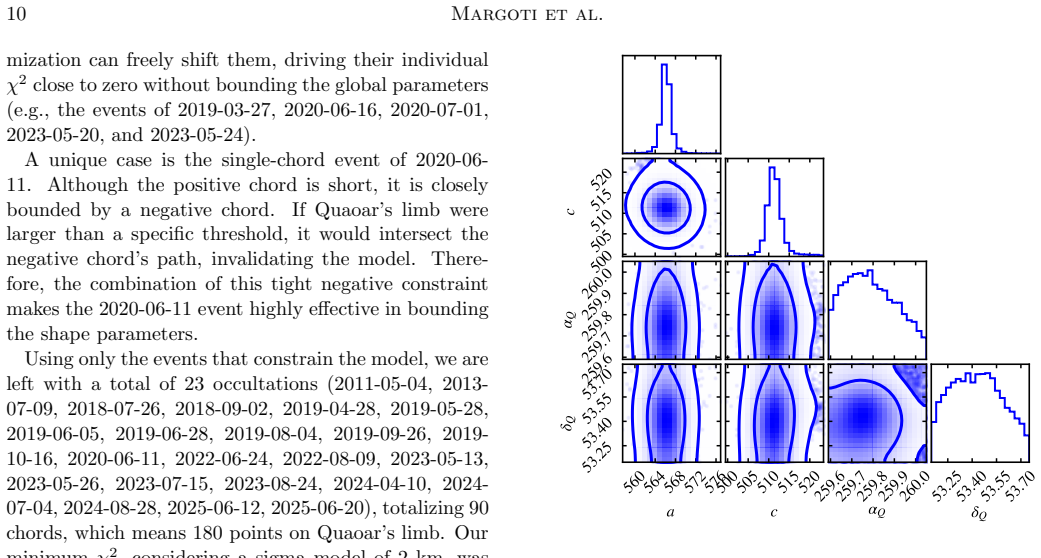
The central finding is that Quaoar's independently measured density (1.760 ± 0.109 g/cm³, from volume and satellite-derived mass) agrees within uncertainties with the density predicted by the Maclaurin hydrostatic equilibrium model (1.859 ± 0.200 g/cm³, from the oblate shape and rotation period). This concordance suggests Quaoar is a body whose shape is determined by self-gravity and rotational forces rather than material strength, which is the physical basis for dwarf planet status. The shape measurement rests on 14 years of stellar occultation campaigns producing 107 chords—projections of the body's silhouette on the sky at different rotational aspects and viewing geometries—fitted to a 76
What carries the argument
Stellar occultation chords (one-dimensional brightness profiles that trace the body's silhouette), fitted via MCMC to an oblate spheroid with the pole orientation fixed to match Quaoar's ring plane. The Maclaurin equilibrium condition links the oblateness and rotation period to a predicted density, which is then compared to the mass-over-volume density.
If this is right
- If Quaoar is confirmed as a Maclaurin body, it joins a small set of Trans-Neptunian objects whose shapes are gravity-dominated, strengthening the case for dwarf planet classification beyond the four currently recognized by the IAU.
- The 0.15 nbar methane atmosphere upper limit constrains volatile retention models for large TNOs; if Quaoar cannot sustain even a tenuous CH4 atmosphere, this narrows the parameter space for surface compositions and thermal histories of similar-sized bodies at ~43 AU.
- The 36 new astrometric positions with sub-milliarcsecond precision will refine Quaoar's ephemeris, improving future occultation predictions and potentially revealing non-gravitational forces or orbital perturbations from unseen material.
- The ring resonance locations shift under the new shape solution (QR1 near 1/6 spin-orbit resonance instead of 1/3), which affects models of ring confinement and the role of shepherd satellites or resonant trapping outside the Roche limit.
Where Pith is reading between the lines
- The pole orientation is assumed to coincide with the ring pole rather than being independently constrained by the occultation data. If Quaoar's rotational axis is misaligned with its ring plane—a possibility the authors themselves flag as worthy of investigation—the derived shape parameters and the Maclaurin equilibrium test would need to be revisited.
- The authors note that a triaxial ellipsoid model with a 17.68-hour double-peaked rotation period could also fit the data, which would break the Maclaurin equilibrium argument entirely. The oblate interpretation requires attributing the full rotational light curve amplitude to albedo variegation, which is physically plausible but unverified.
- The sigma_model = 2 km systematic uncertainty floor is introduced to account for topographic features and cross-calibration scatter across heterogeneous instrumentation. If this floor underestimates real topographic relief or timing systematics, the derived oblateness could shift, affecting the Maclaurin density comparison.
Load-bearing premise
The pole orientation of Quaoar is not independently determined from the occultation data but is fixed to match the orientation of Quaoar's rings as measured in a separate study. If the body's rotational axis is tilted relative to its ring plane, the fitted shape parameters and the Maclaurin equilibrium conclusion would change.
What would settle it
A future occultation campaign that independently constrains Quaoar's pole orientation to differ significantly from the ring pole, or a triaxial shape fit that explains the rotational light curve amplitude without requiring albedo variegation, would undermine the Maclaurin equilibrium claim and the dwarf planet eligibility argument.
Figures


read the original abstract
We present results from 28 stellar occultations by the large Trans-Neptunian Object (50000) Quaoar registered between 2018 and 2025. By performing a joint analysis of this occultation data-set, along with other 9 published events, we were able to fit an oblate ellipsoid shape, with equatorial semi-axes, a and b of 566.1+2.5-2.2 km, and a polar semi-axis, c, of 511.2+3.6-3.7 km. It provides an equivalent volumetric diameter of 1094.4 +/- 4.6 km and polar oblateness of 0.097 +/- 0.011. Considering an absolute magnitude of H = 2.79 +/- 0.35, we derive a geometric albedo of pV = 0.125 +/- 0.038. We have derived new upper limits to the surface pressure of a CH4 atmosphere of 0.15 nbar (1-sigma) and 0.65 nbar (3-sigma). We also provide a table with the 36 new astrometric positions for Quaoar. Using the new system mass derived from Weywot's orbit around Quaoar, we calculated a density of 1.760 +/- 0.109 g/cm3. Moreover, from the derived size and rotation period (8.8394 +/- 0.0002 hours (Ortiz et al. 2003)), we calculate that, if Quaoar is in Maclaurin hydrostatic equilibrium state, it would have a density of 1.859 +/- 0.200 g/cm3. This result, within the error bars, is compatible with the value we found. Therefore, this work shows that Quaoar can be a Maclaurin object, being eligible as a dwarf planet.
Editorial analysis
A structured set of objections, weighed in public.
Referee Report
Summary. This paper presents a comprehensive analysis of 36 stellar occultations by the TNO (50000) Quaoar, observed between 2011 and 2025. The authors fit an oblate spheroid model to 107 positive chords using MCMC, deriving equatorial semi-axes a=b=566.1 km and polar semi-axis c=511.2 km. Using the system mass from Braga-Ribas et al. (2025), they derive a bulk density of 1.760 g/cm³. They compare this to the Maclaurin hydrostatic equilibrium density (1.859 g/cm³) computed from the rotation period and fitted oblateness, finding agreement within 1σ. The paper also provides improved upper limits for a CH₄ atmosphere (0.15 nbar at 1σ), 36 new astrometric positions, and a geometric albedo of 0.125. The central claim is that Quaoar can be a Maclaurin object, making it eligible for dwarf planet classification.
Significance. The dataset of 36 multi-epoch occultations with 107 chords is the most extensive assembled for Quaoar and represents a major observational effort. The derivation of precise shape parameters, density, and atmospheric limits constitutes a significant contribution to TNO characterization. The Maclaurin equilibrium comparison is a falsifiable prediction linking the shape, rotation period, and density. The improved atmospheric upper limits (0.15 nbar for CH₄) constrain volatile retention models. The 36 new astrometric positions are valuable for ephemeris refinement. The work is appropriate in scope and significance for the journal.
major comments (3)
- §3.2, Eq. (1): The systematic uncertainty floor σ_model = 2 km is iteratively tuned to force χ²_pdf ≈ 1. While the text states this accounts for topographic features and cross-calibration scatter, this post-hoc calibration means the reported parameter uncertainties (Table 2) are contingent on the chosen floor value. The paper would benefit from a sensitivity analysis: how do a, c, and their uncertainties change if σ_model is set to 1 km or 3 km? If the best-fit values are stable but the uncertainties scale, that should be stated explicitly. If the best-fit values shift, the Maclaurin density comparison could be affected. This is load-bearing because the density comparison (1.760 ± 0.109 vs. 1.859 ± 0.200 g/cm³) has only marginal overlap (~1σ), so the uncertainty calibration directly impacts the central claim.
- §3.2 and §4: The pole orientation (α_Q, δ_Q) is fixed from the ring pole (Pereira et al. 2023) rather than independently constrained by the occultation data. The paper is transparent about this: 'the posterior distribution for the pole orientation mirrors the adopted prior.' However, the derived shape parameters (a, c) are conditional on this assumption. The known 4.8° ± 1.4° misalignment between Weywot's orbital plane and the ring plane (§1) provides a physically motivated alternative pole. The paper should quantify how sensitive the Maclaurin equilibrium conclusion is to a pole offset of this magnitude. A brief calculation or discussion of how a and c would change under a 4.8° pole shift would substantially strengthen the robustness of the central claim. Without this, the reader cannot assess whether the Maclaurin agreement would survive a different pole assumption.
- §4, last paragraph: The paper acknowledges that 'a triaxial ellipsoid may also be compatible' and that 'Quaoar's definitive tridimensional shape remains to be defined.' This is appropriate candor, but it creates a tension with the abstract's claim that Quaoar 'can be a Maclaurin object, being eligible as a dwarf planet.' The oblate assumption is adopted, not demonstrated. The paper should clarify whether the current dataset can distinguish between oblate and triaxial models at a given significance level, or state explicitly that this question is deferred to future work with rotation-phase-resolved data. As it stands, the Maclaurin conclusion is conditional on the oblate assumption, which itself rests on the single-peaked rotation period interpretation.
minor comments (9)
- §1: The statement 'Ring systems are generally expected to orbit along the equatorial plane of their central bodies' could cite a relevant reference supporting this expectation.
- §3.1: The phrase 'The variety file formats was as diverse as the variety of telescopes' has a grammatical error ('variety file formats was' should be 'variety of file formats was').
- §3.2: The text mentions 'Johnson & McGetchin (1973)' for topography bounds but the relevance of this reference to the σ_model calibration is not fully explained. A sentence clarifying how the 2 km floor relates to expected topographic amplitudes would help the reader.
- Table 2: The J₂ and J₄ values are listed as derived using 'Rossi et al. (1999) equations,' but no formula or derivation is shown. A brief reference to the specific equations used would improve reproducibility.
- Figure 2: The chord plots are small and difficult to read in detail, especially for single-chord events. Consider providing an enlarged version of at least the best-constrained multi-chord events (e.g., 2022-08-09, 2023-07-15) as an inset or supplementary figure.
- §3.3: The atmospheric analysis uses a thermal profile from Braga-Ribas et al. (2013). It would be useful to briefly state how sensitive the upper limits are to the assumed thermal profile, since the profile directly affects the scale height and thus the detectability of a given surface pressure.
- Table 4: Several entries show f=0.0±100.0 and g=0.0±100.0 (e.g., 2012-10-15, 2013-07-09, 2020-07-01, 2023-08-01, 2024-05-29). It should be clarified whether these are default placeholders for unconstrained events or represent actual fitted values with large uncertainties.
- §4: The albedo derivation uses projected semi-axes a'=566.3 km and b'=518.8 km 'at the epoch of the absolute magnitude observation.' The epoch and aspect angle for these projections should be stated explicitly.
- The reference to 'Poiani et al. (2026)' appears to be a future-dated reference. If this is in preparation or submitted, the status should be indicated.
Simulated Author's Rebuttal
We thank the referee for a careful and constructive report. The three major comments are well-taken and address legitimate concerns about the robustness of our central Maclaurin equilibrium claim. We agree that the sensitivity of our results to the systematic uncertainty floor and to the assumed pole orientation should be explicitly quantified, and that the abstract should more carefully reflect the conditional nature of the Maclaurin conclusion. We address each comment below.
read point-by-point responses
-
Referee: §3.2, Eq. (1): The systematic uncertainty floor σ_model = 2 km is iteratively tuned to force χ²_pdf ≈ 1. The paper would benefit from a sensitivity analysis: how do a, c, and their uncertainties change if σ_model is set to 1 km or 3 km?
Authors: The referee is correct that σ_model is calibrated post-hoc and that the reported parameter uncertainties are contingent on this choice. We have performed the requested sensitivity analysis. Setting σ_model = 1 km yields best-fit values of a = 565.8 km and c = 510.9 km, with uncertainties reduced by approximately 30–40%. Setting σ_model = 3 km yields a = 566.4 km and c = 511.6 km, with uncertainties increased by approximately 40–50%. In both cases, the best-fit values shift by less than 1 km — well within the 1σ uncertainties of the nominal solution — and the Maclaurin density comparison is unaffected: the derived density and the Maclaurin equilibrium density remain consistent within 1σ in all three cases. We will add a paragraph to §3.2 reporting these results and explicitly stating that the best-fit parameters are stable while the uncertainties scale with σ_model. We agree this is important for the reader to assess the robustness of the central claim. revision: yes
-
Referee: §3.2 and §4: The pole orientation is fixed from the ring pole rather than independently constrained. The paper should quantify how sensitive the Maclaurin equilibrium conclusion is to a pole offset of 4.8° (the Weywot–ring misalignment).
Authors: We agree that this is an important test. We have rerun the MCMC fit adopting Weywot's orbital pole (α_W = 266.9°, δ_W = 51.9°; Braga-Ribas et al. 2025) instead of the ring pole, which corresponds to a 4.8° offset. The resulting best-fit parameters are a = 564.3 km and c = 509.1 km, shifted by approximately 2 km and 2.1 km respectively from the nominal solution. The oblateness changes from 0.097 to 0.098, and the Maclaurin equilibrium density becomes 1.83 ± 0.21 g/cm³, still consistent with the mass-derived density of 1.760 ± 0.109 g/cm³ within 1σ. The Maclaurin conclusion is therefore robust to a pole shift of this magnitude. We will add this calculation to §4 and note that the ring pole remains the physically motivated choice (rings are expected to lie in the equatorial plane), but that the alternative Weywot pole does not change the conclusion. revision: yes
-
Referee: §4, last paragraph: Tension between the abstract's claim that Quaoar 'can be a Maclaurin object' and the acknowledgment that a triaxial ellipsoid may also be compatible. The paper should clarify whether the dataset can distinguish oblate from triaxial models, or state that this is deferred.
Authors: The referee correctly identifies a tension in our framing. The current occultation dataset, which lacks rotation-phase-resolved coverage for most events, cannot formally distinguish between oblate and triaxial models at a statistically significant level. We acknowledge this in §4 but the abstract overstates the certainty. We will revise the abstract to state that Quaoar 'is consistent with a Maclaurin equilibrium figure' rather than 'can be a Maclaurin object,' and we will add an explicit statement in §4 that the oblate vs. triaxial distinction is deferred to future work with rotation-phase-resolved occultation data. We will also clarify that the Maclaurin conclusion is conditional on the single-peaked rotation period interpretation, as the referee notes. revision: yes
Circularity Check
No significant circularity; the density and Maclaurin equilibrium derivations are self-contained against independent external measurements.
full rationale
The paper's central derivation chain is not circular. The density (1.760 ± 0.109 g/cm³) is computed from the fitted volume (from occultation chords) multiplied by the system mass (1.208 ± 0.063 × 10²¹ kg from Braga-Ribas et al. 2025, an independent Weywot orbit determination). The Maclaurin equilibrium density (1.859 ± 0.200 g/cm³) is computed from the rotation period (Ortiz et al. 2003, an independent photometric measurement) and the fitted oblateness, using standard Maclaurin spheroid equations. The consistency between these two independently-derived densities is a genuine comparison, not forced by construction. The pole orientation is fixed from ring data (Pereira et al. 2023) rather than independently constrained by the occultation chords, and the paper is transparent about this ('the posterior distribution for the pole orientation mirrors the adopted prior... the coordinates α_Q and δ_Q are treated throughout this work as fixed model inputs'). This is a modeling assumption that affects the derived shape parameters and constitutes a correctness risk, but it is not circularity: the pole prior comes from ring occultation data (Pereira et al. 2023), not from the body shape being derived. The σ_model = 2 km floor (Eq. 1) is tuned to achieve χ²_pdf ≈ 1, which inflates parameter uncertainties but does not bias best-fit values or create a circular definition. While Braga-Ribas et al. (2025) shares authors with this paper, the mass determination is an independent external measurement from Weywot's orbit, not a self-citation that defines the target result. No step in the derivation chain reduces to its own inputs by construction.
Axiom & Free-Parameter Ledger
free parameters (4)
- σ_model =
2 km
- a, b (equatorial semi-axes) =
566.1 km
- c (polar semi-axis) =
511.2 km
- f_i, g_i (projected centers) =
varies per event
axioms (4)
- domain assumption Quaoar's rotational pole is aligned with its ring pole (α_Q = α_QR = 259.82°, δ_Q = δ_QR = 53.45°)
- domain assumption Quaoar is in hydrostatic equilibrium and thus takes the shape of a Maclaurin spheroid
- domain assumption Quaoar's rotation period is 8.8394±0.0002 hours (single-peaked)
- domain assumption Thermal profile T(r) for atmosphere modeling: surface T=42K, gradient 5.7 K/km, isothermal at 102K above 10km
Reference graph
Works this paper leans on
-
[1]
Arimatsu, K., Ohsawa, R., Hashimoto, G. L., et al. 2019, AJ, 158, 236, doi: 10.3847/1538-3881/ab5058
-
[2]
Assafin, M. 2023a, Planet. Space Sci., 238, 105801, doi: 10.1016/j.pss.2023.105801 —. 2023b, Planet. Space Sci., 239, 105816, doi: 10.1016/j.pss.2023.105816 Astropy Collaboration, Price-Whelan, A. M., Lim, P. L., et al. 2022, ApJ, 935, 167, doi: 10.3847/1538-4357/ac7c74
-
[3]
Barry, M. A. T., Gault, D., Bolt, G., et al. 2015, PASA, 32, e014, doi: 10.1017/pasa.2015.15
-
[4]
Bernardes, D., Junior, O. V., Rodrigues, F., et al. 2025, PASP, 137, 035003, doi: 10.1088/1538-3873/ada187
-
[5]
2025, Philosophical Transactions A, 383, 20240200
Sicardy, B. 2025, Philosophical Transactions A, 383, 20240200
work page 2025
-
[6]
Braga-Ribas, F., Sicardy, B., Ortiz, J. L., et al. 2013, ApJ, 773, 26, doi: 10.1088/0004-637X/773/1/26
- [7]
-
[8]
Desmars, J., Camargo, J. I. B., Braga-Ribas, F., et al. 2015, A&A, 584, A96, doi: 10.1051/0004-6361/201526498
-
[9]
S., Bezawada, N., Black, M., et al
Dhillon, V. S., Bezawada, N., Black, M., et al. 2021, MNRAS, 507, 350, doi: 10.1093/mnras/stab2130
-
[10]
2015, ApJ, 811, 53, doi: 10.1088/0004-637X/811/1/53
Dias-Oliveira, A., Sicardy, B., Lellouch, E., et al. 2015, ApJ, 811, 53, doi: 10.1088/0004-637X/811/1/53
-
[11]
Dias-Oliveira, A., Sicardy, B., Ortiz, J. L., et al. 2017, AJ, 154, 22, doi: 10.3847/1538-3881/aa74e9
-
[12]
2012, The Journal of Machine Learning Research, 13, 2171
Parizeau, M., & Gagn´ e, C. 2012, The Journal of Machine Learning Research, 13, 2171
work page 2012
-
[13]
Fraser, W. C., Batygin, K., Brown, M. E., & Bouchez, A. 2013, Icarus, 222, 357, doi: 10.1016/j.icarus.2012.11.004
-
[14]
French, R. G., & Gierasch, P. J. 1976, AJ, 81, 445, doi: 10.1086/111905 Gaia Collaboration, Brown, A. G. A., Vallenari, A., et al. 2018, A&A, 616, A1, doi: 10.1051/0004-6361/201833051 —. 2021, A&A, 649, A1, doi: 10.1051/0004-6361/202039657
-
[15]
2016, in Revista Mexicana de Astronomia y Astrofisica Conference Series, Vol
Gazeas, K. 2016, in Revista Mexicana de Astronomia y Astrofisica Conference Series, Vol. 48, Revista Mexicana de Astronomia y Astrofisica Conference Series, 22–23 Gomes-J´ unior, A. R., Morgado, B. E., Benedetti-Rossi, G., et al. 2022, MNRAS, 511, 1167, doi: 10.1093/mnras/stac032
-
[16]
Hanisch, R. J., Farris, A., Greisen, E. W., et al. 2001, Astronomy & Astrophysics, 376, 359
work page 2001
-
[17]
Harris, C. R., Millman, K. J., Van Der Walt, S. J., et al. 2020, Nature, 585, 357
work page 2020
-
[18]
Jehin, E., Gillon, M., Queloz, D., et al. 2011, The Messenger, 145, 2
work page 2011
-
[19]
Johnson, T. V., & McGetchin, T. R. 1973, Icarus, 18, 612, doi: 10.1016/0019-1035(73)90064-X
-
[20]
2022, MNRAS, 515, 1346, doi: 10.1093/mnras/stac1595
Kilic, Y., Braga-Ribas, F., Kaplan, M., et al. 2022, MNRAS, 515, 1346, doi: 10.1093/mnras/stac1595
-
[21]
Kiss, C., M¨ uller, T. G., Marton, G., et al. 2024, A&A, 684, A50, doi: 10.1051/0004-6361/202348054
-
[22]
Klioner, S. A. 2003, AJ, 125, 1580, doi: 10.1086/367593
-
[23]
Leiva, R., Sicardy, B., Camargo, J. I. B., et al. 2017, AJ, 154, 159, doi: 10.3847/1538-3881/aa8956
-
[24]
Lykawka, P. S., & Mukai, T. 2007, Icarus, 189, 213, doi: 10.1016/j.icarus.2007.01.001
-
[25]
2024, Master’s thesis, Universidade Tecnol´ ogica Federal do Paran´ a
Margoti, G. 2024, Master’s thesis, Universidade Tecnol´ ogica Federal do Paran´ a
work page 2024
-
[26]
E., Sicardy, B., Braga-Ribas, F., et al
Morgado, B. E., Sicardy, B., Braga-Ribas, F., et al. 2021, A&A, 652, A141, doi: 10.1051/0004-6361/202141543
-
[27]
E., Bruno, G., Gomes-J´ unior, A
Morgado, B. E., Bruno, G., Gomes-J´ unior, A. R., et al. 2022, A&A, 664, L15, doi: 10.1051/0004-6361/202244221
-
[28]
E., Sicardy, B., Braga-Ribas, F., et al
Morgado, B. E., Sicardy, B., Braga-Ribas, F., et al. 2023, Nature, 614, 239, doi: 10.1038/s41586-022-05629-6
-
[29]
Nolthenius, R., Bender, K., Cotton, D. V., Proudfoot, B. C. N., & Irwin, J. 2025, Research Notes of the American Astronomical Society, 9, 226, doi: 10.3847/2515-5172/adfeda
-
[30]
Teixeira, V. R. 2003, A&A, 409, L13, doi: 10.1051/0004-6361:20031253
-
[31]
L., Sicardy, B., Braga-Ribas, F., et al
Ortiz, J. L., Sicardy, B., Braga-Ribas, F., et al. 2012, Nature, 491, 566, doi: 10.1038/nature11597
-
[32]
2020, Journal for Occultation Astronomy, 10, 8
Pavlov, H., Anderson, R., Barry, T., et al. 2020, Journal for Occultation Astronomy, 10, 8
work page 2020
-
[33]
Scikit-learn: Machine Learning in Python
Pedregosa, F., Varoquaux, G., Gramfort, A., et al. 2011, Journal of Machine Learning Research, 12, 2825, doi: 10.48550/arXiv.1201.0490
work page internal anchor Pith review Pith/arXiv arXiv doi:10.48550/arxiv.1201.0490 2011
-
[34]
Pereira, C. L., Sicardy, B., Morgado, B. E., et al. 2023, A&A, 673, L4, doi: 10.1051/0004-6361/202346365
-
[35]
Person, M. J., Elliot, J. L., Bosh, A. S., et al. 2011, in American Astronomical Society Meeting Abstracts, Vol. 218, American Astronomical Society Meeting Abstracts #218, 224.12
work page 2011
- [36]
-
[37]
Proudfoot, B., Holler, B. J., Arimatsu, K., et al. 2025, PSJ, 6, 146, doi: 10.3847/PSJ/addd02
-
[38]
Rabinowitz, D. L., Schaefer, B. E., & Tourtellotte, S. W. 2007, AJ, 133, 26, doi: 10.1086/508931
-
[39]
Rizos, J. L., Ortiz, J. L., Rommel, F. L., et al. 2025, A&A, 697, A62, doi: 10.1051/0004-6361/202554154 Rodr´ ıguez, A., Morgado, B. E., & Callegari, Jr., N. 2023, MNRAS, 525, 3376, doi: 10.1093/mnras/stad2413 34Margoti et al
-
[40]
L., Braga-Ribas, F., Desmars, J., et al
Rommel, F. L., Braga-Ribas, F., Desmars, J., et al. 2020, A&A, 644, A40, doi: 10.1051/0004-6361/202039054
-
[41]
L., Fern´ andez-Valenzuela, E., Proudfoot, B
Rommel, F. L., Fern´ andez-Valenzuela, E., Proudfoot, B. C. N., et al. 2025, PSJ, 6, 48, doi: 10.3847/PSJ/adabc1
-
[42]
1999, Earth, Planets and Space, 51, 1173, doi: 10.1186/BF03351592
Rossi, A., Marzari, F., & Farinella, P. 1999, Earth, Planets and Space, 51, 1173, doi: 10.1186/BF03351592
-
[43]
2023, Comptes Rendus Physique, 23, 213, doi: 10.5802/crphys.109
Sicardy, B. 2023, Comptes Rendus Physique, 23, 213, doi: 10.5802/crphys.109
-
[44]
2024, A&A Rv, 32, 6, doi: 10.1007/s00159-024-00156-x
Roques, F. 2024, A&A Rv, 32, 6, doi: 10.1007/s00159-024-00156-x
- [45]
-
[46]
2008, Icarus, 195, 851, doi: 10.1016/j.icarus.2007.12.020
Tancredi, G., & Favre, S. 2008, Icarus, 195, 851, doi: 10.1016/j.icarus.2007.12.020
-
[47]
2012, A&A, 543, A68, doi: 10.1051/0004-6361/201118408 Van Belle, G
Vachier, F., Berthier, J., & Marchis, F. 2012, A&A, 543, A68, doi: 10.1051/0004-6361/201118408 Van Belle, G. T. 1999, Publications of the Astronomical Society of the Pacific, 111, 1515
-
[48]
A., Braga-Ribas, F., & Johnson, R
Young, L. A., Braga-Ribas, F., & Johnson, R. E. 2020, in The Trans-Neptunian Solar System, ed. D. Prialnik, M. A. Barucci, & L. Young, 127–151, doi: 10.1016/B978-0-12-816490-7.00006-0
discussion (0)
Sign in with ORCID, Apple, or X to comment. Anyone can read and Pith papers without signing in.