Quantum Monte Carlo calculations of Zemach moments in Aleq 9 nuclei
Pith reviewed 2026-06-27 11:11 UTC · model grok-4.3
The pith
Ab initio calculations give a Zemach radius for lithium-6 larger than atomic measurements show.
A machine-rendered reading of the paper's core claim, the machinery that carries it, and where it could break.
Core claim
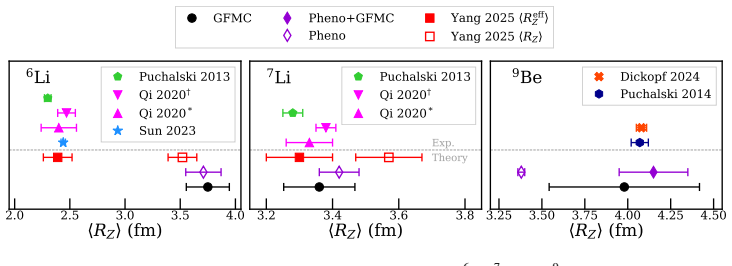
Quantum Monte Carlo evaluations with Norfolk two- and three-body interactions and two-body currents produce a Zemach radius for 6Li that is larger than the atomic extraction while yielding a value for 9Be that matches experiment; the 9Be agreement shows that prior phenomenological discrepancies originated in a model-dependent magnetic-radius input rather than in the charge or magnetization distributions themselves.
What carries the argument
Quantum Monte Carlo sampling of nuclear wave functions generated by Norfolk chiral two- and three-body forces plus two-body electromagnetic currents, used to evaluate the convolution of charge and magnetization densities that defines the Zemach radius.
If this is right
- The discrepancy between calculated and measured Zemach radius in 6Li is established as a real physical effect rather than a modeling artifact.
- The 9Be result shows that earlier phenomenological evaluations were limited mainly by their choice of magnetic-radius input.
- Two-body currents are shown to be necessary for a consistent description of the magnetization distribution entering the Zemach radius.
- The computed moments supply model-independent nuclear inputs for hyperfine-structure calculations in light atoms and muonic atoms.
Where Pith is reading between the lines
- Similar calculations could be extended to other light nuclei to predict Zemach moments where atomic data are absent or sparse.
- Persistent discrepancies in 6Li may motivate joint nuclear-atomic studies to isolate whether missing higher-order currents or relativistic effects are responsible.
- Agreement on 9Be suggests the method can be used to benchmark atomic extractions of nuclear radii in other systems.
Load-bearing premise
The Norfolk interactions and included two-body currents give accurate enough charge and magnetization distributions in these light nuclei for the Zemach moments to be reliable.
What would settle it
An independent calculation with a different set of nuclear interactions that produces a Zemach radius for 6Li matching or falling below the atomic value would falsify the claim that the discrepancy is not an artifact of the nuclear model.
Figures
read the original abstract
Modern atomic spectroscopy has reached a level of precision at which nuclear-structure effects can no longer be neglected and must be quantified reliably. In particular, hyperfine splittings depend on the Zemach radius, which encodes the convolution of the nuclear charge and magnetization distributions. The third electric Zemach moment provides a related finite-size measure and enters the elastic two-photon-exchange contribution to the Lamb shift in muonic atoms. Here, we compute Zemach radii and other electromagnetic moments for light nuclei using quantum Monte Carlo techniques within modern \textit{ab initio} nuclear theory. Using Norfolk two- and three-body interactions derived within chiral effective field theory, we assess the model dependence and study the role of two-body currents. For $^6$Li, we obtain a Zemach radius larger than that extracted from atomic measurements, consistent with recent calculations, confirming that the discrepancy is not an artifact of the nuclear model. For $^9$Be, our results agree with experiment; the discrepancy of previous phenomenological evaluations is traced to a model-dependent input for the magnetic radius.
Editorial analysis
A structured set of objections, weighed in public.
Referee Report
Summary. The manuscript reports quantum Monte Carlo calculations of Zemach radii and third electric Zemach moments for nuclei with A≤9 using the Norfolk family of chiral-EFT two- and three-nucleon interactions. Central claims are that the computed Zemach radius for 6Li exceeds the atomic-extraction value (consistent with other recent calculations, indicating the discrepancy is not a nuclear-model artifact) while the 9Be result agrees with experiment, with prior phenomenological discrepancies traced to a model-dependent magnetic-radius input. Model dependence is assessed and the role of two-body currents is examined.
Significance. If the Norfolk interactions plus two-body currents are shown to control the relevant uncertainties in the charge and magnetization distributions, the work supplies ab initio nuclear inputs that can resolve model-dependent tensions in precision atomic spectroscopy and muonic-atom Lamb shifts. The QMC framework with chiral interactions offers a systematic route to these quantities for light nuclei.
major comments (2)
- Abstract: the headline results for 6Li and 9Be rest on the assumption that the Norfolk interactions and included two-body currents yield sufficiently accurate point-nucleon charge and magnetization distributions for the Zemach convolution; the manuscript must supply quantitative bounds on the chiral truncation error of the magnetic operator at the momentum scales that dominate the Zemach integral.
- Abstract: specific numerical outcomes are stated without accompanying error bars, convergence diagnostics, or statistical uncertainties, so it is not possible to verify that the reported values and their comparison to experiment are robust.
minor comments (2)
- A summary table listing all computed Zemach radii (with uncertainties) for the full set of nuclei would improve readability and allow direct comparison with experiment and other calculations.
- Explicit discussion of the momentum range probed by the Zemach moments and its relation to the chiral cutoff employed in the Norfolk interactions would clarify the expected size of higher-order corrections.
Simulated Author's Rebuttal
We thank the referee for their thorough review and valuable suggestions. We address each major comment below and plan to incorporate revisions to strengthen the manuscript.
read point-by-point responses
-
Referee: Abstract: the headline results for 6Li and 9Be rest on the assumption that the Norfolk interactions and included two-body currents yield sufficiently accurate point-nucleon charge and magnetization distributions for the Zemach convolution; the manuscript must supply quantitative bounds on the chiral truncation error of the magnetic operator at the momentum scales that dominate the Zemach integral.
Authors: We agree that quantitative estimates of the chiral truncation uncertainty for the magnetic operator are necessary to support the claims. The Norfolk interactions allow assessment via cutoff and order variations, which we have used for model dependence. In the revised version, we will provide explicit bounds on the truncation error for the relevant magnetic form factor contributions at momenta dominating the Zemach integral (q ~ 100-300 MeV/c), by comparing results at different chiral orders and referencing the EFT power counting. This analysis will be added to Section on electromagnetic operators and summarized in the abstract. revision: yes
-
Referee: Abstract: specific numerical outcomes are stated without accompanying error bars, convergence diagnostics, or statistical uncertainties, so it is not possible to verify that the reported values and their comparison to experiment are robust.
Authors: The abstract presents qualitative comparisons ('larger than', 'agrees with') rather than specific numerical values, but we acknowledge the need for transparency on uncertainties. The full manuscript includes QMC statistical errors and model-dependence bands for the computed quantities. In the revision, we will include representative error estimates in the abstract (e.g., from statistical Monte Carlo sampling and interaction variations) and explicitly reference the convergence and uncertainty sections in the main text to facilitate verification of robustness. revision: yes
Circularity Check
No significant circularity detected
full rationale
The paper computes Zemach radii and moments via independent quantum Monte Carlo evaluations on top of pre-existing Norfolk chiral-EFT interactions and two-body currents taken from prior literature. No equation in the provided text defines a reported radius or moment in terms of a quantity fitted inside this work, renames a fitted input as a prediction, or reduces the central result to a self-citation chain; the derivation chain therefore remains self-contained against external benchmarks.
Axiom & Free-Parameter Ledger
free parameters (1)
- low-energy constants in Norfolk interactions
axioms (1)
- domain assumption Chiral effective field theory supplies a systematic expansion for nuclear two- and three-body interactions that can be used in QMC for electromagnetic moments.
Reference graph
Works this paper leans on
-
[1]
J. C. Berengut, C. Delaunay, Precision isotope-shift spec- troscopy for new physics searches and nuclear insights, Nature Rev. Phys. 7 (2) (2025) 119–125.doi:10.1038/ s42254-024-00793-2
2025
-
[2]
M. S. Safronova, D. Budker, D. DeMille, D. F. J. Kimball, A. Derevianko, C. W. Clark, Search for new physics with atoms and molecules, Rev. Mod. Phys. 90 (2018) 025008. doi:10.1103/RevModPhys.90.025008. URLhttps://link.aps.org/doi/10.1103/ RevModPhys.90.025008
-
[3]
A. C. Zemach, Proton structure and the hyperfine shift in hydrogen, Physical Review 104 (1956) 1771–1781.doi: 10.1103/PhysRev.104.1771
-
[4]
J. L. Friar, Nuclear finite-size effects in light muonic atoms, Annals of Physics 122 (1979) 151–196.doi: 10.1016/0003-4916(79)90200-2
-
[5]
C. Ji, S. Bacca, N. Barnea, O. J. Hernandez, N. Nevo-Dinur,Abinitiocalculation of nuclear struc- ture corrections in muonic atoms, J. Phys. G 45 (9) (2018) 093002.arXiv:1806.03101,doi:10.1088/ 1361-6471/aad3eb
Pith/arXiv arXiv 2018
-
[6]
B. Ohayon, A. Abeln, S. Bara, T. E. Cocolios, O. Eizenberg, A. Fleischmann, L. Gastaldo, C. God- inho, M. Heines, D. Hengstler, G. Hupin, P. Indeli- cato, K. Kirch, A. Knecht, D. Kreuzberger, J. Machado, P. Navratil, N. Paul, R. Pohl, D. Unger, S. V ogiatzi, K. von Schoeler, F. Wauters, Towards precision muonic x-ray measurements of charge radii of light ...
arXiv 2024
-
[7]
V . A. Yerokhin, Hyperfine structure of li and be+, Phys. Rev. A 78 (2008) 012513.doi: 10.1103/PhysRevA.78.012513. URLhttps://link.aps.org/doi/10.1103/ PhysRevA.78.012513
-
[8]
X.-Q. Qi, P.-P. Zhang, Z.-C. Yan, G. W. F. Drake, Z.-X. Zhong, T.-Y . Shi, S.-L. Chen, Y . Huang, H. Guan, K.-L. Gao, Precision calculation of hyperfine structure and the zemach radii of 6,7Li + ions, Phys. Rev. Lett. 125 (2020) 183002.doi:10.1103/PhysRevLett.125.183002. URLhttps://link.aps.org/doi/10.1103/ PhysRevLett.125.183002
-
[9]
W. Sun, P.-P. Zhang, P.-p. Zhou, S.-l. Chen, Z.-q. Zhou, Y . Huang, X.-Q. Qi, Z.-C. Yan, T.-Y . Shi, G. W. F. Drake, Z.-X. Zhong, H. Guan, K.-l. Gao, Measurement of hyperfine structure and the zemach radius in 6li+ using optical ramsey technique, Phys. Rev. Lett. 131 (2023) 103002.doi:10.1103/PhysRevLett.131.103002. URLhttps://link.aps.org/doi/10.1103/ Ph...
-
[10]
Y . Yang, E. Epelbaum, C. Ji, P. Zhao, Zemach radii and nuclear structure effects in hyperfine splitting of Lithium (9 2025).arXiv:2509.01303
arXiv 2025
-
[11]
M. Puchalski, K. Pachucki, Ground state hy- perfine splitting in 6,7Li atoms and the nuclear structure, Phys. Rev. Lett. 111 (2013) 243001. doi:10.1103/PhysRevLett.111.243001. URLhttps://link.aps.org/doi/10.1103/ PhysRevLett.111.243001
-
[12]
M. Puchalski, K. Pachucki, Ground-state hyperfine splitting in the be + ion, Phys. Rev. A 89 (2014) 032510. doi:10.1103/PhysRevA.89.032510. URLhttps://link.aps.org/doi/10.1103/ PhysRevA.89.032510
-
[13]
S. Dickopf, B. Sikora, A. Kaiser, M. Müller, S. Ulmer, V . A. Yerokhin, Z. Harman, C. H. Keitel, A. Mooser, K. Blaum, Precision spectroscopy on 9be overcomes lim- itations from nuclear structure, Nature 632 (8026) (2024) 757–761.doi:10.1038/s41586-024-07795-1. URLhttp://dx.doi.org/10.1038/ s41586-024-07795-1
-
[14]
N. Nevo Dinur, O. J. Hernandez, S. Bacca, N. Barnea, C. Ji, S. Pastore, M. Piarulli, R. B. Wiringa, Zemach mo- ments and radii of 2,3H and 3,4He, Phys. Rev. C99 (3) (2019) 034004.arXiv:1812.10261,doi:10.1103/ PhysRevC.99.034004
Pith/arXiv arXiv 2019
-
[15]
J. Carlson, S. Gandolfi, F. Pederiva, S. C. Pieper, R. Schi- avilla, K. E. Schmidt, R. B. Wiringa, Quantum Monte Carlo methods for nuclear physics, Rev. Mod. Phys. 87 (2015) 1067.arXiv:1412.3081,doi:10.1103/ RevModPhys.87.1067. 6
Pith/arXiv arXiv 2015
-
[16]
S. Gandolfi, D. Lonardoni, A. Lovato, M. Piarulli, Atomic nuclei from quantum Monte Carlo calculations with chiral EFT interactions (2020).arXiv:2001.01374
arXiv 2020
-
[17]
M. Piarulli, L. Girlanda, R. Schiavilla, A. Kievsky, A. Lovato, L. E. Marcucci, S. C. Pieper, M. Viviani, R. B. Wiringa, Local chiral potentials with∆-intermediate states and the structure of light nuclei, Phys. Rev. C94 (5) (2016) 054007.arXiv:1606.06335,doi:10.1103/ PhysRevC.94.054007
Pith/arXiv arXiv 2016
-
[18]
Light-nuclei spectra from chiral dynamics
M. Piarulli, et al., Light-nuclei spectra from chiral dynamics, Phys. Rev. Lett. 120 (5) (2018) 052503. arXiv:1707.02883,doi:10.1103/PhysRevLett. 120.052503
work page internal anchor Pith review Pith/arXiv arXiv doi:10.1103/physrevlett 2018
-
[19]
A. Baroni, et al., Local chiral interactions, the tritium Gamow-Teller matrix element, and the three-nucleon con- tact term, Phys. Rev. C98 (4) (2018) 044003.arXiv: 1806.10245,doi:10.1103/PhysRevC.98.044003
work page internal anchor Pith review Pith/arXiv arXiv doi:10.1103/physrevc.98.044003 2018
-
[20]
S. Kolling, E. Epelbaum, H. Krebs, U. G. Meissner, Two- pion exchange electromagnetic current in chiral effective field theory using the method of unitary transformation, Phys. Rev. C80 (2009) 045502.arXiv:0907.3437,doi: 10.1103/PhysRevC.80.045502
work page internal anchor Pith review Pith/arXiv arXiv doi:10.1103/physrevc.80.045502 2009
-
[21]
S. Kolling, E. Epelbaum, H. Krebs, U. G. Meissner, Two- nucleon electromagnetic current in chiral effective field theory: One-pion exchange and short-range contributions, Phys. Rev. C84 (2011) 054008.arXiv:1107.0602,doi: 10.1103/PhysRevC.84.054008
work page internal anchor Pith review Pith/arXiv arXiv doi:10.1103/physrevc.84.054008 2011
-
[22]
S. Pastore, R. Schiavilla, J. L. Goity, Electromagnetic two-body currents of one- and two-pion range, Phys. Rev. C78 (2008) 064002.arXiv:0810.1941,doi:10.1103/ PhysRevC.78.064002
Pith/arXiv arXiv 2008
-
[24]
S. Pastore, L. Girlanda, R. Schiavilla, M. Viviani, The two-nucleon electromagnetic charge operator in chiral ef- fective field theory (χEFT) up to one loop, Phys. Rev. C84 (2011) 024001.arXiv:1106.4539,doi:10.1103/ PhysRevC.84.024001
Pith/arXiv arXiv 2011
- [25]
-
[26]
T. Miyagi, X. Cao, R. Seutin, S. Bacca, R. F. Garcia Ruiz, K. Hebeler, J. D. Holt, A. Schwenk, Impact of Two-Body Currents on Magnetic Dipole Moments of Nuclei, Phys. Rev. Lett. 132 (23) (2024) 232503.arXiv:2311.14383, doi:10.1103/PhysRevLett.132.232503
-
[27]
G. Chambers-Wall, A. Gnech, G. B. King, S. Pas- tore, M. Piarulli, R. Schiavilla, R. B. Wiringa, Quan- tum Monte Carlo Calculations of Magnetic Form Fac- tors in Light Nuclei, Phys. Rev. Lett. 133 (21) (2024) 212501.arXiv:2407.03487,doi:10.1103/ PhysRevLett.133.212501
arXiv 2024
-
[28]
G. Chambers-Wall, A. Gnech, G. B. King, S. Pastore, M. Piarulli, R. Schiavilla, R. B. Wiringa, Magnetic struc- ture of A≤10 nuclei using the Norfolk nuclear models with quantum Monte Carlo methods, Phys. Rev. C 110 (5) (2024) 054316.arXiv:2407.04744,doi:10.1103/ PhysRevC.110.054316
arXiv 2024
-
[29]
G. B. King, G. Chambers-Wall, A. Gnech, S. Pastore, M. Piarulli, R. B. Wiringa, Longitudinal form factors of A≤10 nuclei in a chiral effective field theory approach, Phys. Rev. C 110 (5) (2024) 054325.arXiv:2408. 16909,doi:10.1103/PhysRevC.110.054325
-
[30]
X.-X. Sun, V . Baru, A. A. Filin, E. Epelbaum, H. Krebs, U.-G. Meißner, A. Nogga, Ab initio charge form factors and radii of light isoscalar nuclei: Role of the two-body charge density (2026).arXiv:2601.09614. URLhttps://arxiv.org/abs/2601.09614
arXiv 2026
-
[31]
G. B. King, S. Pastore, M. Piarulli, R. Schiavilla, Partial muon capture rates in A=3 and A=6 nu- clei with chiral effective field theory, Phys. Rev. C 105 (4) (2022) L042501.arXiv:2111.11360, doi:10.1103/PhysRevC.105.L042501. URLhttps://link.aps.org/doi/10.1103/ PhysRevC.105.L042501
-
[32]
J. M. Bub, M. Piarulli, R. J. Furnstahl, S. Pastore, D. R. Phillips, Bayesian analysis of nucleon-nucleon scattering data in pionless effective field theory (8 2024).arXiv: 2408.02480
arXiv 2024
-
[33]
R. Somasundaram, J. E. Lynn, L. Huth, A. Schwenk, I. Tews, Maximally local two-nucleon interactions at N3LO in∆-less chiral effective field theory, Phys. Rev. C 109 (3) (2024) 034005.arXiv:2306.13579,doi: 10.1103/PhysRevC.109.034005
-
[34]
Multi-modal contrastive learning of urban space representations from POI data
R. Somasundaram, C. L. Armstrong, P. Giuliani, K. God- bey, S. Gandolfi, I. Tews, Emulators for scarce and noisy data: Application to auxiliary field diffusion Monte Carlo for the deuteron, Phys. Lett. B 866 (2025) 139558.arXiv:2404.11566,doi:10.1016/j. physletb.2025.139558
work page doi:10.1016/j 2025
-
[35]
C. L. Armstrong, P. Giuliani, K. Godbey, R. Somasun- daram, I. Tews, Emulators for Scarce and Noisy Data: Application to Auxiliary-Field Diffusion Monte Carlo for Neutron Matter, Phys. Rev. Lett. 135 (14) (2025) 142501. arXiv:2502.03680,doi:10.1103/9928-wyjm
-
[36]
Amroun, et al., H-3 and He-3 electromagnetic form- factors, Nucl
A. Amroun, et al., H-3 and He-3 electromagnetic form- factors, Nucl. Phys. A579 (1994) 596–626.doi:10. 1016/0375-9474(94)90925-3. 7
1994
-
[37]
J. E. Purcell, J. H. Kelley, E. Kwan, C. G. Sheu, H. R. Weller, Energy levels of light nuclei A=3, Nucl. Phys. A848 (2010) 1–74.doi:10.1016/j.nuclphysa.2010. 08.012
-
[38]
Zemach moments of 3Heand 4He.Phys
I. Sick, Zemach moments of 3He and 4He, Phys. Rev. C 90 (2014) 064002.doi:10.1103/PhysRevC.90.064002. URLhttps://link.aps.org/doi/10.1103/ PhysRevC.90.064002
-
[39]
Shiner, R
D. Shiner, R. Dixson, V . Vedantham, Three-Nucleon Charge Radius: A Precise Laser Determination Using He- 3, Phys. Rev. Lett. 74 (1995) 3553–3556.doi:10.1103/ PhysRevLett.74.3553
1995
-
[40]
J. J. Krauth, et al., Measuring theα-particle charge radius with muonic helium-4 ions, Nature 589 (7843) (2021) 527–531.doi:10.1038/s41586-021-03183-1
-
[41]
W. Nortershauser, T. Neff, R. Sanchez, I. Sick, Charge radii and ground state structure of lithium isotopes: Ex- periment and theory reexamined, Phys. Rev. C84 (2011) 024307.doi:10.1103/PhysRevC.84.024307
-
[42]
C. De Jager, H. De Vries, C. De Vries, Nuclear charge- and magnetization-density-distribution param- eters from elastic electron scattering, Atomic Data and Nuclear Data Tables 14 (5) (1974) 479–508, nu- clear Charge and Moment Distributions.doi:https: //doi.org/10.1016/S0092-640X(74)80002-1. URLhttps://www.sciencedirect.com/science/ article/pii/S0092640X74800021
-
[43]
D. R. Tilley, C. M. Cheves, J. L. Godwin, G. M. Hale, H. M. Hofmann, J. H. Kelley, C. G. Sheu, H. R. Weller, Energy levels of light nuclei A=5, A=6, A=7, Nucl. Phys. A708 (2002) 3–163.doi:10.1016/S0375-9474(02) 00597-3
-
[44]
J. A. Jansen, R. T. Peerdeman, C. De Vries, Nuclear charge radii of 12 C and 9 Be, Nucl. Phys. A 188 (1972) 337–352.doi:10.1016/0375-9474(72)90062-0
-
[45]
D. R. Tilley, J. H. Kelley, J. L. Godwin, D. J. Millener, J. E. Purcell, C. G. Sheu, H. R. Weller, Energy levels of light nuclei A=8,9,10, Nucl. Phys. A745 (2004) 155–362. doi:10.1016/j.nuclphysa.2004.09.059
-
[46]
See supplementary material
-
[47]
Door, et al., Probing New Bosons and Nuclear Struc- ture with Ytterbium Isotope Shifts, Phys
M. Door, et al., Probing New Bosons and Nuclear Struc- ture with Ytterbium Isotope Shifts, Phys. Rev. Lett. 134 (6) (2025) 063002.arXiv:2403.07792,doi:10. 1103/PhysRevLett.134.063002
arXiv 2025
- [48]
-
[49]
E. Hiyama, T. Suzuki, Moments of the Charge Distribu- tion Observed through Electron Scattering in 3H and 3He, PTEP 2024 (8) (2024) 083D02.arXiv:2406.17394, doi:10.1093/ptep/ptae126
-
[50]
K. M. Nollett, R. B. Wiringa, R. Schiavilla, A Six body calculation of the alpha deuteron radiative cap- ture cross-section, Phys. Rev. C63 (2001) 024003. arXiv:nucl-th/0006064,doi:10.1103/PhysRevC. 63.024003
work page internal anchor Pith review Pith/arXiv arXiv doi:10.1103/physrevc 2001
-
[51]
K. M. Nollett, Radiative alpha capture cross-sections from realistic nucleon-nucleon interactions and varia- tional Monte Carlo wave functions, Phys. Rev. C63 (2001) 054002.arXiv:nucl-th/0102022,doi:10.1103/ PhysRevC.63.054002
Pith/arXiv arXiv 2001
-
[52]
A. R. Flores, K. M. Nollett, Variational Monte Carlo calculations of n+H3 scattering, Phys. Rev. C 108 (3) (2023) 034001.arXiv:2209.00093,doi:10.1103/ PhysRevC.108.034001
arXiv 2023
-
[53]
A. R. Flores, K. M. Nollett, M. Piarulli, Quantum Monte Carlo calculations of neutron-αscattering via an integral relation, Phys. Rev. C 112 (1) (2025) 014008.arXiv: 2502.18718,doi:10.1103/q4dy-vhv1
-
[54]
A. Lovato, S. Gandolfi, J. Carlson, S. C. Pieper, R. Schiavilla, Electromagnetic response of 12C: A first-principles calculation, Phys. Rev. Lett. 117 (8) (2016) 082501.arXiv:1605.00248,doi:10.1103/ PhysRevLett.117.082501
Pith/arXiv arXiv 2016
-
[55]
Ab initio calculation of neutral-current $\nu$-$^{12}$C inclusive quasielastic scattering
A. Lovato, S. Gandolfi, J. Carlson, E. Lusk, S. C. Pieper, R. Schiavilla, Quantum Monte Carlo calculation of neutral-currentν− 12 Cinclusive quasielastic scattering, Phys. Rev. C 97 (2) (2018) 022502.arXiv:1711.02047, doi:10.1103/PhysRevC.97.022502
work page internal anchor Pith review Pith/arXiv arXiv doi:10.1103/physrevc.97.022502 2018
- [56]
-
[57]
P. Zhao, Y . Yang, C. Ji, Private communication (2026)
2026
-
[58]
G. B. King, G. Chambers-Wall, A. Gnech, S. Pastore, M. Piarulli, R. B. Wiringa, Electromagnetic radii of light nuclei from variational Monte Carlo calculations, Phys. Rev. C 112 (4) (2025) L041302.arXiv:2504.04201, doi:10.1103/w8kj-p8bv
-
[59]
M. L. Bissell, et al., Interrogating the composition and distribution of nuclear magnetization via the hyperfine anomaly: experiment meets nuclear and atomic theory for short-lived 47K (3 2026).arXiv:2603.20090
arXiv 2026
-
[60]
S. G. Wilkins, et al., Observation of the distribution of nuclear magnetization in a molecule, Science 390 (6771) (2025) adm7717.arXiv:2311.04121,doi:10.1126/ science.adm7717. 8 Supplementary Material In order to estimate the model uncertainty on the more com- putationally intensive GFMC calculations, we performed VMC calculations with several nuclear mod...
arXiv 2025
discussion (0)
Sign in with ORCID, Apple, or X to comment. Anyone can read and Pith papers without signing in.