REVIEW 5 major objections 5 minor 55 references
Applications of Nature-Inspired Algorithms for Dimension Reduction: Enabling Efficient Data Analytics
T0 review · 5 major / 5 minor · reviewed 2026-08-14 · deepseek-v4-flash
Pith's one-line read This survey argues that hybrid feature-selection optimization, coupling filter or wrapper methods with nature-inspired evolutionary algorithms, is an effective domain-independent strategy against the curse of dimensionality.
desk verdict A weak survey whose only value is as a pointer list; the central effectiveness claim is unsupported, and the technical presentation has real errors. read the letter →
The pith
A machine-rendered reading of the paper's core claim, the machinery that carries it, and where it could break.
The reading
What carries the argument
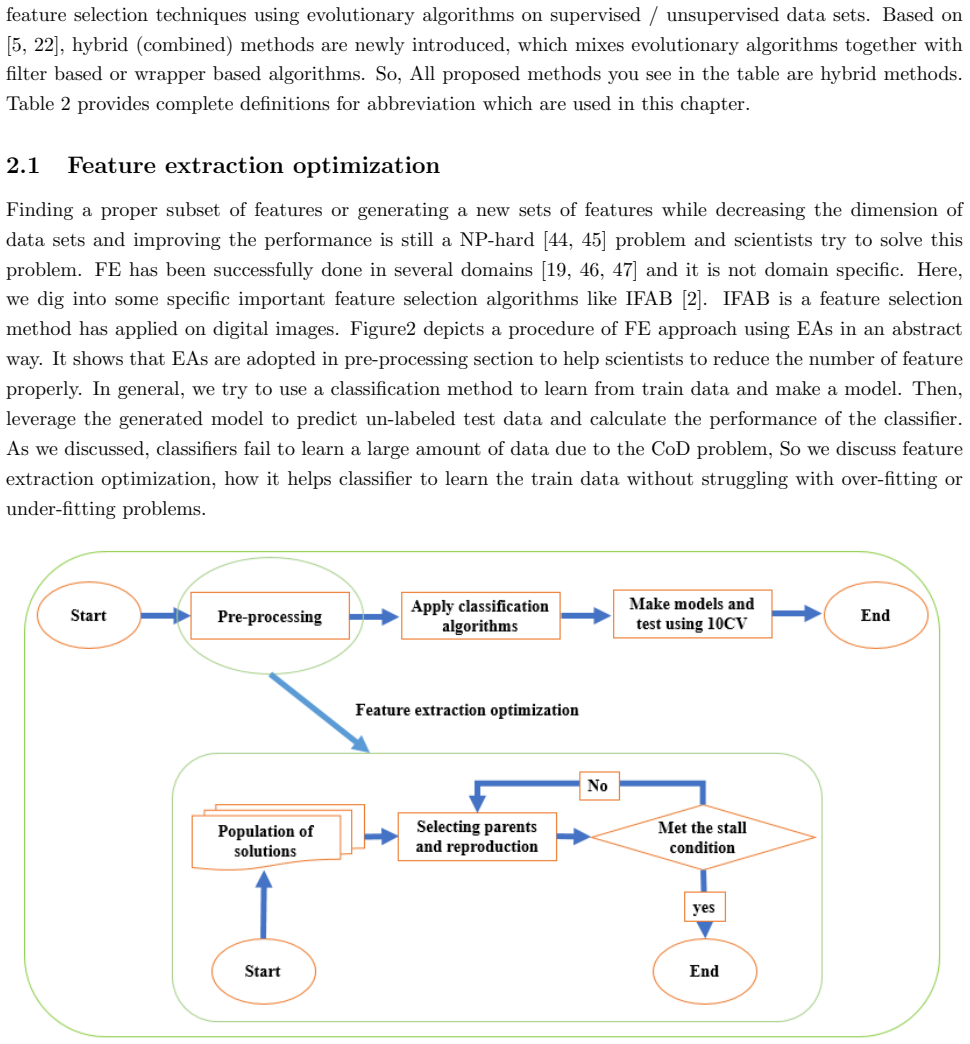
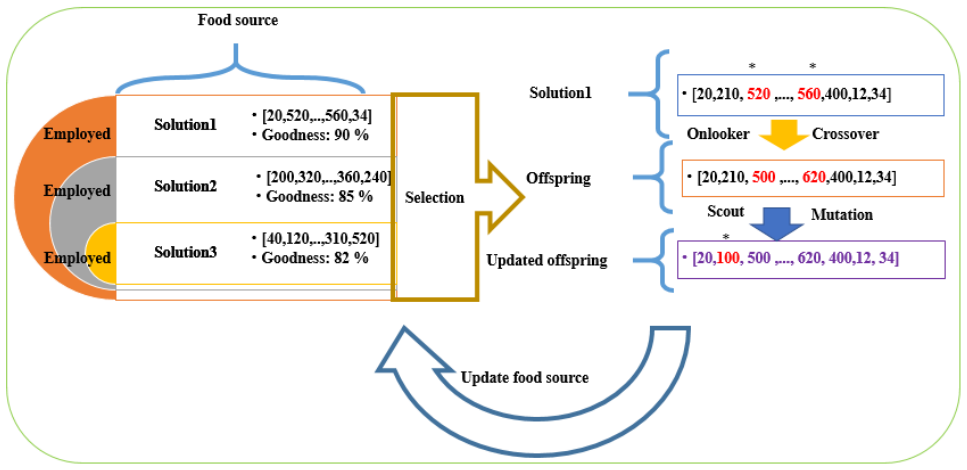
The load-bearing mechanism is the hybrid feature-selection optimization pipeline: an evolutionary algorithm maintains a population of candidate feature subsets, a fitness function (e.g., SVM accuracy, inconsistency rate, or AUC) scores each subset, and selection, crossover, bee-foraging, or particle-update steps iteratively refine the population until convergence to the optimal subset. This is the common skeleton shared by the surveyed methods, and it is what transfers across domains: the same ABC loop used for image steganalysis is reused for hyperspectral band selection, and the same PSO/ReliefF coupling is used for network traffic classification. The chapter's abstract process diagram places evolutionary algorithms in the pre-processing stage, before a classifier learns from the reduced data, which is the architectural claim on which the whole survey rests.
What would settle it
A meta-analysis or replication study that runs several of the surveyed hybrids (e.g., IFAB, RFPSO, CCSO) on a shared set of high-dimensional datasets with identical train/test splits, and finds that on average they do not beat simple non-evolutionary feature selection (e.g., greedy forward selection or LASSO) in accuracy or runtime, would falsify the chapter's central claim.
Extended reading notes
Core claim
The central claim, on the paper's own terms, is that feature selection optimization works: combining feature selection techniques with evolutionary algorithms yields a practical, non-domain-specific approach to large-scale data analytics. Concretely, algorithms such as artificial bee colony (IFAB, RISAB, ISD-ABC), ant colony optimization (ACOAR, UFSACO, ACOFS), grey wolf optimizer (LFGWO), particle swarm optimization (HYBRID, APSO, RFPSO), whale optimization algorithm (WANFIS, IWOA), and genetic algorithms (HGAWE, NSGA-II) have each been used to select relevant feature subsets and improve classification on supervised and unsupervised data. In the chapter's telling, these hybrid methods reduce dimensionality sharply (e.g., IFAB on steganalysis features), enhance classifier performance relative to using all features, and cut the time needed to train models. The chapter presents this as evidence that dimension reduction combined with evolutionary algorithms efficiently addresses the NP-hard curse of dimensionality across engineering and science applications.
Load-bearing premise
The chapter rests on the assumption that the performance improvements reported in the roughly fifty surveyed papers are accurate, comparable, and representative, since it contains no experiments, baselines, or error bars to verify them.
Editorial extensions
If this is right
- Data scientists can deploy the same EA-plus-feature-selection recipe on new high-dimensional problems—biomedical, IoT, text, or otherwise—without redesigning the algorithm, because the approach is presented as domain-independent.
- Classifiers such as SVM and KNN can be made to handle very high-dimensional or imbalanced data by pre-reducing features with evolutionary search, which the chapter argues mitigates over-fitting and under-fitting.
- Unsupervised and cost-sensitive settings are also reachable, as the surveyed methods include unsupervised ant-colony feature selection and multi-objective or cost-sensitive artificial bee colony approaches.
- If the chapter's outlook is right, the NP-hard curse of dimensionality will not be solved by a single algorithm; rather, continued specialized EA-based feature-selection papers will accumulate, each tailored to a data type or objective.
Reading between the lines
- Beyond the paper's own claims: because the evidence is entirely secondhand, the thesis's strength hinges on the reliability of roughly fifty independent studies; a reader should treat the performance gains as reported, not as verified in this chapter.
- A testable consequence the chapter leaves implicit: if the hybrid coupling is what matters, then swapping the evolutionary algorithm while holding the fitness function and dataset fixed should produce similar gains; if it does not, the specific nature-inspired metaphor contributes more than the survey suggests.
- The survey's domain-independence claim implies a practical benchmark design: run the same hybrid pipeline on a shared high-dimensional suite and compare against strong non-evolutionary baselines like greedy forward selection or LASSO to isolate the evolutionary contribution.
- The chapter's future-work suggestion can be pushed further: applying evolutionary search inside representation learning, as it hints, would create a fully unsupervised feature-discovery pipeline, but that extension is not demonstrated here.
Signed reviews
Editorial analysis
A structured set of objections, weighed in public.
Referee Report
Summary. This manuscript is a survey chapter on nature-inspired and evolutionary algorithms for feature selection and dimension reduction. It argues that hybrid feature-selection optimization—combining classical feature selection with evolutionary algorithms—is an effective, domain-independent strategy for mitigating the curse of dimensionality and improving classifier performance and time complexity. The chapter organizes roughly fifty cited studies according to evolutionary-algorithm family (ABC, ACO, PSO, GWO, GA, WOA, etc.) and discusses applications in image steganalysis, network traffic classification, credit scoring, sentiment analysis, and benchmark datasets. The only concrete algorithmic example is IFAB, an ABC-based feature selection method for image steganalysis, described in Section 2.1.1. The chapter contains no new experiments and no quantitative synthesis; its support is descriptive summaries and a taxonomy table.
Significance. If substantiated, the chapter could serve as a useful entry point to the applied literature on evolutionary-algorithm-based feature selection. Its organization by algorithm family and its compilation of recent references are potentially valuable for newcomers. However, the central effectiveness claim—that hybrid feature selection and evolutionary algorithms are broadly effective and domain-independent—is not established by the chapter's own evidence: there are no aggregate results, no baselines, no quality filtering of the surveyed studies, and the flagship IFAB mechanism is not reproducible from the text. The table of surveyed methods contains misclassifications, and the theoretical foundation is outsourced to a companion preprint. These issues make the current version unsuitable as a stand-alone scholarly contribution.
major comments (5)
- [§2.1.1, Eqs. (1)–(3)] The IFAB equations contain undefined and malformed terms: Eq. (2) uses "/v.alt" and Eq. (3) uses "/v.alt′", neither of which is defined as a distribution or operator; variables Xmax, Xmin, Pi, and j are only partially described. Since IFAB is the chapter's leading example and is invoked in the conclusion, the reader cannot reproduce or verify the claimed mechanism from the text. This is a load-bearing exposition issue for the paper's central example.
- [§4, Conclusion] The conclusion states that "IFAB decreased the dimension of a given data set intensely, while also enhancing the performance of the support vector machine (SVM) significantly," but no numeric results, dataset sizes, baselines, or statistical comparisons are provided anywhere in the chapter. This unsupported quantitative claim directly supports the central thesis and therefore cannot be accepted as evidence.
- [Table 1, rows [18] and [19]] Rows [18] and [19] list PCA as "Dimension reduction" with an empty "Evolutionary algorithm" column, yet the surrounding text and table treat them as examples of evolutionary-algorithm-based feature selection. PCA is not an evolutionary algorithm, and including these rows without explanation misclassifies the methods and undermines the survey's taxonomy and reliability.
- [§2 and Table 1] The survey provides no inclusion criteria, search strategy, quality assessment, or heterogeneity analysis for the approximately fifty cited studies. The chapter's central claim that hybrid feature-selection plus evolutionary algorithms is an effective, domain-independent approach requires some form of representative sampling and aggregation; without it, the selected papers are anecdotal evidence, and the conclusion in §4 overreaches the presented material.
- [§1.1, Overview] The theoretical foundations of feature selection and evolutionary algorithms are delegated to the companion preprint [1] with the statement "we have explored the theoretical aspects," but those aspects are not restated or verified here. The chapter's premise depends on an external, non-independent source, so the manuscript does not stand alone as a self-contained survey.
minor comments (5)
- [Abstract and §1.1] Several sentences are ungrammatical or incomplete, e.g., "practical examples of research studies are successfully tackled some application domains" and "Feature selection optimization is hybrid approach." These should be rewritten for clarity.
- [§2.2, Eq. (4)] The text says "T stands for the total number of instances and the number of inconsistencies goes for N," but the equation fitness = N/T lacks a definition of N and T in the surrounding sentence; the notation should be aligned explicitly.
- [§2.1.1 and Figure captions] There are typographical errors such as "dig data," "lover bound," and "stepts" (in the Figure 4 caption). These should be corrected in revision.
- [Table 1] Capitalization is inconsistent (e.g., "Wrapper" vs. "wrapper") and the column "Feature Extraction type" mixes feature-selection types with dimension-reduction methods; the taxonomy could be made more precise.
- [§2.2, Figure 5] The text says "According to the figure" and "Figure 5" for the RFPSO process, but the figure number is not placed consistently in the surrounding prose; the citation should be explicit.
Circularity Check
No circularity: the chapter is a literature survey and its claims are reports of cited experiments, not derivations from fitted inputs.
full rationale
This paper is a survey and taxonomy, not a derivation or prediction exercise. The central claim is that hybrid feature-selection/evolutionary-algorithm methods have been applied across domains; that claim is supported by the cited papers in Table 1 and the accompanying prose, not by any equation fitted to data in this chapter. The self-citations to the authors' prior work are not load-bearing in the circularity sense: [1] supplies background context ("In [1], we have explored the theoretical aspects of feature selection and evolutionary algorithms"), while the IFAB-related performance statements are reports of externally published studies [2, 29, 30], not predictions generated here. No fitted parameter is renamed as a prediction, no uniqueness theorem is imported from the authors, and no ansatz is smuggled in through a citation. The malformed Eqs. (2)-(3) and the PCA rows in Table 1 are correctness/reproducibility defects, not instances of a claim reducing to its own input. Under the stated rules, a survey's evidentiary weakness (absence of quality filtering or quantitative aggregation) is not circularity. Therefore the appropriate finding is no significant circularity.
Assumptions & free parameters
assumptions (3)
- domain assumption The curse of dimensionality is an NP-hard problem.
- domain assumption The theoretical foundations presented in the companion paper [1] are sound.
- domain assumption The surveyed papers' reported performance results are accurate and representative.
Cite this review
Pith. "Pith review of Applications of Nature-Inspired Algorithms for Dimension Reduction: Enabling Efficient Data Analytics." pith.science (2026). https://pith.science/paper/KYHWA5ZH
@misc{pith2026190808563,
  author       = {Pith},
  title        = {Pith review of: Applications of Nature-Inspired Algorithms for Dimension Reduction: Enabling Efficient Data Analytics},
  year         = {2026},
  howpublished = {\url{https://pith.science/paper/KYHWA5ZH}},
  note         = {Machine review of arXiv:1908.08563}
}
read the original abstract
In [1], we have explored the theoretical aspects of feature selection and evolutionary algorithms. In this chapter, we focus on optimization algorithms for enhancing data analytic process, i.e., we propose to explore applications of nature-inspired algorithms in data science. Feature selection optimization is a hybrid approach leveraging feature selection techniques and evolutionary algorithms process to optimize the selected features. Prior works solve this problem iteratively to converge to an optimal feature subset. Feature selection optimization is a non-specific domain approach. Data scientists mainly attempt to find an advanced way to analyze data n with high computational efficiency and low time complexity, leading to efficient data analytics. Thus, by increasing generated/measured/sensed data from various sources, analysis, manipulation and illustration of data grow exponentially. Due to the large scale data sets, Curse of dimensionality (CoD) is one of the NP-hard problems in data science. Hence, several efforts have been focused on leveraging evolutionary algorithms (EAs) to address the complex issues in large scale data analytics problems. Dimension reduction, together with EAs, lends itself to solve CoD and solve complex problems, in terms of time complexity, efficiently. In this chapter, we first provide a brief overview of previous studies that focused on solving CoD using feature extraction optimization process. We then discuss practical examples of research studies are successfully tackled some application domains, such as image processing, sentiment analysis, network traffics / anomalies analysis, credit score analysis and other benchmark functions/data sets analysis.
Figures

Figures from the paper (2 more)


Reference graph
Works this paper leans on
-
[1]
F Ghareh Mohammadi, M Hadi Amini, and Hamid R. Arabnia. Evolutionary computation, optimization and learning algorithms for data science. arXiv preprint arXiv: 1908.08006 , 2019
arXiv 1908
-
[18]
Efficient and robust feature extraction and selection for traffic classification
Hongtao Shi, Hongping Li, Dan Zhang, Chaqiu Cheng, and Wei Wu. Efficient and robust feature extraction and selection for traffic classification. Computer Networks, 119:1–16, 2017
work page 2017
-
[19]
Hongtao Shi, Hongping Li, Dan Zhang, Chaqiu Cheng, and Xuanxuan Cao. An efficient feature generation approach based on deep learning and feature selection techniques for traffic classification. Computer Networks, 132:81–98, 2018
work page 2018
-
[2]
Image steganalysis using a bee colony based feature selection algorithm
F Ghareh Mohammadi and M Saniee Abadeh. Image steganalysis using a bee colony based feature selection algorithm. Engineering Applications of Artificial Intelligence , 31:35–43, 2014
work page 2014
-
[3]
A novel chaotic chicken swarm optimization algorithm for feature selection
Khaled Ahmed, Aboul Ella Hassanien, and Siddhartha Bhattacharyya. A novel chaotic chicken swarm optimization algorithm for feature selection. In 2017 Third International Conference on Research in Computational Intelligence and Communication Networks (ICRCICN) , pages 259–264. IEEE, 2017
work page 2017
-
[4]
An innovative approach for feature selection based on chicken swarm optimization
Ahmed Ibrahem Hafez, Hossam M Zawbaa, Eid Emary, Hamdi A Mahmoud, and Aboul Ella Hassanien. An innovative approach for feature selection based on chicken swarm optimization. In 2015 7th International Conference of Soft Computing and Pattern Recognition (SoCPaR) , pages 19–24. IEEE, 2015
work page 2015
-
[5]
A hybrid genetic algorithm with wrapper-embedded approaches for feature selection
Xiao-Ying Liu, Yong Liang, Sai Wang, Zi-Yi Yang, and Han-Shuo Ye. A hybrid genetic algorithm with wrapper-embedded approaches for feature selection. IEEE Access, 6:22863–22874, 2018
work page 2018
-
[6]
A multi-objective approach for profit-driven feature selection in credit scoring
Nikita Kozodoi, Stefan Lessmann, Konstantinos Papakonstantinou, Yiannis Gatsoulis, and Bart Baesens. A multi-objective approach for profit-driven feature selection in credit scoring. Decision Support Systems, 120:106–117, 2019
work page 2019
Show all 55 references
-
[7]
A self-adaptive artificial bee colony algorithm based on global best for global optimization
Yu Xue, Jiongming Jiang, Binping Zhao, and Tinghuai Ma. A self-adaptive artificial bee colony algorithm based on global best for global optimization. Soft Computing, pages 1–18, 2018
2018
-
[8]
Modified multiple search coop- erative foraging strategy for improved artificial bee colony optimization with robustness analysis
Fatima Harfouchi, Hacene Habbi, Celal Ozturk, and Dervis Karaboga. Modified multiple search coop- erative foraging strategy for improved artificial bee colony optimization with robustness analysis. Soft Computing, 22(19):6371–6394, 2018
2018
-
[9]
An improved optimization method based on krill herd and artificial bee colony with information exchange
Heqi Wang and Jiao-Hong Yi. An improved optimization method based on krill herd and artificial bee colony with information exchange. Memetic Computing, 10(2):177–198, 2018. 14
2018
-
[10]
An improved global best guided artificial bee colony algorithm for continuous optimization problems
Yongcun Cao, Yong Lu, Xiuqin Pan, and Na Sun. An improved global best guided artificial bee colony algorithm for continuous optimization problems. Cluster computing, pages 1–9, 2018
2018
-
[11]
A panorama of future interdependent networks: From intelligent infrastructures to smart cities
M Hadi Amini, Kianoosh G Boroojeni, SS Iyengar, Frede Blaabjerg, Panos M Pardalos, and Asad M Madni. A panorama of future interdependent networks: From intelligent infrastructures to smart cities. In Sustainable interdependent networks, pages 1–10. Springer, 2018
-
[12]
Sustainable smart cities through the lens of complex interdependent infrastructures: Panorama and state-of-the-art
M Hadi Amini, Hamidreza Arasteh, and Pierluigi Siano. Sustainable smart cities through the lens of complex interdependent infrastructures: Panorama and state-of-the-art. In Sustainable Interdependent Networks II, pages 45–68. Springer, 2019
2019
-
[13]
An opposition-based chaotic grey wolf optimizer for global optimisation tasks
Shubham Gupta and Kusum Deep. An opposition-based chaotic grey wolf optimizer for global optimisation tasks. Journal of Experimental & Theoretical Artificial Intelligence , pages 1–29, 2018
2018
-
[14]
An optimizing method based on autonomous animats: fish-swarm algorithm
Xiao-lei Li. An optimizing method based on autonomous animats: fish-swarm algorithm. Systems Engineering-Theory & Practice, 22(11):32–38, 2002
2002
-
[15]
Genetic algorithms in resource optimization of construction project
LY Zhang, Gang Luo, and LN Lu. Genetic algorithms in resource optimization of construction project. Journal of Tianjin University (Science and Technology) , 34(2):188–192, 2001
2001
-
[16]
Feature selection for image steganalysis using levy flight-based grey wolf optimization
Yadunath Pathak, KV Arya, and Shailendra Tiwari. Feature selection for image steganalysis using levy flight-based grey wolf optimization. Multimedia Tools and Applications, 78(2):1473–1494, 2019
2019
-
[17]
Binary optimization using hybrid grey wolf optimization for feature selection
Qasem Al-Tashi, Said Jadid Abdul Kadir, Helmi Md Rais, Seyedali Mirjalili, and Hitham Alhussian. Binary optimization using hybrid grey wolf optimization for feature selection. IEEE Access, 7:39496–39508, 2019
2019
-
[20]
A hybrid feature selection approach based on improved pso and filter approaches for image steganalysis
Rita Rana Chhikara, Prabha Sharma, and Latika Singh. A hybrid feature selection approach based on improved pso and filter approaches for image steganalysis. International Journal of Machine Learning and Cybernetics, 7(6):1195–1206, 2016
2016
-
[21]
Image steganalysis using improved particle swarm optimization based feature selection
Ali Adeli and Ali Broumandnia. Image steganalysis using improved particle swarm optimization based feature selection. Applied Intelligence, pages 1–14, 2018
2018
-
[22]
Particle swarm optimization based feature selection with novel fitness function for image steganalysis
Vahid Rostami and Azar Shahmoradi Khiavi. Particle swarm optimization based feature selection with novel fitness function for image steganalysis. In 2016 Artificial Intelligence and Robotics (IRANOPEN) , pages 109–114. IEEE, 2016. 15
2016
-
[23]
An efficient feature selection method for network video traffic classification
Yuning Dong, Quantao Yue, and Mao Feng. An efficient feature selection method for network video traffic classification. In 2017 IEEE 17th International Conference on Communication Technology (ICCT) , pages 1608–1612. IEEE, 2017
2017
-
[24]
Whale optimization algorithm and adaptive neuro-fuzzy inference system: a hybrid method for feature selection and land pattern classification
Quang-Thanh Bui, Manh Van Pham, Quoc-Huy Nguyen, Linh Xuan Nguyen, and Hai Minh Pham. Whale optimization algorithm and adaptive neuro-fuzzy inference system: a hybrid method for feature selection and land pattern classification. International Journal of Remote Sensing , 40(13):...
2019
-
[25]
Improved whale optimization algorithm for feature selection in arabic sentiment analysis
Mohammad Tubishat, Mohammad AM Abushariah, Norisma Idris, and Ibrahim Aljarah. Improved whale optimization algorithm for feature selection in arabic sentiment analysis. Applied Intelligence, 49(5):1688– 1707, 2019
2019
-
[26]
M Hadi Amini, Mohsen Parsa Moghaddam, and Orkun Karabasoglu. Simultaneous allocation of electric vehicles’ parking lots and distributed renewable resources in smart power distribution networks.Sustainable Cities and Society , 28:332–342, 2017
2017
-
[27]
A simultaneous approach for optimal allocation of renewable energy sources and electric vehicle charging stations in smart grids based on improved ga-pso algorithm
Mostafa Rezaei Mozafar, Mohammad H Moradi, and M Hadi Amini. A simultaneous approach for optimal allocation of renewable energy sources and electric vehicle charging stations in smart grids based on improved ga-pso algorithm. Sustainable cities and society , 32:627–637, 2017
2017
-
[28]
Allocation of electric vehicles’ parking lots in distribution network
M Hadi Amini and Arif Islam. Allocation of electric vehicles’ parking lots in distribution network. In ISGT 2014, pages 1–5. IEEE, 2014
2014
-
[29]
A new metaheuristic feature subset selection approach for image steganalysis
F Ghareh Mohammadi and M Saniee Abadeh. A new metaheuristic feature subset selection approach for image steganalysis. Journal of Intelligent & Fuzzy Systems , 27(3):1445–1455, 2014
2014
-
[30]
Region based image steganalysis using artificial bee colony
F Ghareh Mohammadi and Hedieh Sajedi. Region based image steganalysis using artificial bee colony. Journal of Visual Communication and Image Representation , 44:214–226, 2017
2017
-
[31]
Unsupervised band selection based on artificial bee colony algorithm for hyperspectral image classification
Fuding Xie, Fangfei Li, Cunkuan Lei, Jun Yang, and Yong Zhang. Unsupervised band selection based on artificial bee colony algorithm for hyperspectral image classification. Applied Soft Computing, 75:428–440, 2019
2019
-
[32]
Feature selection based on artificial bee colony and gradient boosting decision tree
Haidi Rao, Xianzhang Shi, Ahoussou Kouassi Rodrigue, Juanjuan Feng, Yingchun Xia, Mohamed Elho- seny, Xiaohui Yuan, and Lichuan Gu. Feature selection based on artificial bee colony and gradient boosting decision tree. Applied Soft Computing , 74:634–642, 2019
2019
-
[33]
Cost-sensitive feature selection using two-archive multi-objective artificial bee colony algorithm
Yong Zhang, Shi Cheng, Yuhui Shi, Dun-wei Gong, and Xinchao Zhao. Cost-sensitive feature selection using two-archive multi-objective artificial bee colony algorithm. Expert Systems with Applications , 2019
2019
-
[34]
An improved feature selection algorithm based on ant colony optimization
Huijun Peng, Chun Ying, Shuhua Tan, Bing Hu, and Zhixin Sun. An improved feature selection algorithm based on ant colony optimization. IEEE Access, 6:69203–69209, 2018
2018
-
[35]
An efficient ant colony optimization approach to attribute reduction in rough set theory
Liangjun Ke, Zuren Feng, and Zhigang Ren. An efficient ant colony optimization approach to attribute reduction in rough set theory. Pattern Recognition Letters, 29(9):1351–1357, 2008. 16
2008
-
[36]
An unsupervised feature selection algorithm based on ant colony optimization
Sina Tabakhi, Parham Moradi, and Fardin Akhlaghian. An unsupervised feature selection algorithm based on ant colony optimization. Engineering Applications of Artificial Intelligence , 32:112–123, 2014
2014
-
[37]
Integration of graph clustering with ant colony optimization for feature selection
Parham Moradi and Mehrdad Rostami. Integration of graph clustering with ant colony optimization for feature selection. Knowledge-Based Systems, 84:144–161, 2015
2015
-
[38]
A new hybrid ant colony optimization algorithm for feature selection
Md Monirul Kabir, Md Shahjahan, and Kazuyuki Murase. A new hybrid ant colony optimization algorithm for feature selection. Expert Systems with Applications , 39(3):3747–3763, 2012
2012
-
[39]
Binary butterfly optimization approaches for feature selection
Sankalap Arora and Priyanka Anand. Binary butterfly optimization approaches for feature selection. Expert Systems with Applications , 116:147–160, 2019
2019
-
[40]
Hybrid binary coral reefs optimization algorithm with simulated annealing for feature selection in high-dimensional biomedical datasets
Chaokun Yan, Jingjing Ma, Huimin Luo, and Ashutosh Patel. Hybrid binary coral reefs optimization algorithm with simulated annealing for feature selection in high-dimensional biomedical datasets. Chemo- metrics and Intelligent Laboratory Systems , 184:102–111, 2019
2019
-
[41]
Feature selection using mutual information and adaptive particle swarm optimization for image steganalysis
Jasmanpreet Kaur and Singara Singh. Feature selection using mutual information and adaptive particle swarm optimization for image steganalysis. In 2018 7th International Conference on Reliability, Infocom Technologies and Optimization (Trends and Future Directions)(ICRITO), pa...
2018
-
[42]
Galaxies image classification using artificial bee colony based on orthogonal gegenbauer moments
Mohamed Abd Elaziz, Khalid M Hosny, and IM Selim. Galaxies image classification using artificial bee colony based on orthogonal gegenbauer moments. Soft Computing, pages 1–11, 2018
2018
-
[43]
Discrete particle swarm optimization for high-order graph matching
Maoguo Gong, Yue Wu, Qing Cai, Wenping Ma, A Kai Qin, Zhenkun Wang, and Licheng Jiao. Discrete particle swarm optimization for high-order graph matching. Information Sciences, 328:158–171, 2016
2016
-
[44]
Taming the curse of dimensionality: Discrete integration by hashing and optimization
Stefano Ermon, Carla Gomes, Ashish Sabharwal, and Bart Selman. Taming the curse of dimensionality: Discrete integration by hashing and optimization. InInternational Conference on Machine Learning, pages 334–342, 2013
2013
-
[45]
The effects of dimensionality curse in high dimensional knn search
Nikolaos Kouiroukidis and Georgios Evangelidis. The effects of dimensionality curse in high dimensional knn search. In 2011 15th Panhellenic Conference on Informatics , pages 41–45. IEEE, 2011
2011
-
[46]
Novel wrapper-based feature selection for efficient clinical decision support system
R Vanaja and Saswati Mukherjee. Novel wrapper-based feature selection for efficient clinical decision support system. In International Conference on Intelligent Information Technologies , pages 113–129. Springer, 2018
2018
-
[47]
Pareto front feature selection based on artificial bee colony optimization
Emrah Hancer, Bing Xue, Mengjie Zhang, Dervis Karaboga, and Bahriye Akay. Pareto front feature selection based on artificial bee colony optimization. Information Sciences, 422:462–479, 2018
2018
-
[48]
A novel deep learning based framework for the detection and classification of breast cancer using transfer learning
SanaUllah Khan, Naveed Islam, Zahoor Jan, Ikram Ud Din, and Joel JP C Rodrigues. A novel deep learning based framework for the detection and classification of breast cancer using transfer learning. Pattern Recognition Letters, 2019. 17
2019
-
[49]
Semantic-fusion gans for semi-supervised satellite image classification
Subhankar Roy, Enver Sangineto, Nicu Sebe, and Beg¨ um Demir. Semantic-fusion gans for semi-supervised satellite image classification. In 2018 25th IEEE International Conference on Image Processing (ICIP) , pages 684–688. IEEE, 2018
2018
-
[50]
Sar image classification using adaptive neighborhood-based convolutional neural network
Anjun Zhang, Xuezhi Yang, Lu Jia, Jiaqiu Ai, and Zhangyu Dong. Sar image classification using adaptive neighborhood-based convolutional neural network. European Journal of Remote Sensing , 52(1):178–193, 2019
2019
-
[51]
Cascaded recurrent neural networks for hyperspectral image classification
Renlong Hang, Qingshan Liu, Danfeng Hong, and Pedram Ghamisi. Cascaded recurrent neural networks for hyperspectral image classification. IEEE Transactions on Geoscience and Remote Sensing , 2019
2019
-
[52]
Blind image steganalysis using neural networks and wrapper feature selection
Meena Kumari and Rita Chhikara. Blind image steganalysis using neural networks and wrapper feature selection. In 2017 International Conference on Computing, Communication and Automation (ICCCA) , pages 1065–1069. IEEE, 2017
2017
-
[53]
A practical approach to feature selection
Kenji Kira and Larry A Rendell. A practical approach to feature selection. InMachine Learning Proceedings 1992, pages 249–256. Elsevier, 1992
1992
-
[54]
Network anomaly detection system using genetic algorithm and fuzzy logic
Anderson Hiroshi Hamamoto, Luiz Fernando Carvalho, Lucas Dias Hiera Sampaio, Taufik Abr˜ ao, and Mario Lemes Proen¸ ca Jr. Network anomaly detection system using genetic algorithm and fuzzy logic. Expert Systems with Applications , 92:390–402, 2018
2018
-
[55]
Coyote optimization algorithm: a new metaheuristic for global optimization problems
Juliano Pierezan and Leandro Dos Santos Coelho. Coyote optimization algorithm: a new metaheuristic for global optimization problems. In 2018 IEEE Congress on Evolutionary Computation (CEC) , pages 1–8. IEEE, 2018. 18
2018
Reviewed August 14, 2026 · model on record in the stance chip above.
Discussion (0). Continue with ORCID to comment.