REVIEW 3 major objections 4 minor 59 references
Phase field crystal model for heterostructures
T0 review · 3 major / 4 minor · reviewed 2026-08-14 · deepseek-v4-flash
Pith's one-line read The paper claims that adding a smoothed-density coupling term to the phase-field crystal free energy gives controlled phase separation and independent control of elastic and lattice properties in multicomponent heterostructures…
desk verdict Sound PFC extension for heterostructures with honest binary benchmarks; the graphene–hBN zigzag preference is a demonstration under trial-and-error parameters, not a robust prediction. read the letter →
The pith
A machine-rendered reading of the paper's core claim, the machinery that carries it, and where it could break.
The reading
What carries the argument
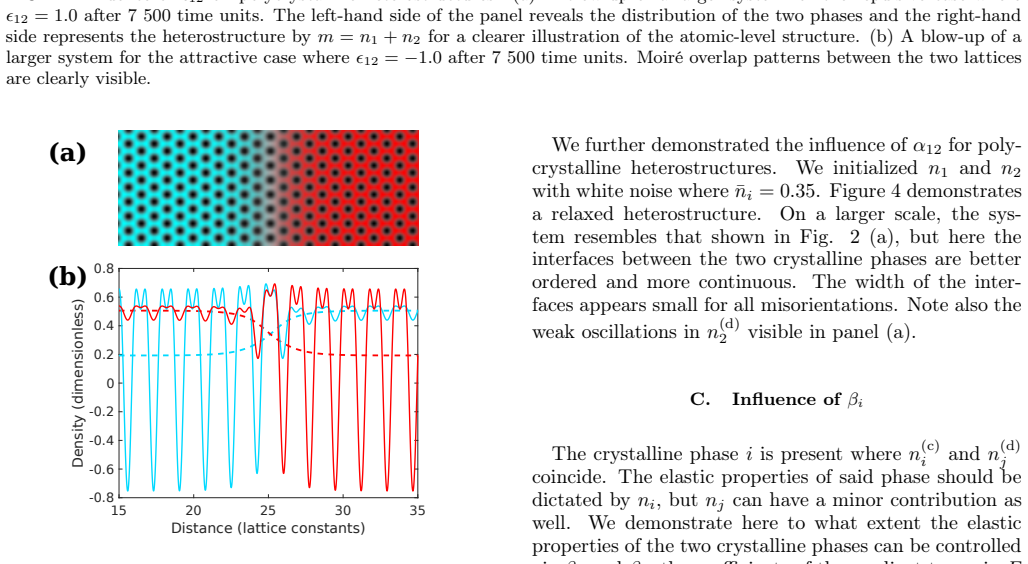
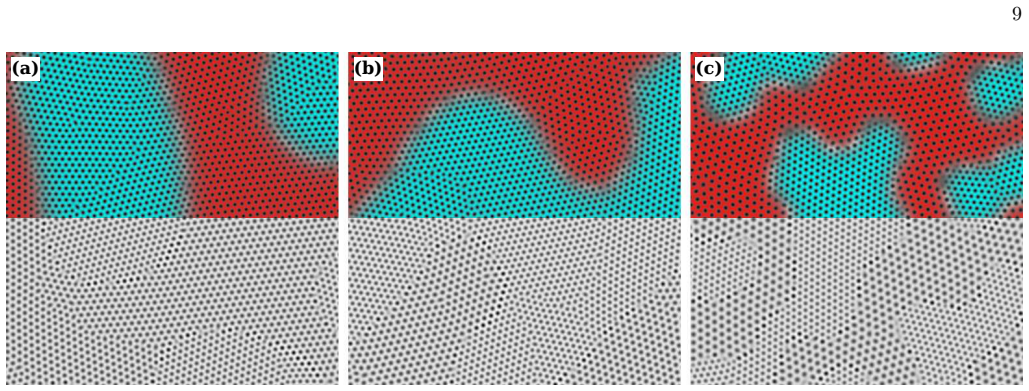
The load-bearing object is the smoothed density field $\eta_i = G * n_i$, obtained by convolving each atomic density field with a Gaussian kernel with spectral width $\sigma = 0.2$, and the free-energy coupling $\int \epsilon_{ij}\eta_i\eta_j\,dr$ that it enables. This coupling drives phase separation through a nonlocal repulsion or attraction between crystalline phases, while local couplings such as $\alpha_{ij}$ align the lattices at interfaces and the parameters $\beta_i$ and $\nu_i$ separately set elastic moduli and lattice constants. Appendix A proves that for $\epsilon_{ij}>0$ the ground state minimizes overlap of the two crystalline phases, and Appendix B estimates that the smoothed coupling contributes negligibly to elastic energies, keeping the elastic benchmarks clean.
What would settle it
Run direct large-system phase-field crystal simulations of graphene–h-BN interfaces for many misorientation angles without assuming the linear segment decomposition of Eq. (13), extract the full angular formation-energy curve, and check whether zigzag remains the global minimum and whether intermediate angles stay bounded by the pure-segment energies; any reversal of the ordering would falsify the stability conclusion.
Extended reading notes
Core claim
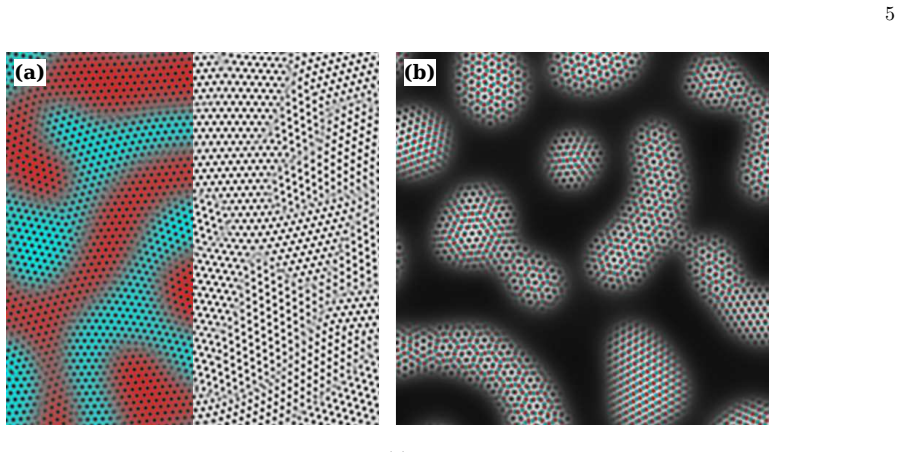
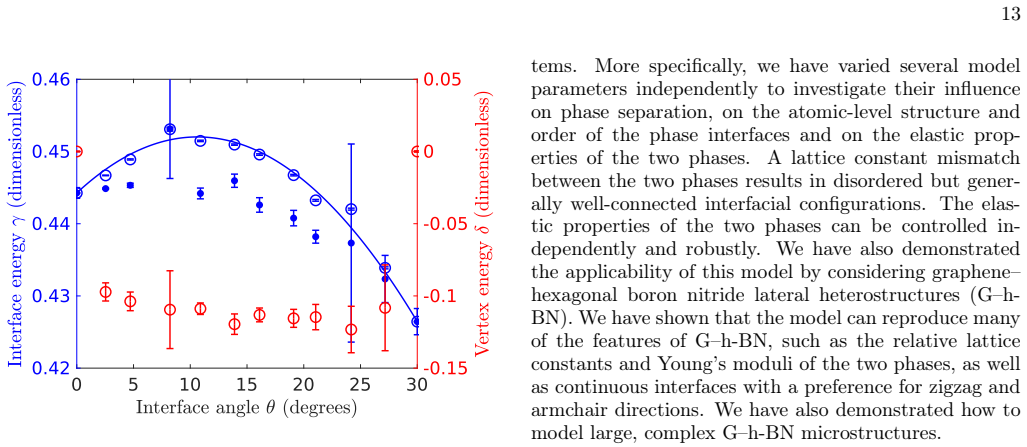
The central discovery is that adding the term $\int \epsilon_{ij}\eta_i\eta_j\,dr$, where $\eta_i = G * n_i$ is a Gaussian-smoothed density field, to the standard phase-field crystal free energy makes multicomponent phase separation controllable. With positive $\epsilon_{ij}$, crystalline regions of different species repel and form separate phases; with negative $\epsilon_{ij}$, they attract and form mixed or coherent structures. The paper shows analytically that this coupling drives ordered and disordered regions of different components to coincide, and numerically that the remaining parameters can be varied one by one to adjust lattice mismatch and stiffness independently. For graphene–hexagonal boron nitride, the model produces continuous, faceted interfaces and predicts that zigzag-oriented interfaces have the lowest formation energy, consistent with experiments and with density functional calculations.
Load-bearing premise
The paper treats a stepped interface as a simple sum of independent zigzag and armchair segment energies, ignoring interactions between neighboring segments; if those interactions are significant, the interface-energy ordering it reports may not hold.
Editorial extensions
If this is right
- Two-dimensional binary heterostructures with lattice mismatch can be simulated in both strained and unstrained modes, with mismatch accommodated by elastic deformation or by periodic misfit dislocations.
- The elastic stiffness of each phase can be tuned almost independently through its gradient coefficient, so model parameters can be matched to specific material pairs.
- Lattice constants can be set independently through the wavenumbers, enabling controlled studies of commensurate and incommensurate interfaces.
- For graphene–hexagonal boron nitride, the model reproduces the measured relative Young’s modulus and lattice constant to within a few percent and predicts zigzag interfaces as lowest-energy, matching faceted experimental shapes.
Reading between the lines
- A direct test the paper leaves implicit is whether the phase-separation mechanism survives in three dimensions, since the analytic argument in Appendix A is not dimension-specific; a 3D binary benchmark would settle that.
- The nearly vanishing elastic contribution of the smoothed fields suggests the model could be used to measure grain-boundary and interface mechanics without correcting for the phase-separation term, a convenience the paper notes but does not exploit quantitatively.
- Because the vertex energy in the interface fits is slightly negative, the model implies that interfaces with more vertices are favored in small systems; whether that preference reverses at macroscopic segment lengths is a testable prediction.
- A quantitative version of the model would require fitting the coupling coefficients to atomistic formation energies; until then, the reported ordering of interface stabilities is best read as a qualitative prediction.
Signed reviews
Editorial analysis
A structured set of objections, weighed in public.
Referee Report
Summary. The paper introduces a phase-field crystal (PFC) model for heterostructures, based on the free energy in Eq. (1), in which smoothed density fields η_i = G ∗ n_i are coupled through a term ∫ϵijηiηj dr. The authors argue that this coupling enables well-controlled phase separation while allowing independent control of the lattice constants and elastic moduli of coexisting phases. Section III benchmarks the model on binary systems: the influence of ϵ12 on phase separation, of α12 on interface continuity, of βi on elastic moduli, and of νi on lattice mismatch. The numerical elastic moduli are compared with an analytical PFC expression and found to agree. Section IV applies the three-component version to lateral graphene–hexagonal boron nitride (G–h-BN) heterostructures. A parameter set is constructed by trial and error (Table III) to reproduce the relative Young's modulus and lattice-constant ratio, and the model is shown to produce sharp, faceted, continuous interfaces. The paper finally reports the angular dependence of the G–h-BN interface formation energy and concludes that zigzag-oriented interfaces have the lowest energy. Appendices A and B contain an analytical phase-separation argument and an estimate showing that the smoothed-density coupling contributes negligibly to elastic energy.
Significance. If the central claims hold, the model provides a useful mesoscale tool for simulating heterostructures and multiphase polycrystalline materials over diffusive time scales, which is a genuine gap between atomistic methods and continuum models. The binary-system benchmarks are a strength: the numerical elastic response is checked against an analytical PFC prediction, the parameter study is systematic, and the lattice-mismatch structures with misfit dislocations are plausible. The paper also makes contact with experimental and DFT results on G–h-BN interface orientation, which is valuable context. The main advertised result, however, the zigzag-interface energy minimum in G–h-BN, rests on a manually tuned parameter set and on a simplified coherent-interface calculation, so the strength of the evidence is weaker than the abstract suggests. The analytical phase-separation proof in Appendix A also does not cover the sign pattern used in the G–h-BN demonstration. These issues are fixable and do not undermine the core binary-model benchmarks.
major comments (3)
- [Sec. IV A / Sec. IV C / Table III] The headline result that zigzag G–h-BN interfaces have the lowest formation energy is obtained with a parameter set (Table III) that was selected by trial and error to match only the relative Young's modulus and lattice-constant ratios and qualitative interface criteria. Because the interface energies were not used in the fitting, the result is not circular, but it is a prediction of an underconstrained parameter set; a modest change in ϵ12, α12, or the average densities could reverse γ(30°) < γ(0°). I ask for a sensitivity analysis (e.g., vary these parameters by ±10–20% and report whether the ordering persists) or a fit to interfacial formation energies before the abstract-level claim is retained. The paper's own Sec. V defers such fitting to future work, so the current wording overstates the strength of the evidence.
- [Appendix A] The analytic phase-separation argument assumes that the smoothed densities of both components have the same ordering between crystalline and disordered phases, i.e., (η(c)_A − η(d)_A) and (η(c)_B − η(d)_B) have the same sign. The G–h-BN parameter set in Table III violates this: n̄(c)_1 = 0.31 < n̄(d)_1 = 0.66, while n̄(c)_2 = −0.32 > n̄(d)_2 = −0.65. The actual condition for the coupling term to penalize overlap of the two crystalline phases is sign(ϵAB) (η(c)_A − η(d)_A)(η(c)_B − η(d)_B) > 0, which does hold for the G–h-BN set (negative ϵ with opposite-signed density jumps). The proof should be generalized to this condition; as written, the appendix does not cover the paper's main demonstration.
- [Sec. IV C / Eq. (13)] The interface-energy extraction is restricted to strained bicrystals with perfect honeycomb order and no misfit dislocations. For the target lattice mismatch (ah-BN/aG ≈ 1.018), Sec. III D shows that unstrained interfaces contain dislocation arrays; dislocation core energies are orientation-dependent and are not included in the γ reported here. The agreement between the numerical γ and Eq. (13) supports additivity of segment energies in the long-segment limit, but the conclusion that zigzag interfaces have the lowest formation energy should be qualified as applying to coherent strained interfaces, or the analysis should be repeated for the relaxed, dislocation-containing interfaces.
minor comments (4)
- [Abstract / Introduction / figure captions] There are several typographical errors: 'possiblity' in the abstract, 'introducespatially' in Sec. I, 'coindicental' in the Fig. 1 caption, and 'representedy' in the Fig. 8 caption. These should be corrected.
- [Sec. III D] The sentence defining the tilt angle as '2θ = θ − (−θ)' is tautological; it should be written as a symmetric tilt ±θ or 2θ = θ1 − θ2 to avoid confusion.
- [Fig. 11 caption] The caption uses n both as an integer multiple of L⊥ (with m for L‖) and as the density-field symbol used throughout the paper; renaming the integer variable (e.g., k) would remove ambiguity.
- [Sec. IV A / Abstract] The abstract states that the model reproduces consistent relative elastic moduli and lattice constants, but these quantities were used as fitting targets for the G–h-BN parameter set; the wording should acknowledge that these were matched by construction for that demonstration.
Circularity Check
No significant circularity: the elastic benchmarks, phase-separation proof, and G–hBN interface-energy results are not constructed from their own outputs; parameter matching is openly acknowledged rather than presented as prediction.
full rationale
The derivation chain is self-contained. The phase-separation claim is supported by an analytic argument (Appendix A) that starts from the free-energy expression and the sign of ϵAB; it does not assume the phase-separated state. The elastic-modulus benchmark compares full numerical strain simulations to the one-mode analytical formula C11 = 9 Σ βi φi² (Eqs. 8–10, cited to Ref. 30); the formula is an independent closed-form result and the comparison is a consistency check, not a fit. The G–hBN parameters in Table III are explicitly chosen to match target values of Yh-BN/YG and ah-BN/aG ('The other parameters were chosen by trial and error' and 'this choice of parameters yielded ... in fair agreement with the target values'); the paper does not present those reproduced ratios as predictions. The zigzag-lowest-energy conclusion comes from interface-energy simulations (Sec. IV C) and is not a fit target; the paper explicitly defers 'fitting to interfacial formation energies' to future work. Self-citations (Refs. 26, 30, 33, 59) provide model parameters and standard PFC elasticity results, but none of these citations assumes the paper's central claim; therefore they do not constitute circularity.
Assumptions & free parameters
free parameters (5)
- ϵ12 (smoothed-density coupling) =
-0.2 to 2.0; -0.8 in G-hBN
- α12 (quadratic inter-density coupling) =
-0.03 (binary), -0.04 (G-hBN)
- σ (Gaussian smoothing width) =
0.2
- G-hBN parameter set (Table III) =
α11=-1.4, β11=2.25, δ11=2.25, γ23=0.3, β23=0.02, ϵ12=ϵ13=-0.8, λ2=λ3=1.018, average densities in Table III
- Average densities n̄_i(c), n̄_i(d) =
e.g., 0.12/0.58, 0.31/0.66, and negative values in G-hBN
assumptions (5)
- domain assumption The PFC free energy functional form of Eq. (1) is an appropriate thermodynamic model for crystalline phases.
- ad hoc to paper Gaussian smoothing with σ=0.2 sufficiently removes atomic-scale oscillations without disturbing the physics.
- ad hoc to paper In Appendix A, the smoothed densities of both components have the same ordering between crystalline and disordered phases, η(c)>η(d) or η(c)<η(d) for both.
- ad hoc to paper Boron and nitrogen are interchangeable in the G-hBN model, F(n1,n2,n3)=F(n1,n3,n2).
- ad hoc to paper The interface energy of a stepped interface is the linear sum of independent zigzag and armchair segment energies.
invented entities (1)
-
Smoothed density field η_i = G ∗ n_i
Cite this review
Pith. "Pith review of Phase field crystal model for heterostructures." pith.science (2026). https://pith.science/paper/KYLOW3AL
@misc{pith2026190805564,
  author       = {Pith},
  title        = {Pith review of: Phase field crystal model for heterostructures},
  year         = {2026},
  howpublished = {\url{https://pith.science/paper/KYLOW3AL}},
  note         = {Machine review of arXiv:1908.05564}
}
read the original abstract
Atomically thin 2-dimensional heterostructures are a promising, novel class of materials with groundbreaking properties. The possiblity of choosing the many constituent components and their proportions allows optimizing these materials to specific requirements. The wide adaptability comes with a cost of large parameter space making it hard to experimentally test all the possibilities. Instead, efficient computational modelling is needed. However, large range of relevant time and length scales related to physics of polycrystalline materials poses a challenge for computational studies. To this end, we present an efficient and flexible phase-field crystal model to describe the atomic configurations of multiple atomic species and phases coexisting in the same physical domain. We extensively benchmark the model for two-dimensional binary systems in terms of their elastic properties and phase boundary configurations and their energetics. As a concrete example, we demonstrate modelling lateral heterostructures of graphene and hexagonal boron nitride. We consider both idealized bicrystals and large-scale systems with random phase distributions. We find consistent relative elastic moduli and lattice constants, as well as realistic continuous interfaces and faceted crystal shapes. Zigzag-oriented interfaces are observed to display the lowest formation energy.
Figures

Figures from the paper (10 more)





Reference graph
Works this paper leans on
-
[1]
author author R. Mas-Ballest\' e , author C. G\' o mez-Navarro , author J. G\' o mez-Herrero , \ and\ author F. Zamora ,\ 10.1039/C0NR00323A journal journal Nanoscale \ volume 3 ,\ pages 20 ( year 2011 ) NoStop
-
[2]
author author F. Xia , author H. Wang , author D. Xiao , author M. Dubey , \ and\ author A. Ramasubramaniam ,\ 10.1038/nphoton.2014.271 journal journal Nature Photonics \ volume 8 ,\ pages 899 ( year 2014 ) NoStop
-
[3]
author author F. Wang , author Z. Wang , author Q. Wang , author F. Wang , author L. Yin , author K. Xu , author Y. Huang , \ and\ author J. He ,\ 10.1088/0957-4484/26/29/292001 journal journal Nanotechnology \ volume 26 ,\ pages 292001 ( year 2015 ) NoStop
-
[4]
author author H. Liu , author Y. Du , author Y. Deng , \ and\ author P. D. \ Ye ,\ 10.1039/C4CS00257A journal journal Chemical Society Reviews \ volume 44 ,\ pages 2732 ( year 2015 ) NoStop
-
[5]
author author K. F. \ Mak \ and\ author J. Shan ,\ 10.1038/nphoton.2015.282 journal journal Nature Photonics \ volume 10 ,\ pages 216 ( year 2016 ) NoStop
-
[6]
author author F. Shahzad , author M. Alhabeb , author C. B. \ Hatter , author B. Anasori , author S. Man Hong , author C. M. \ Koo , \ and\ author Y. Gogotsi ,\ 10.1126/science.aag2421 journal journal Science \ volume 353 ,\ pages 1137 ( year 2016 ) NoStop
-
[7]
author author D. Akinwande , author C. J. \ Brennan , author J. S. \ Bunch , author P. Egberts , author J. R. \ Felts , author H. Gao , author R. Huang , author J.-S. \ Kim , author T. Li , author Y. Li , author K. M. \ Liechti , author N. Lu , author H. S. \ Park , author E. J. \ Reed , author P. Wang , author B. I. \ Yakobson , author T. Zhang , author ...
-
[8]
author author S. Manzeli , author D. Ovchinnikov , author D. Pasquier , author O. V. \ Yazyev , \ and\ author A. Kis ,\ 10.1038/natrevmats.2017.33 journal journal Nature Reviews Materials \ volume 2 ,\ pages 17033 ( year 2017 ) NoStop
Show all 59 references
-
[9]
Fan , author P
author author Z. Fan , author P. Hirvonen , author L. F. C. \ Pereira , author M. M. \ Ervasti , author K. R. \ Elder , author D. Donadio , author A. Harju , \ and\ author T. Ala-Nissila ,\ 10.1021/acs.nanolett.7b01742 journal journal Nano Letters \ volume 17 ,\ pages 5919 ( y...
-
[10]
Dong , author P
author author H. Dong , author P. Hirvonen , author Z. Fan , \ and\ author T. Ala-Nissila ,\ 10.1039/C8CP05159C journal journal Physical Chemistry Chemical Physics \ volume 20 ,\ pages 24602 ( year 2018 ) NoStop
2018 doi
-
[11]
author author K. S. \ Novoselov , author A. Mishchenko , author A. Carvalho , \ and\ author A. H. \ Castro Neto ,\ 10.1126/science.aac9439 journal journal Science \ volume 353 ( year 2016 ),\ 10.1126/science.aac9439 NoStop
2016 doi
-
[12]
\ Li , author C.-H
author author M.-Y. \ Li , author C.-H. \ Chen , author Y. Shi , \ and\ author L.-J. \ Li ,\ 10.1016/j.mattod.2015.11.003 journal journal Materials Today \ volume 19 ,\ pages 322 ( year 2016 ) NoStop
2015 doi
-
[13]
Kang , author K.-H
author author K. Kang , author K.-H. \ Lee , author Y. Han , author H. Gao , author S. Xie , author D. A. \ Muller , \ and\ author J. Park ,\ 10.1038/nature23905 journal journal Nature \ volume 550 ,\ pages 229 ( year 2017 ) NoStop
2017 doi
-
[14]
author author M. P. \ Levendorf , author C.-J. \ Kim , author L. Brown , author P. Y. \ Huang , author R. W. \ Havener , author D. A. \ Muller , \ and\ author J. Park ,\ 10.1038/nature11408 journal journal Nature \ volume 488 ,\ pages 627 ( year 2012 ) NoStop
-
[15]
Liu , author L
author author Z. Liu , author L. Ma , author G. Shi , author W. Zhou , author Y. Gong , author S. Lei , author X. Yang , author J. Zhang , author J. Yu , author K. P. \ Hackenberg , author A. Badakhani , author J.-C. \ Idrobo , author R. Vajtai , author J. Lou , \ and\ author ...
-
[16]
author author G. H. \ Han , author J. A. \ Rodr\' i guez-Manzo , author C.-W. \ Lee , author N. J. \ Kybert , author M. B. \ Lerner , author Z. J. \ Qi , author E. N. \ Dattoli , author A. M. \ Rappe , author M. Drndic , \ and\ author A. T. C. \ Johnson ,\ 10.1021/nn404331f jo...
-
[17]
Ling , author Y
author author X. Ling , author Y. Lin , author Q. Ma , author Z. Wang , author Y. Song , author L. Yu , author S. Huang , author W. Fang , author X. Zhang , author A. L. \ Hsu , author Y. Bie , author Y.-H. \ Lee , author Y. Zhu , author L. Wu , author J. Li , author P. Jarill...
-
[18]
author author K. R. \ Elder , author M. Katakowski , author M. Haataja , \ and\ author M. Grant ,\ 10.1103/PhysRevLett.88.245701 journal journal Physical Review Letters \ volume 88 ,\ pages 245701 ( year 2002 ) NoStop
2002 doi
-
[19]
author author K. R. \ Elder \ and\ author M. Grant ,\ 10.1103/PhysRevE.70.051605 journal journal Physical Review E \ volume 70 ,\ pages 051605 ( year 2004 ) NoStop
2004 doi
-
[20]
Emmerich , author H
author author H. Emmerich , author H. L\"owen , author R. Wittkowski , author T. Gruhn , author G. I. \ T\'oth , author G. Tegze , \ and\ author L. Gr\'an\'asy ,\ 10.1080/00018732.2012.737555 journal journal Advances in Physics \ volume 61 ,\ pages 665 ( year 2012 ) NoStop
2012
-
[21]
Gr\'an\'asy , author G
author author L. Gr\'an\'asy , author G. I. \ T\'oth , author J. A. \ Warren , author F. Podmaniczky , author G. Tegze , author L. R\'atkai , \ and\ author T. Pusztai ,\ 10.1016/j.pmatsci.2019.05.002 journal journal Progress in Materials Science \ ,\ pages 100569 ( year 2019 ) NoStop
2019 doi
-
[22]
author author K. R. \ Elder , author N. Provatas , author J. Berry , author P. Stefanovic , \ and\ author M. Grant ,\ 10.1103/PhysRevB.75.064107 journal journal Physical Review B \ volume 75 ,\ pages 064107 ( year 2007 ) NoStop
2007 doi
-
[23]
author author K. R. \ Elder , author Z.-F. \ Huang , \ and\ author N. Provatas ,\ 10.1103/PhysRevE.81.011602 journal journal Physical Review E \ volume 81 ,\ pages 011602 ( year 2010 ) NoStop
2010 doi
-
[24]
Greenwood , author N
author author M. Greenwood , author N. Ofori-Opoku , author J. Rottler , \ and\ author N. Provatas ,\ 10.1103/PhysRevB.84.064104 journal journal Physical Review B \ volume 84 ,\ pages 064104 ( year 2011 ) NoStop
2011 doi
-
[25]
Ofori-Opoku , author V
author author N. Ofori-Opoku , author V. Fallah , author M. Greenwood , author S. Esmaeili , \ and\ author N. Provatas ,\ 10.1103/PhysRevB.87.134105 journal journal Physical Review B \ volume 87 ,\ pages 134105 ( year 2013 ) NoStop
2013 doi
-
[26]
Taha , author S
author author D. Taha , author S. K. \ Mkhonta , author K. R. \ Elder , \ and\ author Z.-F. \ Huang ,\ 10.1103/PhysRevLett.118.255501 journal journal Physical Review Letters \ volume 118 ,\ pages 255501 ( year 2017 ) NoStop
2017 doi
-
[27]
author author A. R. \ Balakrishna \ and\ author W. C. \ W. Carter ,\ @noop journal journal Physical Review E \ volume 97 ,\ pages 043304 ( year 2018 ) NoStop
2018
-
[28]
Kocher \ and\ author N
author author G. Kocher \ and\ author N. Provatas ,\ 10.1103/PhysRevLett.114.155501 journal journal Physical Review Letters \ volume 114 ,\ pages 155501 ( year 2015 ) NoStop
2015 doi
-
[29]
Guo , author J
author author C. Guo , author J. Wang , author Z. Wang , author J. Li , author Y. Guo , \ and\ author Y. Huang ,\ 10.1039/C6SM00774K journal journal Soft Matter \ volume 12 ,\ pages 4666 ( year 2016 ) NoStop
2016 doi
-
[30]
Provatas \ and\ author K
author author N. Provatas \ and\ author K. Elder ,\ @noop title Phase-field methods in materials science and engineering \ ( publisher John Wiley & Sons ,\ year 2011 ) NoStop
2011
-
[31]
Jaatinen ,\ title Modeling materials with phase field crystal models ,\ @noop Ph.D
author author A. Jaatinen ,\ title Modeling materials with phase field crystal models ,\ @noop Ph.D. thesis ,\ school Aalto University ( year 2010 ) NoStop
2010
-
[32]
Heinonen ,\ title Phase field crystal models and fast dynamics ,\ @noop Ph.D
author author V. Heinonen ,\ title Phase field crystal models and fast dynamics ,\ @noop Ph.D. thesis ,\ school Aalto University ( year 2016 ) NoStop
2016
-
[33]
Hirvonen , author M
author author P. Hirvonen , author M. M. \ Ervasti , author Z. Fan , author M. Jalalvand , author M. Seymour , author S. M. \ Vaez Allaei , author N. Provatas , author A. Harju , author K. R. \ Elder , \ and\ author T. Ala-Nissila ,\ 10.1103/PhysRevB.94.035414 journal journal ...
-
[34]
Jaatinen \ and\ author T
author author A. Jaatinen \ and\ author T. Ala-Nissila ,\ 10.1088/0953-8984/22/20/205402 journal journal Journal of Physics: Condensed Matter \ volume 22 ,\ pages 205402 ( year 2010 ) NoStop
2010 doi
-
[35]
Sutter , author R
author author P. Sutter , author R. Cortes , author J. Lahiri , \ and\ author E. Sutter ,\ 10.1021/nl302398m journal journal Nano Letters \ volume 12 ,\ pages 4869 ( year 2012 ) NoStop
2012 doi
-
[36]
author author P. M. \ Chaikin , author T. C. \ Lubensky , \ and\ author T. A. \ Witten ,\ @noop journal journal Physics Today \ volume 48 ,\ pages 82 ( year 1995 ) NoStop
1995
-
[37]
author author O. V. \ Yazyev \ and\ author S. G. \ Louie ,\ 10.1103/PhysRevB.81.195420 journal journal Physical Review B \ volume 81 ,\ pages 195420 ( year 2010 ) NoStop
2010 doi
-
[38]
author author G. M. L. \ Boissoni \` e re \ and\ author R. Choksi ,\ 10.1088/1361-651x/aaa635 journal journal Modelling and Simulation in Materials Science and Engineering \ volume 26 ,\ pages 035001 ( year 2018 ) NoStop
2018 doi
-
[39]
Lee , author X
author author C. Lee , author X. Wei , author J. W. \ Kysar , \ and\ author J. Hone ,\ 10.1126/science.1157996 journal journal Science \ volume 321 ,\ pages 385 ( year 2008 ) NoStop
2008 doi
-
[40]
Falin , author Q
author author A. Falin , author Q. Cai , author E. J. \ Santos , author D. Scullion , author D. Qian , author R. Zhang , author Z. Yang , author S. Huang , author K. Watanabe , author T. Taniguchi , et al. ,\ 10.1038/ncomms15815 journal journal Nature Communications \ volume 8...
-
[41]
Giovannetti , author P
author author G. Giovannetti , author P. A. \ Khomyakov , author G. Brocks , author P. J. \ Kelly , \ and\ author J. van den Brink ,\ 10.1103/PhysRevB.76.073103 journal journal Physical Review B \ volume 76 ,\ pages 073103 ( year 2007 ) NoStop
-
[42]
Li , author G
author author J. Li , author G. Gui , \ and\ author J. Zhong ,\ 10.1063/1.3006138 journal journal Journal of Applied Physics \ volume 104 ,\ pages 094311 ( year 2008 ) NoStop
2008 doi
-
[43]
Wang ,\ 10.1143/JPSJ.79.064602 journal journal Journal of the Physical Society of Japan \ volume 79 ,\ pages 064602 ( year 2010 ) NoStop
author author S. Wang ,\ 10.1143/JPSJ.79.064602 journal journal Journal of the Physical Society of Japan \ volume 79 ,\ pages 064602 ( year 2010 ) NoStop
2010 doi
-
[44]
Gao , author Y
author author Y. Gao , author Y. Zhang , author P. Chen , author Y. Li , author M. Liu , author T. Gao , author D. Ma , author Y. Chen , author Z. Cheng , author X. Qiu , author W. Duan , \ and\ author Z. Liu ,\ 10.1021/nl4021123 journal journal Nano Letters \ volume 13 ,\ pag...
-
[45]
a m\" a l\
author author R. Drost , author A. Uppstu , author F. Schulz , author S. K. \ H\" a m\" a l\" a inen , author M. Ervasti , author A. Harju , \ and\ author P. Liljeroth ,\ 10.1021/nl501895h journal journal Nano Letters \ volume 14 ,\ pages 5128 ( year 2014 ) NoStop
-
[46]
Lu , author L
author author J. Lu , author L. C. \ Gomes , author R. W. \ Nunes , author A. H. \ Castro Neto , \ and\ author K. P. \ Loh ,\ 10.1021/nl501900x journal journal Nano Letters \ volume 14 ,\ pages 5133 ( year 2014 ) NoStop
2014 doi
-
[47]
Liu , author Y
author author M. Liu , author Y. Li , author P. Chen , author J. Sun , author D. Ma , author Q. Li , author T. Gao , author Y. Gao , author Z. Cheng , author X. Qiu , author Y. Fang , author Y. Zhang , \ and\ author Z. Liu ,\ 10.1021/nl502780u journal journal Nano Letters \ vo...
-
[48]
a m \"a l \
author author R. Drost , author S. Kezilebieke , author M. M. \ Ervasti , author S. K. \ H \"a m \"a l \"a inen , author F. Schulz , author A. Harju , \ and\ author P. Liljeroth ,\ 10.1038/srep16741 journal journal Scientific reports \ volume 5 ,\ pages 16741 ( year 2015 ) NoStop
-
[49]
Liu , author X
author author Y. Liu , author X. Zou , \ and\ author B. I. \ Yakobson ,\ 10.1021/nn302099q journal journal ACS Nano \ volume 6 ,\ pages 7053 ( year 2012 ) NoStop
2012 doi
-
[50]
note The energy F needs to be relaxed with respect to L_ and L_ to relieve possible mechanical stresses NoStop
-
[51]
Liu , author A
author author Y. Liu , author A. Dobrinsky , \ and\ author B. I. \ Yakobson ,\ 10.1103/PhysRevLett.105.235502 journal journal Physical Review Letters \ volume 105 ,\ pages 235502 ( year 2010 ) NoStop
2010 doi
-
[52]
Liu , author J
author author L. Liu , author J. Park , author D. A. \ Siegel , author K. F. \ McCarty , author K. W. \ Clark , author W. Deng , author L. Basile , author J. C. \ Idrobo , author A.-P. \ Li , \ and\ author G. Gu ,\ 10.1126/science.1246137 journal journal Science \ volume 343 ,...
-
[53]
Liu , author S
author author Y. Liu , author S. Bhowmick , \ and\ author B. I. \ Yakobson ,\ 10.1021/nl2011142 journal journal Nano Letters \ volume 11 ,\ pages 3113 ( year 2011 ) NoStop
2011 doi
-
[54]
Bhowmick , author A
author author S. Bhowmick , author A. K. \ Singh , \ and\ author B. I. \ Yakobson ,\ 10.1021/jp200671p journal journal The Journal of Physical Chemistry C \ volume 115 ,\ pages 9889 ( year 2011 ) NoStop
2011 doi
-
[55]
Zhang , author W
author author J. Zhang , author W. Xie , author X. Xu , author S. Zhang , \ and\ author J. Zhao ,\ 10.1021/acs.chemmater.6b01764 journal journal Chemistry of Materials \ volume 28 ,\ pages 5022 ( year 2016 ) NoStop
2016 doi
-
[56]
author author A. H. \ King ,\ 10.1023/A:1008769209265 journal journal Interface Science \ volume 7 ,\ pages 251 ( year 1999 ) NoStop
1999 doi
-
[57]
author author S. G. \ Srinivasan , author J. W. \ Cahn , author H. J\' o nsson , \ and\ author G. Kalonji ,\ 10.1016/S1359-6454(99)00120-2 journal journal Acta Materialia \ volume 47 ,\ pages 2821 ( year 1999 ) NoStop
1999 doi
-
[58]
Hirvonen , author Z
author author P. Hirvonen , author Z. Fan , author M. M. \ Ervasti , author A. Harju , author K. R. \ Elder , \ and\ author T. Ala-Nissila ,\ 10.1038/s41598-017-04852-w journal journal Scientific reports \ volume 7 ,\ pages 4754 ( year 2017 ) NoStop
-
[59]
Heinonen , author C
author author V. Heinonen , author C. V. \ Achim , author K. R. \ Elder , author S. Buyukdagli , \ and\ author T. Ala-Nissila ,\ 10.1103/PhysRevE.89.032411 journal journal Phys. Rev. E \ volume 89 ,\ pages 032411 ( year 2014 ) NoStop
2014 doi
Reviewed August 14, 2026 · model on record in the stance chip above.
Discussion (0). Continue with ORCID to comment.