REVIEW 3 major objections 5 minor 39 references
Blind Image Deconvolution using Pretrained Generative Priors
T0 review · 3 major / 5 minor · reviewed 2026-08-14 · deepseek-v4-flash
Pith's one-line read The paper claims that blind image deblurring can be solved by alternating gradient descent in the latent spaces of two pretrained generative models—one for sharp images and one for blur kernels—so that no end-to-end retraining is required.
desk verdict A credible but incomplete extension of generative priors to blind deconvolution; the best numbers come from the slack variant and the paper never isolates the generative prior's contribution. read the letter →
The pith
A machine-rendered reading of the paper's core claim, the machinery that carries it, and where it could break.
The reading
What carries the argument
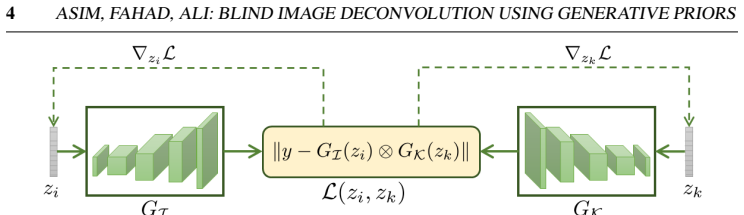
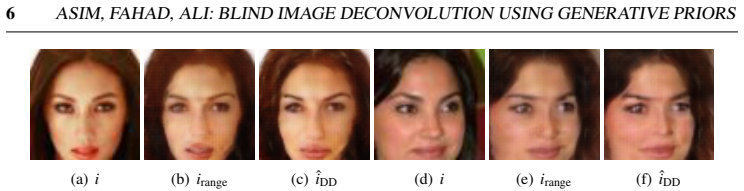
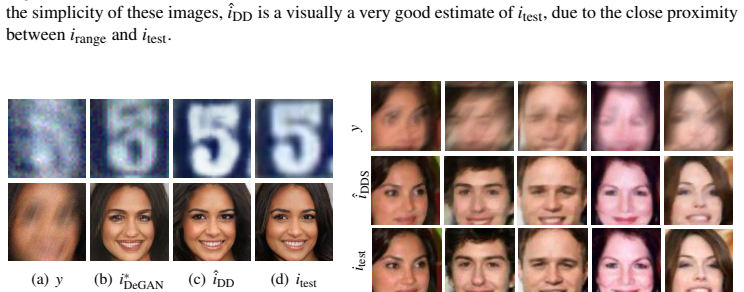
The load-bearing objects are the two pretrained generators $G_I: \mathbb{R}^l \to \mathbb{R}^n$ and $G_K: \mathbb{R}^m \to \mathbb{R}^n$, whose ranges act as the feasible sets for the sharp image and the blur kernel. The algorithm is alternating gradient descent on the latent codes $(z_i, z_k)$ to minimize the data-fidelity term $\|y - G_I(z_i)\otimes G_K(z_k)\|^2$ plus $\ell^2$ penalties on the codes, with random restarts to escape poor local minima. The named algorithms are Deep Deblur (strictly constrained to the generator ranges) and Deep Deblur with Slack (DDS), which adds an intermediate image $i$ tied to $G_I(z_i)$ by $\|i - G_I(z_i)\|^2$ and regularized by total variation, allowing recovery outside the generator range. The key diagnostic quantity is the range error $\|i_{\text{test}} - i_{\text{range}}\|$, the distance from a true test image to the nearest image the generator can produce.
What would settle it
Take a test image $i_{\text{test}}$ far from the generator range, compute its nearest range image $i_{\text{range}}$, blur both with the same kernel and noise to form $y_{\text{test}}$ and $y_{\text{range}}$, then run Deep Deblur on each. If the output from $y_{\text{test}}$ is no closer to $i_{\text{test}}$ than $i_{\text{range}}$ already is, the recovery claim fails for out-of-range images.
Extended reading notes
Core claim
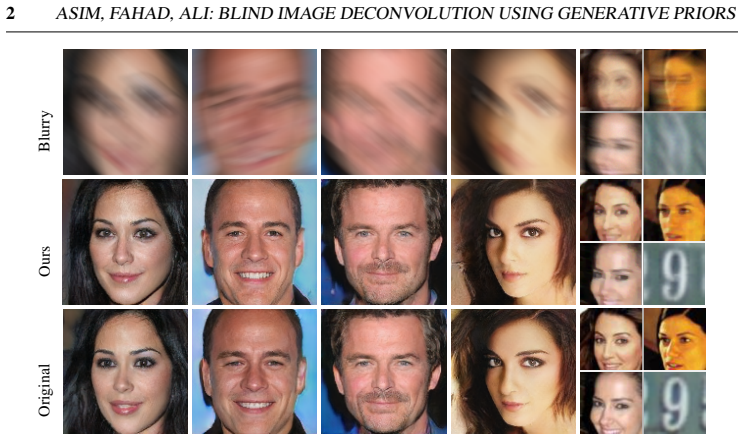
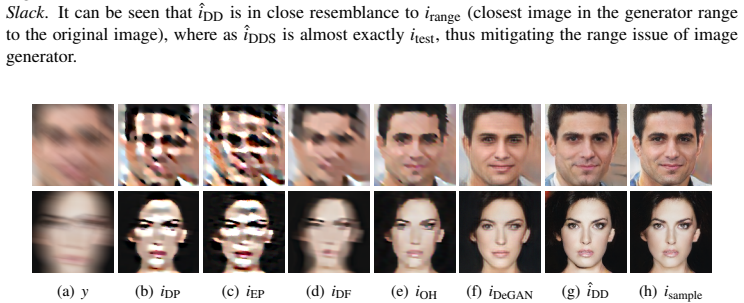
The central claim is that the range of a pretrained image generator is a strong enough prior to disambiguate blind deconvolution. Given a blurry observation $y$, the paper solves $(\hat z_i,\hat z_k) = \arg\min_{z_i,z_k}\|y - G_I(z_i)\otimes G_K(z_k)\|^2 + \gamma\|z_i\|^2 + \lambda\|z_k\|^2$ with random restarts, where $G_I$ and $G_K$ are fixed pretrained generators for images and blur kernels. The authors report that this 'Deep Deblur' procedure yields sharp deblurred images that beat classical priors such as dark-channel and extreme-channel methods, and that on rich datasets the 'Deep Deblur with Slack' variant—which adds a total-variation term and lets the image deviate from the generator range—outperforms end-to-end networks such as DeblurGAN. The paper frames the approach as the first use of pretrained generative models for blind image deblurring.
Load-bearing premise
The method assumes the true sharp image lies close to the range of the pretrained image generator; if the generator cannot represent the test image, the deblurred output collapses toward the nearest generator-range image rather than the true image.
Editorial extensions
If this is right
- Blind deblurring becomes a fixed-cost optimization over pretrained models: the same image and blur generators handle different blur sizes and noise levels without retraining.
- The quality of deblurring is bounded by the expressiveness of the image generator; images inside the generator range are recovered much more accurately than arbitrary images.
- On complex image classes where the generator range is incomplete, the slack variant that allows out-of-range images should be used instead of strict range constraint.
- End-to-end deblurring networks lose their advantage as blur size or noise grows, while the generative-prior approach degrades more gracefully.
Reading between the lines
- This suggests the same alternating latent-space scheme could apply to other blind inverse problems, such as blind super-resolution or blind inpainting, whenever one generator for clean signals and one for the degradation are available.
- The range-error bottleneck points to a concrete upgrade path: replacing the GAN/VAE generator with a more expressive generative prior, such as a diffusion model, should improve deblurring on complex natural image classes.
- A testable practical corollary is that the slack parameter $\tau$ in the DDS objective should scale with the measured range error of the image generator class; the paper does not provide such a rule.
Signed reviews
Editorial analysis
A structured set of objections, weighed in public.
Referee Report
Summary. The paper proposes a blind image deconvolution method that regularizes the ill-posed inverse problem by constraining the recovered image and blur kernel to the ranges of two pretrained generative models. The authors formulate a latent-space objective (Eq. 4) and minimize it by alternating gradient descent with random restarts, calling this Deep Deblur. To handle datasets where the generator range is insufficient, they introduce Deep Deblur with Slack (DDS, Eq. 5), which adds a free pixel-domain image, a range-error penalty, and a total-variation prior. Experiments on SVHN, Shoes, and CelebA report PSNR/SSIM values against classical deblurring priors and end-to-end networks, plus noise and large-blur robustness experiments. The paper's central claims are that this is the first use of pretrained generative models for blind image deblurring and that the proposed approach outperforms existing methods without retraining for different noise levels.
Significance. If the central claims are fully supported, the paper proposes a conceptually interesting way to use pretrained generative models for blind deconvolution, combining latent-space optimization with a slack variable to mitigate generator range limitations. The idea is timely and the results on the tested datasets are promising, especially the DDS variant. However, the paper's experimental evidence currently has a load-bearing attribution gap: the best numbers come from the slack objective that mixes generative and classical priors, and the contribution of the generative image prior is not isolated. The paper also provides no quantitative evaluation of kernel estimation accuracy, even though joint image-kernel recovery is a stated contribution, and it defers all hyperparameters and algorithmic details to a missing supplementary. These issues need to be addressed before the claims can be accepted at face value.
major comments (3)
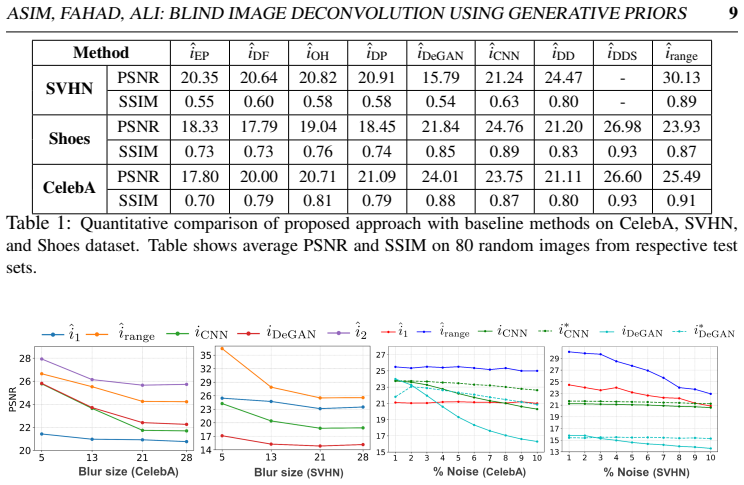
- [Section 3.2.2, Table 1] The quantitative claim that the proposed approach outperforms all competitors on Shoes and CelebA is carried by DDS (Eq. 5), not by the pure generative-prior objective (Eq. 4). On Shoes, Deep Deblur attains 21.20 dB versus 21.84 dB for DeblurGAN and 24.76 dB for CNN; on CelebA it attains 21.11 dB versus 24.01 dB for DeblurGAN. DDS adds a free pixel-domain image variable i, a total-variation term ρ||i||_tv, and three weights τ, ζ, ρ beyond Eq. (4). No ablation is reported (e.g., τ=0, ρ=0, or a TV-only blind deconvolution using the same kernel generator). Without such an ablation, the observed gains cannot be attributed to the pretrained image generator, which is the paper's central novelty. This is a load-bearing omission.
- [Section 2 and Section 3] The paper's stated contribution is recovering 'true image and blur kernel' (Section 1), and Eq. (4) and (5) optimize both latent variables for the image and the kernel. However, all quantitative results in Table 1 and Figure 9 are image PSNR/SSIM only. No metric for blur kernel estimation accuracy (e.g., kernel MSE, normalized cross-correlation, or visual comparison of recovered kernels) is reported. The claim of joint image-kernel recovery is therefore not substantiated by the experiments.
- [Section 3.1] The choice of all free parameters (γ, λ, τ, ζ, ρ), the gradient step sizes, and the random-restart schedule are deferred to a supplementary material that is not included with the manuscript. Because the method is a non-convex optimization with tuned hyperparameters, omitting these values makes the experiments non-reproducible and prevents the reader from assessing the sensitivity of the results to parameter choices. The supplementary material should be provided, or at minimum a table of all hyperparameter values and a description of the random-restart procedure should be added.
minor comments (5)
- [Throughout] The manuscript contains several typographical and grammatical errors, for example 'with in' in the contributions list, 'T echnology' in the author affiliation, and 'these comparison' in Section 3.2.2. A careful proofreading pass is needed.
- [Section 2] The random-restart criterion is described as restarting when the measurement loss 'does not reduce sufficiently after reasonably many iterations'; this is too vague to reproduce. Please specify the exact threshold and iteration counts.
- [Section 3.2.3, Figure 9] The noise and blur robustness curves are presented as averages, but no error bars or confidence intervals are shown. Given that Table 1 reports only 80 test images per dataset, adding variance information would help assess the statistical reliability of the comparisons.
- [Section 3.1] The CNN baseline from [13] is designed for text deblurring, but it is evaluated on Shoes and CelebA. Please clarify whether this network was retrained or used off-the-shelf, and whether any domain adaptation was performed.
- [Section 3.2.2, Table 1] The SVHN row has no DDS entry, and the text explains the choice, but this should also be stated in the table caption for clarity.
Circularity Check
No circularity found.
full rationale
The paper's central claim is that minimizing the latent-space objective (4) — or its slack variant (5) — with pre-trained generators yields deblurred images and kernels that compete with or exceed baselines. No step of the derivation assumes the target result. Equation (4) is a plain forward-model data-fit term ||y - G_I(z_i) ⊗ G_K(z_k)||^2 plus latent-norm regularizers; equation (5) adds an explicit slack image, a range-error coupling term, and a TV prior. These are optimization objectives, not fitted expressions that are later relabeled as predictions. The reported PSNR/SSIM values in Table 1 are evaluated on 80 held-out test images from SVHN, Shoes, and CelebA, and the noise-robustness experiments use fixed hyperparameters across noise levels. The authors' self-citations (refs. [31] and [32]) are related-work references to their own prior generative-prior inverse-problem papers; they are not invoked as a uniqueness theorem, an ansatz justification, or a load-bearing premise for the current derivation. The acknowledged limitation that Deep Deblur recovers something close to the range image irange is an honest statement about the generator's representational reach, not a circularity: the method's output being constrained to Range(G_I) is the stated design, and the paper measures how close that comes to the true image. The skeptical concern that Table 1's strongest numbers come from DDS, which adds TV and a slack variable without an ablation, is an attribution/ablation issue about what drives the improvement, not a circularity: those terms are additional inputs rather than restatements of the claimed outputs. The derivation chain is self-contained with respect to the experimental evaluation, and no prediction reduces by construction to a fit or to the authors' prior claims.
Assumptions & free parameters
free parameters (6)
- gamma (latent image regularization weight) =
unknown
- lambda (latent kernel regularization weight) =
unknown
- tau (range-error weight in DDS) =
unknown
- zeta (measurement-loss weight in DDS) =
unknown
- rho (total-variation weight in DDS) =
unknown
- optimization step sizes and random-restart schedule =
unknown
assumptions (5)
- domain assumption Spatially invariant convolution forward model y = i⊗k+n
- domain assumption Latent codes zi and zk follow standard Gaussian distributions
- domain assumption Pretrained generator ranges approximate the image and blur classes closely enough
- ad hoc to paper Alternating gradient descent with random restarts finds acceptable minima of the non-convex objective
- domain assumption Motion blur kernels are drawn from the distribution learned by the kernel generator
Cite this review
Pith. "Pith review of Blind Image Deconvolution using Pretrained Generative Priors." pith.science (2026). https://pith.science/paper/KYMKIVYG
@misc{pith2026190807404,
  author       = {Pith},
  title        = {Pith review of: Blind Image Deconvolution using Pretrained Generative Priors},
  year         = {2026},
  howpublished = {\url{https://pith.science/paper/KYMKIVYG}},
  note         = {Machine review of arXiv:1908.07404}
}
read the original abstract
This paper proposes a novel approach to regularize the ill-posed blind image deconvolution (blind image deblurring) problem using deep generative networks. We employ two separate deep generative models - one trained to produce sharp images while the other trained to generate blur kernels from lower dimensional parameters. To deblur, we propose an alternating gradient descent scheme operating in the latent lower-dimensional space of each of the pretrained generative models. Our experiments show excellent deblurring results even under large blurs and heavy noise. To improve the performance on rich image datasets not well learned by the generative networks, we present a modification of the proposed scheme that governs the deblurring process under both generative and classical priors.
Figures
Figures from the paper (5 more)


Reference graph
Works this paper leans on
-
[1]
Shahrukh Athar, Evgeny Burnaev, and Victor Lempitsky. Latent convolutional models. 2018
work page 2018
-
[2]
Compressed sensing using generative models
Ashish Bora, Ajil Jalal, Eric Price, and Alexandros G Dimakis. Compressed sensing using generative models. arXiv preprint arXiv:1703.03208, 2017
arXiv 2017
-
[3]
Modeling the performance of image restora- tion from motion blur
Giacomo Boracchi, Alessandro Foi, et al. Modeling the performance of image restora- tion from motion blur. IEEE Trans. Image Processing, 21(8):3502–3517, 2012
work page 2012
-
[4]
Blind motion deblurring from a single image using sparse approximation
Jian-Feng Cai, Hui Ji, Chaoqiang Liu, and Zuowei Shen. Blind motion deblurring from a single image using sparse approximation. In Computer Vision and Pattern Recogni- tion, 2009. CVPR 2009. IEEE Conference on , pages 104–111. IEEE, 2009
work page 2009
-
[5]
Blind image deconvolution: theory and appli- cations
Patrizio Campisi and Karen Egiazarian. Blind image deconvolution: theory and appli- cations. CRC press, 2016
work page 2016
-
[6]
Total variation blind deconvolution.IEEE trans- actions on Image Processing, 7(3):370–375, 1998
Tony F Chan and Chiu-Kwong Wong. Total variation blind deconvolution.IEEE trans- actions on Image Processing, 7(3):370–375, 1998
work page 1998
-
[7]
Blind image deblur- ring with outlier handling
Jiangxin Dong, Jinshan Pan, Zhixun Su, and Ming-Hsuan Yang. Blind image deblur- ring with outlier handling. In IEEE International Conference on Computer Vision (ICCV), pages 2478–2486, 2017
work page 2017
-
[8]
Removing camera shake from a single photograph
Rob Fergus, Barun Singh, Aaron Hertzmann, Sam T Roweis, and William T Freeman. Removing camera shake from a single photograph. In ACM transactions on graphics (TOG), volume 25, pages 787–794. ACM, 2006
work page 2006
Show all 39 references
-
[9]
double-dip
Yossi Gandelsman, Assaf Shocher, and Michal Irani. " double-dip": Unsupervised im- age decomposition via coupled deep-image-priors. arXiv preprint arXiv:1812.00467 , 2018
2018 arXiv
-
[10]
Generative adversarial nets
Ian Goodfellow, Jean Pouget-Abadie, Mehdi Mirza, Bing Xu, David Warde-Farley, Sherjil Ozair, Aaron Courville, and Yoshua Bengio. Generative adversarial nets. In Advances in neural information processing systems , pages 2672–2680, 2014
2014
-
[11]
Global guarantees for enforcing deep generative priors by empirical risk
Paul Hand and Vladislav V oroninski. Global guarantees for enforcing deep generative priors by empirical risk. arXiv preprint arXiv:1705.07576, 2017. ASIM, FAHAD, ALI: BLIND IMAGE DECONVOLUTION USING GENERA TIVE PRIORS 11
2017 arXiv
-
[12]
Phase retrieval under a generative prior
Paul Hand, Oscar Leong, and Vlad V oroninski. Phase retrieval under a generative prior. In Advances in Neural Information Processing Systems , pages 9154–9164, 2018
2018
-
[13]
Convolutional neural networks for direct text deblurring
Michal Hradiš, Jan Kotera, Pavel Zemcík, and Filip Šroubek. Convolutional neural networks for direct text deblurring. In Proceedings of BMVC, volume 10, 2015
2015
-
[14]
Single image deblurring with adap- tive dictionary learning
Zhe Hu, Jia-Bin Huang, and Ming-Hsuan Yang. Single image deblurring with adap- tive dictionary learning. In Image Processing (ICIP), 2010 17th IEEE International Conference on, pages 1169–1172. IEEE, 2010
2010
-
[15]
Progressive growing of gans for improved quality, stability, and variation
Tero Karras, Timo Aila, Samuli Laine, and Jaakko Lehtinen. Progressive growing of gans for improved quality, stability, and variation. arXiv preprint arXiv:1710.10196 , 2017
2017 arXiv
-
[16]
Auto-encoding variational bayes
Diederik P Kingma and Max Welling. Auto-encoding variational bayes. arXiv preprint arXiv:1312.6114, 2013
2013 arXiv
-
[17]
Blind image deconvolution
Deepa Kundur and Dimitrios Hatzinakos. Blind image deconvolution. IEEE signal processing magazine, 13(3):43–64, 1996
1996
-
[18]
Deblurgan: Blind motion deblurring using conditional adversarial networks
Orest Kupyn, V olodymyr Budzan, Mykola Mykhailych, Dmytro Mishkin, and Jiri Matas. Deblurgan: Blind motion deblurring using conditional adversarial networks. arXiv preprint arXiv:1711.07064, 2017
2017 arXiv
-
[19]
Understanding and evaluating blind deconvolution algorithms
Anat Levin, Yair Weiss, Fredo Durand, and William T Freeman. Understanding and evaluating blind deconvolution algorithms. In Computer Vision and Pattern Recogni- tion, 2009. CVPR 2009. IEEE Conference on , pages 1964–1971. IEEE, 2009
2009
-
[20]
Learning a discriminative prior for blind image deblurring
Lerenhan Li, Jinshan Pan, Wei-Sheng Lai, Changxin Gao, Nong Sang, and Ming- Hsuan Yang. Learning a discriminative prior for blind image deblurring. In Pro- ceedings of the IEEE Conference on Computer Vision and Pattern Recognition , pages 6616–6625, 2018
2018
-
[21]
Using deep neural networks for inverse problems in imaging: beyond analytical methods
Alice Lucas, Michael Iliadis, Rafael Molina, and Aggelos K Katsaggelos. Using deep neural networks for inverse problems in imaging: beyond analytical methods. IEEE Signal Processing Magazine, 35(1):20–36, 2018
2018
-
[22]
Deep multi-scale convolutional neural network for dynamic scene deblurring
Seungjun Nah, Tae Hyun Kim, and Kyoung Mu Lee. Deep multi-scale convolutional neural network for dynamic scene deblurring. arXiv preprint arXiv:1612.02177, 2016
2016 arXiv
-
[23]
Blur-invariant deep learning for blind-deblurring
TM Nimisha, Akash Kumar Singh, and AN Rajagopalan. Blur-invariant deep learning for blind-deblurring. In Proceedings of the IEEE Conference on Computer Vision and Pattern Recognition, pages 4752–4760, 2017
2017
-
[24]
Motion blur kernel estimation via salient edges and low rank prior
Jinshan Pan, Risheng Liu, Zhixun Su, and Guili Liu. Motion blur kernel estimation via salient edges and low rank prior. In Multimedia and Expo (ICME), 2014 IEEE International Conference on, pages 1–6. IEEE, 2014
2014
-
[25]
Blind image de- blurring using dark channel prior
Jinshan Pan, Deqing Sun, Hanspeter Pfister, and Ming-Hsuan Yang. Blind image de- blurring using dark channel prior. InProceedings of the IEEE Conference on Computer Vision and Pattern Recognition, pages 1628–1636, 2016. 12 ASIM, FAHAD, ALI: BLIND IMAGE DECONVOLUTION USING GENER...
2016
-
[26]
Learning discriminative data fitting functions for blind image deblurring
Jinshan Pan, Jiangxin Dong, Yu-Wing Tai, Zhixun Su, and Ming-Hsuan Yang. Learning discriminative data fitting functions for blind image deblurring. In ICCV, pages 1077– 1085, 2017
2017
-
[27]
Image deblurring via enhanced low-rank prior
Wenqi Ren, Xiaochun Cao, Jinshan Pan, Xiaojie Guo, Wangmeng Zuo, and Ming- Hsuan Yang. Image deblurring via enhanced low-rank prior. IEEE Transactions on Image Processing, 25(7):3426–3437, 2016
2016
-
[28]
Improved techniques for training gans
Tim Salimans, Ian Goodfellow, Wojciech Zaremba, Vicki Cheung, Alec Radford, and Xi Chen. Improved techniques for training gans. In Advances in Neural Information Processing Systems, pages 2234–2242, 2016
2016
-
[29]
Learning to deblur
Christian J Schuler, Michael Hirsch, Stefan Harmeling, and Bernhard Schölkopf. Learning to deblur. IEEE transactions on pattern analysis and machine intelligence , 38(7):1439–1451, 2016
2016
-
[30]
Solving linear inverse problems using gan priors: An algorithm with provable guarantees
Viraj Shah and Chinmay Hegde. Solving linear inverse problems using gan priors: An algorithm with provable guarantees. arXiv preprint arXiv:1802.08406, 2018
2018 arXiv
-
[31]
Robust compressive phase retrieval via deep gener- ative priors
Fahad Shamshad and Ali Ahmed. Robust compressive phase retrieval via deep gener- ative priors. arXiv preprint arXiv:1808.05854, 2018
2018 arXiv
-
[32]
Deep ptych: Subsampled fourier ptychography using generative priors
Fahad Shamshad, Farwa Abbas, and Ali Ahmed. Deep ptych: Subsampled fourier ptychography using generative priors. arXiv preprint arXiv:1812.11065, 2018
2018 arXiv
-
[33]
Image quality assessment: from error visibility to structural similarity
Zhou Wang, Alan C Bovik, Hamid R Sheikh, and Eero P Simoncelli. Image quality assessment: from error visibility to structural similarity. IEEE transactions on image processing, 13(4):600–612, 2004
2004
-
[34]
Image smoothing via l 0 gradient minimization
Li Xu, Cewu Lu, Yi Xu, and Jiaya Jia. Image smoothing via l 0 gradient minimization. In ACM Transactions on Graphics (TOG), volume 30, page 174. ACM, 2011
2011
-
[35]
Learning to super-resolve blurry face and text images
Xiangyu Xu, Deqing Sun, Jinshan Pan, Yujin Zhang, Hanspeter Pfister, and Ming- Hsuan Yang. Learning to super-resolve blurry face and text images. In Proceedings of the IEEE Conference on Computer Vision and Pattern Recognition , pages 251–260, 2017
2017
-
[36]
Image deblur- ring via extreme channels prior
Yanyang Yan, Wenqi Ren, Yuanfang Guo, Rui Wang, and Xiaochun Cao. Image deblur- ring via extreme channels prior. In Proceedings of the IEEE Conference on Computer Vision and Pattern Recognition, pages 4003–4011, 2017
2017
-
[37]
Semantic image inpainting with deep generative models
Raymond A Yeh, Chen Chen, Teck Yian Lim, Alexander G Schwing, Mark Hasegawa- Johnson, and Minh N Do. Semantic image inpainting with deep generative models. In Proceedings of the IEEE Conference on Computer Vision and Pattern Recognition , pages 5485–5493, 2017
2017
-
[38]
Fine-grained visual comparisons with local learning
Aron Yu and Kristen Grauman. Fine-grained visual comparisons with local learning. In Proceedings of the IEEE Conference on Computer Vision and Pattern Recognition , pages 192–199, 2014
2014
-
[39]
Sparse repre- sentation based blind image deblurring
Haichao Zhang, Jianchao Yang, Yanning Zhang, and Thomas S Huang. Sparse repre- sentation based blind image deblurring. In Multimedia and Expo (ICME), 2011 IEEE International Conference on, pages 1–6. IEEE, 2011
2011
Reviewed August 14, 2026 · model on record in the stance chip above.
Discussion (0). Continue with ORCID to comment.