REVIEW 2 minor 1 cited by
From spectral structure to sensing limits in quantum thermometry
T0 review · 0 major / 2 minor · reviewed 2026-06-25 · grok-4.3
Pith's one-line read The energy spectrum of a quantum probe dictates distinct high-temperature decay rates of T^{-4} or T^{-2} for its thermometric precision.
desk verdict This paper maps spectral features of probes to concrete QFI scaling laws for thermometry, separating finite vs unbounded spectra at high T and showing degeneracy or topology routes at low T. read the letter →
The pith
A machine-rendered reading of the paper's core claim, the machinery that carries it, and where it could break.
The reading
What carries the argument
Quantum Fisher information of the thermal Gibbs state, computed directly from the probe's energy eigenvalues and their degeneracies.
What would settle it
Measure the quantum Fisher information for a finite two-level spin system at high temperature and check whether it decays precisely as T^{-4} rather than the slower T^{-2} rate of continuous-spectrum probes.
Extended reading notes
Core claim
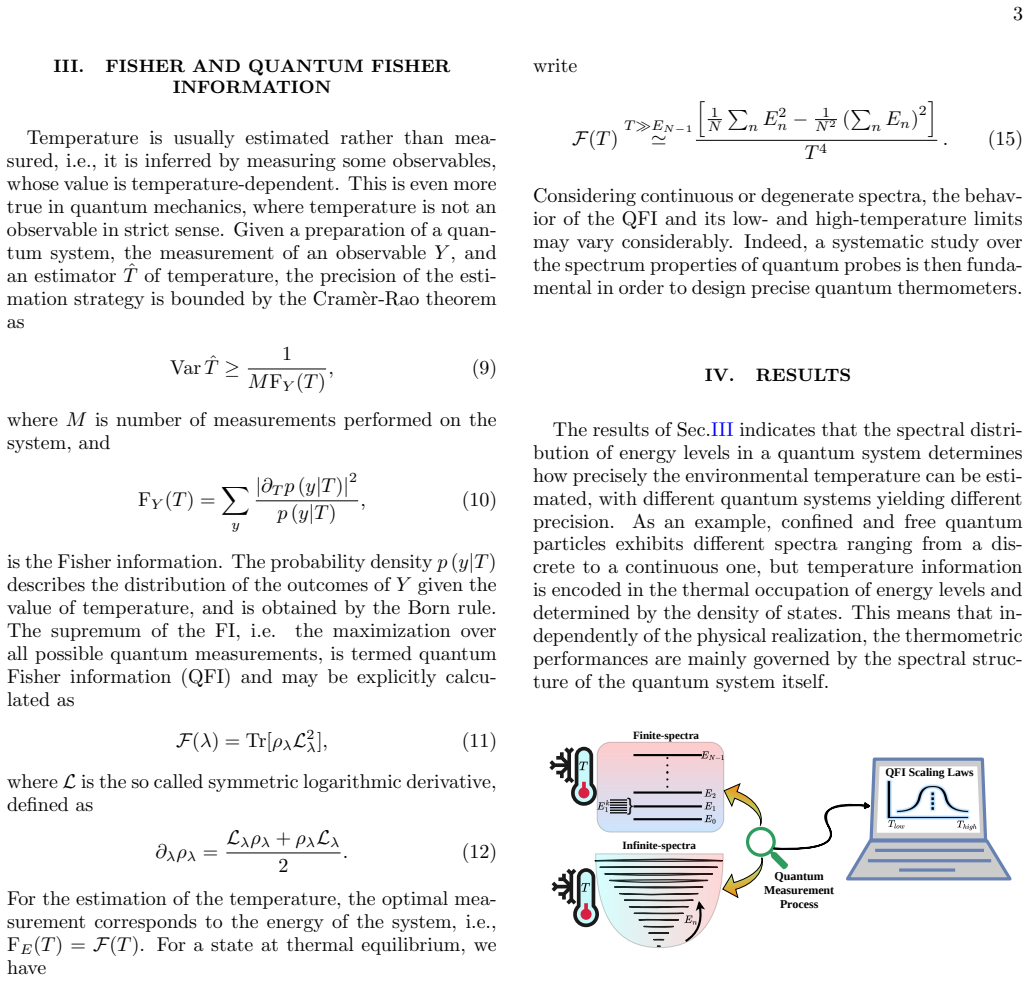
Finite-spectrum probes exhibit a T^{-4} decay of quantum Fisher information at high temperature, while unbounded or continuous spectra yield a slower T^{-2} decay; at low temperature, degeneracy or fully-connected quantum-walk topology can enhance sensitivity arbitrarily while specific topologies yield an optimized T^{-2} scaling via gap engineering. Power-law spectra enable tunable scaling of thermometric performance with system size.
Load-bearing premise
The probe reaches a thermal Gibbs state whose spectrum is known exactly and whose quantum Fisher information sets the ultimate sensing precision.
Editorial extensions
If this is right
- Finite-spectrum probes lose precision faster than unbounded-spectrum ones at high temperatures.
- Degenerate excited states or fully connected quantum-walk topologies can remove the usual exponential suppression of low-temperature sensitivity.
- Gap engineering in specific quantum-walk networks yields an optimized T^{-2} low-temperature scaling for chosen network sizes.
- Power-law spectra provide a direct handle to tune thermometric performance by varying system size.
Reading between the lines
- For high-temperature applications, continuous or unbounded spectra such as those in harmonic oscillators would outperform finite-level systems.
- The gap-engineering route could be realized and tested in optical-lattice quantum walks to confirm the T^{-2} scaling.
- Hybrid probes mixing finite and continuous spectral components might be designed for temperature windows where neither class alone is optimal.
Editorial analysis
A structured set of objections, weighed in public.
Referee Report
Summary. The paper claims to derive exact scaling laws for the quantum Fisher information (QFI) of thermal states by mapping the spectral structure of various quantum probes—including finite spin ensembles, degenerate atoms, confining potentials, quantum walks, and continuous-spectrum models—to thermometric performance. It identifies two high-temperature universality classes (T^{-4} decay for finite spectra vs. T^{-2} for unbounded/continuous spectra) and low-temperature enhancements via degeneracy, fully-connected topologies, gap engineering, or power-law spectra, all framed as fundamental bounds and design guidelines for quantum thermometry.
Significance. If the central derivations hold, the work supplies a systematic classification of how energy-level configurations determine sensing limits, with clear universality classes and concrete mechanisms (degeneracy, topology, gap engineering) that can be used to optimize probes in given temperature windows. The grounding in the standard QFI formula for Gibbs states and the emphasis on exact rather than fitted scalings are strengths that could inform both theory and device design in quantum sensing.
minor comments (2)
- [Abstract] Abstract: the phrasing 'exact scaling laws' and the specific exponents (T^{-4}, T^{-2}) would benefit from an immediate parenthetical reference to the underlying relation F_T = Var(H)/T^4 so that the origin of the universality classes is transparent on first reading.
- The low-temperature discussion of 'arbitrarily enhanced' sensitivity via degeneracy or fully-connected walks should include a brief statement of the regime of validity (e.g., whether the enhancement remains bounded once the thermal state is properly normalized).
Simulated Author's Rebuttal
We thank the referee for the careful reading and positive assessment of our work, including the recognition of its systematic classification of spectral structures and the identification of high- and low-temperature universality classes. The recommendation for minor revision is noted. No specific major comments were provided in the report.
Circularity Check
No significant circularity; derivation self-contained
full rationale
The paper derives QFI scaling laws directly from the standard thermal-state relation F_T = Var(H)/T^4 and the explicit form of the partition function for given spectra (finite vs. unbounded, degenerate levels, quantum-walk topologies). These steps use only the Hamiltonian spectrum as input and standard quantum-information identities; no parameter is fitted to data and then renamed as a prediction, no self-citation chain is load-bearing for the central claims, and no ansatz or uniqueness theorem is smuggled in. The reported T^{-4}, T^{-2}, and degeneracy-enhanced behaviors are therefore independent consequences of the spectral assumptions rather than reductions to the paper's own outputs.
Assumptions & free parameters
assumptions (1)
- domain assumption The quantum Fisher information of the thermal state of the probe bounds the ultimate precision of temperature estimation.
Cite this review
Pith. "Pith review of From spectral structure to sensing limits in quantum thermometry." pith.science (2026). https://pith.science/paper/KYV3KADI
@misc{pith2026260625933,
  author       = {Pith},
  title        = {Pith review of: From spectral structure to sensing limits in quantum thermometry},
  year         = {2026},
  howpublished = {\url{https://pith.science/paper/KYV3KADI}},
  note         = {Machine review of arXiv:2606.25933}
}
abstract
The precision of a quantum thermometer is fundamentally constrained by the spectral structure of the probe itself, and a systematic mapping between the configurations of energy levels and thermometric performance provides relevant information to design optimized devices. In this work, we establish such a mapping by analyzing a broad class of quantum systems, ranging from finite spin ensembles and degenerate atoms to confining potentials, quantum walks, and continuous-spectrum models. We derive exact scaling laws for the quantum Fisher information, revealing two distinct high-temperature universality classes: finite-spectrum probes exhibit a $T^{-4}$ decay, while unbounded or continuous spectra yield a slower $T^{-2}$ decay. At low temperatures, we show that sensitivity, though universally exponentially suppressed, can be enhanced arbitrarily by engineering degenerate excited states or a quantum walk on a fully connected topology. By contrast, specific quantum walk topologies provide a distinct enhancement mechanism based on gap engineering, whereby an optimal network size yields an optimized $T^{-2}$ low-temperature scaling. Furthermore, power-law spectra enable tunable scaling of thermometric performance with system size, offering a design principle for optimal probes in specific temperature windows. Our results contribute to transform spectral information into a resource for quantum thermometry, providing both fundamental bounds and practical guidelines to tailored temperature sensing.
Figures
Forward citations
Cited by 1 Pith paper
-
Finite-size reliability of homothetic quantum Otto engines
For finite homothetic quantum Otto engines, exact finite-N work statistics show a reliability crossover and noncommuting high-temperature and infinite-dimensional limits.
Reference graph
Works this paper leans on
-
[1]
Spin Systems We begin this analysis withNdimensional spin sys- tems. Specifically, for a spin-sparticle in a uniform mag- netic fieldBalong thez-axis, the Hamiltonian can be written as H s =−ωS z, ω=γB >0,(16) and the associated energy spectrum is Es m =−ωm, m=−s,−s+ 1, . . . , s ,(17) i.e.N= 2s+1 equally spaced levels with spacing ∆ =ω. Each energy level...
-
[2]
Quantum walks When a quantum system can be modeled as a collec- tion of n qubits (nodes) that form a network connected by 5 a specific topology, it may be described using the quan- tum walk (QW) formalism. The system is described by an excitation-preserving Hamiltonian in the form H QW = N−1X i=0 ωi σ+ i σ− i + N−1X i,j=0 gi,j σ+ i σ− j +σ + j σ− i , (27)...
-
[3]
Quantum harmonic oscillator As a first confining potential we look at the quantum harmonic oscillator (QHO), as it represents an ubiquitous model in quantum sensing and generally in physics [62– 64]. The Hamiltonian of a harmonic oscillatorkcan be written in the form H qho k = p2 k 2m + 1 2 mω2x2 k,(39) and describe, at least to a first approximation, any...
-
[4]
Together those two models represent the ba- sis of the quantum description of the degrees of freedom of any quantum rigid system
Quantum Rotor After the description of the thermometric properties of a quantum harmonic oscillator, which can be adopted to model of the vibrational modes of any quantum system, we now focus on a model which can describe rotational 7 modes [65]. Together those two models represent the ba- sis of the quantum description of the degrees of freedom of any qu...
-
[5]
(54) Despite the simplicity of the model, this Hamilto- nian provides a convenient description for semiconductor hetero-structures or quantum dots [61]
Quantum Wells One of the easiest yet widely adopted confined model consist in considering a system with a Hamiltonian in the form H qw = ˆp2 2m + ˆV(x k),(53) where ˆV(x k) = ( ∞, if|x k|> d k, 0, if|x k|< d k. (54) Despite the simplicity of the model, this Hamilto- nian provides a convenient description for semiconductor hetero-structures or quantum dots...
-
[6]
Power-law spectral model After the characterization of the thermometric perfor- mances of different confined probes, a key question to ad- dress is how the QFI of such systems scales with system size and the structure of the energy spectrum. In con- fined thermometry, where quantum states are trapped in finite domains, the energy spectrum is inherently di...
-
[7]
Hydrogen-like systems The most used model to describe atomic systems is the hydrogen-like atom, whose spectrum arises from the Coulomb interaction and can be systematically refined through fine-structure, hyperfine-structure, and Zeeman corrections. For the hydrogen-like atom, the full Hamil- tonian reads H=H C +H fs +H hfs,(75) where each contribution is...
-
[8]
Diatomic Molecules Combining together the effects of electrostatic poten- tial, to rotational and vibrational modes it is possible to describe diatomic molecular systems such as homo- nuclear molecules made of light elements, as well as hetero-nuclear molecules such as carbon monoxide, nitric oxide. The Hamiltonian of such systems may be written as H m =H...
Show all 87 references
-
[9]
Spin Systems The low and high temperature limits of the QFI for spin systems are based on the asymptotic expansions of the hyperbolic cosecant. Particularly csch(x)≃2e −x, x≫1, csch(x)≃ 1 x − x 6 , x≪1.(A1) ForT→0 one has x= ω 2T ≫1,(A2) so that csch2(x)≃4e −2x.(A3) Therefore,...
-
[10]
Accordingly the QFI is F qr(T) = Var(Hqr) T 4 .(A12) However, in the low-temperature limitT→0 (β→ ∞), thermal occupation is effectively restricted to the lowest energy levels
Quantum Rotor Given that the quantum rotor model exhibits degener- acyg n, the canonical partition function yields Z(β) = ∞X n=0 gne−βE qr n .(A10) The energy variance of a quantum rotor is V ar(H qr) = 1 2I 2 P n gnh2 ne−βE qr n P n gne−βE qr n − P n gnhne−βE qr n P n gne−βE ...
-
[11]
Quantum Wells The spectrum of the Quantum Wells has a level spacing that grows linearly withni.e., ∆E n =E n+1 −E n = α(2n+ 1). In this case the partition function is Z(β) = ∞X n=1 e−βE qw n = ∞X n=1 e−αβn2 ,(A26) the above expression does not allow a compact formula without s...
-
[12]
Let assume thatδ=αβ→0. Using the Jacobi transformation [75], we have ϑ3(0, e−δ) = r π δ ϑ3(0, e−π2/δ).(A42) For smallδ, we haveϑ 3(0, e−π2/δ)→1, then ϑ3(0, q)≃ r π δ .(A43) Let’s definef(δ) =ϑ 3(0, e−δ)≃ √πδ −1/2. Then, the derivatives are f ′(δ)≃ − 1 2 √πδ −3/2, f ′′(δ)≃ 3 4 ...
-
[13]
Systems with both discrete and continuous spectra It is convenient to separate discrete and continuum contributions by defining Z(β) =Z d(β) +Z c(β),(A48) where Zd(β) = X n gne−βEn ,(A49) Zc(β) = Z ∞ Ec dE ρ(E)e −βE .(A50) The mean energy is ⟨H⟩= M(d) 1 +M (c) 1 Zd +Z c ,(A51)...
-
[14]
M. A. Nielsen and I. L. Chuang,Quantum Computa- tion and Quantum Information: 10th Anniversary Edi- tion(Cambridge University Press, 2010)
2010
-
[15]
Riera, C
A. Riera, C. Gogolin, and J. Eisert, Physical review let- ters108, 080402 (2012)
2012
- [16]
-
[17]
Callies, M
A. Callies, M. Hanser, J. C. Goldschmidt, B. Bl¨ asi, and O. H¨ ohn, Optics Express31, 19428 (2023)
2023
-
[18]
Cavazzoni, G
S. Cavazzoni, G. Ragazzi, P. Bordone, and M. G. A. Paris, Advanced Quantum Technologies9, e00897 (2026)
2026
-
[19]
F. Ye, L. S. Dhami, and J. M. Nichol, Phys. Rev. Appl. 25, 024045 (2026)
2026
-
[20]
R. M. Daniel and M. J. Danson, Trends in biochemical sciences35, 584 (2010)
2010
-
[21]
C. E. Moore, K. Meacham-Hensold, P. Lemonnier, R. A. Slattery, C. Benjamin, C. J. Bernacchi, T. Lawson, and A. P. Cavanagh, Journal of experimental botany72, 2822 (2021)
2021
-
[22]
T. M. Stace, Physical Review A—Atomic, Molecular, and Optical Physics82, 011611 (2010)
2010
-
[23]
W. Tham, H. Ferretti, A. Sadashivan, and A. Steinberg, Scientific reports6, 38822 (2016)
2016
-
[24]
D. Xie, C. Xu, and A. M. Wang, Quantum information processing16, 155 (2017)
2017
-
[25]
Mukherjee, A
V. Mukherjee, A. Zwick, A. Ghosh, X. Chen, and G. Kur- izki, Communications Physics2, 162 (2019)
2019
-
[26]
A. K. Pati, C. Mukhopadhyay, S. Chakraborty, and S. Ghosh, Physical Review A102, 012204 (2020)
2020
-
[27]
Kulikov, R
A. Kulikov, R. Navarathna, and A. Fedorov, Phys. Rev. Lett.124, 240501 (2020)
2020
-
[28]
K. V. Hovhannisyan, M. R. Jørgensen, G. T. Landi, ´A. M. Alhambra, J. B. Brask, and M. Perarnau-Llobet, Prx Quantum2, 020322 (2021)
2021
-
[29]
Planella, M
G. Planella, M. F. Cenni, A. Acin, and M. Mehboudi, Physical Review Letters128, 040502 (2022)
2022
-
[30]
Ullah, M
A. Ullah, M. T. Naseem, and ¨O. E. M¨ ustecaplıo˘ glu, Phys- ical Review Research5, 043184 (2023)
2023
-
[31]
Abiuso, P
P. Abiuso, P. Andrea Erdman, M. Ronen, F. No´ e, G. Haack, and M. Perarnau-Llobet, Quantum Science and Technology9, 035008 (2024)
2024
-
[32]
Aiache, A
Y. Aiache, A. El Allati, and K. El Anouz, Phys. Rev. A 110, 032605 (2024)
2024
-
[33]
D. S. Lvov, S. A. Lemziakov, E. Ankerhold, J. T. Pel- tonen, and J. P. Pekola, Phys. Rev. Appl.23, 054079 (2025)
2025
-
[34]
Aiache, A
Y. Aiache, A. Ullah, O. E. M¨ ustecaplıo˘ glu, and A. E. Allati, Phys. Rev. A111, 062619 (2025)
2025
-
[35]
H. J. Miller and J. Anders, Nature communications9, 2203 (2018)
2018
-
[36]
Mehboudi, A
M. Mehboudi, A. Sanpera, and L. A. Correa, Journal of Physics A: Mathematical and Theoretical52, 303001 (2019)
2019
-
[37]
L. A. Correa, M. Mehboudi, G. Adesso, and A. Sanpera, Physical review letters114, 220405 (2015)
2015
-
[38]
Mancino, M
L. Mancino, M. Sbroscia, I. Gianani, E. Roccia, and M. Barbieri, Physical Review Letters118, 130502 (2017)
2017
-
[39]
S. Seah, S. Nimmrichter, D. Grimmer, J. P. Santos, V. Scarani, and G. T. Landi, Physical review letters123, 180602 (2019)
2019
-
[40]
Xie, F.-X
D. Xie, F.-X. Sun, and C. Xu, Physical Review A101, 063844 (2020)
2020
-
[41]
M. T. Mitchison, T. Fogarty, G. Guarnieri, S. Campbell, T. Busch, and J. Goold, Phys. Rev. Lett.125, 080402 (2020)
2020
-
[42]
O’Connor, B
E. O’Connor, B. Vacchini, and S. Campbell, Entropy23, 1634 (2021)
2021
-
[43]
Fujiwara and Y
M. Fujiwara and Y. Shikano, Nanotechnology32, 482002 (2021)
2021
-
[44]
Zhang and D
D.-J. Zhang and D. Tong, npj Quantum Information8, 81 (2022)
2022
-
[45]
Dedyulin, Z
S. Dedyulin, Z. Ahmed, and G. Machin, Measurement Science and Technology33, 092001 (2022)
2022
-
[46]
Briant, S
T. Briant, S. Krenek, A. Cupertino, F. Loubar, R. Braive, 17 L. Weituschat, D. Ramos, M. J. Martin, P. A. Postigo, A. Casas,et al., Optics3, 159 (2022)
2022
-
[47]
C. Liu, H. Hu, Z. Liu, S. Xiao, J. Wang, Y. Zhou, and Q. Song, Photonics Research12, 1696 (2024)
2024
-
[48]
Aiache, C
Y. Aiache, C. Seida, K. El Anouz, and A. El Allati, Phys. Rev. E110, 024132 (2024)
2024
-
[49]
Mehboudi, F
M. Mehboudi, F. Meier, M. Huber, and H. J. D. Miller, Phys. Rev. A111, L020401 (2025)
2025
-
[50]
D. Y. Akamatsu, L. F. R. de Moura, G. G. Damas, G. D. de Moraes Neto, V. Montenegro, and N. G. de Almeida, Quantum Science and Technology10, 045062 (2025)
2025
-
[51]
T. M. Stace, Phys. Rev. A82, 011611 (2010)
2010
-
[52]
C. L. Latune, I. Sinayskiy, and F. Petruccione, New Jour- nal of Physics22, 083049 (2020)
2020
-
[53]
Glatthard, K
J. Glatthard, K. V. Hovhannisyan, M. Perarnau-Llobet, L. A. Correa, and H. J. D. Miller, Quantum7, 1190 (2023)
2023
-
[54]
Chang, Y
S. Chang, Y. Yan, L. Wang, W. Ye, X. Rao, H. Zhang, L. Huang, M. Luo, Y. Chen, Q. Ma, and S. Gao, Phys. Rev. Res.6, 043171 (2024)
2024
-
[55]
Campbell, M
S. Campbell, M. G. Genoni, and S. Deffner, Quantum Science and Technology3, 025002 (2018)
2018
-
[56]
Salado-Mej´ ıa, R
M. Salado-Mej´ ıa, R. Rom´ an-Ancheyta, F. Soto-Eguibar, and H. Moya-Cessa, Quantum Science and Technology6, 025010 (2021)
2021
-
[57]
J.-B. Yuan, B. Zhang, Y.-J. Song, S.-Q. Tang, X.-W. Wang, and L.-M. Kuang, Physical Review A107, 063317 (2023)
2023
-
[58]
Ullah, O
A. Ullah, O. E. M¨ ustecaplıo˘ glu, and M. G. A. Paris, Phys. Rev. A113, 012408 (2026)
2026
-
[59]
W.-K. Mok, K. Bharti, L.-C. Kwek, and A. Bayat, Com- munications physics4, 62 (2021)
2021
-
[61]
Zhang, S.-Y
N. Zhang, S.-Y. Bai, and C. Chen, Phys. Rev. A110, 012211 (2024)
2024
-
[62]
J. D. Cresser and J. Anders, Physical Review Letters 127, 250601 (2021)
2021
-
[63]
Candeloro, L
A. Candeloro, L. Razzoli, S. Cavazzoni, P. Bordone, and M. G. A. Paris, Physical Review A102, 042214 (2020)
2020
-
[64]
Cavazzoni, G
S. Cavazzoni, G. Ragazzi, P. Bordone, and M. G. A. Paris, Physical Review A111, 032439 (2025)
2025
-
[65]
Zimbor´ as, M
Z. Zimbor´ as, M. Faccin, Z. Kadar, J. D. Whitfield, B. P. Lanyon, and J. Biamonte, Scientific reports3, 2361 (2013)
2013
-
[66]
Frigerio, C
M. Frigerio, C. Benedetti, S. Olivares, and M. G. A. Paris, Phys. Rev. A104, L030201 (2021)
2021
-
[67]
Candeloro, L
A. Candeloro, L. Razzoli, P. Bordone, and M. G. A. Paris, Physical Review E104, 014136 (2021)
2021
-
[68]
Coutinho, K
G. Coutinho, K. Guo, and V. Schmeits, arXiv preprint arXiv:2505.11986 (2025)
2025
-
[69]
M. G. A. Paris, Journal of Physics A: Mathematical and Theoretical49, 03LT02 (2015)
2015
-
[70]
K. V. Hovhannisyan and L. A. Correa, Phys. Rev. B98, 045101 (2018)
2018
-
[71]
P. P. Potts, J. B. Brask, and N. Brunner, Quantum3, 161 (2019)
2019
-
[72]
Aiache, A
Y. Aiache, A. E. Allati, ˙I. Demir, and K. E. Anouz, Phys. Rev. A112, 062229 (2025)
2025
-
[73]
Forghieri, A
G. Forghieri, A. Secchi, A. Bertoni, P. Bordone, and F. Troiani, Physical Review Research5, 043159 (2023)
2023
-
[74]
Fanucchi, G
E. Fanucchi, G. Forghieri, A. Secchi, P. Bordone, and F. Troiani, Physical Review B111, 205409 (2025)
2025
-
[75]
Leitch, N
H. Leitch, N. Piccione, B. Bellomo, and G. De Chiara, AVS Quantum Science4, 10.1116/5.0072067 (2022)
2022 doi
-
[76]
Cavazzoni, B
S. Cavazzoni, B. Teklu, and M. G. A. Paris, npj Quantum Information11, 174 (2025)
2025
-
[77]
Longhi, Quantum9, 1677 (2025)
S. Longhi, Quantum9, 1677 (2025)
2025
-
[78]
Leitch, K
H. Leitch, K. Hammam, and G. De Chiara, Physical Re- view E109, 024108 (2024)
2024
-
[79]
A. E. Miroshnichenko, S. Flach, and Y. S. Kivshar, Rev. Mod. Phys.82, 2257 (2010)
2010
-
[80]
Garmon, T
S. Garmon, T. Petrosky, L. Simine, and D. Se- gal, Fortschritte der Physik61, 261 (2013), https://onlinelibrary.wiley.com/doi/pdf/10.1002/prop.201200077
2013 doi
-
[81]
Z. Xu, C. Liu, S. Zhao, S. Chen, and Y. Zhao, Chemical reviews119, 195 (2018)
2018
-
[82]
DeMille, N
D. DeMille, N. R. Hutzler, A. M. Rey, and T. Zelevinsky, Nature Physics20, 741 (2024)
2024
-
[83]
J. Du, F. Shi, X. Kong, F. Jelezko, and J. Wrachtrup, Reviews of Modern Physics96, 025001 (2024)
2024
-
[84]
J. M. Brown and A. Carrington,Rotational spec- troscopy of diatomic molecules(Cambridge university press, 2003)
2003
-
[85]
G. V. Calder and K. Ruedenberg, The Journal of Chem- ical Physics49, 5399 (1968)
1968
-
[86]
J. A. Kunc and F. J. Gordillo-V´ azquez, The Jour- nal of Physical Chemistry A101, 1595 (1997), https://doi.org/10.1021/jp962817d
1997 doi
-
[87]
BecauseB≪ω, rotational excitations enter the thermal window at significantly lower temperatures than vibra- tional ones
-
[88]
E. T. Whittaker and G. N. Watson,A course of modern analysis(Courier Dover Publications, 2020)
2020
Reviewed June 25, 2026 · model on record in the stance chip above.
Discussion (0). Continue with ORCID to comment.