REVIEW 4 major objections 7 minor 56 references
Planet-induced Gas and Dust Substructure Feedbacks on Disk Thermal Structure
T0 review · 4 major / 7 minor · reviewed 2026-08-06 · deepseek-v4-flash
Pith's one-line read Planet-carved gaps heat protoplanetary disk midplanes by tens of Kelvin, shifting and multiplying volatile icelines while the heating feeds back to make the gaps shallower.
desk verdict A careful multi-dust extension of C23 that makes the disk thermal-structure feedback richer; the headline 10 K gap-temperature shift is plausible but hinges on an acknowledged, unquantified T_gas = T_dust assumption. read the letter →
The pith
A machine-rendered reading of the paper's core claim, the machinery that carries it, and where it could break.
The reading
What carries the argument
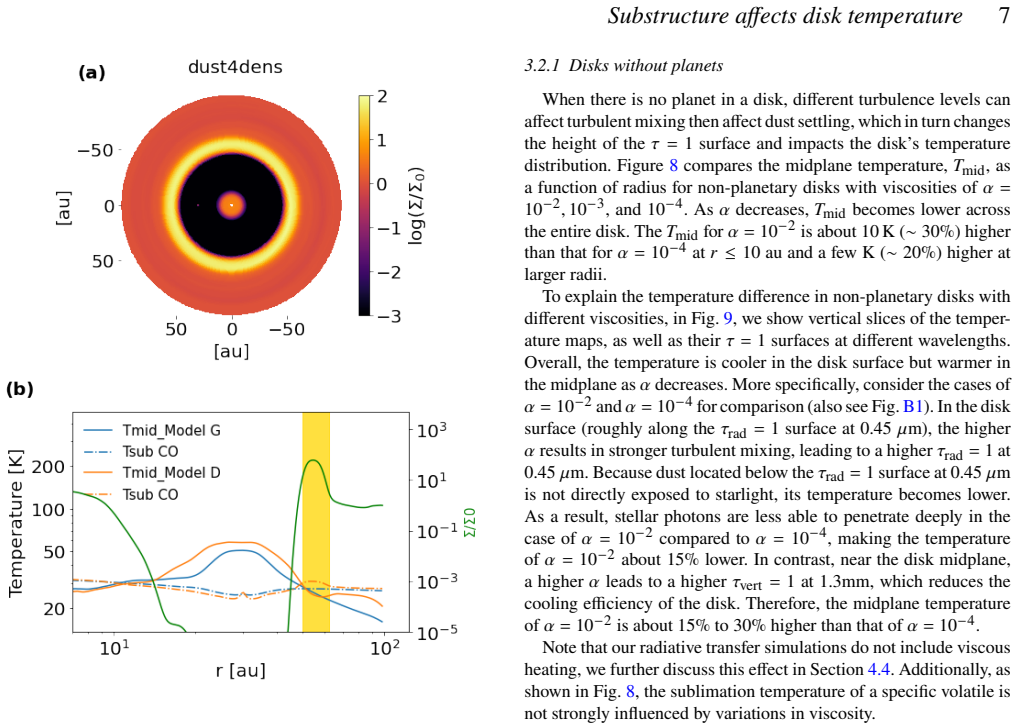
The mechanism that carries the argument is an iteration loop between the FARGO3D hydrodynamics code and the RADMC-3D Monte Carlo radiative transfer code, run to 2000 planetary orbits with temperature feedback every 100 orbits. The central identity is Eq. (2): the gas temperature fed into the next hydrodynamics step is the dust surface-area-averaged temperature over the four grain sizes, computed from the dust temperatures and number densities in each cell. This identity is what couples the thermal structure to the grain-size-dependent opacity and dust distribution: in the gap, sparse dust lets stellar photons penetrate and heat the midplane, raising the aspect ratio and shallowing the gap; at the dust ring, millimeter grains raise the optical depth and cool the midplane, lowering the sublimation temperature of volatiles.
What would settle it
A resolved measurement of gas temperature inside a planet-carved gap — for example from CO rotational line ratios or HD emission — that shows $T_{\rm gas}$ below $T_{\rm dust}$ in the gap midplane, or a hydrodynamics run that couples gas and dust temperatures separately and produces gaps deeper rather than shallower than a gas-only model, would refute the central feedback claim. The paper itself notes that Facchini et al. (2018) already found $T_{\rm gas}/T_{\rm dust} < 1$ in gap midplanes, so this test is the natural next step.
Extended reading notes
Core claim
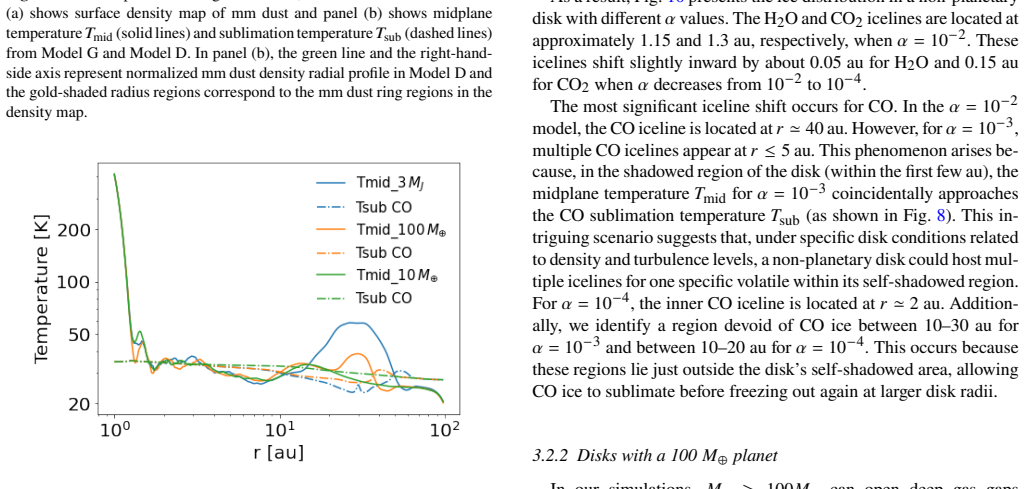
The central claim is that planet-induced substructures and disk temperature must be computed self-consistently: a giant planet's gap heats the surrounding gas and dust significantly, and that heating raises the disk aspect ratio, which in turn limits how deep the gap can grow. In the authors' simulations, a 3 Jupiter-mass planet at 30 au raises the midplane temperature in the gap from about 30 K to about 60 K, while a 100 Earth-mass planet at 10 au raises it by about 10 K; dust rings at the outer gap edge, formed by pressure-bump trapping of millimeter grains, cool the midplane by several Kelvin and act as volatile freeze-out regions. Including multiple dust species (0.1 μm to 1 mm) rather than a single well-mixed grain size yields gas gaps roughly 1.5 times shallower and gap temperatures about 10 K (25%) higher than the gas-only model, because the larger grains make the disk marginally optically thick at long wavelengths and slow the escape of cooling radiation. The overall midplane ice distribution of H2O, CO2, and CO is similar in both models, but the hot-gap/cold-ring configuration creates a volatile sublimation and re-freeze-out cycle.
Load-bearing premise
The entire feedback loop rests on treating the surface-area-averaged dust temperature as equal to the gas temperature in every cell; if the gas in a deep gap is actually cooler than the dust, the gap would deepen instead of shallowing, reversing the paper's headline result about shallower gaps in the multi-dust model.
Editorial extensions
If this is right
- Volatile icelines in a planet-structured disk are not single, smoothly located radii: the CO iceline can multiply and shift outward, so comparing observed ring positions to iceline predictions from smooth temperature profiles is unreliable.
- A deep H$_2$ gap located beyond the smooth-disk CO iceline can appear as a bright CO molecular ring rather than an emission gap in ALMA observations, complicating the interpretation of molecular emission gaps.
- Dust rings at pressure bumps cool the midplane by a few Kelvin and act as volatile freeze-out zones, while the adjacent hot gap sublimates the same volatiles, creating a cycle that can concentrate solids for planetesimal growth.
- Disk viscosity affects midplane temperature through turbulent dust mixing, but gap opening counteracts this, so iceline locations and the number of ice regions do not vary monotonically with $\alpha$.
- The predicted temperature changes and outward CO iceline shift in a gap-hosting disk are testable with ALMA CO intensity maps or spectral lines at roughly 30 au resolution.
Reading between the lines
- A consequence not explored in the paper: because the feedback strength depends on the grain size distribution, disks with ongoing dust growth or fragmentation may oscillate between shallow and deep gap states as grain sizes evolve, testable with multi-epoch observations of the same disk.
- The shallow-gap result in the multi-dust model hinges on the gas-dust temperature equality; if the two thermally decouple in deep gaps, the gap-depth comparison between Model G and Model D could reverse, so the quantitative claim should be re-checked with a two-temperature coupling.
- The proposed ALMA test — comparing CO iceline extent in a gap-hosting disk against a smooth-disk counterpart — could be applied to existing disk surveys, since the predicted outward shift of the CO iceline is a large, resolvable effect.
Editorial analysis
A structured set of objections, weighed in public.
Referee Report
Summary. The manuscript presents an iterative hydrodynamics + Monte Carlo radiative transfer framework (extending C23) in which gas and multiple dust species evolve, and the resulting dust temperature is fed back as the gas temperature. The authors show that planet-carved substructures alter the disk temperature relative to smooth disks: gap midplanes are warmer by tens of kelvin, dust-trap rings are cooler by several kelvin, and volatile icelines shift or multiply. They further compare the multi-dust model (Model D) with a gas-only/0.1-micron-dust model (Model G), reporting that Model D produces ~1.5x shallower gaps and ~10 K (~25%) higher gap temperatures, and they study the effect of alpha viscosity on temperature and icelines. An ALMA observational strategy is proposed.
Significance. The iterative coupling of hydrodynamics and radiative transfer is a genuine strength: the temperature changes are emergent outputs, not imposed by fitted parameters, and the paper extends the prior gas-only approach by including multiple dust sizes with dynamics in both HD and MCRT. If the quantitative results hold, they would imply that smooth-disk temperature assumptions are inadequate for interpreting gap/ring observations and volatile distributions. The comparison with C23 as a baseline is appropriate and non-circular. However, the central quantitative claims rely on the assumed equality between dust and gas temperatures in gap regions, which the authors themselves identify as fragile, and on the neglect of viscous heating; these issues must be addressed before the specific magnitudes (10 K, 1.5x, tens of kelvin) can be accepted.
major comments (4)
- [2.3, Eq. (2); 4.4] The assumption T_gas = surface-area-averaged T_dust is load-bearing for the central Model D versus Model G result in Section 3.1.2. The authors note in Section 4.4 that Facchini et al. (2018) find T_gas/T_dust < 1 in deep-gap midplanes because the reduced dust surface area weakens collisional coupling. Since the aspect ratio h/r is set by T_gas, a cooler gas temperature in the gap would reduce h/r and deepen the gap, counteracting or even reversing the claimed shallower-gap trend. The magnitude and sign of the feedback are therefore uncertain. Please quantify this uncertainty, for example by repeating the iteration with a parametric T_gas/T_dust ratio or by implementing a two-temperature prescription in the gap region.
- [3.1.2, Fig. 3; 4.4] The omission of viscous heating may change the sign of the gap temperature perturbation in the inner disk. The authors cite Broome et al. (2023) showing that with viscous heating, T_mid in a Jovian gap at ~3 au can decrease by 20-30% relative to a gap-free model, which is opposite in sign to the stellar-heating-only result presented here. Since the abstract's 'midplane temperatures in gaps can increase by tens of kelvin' is a headline claim, the radial range over which this claim holds should be stated explicitly, and the qualitative conclusion should be qualified accordingly, particularly for the r_p = 4 au cases.
- [3.1.2] The claim that Model D gaps are about 1.5 times shallower than Model G gaps is presented as a general statement but is based on one representative case (100 M_Earth at 10 au). The authors note exceptions for eccentric-gap cases with 3 M_J, where Model G gaps are actually shallower than Model D. This exception is not quantified and weakens the generality of the headline comparison. Please provide gap-depth statistics across the full parameter grid (Table 1) or restrict the claim to the cases for which it holds.
- [3.1.3, Fig. 5] The dust-ring cooling of 'several kelvin' is close to the expected uncertainty from dust opacity and grain-size choices: the 4-species versus 8-species test in Section 3.1.2 shows temperature differences up to 15% in most regions. The claim that dust rings 'create volatile freeze-out regions' should be softened or supported by a sensitivity test on the grain-size distribution, since the magnitude of the cooling is near the model's internal scatter.
minor comments (7)
- [2.3 heading] The heading 'Prossessing between radiative transfer and hydro' contains a typo; it should be 'Processing'.
- [Table 1 caption] The caption refers to the 'nineth row' of the table; this should be 'ninth row'.
- [Section 2] The word 'locaitons' in the parameter-list sentence should be 'locations'.
- [Section 4] The heading 'Limits of our model' is spelled 'limtis' in the text; please correct the typo.
- [Figures 6 and 7 captions] The captions contain typos: 'differemt' and 'Miplane' in Fig. 6, and 'Comparions' in Fig. 7.
- [3.2.1] The statement that the radiative transfer simulations do not include viscous heating appears in the results section; it would be better placed in Section 4.4 where the limitation is discussed in detail.
- [2.3] Please clarify that Eq. (3) produces a vertically averaged, density-weighted temperature that is not necessarily equal to the midplane temperature used later for iceline analysis; the difference between T_iterate and T_mid should be stated explicitly.
Circularity Check
No significant circularity: the temperature and iceline results are emergent outputs of an iterated HD-MCRT loop, and the T_gas = T_dust assumption is a flagged limitation rather than a definitional equivalence.
full rationale
The derivation chain is self-contained: all reported temperatures, gap depths, aspect-ratio changes, and iceline positions are emergent outputs of the iterated FARGO3D + RADMC-3D loop (Section 2), not quantities fitted to the same data they are used to predict. The comparison between Model G and Model D is a controlled simulation difference with the same initial conditions, not an input-equivalent construction. The only self-referential element is the adoption of the authors' prior C23 workflow and disk setup ('We modify our previous iteration model in Figure 1 in C23'), which is method inheritance rather than evidence import; C23 is a baseline, and the new multi-dust result is computed rather than assumed. The Section 2.3 assumption T_dust = T_gas via Eq. (2)-(3), and the Section 4.4 caveat that Facchini et al. (2018) find T_gas/T_dust < 1 in deep gaps, is a model limitation and validity concern, not a circular step: the paper does not define the temperature predictions in terms of that assumption, and it explicitly flags where the assumption can break. No fitted parameter is relabeled a prediction, no uniqueness theorem is imported from the authors, and no known result is merely renamed.
Assumptions & free parameters
free parameters (5)
- alpha viscosity =
10^-2, 10^-3, 10^-4 (scanned)
- Planet mass M_p =
10 M_Earth, 100 M_Earth, 3 M_Jupiter
- Planet location r_p =
4, 10, 30 au
- Dust-to-gas ratio epsilon =
0.01
- Initial gas surface density normalization Sigma0 =
1.8e-4, 4.5e-4, 1.34e-3 (M_star/r0^2)
assumptions (6)
- domain assumption Gas temperature equals surface-area-averaged dust temperature (T_gas = T_dust).
- domain assumption Vertical dust distribution follows the steady-state turbulent diffusion-settling solution (Fromang & Nelson 2009, eq. 19).
- domain assumption Only stellar radiation is included in the MCRT; viscous heating and external radiation are omitted.
- domain assumption Dust grain sizes are fixed to four species following n(a) ~ a^-3.5, with no growth or fragmentation.
- domain assumption The MCRT temperature field is azimuthally averaged before being returned to the HD simulation.
- standard math The public hydrodynamics and radiative transfer solvers (FARGO3D, RADMC-3D) correctly implement the relevant physics.
Cite this review
Pith. "Pith review of Planet-induced Gas and Dust Substructure Feedbacks on Disk Thermal Structure." pith.science (2026). https://pith.science/paper/KZ44I2SA
@misc{pith2026250701336,
  author       = {Pith},
  title        = {Pith review of: Planet-induced Gas and Dust Substructure Feedbacks on Disk Thermal Structure},
  year         = {2026},
  howpublished = {\url{https://pith.science/paper/KZ44I2SA}},
  note         = {Machine review of arXiv:2507.01336}
}
abstract
Protoplanets can interact with their natal disks and generate gas and dust substructures such as gaps and rings. However, how these planet-induced substructures affect the disk temperature, and how that in turn influences the substructures, remains unclear. We aim to study disk substructures and the thermal structure self-consistently and explore their impact on volatile distribution. To this end, we perform iterative multi-fluid hydrodynamical and radiative transfer simulations of planet-disk interactions. We find that the temperature in a structured disk deviates significantly from that of a smooth disk due to giant planet formation. In particular, midplane temperatures in gaps can increase by tens of Kelvin, leading to volatile sublimation as well as radial shifts and multiplication of icelines. Comparing our multi-dust models with previous gas-only models, we find that the former produces slightly shallower gaps and temperatures about 10 K ($\sim25\%$) higher. Furthermore, the temperature at dust rings formed by pressure bumps can drop by several Kelvin, creating volatile freeze-out regions. Nevertheless, the overall midplane ice distribution is not strongly sensitive to whether dust is included. We also investigate the effect of varying disk viscosity. Increasing $\alpha$ viscosity from $10^{-4}$ to $10^{-2}$ leads to a roughly 10 K ($\sim25\%$) warmer midplane due to enhanced vertical dust mixing. However, higher viscosity suppresses gap opening and reduces the temperature enhancement within gaps. As a result, iceline locations do not follow a simple trend with viscosity. Finally, we propose an observational strategy using ALMA to test our predicted temperature changes within disk gaps.
Figures


Figures from the paper (9 more)



Reference graph
Works this paper leans on
-
[1]
A., Barraza-Alfaro M., 2020, @doi [The Astrophysical Journal] 10.3847/1538-4357/abc1d6 , 905, 68
Alarcón F., Teague R., Zhang K., Bergin E. A., Barraza-Alfaro M., 2020, @doi [The Astrophysical Journal] 10.3847/1538-4357/abc1d6 , 905, 68
-
[2]
M., et al., 2018, @doi [The Astrophysical Journal] 10.3847/2041-8213/aaf741 , 869, L41
Andrews S. M., et al., 2018, @doi [The Astrophysical Journal] 10.3847/2041-8213/aaf741 , 869, L41
-
[3]
Bae J., 2017, @doi [The Astrophysical Journal] https://doi.org/10.3847/1538-4357/aa9705 , p. 10
-
[4]
Birnstiel T., 2023, Dust growth and evolution in protoplanetary disks, http://arxiv.org/abs/2312.13287
arXiv 2023
-
[5]
Birnstiel T., Ormel C. W., Dullemond C. P., 2011, @doi [Astronomy & Astrophysics] 10.1051/0004-6361/201015228 , 525, A11
-
[6]
Broome M., Kama M., Booth R., Shorttle O., 2023, @doi [Monthly Notices of the Royal Astronomical Society] 10.1093/mnras/stad1159 , 522, 3378
-
[7]
K., et al., 2021, @doi [The Astrophysical Journal] 10.3847/1538-4357/abd255 , 908, 8
Calahan J. K., et al., 2021, @doi [The Astrophysical Journal] 10.3847/1538-4357/abd255 , 908, 8
-
[8]
Chen K., Dong R., 2024, @doi [The Astrophysical Journal] 10.3847/1538-4357/ad83d0 , 976, 49
Show all 56 references
-
[9]
Chen K., Kama M., Pinilla P., Keyte L., 2023, @doi [Monthly Notices of the Royal Astronomical Society] 10.1093/mnras/stad3247 , 527, 2049
2023 doi
-
[10]
Crida A., Morbidelli A., Masset F., 2006, @doi [Icarus] 10.1016/j.icarus.2005.10.007 , 181, 587
2006 doi
-
[11]
ascl:2104.010
Dominik C., Min M., Tazaki R., 2021, Astrophysics Source Code Library, p. ascl:2104.010
2021
-
[12]
Dong R., Li S., Chiang E., Li H., 2017, @doi [The Astrophysical Journal] 10.3847/1538-4357/aa72f2 , 843, 127
2017 doi
-
[13]
C., 2020, @doi [The Astrophysical Journal] 10.3847/1538-4357/ab5b0f , 889, 16
Duffell P. C., 2020, @doi [The Astrophysical Journal] 10.3847/1538-4357/ab5b0f , 889, 16
2020 doi
-
[14]
P., Dominik C., 2004, @doi [Astronomy & Astrophysics] 10.1051/0004-6361:20040284 , 421, 1075
Dullemond C. P., Dominik C., 2004, @doi [Astronomy & Astrophysics] 10.1051/0004-6361:20040284 , 421, 1075
2004 doi
-
[15]
P., Juhasz A., Pohl A., Sereshti F., Shetty R., Peters T., Commercon B., Flock M., 2012, Astrophysics Source Code Library, p
Dullemond C. P., Juhasz A., Pohl A., Sereshti F., Shetty R., Peters T., Commercon B., Flock M., 2012, Astrophysics Source Code Library, p. ascl:1202.015
2012
-
[16]
P., et al., 2018, @doi [The Astrophysical Journal] 10.3847/2041-8213/aaf742 , 869, L46
Dullemond C. P., et al., 2018, @doi [The Astrophysical Journal] 10.3847/2041-8213/aaf742 , 869, L46
2018 doi
-
[17]
F., 2017, @doi [Astronomy & Astrophysics] 10.1051/0004-6361/201630329 , 605, A16
Facchini S., Birnstiel T., Bruderer S., van Dishoeck E. F., 2017, @doi [Astronomy & Astrophysics] 10.1051/0004-6361/201630329 , 605, A16
2017 doi
-
[18]
F., de Juan Ovelar M., 2018, @doi [Astronomy & Astrophysics] 10.1051/0004-6361/201731390 , 612, A104
Facchini S., Pinilla P., van Dishoeck E. F., de Juan Ovelar M., 2018, @doi [Astronomy & Astrophysics] 10.1051/0004-6361/201731390 , 612, A104
2018 doi
-
[19]
F., Kama M., Bruderer S., Hogerheijde M
Fedele D., Van Dishoeck E. F., Kama M., Bruderer S., Hogerheijde M. R., 2016, @doi [Astronomy & Astrophysics] 10.1051/0004-6361/201526948 , 591, A95
2016 doi
-
[20]
M., Hughes A
Flaherty K. M., Hughes A. M., Rosenfeld K. A., Andrews S. M., Chiang E., Simon J. B., Kerzner S., Wilner D. J., 2015, @doi [The Astrophysical Journal] 10.1088/0004-637X/813/2/99 , 813, 99
2015 doi
-
[21]
Flaherty K., Hughes A., Teague R., Simon J., Andrews S., Wilner D., 2018, @doi [The Astrophysical Journal] 10.3847/1538-4357/aab615 , 856, 117
2018 doi
-
[22]
Flaherty K., et al., 2020, @doi [The Astrophysical Journal] 10.3847/1538-4357/ab8cc5 , 895, 109
2020 doi
-
[23]
P., 2009, @doi [Astronomy & Astrophysics] 10.1051/0004-6361/200811220 , 496, 597
Fromang S., Nelson R. P., 2009, @doi [Astronomy & Astrophysics] 10.1051/0004-6361/200811220 , 496, 597
2009 doi
-
[24]
Fung J., Shi J.-M., Chiang E., 2014, @doi [The Astrophysical Journal] 10.1088/0004-637X/782/2/88 , 782, 88
2014 doi
-
[25]
J., Bergin E
Hollenbach D., Kaufman M. J., Bergin E. A., Melnick G. J., 2009, @doi [The Astrophysical Journal] 10.1088/0004-637X/690/2/1497 , 690, 1497
2009 doi
-
[26]
Huang J., et al., 2018, @doi [The Astrophysical Journal] 10.3847/2041-8213/aaf740 , 869, L42
2018 doi
-
[27]
D., Muto T., Tanaka H., Tanigawa T., Takeuchi T., Tsukagoshi T., Momose M., 2015, @doi [The Astrophysical Journal] 10.1088/2041-8205/806/1/L15 , 806, L15
Kanagawa K. D., Muto T., Tanaka H., Tanigawa T., Takeuchi T., Tsukagoshi T., Momose M., 2015, @doi [The Astrophysical Journal] 10.1088/2041-8205/806/1/L15 , 806, L15
2015 doi
-
[28]
D., Zhang K., Schwarz K
Krijt S., Bosman A. D., Zhang K., Schwarz K. R., Ciesla F. J., Bergin E. A., 2020, @doi [The Astrophysical Journal] 10.3847/1538-4357/aba75d , 899, 134
2020 doi
-
[29]
J., et al., 2021a, @doi [The Astrophysical Journal Supplement Series] 10.3847/1538-4365/ac1434 , 257, 3
Law C. J., et al., 2021a, @doi [The Astrophysical Journal Supplement Series] 10.3847/1538-4365/ac1434 , 257, 3
-
[30]
J., et al., 2021b, @doi [The Astrophysical Journal Supplement Series] 10.3847/1538-4365/ac1439 , 257, 4
Law C. J., et al., 2021b, @doi [The Astrophysical Journal Supplement Series] 10.3847/1538-4365/ac1439 , 257, 4
-
[31]
J., et al., 2024, Mapping the Vertical Gas Structure of the Planet -hosting PDS 70 Disk , http://arxiv.org/abs/2401.03018
Law C. J., et al., 2024, Mapping the Vertical Gas Structure of the Planet -hosting PDS 70 Disk , http://arxiv.org/abs/2401.03018
2024 arXiv
-
[32]
Leemker M., et al., 2022, arXiv:2204.03666 [astro-ph]
2022 arXiv
-
[33]
Long F., et al., 2018, @doi [The Astrophysical Journal] 10.3847/1538-4357/aae8e1 , 869, 17
2018 doi
-
[34]
S., Rumpl W., Nordsieck K
Mathis J. S., Rumpl W., Nordsieck K. H., 1977, @doi [The Astrophysical Journal] 10.1086/155591 , 217, 425
1977 doi
-
[35]
P., Uribe A
Pinilla P., Birnstiel T., Ricci L., Dullemond C. P., Uribe A. L., Testi L., Natta A., 2012a, @doi [Astronomy & Astrophysics] 10.1051/0004-6361/201118204 , 538, A114
-
[36]
Pinilla P., Benisty M., Birnstiel T., 2012b, @doi [Astronomy & Astrophysics] 10.1051/0004-6361/201219315 , 545, A81
-
[37]
M., Birnstiel T., 2017, @doi [The Astrophysical Journal] 10.3847/1538-4357/aa7edb , 845, 68
Pinilla P., Pohl A., Stammler S. M., Birnstiel T., 2017, @doi [The Astrophysical Journal] 10.3847/1538-4357/aa7edb , 845, 68
2017 doi
-
[38]
Pinte C., Dent W. R. F., Ménard F., Hales A., Hill T., Cortes P., Gregorio-Monsalvo I. D., 2016, @doi [The Astrophysical Journal] 10.3847/0004-637X/816/1/25 , 816, 25
2016 doi
-
[39]
A., Delage T
Pyerin M. A., Delage T. N., Kurtovic N. T., Gárate M., Henning T., Pinilla P., 2021, arXiv:2110.03373 [astro-ph]
2021 arXiv
-
[40]
Qi C., et al., 2013, @doi [Science] 10.1126/science.1239560 , 341, 630
2013 doi
-
[41]
P., Juhasz A., Booth R
Rosotti G. P., Juhasz A., Booth R. A., Clarke C. J., 2016, @doi [Monthly Notices of the Royal Astronomical Society] 10.1093/mnras/stw691 , 459, 2790
2016 doi
-
[42]
Savvidou S., Bitsch B., Lambrechts M., 2020, @doi [Astronomy & Astrophysics] 10.1051/0004-6361/201936576 , 640, A63
2020 doi
-
[43]
W., 2017, @doi [Astronomy & Astrophysics] 10.1051/0004-6361/201630013 , 602, A21
Schoonenberg D., Ormel C. W., 2017, @doi [Astronomy & Astrophysics] 10.1051/0004-6361/201630013 , 602, A21
2017 doi
-
[44]
R., Bergin E
Schwarz K. R., Bergin E. A., Cleeves L. I., Zhang K., Öberg K. I., Blake G. A., Anderson D., 2018, @doi [The Astrophysical Journal] 10.3847/1538-4357/aaae08 , 856, 85
2018 doi
-
[45]
R., Bergin E
Schwarz K. R., Bergin E. A., Cleeves L. I., Zhang K., Öberg K. I., Blake G. A., Anderson D. E., 2019, @doi [The Astrophysical Journal] 10.3847/1538-4357/ab1c5e , 877, 131
2019 doi
-
[46]
Teague R., et al., 2018, @doi [The Astrophysical Journal] 10.3847/1538-4357/aad80e , 864, 133
2018 doi
-
[47]
J., Choukroun M., Castillo-Rogez J., Bryden G., 2012, @doi [The Astrophysical Journal] 10.1088/0004-637X/748/2/92 , 748, 92
Turner N. J., Choukroun M., Castillo-Rogez J., Bryden G., 2012, @doi [The Astrophysical Journal] 10.1088/0004-637X/748/2/92 , 748, 92
2012 doi
-
[48]
Weber P., Pérez S., Benítez-Llambay P., Gressel O., Casassus S., Krapp L., 2019, @doi [The Astrophysical Journal] 10.3847/1538-4357/ab412f , 884, 178
2019 doi
-
[49]
J., 1977, @doi [Monthly Notices of the Royal Astronomical Society] 10.1093/mnras/180.2.57 , 180, 57
Weidenschilling S. J., 1977, @doi [Monthly Notices of the Royal Astronomical Society] 10.1093/mnras/180.2.57 , 180, 57
1977 doi
-
[50]
A., Bergin E
Zhang K., Blake G. A., Bergin E. A., 2015, @doi [The Astrophysical Journal] 10.1088/2041-8205/806/1/L7 , 806, L7
2015 doi
-
[51]
A., Blake G
Zhang K., Bergin E. A., Blake G. A., Cleeves L. I., Schwarz K. R., 2017, @doi [Nature Astronomy] 10.1038/s41550-017-0130 , 1, 0130
2017 doi
-
[52]
Zhang S., et al., 2018, @doi [The Astrophysical Journal] 10.3847/2041-8213/aaf744 , 869, L47
2018 doi
-
[53]
Zhang S., Hu X., Zhu Z., Bae J., 2021, arXiv:2110.00858 [astro-ph]
2021 arXiv
-
[54]
M., Rafikov R
Zhu Z., Stone J. M., Rafikov R. R., Bai X.-n., 2014, @doi [The Astrophysical Journal] 10.1088/0004-637X/785/2/122 , 785, 122
2014 doi
-
[55]
I., Murray-Clay R., Bergin E
Öberg K. I., Murray-Clay R., Bergin E. A., 2011, @doi [The Astrophysical Journal] 10.1088/2041-8205/743/1/L16 , 743, L16
2011 doi
-
[56]
I., et al., 2021, @doi [The Astrophysical Journal Supplement Series] 10.3847/1538-4365/ac1432 , 257, 1
Öberg K. I., et al., 2021, @doi [The Astrophysical Journal Supplement Series] 10.3847/1538-4365/ac1432 , 257, 1
2021 doi
Reviewed August 6, 2026 · model on record in the stance chip above.
Discussion (0). Sign in to comment.