REVIEW 4 major objections 4 minor 83 references
Reproducing $\Lambda$CDM-like Solutions in $f(Q)$ Gravity: A Comprehensive Study Across All Connection Branches
T0 review · 4 major / 4 minor · reviewed 2026-08-10 · deepseek-v4-flash
Pith's one-line read f(Q) gravity can reproduce the ΛCDM expansion exactly for all three connection branches
desk verdict Solid reconstruction study: the new Gamma2 analytic result is the clear contribution; the Gamma3 numerical branch is plausible but under-reported and needs code/data before the 'all three branches' claim is fully sealed. read the letter →
The pith
A machine-rendered reading of the paper's core claim, the machinery that carries it, and where it could break.
The reading
What carries the argument
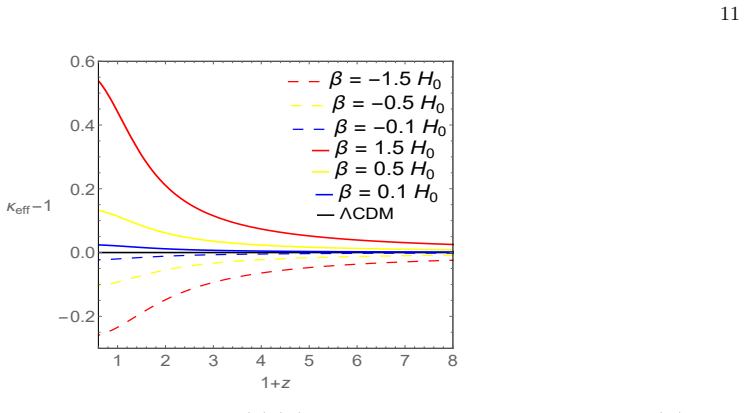
The reconstruction is driven by the cosmographic condition $j(z)=1$ on the jerk parameter, which is equivalent to demanding the $\Lambda$CDM-like Hubble rate $H^2(z)=H_0^2[c_1(1+z)^3+1-c_1]$. The field equations of $f(Q)$ gravity, together with the connection equation $\nabla_\mu\nabla_\nu(\sqrt{-g}f_Q P^{\mu\nu}{}_{\sigma})=0$, are then integrated to determine $f(Q)$ for each connection branch. For $\Gamma_2$ this integration gives an analytic quadratic form in $Q$; for $\Gamma_3$ the key step is rewriting the connection evolution as a decoupled first-order equation for $x=\gamma/H$, Eq. (117), which permits numerical solution. The physical-viability condition $f_Q>0$ is used throughout to constrain the free parameters, and the effective gravitational coupling $\kappa_{\rm eff}=1/f_Q$ is tracked to identify where the reconstructed theory coincides with (STE)GR.
What would settle it
A direct detection that standard matter has a non-minimal coupling to the symmetric teleparallel connection, giving non-vanishing hypermomentum, would invalidate the connection field equation used here and hence all three reconstructed $f(Q)$ forms; alternatively, a precise measurement showing that the dynamical connection function for $\Gamma_2$ does not grow linearly with the Hubble rate as in Eq. (79) would falsify the analytic reconstruction.
Extended reading notes
Core claim
The paper proves that $\Lambda$CDM-mimicking $f(Q)$ models exist for all three homogeneous, isotropic, spatially flat symmetric teleparallel connection branches. Branch $\Gamma_1$, the coincident gauge where $Q=-6H^2$, yields the previously known two-parameter family $f(Q)=-2\Lambda+\left(\Lambda/H_0^2/(1-2q_0)\right)Q+\beta\sqrt{-Q}$, with $\beta$ and $\Lambda$ the free parameters and with STEGR as a past attractor when $\Lambda=H_0^2(1-2q_0)$. Branch $\Gamma_2$ is reconstructed analytically as $f(Q)=-2\Lambda+\alpha Q-\beta Q^2$, a three-parameter family constrained so that the effective gravitational coupling stays positive, and with a parameter choice that yields a one-parameter model $f(Q)=-2H_0^2(1-2q_0)+Q-\frac{1}{4H_0^2}\left(\frac{1-D}{1-2q_0}\right)Q^2$. For branch $\Gamma_3$, the evolution equation for the dynamical connection function decouples from $Q$, allowing a numerical reconstruction. The central conclusion is that the background kinematics alone cannot distinguish $f(Q)$ gravity from $\Lambda$CDM in any of the three branches.
Load-bearing premise
The reconstruction assumes that ordinary matter feels only the metric, so the matter Lagrangian does not couple to the connection, hypermomentum vanishes, and dust density redshifts as $(1+z)^3$.
Editorial extensions
If this is right
- If the paper is correct, the $\Lambda$CDM expansion history is compatible with infinitely many $f(Q)$ theories, one family for each connection branch, so background data alone cannot select among them.
- For the $\Gamma_2$ branch the reconstructed theory can reproduce $\Lambda$CDM-like evolution with a vanishing cosmological constant, offering a concrete route to address the cosmological constant problem within symmetric teleparallel gravity.
- The reconstructed models reduce to (STE)GR in the appropriate asymptotic regime when parameters are chosen within the stated bounds, so they can inherit standard early-universe behavior while modifying late-time dynamics.
- The same cosmographic reconstruction procedure can be applied to other constant-jerk values or to a redshift-dependent jerk, providing a systematic way to generate 'almost-$\Lambda$CDM' $f(Q)$ models.
- Because the background is indistinguishable from $\Lambda$CDM, the models are expected to differ only at the perturbation level, through the time-dependent effective gravitational coupling $\kappa_{\rm eff}$.
Reading between the lines
- A natural extension is to confront the reconstructed $\Gamma_2$ form $f(Q)=-2\Lambda+\alpha Q-\beta Q^2$ with growth-rate and weak-lensing data, since its quadratic correction may produce a distinctive scale dependence in structure formation.
- The decoupled evolution equation for $\Gamma_3$ suggests that the same numerical method could be applied to other background histories, such as an evolving-dark-energy parametrization, without needing an analytic form for $f(Q)$.
- If future measurements find $j(z)\neq 1$ at high significance, the reconstruction procedure remains valid but the resulting $f(Q)$ would no longer be the exact $\Lambda$CDM mimic, illustrating how cosmographic data directly map onto the gravitational Lagrangian.
- The authors' assumption of vanishing hypermomentum is the point most likely to be revisited; coupling matter to the connection would change the field equations and invalidate all three reconstructed forms.
Signed reviews
Editorial analysis
A structured set of objections, weighed in public.
Referee Report
Summary. This paper reconstructs f(Q) theories whose flat FLRW background reproduces exactly H²(z)=H0²[c1(1+z)^3+1-c1] with c1=2(1+q0)/3, for each of the three symmetric teleparallel connection branches. Branch Γ1 yields f(Q)=-2Λ+[Λ/H0²/(1-2q0)]Q+β√(-Q), recovering previous results; branch Γ2 is reconstructed analytically as a quadratic f(Q), with a consistency condition, parameter counting, and viability bounds; branch Γ3 is treated numerically after decoupling an ODE for the dynamical connection function. The paper also analyzes the effective gravitational coupling, the stability of the Γ1 solution, robustness to small deviations of the jerk parameter, and the model-dependence of the inferred Ωm0.
Significance. If correct, the paper gives a useful completeness statement: the ΛCDM background does not select a unique connection branch in f(Q) gravity. The analytic parts for Γ1 and Γ2 are the main strengths; the derivations are mostly explicit, the parameter counting is careful, and the fQ>0 constraints are applied systematically. The paper also explicitly flags that the vanishing-hypermomentum assumption is a physical limitation, which is appropriate and does not undermine the background-level claims. However, the Γ3 branch is the load-bearing piece of the 'all three branches' claim, and as presented it is not reproducible: it consists of plots without data, code, or a check of the inversion Q(z) and of the Friedmann constraint at z=0. The stress-test concern about Γ3 therefore lands, and it requires a substantive revision.
major comments (4)
- [Section VIII D, Figs. 3-7] The numerical reconstruction for Γ3 is not independently reproducible from the text. The paper reports only plots, with no tabulated (z, Q, fQ, f) values and no code or integration details for Eqs. (116)-(118). Since this branch is the only support for the abstract's 'all three branches' claim, please provide a reproducibility supplement (data files or code) and state the integration scheme, tolerances, and the exact parameter values used for each plotted curve.
- [Section VIII (after Eq. (114); Figs. 4 and 7)] The construction requires inverting Q=Q(z) to obtain fQ(Q)=fQ(z(Q)), but the paper never proves that Q(z) is monotone or single-valued on (0,(1+4z*)/3). The text itself notes that ∣Q changes sign near x=-4, so this is not a formality; if Q(z) is not one-to-one, fQ(Q) is multivalued and the 'reconstructed f(Q)' is not a function. The authors should prove monotonicity on the integration interval, restrict to monotonic subintervals, or give a different well-defined elimination argument.
- [Sections VIII B and VIII D, Eq. (123)] The plotted Γ3 curves are not validated against the z=0 constraint. Eq. (123), evaluated at z=0, is supposed to determine Ωm0 (or equivalently relate Λ, c, z*, Ωm0), but in the numerical section Ωm0=c1=0.3 is assumed and no value of Λ (or λ) is reported. Without this, one cannot check whether the displayed f(Q) satisfies the Friedmann equation at z=0, let alone on the whole interval. Please report the full parameter sets for the plotted solutions and demonstrate that Eq. (123) holds at z=0 and at representative redshifts.
- [Abstract and Section IX (Γ3 bullet)] The word 'proves' in the abstract is stronger than the Γ3 analysis supports. For Γ3 the result is a numerical reconstruction that depends on the ad hoc condition fQ(z*)=1 (i.e., x=-2 at z*), on the chosen z*, and on the auxiliary parameter c; no existence or uniqueness argument for the full f(Q) is given. Please either soften the claim to 'provides evidence for' or 'presents a numerical construction of', or supply a rigorous existence argument, and correspondingly adjust the summary section.
minor comments (4)
- [Figs. 3-7] Most axes lack labels and the horizontal tick labels are garbled (e.g., '1 5 1 0 5 0 1 0 0'), making it impossible to read the plotted ranges without guessing.
- [Eq. (115) and Section VII] The same symbol c is used with different dimensions for Γ2 (c≡C/H0) and Γ3 (c≡C/H0³); although a footnote warns the reader, the notation is easy to confuse in the adjacent sections and should be changed or emphasized more strongly.
- [Eqs. (127)-(135)] The approximate analytic reconstruction for Γ3 is presented as valid near z*, but the text does not quantify the order of the expansion or its radius of validity; please state the error order and the expected range of applicability.
- [Section II] The statement that c1 is 'completely kinematical' should be reconciled with the later, correct observation that its relation to Ωm0 is model-dependent; the current wording may confuse readers about the status of c1.
Circularity Check
No circularity: the f(Q) forms are derived by integrating the f(Q) field equations with the assumed H(z) as input and then verified by substitution; the reconstruction is not a fit renamed as a prediction.
full rationale
The paper's central claim is an existence construction: impose the LambdaCDM-like H(z) of Eqs. (7)/(11) and solve the metric and connection field equations for f(Q) on each connection branch. For Gamma1, Eq. (36) is integrated to obtain Eq. (41), and substituting this f(Q) into the Friedmann equation reproduces Eq. (11) identically; the parameters beta and Lambda are identified as free parameters, not fitted to the target. For Gamma2, Eq. (29)/(70) is integrated for fQ(z), Eq. (77) determines gamma(z), Eq. (79) gives Q(z), and Eqs. (80)-(81) integrate to the quadratic f(Q); the redshift-independent constraint Eq. (82) is a consistency condition relating the parameters, not a recycled input. For Gamma3, the decoupled equation (113) is solved numerically and fQ(Q) is obtained by inverting Q(z); this is a genuinely independent numerical construction rather than a renaming or a fit to the target H(z). The self-citation [41] is used only to define 'LambdaCDM-like' kinematically, and the Gamma1 result is explicitly compared with prior independent work [18,33]; neither citation carries the derivation. The vanishing-hypermomentum assumption is explicitly flagged in Section IX as a limitation and does not make the reconstruction circular. A separate concern, not circularity, is that the Gamma3 numerical data are not tabulated and Q(z) monotonicity is not demonstrated, so the third-branch result is not independently reproducible from the paper alone; this weakens verifiability, not the logical independence of the reconstruction.
Assumptions & free parameters
free parameters (7)
- beta (coefficient of sqrt(-Q), Gamma1) =
Free; constrained by beta/H0 < 2*sqrt(6)*h(z) and by the bound on kappa_eff variation
- Lambda (cosmological constant term) =
Free in general; Gamma1 bound 0<Lambda/H0^2<3/2*(1-2q0)/(1+q0); setting Lambda=H0^2(1-2q0) makes STEGR a past attractor
- c (Gamma2 dimensionless integration constant) =
Negative; bounds -3c1/(2h(z_star)) <= c < 0
- D (Gamma2 integration constant) =
0 <= D < 1 - 2|c|/(3c1)
- c (Gamma3 dimensionless integration constant) =
c=0.1 used in the numerical plots; bound c < 12*sqrt(3)*c1^(3/2)*sqrt(1+z_star)
- z_star (Gamma3, and equivalently Gamma2) =
z_star=20 and z_star=100 used in the numerical examples
- q0 (present-day deceleration parameter) =
Approximately -0.55 used in figures; c1=2/3(1+q0)
assumptions (5)
- domain assumption The connection branches Gamma1, Gamma2, and Gamma3 exhaust the curvature-free, torsion-free, FLRW-compatible symmetric teleparallel connections.
- domain assumption Matter is a pressureless perfect fluid with vanishing hypermomentum, so the connection equation is Eq. (23) and dust energy is conserved with respect to the Levi-Civita connection.
- domain assumption Physical viability requires fQ>0.
- domain assumption The LambdaCDM-like evolution is defined by j=1, i.e. H^2=H0^2[c1(1+z)^3+1-c1] with c1=2/3(1+q0).
- ad hoc to paper For the Gamma3 numerical reconstruction, f(Q) is assumed to match STEGR at z=z_star in the matter-dominated era (fQ(z_star)=1, x=-2), and z is restricted to (0,(1+4z_star)/3) to avoid a singularity.
Cite this review
Pith. "Pith review of Reproducing $\Lambda$CDM-like Solutions in $f(Q)$ Gravity: A Comprehensive Study Across All Connection Branches." pith.science (2026). https://pith.science/paper/KZMJMUZZ
@misc{pith2026250115159,
  author       = {Pith},
  title        = {Pith review of: Reproducing $\Lambda$CDM-like Solutions in $f(Q)$ Gravity: A Comprehensive Study Across All Connection Branches},
  year         = {2026},
  howpublished = {\url{https://pith.science/paper/KZMJMUZZ}},
  note         = {Machine review of arXiv:2501.15159}
}
abstract
Given the remarkable success of the $\Lambda$CDM model in fitting various cosmological observations, a pertinent question in assessing the phenomenological viability of modified gravity theories is whether they can reproduce an exactly $\Lambda$CDM-like cosmic background evolution. In this paper, we address this question in the context of $f(Q)$ gravity, where $Q$ denotes the nonmetricity scalar. It is known that there are three possible symmetric teleparallel connection branches that respect the cosmological principles of spatial homogeneity, isotropy, and global spatial flatness. By enforcing a $\Lambda$CDM-like background evolution via the cosmographic condition $j(z)=1$, where $j$ is the jerk parameter, we reconstruct the $\Lambda$CDM-mimicking $f(Q)$ theory for each of the three possible connection branches. For the first connection branch, also known as the ``coincident gauge'' in cosmology, we recover the previously known result that a theory of the form $f(Q)=-2\Lambda+\alpha Q+\beta\sqrt{-Q}$ can exactly reproduce a $\Lambda$CDM-like cosmic evolution. Furthermore, we establish that the stability of the $\Lambda$CDM-like cosmic solution within this reconstructed $f(Q)$, as well as the robustness of the reconstructed $f(Q)$ form with respect to small errors in the astrophysical measurements of the jerk parameter. For the second connection branch, we analytically reconstruct the $\Lambda$CDM-mimicking $f(Q)$ to be of the form $f(Q)=-2\Lambda+\alpha Q-\beta Q^2$. For the third connection branch, we could decouple the evolution equation for the dynamical connection function, which enabled us to perform a numerical reconstruction. Our analysis proves that, at least at the background level, it is possible to obtain $\Lambda$CDM-mimicking $f(Q)$ models for all the three possible connection branches.
Figures


Figures from the paper (4 more)


Reference graph
Works this paper leans on
-
[1]
Riess et al
Adam G. Riess et al. Observational evidence from supernovae for an accelerating universe and a cosmological constant. Astron. J., 116:1009–1038, 1998
1998
-
[2]
Perlmutter et al
S. Perlmutter et al. Measurements of Ω and Λ from 42 High Redshift Supernovae. Astrophys. J., 517:565–586, 1999
1999
-
[3]
The Cosmological Constant Problem
Steven Weinberg. The Cosmological Constant Problem. Rev. Mod. Phys., 61:1–23, 1989
work page 1989
- [4]
- [5]
-
[6]
R. Aldrovandi and J. G. Pereira. Teleparallelism: A New Way to Think the Gravitational Interaction. Ciencia Hoje, 55:32, 2015
work page 2015
-
[7]
Coincident General Relativity.Phys
Jose Beltr´ an Jim´ enez, Lavinia Heisenberg, and Tomi Koivisto. Coincident General Relativity.Phys. Rev. D, 98(4):044048, 2018
work page 2018
-
[8]
Christian G. Boehmer and Erik Jensko. Modified gravity: A unified approach to metric-affine models. J. Math. Phys., 64(8):082505, 2023
work page 2023
Show all 83 references
-
[9]
Boehmer and Erik Jensko
Christian G. Boehmer and Erik Jensko. Modified gravity: A unified approach. Phys. Rev. D, 104(2):024010, 2021
2021
-
[10]
Boehmer, Erik Jensko, and Ruth Lazkoz
Christian G. Boehmer, Erik Jensko, and Ruth Lazkoz. Cosmological dynamical systems in modified gravity. Eur. Phys. J. C, 82(6):500, 2022
2022
-
[11]
Koivisto
D´ ebora Aguiar Gomes, Jose Beltr´ an Jim´ enez, Alejandro Jim´ enez Cano, and Tomi S. Koivisto. Pathological Character of Modifications to Coincident General Relativity: Cosmological Strong Coupling and Ghosts in f(Q) Theories. Phys. Rev. Lett., 132(14):141401, 2024
2024
-
[12]
Nonpropagating ghost in covariant f(Q) gravity
Kun Hu, Makishi Yamakoshi, Taishi Katsuragawa, Shin’ichi Nojiri, and Taotao Qiu. Nonpropagating ghost in covariant f(Q) gravity. Phys. Rev. D, 108(12):124030, 2023
2023
-
[13]
Minkowski space inf (T ) gravity
Jose Beltr´ an Jim´ enez, Alexey Golovnev, Tomi Koivisto, and Hardi Veerm¨ ae. Minkowski space inf (T ) gravity. Phys. Rev. D, 103(2):024054, 2021
2021
-
[14]
Cosmological teleparallel perturbations
Lavinia Heisenberg, Manuel Hohmann, and Simon Kuhn. Cosmological teleparallel perturbations. JCAP, 03:063, 2024
2024
-
[15]
Bello-Morales, Jose Beltr´ an Jim´ enez, Alejandro Jim´ enez Cano, Tomi S
Antonio G. Bello-Morales, Jose Beltr´ an Jim´ enez, Alejandro Jim´ enez Cano, Tomi S. Koivisto, and Antonio L. Maroto. A class of ghost-free theories in symmetric teleparallel geometry. JHEP, 12:146, 2024
2024
-
[16]
force term
features the same number of background parameters as the standard General Relativistic ΛCDM model. Notably, the reconstructed model for the connection branch Γ 1 has been shown in [ 17] to provide a better observational fit than ΛCDM even when RSD data is included. Hence, whil...
-
[17]
Anagnostopoulos, Spyros Basilakos, and Emmanuel N
Fotios K. Anagnostopoulos, Spyros Basilakos, and Emmanuel N. Saridakis. First evidence that non-metricity f(Q) gravity could challenge ΛCDM. Phys. Lett. B, 822:136634, 2021
2021
-
[18]
Canf (Q) gravity challenge ΛCDM? Phys
Lu ´ ıs Atayde and Noemi Frusciante. Canf (Q) gravity challenge ΛCDM? Phys. Rev. D, 104(6):064052, 2021
2021
-
[19]
Albuquerque and Noemi Frusciante
Inˆ es S. Albuquerque and Noemi Frusciante. A designer approach to f(Q) gravity and cosmological implications. Phys. Dark Univ., 35:100980, 2022
2022
-
[20]
Structure growth in f (Q) cosmology
Shambel Sahlu, Alvaro de la Cruz-Dombriz, and Amare Abebe. Structure growth in f (Q) cosmology. arXiv:2405.07361 [gr-qc], 5 2024. 32
2024 arXiv
-
[21]
Gon¸ calves, Lu ´ ıs Atayde, and Noemi Frusciante
Tiago B. Gon¸ calves, Lu ´ ıs Atayde, and Noemi Frusciante. Cosmological study of a symmetric teleparallel gravity model. Phys. Rev. D, 109(8):084003, 2024
2024
-
[22]
On the viability of f(Q) gravity models
Avik De and Tee-How Loo. On the viability of f(Q) gravity models. Class. Quant. Grav., 40(11):115007, 2023
2023
-
[23]
Ruth Lazkoz, Francisco S. N. Lobo, Mar ´ ıa Ortiz-Ba˜ nos, and Vincenzo Salzano. Observational constraints off (Q) gravity. Phys. Rev. D, 100(10):104027, 2019
2019
-
[24]
Observational constraints on cosmological solutions of f (Q) theories
Ismael Ayuso, Ruth Lazkoz, and Vincenzo Salzano. Observational constraints on cosmological solutions of f (Q) theories. Phys. Rev. D, 103(6):063505, 2021
2021
-
[25]
Signatures of f (Q)-gravity in cosmology
Noemi Frusciante. Signatures of f (Q)-gravity in cosmology. Phys. Rev. D, 103(4):044021, 2021
2021
-
[26]
Anagnostopoulos, Viktor Gakis, Emmanuel N
Fotios K. Anagnostopoulos, Viktor Gakis, Emmanuel N. Saridakis, and Spyros Basilakos. New models and big bang nucleosynthesis constraints in f(Q) gravity. Eur. Phys. J. C, 83(1):58, 2023
2023
-
[27]
Aghanim et al
N. Aghanim et al. Planck 2018 results. VI. Cosmological parameters. Astron. Astrophys., 641:A6, 2020. [Erratum: Astron.Astrophys. 652, C4 (2021)]
2021
-
[28]
A. G. Adame et al. The Early Data Release of the Dark Energy Spectroscopic Instrument. Astron. J., 168(2):58, 2024
2024
-
[29]
Marina Cortˆ es and Andrew R. Liddle. Interpreting DESI’s evidence for evolving dark energy. JCAP, 12:007, 2024
2024
-
[30]
Peter K. S. Dunsby, Emilo Elizalde, Rituparno Goswami, Sergei Odintsov, and Diego Saez Gomez. On the LCDM Universe in f(R) gravity. Phys. Rev. D, 82:023519, 2010
2010
-
[31]
Revisiting f (R) gravity models that reproduce ΛCDM expansion
Jian-hua He and Bin Wang. Revisiting f (R) gravity models that reproduce ΛCDM expansion. Phys. Rev. D, 87(2):023508, 2013
2013
-
[32]
S. Fay, S. Nesseris, and L. Perivolaropoulos. Can f(R) Modified Gravity Theories Mimic a LCDM Cosmology? Phys. Rev. D, 76:063504, 2007
2007
-
[33]
Elizalde, R
E. Elizalde, R. Myrzakulov, V. V. Obukhov, and D. Saez-Gomez. LambdaCDM epoch reconstruction from F(R,G) and modified Gauss-Bonnet gravities. Class. Quant. Grav., 27:095007, 2010
2010
-
[34]
Gadbail, Sanjay Mandal, and P
Gaurav N. Gadbail, Sanjay Mandal, and P. K. Sahoo. Reconstruction of ΛCDM universe in f(Q) gravity. Phys. Lett. B, 835:137509, 2022
2022
-
[35]
General covariant symmetric teleparallel cosmology
Manuel Hohmann. General covariant symmetric teleparallel cosmology. Phys. Rev. D, 104(12):124077, 2021
2021
-
[36]
The impact of the non-coincidence gauge on the dark energy dynamics in f(Q)-gravity
Andronikos Paliathanasis. The impact of the non-coincidence gauge on the dark energy dynamics in f(Q)-gravity. Gen. Rel. Grav., 55(11):130, 2023
2023
-
[37]
Model-independent reconstruction of f(Q) non-metric gravity
Salvatore Capozziello and Rocco D’Agostino. Model-independent reconstruction of f(Q) non-metric gravity. Phys. Lett. B, 832:137229, 2022
2022
-
[38]
Reconstructing isotropic and anisotropic f(Q) cosmologies
Fabrizio Esposito, Sante Carloni, Roberto Cianci, and Stefano Vignolo. Reconstructing isotropic and anisotropic f(Q) cosmologies. Phys. Rev. D, 105(8):084061, 2022
2022
-
[39]
Shin’ichi Nojiri and S. D. Odintsov. Well-defined f(Q) gravity, reconstruction of FLR W spacetime and unification of inflation with dark energy epoch. Phys. Dark Univ., 45:101538, 2024
2024
-
[40]
Saridakis
Yuhang Yang, Xin Ren, Bo Wang, Yi-Fu Cai, and Emmanuel N. Saridakis. Data reconstruction of the dynamical connection function in f(Q) cosmology. Mon. Not. Roy. Astron. Soc., 533(2):2232–2241, 2024
2024
-
[41]
E. R. Harrison. Observational tests in cosmology. Nature, 260(5552):591–592, April 1976
1976
-
[42]
Saikat Chakraborty, Daniele Gregoris, and B. Mishra. On the uniqueness of ΛCDM-like evolution for homogeneous and isotropic cosmology in General Relativity. Phys. Lett. B, 842:137962, 2023
2023
-
[43]
Starobinsky, and Ujjaini Alam
Varun Sahni, Tarun Deep Saini, Alexei A. Starobinsky, and Ujjaini Alam. Statefinder: A New geometrical diagnostic of dark energy. JETP Lett., 77:201–206, 2003
2003
-
[44]
Jose Luis Bernal, Licia Verde, and Adam G. Riess. The trouble with H0. JCAP, 10:019, 2016
2016
-
[45]
Non-parametric reconstruction of the cosmological jerk parameter
Purba Mukherjee and Narayan Banerjee. Non-parametric reconstruction of the cosmological jerk parameter. Eur. Phys. J. C, 81(1):36, 2021
2021
-
[46]
Nonparametric late-time expansion history reconstruction and implications for the Hubble tension in light of recent DESI and type Ia supernovae data
Jun-Qian Jiang, Davide Pedrotti, Simony Santos da Costa, and Sunny Vagnozzi. Nonparametric late-time expansion history reconstruction and implications for the Hubble tension in light of recent DESI and type Ia supernovae data. Phys. Rev. D, 110(12):123519, 2024
2024
-
[47]
Imprints of cosmological tensions in reconstructed gravity
Levon Pogosian, Marco Raveri, Kazuya Koyama, Matteo Martinelli, Alessandra Silvestri, Gong-Bo Zhao, Jian Li, Simone Peirone, and Alex Zucca. Imprints of cosmological tensions in reconstructed gravity. Nature Astron., 6(12):1484–1490, 2022
2022
-
[48]
James M. Bardeen. Gauge Invariant Cosmological Perturbations. Phys. Rev. D, 22:1882–1905, 1980
1905
-
[49]
Dark energy from a positive jerk parameter
Orlando Luongo. Dark energy from a positive jerk parameter. Mod. Phys. Lett. A, 28:1350080, 2013
2013
-
[50]
Recovering ΛCDM model from a cosmographic study
Hassan Amirhashchi and Soroush Amirhashchi. Recovering ΛCDM model from a cosmographic study. Gen. Rel. Grav., 52(2):13, 2020
2020
-
[51]
ΛCDM suitably embedded in f(R) with a non-minimal coupling to matter
Mar ´ ıa Ortiz-Ba˜ nos, Mariam Bouhmadi-L´ opez, Ruth Lazkoz, and Vincenzo Salzano. ΛCDM suitably embedded in f(R) with a non-minimal coupling to matter. Eur. Phys. J. C, 81(3):237, 2021
2021
-
[52]
Reconstruction of f (R) gravity models for an accelerated universe using the Raychaudhuri equation
Shibendu Gupta Choudhury, Ananda Dasgupta, and Narayan Banerjee. Reconstruction of f (R) gravity models for an accelerated universe using the Raychaudhuri equation. Mon. Not. Roy. Astron. Soc., 485(4):5693–5699, 2019
2019
-
[53]
Gadbail, Avik De, and P
Gaurav N. Gadbail, Avik De, and P. K. Sahoo. Cosmological reconstruction and ΛCDM universe in f (Q, C) gravity. Eur. Phys. J. C, 83(12):1099, 2023
2023
-
[54]
Sante Carloni, Rituparno Goswami, and Peter K. S. Dunsby. A new approach to reconstruction methods in f (R) gravity. Class. Quant. Grav., 29:135012, 2012
2012
-
[55]
Cosmic Jerk, Snap and Beyond
Maciej Dunajski and Gary Gibbons. Cosmic Jerk, Snap and Beyond. Class. Quant. Grav., 25:235012, 2008
2008
-
[56]
The Large Scale Structure of f(R) Gravity
Yong-Seon Song, Wayne Hu, and Ignacy Sawicki. The Large Scale Structure of f(R) Gravity. Phys. Rev. D, 75:044004, 2007
2007
-
[57]
The pattern of growth in viable f(R) cosmologies
Levon Pogosian and Alessandra Silvestri. The pattern of growth in viable f(R) cosmologies. Phys. Rev. D, 77:023503, 2008. [Erratum: Phys.Rev.D 81, 049901 (2010)]. 33
2010
-
[58]
A New Class of Cosmologically ‘Viable’ f (R) Models
Rohin Kumar. A New Class of Cosmologically ‘Viable’ f (R) Models. arXiv: 1611.03728 [gr-qc], 11 2016
2016 arXiv
-
[59]
A model independent approach to the study of f (R) cosmologies with expansion histories close to ΛCDM
Saikat Chakraborty, Kelly MacDevette, and Peter Dunsby. A model independent approach to the study of f (R) cosmologies with expansion histories close to ΛCDM. Phys. Rev. D, 103(12):124040, 2021
2021
-
[60]
Reconstruction and constraining of the jerk parameter from OHD and SNe Ia observations
Zhong-Xu Zhai, Ming-Jian Zhang, Zhi-Song Zhang, Xian-Ming Liu, and Tong-Jie Zhang. Reconstruction and constraining of the jerk parameter from OHD and SNe Ia observations. Phys. Lett. B, 727:8–20, 2013
2013
-
[61]
Escamilla, Simony Santos da Costa, and Sunny Vagnozzi
Davide Pedrotti, Jun-Qian Jiang, Luis A. Escamilla, Simony Santos da Costa, and Sunny Vagnozzi. Multidimensionality of the Hubble tension: The roles of Ωm and ωc. Phys. Rev. D, 111(2):023506, 2025
2025
-
[62]
A. R. Sandage. Cosmology: a search for two numbers. Physics Today, 23(2):34–41, January 1970
1970
-
[63]
Metric-affine Geometries With Spherical Symmetry
Manuel Hohmann. Metric-affine Geometries With Spherical Symmetry. Symmetry, 12(3):453, 2020
2020
-
[64]
Covariant formulation of f(Q) theory
Dehao Zhao. Covariant formulation of f(Q) theory. Eur. Phys. J. C, 82(4):303, 2022
2022
-
[65]
Nonmetricity formulation of general relativity and its scalar-tensor extension
Laur J¨ arv, Mihkel R¨ unkla, Margus Saal, and Ott Vilson. Nonmetricity formulation of general relativity and its scalar-tensor extension. Phys. Rev. D, 97(12):124025, 2018
2018
-
[66]
Exploring the stability of f(Q) cosmology near general relativity limit with different connections
Maria-Jose Guzman, Laur J¨ arv, and Laxmipriya Pati. Exploring the stability of f(Q) cosmology near general relativity limit with different connections. Phys. Rev. D, 110(12):124013, 2024
2024
-
[67]
Cosmology inf (Q) geometry
Jose Beltr´ an Jim´ enez, Lavinia Heisenberg, Tomi Sebastian Koivisto, and Simon Pekar. Cosmology inf (Q) geometry. Phys. Rev. D, 101(10):103507, 2020
2020
-
[68]
Dark energy models with time-dependent gravitational constant
Saibal Ray and Utpal Mukhopadhyay. Dark energy models with time-dependent gravitational constant. Int. J. Mod. Phys. D, 16:1791–1802, 2007
2007
-
[69]
Saridakis, and M
Mubasher Jamil, Emmanuel N. Saridakis, and M. R. Setare. Holographic dark energy with varying gravitational constant. Phys. Lett. B, 679:172–176, 2009
2009
-
[70]
Extended Gravity Cosmography
Salvatore Capozziello, Rocco D’Agostino, and Orlando Luongo. Extended Gravity Cosmography. Int. J. Mod. Phys. D, 28(10):1930016, 2019
2019
-
[71]
Boehmer and Nyein Chan
Christian G. Boehmer and Nyein Chan. Dynamical systems in cosmology.2017
2017
-
[72]
Barrow and A
John D. Barrow and A. C. Ottewill. The Stability of General Relativistic Cosmological Theory. J. Phys. A, 16:2757, 1983
1983
-
[73]
On the stability of the cosmological solutions in f (R, G) gravity
Alvaro de la Cruz-Dombriz and Diego Saez-Gomez. On the stability of the cosmological solutions in f (R, G) gravity. Class. Quant. Grav., 29:245014, 2012
2012
-
[74]
Saridakis
Qingqing Wang, Xin Ren, Yi-Fu Cai, Wentao Luo, and Emmanuel N. Saridakis. Observational Test of f(Q) Gravity with Weak Gravitational Lensing. Astrophys. J., 974(1):7, 2024
2024
-
[75]
Linear Cosmological perturbations in f (Q) Gravity
Shambel Sahlu and Endalkachew Tsegaye. Linear Cosmological perturbations in f (Q) Gravity. arXiv:2206.02517 [gr-qc], 6 2022
2022 arXiv
-
[76]
Y. B. Zeldovich. Cosmological Constant and Elementary Particles. JETP Lett., 6:316, 1967
1967
-
[77]
The Λ and the CDM as Integration Constants
Priidik Gallagher and Tomi Koivisto. The Λ and the CDM as Integration Constants. Symmetry, 13(11):2076, 2021
2021
-
[78]
Feng and Pisin Chen
Justin C. Feng and Pisin Chen. Cosmological constant as an integration constant. Eur. Phys. J. C, 84(12):1331, 2024
2024
-
[79]
Ferreira, and Richard D
Jaime Ruiz-Zapatero, Carlos Garc ´ ıa-Garc ´ ıa, David Alonso, Pedro G. Ferreira, and Richard D. P. Grumitt. Model-independent constraints on Ωm and H(z) from the link between geometry and growth. Mon. Not. Roy. Astron. Soc., 512(2):1967–1984, 2022
1967
-
[80]
A model independent approach to the study of structure growth in f (R) gravity
Kelly MacDevette, Jess Worsley, Peter Dunsby, and Saikat Chakraborty. A model independent approach to the study of structure growth in f (R) gravity. arXiv:2408.03998 [gr-qc], 8 2024
2024 arXiv
-
[81]
Anagnostopoulos, Spyros Basilakos, and Emmanuel N
Fotios K. Anagnostopoulos, Spyros Basilakos, and Emmanuel N. Saridakis. Bayesian analysis of f (T ) gravity using f σ8 data. Phys. Rev. D, 100(8):083517, 2019
2019
-
[82]
Geodesic deviation equation in f(Q)-gravity
Jing-Theng Beh, Tee-how Loo, and Avik De. Geodesic deviation equation in f(Q)-gravity. Chin. J. Phys., 77:1551–1560, 2022
2022
-
[83]
Gravitational waves in f(Q) non-metric gravity via geodesic deviation
Salvatore Capozziello, Maurizio Capriolo, and Shin’ichi Nojiri. Gravitational waves in f(Q) non-metric gravity via geodesic deviation. Phys. Lett. B, 850:138510, 2024
2024
Reviewed August 10, 2026 · model on record in the stance chip above.
Discussion (0). Continue with ORCID to comment.