REVIEW 4 minor 7 references
Time Scale for Velocity to Track a Force
T0 review · 0 major / 4 minor · reviewed 2026-08-14 · deepseek-v4-flash
Pith's one-line read This paper derives the exact time a constant force takes to turn an initial velocity to within a given angle of the force, and shows that viscous drag shortens that time logarithmically.
desk verdict A correct, cleanly written educational note that repackages constant-acceleration kinematics; worth a referee for a teaching journal, not for a research journal. read the letter →
The pith
A machine-rendered reading of the paper's core claim, the machinery that carries it, and where it could break.
The reading
What carries the argument
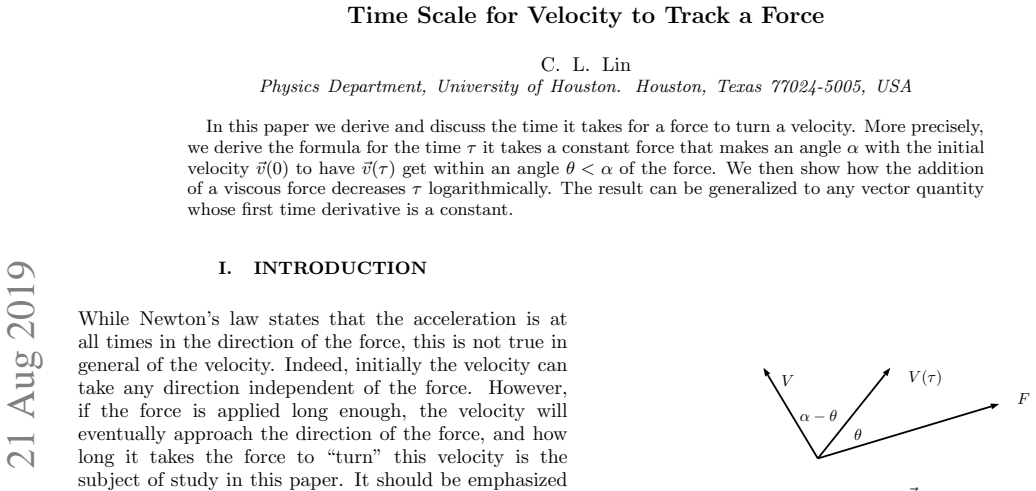
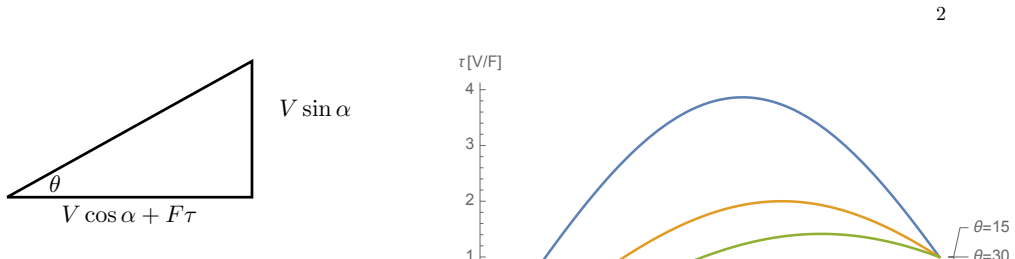
The central object is the right triangle of velocity components in a frame fixed to the force direction. Since the parallel component grows at rate $F$ while the perpendicular component $V\sin\alpha$ stays constant, the angle at time $\tau$ satisfies $\tan\theta = \frac{V\sin\alpha}{V\cos\alpha+F\tau}$, which rearranges directly to Eq. (2). In the viscous case the same triangle is used with the parallel component approaching $F/\eta$ exponentially, which gives the logarithmic time shortening. The universality of the result comes from the fact that only the ratio of a constant time derivative to the current magnitude enters, via the time scale $V/F$.
What would settle it
Measure the time for a known initial velocity to reach angle $\theta$ from a known constant force per mass $F$—for instance a cart on a tilted air track or a charge in a uniform electric field—and compare with Eq. (2); for the viscous version, fit a measured velocity time series to Eq. (7) and check that the fitted $\eta$ and $\tau_0$ satisfy the logarithmic relation.
Extended reading notes
Core claim
The central claim is the closed-form turning time, Eq. (2): for a constant vector rate of change $\vec{F}$ of magnitude $F$ acting at an initial angle $\alpha$ to a velocity of magnitude $V$, the velocity direction first reaches an angle $\theta<\alpha$ from $\vec{F}$ after $\tau = \frac{V}{F}\left(\frac{\sin\alpha}{\tan\theta}-\cos\alpha\right)$. Because only the velocity component parallel to $\vec{F}$ grows while the perpendicular component $V\sin\alpha$ remains fixed, the angle can approach but never reach zero unless $\alpha=0$ or $180^\circ$. Adding a linear viscous drag $-\eta\vec{v}$ preserves the same geometry with the parallel component approaching the terminal velocity $F/\eta$ exponentially, yielding $\tau = \frac{1}{\eta}\ln(1+\eta\tau_0) \le \tau_0$, where $\tau_0$ is the inviscid time. The author notes that the result holds for any vector quantity whose first time derivative is a constant.
Load-bearing premise
The load-bearing premise is that the force per mass $\vec{F}$ is constant in magnitude and direction over the whole interval $[0,\tau]$; in the viscous version the applied force is constant and the drag is exactly linear in velocity.
Editorial extensions
If this is right
- For a constant force, the velocity can never be turned exactly parallel to the force in finite time unless it already is; the perpendicular component $V\sin\alpha$ never shrinks, so $\tau\to\infty$ as $\theta\to0$.
- For any target angle $\theta$, the worst case is an initial angle $\alpha=90^\circ+\theta$, giving a maximum turning time $\tau_{\max}=\frac{V}{F}\frac{1}{\sin\theta}$; for $\theta=30^\circ$ the rule of thumb is $\tau_{\max}=2V/F$.
- Adding linear viscous drag always makes velocity track the force sooner or at the same time, with $\tau=\frac{1}{\eta}\ln(1+\eta\tau_0)\le\tau_0$.
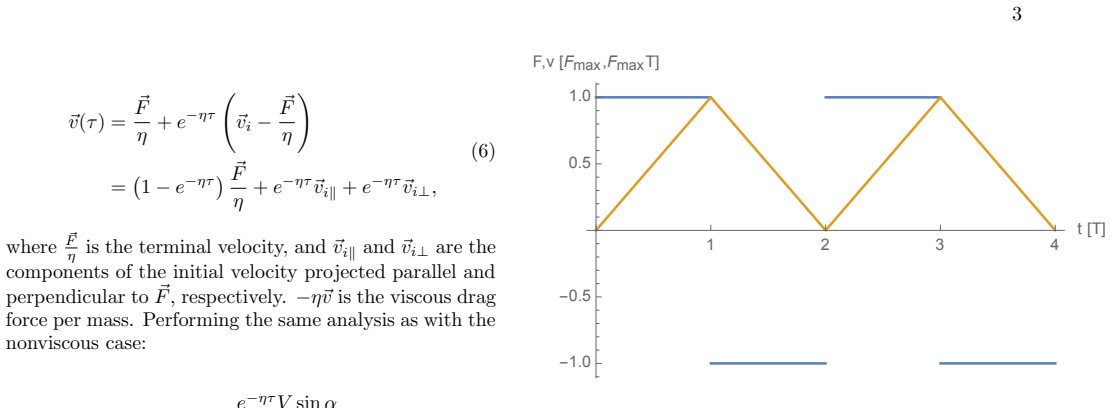
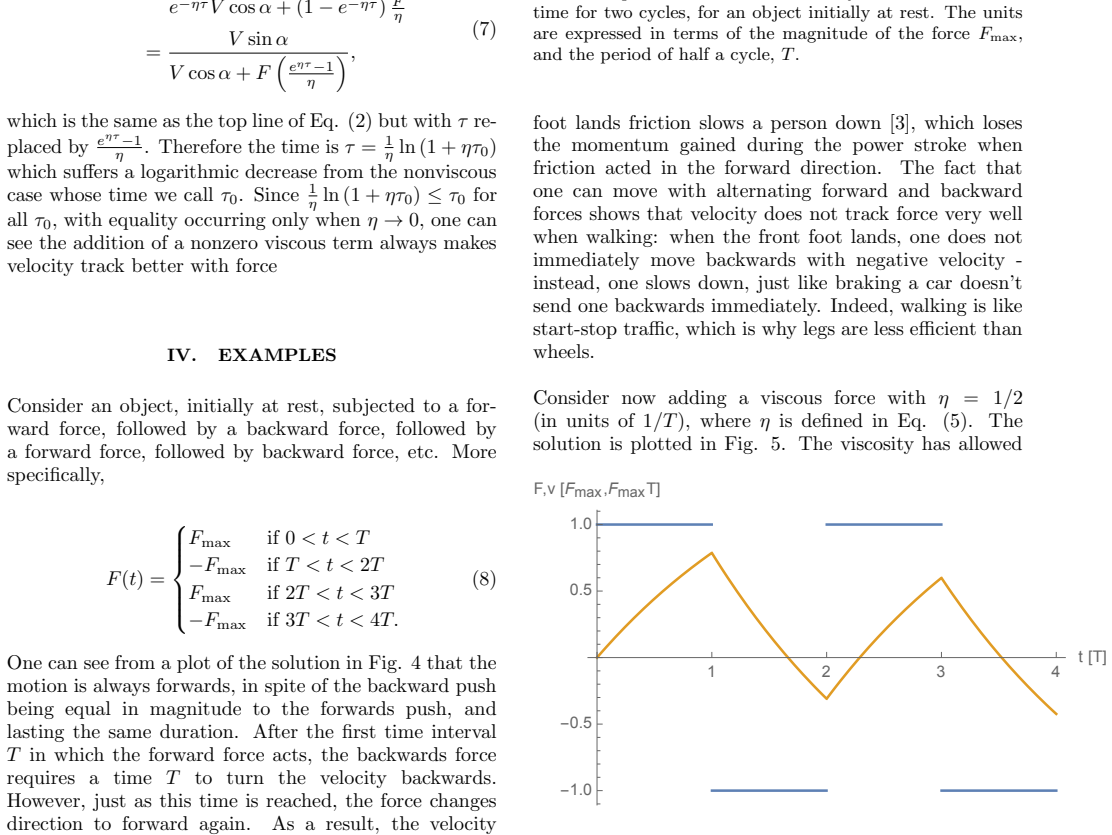
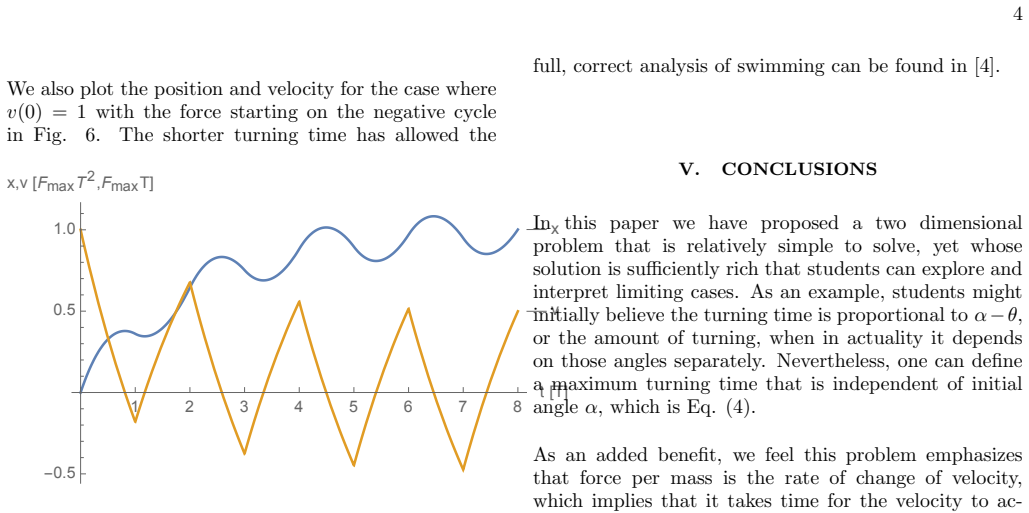
- If the force changes on a timescale shorter than the turning time, the velocity need not track the force at all; the alternating push-pull example shows that an object can keep moving forward under equal forward and backward pushes, a crude model of walking.
- Because the derivation only uses the fact that $\vec{F}$ is a constant rate of change, the same formula applies to any vector whose first time derivative is constant, not just to mechanical velocity.
Reading between the lines
- A practical control criterion follows from Eq. (2): if a force direction is switched every $t_c$, the velocity will lag visibly unless $t_c$ is at least comparable to $\tau_{\max}$; this could guide the timing of robotic or prosthetic actuation.
- The alternating-force model could be made quantitative: with a chosen viscosity $\eta$ and half-period $T$, Eq. (7) predicts the threshold $\eta$ at which the velocity first goes negative during the backward half-cycle, a testable extension of the paper's qualitative walking discussion.
- An A/B teaching experiment could test whether presenting Eq. (2) reduces the tendency to say velocity points along force: compare predictions for alternating push-pull motion between students who derived the formula and those given only Newton's law.
Signed reviews
Editorial analysis
A structured set of objections, weighed in public.
Referee Report
Summary. The manuscript derives the time scale τ for a constant force per mass F, initially at angle α to the velocity V, to bring the velocity to within an angle θ < α of the force. The main result is Eq. (2), τ = (V/F)(sin α / tan θ − cos α), obtained from the geometry of velocity components under constant acceleration. The paper then treats linear drag −ηv, obtaining the exact viscous time τ = (1/η) ln(1 + ητ0) ≤ τ0, where τ0 is the inviscid time. It also derives the maximum turning time over initial angles, τmax = V/(F sin θ), and discusses illustrative examples involving periodic forces, walking, and swimming. The closing section notes the generalization to any vector quantity whose first time derivative is constant.
Significance. If correct, this is a clean, self-contained pedagogical contribution. It quantifies the intuitive but often-misunderstood statement that velocity takes time to align with force, provides a simple rule of thumb (τmax = V/(F sin θ)), and demonstrates that linear drag always shortens the turning time. The derivation uses no fitted parameters and relies only on Newton's second law and elementary geometry; the viscous extension is an exact solution. The manuscript explicitly acknowledges the constant-force limitation of the formulas and treats the illustrative examples as qualitative. These strengths make the paper suitable for an educational physics journal.
minor comments (4)
- [III A, Eq. (3)] The evaluation τ = V/F at α = 180°, θ = 0° is not a direct substitution into Eq. (2), where the ratio sin α / tan θ is formally 0/0. The authors should state explicitly that this follows as the limiting value as θ → 0+ at fixed α = 180°, or by the physical argument that the velocity component along the force changes from −V to +V at τ = V/F.
- [III C, after Eq. (7)] The phrase 'suffers a logarithmic decrease' is imprecise because for small η the decrease is linear (τ ≈ τ0 − η τ0²/2), and the logarithmic dependence dominates only for ητ0 ≫ 1. Rephrasing to something like 'τ is shortened relative to τ0 by an amount that grows logarithmically in ητ0 for large η' would be more accurate.
- [III C, Eq. (7)] The sentence 'which is the same as the top line of Eq. (2) but with τ replaced by (e^{ητ}−1)/η' could be misread as replacing the time variable itself. The comparison is at the level of Fτ versus F(e^{ητ}−1)/η; a clarifying word would avoid confusion.
- [I and Fig. 1] There are minor typographical issues: the Fig. 1 caption has 'intitially', the Introduction contains '⃗ vand' without a space, and the vertical axis label of Fig. 3 would be clearer as τ / (V/F). These should be corrected in revision.
Circularity Check
No significant circularity: the derivation is self-contained and does not reduce to its inputs.
full rationale
The paper derives Eq. (2) directly from the kinematic geometry of a constant force per mass: the velocity component parallel to the force grows as V cos α + F τ while the perpendicular component remains V sin α, giving tan θ = V sin α/(V cos α + F τ) and hence τ = (V/F)(sin α/tan θ − cos α). This is a straightforward trigonometric inversion of Newton's second law, with no fitted parameter and no assumed target result. The viscous extension in Eq. (7) follows from the explicit solution of the linear-drag equation, F − η v = dv/dt, and solving tan θ = V sin α/[V cos α + F(e^{ητ} − 1)/η] for τ yields τ = (1/η) ln(1 + ητ0), where τ0 is the nonviscous time computed independently from Eq. (2). This is an algebraic consequence of the solution, not a restatement of the target. The paper explicitly limits the examples to qualitative discussions because the formulas only apply to constant forces, and it does not invoke self-citations or imported uniqueness arguments. No load-bearing step reduces by construction to its own inputs. Therefore the appropriate circularity score is 0.
Assumptions & free parameters
assumptions (3)
- domain assumption The net acceleration (force per mass) F is constant over the time interval considered (Section II).
- standard math The motion stays in the plane of the initial velocity and F (Section II, Fig. 2).
- domain assumption The viscous drag force per mass is −η v with constant η (Section III.C, Eq. (5)).
Cite this review
Pith. "Pith review of Time Scale for Velocity to Track a Force." pith.science (2026). https://pith.science/paper/KZUCUYEX
@misc{pith2026190808038,
  author       = {Pith},
  title        = {Pith review of: Time Scale for Velocity to Track a Force},
  year         = {2026},
  howpublished = {\url{https://pith.science/paper/KZUCUYEX}},
  note         = {Machine review of arXiv:1908.08038}
}
abstract
In this paper we derive and discuss the time it takes for a force to turn a velocity. More precisely, we derive the formula for the time $\tau$ it takes a constant force that makes an angle $\alpha$ with the initial velocity $\vec{v}(0)$ to have $\vec{v}(\tau)$ get within an angle $\theta<\alpha$ of the force. We then show how the addition of a viscous force decreases $\tau$ logarithmically. The result can be generalized to any vector quantity whose first time derivative is a constant.
Figures
Figures from the paper (2 more)
Reference graph
Works this paper leans on
-
[1]
Hypothetical pre-classical equa- tions of motion,
E. Disy and J. Garner, “Hypothetical pre-classical equa- tions of motion,” The Physics Teacher , vol. 37, no. 1, pp. 42–45, 1999
work page 1999
- [2]
-
[3]
Standing, walking, running, and jumping on a force plate,
R. Cross, “Standing, walking, running, and jumping on a force plate,” American Journal of Physics , vol. 67, no. 4, pp. 304–309, 1999
work page 1999
-
[4]
E. M. Purcell, “Life at low reynolds number,” American Journal of Physics , vol. 45, no. 1, pp. 3–11, 1977
work page 1977
-
[5]
The rate of change of force is proportional to the “jerk,” and its interpretation is discussed in [2]
-
[6]
⃗F for this case would represent the force divided by the mass
- [7]
Reviewed August 14, 2026 · model on record in the stance chip above.
Discussion (0). Continue with ORCID to comment.