Propagation of Dirac spherical waves in the expanding universe
Pith reviewed 2026-06-26 16:23 UTC · model grok-4.3
The pith
Explicit formulas are derived for spherical solutions of the Dirac equation in the expanding de Sitter universe.
A machine-rendered reading of the paper's core claim, the machinery that carries it, and where it could break.
Core claim
The explicit formulas for the spherical solutions of the Dirac equation in the expanding universe are given. The initial value of the solution can be, in particular, a wave function of the hydrogen-like atom or a spherical wave in the Minkowski space, that then propagates in the Friedmann-Lemaître-Robertson-Walker space-time, which is expanding with the de Sitter scale factor.
What carries the argument
Explicit closed-form expressions for spherical solutions of the Dirac equation in de Sitter FLRW spacetime.
If this is right
- Solutions initialized from a hydrogen-like atom wave function propagate forward in the expanding FLRW background.
- Minkowski spherical waves extend explicitly into the de Sitter expanding universe.
- The formulas track the evolution of Dirac fields under specific cosmological initial conditions.
Where Pith is reading between the lines
- The closed forms could be inserted into calculations of expectation values to track how spinor probabilities or currents change during expansion.
- The same technique might apply to other initial data or to related wave equations in the same metric.
Load-bearing premise
The Dirac equation in the de Sitter FLRW metric admits explicit spherical solutions that can be written in closed form.
What would settle it
Direct substitution of the given formulas into the Dirac equation to check whether they satisfy the equation, or comparison against independent numerical integration of the same initial-value problem.
Figures
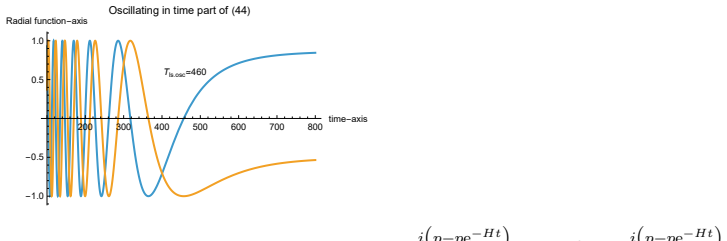
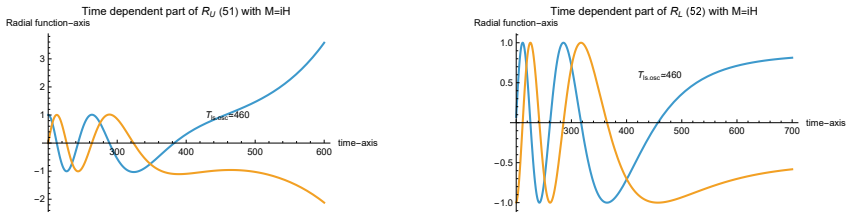
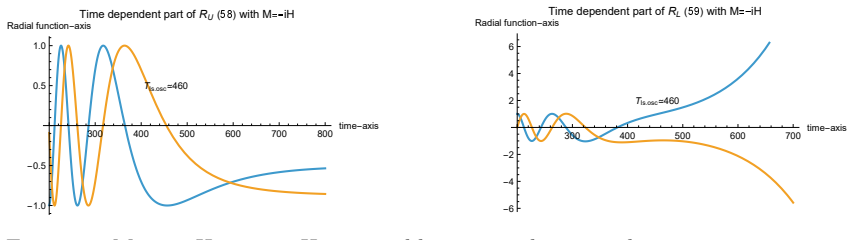
read the original abstract
The explicit formulas for the spherical solutions of the Dirac equation in the expanding universe are given. The initial value of the solution can be, in particular, a wave function of the hydrogen-like atom or a spherical wave in the Minkowski space, that then propagates in the Friedmann-Lema\^itre-Robertson-Walker space-time, which is expanding with the de~Sitter scale
Editorial analysis
A structured set of objections, weighed in public.
Referee Report
Summary. The paper claims to provide explicit formulas for the spherical solutions of the Dirac equation in the FLRW spacetime with de Sitter scale factor a(t)=exp(Ht), such that an initial wave function corresponding to a hydrogen-like atom or a Minkowski spherical wave propagates exactly in the expanding universe.
Significance. If the explicit closed-form expressions are correct and hold for massive fields with arbitrary spherical initial data, the result would be significant for exact solvability in cosmological backgrounds, where Dirac propagation is usually treated via mode expansions or approximations.
major comments (1)
- [Abstract] Abstract: the central claim that explicit formulas exist for propagation of arbitrary initial spherical Dirac data (including hydrogen-like) is load-bearing, yet the time-dependent scale factor renders the radial Dirac system non-autonomous for m>0; the manuscript must show explicitly how the solution for non-eigenfunction initial data remains closed-form rather than requiring a non-elementary integral transform or numerical evolution.
Simulated Author's Rebuttal
We thank the referee for their careful reading and for identifying a point that requires clarification regarding the explicit character of the solutions. We address the major comment below and will incorporate revisions to strengthen the presentation.
read point-by-point responses
-
Referee: [Abstract] Abstract: the central claim that explicit formulas exist for propagation of arbitrary initial spherical Dirac data (including hydrogen-like) is load-bearing, yet the time-dependent scale factor renders the radial Dirac system non-autonomous for m>0; the manuscript must show explicitly how the solution for non-eigenfunction initial data remains closed-form rather than requiring a non-elementary integral transform or numerical evolution.
Authors: We thank the referee for this observation. The manuscript derives explicit closed-form expressions for the spherical Dirac solutions in de Sitter FLRW by reducing the system to radial ODEs whose time dependence is solved exactly for a(t)=exp(Ht) (Sections 3 and 4). Although the equations are non-autonomous for m>0, the specific exponential scale factor permits solutions in elementary functions; the general spherical solution is then obtained by linear superposition of these explicit time-evolved components. For the hydrogen-like and Minkowski-wave initial data highlighted in the paper, the propagated wave function is therefore given directly by the closed-form formula without further transforms or numerics. To meet the referee's request for an explicit demonstration with non-eigenfunction data, we will add a worked example in the revised manuscript (new subsection in Section 5) showing the evolution of a superposition initial datum. We will also adjust the abstract wording for precision. This constitutes a targeted clarification rather than a change to the core results. revision: yes
Circularity Check
No significant circularity; explicit formulas derived directly from Dirac equation on FLRW metric
full rationale
The paper states it provides explicit formulas for spherical Dirac solutions with initial data such as hydrogen-like wave functions or Minkowski spherical waves propagating in de Sitter FLRW spacetime. No equations or steps in the abstract or described claims reduce a claimed result to its own inputs by definition, rename a fitted parameter as a prediction, or rely on load-bearing self-citations whose content is unverified. The derivation chain begins from the standard Dirac equation on the given metric and proceeds to closed-form expressions without self-referential loops or ansatzes smuggled via prior author work. This is the common case of a self-contained mathematical construction.
Axiom & Free-Parameter Ledger
axioms (2)
- domain assumption The Dirac equation is the correct field equation for spin-1/2 particles in curved spacetime
- domain assumption The metric is exactly FLRW with de Sitter scale factor
Reference graph
Works this paper leans on
-
[1]
Darwin, The wave equations of the electron, Proc
C.G. Darwin, The wave equations of the electron, Proc. R. Soc. L ond. Ser. A Contain. Pap. Math. Phys. Character 118 (1928) 654–680. DOI 10.1098/r spa.1928.0076
work page doi:10.1098/r 1928
-
[2]
Bethe, E.E
H.A. Bethe, E.E. Salpeter, Quantum mechanics of one- and two–e lectron atoms. Springer–Verlag, Berlin–G¨ ottingen–Heidelberg; Academic Press,Inc., New York, 1957
1957
-
[3]
Akhiezer, V.B
A.I. Akhiezer, V.B. Berestetsky, Quantum Electrodynamics, Na uka, Moscow, 1981
1981
-
[4]
Greiner, Relativistic quantum mechanics
W. Greiner, Relativistic quantum mechanics. Wave equations. Tra nslated from the sec- ond German (1987) ed., third ed., Springer–Verlag, Berlin, 2000
1987
-
[5]
Thaller, The Dirac equation, Texts and Monographs in Physics
B. Thaller, The Dirac equation, Texts and Monographs in Physics. Springer–Verlag, Berlin, 1992
1992
-
[6]
M¨ oller, The theory of relativity, Oxford, Clarendon Press, 1 952
C. M¨ oller, The theory of relativity, Oxford, Clarendon Press, 1 952
-
[7]
A.O. Barut, I.H. Duru, Exact solutions of the Dirac equation in spa tially flat Robertson–Walker space-times, Phys. Rev. D (3) 36 (1987) 3 705–3711. https://doi.org/10.1103/PhysRevD.36.3705
-
[8]
Bogolyubov, D.V
N.N. Bogolyubov, D.V. Shirkov, Introduction to quantum field the ory, fourth ed., Nauka, Moscow, 1984
1984
-
[9]
Landau-Lifshits
V. B. Berestetskii, E. M. Lifshits, L. P. Pitaevskii, Theoretical p hysics IV. (Russian) [Theoretical physics (“Landau-Lifshits”). Vol. IV] [Quantum elect rodynamics] Third edition. Nauka, Moscow, 1989
1989
-
[10]
O. V. Veko, K. V. Dashuk, E. M. Ovsiyuk, V. M. Red’kov, A. M. Is hkhanyan, Hydrogen atom in de Sitter spaces. Nonlinear Phenom. Complex Syst. 19 (2016 ) 16–29
2016
-
[11]
R.H. Price, J.D. Romano, In an expanding universe, what doesn’t expand?, Am. J. Phys. 80 (2012) 376–381. https://doi.org/10.1119/1.3699245
-
[12]
M.-A. Baloi, The production of particles with well determined angu lar momentum in external Coulomb field on de Sitter expanding universe, Nuclear Phy s. B 980 (2022) 115796. https://doi.org/10.1016/j.nuclphysb.2022.115796
-
[13]
D. Baskin, J. Wunsch, Diffraction for the Dirac-Coulomb propag ator, Ann. Henri Poincar´ e 24 (2023) 2607–2659. https://doi.org/10.1007/s0002 3-023-01279-0
-
[14]
K. Yagdjian, Fundamental solutions of the Dirac operator in th e Friedmann- Lemaˆitre-Robertson-Walker spacetime. Ann. Physics 421 (2020) 1682 66. https://doi.org/10.1016/j.aop.2020.168266 Get rights and conten t
-
[15]
Nowotny, Hydrogen atom in the Friedman universe, Comm
E. Nowotny, Hydrogen atom in the Friedman universe, Comm. Ma th. Phys. 26 (1972) 321–332. DOI: 10.1007/BF01645527 15
-
[16]
G. C. McVittie, Dirac’s equation in General Relativity, Monthly Not ices of the Royal Astronomical Society 92 (9) (1932) 868–877. https://doi.org/10 .1093/mnras/92.9.868
1932
-
[17]
Dautcourt, Topology and local physical laws, Gen
G. Dautcourt, Topology and local physical laws, Gen. Relativity Gravitation 2 (1971) 97–103. DOI: 10.1007/BF02450442
-
[18]
de Oliveira, A.G.M
M.D. de Oliveira, A.G.M. Schmidt, Exact solutions of Dirac equation o n a static curved space-time. Ann. Physics 401 (2019) 21–39. https://doi.org/10.1 016/j.aop.2018.11.025
2019
-
[19]
V. W¨ unsch, Cauchy’s problem and Huygens’ principle for relativ istic higher spin wave equations in an arbitrary curved space–time. Gen. Relativity Gravit ation 17 (1) (1985) 15–38. https://doi.org/10.1007/BF00760104
-
[20]
Yagdjian, Huygens’ principle for the generalized Dirac opera tor in curved spacetime
K. Yagdjian, Huygens’ principle for the generalized Dirac opera tor in curved spacetime. J. Phys. A 54 (9) (2021) 095204. DOI 10.1088/1751-8121/abdde 9
-
[21]
Feinberg, Particles that go faster than light
G. Feinberg, Particles that go faster than light. Scientific Amer ican 222 (2) (1970) 68-81. https://www.cia.gov/readingroom/docs/CIA-RDP96-00787R000100030001-9.pdf
1970
-
[22]
L. Ross, A. Dawe, C.K. Hines, The Physics of Tachyons II. Tach yon Dynamics, Aust. J. Phys. 45 (1992) 725-738. https://doi.org/10.1071/PH920725
-
[23]
K. C. K. Chan, R. B. Mann, Static charged black holes in (2+1)- dimensional dilaton gravity. Phys. Rev. D (3) 50 (10) (1994) 6385– 6393. DOI: https://doi.org/10.1103/PhysRevD.50.6385
-
[24]
S. Schmidt, D. Blaschke, G. R¨ opke, S. A. Smolyansky, A. V. Prozorkevich, V. D. Toneev, A Quantum Kinetic Equation for Particle Production in the Schwinger M echanism 07 (06) (1998) 709–722. https://doi.org/10.1142/S021830139800 0403
-
[25]
Schwartz, Tachyons in general relativity
C. Schwartz, Tachyons in general relativity. J. Math. Phys. 5 2 (5) (2011) 052501. https://doi.org/10.1063/1.3587119
-
[26]
Schwartz, Tachyons with any spin
C. Schwartz, Tachyons with any spin. Internat. J. Modern Ph ys. A 37 (2) (2022) 2250001. https://doi.org/10.1142/S0217751X22500014
-
[27]
J. Paczos, K. Debski, S. Cedrowski, S. Charzynski, K. Turzyn ski, A. Ekert, A. Dragan, Covariant quantum field theory of tachyons. Phys. Rev. D 110 (1) (2024) 015006. DOI: https://doi.org/10.1103/PhysRevD.110.015006
-
[28]
K. Jodlowski, Covariant quantum field theory of tachyons is unp hysical. Phys. Rev. D 110 (11) (2024) 115042. DOI: https://doi.org/10.1103/PhysRev D.110.115042
-
[29]
Jodlowski, Is a covariant virtual tachyon viable? Phys
K. Jodlowski, Is a covariant virtual tachyon viable? Phys. Rev. D 113 (6) (2026) 065016. DOI: https://doi.org/10.1103/spbd-sd3s
-
[30]
F.M.O. Moucherek, Effective CPL reconstruction of tachyon da rk energy: Back- ground dynamics and observational constraints. Phys. Lett. B 8 78 (2026) 140533. https://doi.org/10.1016/j.physletb.2026.140533 16
-
[31]
P. Schluter, K.-H. Wietschorke, W. Greiner, The Dirac equation in orthogonal coordi- nate systems. I. The local representation, J. Phys. A: Math. Ge n. 16 (1983) 1999-2016. DOI 10.1088/0305-4470/16/9/024
-
[32]
Existence of corotating and counter-rotating vortex pairs for active scalar equations
K. Yagdjian, A. Galstian, Fundamental Solutions for the Klein-G ordon Equation in de Sitter Spacetime, Comm. Math. Phys. 285 (2009) 293–344. DOI : 10.1007/s00220- 008-0649-4
-
[33]
K. Yagdjian, Waves in cosmological background with static Schw arzschild radius in the expanding universe. J. Math. Phys. 65 (2024) 083503 . https://doi.org/10.1063/5.0166195
-
[34]
Bateman, A
H. Bateman, A. Erdelyi, Higher Transcendental Functions, v.1 ,2, McGraw-Hill, New York, 1953
1953
-
[35]
Spherical solutions to the Klein-Gordon equation in the expanding universe
K. Yagdjian, Spherical solutions to the Klein-Gordon equation in the expanding uni- verse, arXiv:2508.15812v2. https://doi.org/10.48550/arXiv.2508 .15812
work page internal anchor Pith review Pith/arXiv arXiv doi:10.48550/arxiv.2508
-
[36]
D. Senjaya, Exact analytical quasibound states of a scalar pa rticle around a Reissner-Nordstr¨ om black hole. Phys. Lett. B 848 (2024) 1383 73. https://doi.org/10.1016/j.physletb.2023.138373
-
[37]
P. D’Ancona, L. Fanelli, N.M. Schiavone, Eigenvalue bounds for no n-selfadjoint Dirac operators. Math. Ann. 383 (1–2) (2022) 621–644. https://doi.o rg/10.1007/s00208-021- 02158-x
-
[38]
P. Kennedy, N. Dombey, R.L. Hall, Phase shifts and resonances in the Dirac equation. Internat. J. Modern Phys. A 19 (21) (2004) 3557 –3581. https://doi.org/10.1142/S0217751X04018713 17
discussion (0)
Sign in with ORCID, Apple, or X to comment. Anyone can read and Pith papers without signing in.