REVIEW 2 minor 17 references
Reviewed by Pith at T0; open to challenge.
T0 means a machine referee read the full paper against a public rubric. The mark states how deep the mechanical check went, never who wrote it. the ladder, T0–T4 →
T0 review · grok-4.3
Tuza's conjecture on triangle edge covers holds in random geometric graphs over a wide density range.
2026-06-27 15:49 UTC pith:L2LG6TP6
load-bearing objection The paper verifies Tuza's conjecture for random geometric graphs over a density range and gives almost-perfect packings for an infinite family of F, but the abstract supplies no proof details.
Almost-perfect packings and Tuza's conjecture in the random geometric graph
The pith
A machine-rendered reading of the paper's core claim, the machinery that carries it, and where it could break.
Core claim
We show that Tuza's conjecture holds in the random geometric graph for a large range of densities. We also show the existence of almost-perfect packings for an infinite family of F.
What carries the argument
The random geometric graph with connection radius tuned across density regimes, together with its triangle packing number and minimum triangle edge cover.
Load-bearing premise
The connection radius must be chosen so the resulting graph sits in a density regime whose local triangle structure permits the global packing and covering bounds to apply.
What would settle it
A single random geometric graph realization at some density where the minimum triangle edge cover exceeds twice the maximum triangle packing would falsify the claim for that regime.
If this is right
- Tuza's bound of twice the packing number applies to triangle covers in this model across many densities.
- Almost-perfect edge packings exist for an infinite family of fixed graphs F.
- Negative results show that almost-perfect packings fail for certain other choices of F.
Where Pith is reading between the lines
- The same methods could be tried on packings of larger cliques or other fixed subgraphs in the same model.
- Similar verification of Tuza's conjecture might be attempted in the Erdős–Rényi random graph at comparable densities.
- The density thresholds identified here mark natural boundaries where packing behavior may shift, inviting further analysis at the transition points.
Editorial analysis
A structured set of objections, weighed in public.
Referee Report
Summary. The paper proves that Tuza's conjecture holds for the random geometric graph G(n,r) over a large range of the density parameter r, establishes the existence of almost-perfect packings by edge-disjoint copies of a fixed graph F for an infinite family of F, and provides some negative results for other F.
Significance. If the results hold, they extend Tuza's conjecture to the random geometric setting and advance packing-covering problems in geometric random graphs, which are central to both extremal combinatorics and applications in geometric probability. The work supplies explicit density regimes and an infinite family of positive packing results.
minor comments (2)
- The abstract states the main theorems at a high level; a brief indication of the proof strategy (e.g., the use of the geometric structure or the range of r) in the introduction would help readers assess the scope immediately.
- Notation for the random geometric graph G(n,r) and the packing number ν(G) is standard, but the precise definition of 'almost-perfect packing' (e.g., the o(1) fraction of uncovered edges) should be stated explicitly when first introduced.
Simulated Author's Rebuttal
We thank the referee for their positive summary of the manuscript and for recommending minor revision. The report contains no specific major comments.
Circularity Check
No significant circularity detected
full rationale
The paper claims that Tuza's conjecture holds in random geometric graphs over a density range and that almost-perfect F-packings exist for an infinite family of F. These are existential and probabilistic statements about graph properties in a random model. No derivation step reduces a claimed prediction or theorem to a fitted parameter, self-definition, or self-citation chain by the paper's own equations. The density regime is an explicit modeling assumption rather than a circular construct. The work is self-contained against external benchmarks such as the original Tuza conjecture and standard random geometric graph theory.
Axiom & Free-Parameter Ledger
axioms (1)
- domain assumption Standard definition and properties of the random geometric graph model in the unit square with Euclidean distance threshold.
read the original abstract
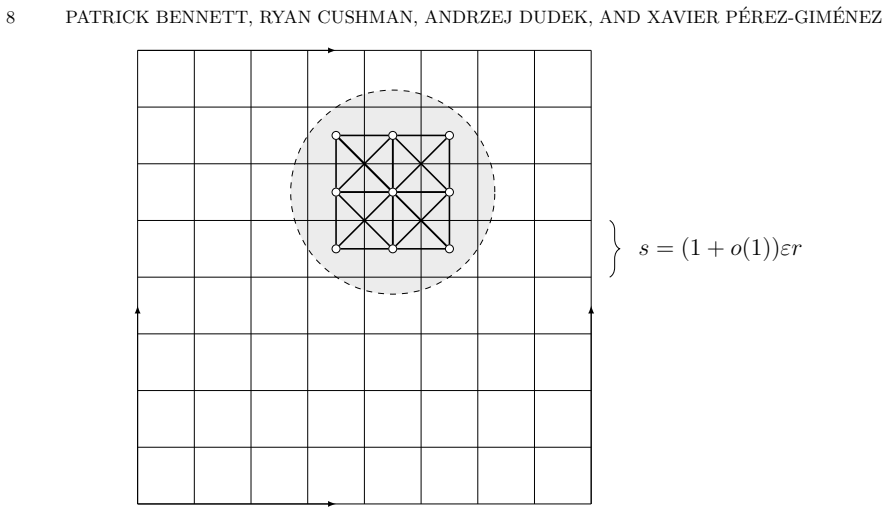
The triangle packing number $\nu(G)$ of a graph $G$ is the maximum size of a set of edge-disjoint triangles in $G$. Tuza conjectured that in any graph $G$ there exists a set of at most $2\nu(G)$ edges intersecting every triangle in $G$. We show that Tuza's conjecture holds in the random geometric graph for a large range of densities. We also study the problem of covering almost all edges of the random geometric graph with edge-disjoint copies of some fixed graph $F$. In particular, we show the existence of almost-perfect packings for an infinite family of $F$, and state some negative results as well.
Figures


Reference graph
Works this paper leans on
-
[1]
Aharoni and S
R. Aharoni and S. Zerbib. A generalization of Tuza’s conjecture.J. Graph Theory, 94(3):445–462, 2020
2020
-
[2]
J. D. Baron and J. Kahn. Tuza’s conjecture is asymptotically tight for dense graphs.Combin. Probab. Comput., 25(5):645–667, 2016
2016
-
[3]
Bennett, R
P. Bennett, R. Cushman, and A. Dudek. Closing the random graph gap in Tuza’s conjecture through the online triangle packing process.SIAM J. Discrete Math., 35(3):2145–2169, 2021
2021
-
[4]
Bennett, A
P. Bennett, A. Dudek, and S. Zerbib. Large triangle packings and Tuza’s conjecture in sparse random graphs.Combin. Probab. Comput., 29(5):757–779, 2020
2020
-
[5]
Burggraf and A
L. Burggraf and A. Wesolek. personal communication, 2025. 26 PATRICK BENNETT, RYAN CUSHMAN, ANDRZEJ DUDEK, AND XAVIER P ´EREZ-GIM´ENEZ
2025
-
[6]
Dubhashi and D
D. Dubhashi and D. Ranjan. Balls and bins: A study in negative dependence.Random Structures & Algorithms, 13(2):99–124, 1998
1998
-
[7]
Hajnal, L
A. Hajnal, L. Lov´ asz, and V. T. S´ os, editors.Finite and infinite sets. Vol. I, II, volume 37 ofColloquia Mathematica Societatis J´ anos Bolyai. North-Holland Publishing Co., Amsterdam, 1984
1984
-
[8]
P. E. Haxell. Packing and covering triangles in graphs.Discrete Math., 195(1-3):251–254, 1999
1999
-
[9]
P. E. Haxell and V. R¨ odl. Integer and fractional packings in dense graphs.Combinatorica, 21(1):13–38, 2001
2001
-
[10]
Janson, T
S. Janson, T. L uczak, and A. Ruci´ nski.Random Graphs. Wiley Series in Discrete Mathematics and Optimization. Wiley, 2011
2011
-
[11]
J. Kahn. A linear programming perspective on the Frankl-R¨ odl-Pippenger theorem.Random Structures Algorithms, 8(2):149–157, 1996
1996
-
[12]
Kahn and J
J. Kahn and J. Park. Tuza’s conjecture for random graphs.Random Structures Algorithms, 61(2):235– 249, 2022
2022
-
[13]
D. Kershaw. Some extensions of W. Gautschi’s inequalities for the Gamma function.Mathematics of Computation, 41(164):607–611, 1983
1983
-
[14]
Krivelevich
M. Krivelevich. On a conjecture of Tuza about packing and covering of triangles.Discrete Math., 142(1- 3):281–286, 1995
1995
-
[15]
Penrose.Random Geometric Graphs
M. Penrose.Random Geometric Graphs. Oxford studies in probability. Oxford University Press, 2003
2003
-
[16]
Z. Tuza. A conjecture on triangles of graphs.Graphs Combin., 6(4):373–380, 1990
1990
-
[17]
R. Yuster. Dense graphs with a large triangle cover have a large triangle packing.Combin. Probab. Comput., 21(6):952–962, 2012. Department of Mathematics, Western Michigan University, Kalamazoo, MI, USA Email address:patrick.bennett@wmich.edu Department of Mathematics, University of Tennessee, Knoxville, Knoxville, TN, USA Email address:rcushma3@utk.edu D...
2012
discussion (0)
Sign in with ORCID, Apple, or X to comment. Anyone can read and Pith papers without signing in.