REVIEW 3 major objections 6 minor 31 references
Realistic and Controllable 3D Gaussian-Guided Object Editing for Driving Video Generation
T0 review · 3 major / 6 minor · reviewed 2026-08-05 · deepseek-v4-flash
Pith's one-line read This paper claims that rendering the edited object as a 3D Gaussian video and feeding it into a diffusion inpainter yields precise, controllable object pose in driving-video edits while keeping appearance realistic.
desk verdict Worth a serious referee, but the pose-control claim is not yet proven—it's a detector proxy, not a direct pose error. read the letter →
The pith
A machine-rendered reading of the paper's core claim, the machinery that carries it, and where it could break.
The reading
What carries the argument
The load-bearing mechanism is the 'Gaussian video': 3D Gaussians of the object are rigidly posed by Eq. (4)-(5), projected to the image, alpha-blended by Eq. (6), and their VAE latents are concatenated with the masked video, noise, and edge masks as input channels to the inpainting UNet. This converts pose control into a restoration-like task. Supporting machinery includes scene-level depth-aware 3D boxes that keep non-target objects and occluded background consistent; ReferenceNet spatial-attention injection plus random horizontal flipping of the reference image to stop pose leakage from the reference; and temporal attention layers for frame consistency.
What would settle it
Take a Gaussian asset and intentionally give its rendered pose a yaw error opposite to the target 3D box pose, then edit a video and measure the detected pose of the output object. If the output follows the box rather than the rendered Gaussian, the dense-prior claim fails; if it follows the Gaussian, the box signal is not the controlling factor. Either outcome settles which signal drives pose control.
Extended reading notes
Core claim
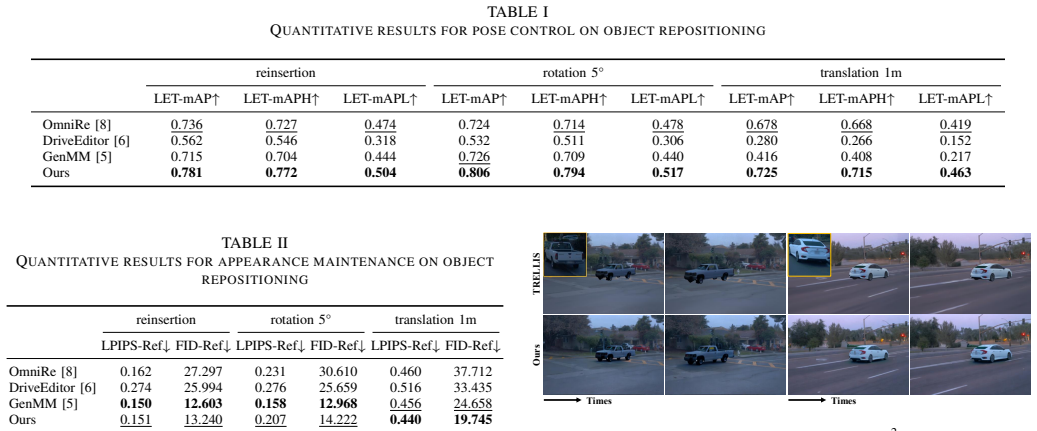
The central claim is that a 3D Gaussian rendering of the edited object, placed at the target pose and projected into the camera view, supplies a dense and spatially aligned prior that makes diffusion-based inpainters follow the desired object pose almost exactly. The model treats editing as restoring a slightly blurred Gaussian image rather than imagining a new object from a box, which simplifies learning and keeps appearance consistent through a ReferenceNet and CLIP features. Empirically this yields LET-mAP 0.806 for 5-degree rotation versus 0.726 for GenMM and 0.724 for OmniRe, and 0.725 versus 0.416 and 0.678 for 1-meter translation; ablations show removing the Gaussian render drops rota
Load-bearing premise
The input 3D Gaussian asset must faithfully represent the object's geometry and appearance; distortions from sparse-view reconstruction or image-to-3D generation are inherited by the diffusion output and bound the claimed pose and fidelity gains.
Editorial extensions
If this is right
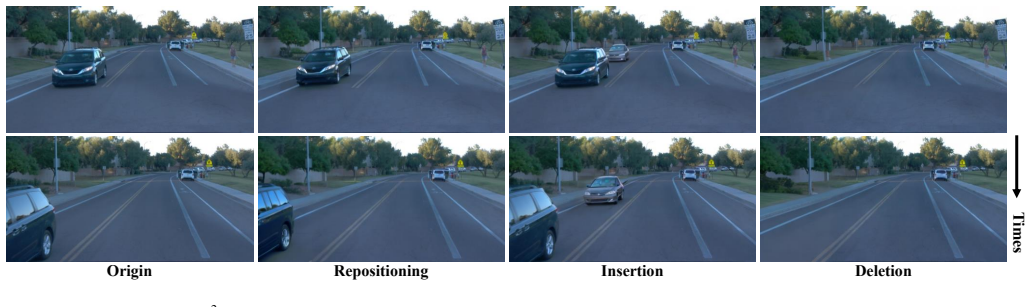
- Repositioning, insertion, and deletion are unified in one diffusion framework, so corner-case generation can be driven by annotated boxes plus a single object asset.
- Rotation and translation edits keep detected object pose precise enough that fine-tuning a monocular 3D detector on edited data beats duplicating real data (LET-mAP 0.628 vs 0.612).
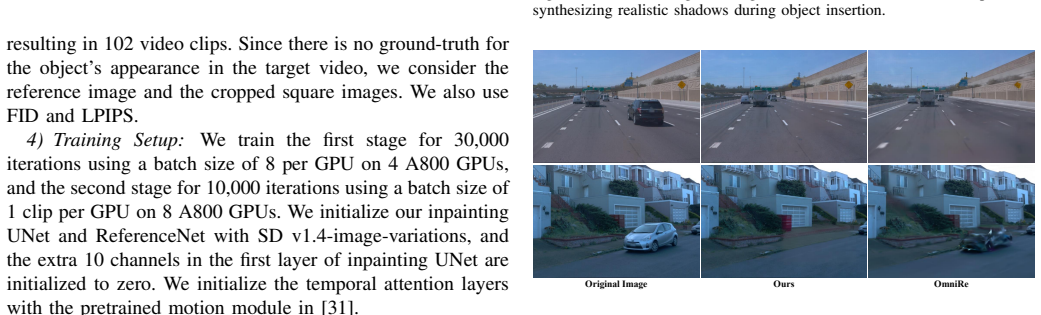
- Because assets may come from multiview reconstruction or image-to-3D generation, the pipeline can insert novel objects into scenes without retraining, leaving lighting and shadow synthesis to the diffusion model.
- Scene-level boxes plus temporal layers let non-target objects stay intact while their occluded parts are reconstructed across frames.
Reading between the lines
- A testable extension: the random horizontal-flip trick for stopping pose leakage from the reference image should transfer to any reference-conditioned editor where the reference itself contains pose cues.
- The dense-prior principle generalizes: rendering the whole scene as 3DGS, not just the edited object, could give a controllable full-scene driving-video generator with the same restoration-style training objective.
- Because asset fidelity bounds the pipeline, pairing G2Editor with explicit lighting and shadow modeling for Gaussian assets would likely extend reliable editing to night and adverse-weather scenes; the paper does not test this.
- Since the ablation ties pose gains mainly to the Gaussian render and appearance gains to ReferenceNet, applications with loose pose tolerances could drop the Gaussian render and use a cheaper pipeline.
Editorial analysis
A structured set of objections, weighed in public.
Referee Report
Summary. The paper proposes G2Editor, a diffusion-based video inpainting framework for editing objects in driving videos (repositioning, insertion, deletion). The method injects a rendered 3D Gaussian video as a dense pose prior, together with scene-level depth-aware bounding boxes and reference-image features (CLIP + ReferenceNet), into a Stable Diffusion inpainting UNet, with temporal layers for consistency. Trained and evaluated on the Waymo Open Dataset, the authors report improved pose-control LET-mAP over OmniRe, DriveEditor, and GenMM (Table I), competitive appearance metrics (Table II), and a small downstream detection gain (Table IV).
Significance. The central idea—using a 3DGS render as a geometric prior inside a diffusion inpainting model—is a plausible and reasonably novel hybrid that addresses a real need in autonomous-driving corner-case generation. The ablation in Table III does isolate the positive effect of the 3DGS prior on the reported pose-control score, and the downstream detection experiment (Table IV) is a useful practical probe. However, the evaluation methodology has substantial gaps: pose control is measured only by an indirect detector-based proxy, the appearance metric is confounded with pose fidelity and actually shows GenMM superior on the rotation task, and the test set is small (8 scenes / 180 clips). The paper's headline claims are therefore not yet convincingly established, though the approach is promising.
major comments (3)
- [§IV-A3 / Table II] The appearance evaluation is confounded with pose fidelity. LPIPS and FID are computed between the edited object region and the original frame. For the rotation and translation tasks, a method that fails to perform the manipulation leaves the object near its original position, trivially lowering these distances. The paper itself invokes exactly this explanation for the w/o-3DGS row in Table III, but does not apply it to GenMM's lower LPIPS/FID in Table II. Thus the abstract's claim of 'outperforming existing methods in both pose controllability and visual quality' is not supported; for rotation 5°, GenMM reports LPIPS 0.158 vs 0.207 and FID 12.968 vs 14.222. A pose-invariant appearance metric (e.g., comparison against the target rendered view, identity preservation, or a human study) is needed.
- [§IV-A3 / Table I] Pose control is only measured by the PGD detector's LET-mAP with a 5% longitudinal error tolerance. This is an indirect proxy; it does not report actual angular/translational error, confidence intervals, or sensitivity to the 5° / 1m manipulation. The ablation in Table III shows only that removing the 3DGS prior degrades the score, but does not establish that the metric can reliably distinguish a correct 5° rotation from an incorrect one. Moreover, only 8 scenes / 180 clips are used. The claim of 'precise pose control' requires a direct pose-error metric, or at least a monotonicity check over increasing rotation/translation magnitudes, plus error bars.
- [§IV-A2 / §IV-B1] The comparison with OmniRe is partially circular: the Gaussian asset used by G2Editor is reconstructed by OmniRe, and OmniRe is also the primary 3DGS baseline. Therefore the favorable numbers vs. OmniRe in Table I could largely reflect diffusion-based refinement of OmniRe's own renderings rather than the proposed pose-control mechanism. The authors acknowledge the shared origin, but the framing 'outperform' is misleading. An additional baseline that applies the same Gaussian rendering and a restoration/refinement step without the full proposed architecture (or an independent 3DGS reconstruction) would disentangle these contributions.
minor comments (6)
- [Abstract / §IV-B1] The abstract states G2Editor 'outperforms existing methods in both pose controllability and visual quality,' but Table II shows GenMM has better LPIPS and FID for rotation and reinsertion. Please soften the visual-quality claim to match the reported results or provide stronger evidence.
- [§IV-A3] The metric names 'LPIPS-Ref' and 'FID-Ref' are ambiguous: the text says the metrics are computed between the edited and original images, while the names suggest a reference image. Clarify what the reference is and how the square region is cropped for each task.
- [§IV-C / Table III] The w/o-3DGS row reports better LPIPS than the full model for rotation (0.201 vs 0.207). The paper attributes this to poor pose control making outputs more similar to the original; this explanation should also be applied to GenMM's Table II scores, which are not necessarily evidence of better appearance quality.
- [§III-C] Random horizontal flipping of the reference image is proposed to prevent the network from learning pose from ReferenceNet. This is an interesting trick, but flipping also changes asymmetric appearance cues (e.g., text, side mirrors). Please discuss potential side effects or ablations with flipped vs. non-flipped reference images for appearance fidelity.
- [§IV-D / Table IV] The downstream detection improvement is small (0.628 vs 0.612 LET-mAP) and no statistical significance, multiple seeds, or variance are reported. Please add confidence intervals or acknowledge that the gain may not be significant.
- [Eq. (5)] The notation 'Rw = WT R' is unclear: W appears to be a rotation matrix in Eq. (4), so the world rotation should likely be W R or W^T R depending on convention. Please define the coordinate frames and the meaning of W^T.
Circularity Check
No significant circularity: the paper is a conditional-generation system whose pose control is an explicitly supplied 3DGS render, and the comparisons use external benchmarks; no derivation reduces to its own inputs.
full rationale
The paper does not present a formal derivation chain that could be circular; it presents an inpainting pipeline conditioned on a 3DGS render. The pose-related signal is obtained by transforming Gaussians with the target object pose (Eqs. 4-5), rendering them (Eq. 6), and concatenating that render into the denoising UNet. The paper explicitly says this makes the task 'more akin to Gaussian image restoration' (Sec. III-B), meaning the render is a deliberate input prior, not a hidden tautology. The pose-control result is an empirical property of the learned conditional inpainting and is measured with an external detector (PGD) and Waymo LET metrics; it is not an analytic consequence of the equations. The ablation (Table III) showing that removing the 3DGS render drops LET-mAP demonstrates the mechanism, not circularity. The acknowledged use of OmniRe-derived Gaussian videos while also comparing against OmniRe (Sec. IV-A.2) is a potential evaluation confound—the comparison isolates the diffusion-refinement contribution since both sides start from the same render—but it does not reduce the claimed result to its input by construction. No load-bearing self-citations, imported uniqueness theorems, or renamed known results appear. Under the required standard that circularity must be exhibited as a specific reduction, no such step is present.
Assumptions & free parameters
free parameters (3)
- Diffusion network weights (inpainting UNet, ReferenceNet, temporal layers) =
trained on 19,477 Waymo clips, 30k + 10k iterations
- Evaluation protocol scalars =
beta=5 degrees rotation, 1 m translation, 5% LET tolerance, N=10 frames, 512x512 eval crops
- Mask enlargement amount =
not specified
assumptions (6)
- domain assumption Stable Diffusion latent diffusion formulation (Eq. 1-2) is a valid base for object-level video inpainting.
- domain assumption 3D Gaussian Splatting rendering (Eq. 6) with known camera intrinsics/extrinsics and object pose produces a spatially aligned dense prior.
- domain assumption Waymo Open Dataset 3D box annotations and camera poses are accurate enough for training and evaluation.
- domain assumption PGD detector and LET-mAP faithfully measure true 3D pose control.
- domain assumption OmniRe and TRELLIS supply 3D Gaussian assets of sufficient quality for training and inference.
- domain assumption ReferenceNet and CLIP feature injection preserve appearance without leaking pose, especially after random horizontal flipping.
Cite this review
Pith. "Pith review of Realistic and Controllable 3D Gaussian-Guided Object Editing for Driving Video Generation." pith.science (2026). https://pith.science/paper/L2NVWZR7
@misc{pith2026250820471,
  author       = {Pith},
  title        = {Pith review of: Realistic and Controllable 3D Gaussian-Guided Object Editing for Driving Video Generation},
  year         = {2026},
  howpublished = {\url{https://pith.science/paper/L2NVWZR7}},
  note         = {Machine review of arXiv:2508.20471}
}
read the original abstract
Corner cases are crucial for training and validating autonomous driving systems, yet collecting them from the real world is often costly and hazardous. Editing objects within captured sensor data offers an effective alternative for generating diverse scenarios, commonly achieved through 3D Gaussian Splatting or image generative models. However, these approaches often suffer from limited visual fidelity or imprecise pose control. To address these issues, we propose G^2Editor, a framework designed for photorealistic and precise object editing in driving videos. Our method leverages a 3D Gaussian representation of the edited object as a dense prior, injected into the denoising process to ensure accurate pose control and spatial consistency. A scene-level 3D bounding box layout is employed to reconstruct occluded areas of non-target objects. Furthermore, to guide the appearance details of the edited object, we incorporate hierarchical fine-grained features as additional conditions during generation. Experiments on the Waymo Open Dataset demonstrate that G^2Editor effectively supports object repositioning, insertion, and deletion within a unified framework, outperforming existing methods in both pose controllability and visual quality, while also benefiting downstream data-driven tasks.
Figures


Figures from the paper (3 more)

Reference graph
Works this paper leans on
-
[1]
A survey on imitation learning techniques for end-to-end autonomous vehicles,
L. Le Mero, D. Yi, M. Dianati, and A. Mouzakitis, “A survey on imitation learning techniques for end-to-end autonomous vehicles,” IEEE Transactions on Intelligent Transportation Systems, vol. 23, no. 9, pp. 14128–14147, 2022
work page 2022
-
[2]
Synthetic dataset generation using logical scenario files for automotive perception testing,
M. Garc ´ıa, A. Iglesias, M. S ´anchez, R. Naranjo, J. A. I. De Gordoa, M. Nieto, and N. Aginako, “Synthetic dataset generation using logical scenario files for automotive perception testing,” in 2025 IEEE Intelli- gent Vehicles Symposium (IV) , pp. 392–397, IEEE, 2025
work page 2025
-
[3]
Drivescape: High-resolution driving video generation by multi-view feature fusion,
W. Wu, X. Guo, W. Tang, T. Huang, C. Wang, and C. Ding, “Drivescape: High-resolution driving video generation by multi-view feature fusion,” in Proceedings of the Computer Vision and Pattern Recognition Confer- ence, pp. 17187–17196, 2025
work page 2025
-
[4]
Panacea: Panoramic and controllable video generation for autonomous driving,
Y . Wen, Y . Zhao, Y . Liu, F. Jia, Y . Wang, C. Luo, C. Zhang, T. Wang, X. Sun, and X. Zhang, “Panacea: Panoramic and controllable video generation for autonomous driving,” in Proceedings of the IEEE/CVF Conference on Computer Vision and Pattern Recognition , pp. 6902– 6912, 2024
work page 2024
-
[5]
Genmm: Geometrically and temporally consistent multimodal data generation for video and lidar,
B. Singh, V . Kulharia, L. Yang, A. Ravichandran, A. Tyagi, and A. Shri- vastava, “Genmm: Geometrically and temporally consistent multimodal data generation for video and lidar,” 2024
work page 2024
-
[6]
Y . Liang, Z. Yan, L. Chen, J. Zhou, L. Yan, S. Zhong, and X. Zou, “Driveeditor: A unified 3d information-guided framework for control- lable object editing in driving scenes,” in Proceedings of the AAAI Conference on Artificial Intelligence , vol. 39, pp. 5164–5172, 2025
work page 2025
-
[7]
Driv- inggaussian: Composite gaussian splatting for surrounding dynamic au- tonomous driving scenes,
X. Zhou, Z. Lin, X. Shan, Y . Wang, D. Sun, and M.-H. Yang, “Driv- inggaussian: Composite gaussian splatting for surrounding dynamic au- tonomous driving scenes,” in Proceedings of the IEEE/CVF conference on computer vision and pattern recognition , pp. 21634–21643, 2024
work page 2024
-
[8]
Omnire: Omni urban scene reconstruction,
Z. Chen, J. Yang, J. Huang, R. de Lutio, J. M. Esturo, B. Ivanovic, O. Litany, Z. Gojcic, S. Fidler, M. Pavone, et al., “Omnire: Omni urban scene reconstruction,” arXiv preprint arXiv:2408.16760 , 2024
arXiv 2024
Show all 31 references
-
[9]
Scalability in perception for autonomous driving: Waymo open dataset,
P. Sun, H. Kretzschmar, X. Dotiwalla, A. Chouard, V . Patnaik, P. Tsui, J. Guo, Y . Zhou, Y . Chai, B. Caine, et al. , “Scalability in perception for autonomous driving: Waymo open dataset,” in Proceedings of the IEEE/CVF conference on computer vision and pattern recognition ,...
2020
-
[10]
Street-view image generation from a bird’s-eye view layout,
A. Swerdlow, R. Xu, and B. Zhou, “Street-view image generation from a bird’s-eye view layout,” IEEE Robotics and Automation Letters , 2024
2024
-
[11]
Critical test cases generalization for autonomous driving object detection algorithms,
Z. Jiang, J. Liu, M. Sang, H. Li, and Y . Pan, “Critical test cases generalization for autonomous driving object detection algorithms,” in 2024 IEEE Intelligent Vehicles Symposium (IV) , pp. 1149–1156, IEEE, 2024
2024
-
[12]
Subjectdrive: Scaling generative data in autonomous driving via subject control,
B. Huang, Y . Wen, Y . Zhao, Y . Hu, Y . Liu, F. Jia, W. Mao, T. Wang, C. Zhang, C. W. Chen, et al., “Subjectdrive: Scaling generative data in autonomous driving via subject control,” in Proceedings of the AAAI Conference on Artificial Intelligence , vol. 39, pp. 3617–3625, 2025
2025
-
[13]
High- resolution image synthesis with latent diffusion models,
R. Rombach, A. Blattmann, D. Lorenz, P. Esser, and B. Ommer, “High- resolution image synthesis with latent diffusion models,” in Proceedings of the IEEE/CVF conference on computer vision and pattern recognition, pp. 10684–10695, 2022
2022
-
[14]
Emu edit: Precise image editing via recognition and generation tasks,
S. Sheynin, A. Polyak, U. Singer, Y . Kirstain, A. Zohar, O. Ashual, D. Parikh, and Y . Taigman, “Emu edit: Precise image editing via recognition and generation tasks,” in Proceedings of the IEEE/CVF Conference on Computer Vision and Pattern Recognition , pp. 8871– 8879, 2024
2024
-
[15]
A task is worth one word: Learning with task prompts for high-quality versatile image inpainting,
J. Zhuang, Y . Zeng, W. Liu, C. Yuan, and K. Chen, “A task is worth one word: Learning with task prompts for high-quality versatile image inpainting,” in European Conference on Computer Vision, pp. 195–211, Springer, 2024
2024
-
[16]
Objectstitch: Object compositing with diffusion model,
Y . Song, Z. Zhang, Z. Lin, S. Cohen, B. Price, J. Zhang, S. Y . Kim, and D. Aliaga, “Objectstitch: Object compositing with diffusion model,” in Proceedings of the IEEE/CVF Conference on Computer Vision and Pattern Recognition, pp. 18310–18319, 2023
2023
-
[17]
Paint by example: Exemplar-based image editing with diffusion models,
B. Yang, S. Gu, B. Zhang, T. Zhang, X. Chen, X. Sun, D. Chen, and F. Wen, “Paint by example: Exemplar-based image editing with diffusion models,” in Proceedings of the IEEE/CVF conference on computer vision and pattern recognition , pp. 18381–18391, 2023
2023
-
[18]
Nerf: Representing scenes as neural radiance fields for view synthesis,
B. Mildenhall, P. P. Srinivasan, M. Tancik, J. T. Barron, R. Ramamoorthi, and R. Ng, “Nerf: Representing scenes as neural radiance fields for view synthesis,” Communications of the ACM , vol. 65, no. 1, pp. 99–106, 2021
2021
-
[19]
3d gaussian splatting for real-time radiance field rendering.,
B. Kerbl, G. Kopanas, T. Leimk ¨uhler, and G. Drettakis, “3d gaussian splatting for real-time radiance field rendering.,” ACM Trans. Graph. , vol. 42, no. 4, pp. 139–1, 2023
2023
-
[20]
Mars: An instance-aware, modular and realistic simulator for autonomous driving,
Z. Wu, T. Liu, L. Luo, Z. Zhong, J. Chen, H. Xiao, C. Hou, H. Lou, Y . Chen, R. Yang,et al., “Mars: An instance-aware, modular and realistic simulator for autonomous driving,” in CAAI International Conference on Artificial Intelligence, pp. 3–15, Springer, 2023
2023
-
[21]
Unisim: A neural closed-loop sensor simulator,
Z. Yang, Y . Chen, J. Wang, S. Manivasagam, W.-C. Ma, A. J. Yang, and R. Urtasun, “Unisim: A neural closed-loop sensor simulator,” in Proceedings of the IEEE/CVF Conference on Computer Vision and Pattern Recognition, pp. 1389–1399, 2023
2023
-
[22]
Lift3d: Synthesize 3d training data by lifting 2d gan to 3d generative radiance field,
L. Li, Q. Lian, L. Wang, N. Ma, and Y .-C. Chen, “Lift3d: Synthesize 3d training data by lifting 2d gan to 3d generative radiance field,” in Proceedings of the IEEE/CVF Conference on Computer Vision and Pattern Recognition, pp. 332–341, 2023
2023
-
[23]
Gina-3d: Learning to generate implicit neural assets in the wild,
B. Shen, X. Yan, C. R. Qi, M. Najibi, B. Deng, L. Guibas, Y . Zhou, and D. Anguelov, “Gina-3d: Learning to generate implicit neural assets in the wild,” in Proceedings of the IEEE/CVF conference on computer vision and pattern recognition , pp. 4913–4926, 2023
2023
-
[24]
Recondreamer: Crafting world models for driving scene reconstruction via online restoration,
C. Ni, G. Zhao, X. Wang, Z. Zhu, W. Qin, G. Huang, C. Liu, Y . Chen, Y . Wang, X. Zhang, et al. , “Recondreamer: Crafting world models for driving scene reconstruction via online restoration,” in Proceedings of the Computer Vision and Pattern Recognition Conference , pp. 1559–...
2025
-
[25]
Animate anyone: Consistent and controllable image-to-video synthesis for character animation,
L. Hu, “Animate anyone: Consistent and controllable image-to-video synthesis for character animation,” in Proceedings of the IEEE/CVF Conference on Computer Vision and Pattern Recognition , pp. 8153– 8163, 2024
2024
-
[26]
Structured 3d latents for scalable and versatile 3d generation,
J. Xiang, Z. Lv, S. Xu, Y . Deng, R. Wang, B. Zhang, D. Chen, X. Tong, and J. Yang, “Structured 3d latents for scalable and versatile 3d generation,” arXiv preprint arXiv:2412.01506 , 2024
2024 arXiv
-
[27]
Probabilistic and geometric depth: Detecting objects in perspective,
T. Wang, Z. Xinge, J. Pang, and D. Lin, “Probabilistic and geometric depth: Detecting objects in perspective,” in Conference on Robot Learn- ing, pp. 1475–1485, PMLR, 2022
2022
-
[28]
Let-3d-ap: Longitudinal error tolerant 3d average precision for camera- only 3d detection,
W.-C. Hung, V . Casser, H. Kretzschmar, J.-J. Hwang, and D. Anguelov, “Let-3d-ap: Longitudinal error tolerant 3d average precision for camera- only 3d detection,” in 2024 IEEE International Conference on Robotics and Automation (ICRA) , pp. 8272–8279, IEEE, 2024
2024
-
[29]
Gans trained by a two time-scale update rule converge to a local nash equilibrium,
M. Heusel, H. Ramsauer, T. Unterthiner, B. Nessler, and S. Hochreiter, “Gans trained by a two time-scale update rule converge to a local nash equilibrium,” Advances in neural information processing systems , vol. 30, 2017
2017
-
[30]
The unreasonable effectiveness of deep features as a perceptual metric,
R. Zhang, P. Isola, A. A. Efros, E. Shechtman, and O. Wang, “The unreasonable effectiveness of deep features as a perceptual metric,” in Proceedings of the IEEE conference on computer vision and pattern recognition, pp. 586–595, 2018
2018
-
[31]
Animatediff: Animate your personalized text-to- image diffusion models without specific tuning,
Y . Guo, C. Yang, A. Rao, Z. Liang, Y . Wang, Y . Qiao, M. Agrawala, D. Lin, and B. Dai, “Animatediff: Animate your personalized text-to- image diffusion models without specific tuning,” in ICLR, 2024
2024
Reviewed August 5, 2026 · model on record in the stance chip above.
Discussion (0). Sign in to comment.