White Dwarf Classification of DESI DR1 Spectra1
Pith reviewed 2026-07-02 06:30 UTC · model grok-4.3
The pith
Magnetic white dwarfs are more massive than average and show fields before crystallization begins.
A machine-rendered reading of the paper's core claim, the machinery that carries it, and where it could break.
Core claim
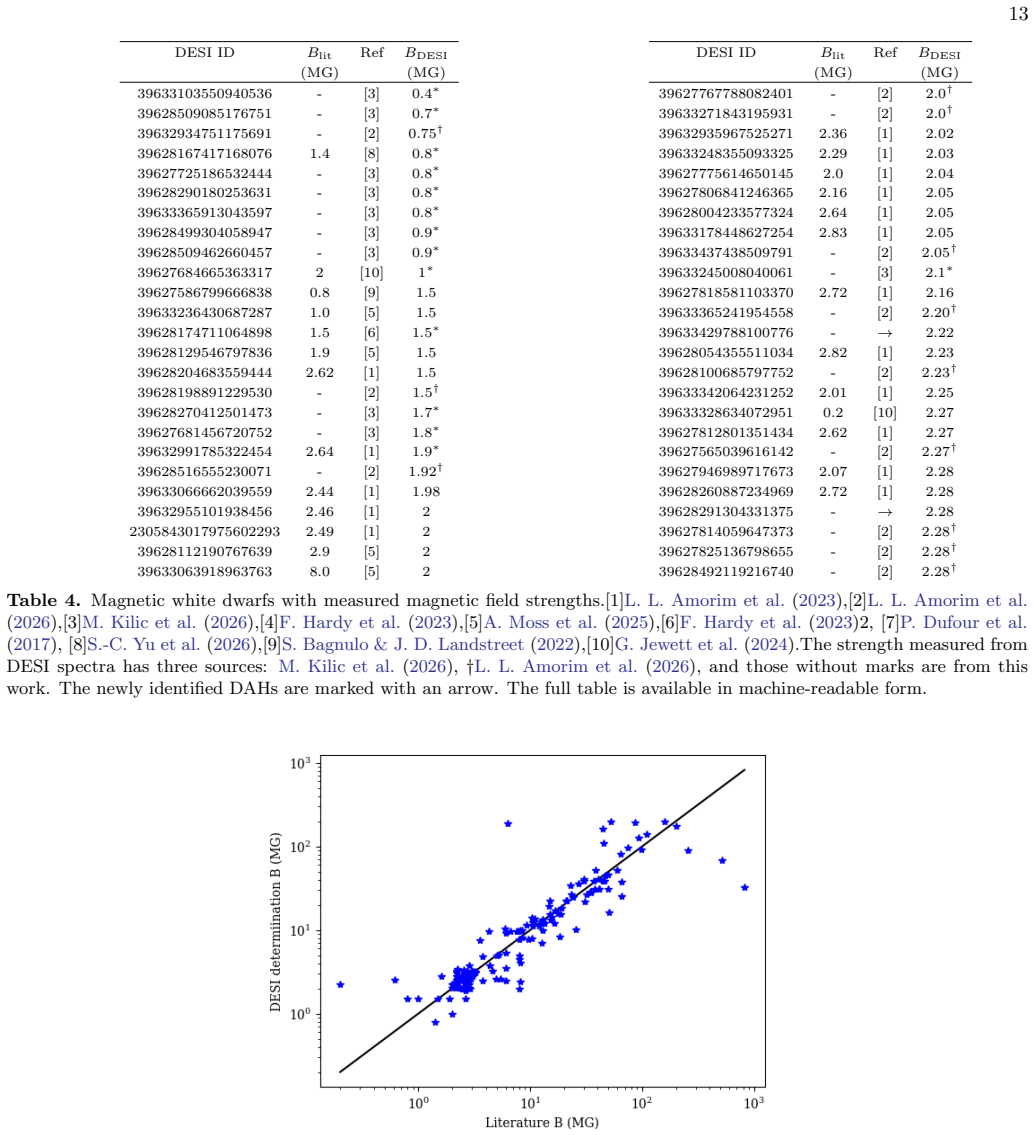
We identify 547 magnetic white dwarfs by detecting Zeeman splitting, including 84 new discoveries, and estimate their magnetic field strengths using off-centered, inclined dipole models when possible. We compare our magnetic field determinations with previous measurements and find overall good agreement. Finally, we investigate the relation between stellar properties and magnetism, finding that magnetic white dwarfs are systematically more massive than the general white dwarf population and that intermediate-strength magnetic fields are already present in stars that have not yet entered the crystallization phase. This result suggests that crystallization is unlikely to be the sole mechanism
What carries the argument
Detection of Zeeman splitting in spectra to identify magnetic white dwarfs, combined with spectroscopic model fitting to derive masses and compare crystallization status.
If this is right
- Magnetic white dwarfs have a higher average mass than the general white dwarf population.
- Intermediate magnetic fields exist in white dwarfs that have not entered the crystallization phase.
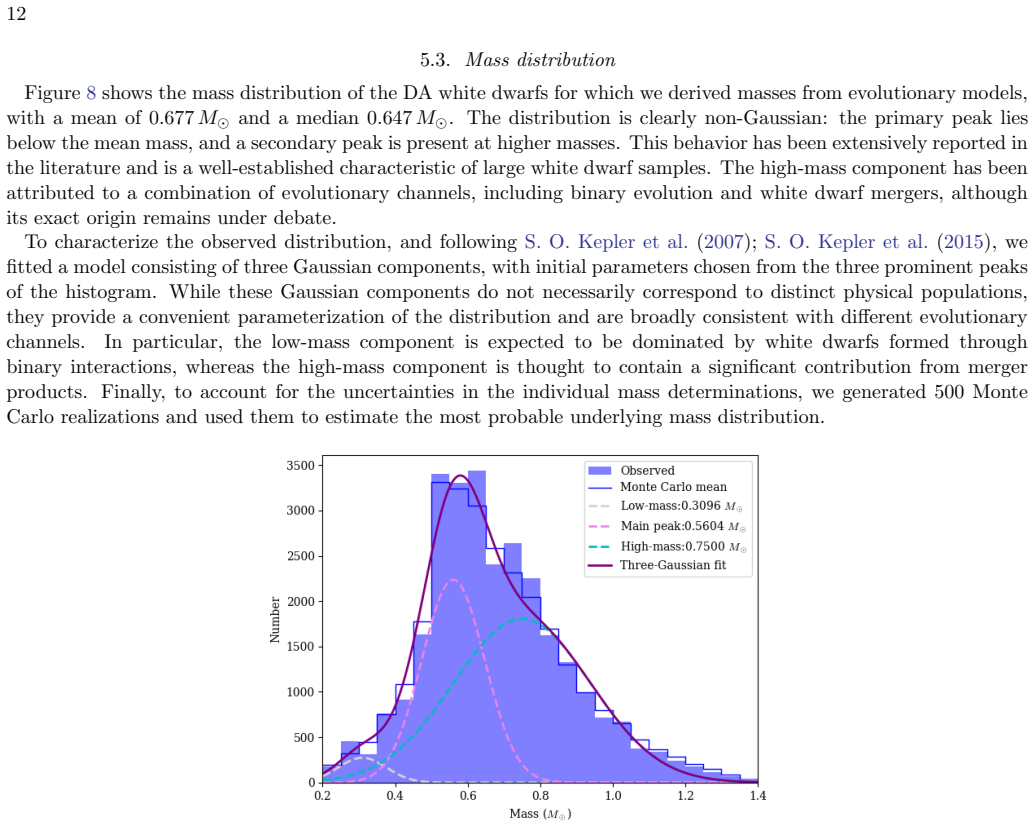
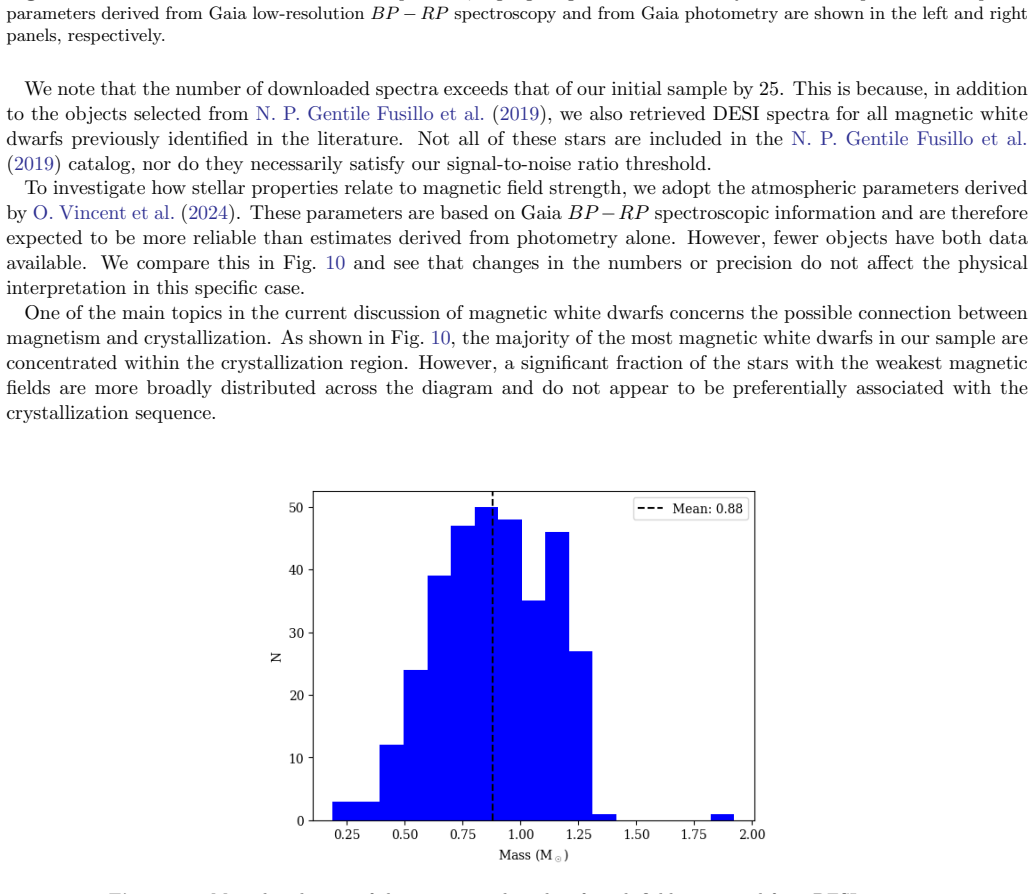
- The overall white dwarf mass distribution is non-Gaussian with a mean of 0.677 solar masses.
- Large spectroscopic surveys can uncover dozens of new magnetic white dwarfs.
Where Pith is reading between the lines
- Alternative field-generation processes such as inherited fields from progenitor stars may operate alongside any crystallization-related mechanism.
- Surveys targeting younger white dwarfs could test whether even weaker fields are common before crystallization.
- Mass-dependent selection effects in future catalogs should be checked against these magnetic trends.
Load-bearing premise
The visual classification of 44,417 spectra is accurate and unbiased, and the spectroscopic model fitting for DA white dwarfs produces reliable atmospheric parameters without significant systematic errors.
What would settle it
A sample of magnetic white dwarfs with masses matching the non-magnetic population or with fields appearing only after crystallization would contradict the reported relations.
Figures
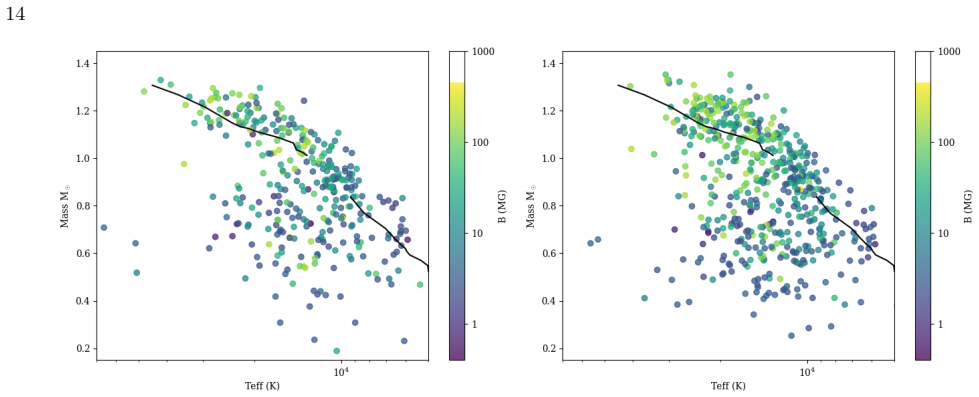
read the original abstract
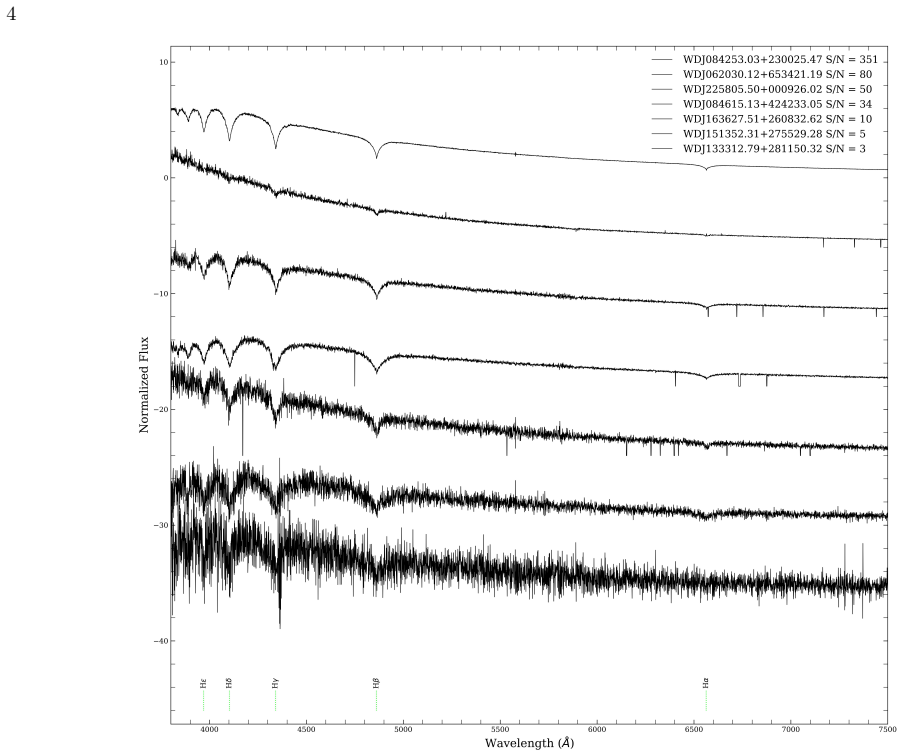
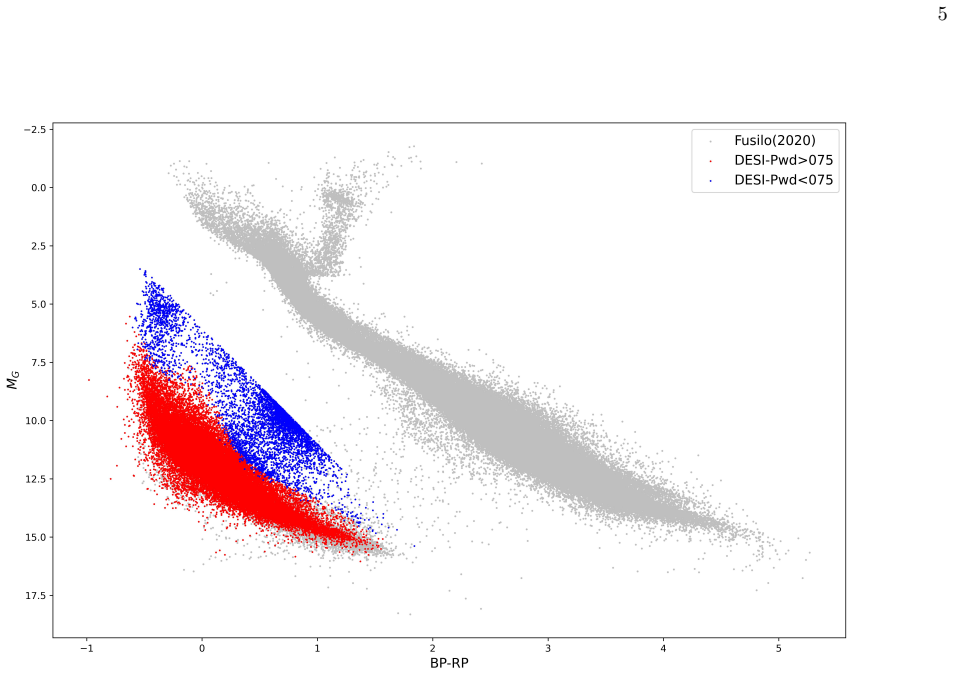
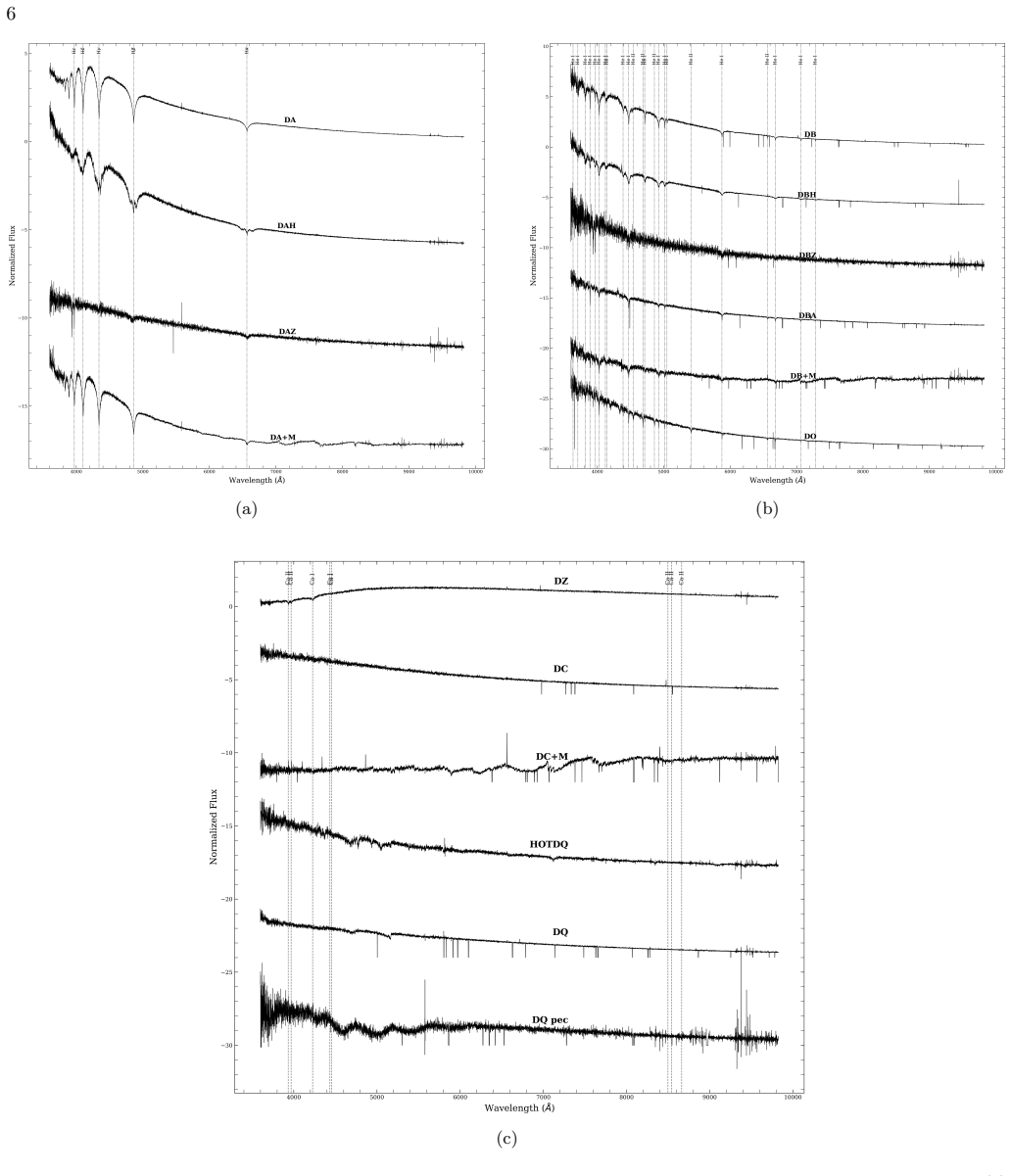
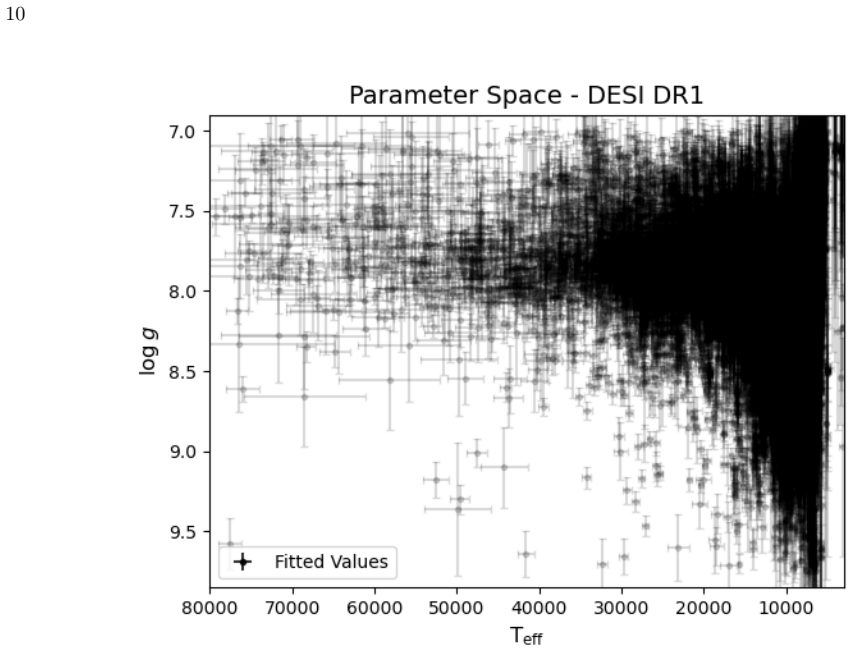
We present a new catalog of spectroscopically confirmed white dwarfs from the Dark Energy Spectroscopic Instrument (DESI) Data Release 1. We visually classified 44,417 white dwarf spectra and derived atmospheric parameters for 29,072 DA white dwarfs through spectroscopic model fitting. The resulting mass distribution is non-Gaussian, with a mean mass of $0.677\,M_\odot$, consistent with previous studies. We identify 547 magnetic white dwarfs by detecting Zeeman splitting, including 84 new discoveries, and estimate their magnetic field strengths using off-centered, inclined dipole models when possible. We compare our magnetic field determinations with previous measurements and find overall good agreement. Finally, we investigate the relation between stellar properties and magnetism, finding that magnetic white dwarfs are systematically more massive than the general white dwarf population and that intermediate-strength magnetic fields are already present in stars that have not yet entered the crystallization phase. This result suggests that crystallization is unlikely to be the sole mechanism responsible for the origin of magnetic fields in white dwarfs.
Editorial analysis
A structured set of objections, weighed in public.
Referee Report
Summary. The manuscript presents a catalog of spectroscopically confirmed white dwarfs from DESI DR1. It reports visual classification of 44,417 spectra, spectroscopic model fitting to derive atmospheric parameters for 29,072 DA white dwarfs (mean mass 0.677 M_⊙), identification of 547 magnetic white dwarfs (84 new) via Zeeman splitting with field strength estimates from off-centered dipole models, and comparisons showing magnetic white dwarfs are systematically more massive with intermediate-strength fields present prior to crystallization, implying crystallization is unlikely to be the sole origin mechanism.
Significance. If robust, the large sample size and the pre-crystallization field detection would be a notable contribution to white dwarf population studies and magnetic field origin models. The work adds substantially to the known magnetic white dwarf sample and provides direct comparisons to prior measurements. No machine-checked proofs or parameter-free derivations are present, but the scale of the observational catalog is a clear strength.
major comments (2)
- [Visual classification and magnetic sample selection] Visual classification section: The identification of the 547 magnetic white dwarfs rests on visual detection of Zeeman splitting across 44,417 spectra, yet no quantitative metrics (repeatability, inter-rater agreement, or false-positive rate) are supplied. This directly affects the reliability of the reported mass offset between magnetic and non-magnetic populations.
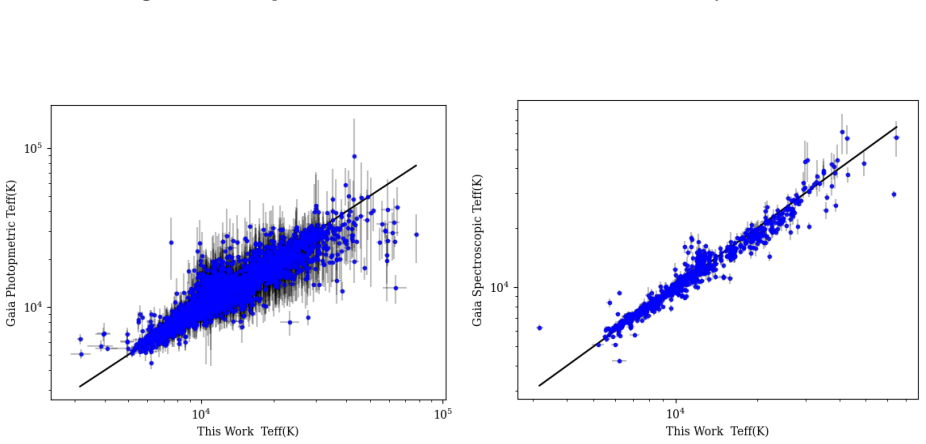
- [DA parameter derivation and crystallization analysis] Spectroscopic model fitting section: Atmospheric parameters (Teff, log g, mass) for the 29,072 DA white dwarfs are obtained via model fitting, but the manuscript provides no cross-validation against photometric masses, no tests of systematic errors induced by weak magnetic fields, and no explicit exclusion criteria or crystallization boundary definition. These steps are required to support the claim that intermediate fields appear before crystallization.
minor comments (2)
- [Results on mass distribution] The statement that the mass distribution is 'non-Gaussian' would benefit from a quantitative measure (e.g., skewness statistic or comparison to a Gaussian fit) rather than qualitative description.
- [Figures] Figure captions for example spectra and mass histograms should explicitly label which panels or symbols correspond to magnetic versus non-magnetic objects for immediate clarity.
Simulated Author's Rebuttal
We thank the referee for their careful and constructive review. The comments highlight important aspects of the classification and analysis that we will strengthen in revision. We address each major comment below.
read point-by-point responses
-
Referee: Visual classification section: The identification of the 547 magnetic white dwarfs rests on visual detection of Zeeman splitting across 44,417 spectra, yet no quantitative metrics (repeatability, inter-rater agreement, or false-positive rate) are supplied. This directly affects the reliability of the reported mass offset between magnetic and non-magnetic populations.
Authors: We agree that quantitative metrics for the visual classification process are not provided in the current version and that their absence limits assessment of the magnetic sample reliability. In the revised manuscript we will add a dedicated subsection describing the classification workflow: all spectra were examined independently by at least two team members, with disagreements resolved through joint review and consensus; we will report the inter-rater agreement fraction on a randomly selected 10% subsample and will estimate the false-positive rate by applying the identical visual criteria to a control set of 500 spectroscopically confirmed non-magnetic DA white dwarfs drawn from the literature. These additions will directly support the robustness of the reported mass offset. revision: yes
-
Referee: Spectroscopic model fitting section: Atmospheric parameters (Teff, log g, mass) for the 29,072 DA white dwarfs are obtained via model fitting, but the manuscript provides no cross-validation against photometric masses, no tests of systematic errors induced by weak magnetic fields, and no explicit exclusion criteria or crystallization boundary definition. These steps are required to support the claim that intermediate fields appear before crystallization.
Authors: We acknowledge that the manuscript currently lacks these validation steps and explicit definitions. We will add: (1) a comparison of spectroscopic masses against photometric masses derived from Gaia DR3 photometry and parallaxes for the subset of objects with reliable photometry; (2) a brief discussion of possible systematic biases from undetected weak fields, noting that the magnetic sample is defined by clearly resolved Zeeman splitting and that objects with marginal splitting were excluded; (3) the explicit crystallization boundary adopted from the standard cooling models of Salaris et al. (2010) together with the precise exclusion criteria used to identify pre-crystallization objects. These additions will clarify the supporting evidence for the pre-crystallization field detection. revision: yes
Circularity Check
No circularity: purely observational catalog and comparison
full rationale
The paper performs visual classification of 44,417 spectra, spectroscopic model fitting for DA parameters, Zeeman-based identification of 547 magnetic white dwarfs, and direct comparison of mass distributions to prior work. No equations, fitted parameters renamed as predictions, self-definitional steps, or load-bearing self-citations appear in the derivation chain. All central claims rest on empirical measurements and external benchmarks rather than any reduction to the paper's own inputs by construction.
Axiom & Free-Parameter Ledger
axioms (2)
- domain assumption Standard DA white dwarf atmosphere models accurately recover temperature, gravity, and mass from spectra.
- domain assumption Zeeman splitting detection reliably identifies magnetic white dwarfs and off-centered dipole models give valid field strengths.
Reference graph
Works this paper leans on
-
[1]
Althaus, L. G., Miller Bertolami, M. M., & C´ orsico, A. H. 2013, A&A, 557, A19, doi: 10.1051/0004-6361/201321868
-
[2]
Romero, A. D. 2023, ApJ, 944, 56, doi: 10.3847/1538-4357/acaf6e
-
[3]
Amorim, L. L., Kepler, S. O., & Romero, A. D. 2026, ApJ, 1001, 202, doi: 10.3847/1538-4357/ae5524
-
[4]
Bagnulo, S., & Landstreet, J. D. 2022, ApJL, 935, L12, doi: 10.3847/2041-8213/ac84d3
-
[5]
Barstow, M. A., Barstow, J. K., Casewell, S. L., Holberg, J. B., & Hubeny, I. 2014, MNRAS, 440, 1607, doi: 10.1093/mnras/stu216
-
[6]
2024, White dwarf fundamentals, https://arxiv.org/abs/2409.03941
Blouin, S. 2024, White dwarf fundamentals, https://arxiv.org/abs/2409.03941
-
[7]
Bruhweiler, F. C., & Kondo, Y. 1983, ApJ, 269, 657, doi: 10.1086/161073
-
[8]
Data Release 1 of the Dark Energy Spectroscopic Instrument
Chayer, P., Bergeron, P., Fontaine, G., & Wesemael, F. 1989, JRASC, 83, 325 DESI Collaboration, Abdul-Karim, M., Adame, A. G., et al. 2025 arXiv e-prints, doi: 10.48550/arXiv.2503.14745 DESI Collaboration, Abareshi, B., Aguilar, J., et al. 2022, AJ, 164, 207, doi: 10.3847/1538-3881/ac882b
work page internal anchor Pith review Pith/arXiv arXiv doi:10.48550/arxiv.2503.14745 1989
-
[9]
2005, ApJ, 627, 404, doi: 10.1086/430373
Dufour, P., Bergeron, P., & Fontaine, G. 2005, ApJ, 627, 404, doi: 10.1086/430373
-
[10]
The Montreal White Dwarf Database: a Tool for the Community
Dufour, P., Blouin, S., Coutu, S., et al. 2017, in Astronomical Society of the Pacific Conference Series, Vol. 509, 20th European White Dwarf Workshop, ed. P.-E. Tremblay, B. Gaensicke, & T. Marsh, 3, doi: 10.48550/arXiv.1610.00986
work page internal anchor Pith review Pith/arXiv arXiv doi:10.48550/arxiv.1610.00986 2017
-
[11]
Ferrario, L., de Martino, D., & G¨ ansicke, B. T. 2015, SSRv, 191, 111, doi: 10.1007/s11214-015-0152-0
-
[12]
2008, PASP, 120, 1043, doi: 10.1086/592788 16
Fontaine, G., & Brassard, P. 2008, PASP, 120, 1043, doi: 10.1086/592788 16
-
[13]
2001, PASP, 113, 409, doi: 10.1086/319535
Fontaine, G., Brassard, P., & Bergeron, P. 2001, PASP, 113, 409, doi: 10.1086/319535
-
[14]
1979, ApJ, 231, 826, doi: 10.1086/157247 Gentile Fusillo, N
Fontaine, G., & Michaud, G. 1979, ApJ, 231, 826, doi: 10.1086/157247 Gentile Fusillo, N. P., Tremblay, P.-E., G¨ ansicke, B. T., et al. 2019, MNRAS, 482, 4570, doi: 10.1093/mnras/sty3016 Gentile Fusillo, N. P., Tremblay, P.-E., Cukanovaite, E., et al. 2021, Monthly Notices of the Royal Astronomical Society, 508, 3877, doi: 10.1093/mnras/stab2672
-
[15]
Ghazaryan, S., Alecian, G., & Hakobyan, A. A. 2018, Monthly Notices of the Royal Astronomical Society, 480, 2953, doi: 10.1093/mnras/sty1912
-
[16]
2023, AJ, 165, 144, doi: 10.3847/1538-3881/acb212
Guy, J., Bailey, S., Kremin, A., et al. 2023, AJ, 165, 144, doi: 10.3847/1538-3881/acb212
-
[17]
2023, MNRAS, 520, 6111, doi: 10.1093/mnras/stad196
Hardy, F., Dufour, P., & Jordan, S. 2023, MNRAS, 520, 6111, doi: 10.1093/mnras/stad196
-
[18]
2016, PASP, 128, 082001, doi: 10.1088/1538-3873/128/966/082001
Heber, U. 2016, PASP, 128, 082001, doi: 10.1088/1538-3873/128/966/082001
-
[19]
A., Tremblay, P.-E., G¨ ansicke, B
Hollands, M. A., Tremblay, P.-E., G¨ ansicke, B. T., et al. 2018, MNRAS, 480, 3942
2018
-
[20]
2024, ApJ, 974, 12, doi: 10.3847/1538-4357/ad6905
Jewett, G., Kilic, M., Bergeron, P., et al. 2024, ApJ, 974, 12, doi: 10.3847/1538-4357/ad6905
-
[21]
Kepler, S. O., Kleinman, S. J., Nitta, A., et al. 2007, MNRAS, 375, 1315, doi: 10.1111/j.1365-2966.2006.11388.x
-
[22]
2021, Monthly Notices of the Royal Astronomical Society, 507, 4646–4660, doi: 10.1093/mnras/stab2411
Ourique, G. 2021, Monthly Notices of the Royal Astronomical Society, 507, 4646–4660, doi: 10.1093/mnras/stab2411
-
[23]
O., Pelisoli, I., Koester, D., et al
Kepler, S. O., Pelisoli, I., Koester, D., et al. 2015 MNRAS, 446, 4078, doi: 10.1093/mnras/stu2388
-
[25]
O., Pelisoli, I., Jordan, S., et al
Kepler, S. O., Pelisoli, I., Jordan, S., et al. 2013, MNRAS, 429, 2934, doi: 10.1093/mnras/sts522
-
[26]
O., Pelisoli, I., Koester, D., et al
Kepler, S. O., Pelisoli, I., Koester, D., et al. 2019, MNRAS, 486, 2169, doi: 10.1093/mnras/stz960
-
[27]
2026, ApJ, 1000, 216, doi: 10.3847/1538-4357/ae43ee
Kilic, M., Bergeron, P., Moss, A., et al. 2026, ApJ, 1000, 216, doi: 10.3847/1538-4357/ae43ee
-
[28]
Kleinman, S. J., Kepler, S. O., Koester, D., et al. 2013, ApJS, 204, 5, doi: 10.1088/0067-0049/204/1/5
-
[29]
2010, Mem
Koester, D. 2010, Mem. Soc. Astron. Italiana, 81, 921 K¨ ulebi, B., Jordan, S., Euchner, F., G¨ ansicke, B. T., &
2010
-
[30]
2009, A&A, 506, 1341, doi: 10.1051/0004-6361/200912570
Hirsch, H. 2009, A&A, 506, 1341, doi: 10.1051/0004-6361/200912570
-
[31]
Lauffer, G. R., Romero, A. D., & Kepler, S. O. 2018, MNRAS, 480, 1547, doi: 10.1093/mnras/sty1925
-
[32]
J., Izquierdo, P., G¨ ansicke, B
Manser, C. J., Izquierdo, P., G¨ ansicke, B. T., et al. 2024 MNRAS, 535, 254, doi: 10.1093/mnras/stae2205
-
[33]
Morales, R. A., Castanheira, B. G., Blanchard, J., et al. 2025, ApJ, 992, 150, doi: 10.3847/1538-4357/adff84
-
[34]
2025, ApJ, 990, 25, doi: 10.3847/1538-4357/aded8f
Moss, A., Kilic, M., Bergeron, P., et al. 2025, ApJ, 990, 25, doi: 10.3847/1538-4357/aded8f
-
[35]
Pelisoli, I., Kepler, S. O., & Koester, D. 2018, MNRAS, 475, 2480, doi: 10.1093/mnras/sty011
-
[36]
Rebassa-Mansergas, A., G¨ ansicke, B. T., & Koester, D. 2009, in Journal of Physics Conference Series, Vol. 172, Journal of Physics Conference Series (IOP), 012025, doi: 10.1088/1742-6596/172/1/012025
-
[37]
2026, A&A, 709, A250, doi: 10.1051/0004-6361/202660074
Rebassa-Mansergas, A., Tejero-G´ omez, I., & Raddi, R. 2026, A&A, 709, A250, doi: 10.1051/0004-6361/202660074
-
[38]
Rebassa-Mansergas, A., Solano, E., Jim´ enez-Esteban, F. M., et al. 2021, MNRAS, 506, 5201, doi: 10.1093/mnras/stab2039
-
[39]
Rebassa-Mansergas, A., Solano, E., Brown, A. J., et al. 2025, A&A, 699, A153, doi: 10.1051/0004-6361/202554700
-
[40]
Toonen, S., Hollands, M., G¨ ansicke, B. T., & Boekholt, T. 2017, A&A, 602, A16, doi: 10.1051/0004-6361/201629978
-
[41]
Vincent, O., Barstow, M. A., Jordan, S., et al. 2024, A&A, 682, A5, doi: 10.1051/0004-6361/202347694
-
[42]
Williams, K. A., Kepler, S. O., & Sion, E. M. 2019, Research Notes of the American Astronomical Society, 3, 109, doi: 10.3847/2515-5172/ab3469
-
[43]
Yu, S.-C., Ren, J.-J., Neustroev, V. V., et al. 2026, A&A, 708, A275, doi: 10.1051/0004-6361/202557083
discussion (0)
Sign in with ORCID, Apple, or X to comment. Anyone can read and Pith papers without signing in.