Evolution of Stars During the Main Sequence and the Transition to the Red Giant Phase
Pith reviewed 2026-06-25 22:32 UTC · model grok-4.3
The pith
An analytical relation shows main-sequence stars of 3-10 solar masses terminate when core hydrogen drops to 2.5e-4 and core mass reaches 0.11 of total mass.
A machine-rendered reading of the paper's core claim, the machinery that carries it, and where it could break.
Core claim
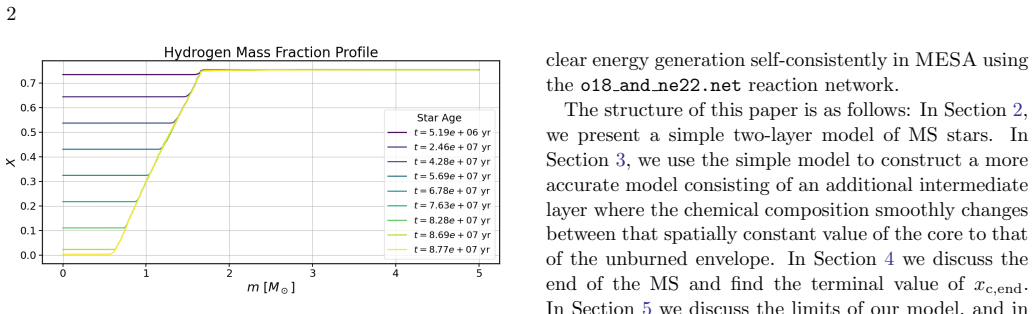
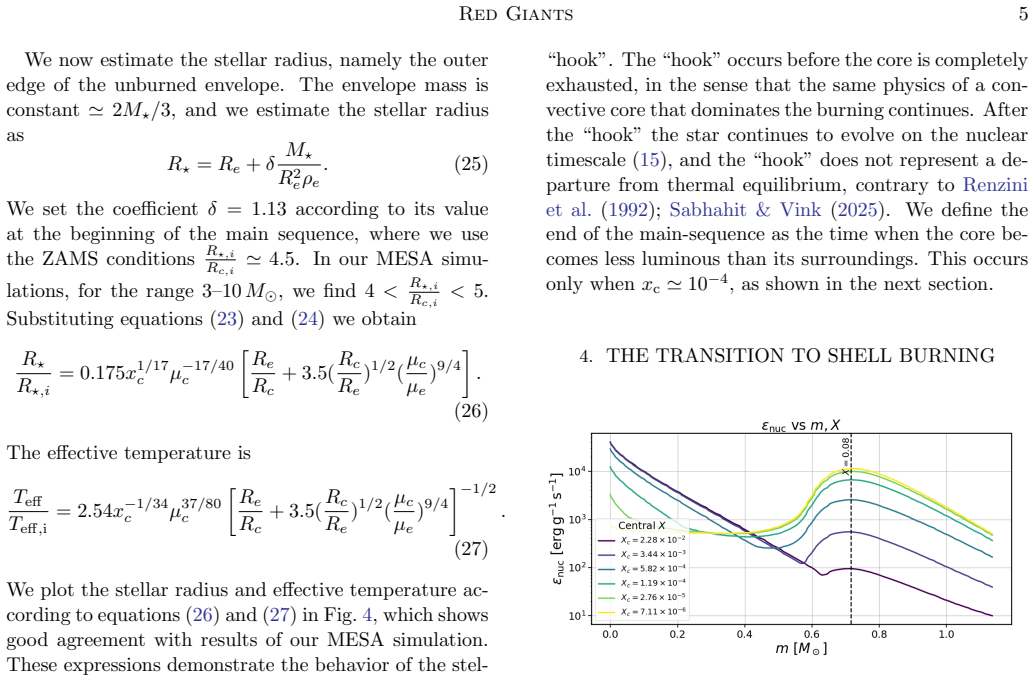
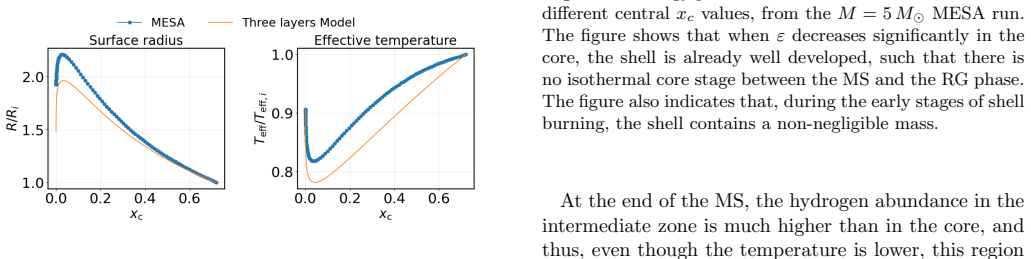
The central claim is that the convective core mass obeys the relation M_star/M_c = 1 + 2.1 (mu_c / mu_e)^2. This relation yields mu(m) proportional to m to the minus 0.7 outside the core; the resulting power-law structure allows analytic expressions for stellar radius, luminosity and effective temperature as functions of mu_c. The main-sequence hook occurs at core hydrogen fraction x_c approximately 0.045. The sequence itself terminates only once x_c reaches approximately 2.5 times 10 to the minus 4, when M_c reaches 0.11 M_star and the shell luminosity becomes comparable to the core luminosity; at that stage the core remains far from isothermal and therefore the termination is unrelated to
What carries the argument
The closed-form convective-core-mass relation M_star/M_c = 1 + 2.1 (mu_c / mu_e)^2, which closes the analytic expressions for the hydrogen profile and the power-law thermodynamic structure outside the core.
Load-bearing premise
Temperature, density and pressure follow power laws of radius throughout the region of variable mean molecular weight outside the convective core.
What would settle it
A direct numerical check whether the core mass fraction reaches 0.11 and the core hydrogen fraction falls to 2.5e-4 at the point where shell luminosity equals core luminosity, using independent stellar-evolution codes or cluster turn-off data for stars of 3-10 solar masses.
Figures
read the original abstract
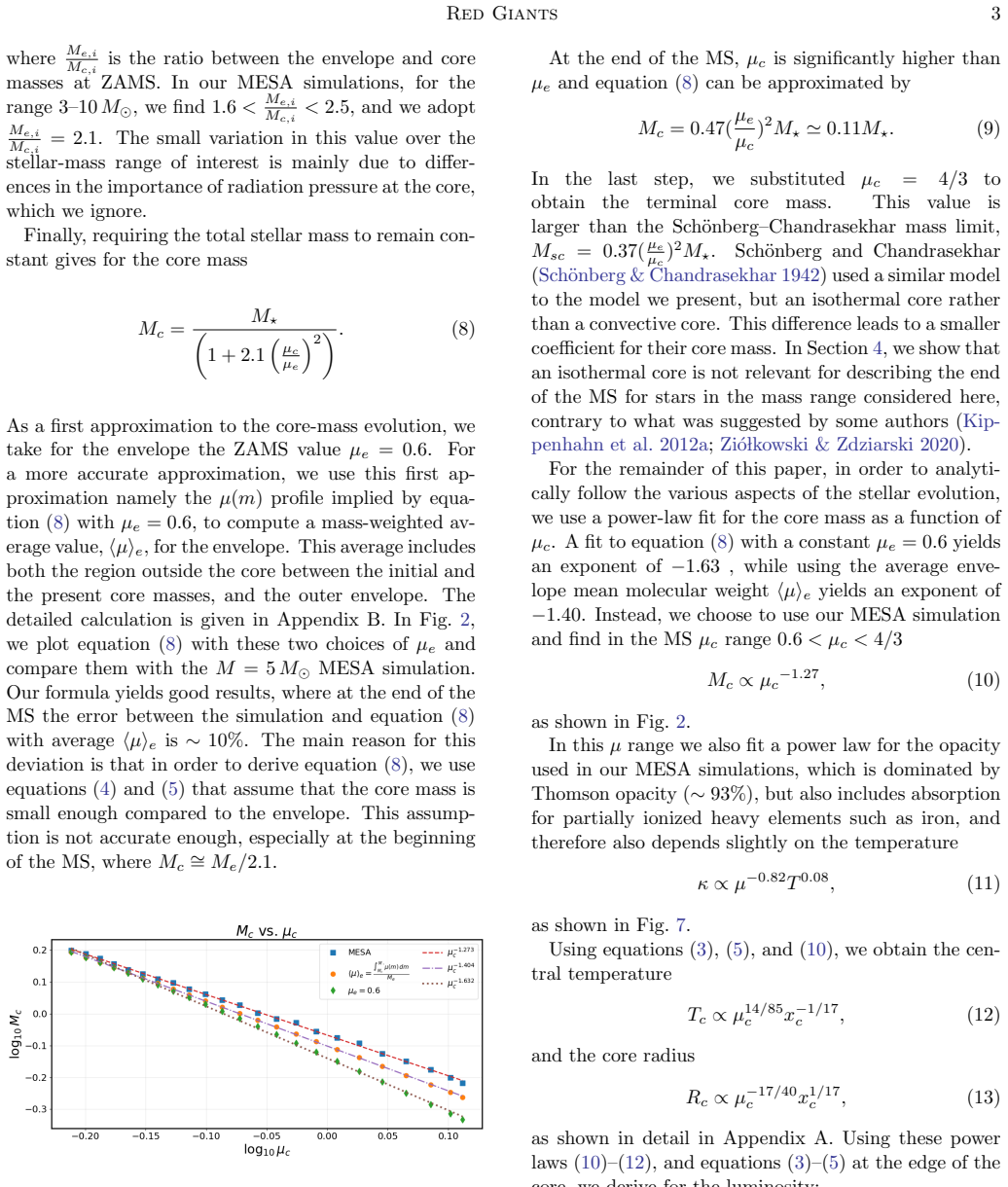
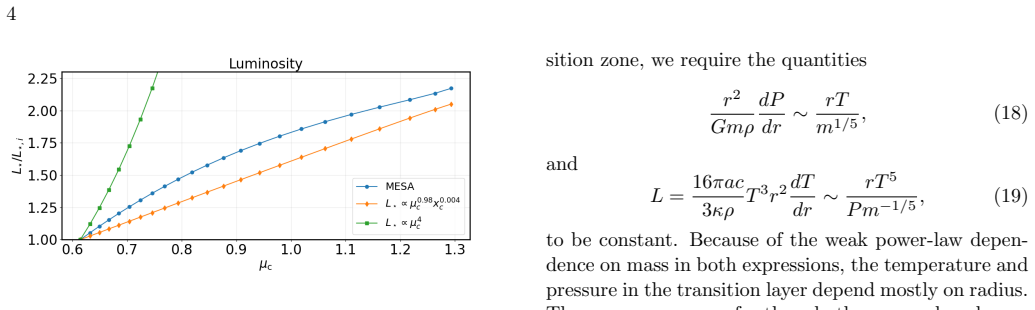
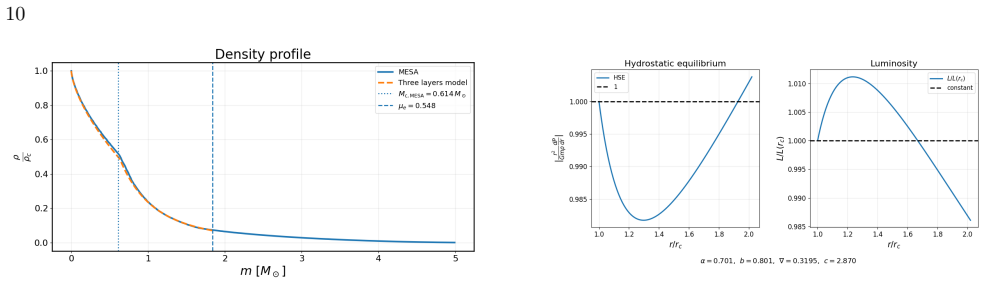
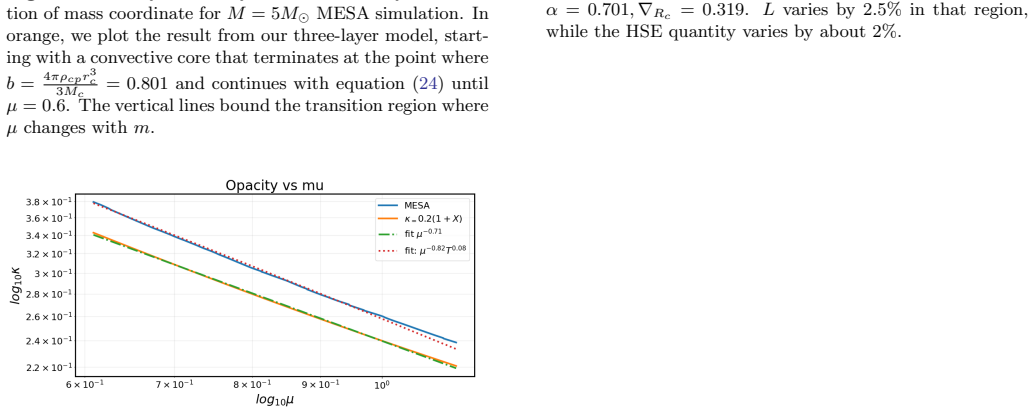
We derive a simple analytical description for the structure and evolution of $3$--$10 M_\odot$ stars throughout main-sequence hydrogen burning. We obtain an analytical relation for the convective core mass, $\frac{M_\star}{M_c}=1+2.1\left(\frac{\mu_c}{\mu_e}\right)^2$, where $\mu$ is the mean molecular weight of the core and envelope. Using this relation, we analytically derive the hydrogen abundance profile outside the convective core. We find that $\mu(m)\propto m^{-0.7}$, and show that this profile is important for an analytical description of these stars. Within this region of variable $\mu$, the temperature, density, and pressure are well approximated by power laws of radius. We derive analytical expressions for the core and stellar radii, stellar luminosity, and effective temperature as functions of $\mu_c$. We provide a simple physical explanation for the main-sequence hook, defined by the minimum in effective temperature. We show that the hook occurs when the hydrogen mass fraction in the core is $x_c\simeq0.045$, and stress that the same convective-core burning physics governs the subsequent evolution. In that sense, at the hook hydrogen is not yet fully exhausted. During late main-sequence evolution, we find that the ratio of nuclear luminosity between the core and the surrounding hydrogen-rich shell is $\simeq4000x_c$. Hence, the main sequence terminates only once $x_c\simeq2.5\times10^{-4}$, when the surrounding layers become as luminous as the core itself and $M_c\simeq0.11 M_\star$. Although this terminal core mass is numerically similar to the Sch"onberg--Chandrasekhar limit, we show that the two are physically unrelated, since the core remains far from isothermal even at this stage. We validate all analytical results using MESA simulations.
Editorial analysis
A structured set of objections, weighed in public.
Referee Report
Summary. The paper derives an analytical model for the structure and evolution of 3–10 M⊙ stars during core hydrogen burning. It obtains the convective-core mass relation M⋆/Mc = 1 + 2.1(μc/μe)², shows that μ(m) ∝ m^{-0.7} outside the core, adopts power-law forms for T(r), ρ(r), and P(r) in the variable-μ radiative zone, and derives closed-form expressions for core and stellar radius, luminosity, and Teff(μc). The model supplies a physical account of the main-sequence hook (at xc ≃ 0.045) and the termination of the main sequence (at xc ≃ 2.5 × 10^{-4}, Mc ≃ 0.11 M⋆), argues that the terminal core mass is unrelated to the Schönberg–Chandrasekhar limit because the core remains non-isothermal, and validates the relations against MESA simulations.
Significance. If the approximations are robust, the work supplies a compact analytical framework that isolates the role of the μ gradient and offers a transparent explanation for the hook and the end of the main sequence in intermediate-mass stars. The explicit MESA validation is a positive feature that permits direct assessment of the power-law closure. The presence of a fitted numerical coefficient and an imposed functional form, however, limits the extent to which the results can be regarded as parameter-free or derived from first principles.
major comments (3)
- [core-mass relation (abstract and § deriving Mc)] The coefficient 2.1 that appears in the central core-mass relation M⋆/Mc = 1 + 2.1(μc/μe)² is not obtained from the stellar-structure equations but is inserted to reproduce numerical structure; its presence converts the claimed “analytical relation” into a semi-empirical fit whose value must be re-determined for any change in input physics.
- [variable-μ region and derivation of R, L, Teff] The power-law closures T ∝ r^α, ρ ∝ r^β, P ∝ r^γ adopted throughout the radiative zone of varying μ are stated to be “well approximated” but are not derived from the equations of stellar structure; they are imposed to obtain closed-form expressions for R, L, and Teff. No error budget or sensitivity study is supplied showing how the derived indices vary with μc or with radius, which directly controls the quantitative predictions for the hook location and the termination condition xc ≃ 2.5 × 10^{-4}.
- [late main-sequence evolution and termination] The termination criterion (nuclear luminosity ratio core/shell ≃ 4000 xc, shell luminosity equals core luminosity at xc ≃ 2.5 × 10^{-4}) follows from the same power-law model. Because the indices themselves are not shown to be constant across the relevant range of μc, the numerical value of the terminal core mass Mc ≃ 0.11 M⋆ and the claim that it is unrelated to the Schönberg–Chandrasekhar limit rest on an unquantified approximation.
minor comments (1)
- [abstract and text] The spelling “Sch"onberg” should be corrected to “Schönberg” throughout.
Simulated Author's Rebuttal
We thank the referee for the thorough review and valuable feedback on our manuscript. We respond to each major comment in turn and indicate the changes we will make to address the concerns raised.
read point-by-point responses
-
Referee: [core-mass relation (abstract and § deriving Mc)] The coefficient 2.1 that appears in the central core-mass relation M⋆/Mc = 1 + 2.1(μc/μe)² is not obtained from the stellar-structure equations but is inserted to reproduce numerical structure; its presence converts the claimed “analytical relation” into a semi-empirical fit whose value must be re-determined for any change in input physics.
Authors: We agree with the referee that the coefficient 2.1 is determined empirically by comparison with numerical stellar models rather than being derived solely from the stellar structure equations. The quadratic dependence on the μ ratio follows from our analytical integration assuming a sharp μ jump at the core boundary. In the revised manuscript, we will modify the abstract and relevant sections to describe the relation as semi-analytical, explicitly noting the calibration of the coefficient against MESA simulations. We will also provide additional discussion on the sensitivity of this coefficient to changes in input physics such as opacity and nuclear rates. revision: yes
-
Referee: [variable-μ region and derivation of R, L, Teff] The power-law closures T ∝ r^α, ρ ∝ r^β, P ∝ r^γ adopted throughout the radiative zone of varying μ are stated to be “well approximated” but are not derived from the equations of stellar structure; they are imposed to obtain closed-form expressions for R, L, and Teff. No error budget or sensitivity study is supplied showing how the derived indices vary with μc or with radius, which directly controls the quantitative predictions for the hook location and the termination condition xc ≃ 0.045 and xc ≃ 2.5 × 10^{-4}.
Authors: The power-law forms are chosen because they provide a good approximation to the numerical profiles obtained from MESA, allowing us to derive closed-form expressions. We recognize that a sensitivity study of the indices with respect to μc and radius was not included. In the revision we will add an analysis showing the variation of α, β, and γ across the main-sequence evolution and quantify the impact on the predicted locations of the hook and main-sequence termination. This will include direct comparisons of the analytical predictions with MESA results to establish an error budget. revision: yes
-
Referee: [late main-sequence evolution and termination] The termination criterion (nuclear luminosity ratio core/shell ≃ 4000 xc, shell luminosity equals core luminosity at xc ≃ 2.5 × 10^{-4}) follows from the same power-law model. Because the indices themselves are not shown to be constant across the relevant range of μc, the numerical value of the terminal core mass Mc ≃ 0.11 M⋆ and the claim that it is unrelated to the Schönberg–Chandrasekhar limit rest on an unquantified approximation.
Authors: We note that the power-law indices are approximately constant in our MESA validation, which underpins the termination criterion. However, we agree that an explicit demonstration of their constancy over the late main-sequence range of μc would strengthen the argument. The physical distinction from the Schönberg-Chandrasekhar limit is based on the temperature gradient in the core, which is shown to persist in the models. We will incorporate in the revised manuscript a plot or table demonstrating the stability of the indices during the relevant evolutionary phase and discuss the implications for the terminal Mc and its relation to the SC limit. revision: yes
Circularity Check
Fitted 2.1 coefficient in core-mass relation and imposed power-law ansatz reduce central analytical results to inputs by construction
specific steps
-
fitted input called prediction
[Abstract]
"We obtain an analytical relation for the convective core mass, M⋆/Mc=1+2.1(μc/μe)², where μ is the mean molecular weight of the core and envelope. ... Within this region of variable μ, the temperature, density, and pressure are well approximated by power laws of radius. We derive analytical expressions for the core and stellar radii, stellar luminosity, and effective temperature as functions of μc."
The coefficient 2.1 is inserted to match structure (not obtained from first-principles integration of the equations) and the power-law forms are imposed as an approximation to close the algebra; the derived μ(m)∝m^{-0.7} profile, the hook location, the xc termination value, and the Mc≈0.11M⋆ result are therefore forced by these inputs rather than independent predictions.
full rationale
The paper presents an 'analytical relation' M⋆/Mc = 1 + 2.1(μc/μe)² and subsequent closed-form expressions for μ(m), R, L, Teff that rest on this coefficient plus the statement that T, ρ, P 'are well approximated by power laws of radius' in the variable-μ zone. Both the numerical prefactor and the power-law closure are adopted to obtain tractable expressions rather than derived from the stellar structure equations; the termination condition xc ≃ 2.5×10^{-4} and the claimed independence from the Schönberg-Chandrasekhar limit then follow directly from these fitted/ansatz forms. Validation against MESA does not remove the circularity in the derivation chain itself.
Axiom & Free-Parameter Ledger
free parameters (1)
- coefficient 2.1 =
2.1
axioms (2)
- standard math Hydrostatic equilibrium, energy generation, and radiative/convective transport hold in the standard form for main-sequence stars.
- domain assumption Power-law approximations for T, rho, P versus radius are valid in the variable-mu envelope region.
Reference graph
Works this paper leans on
-
[1]
Anders, E. H., & Pedersen, M. G. 2023, Galaxies, 11, 56, doi: 10.3390/galaxies11020056
-
[2]
Bareli, H., & Ginzburg, S. 2026
2026
-
[3]
2000, Astronomy and Astrophysics, 360, 952
Herwig, F. 2000, Astronomy and Astrophysics, 360, 952
2000
-
[4]
2007, Nuclear Physics of Stars (Wiley-VCH)
Iliadis, C. 2007, Nuclear Physics of Stars (Wiley-VCH)
2007
-
[5]
Jermyn, A. S., Bauer, E. B., Schwab, J., et al. 2023, The Astrophysical Journal Supplement Series, 265, 15, doi: 10.3847/1538-4365/acbcce
-
[6]
Kippenhahn, R., Weigert, A., & Weiss, A. 2012a, Springer —. 2012b, Stellar Structure and Evolution, 2nd edn., Astronomy and Astrophysics Library (Springer), doi: 10.1007/978-3-642-30304-3
-
[7]
Aguilera-Dena, D. R. 2020, Astronomy & Astrophysics, 642, A174, doi: 10.1051/0004-6361/202038070
-
[8]
2011, ApJS, 192, 3, doi: 10.1088/0067-0049/192/1/3
Paxton, B., Bildsten, L., Dotter, A., et al. 2011, The Astrophysical Journal Supplement Series, 192, 3, doi: 10.1088/0067-0049/192/1/3
-
[10]
Paxton, B., Cantiello, M., Arras, P., et al. 2013, The Astrophysical Journal Supplement Series, 208, 4, doi: 10.1088/0067-0049/208/1/4
work page internal anchor Pith review doi:10.1088/0067-0049/208/1/4 2013
-
[11]
Modules for Experiments in Stellar Astrophysics (MESA): Binaries, Pulsations, and Explosions
Paxton, B., Marchant, P., Schwab, J., et al. 2015, The Astrophysical Journal Supplement Series, 220, 15, doi: 10.1088/0067-0049/220/1/15
work page internal anchor Pith review doi:10.1088/0067-0049/220/1/15 2015
-
[12]
Paxton, B., Schwab, J., Bauer, E. B., et al. 2018, The Astrophysical Journal Supplement Series, 234, 34, doi: 10.3847/1538-4365/aaa5a8
work page internal anchor Pith review doi:10.3847/1538-4365/aaa5a8 2018
-
[13]
2019, ApJS, 243, 10, doi: 10.3847/1538-4365/ab2241
Paxton, B., Smolec, R., Schwab, J., et al. 2019, The Astrophysical Journal Supplement Series, 243, 10, doi: 10.3847/1538-4365/ab2241
-
[14]
Eggleton, P. P. 1998, Monthly Notices of the Royal Astronomical Society, 298, 525, doi: 10.1046/j.1365-8711.1998.01658.x
-
[15]
1992, The Astrophysical Journal, 400, 280, doi: 10.1086/171995
Renzini, A., Greggio, L., Ritossa, C., & Ferrario, L. 1992, The Astrophysical Journal, 400, 280, doi: 10.1086/171995
-
[16]
Sabhahit, G. N., & Vink, J. S. 2025, A&A, 693, A10, doi: 10.1051/0004-6361/202451976 Sch¨ onberg, M., & Chandrasekhar, S. 1942, Astrophysical Journal, 96, 161
-
[17]
2012, The Astrophysical Journal
Shao, Y., & Li, X.-D. 2012, The Astrophysical Journal
2012
-
[18]
Tauris, T. M. 2011, Monthly Notices of the Royal Astronomical Society
2011
-
[19]
Tauris, T. M., van den Heuvel, E. P. J., & Savonije, G. J. 2000, The Astrophysical Journal Letters, 530, L93 Zi´ o lkowski, J., & Zdziarski, A. A. 2020, Monthly Notices of the Royal Astronomical Society, 499, 4832, doi: 10.1093/mnras/staa3088
discussion (0)
Sign in with ORCID, Apple, or X to comment. Anyone can read and Pith papers without signing in.