REVIEW 4 major objections 5 minor 20 references
Recognizing Image Objects by Relational Analysis Using Heterogeneous Superpixels and Deep Convolutional Features
T0 review · 4 major / 5 minor · reviewed 2026-08-14 · deepseek-v4-flash
Pith's one-line read A Superpixel Capsule Network pools convolutional features into superpixel regions, routes them as capsules to class capsules, and obtains about 89% validation accuracy on Linnaeus 5 with 88% fewer trainable parameters than VGG-16, while…
desk verdict Genuinely new combination of SLIC superpixels and capsule routing with a defensible feasibility result, but the part-whole interpretability claim is unsupported and the evaluation details are sloppy. read the letter →
The pith
A machine-rendered reading of the paper's core claim, the machinery that carries it, and where it could break.
The reading
What carries the argument
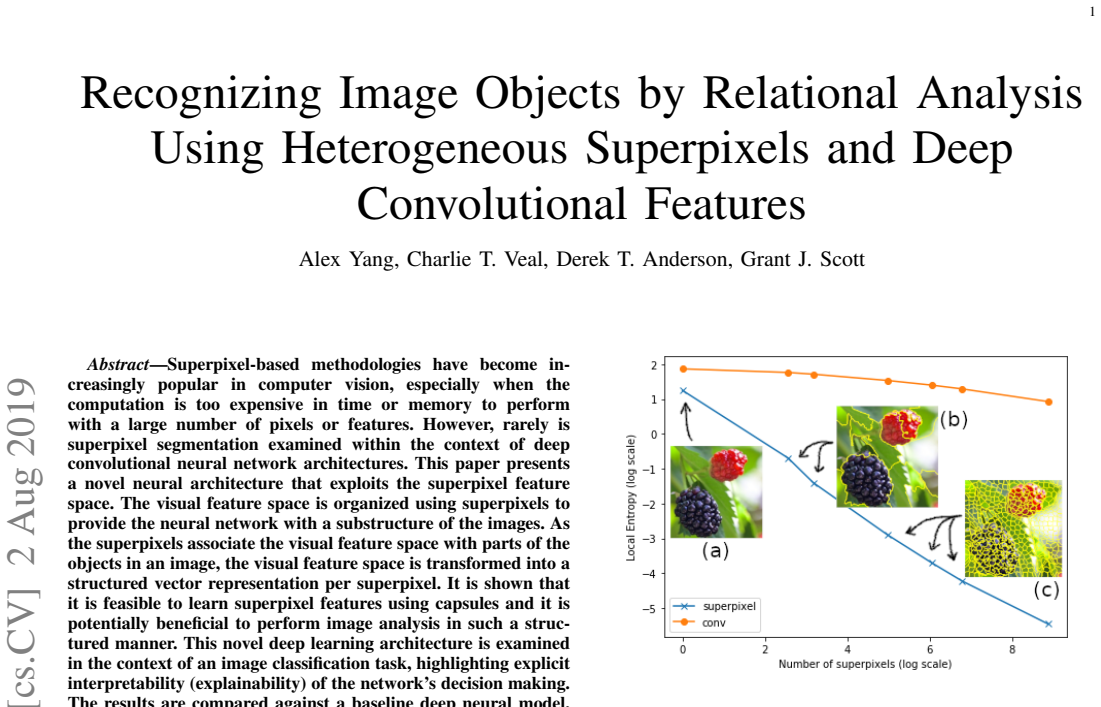
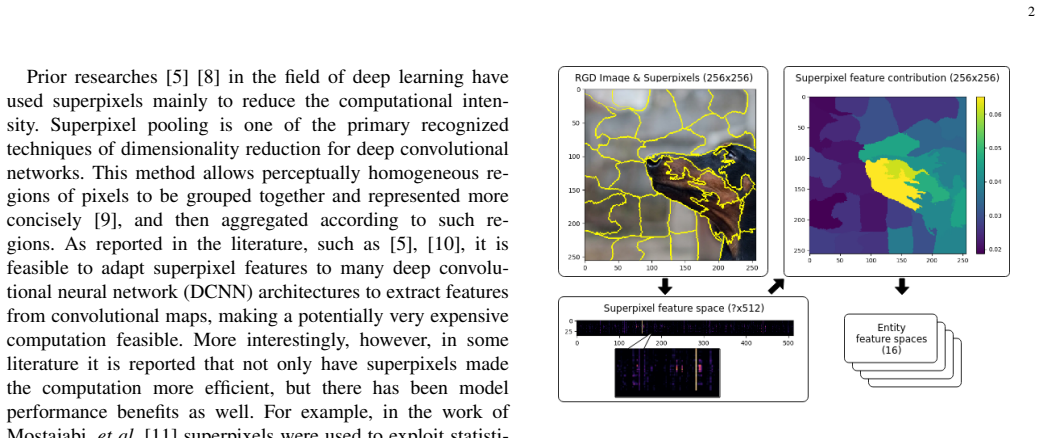
The central machinery is a two-stage reorganization. First, heterogeneous superpixels — SLIC regions allowed to have higher internal entropy than conventional oversegmentations — convert a spatial feature map into a structured set of region vectors, preserving the association between features and image locations. Second, dynamic routing treats those region vectors as low-level capsules and iteratively maps them to class-level capsules via $v_j = \varphi(\sum_i c_{ij} W_{ij} u_i)$, where $c_{ij}$ are routing coefficients; the scalar projection $z_{ij} = (W_{ij}u_i)^{\mathsf{T}} v_j / \|v_j\|$ then measures each superpixel's contribution to a class. This combination is what allows the network to learn part-whole relations from classification labels alone and to render those relations as a segmentation-like map.
What would settle it
Replace the SLIC superpixels with random regions of identical size and shape, keeping everything else fixed. If accuracy and the clarity of the contribution maps stay roughly unchanged, the superpixel-feature correspondence is not doing the work claimed; if they drop sharply, the correspondence is confirmed as the mechanism.
Extended reading notes
Core claim
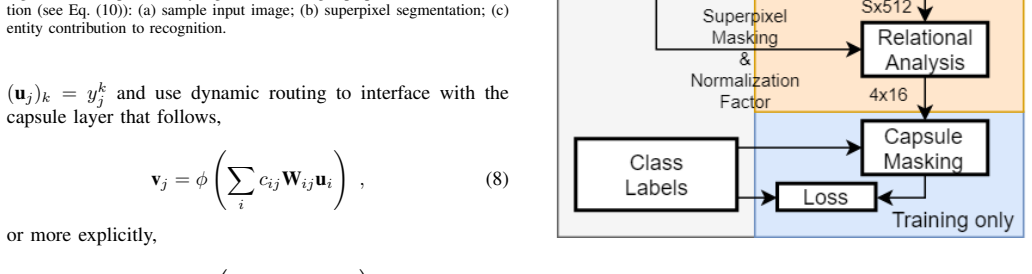
The central discovery the paper argues for is that superpixel features can be learned with capsules, and that organizing convolutional features by heterogeneous superpixels before relational analysis is beneficial for both recognition and interpretability. A pretrained VGG-16 backbone produces an $8 \times 8 \times 512$ feature map; SLIC superpixels computed on the original image define irregular regions, and each superpixel aggregates the convolutional feature values in its corresponding feature-map tiles, producing one vector per superpixel. These vectors are treated as low-level capsules and routed through learned linear transformations to class capsules whose vector magnitudes indicate class presence. On Linnaeus 5, configurations with roughly 25 to 100 superpixels reach about 88--89% validation accuracy with 17 million trainable parameters, against the VGG-16 baseline's 96% validation accuracy with 134 million parameters. The scalar projection of each superpixel vector onto a class vector can be painted back onto the segmentation, yielding entity contribution maps that align with object parts without any segmentation labels.
Load-bearing premise
The argument rests on the assumption that superpixel regions computed on the full-resolution image align correctly with the coarse $8 \times 8$ convolutional feature map, so each pooled vector represents a genuine spatial part of the object; the paper asserts this correspondence is accurate with its Eq. (5) but runs no experiment that checks the alignment.
Editorial extensions
If this is right
- A classifier can be assembled by pooling convolutional features into superpixel regions and routing them with capsules; it needs only class labels, yet it produces region-level explanations of its decision.
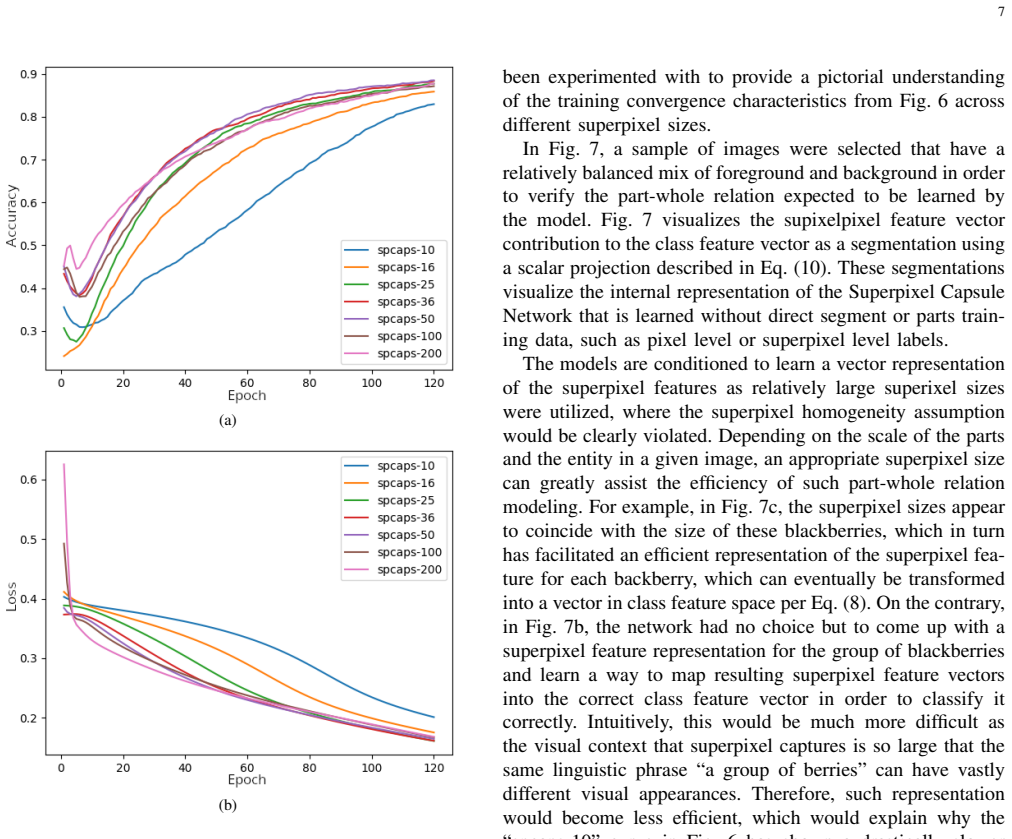
- Superpixel count acts as a receptive-field hyperparameter: roughly 25--100 superpixels per image keep validation accuracy near 88--89% on Linnaeus 5, while very large superpixels slow convergence and very small ones dilute the contribution maps.
- Using 88% fewer trainable parameters than VGG-16, the network reaches about 89% validation accuracy, so strongly reducing parameter count does not force the abandonment of structured part-whole reasoning.
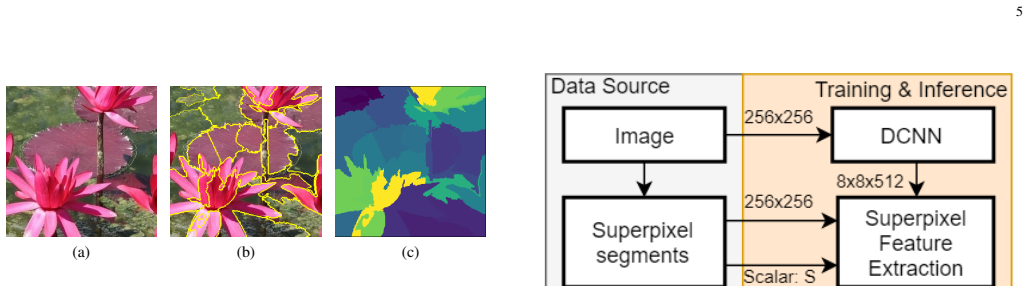
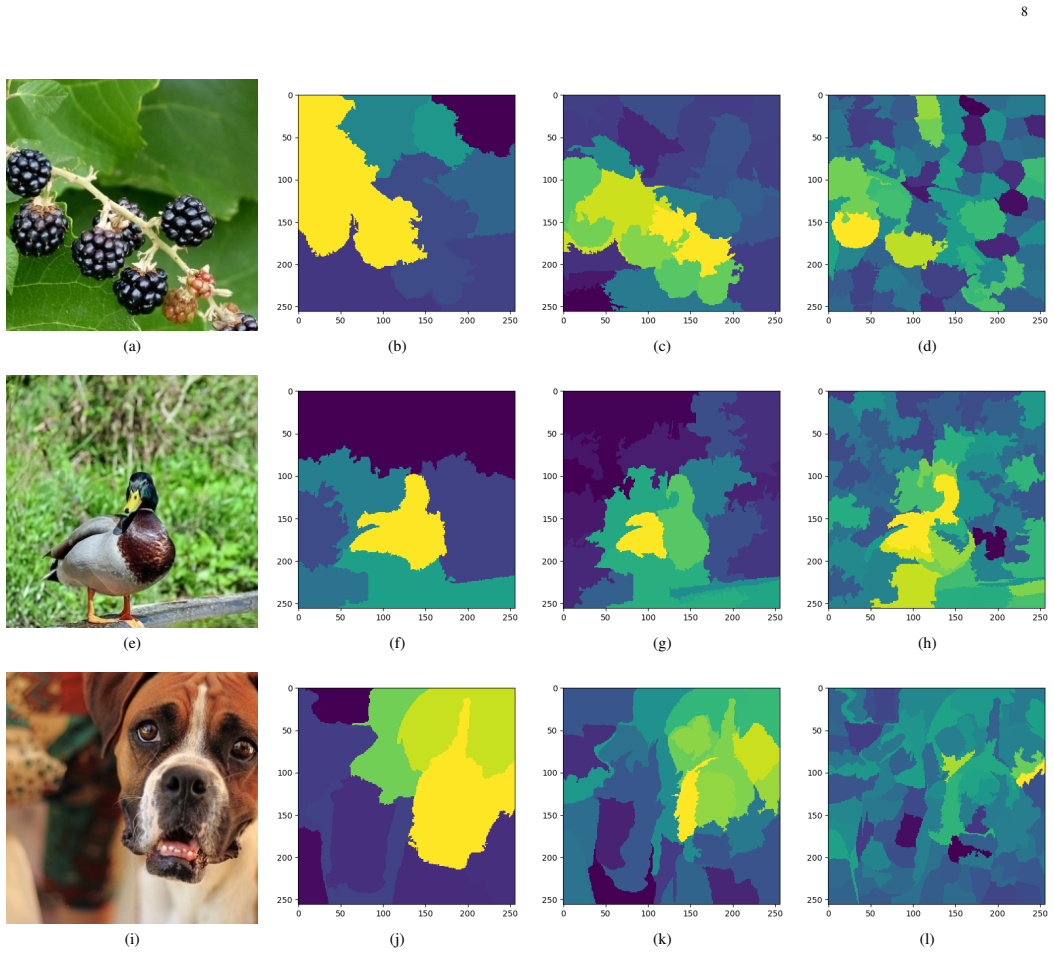
- The per-superpixel scalar projections provide object-highlighting maps, meaning segmentation-like interpretability is available without pixel-level or superpixel-level labels.
- Widening the class vector from 16 to 64 dimensions lowers accuracy across the board in the reported experiments, indicating that simply increasing capsule capacity is not an effective route to better performance.
Reading between the lines
- If the superpixel-to-feature-map correspondence is sound, the same relational-analysis layer could be attached to lighter convolutional backbones than VGG-16, trading a little accuracy for a much smaller parameter budget with built-in interpretability.
- The contribution maps could serve as a weak-supervision signal: thresholds applied to the per-superpixel projections might generate pseudo-segmentation masks with which to train other models, something the paper does not test.
- The consistent drop with 64-dimensional class vectors suggests capsule routing may need more data or regularization when the routing space expands; a direct test would be to train longer on a larger dataset and see whether larger vectors recover.
- The reported empirical relation that mean superpixel entropy scales roughly as the inverse of superpixel count could be used to choose superpixel granularity from image resolution alone, before training multiple models.
Signed reviews
Editorial analysis
A structured set of objections, weighed in public.
Referee Report
Summary. The paper proposes a Superpixel Capsule Network for image classification. A VGG-16 network (pretrained on ImageNet) produces 8×8×512 convolutional feature maps, which are reorganized by pooling into a variable number of SLIC superpixels (Eqs. (4)–(7)). The resulting S×k superpixel feature vectors are treated as low-level capsules and routed into class capsules via dynamic routing (Eqs. (8)–(9)). The magnitude of each class vector gives a classification score, and a scalar projection (Eq. (10)) is used to produce superpixel-wise contribution maps for visual explanation. The authors report about 89% validation accuracy on the Linnaeus 5 dataset with roughly 88% fewer trainable parameters than VGG-16, and they argue that the resulting part-whole structure provides interpretability and a basis for localization without pixel-level labels.
Significance. If the claims are upheld, the architecture offers a parameter-efficient alternative to standard dense classification heads and provides an intuitive form of explainability through superpixel contribution maps. The paper combines standard components (VGG-16 features, SLIC, capsule routing) in a novel pipeline and evaluates it on a public dataset. The consistent accuracy across many superpixel counts (Table III) is a positive indicator. However, the significance of the interpretability claim depends critically on whether the superpixel-feature association preserves spatial part-whole relations, which the paper does not validate. The evaluation also lacks statistical rigor (no error bars, inconsistent dataset description), and the benefit of capsule routing over simpler superpixel-based classifiers is not demonstrated.
major comments (4)
- [§II-B, Eqs. (5)–(6)] The association of each conv5 feature vector with a 32×32 image tile is not sufficient to make the feature vector a localized descriptor of that tile. In VGG-16, the effective receptive field of conv5_3 features is roughly 196×196 pixels at the original resolution, so each feature vector encodes content far outside its assigned tile. Consequently, superpixel features aggregated via Eq. (7) are mixtures of overlapping large-context descriptors, not localized representations of the superpixel regions. The claim in §II-B that the association 'is accurate with Eq. 5' is only a statement about tiling; it does not address the receptive-field mismatch. This undermines the central interpretability claims in §V-B and Figs. 7–8, where the network's internal part-whole representation is inferred from superpixel contribution maps. The authors should provide an experiment or analysis that validates the spatial locality of the features used for superpixel pooling, or soften the part-whole interpretation accordingly.
- [§V, dataset description] The dataset description is internally inconsistent. Section V states that Linnaeus 5 'has 4 classes: berry, bird, dog and flower and other unclassified images as adversarial examples,' but two sentences later says 'Each of the 5 categories contains 1200 training images and 400 test images.' Section V-C then refers to 'the 4-class dataset consisting of 6400 images' with 25% held out as validation. These statements cannot all be true, and they prevent a reader from determining what was actually trained and evaluated. The paper must clarify the exact number of classes, the number of images per class, and the train/test or cross-validation split actually used.
- [§V, Table III] The paper claims a 10-fold cross-validation methodology, but Table III reports only a single training and validation accuracy for each configuration, with no standard deviations or confidence intervals. Given the small differences among S=25, 36, 50, and 100 (all around 88–89%), it is impossible to assess whether the observed patterns are statistically meaningful. The authors should report the mean and standard deviation across folds (or across repeated runs) for the central configurations, and state whether the numbers in Table III correspond to a single fold, the average, or the best run. Without this, the empirical support for the main feasibility claim is incomplete.
- [§III, §V] The paper does not include a baseline that uses the same superpixel feature extraction and class labels but replaces capsule routing with a simpler classifier (e.g., a fully connected layer or a global average of superpixel features followed by logistic regression). Such a baseline is needed to support the claim that relational analysis via capsules is 'potentially beneficial' over naive aggregation. As presented, the results show only that superpixel features plus capsules achieve about 89% accuracy; they do not isolate the contribution of the capsule routing mechanism. Adding this baseline would make the central claim about the value of relational analysis testable.
minor comments (5)
- [General] There are numerous typographical errors, including 'Supixelpixel' in the captions of Figs. 7 and 8, 'segmemtations' after Eq. (10), and 'backberry' in §V-B. The paper would benefit from a careful proofreading pass.
- [Eq. (2)] The entropy operator H(·) is used in Eqs. (2)–(3) and in the text but is never formally defined. The text mentions a 256-bin hue histogram with respect to each superpixel region; this definition should be made explicit in a formal equation or at the point of first use.
- [Table II] The layout of Table II is confusing: the column headers appear misaligned, and the 'M' values implied by Eq. (3) are not listed. It would be clearer to present the superpixel-weighted entropy directly and state the fitted value of M for each row.
- [§IV, training setup] The learning rate, batch size, and optimizer settings are only partially specified (stochastic gradient descent with learning rate 2×10^{-5} is stated, but no batch size or momentum is given). These details are needed for reproducibility.
- [References] Reference [1] is cited as the source of both ImageNet and the pretrained VGG-16 weights, but it is a URL to the ILSVRC challenge page, not a citable paper. The authors should cite the ImageNet publication and the VGG-16 paper more precisely.
Circularity Check
Minor self-definitional step in the resolution-association proof; the classification claim itself is empirical and not circular.
-
self definitional
[Section II-B, Eqs. (5)-(6)]
"The value of any pixel in an image ( x :V → R) up-scaled ... by an integer factor (to x′ :V → R = x◦τ) can be found directly from x. ... ∀p∈Tij : (x′◦T )(i,j ) = x′(Tij) = x′(p) = (x◦τ )(p) = x(τ (p)) = x(i,j ) . (5) in short, x =x′◦T . (6) ... Such direct association is pointed out in [5] as well, but it is demonstrated that it is accurate with Eq. 5."
Eq. (5) is true by construction: x′ is defined as x∘τ, so the tile-constant equality x = x′∘T restates the definition rather than proving accuracy. The paper says this demonstrates that the direct association across feature-map resolutions 'is accurate', but no experiment or analytic argument shows that VGG-16 conv5 features are localized to their assigned tiles; their receptive fields are much larger than one tile. The association is therefore an unvalidated modeling assumption presented as a derivation. This is a self-definitional step, not a circular derivation of the classification numbers, which come from direct training and validation.
full rationale
The central claim is empirical: a specific Superpixel Capsule Network with VGG-16 features was trained on Linnaeus 5 and evaluated against VGG-16 (Table III, Fig. 9). The pooling equations (4) and (7), capsule routing (8), and contribution projection (10) are standard constructions, not fitted parameters renamed as predictions. The entropy relation M≈S^{-1} is an empirical observation about superpixel segmentation and is not used to predict classification accuracy. The paper contains no load-bearing self-citation: its references to SLIC, VGG-16, and capsule routing are external works, and none of the defining theorems or algorithms are imported from the present authors' prior publications. The only reduction-by-construction is the resolution-association proof in Eqs. (5)-(6), which asserts accuracy by definition rather than by measurement; this is a minor logical gap in the interpretability argument, not a circularity in the classification derivation. The receptive-field concern raised by the skeptic is a correctness risk for the part-whole interpretation, not a circularity. Score 1.
Assumptions & free parameters
free parameters (5)
- Number of superpixels S =
10, 16, 25, 36, 50, 100, 200 (swept)
- Capsule class vector dimension Q =
16 and 64
- SLIC compactness m =
0.1
- SLIC smoothing factor sigma =
0
- Entropy scaling relation M approximately S^{-1} =
empirically fit to Table II
assumptions (4)
- domain assumption Superpixels at full resolution can be mapped onto lower-resolution conv feature maps via Eqs. (5)-(6) without loss of spatial association.
- domain assumption Pretrained VGG-16 features are an adequate representation for the subsequent superpixel pooling and capsule layers.
- ad hoc to paper Hue histogram entropy over superpixel regions is a meaningful measure of information content for this task.
- domain assumption Standard capsule dynamic routing generalizes to inputs that are superpixel feature vectors of varying spatial structure.
Cite this review
Pith. "Pith review of Recognizing Image Objects by Relational Analysis Using Heterogeneous Superpixels and Deep Convolutional Features." pith.science (2026). https://pith.science/paper/L3OYST2C
@misc{pith2026190800669,
  author       = {Pith},
  title        = {Pith review of: Recognizing Image Objects by Relational Analysis Using Heterogeneous Superpixels and Deep Convolutional Features},
  year         = {2026},
  howpublished = {\url{https://pith.science/paper/L3OYST2C}},
  note         = {Machine review of arXiv:1908.00669}
}
read the original abstract
Superpixel-based methodologies have become increasingly popular in computer vision, especially when the computation is too expensive in time or memory to perform with a large number of pixels or features. However, rarely is superpixel segmentation examined within the context of deep convolutional neural network architectures. This paper presents a novel neural architecture that exploits the superpixel feature space. The visual feature space is organized using superpixels to provide the neural network with a substructure of the images. As the superpixels associate the visual feature space with parts of the objects in an image, the visual feature space is transformed into a structured vector representation per superpixel. It is shown that it is feasible to learn superpixel features using capsules and it is potentially beneficial to perform image analysis in such a structured manner. This novel deep learning architecture is examined in the context of an image classification task, highlighting explicit interpretability (explainability) of the network's decision making. The results are compared against a baseline deep neural model, as well as among superpixel capsule networks with a variety of hyperparameter settings.
Figures

Figures from the paper (6 more)


Reference graph
Works this paper leans on
- [1]
-
[2]
Microsoft coco: Common objects in context
Tsung-Yi Lin, Michael Maire, Serge Belongie, James Hays, Pietro Perona, Deva Ramanan, Piotr Doll´ar, and C Lawrence Zitnick. Microsoft coco: Common objects in context. In European conference on computer vision, pages 740–755. Springer, 2014
2014
-
[3]
Fully convolutional networks for semantic segmentation
Jonathan Long, Evan Shelhamer, and Trevor Darrell. Fully convolutional networks for semantic segmentation. In Proceedings of the IEEE conference on computer vision and pattern recognition , pages 3431– 3440, 2015
2015
-
[4]
Understanding convolution for semantic segmentation
Panqu Wang, Pengfei Chen, Ye Yuan, Ding Liu, Zehua Huang, Xiaodi Hou, and Garrison Cottrell. Understanding convolution for semantic segmentation. In 2018 IEEE Winter Conference on Applications of Computer Vision (WACV), pages 1451–1460. IEEE, 2018
work page 2018
-
[5]
F. Liu, C. Shen, G. Lin, and I. Reid. Learning depth from single monocular images using deep convolutional neural fields. IEEE Trans. Pattern Anal. Mach. Intell. , 38(10), oct 2016
work page 2016
-
[6]
Deep learning advances in computer vision with 3d data: A survey
Anastasia Ioannidou, Elisavet Chatzilari, Spiros Nikolopoulos, and Ioan- nis Kompatsiaris. Deep learning advances in computer vision with 3d data: A survey. ACM Computing Surveys (CSUR) , 50(2):20, 2017
work page 2017
-
[7]
Deformable convnets v2: More deformable, better results
Xizhou Zhu, Han Hu, Stephen Lin, and Jifeng Dai. Deformable convnets v2: More deformable, better results. In Proceedings of the IEEE Conference on Computer Vision and Pattern Recognition , pages 9308– 9316, 2019
work page 2019
-
[8]
Ef- ficient semantic image segmentation with superpixel pooling
Mathijs Schuurmans, Maxim Berman, and Matthew B Blaschko. Ef- ficient semantic image segmentation with superpixel pooling. arXiv preprint arXiv:1806.02705, 2018
arXiv 2018
Show all 20 references
-
[9]
Achanta, A
R. Achanta, A. Shaji, K. Smith, A. Lucchi, P. Fua, and S. Susstrunk. Slic superpixels compared to state-of-the-art superpixel methods. IEEE Trans. Pattern Anal. Mach. Intell. , 34(11):22742282, nov 2012
2012
-
[10]
Fast cloud image segmentation with superpixel analysis based convolutional networks
Lifang Wu, Jiaoyu He, Meng Jian, Jianan Zhang, and Yunzhen Zou. Fast cloud image segmentation with superpixel analysis based convolutional networks. In Systems, Signals and Image Processing (IWSSIP), 2017 International Conference on , pages 1–5. IEEE, 2017
2017
-
[11]
Feedforward semantic segmentation with zoom-out features
Mohammadreza Mostajabi, Payman Yadollahpour, and Gregory Shakhnarovich. Feedforward semantic segmentation with zoom-out features. In Proceedings of the IEEE conference on computer vision and pattern recognition , pages 3376–3385, 2015
2015
-
[12]
Dynamic routing between capsules
Sara Sabour, Nicholas Frosst, and Geoffrey E Hinton. Dynamic routing between capsules. In Advances in neural information processing systems, pages 3856–3866, 2017
2017
-
[13]
U-net: Convo- lutional networks for biomedical image segmentation
Olaf Ronneberger, Philipp Fischer, and Thomas Brox. U-net: Convo- lutional networks for biomedical image segmentation. In International Conference on Medical image computing and computer-assisted inter- vention, pages 234–241. Springer, 2015
2015
-
[14]
Capsdemm: Capsule network for detection of munros microabscess in skin biopsy images
Anabik Pal, Akshay Chaturvedi, Utpal Garain, Aditi Chandra, Raghu- nath Chatterjee, and Swapan Senapati. Capsdemm: Capsule network for detection of munros microabscess in skin biopsy images. In International Conference on Medical Image Computing and Computer- Assisted Interven...
2018
-
[15]
Capsules for object segmentation
Rodney LaLonde and Ulas Bagci. Capsules for object segmentation. arXiv preprint arXiv:1804.04241 , 2018
2018 arXiv
-
[16]
gslicr: Slic superpixels at over 250hz
Carl Yuheng Ren, Victor Adrian Prisacariu, and Ian D Reid. gslicr: Slic superpixels at over 250hz. arXiv preprint arXiv:1509.04232 , 2015
2015 arXiv
-
[17]
Matrix capsules with em routing
Geoffrey E Hinton, Sara Sabour, and Nicholas Frosst. Matrix capsules with em routing. 6th International Conference on Learning Represen- tations, ICLR, 2018
2018
-
[18]
Simonyan and A
K. Simonyan and A. Zisserman. Very deep convolutional networks for large-scale image recognition. In Int. Conf. Learn. Representations , 2015
2015
-
[19]
Linnaeus 5 dataset for machine learning
Giorgi Chaladze and Levan kalatozishvili. Linnaeus 5 dataset for machine learning. 2017
2017
-
[2012]
image-net
URL http://www. image-net. org/challenges/LSVRC , 2012
2012
Reviewed August 14, 2026 · model on record in the stance chip above.
Discussion (0). Continue with ORCID to comment.