REVIEW 3 major objections 4 minor 35 references
Protocol generalisation for brain tissue microstructure estimation via hypernetwork-controlled geometric deep learning
T0 review · 3 major / 4 minor · reviewed 2026-08-04 · deepseek-v4-flash
Pith's one-line read A single geometric deep network can match protocol-specific models across diffusion MRI b-values by letting a hypernetwork generate its first-layer weights.
desk verdict Useful hypernetwork-SCNN combo for protocol-conditional dMRI estimation, but 'unseen b-value' claims only test interpolation and need an out-of-range experiment. read the letter →
The pith
A machine-rendered reading of the paper's core claim, the machinery that carries it, and where it could break.
The reading
What carries the argument
The central object is the hypernetwork, a small MLP that takes the two b-values as input and outputs the weights of the first spherical convolution layer of an SCNN. This design lets the network condition its internal representation on the acquisition protocol while keeping the spherical-harmonic input format intact and preserving the SCNN's equivariance properties. The first-layer-only conditioning is a deliberate design choice to limit complexity and overparameterisation.
What would settle it
Train hSCNN on the same varied b-value pairs as in the paper, then test it on b-values far outside the training ranges (e.g., 500 and 4000 s/mm²). If its RMSE on synthetic data diverges from an SCNN trained specifically for those b-values while a variant that conditions all layers does not, the first-layer-only assumption is falsified.
Extended reading notes
Core claim
The paper claims that attaching a hypernetwork to the first spherical convolution layer of an SCNN endows the network with b-value generalisation without sacrificing rotational equivariance or b-vector generalisation. The hypernetwork maps the two b-values of a protocol to the 1,152 weights of that first layer, so the network adapts its feature extraction to the acquisition protocol. On synthetic data, the hypernetwork-SCNN (hSCNN) matches the bias and RMSE of SCNNs trained separately for each protocol; on in-vivo data, it yields parametric maps that closely agree with conventional NODDI fitting. The authors interpret this as the first deep learning model to combine protocol generalisation a
Load-bearing premise
Conditioning only the first spherical convolution layer on b-values is enough to account for all b-value-dependent signal variation across the six-layer network; if higher layers also need protocol-adaptive weights, the hSCNN would fail to generalise.
Editorial extensions
If this is right
- A single hSCNN trained on varied b-value pairs can be deployed on new protocols without retraining, reducing the practical burden of protocol changes in clinical diffusion MRI.
- The approach combines rotational equivariance with b-value generalisation, a combination that prior protocol-aware ML methods lacked, potentially improving reliability across unseen fibre orientations and acquisition settings.
- The same hypernetwork mechanism could be applied to other forward models and other acquisition variables, such as SNR, extending the method beyond NODDI.
- The results suggest that explicitly conditioning the network on b-values resolves a degeneracy that prevents a multi-protocol-trained SCNN from learning generalisable patterns.
Reading between the lines
- If the hypernetwork can be extended to generate weights for more than one layer, the model might generalise across a wider range of b-value combinations or variable numbers of shells, an extension the paper lists as future work.
- A self-supervised version of hSCNN, as the paper mentions, could remove the need for ground-truth tissue labels, potentially enabling training on real data where ground truth is unavailable.
- The pattern of first-layer conditioning might transfer to other rotationally equivariant architectures beyond spherical CNNs, suggesting a general recipe for making equivariant networks protocol-adaptive.
- The paper's explanation of degeneracy implies that b-value conditioning acts as a regulariser; one could test this by measuring whether hSCNN's advantage grows as the b-value range widens.
Editorial analysis
A structured set of objections, weighed in public.
Referee Report
Summary. The manuscript proposes hSCNN, a spherical CNN whose first spherical convolution layer weights are generated by a hypernetwork conditioned on the two b-values of a two-shell acquisition. The model is trained on synthetic NODDI signals with variable b-value pairs and compared with three baselines: SCNNs trained on fixed protocols and an SCNN trained on the same variable b-value data. Evaluation uses synthetic test sets and HCP in-vivo data, with conventional NODDI fitting as pseudo-ground truth. The authors report that hSCNN's bias/RMSE approximately match those of protocol-specific SCNNs and are substantially better than the variable-data SCNN, and conclude that hSCNN achieves b-value generalization while preserving rotational equivariance and b-vector generalization.
Significance. If the b-value generalization claim held, the contribution would be practically valuable: a single rotationally equivariant model that can be deployed across acquisition protocols without retraining would reduce the clinical adaptation cost of deep-learning microstructure estimation. The paper has clear strengths: the synthetic evaluation uses known ground truth, the comparison against protocol-specific SCNNs is direct, the architecture is described in sufficient detail, and code is publicly available. The experimental results appear internally consistent. However, the headline claim of 'unseen b-value generalisation' is not supported by the current experiments, because all tested b-values fall inside the training distribution. The in-vivo evaluation is also partly self-referential because NODDI is both the generative training model and the reference standard. With a properly held-out b-value experiment and a more cautious framing, the contribution would be solid.
major comments (3)
- [Section 3.2.1; Abstract; Section 5] The claimed 'unseen b-value generalisation' is not tested. The training distribution for hSCNNvar samples the lower b uniformly from [700,1200] s/mm^2 and the higher b from [2000,3000] s/mm^2. All test b-value pairs lie inside these intervals: test1k2k uses (1000,2000), test1k3k uses (1000,3000), testvar is drawn from the same distribution, and the in-vivo subsets use (1000,2000) and (1000,3000). Section 3.2.1 even states that the variable dataset evaluates 'generalisation in the standard ML sense, across protocols drawn from the training distribution.' Therefore the experiments demonstrate interpolation over the trained b-value range, not extrapolation to unseen b-values. The abstract's 'robustness to unseen b-values' and Section 5's 'generalise to unseen b-value pairs' are unsupported. Please add held-out tests with b-values outside [700,1200] x [2000,3000] (e.g., lower b < 700 or high
- [Section 3.2.2; Section 4.2] The in-vivo evaluation uses NODDI fitting as pseudo-ground truth, but the synthetic training data are generated from the NODDI forward model. Agreement with NODDI on real data is therefore partly a self-consistency check: an estimator trained to invert NODDI simulations should agree with NODDI fits if the model has learned the intended mapping. The comparisons between hSCNN and the specialized SCNNs on the same real data remain informative, but the claim of 'higher agreement with conventional NODDI fitting' should be presented as expected under the shared generative model, not as independent validation of tissue-microstructure accuracy. A limitation statement to this effect is needed.
- [Section 3.1] The hypernetwork only generates weights for the first spherical convolution layer; the remaining five layers have fixed protocol-independent weights. The paper states that this was 'a deliberate choice to minimise complexity and prevent overparameterisation,' but no experiment or analysis is provided showing that first-layer conditioning is sufficient to encode the b-value dependence of the entire six-layer network. Because all test b-values are within the training range, the current results cannot rule out failure on more extreme b-values if higher layers also require b-value-adaptive weights. An ablation that conditions additional layers, or an explicit argument for sufficiency, would address this load-bearing assumption.
minor comments (4)
- [Section 3.3; Section 4.1] hSCNNvar is trained with learning rate 1e-4 and weight decay 1e-6, while SCNNvar uses 5e-4 and no weight decay. The reported improvement of hSCNNvar over SCNNvar could partly reflect hyperparameter tuning. Running the baseline with the same optimizer schedule would strengthen the attribution of the improvement to the hypernetwork.
- [Section 4.2; Tables 1 and 2] The qualitative claim that hSCNN 'matches' the protocol-specific SCNN is not always reflected in the tables. On the (1000,3000) in-vivo subset, hSCNNvar has ODI RMSE 0.0827 versus 0.0701 for SCNN1k3k, an 18% difference. Please soften or quantify the 'matching' claim.
- [Figure 7] The line plots for bias, standard deviation, and RMSE do not show variability across the 100 noise repetitions per voxel. Adding error bars or confidence intervals, or reporting numeric values with uncertainties, would improve interpretability.
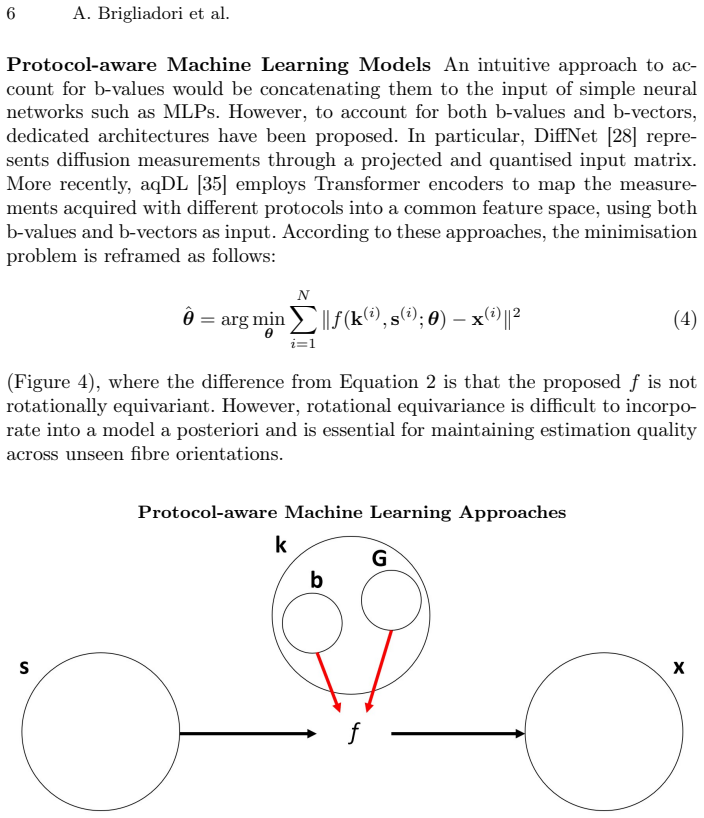
- [Section 2.2.2; Section 5] The paper does not compare with the non-equivariant protocol-general baselines DiffNet and aqDL that it discusses. Since the stated novelty is combining protocol generalisation with rotational equivariance, a quantitative comparison on the same synthetic test sets would help contextualize the contribution.
Circularity Check
No significant circularity: central hSCNN-vs-specialized-SCNN comparison rests on synthetic ground truth and a self-contained architecture.
full rationale
The paper's central claim is that hSCNN, a hypernetwork-conditioned SCNN, matches the performance of SCNNs trained specifically for each test protocol. This is evaluated on synthetic data with known ground truth (Section 3.2.1, 3.4.1) and on in-vivo data using NODDI fitting as a reference. The synthetic evaluation is self-contained: the model is trained on NODDI-simulated data and tested on held-out synthetic voxels with known parameter values. No equation or learned parameter is defined in terms of the target outcome; the hypernetwork simply maps b-values to convolutional weights, and the test pairs lie within the training distribution, which is a standard interpolation setting. The in-vivo evaluation uses NODDI as both the training forward model and the pseudo-ground truth, making absolute agreement partly a self-consistency check, but the paper's main comparative result (hSCNN matching the specialized SCNN) holds regardless of this reference. The phrase 'unseen b-values' is stronger than warranted because all test b-values fall within the training ranges [700,1200] and [2000,3000], but this is a correctness/overclaim issue, not a circular reduction of the derivation to its inputs. Self-citations to prior work on SCNN rotational equivariance (refs [11,22]) are not load-bearing for the novel hypernetwork contribution; the architecture is described in full. No fitted parameter is renamed as a prediction, and no uniqueness theorem is imported from the authors' own work. Hence no circular step can be exhibited, and the appropriate score is 0.
Assumptions & free parameters
free parameters (4)
- Hypernetwork hidden size =
8
- Hypernetwork output size (first layer weights) =
1152
- Training b-value sampling ranges =
lower U[700,1200], upper U[2000,3000] s/mm^2
- Rician noise SNR =
15
assumptions (4)
- domain assumption NODDI forward model with parallel diffusivity fixed at 1.7e-3 mm^2/s adequately represents the in-vivo signal.
- domain assumption Models trained on synthetic data with Rician noise (SNR=15) transfer to in-vivo data without adaptation.
- standard math The hypernetwork's first-layer-conditional weights preserve the rotational equivariance of the SCNN.
- domain assumption 45 spherical harmonic coefficients per shell capture the signal information needed for NODDI estimation.
Cite this review
Pith. "Pith review of Protocol generalisation for brain tissue microstructure estimation via hypernetwork-controlled geometric deep learning." pith.science (2026). https://pith.science/paper/L3SAN6HH
@misc{pith2026260802053,
  author       = {Pith},
  title        = {Pith review of: Protocol generalisation for brain tissue microstructure estimation via hypernetwork-controlled geometric deep learning},
  year         = {2026},
  howpublished = {\url{https://pith.science/paper/L3SAN6HH}},
  note         = {Machine review of arXiv:2608.02053}
}
read the original abstract
Brain tissue microstructure estimation with machine learning provides higher computational efficiency than conventional fitting. However, machine learning still presents important limitations that hamper its clinical utility. Specifically, current models typically lack generalisation across diffusion MRI acquisition protocols and require retraining whenever b-vectors or b-values change. Moreover, the recent machine learning methods that were developed to address protocol generalisation lack rotational equivariance. Particularly suitable for dMRI parameter estimation is a geometric deep learning model known as spherical convolutional neural network (SCNN), which guarantees rotational equivariance and b-vector generalisation. However, this architecture currently does not account for b-values. Therefore, obtaining a model that combines protocol generalisation and rotational equivariance remains an open challenge. In this paper, we directly address this issue by incorporating explicit b-value dependence into an SCNN architecture via a hypernetwork. This new approach is illustrated using NODDI as an example forward model for estimating brain tissue microstructure. To evaluate b-value generalisation, the original and newly proposed SCNN architectures are trained on synthetic data and tested on both synthetic and real data across different b-value pairs. Results demonstrate that the proposed method achieves reduced RMSE and bias on synthetic data, as well as higher agreement with conventional NODDI fitting on real data, indicating improved robustness to unseen b-values and a reduced need for retraining. By combining generalisation across b-values with generalisation across b-vectors and rotational equivariance, the proposed framework enhances the applicability of deep learning to clinical diffusion MRI parameter estimation. Code available at https://github.com/aerdnairo/arXiv\_generalisedSCNN.
Figures


Figures from the paper (6 more)


Reference graph
Works this paper leans on
-
[1]
Medical Physics46(4), 1581–1591 (2019)
Aliotta, E., Nourzadeh, H., Sanders, J., Muller, D., Ennis, D.B.: Highly accel- erated, model-free diffusion tensor MRI reconstruction using neural networks. Medical Physics46(4), 1581–1591 (2019). https://doi.org/10.1002/mp.13400, https://doi.org/10.1002/mp.13400
-
[2]
ISMRM, Cape Town, South Africa (May 2026), http://echo.ismrm.org/abstracts/view/e578a3aa- 835c-49a9-b69f-28f3dd1e14d9, program Number: 668-03-007
Brigliadori, A., Zhang, G., Kerkelä, L.: Protocol generalisation for brain tissue mi- crostructureestimationwithgeometricdeeplearning:ahypernetworkapproach.In: Cape Town - 2026 ISMRM-ISMRT Annual Meeting and Exhibition. ISMRM, Cape Town, South Africa (May 2026), http://echo.ismrm.org/abstracts/view/e578a3aa- 835c-49a9-b69f-28f3dd1e14d9, program Number: 668-03-007
2026
-
[3]
Quantitative Imaging in Medicine and Surgery5(3) (2015)
Chilla, G.S., Tan, C.H., Xu, C., Poh, C.L.: Diffusion weighted magnetic resonance imaging and its recent trend - a survey. Quantitative Imaging in Medicine and Surgery5(3) (2015). https://doi.org/10.3978/j.issn.2223-4292.2015.03.01
arXiv 2015
-
[4]
arXiv preprint arXiv:1801.10130 (2018)
Cohen, T.S., Geiger, M., Köhler, J., Welling, M.: Spherical CNNs. arXiv preprint arXiv:1801.10130 (2018)
arXiv 2018
-
[5]
In: Proceedings of the 14th Scientific Meeting of the International Society for Magnetic Resonance in Medicine (ISMRM)
Cook, P.A., Bai, Y., Nedjati-Gilani, S., Seunarine, K.K., Hall, M.G., Parker, G.J., Alexander, D.C.: Camino: Open-source diffusion-MRI reconstruction and process- ing. In: Proceedings of the 14th Scientific Meeting of the International Society for Magnetic Resonance in Medicine (ISMRM). p. 2759. Seattle, WA, USA (2006)
2006
-
[6]
In: Proceedings of the european conference on computer vision (ECCV)
Esteves, C., Allen-Blanchette, C., Makadia, A., Daniilidis, K.: Learning SO(3) equivariant representations with spherical CNNs. In: Proceedings of the european conference on computer vision (ECCV). pp. 52–68 (2018)
2018
-
[7]
https://doi.org/10.1007/978-3- 319-54130-3\_16
Fick, R.H.J., Daianu, M., Pizzolato, M., Wassermann, D., Jacobs, R.E., Thompson, P.M., Town, T., Deriche, R.: Comparison of biomarkers in transgenic Alzheimer rats using multi-shell diffusion MRI (Aug 2023). https://doi.org/10.1007/978-3- 319-54130-3\_16
doi:10.1007/978-3- 2023
-
[8]
Biological Cybernetics 36(4), 193–202 (1980)
Fukushima, K.: Neocognitron: A self-organizing neural network model for a mech- anism of pattern recognition unaffected by shift in position. Biological Cybernetics 36(4), 193–202 (1980). https://doi.org/10.1007/BF00344251
Show all 35 references
-
[9]
IEEE Transactions on Medical Imaging35(5), 1344–1351 (2016)
Golkov, V., Dosovitskiy, A., Sperl, J.I., Menzel, M.I., Czisch, M., Sä- mann, P., Brox, T., Cremers, D.: q-space deep learning: Twelve-fold shorter and model-free diffusion MRI scans. IEEE Transactions on Medical Imaging35(5), 1344–1351 (2016). https://doi.org/10.1109/TMI.2016...
2016
-
[10]
arXiv (2023), https://arxiv.org/abs/2301.12294
Gong, T., Grussu, F., Gandini Wheeler-Kingshott, C.A.M., Alexander, D.C., Zhang, H.: Machine-learning-informed parameter estimation improves the reliabil- ity of spinal cord diffusion MRI. arXiv (2023), https://arxiv.org/abs/2301.12294
2023 arXiv
-
[11]
(eds.) Computational Diffusion MRI
Goodwin-Allcock, T., McEwen, J.D., Gray, R., Nachev, P., Zhang, H.: How can spherical CNNs benefit ML-based diffusion MRI parameter estimation? In: Cetin-Karayumak, S., et al. (eds.) Computational Diffusion MRI. Lecture Notes in Computer Science, vol. 13722, pp. 96–108. Spring...
2022 doi
-
[12]
Brain144(5), 1296–1311 (2021)
Granziera, C., Wuerfel, J., Barkhof, F., et al.: Quantitative magnetic resonance imaging towards clinical application in multiple sclerosis. Brain144(5), 1296–1311 (2021). https://doi.org/10.1093/brain/awab029 Protocol generalisation via hypernetwork-controlled geometric deep ...
2021 doi
-
[13]
https://doi.org/https://doi.org/10.1002/acn3.445
Grussu, F., Schneider, T., Tur, C., Yates, R.L., Tachrount, M., Ianuş, A., Yian- nakas, M.C., Newcombe, J., Zhang, H., Alexander, D.C., DeLuca, G.C., Gandini Wheeler-Kingshott, C.A.M.: Neurite dispersion: a new marker of multiple sclero- sis spinal cord pathology? Annals of Cl...
2017 doi
-
[14]
Magnetic Resonance in Medicine87(2), 932–947 (2022)
Gyori, N.G., Palombo, M., Clark, C.A., Zhang, H., Alexander, D.C.: Training data distribution significantly impacts the estimation of tissue microstructure with machine learning. Magnetic Resonance in Medicine87(2), 932–947 (2022). https://doi.org/https://doi.org/10.1002/mrm.29014
2022 doi
-
[15]
Ha, D., Dai, A., Le, Q.V.: Hypernetworks (2016), https://arxiv.org/abs/1609.09106
2016 arXiv
-
[16]
NeuroImage224, 117425 (2021)
Hill, I., Palombo, M., Santin, M., Branzoli, F., Philippe, A.C., Wassermann, D., Aigrot,M.S.,Stankoff,B.,Baron-VanEvercooren,A.,Felfli,M.,Langui,D.,Zhang, H., Lehericy, S., Petiet, A., Alexander, D.C., Ciccarelli, O., Drobnjak, I.: Machine learning based white matter models wi...
2021
-
[17]
NMR in Biomedicine23(7), 865–872 (2010)
Inglese, M., Bester, M.: Diffusion imaging in multiple sclerosis: research and clinical implications. NMR in Biomedicine23(7), 865–872 (2010). https://doi.org/10.1002/nbm.1515
2010 doi
-
[18]
Magnetic Resonance in Medicine 86(4), 2250–2265 (2021)
Kaandorp, M.P.T., Barbieri, S., Klaassen, R., van Laarhoven, H.W.M., Crezee, H., While, P.T., Nederveen, A.J., Gurney-Champion, O.J.: Improved unsuper- vised physics-informed deep learning for intravoxel incoherent motion modeling and evaluation in pancreatic cancer patients. ...
2021 doi
-
[19]
Journal of Neuroscience Methods346, 108908 (2020)
Kamiya, K., Hori, M., Aoki, S.: Noddi in clinical research. Journal of Neuroscience Methods346, 108908 (2020). https://doi.org/10.1016/j.jneumeth.2020.108908
2020
-
[20]
arXiv (2024), https://arxiv.org/abs/2402.00019
Karimi, D.: Diffusion MRI with machine learning. arXiv (2024), https://arxiv.org/abs/2402.00019
2024
-
[21]
Imaging Neuro- science2, 1–55 (2024)
Karimi, D., Warfield, S.K.: Diffusion MRI with machine learning. Imaging Neuro- science2, 1–55 (2024)
2024
-
[22]
Frontiers in Neuroimaging3(2024)
Kerkela, L., Seunarine, K., Szczepankiewicz, F., Clark, C.A.: Spheri- cal convolutional neural networks can improve brain microstructure esti- mation from diffusion MRI data. Frontiers in Neuroimaging3(2024). https://doi.org/10.3389/fnimg.2024.1349415
2024
-
[23]
Biological Psychiatry: Global Open Science3(1), 10– 21 (2022)
Kraguljac, N.V., Guerreri, M., Strickland, M.J., Zhang, H.: Neurite orientation dispersion and density imaging in psychiatric disorders: A systematic literature review and a technical note. Biological Psychiatry: Global Open Science3(1), 10– 21 (2022). https://doi.org/10.1016/...
2022 doi
-
[24]
Comptes-Rendus de l’Académie des Sciences93(5), 27–34 (1985)
Le Bihan, D., Breton, E.: Imagerie de diffusion in-vivo par résonance magnétique nucléaire. Comptes-Rendus de l’Académie des Sciences93(5), 27–34 (1985)
1985
-
[25]
Eu- ropean Radiology31(8), 6334–6341 (2021)
Manfrini, E., Smits, M., Thust, S., et al.: From research to clinical practice: A euro- pean neuroradiological survey on quantitative advanced MRI implementation. Eu- ropean Radiology31(8), 6334–6341 (2021). https://doi.org/10.1007/s00330-020- 07582-2
2021 doi
-
[26]
NeuroImaging Tools & Resources Collaboratory (NITRC)
Microstructure Imaging Group: NODDI MATLAB toolbox (2021), ver- sion 1.05. NeuroImaging Tools & Resources Collaboratory (NITRC). https://www.nitrc.org/projects/noddi_toolbox. Accessed 2026-08-03 18 A. Brigliadori et al
2021
-
[27]
Minore, G.V., Dwyer-Hemmings, L., Bray, T.J.P., Zhang, H.: Resolving quanti- tative MRI model degeneracy in self-supervised machine learning, p. 186–199. Springer Nature Switzerland (Aug 2025). https://doi.org/10.1007/978-3-031- 96625-5_13
2025 doi
-
[28]
IEEE Transactions on Medi- cal Imaging41(2), 491–499 (2022)
Park, J., Jung, W., Choi, E.J., Oh, S.H., Jang, J., Shin, D., An, H., Lee, J.: DIFFnet: Diffusion parameter mapping network generalized for in- put diffusion gradient schemes and b-value. IEEE Transactions on Medi- cal Imaging41(2), 491–499 (2022). https://doi.org/10.1109/TMI....
2022
-
[29]
Scientific Reports 10(1), 9223 (2020)
Roberts, T.A., Hyare, H., Agliardi, G., Hipwell, B., d’Esposito, A., Ianus, A., Breen-Norris, J.O., Ramasawmy, R., Taylor, V., Atkinson, D., Punwani, S., Lyth- goe, M.F., Siow, B., Brandner, S., Rees, J., Panagiotaki, E., Alexander, D.C., Walker-Samuel, S.: Noninvasive diffusi...
2020 doi
-
[30]
arXiv preprint (2025), pMID: 40709300; PMCID: PMC12288656
Rot, S., Dragonu, I., Triantafyllou, C., Grech-Sollars, M., Papadaki, A., Mancini, L., Wastling, S., Steeden, J., Thornton, J., Yousry, T., Wheeler-Kingshott, C.A.M.G., Thomas, D.L., Alexander, D.C., Zhang, H.: Real-time, inline quanti- tative MRI enabled by scanner-integrated...
2025
-
[31]
Nature323(6088), 533–536 (1986)
Rumelhart, D.E., Hinton, G.E., Williams, R.J.: Learning representa- tions by back-propagating errors. Nature323(6088), 533–536 (1986). https://doi.org/10.1038/323533a0
1986 doi
-
[32]
Acta Radiologica Open6(4), 2058460117703816 (2017)
Sato, K., Kerever, A., Kamagata, K., Tsuruta, K., Irie, R., Tagawa, K., Okazawa, H., Arikawa-Hirasawa, E., Nitta, N., Aoki, I., Aoki, S.: Understanding mi- crostructure of the brain by comparison of neurite orientation dispersion and density imaging (NODDI) with transparent mo...
2017 doi
-
[33]
In: de Bruijne, M., et al
Sedlar, S., Alimi, A., Papadopoulo, T., Deriche, R., Deslauriers-Gauthier, S.: A spherical convolutional neural network for white matter structure imaging via dMRI. In: de Bruijne, M., et al. (eds.) Medical Image Computing and Computer- Assisted Intervention - MICCAI 2021. Lec...
2021 doi
-
[34]
NeuroImage61(4), 1000–1016 (2012)
Zhang, H., Schneider, T., Wheeler-Kingshott, C.A., Alexander, D.C.: NODDI: Practical in vivo neurite orientation dispersion and density imaging of the human brain. NeuroImage61(4), 1000–1016 (2012). https://doi.org/10.1016/j.neuroimage.2012.03.072
2012 doi
-
[35]
IEEE Journal of Biomedical and Health Informatics29(2), 1176–1188 (2025)
Zong, F., Zhu, Z., Zhang, J., Deng, X., Li, Z., Ye, C., Liu, Y.: Attention-based q- space deep learning generalized for accelerated diffusion magnetic resonance imag- ing. IEEE Journal of Biomedical and Health Informatics29(2), 1176–1188 (2025). https://doi.org/10.1109/JBHI.20...
2025
Reviewed August 4, 2026 · model on record in the stance chip above.
Discussion (0). Sign in to comment.