Thresholded Local Hyper-Flow Diffusion
Pith reviewed 2026-06-27 17:22 UTC · model grok-4.3
The pith
Thresholded local hyper-flow diffusion performs exact projected subgradient steps on an expanding active region and its boundary.
A machine-rendered reading of the paper's core claim, the machinery that carries it, and where it could break.
Core claim
The degree-preconditioned projected subgradient step restricted to the active region and its boundary coincides exactly with the unrestricted global update; thresholded boundary activation can be analyzed as an inexact step with explicit skipped-boundary error that remains controllable, transferring finite-time dual suboptimality and a robust sweep-cut guarantee to early-stopped local iterates.
What carries the argument
Thresholded Local Hyper-Flow Diffusion (TL-HFD), the method that maintains an active region, performs degree-preconditioned projected subgradient updates on that region and its boundary, and expands the region by top-k thresholded boundary activation.
If this is right
- Each iteration remains local in the scanned region and oracle-sensitive only on the hyperedges touching the active set.
- Finite-time dual suboptimality holds for both exact local updates and the thresholded inexact variants.
- Approximate dual optimality with localized support converts directly into a robust sweep-cut guarantee for early-stopped runs.
- An additive activated-volume bound is controlled by realized local subgradient norms and the minimum boundary-push of new vertices.
- On general submodular cut-costs the method often matches global HFD quality while activating strictly less volume.
Where Pith is reading between the lines
- The same localization argument could be applied to other first-order diffusion methods that rely on projected subgradient steps.
- The explicit volume bound supplies a practical stopping criterion that predicts how much additional region must be scanned to reach a target guarantee.
- Because the local update is provably identical to the global one, any existing convergence theory for global HFD transfers immediately once the thresholded error is controlled.
Load-bearing premise
The error introduced by skipping some boundary vertices in the top-k activation step stays bounded by the local subgradient norms and the minimum push among the newly activated vertices.
What would settle it
A counter-example hypergraph instance where an early-stopped TL-HFD iterate produces a sweep cut whose conductance deviates from the global optimum by more than the predicted additive volume term.
Figures
read the original abstract
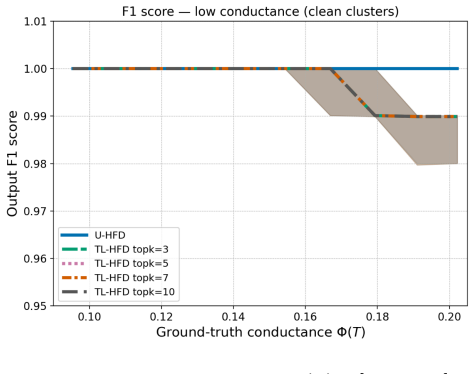
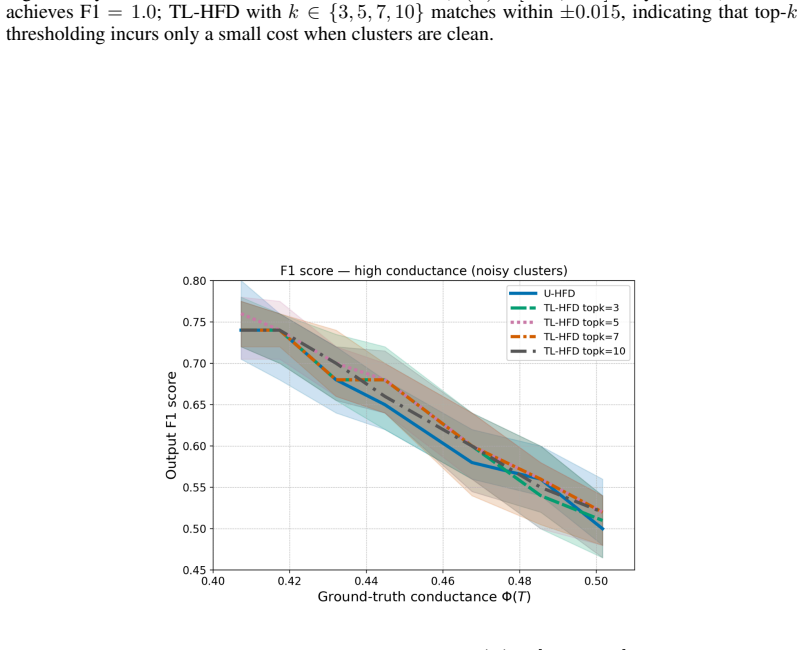
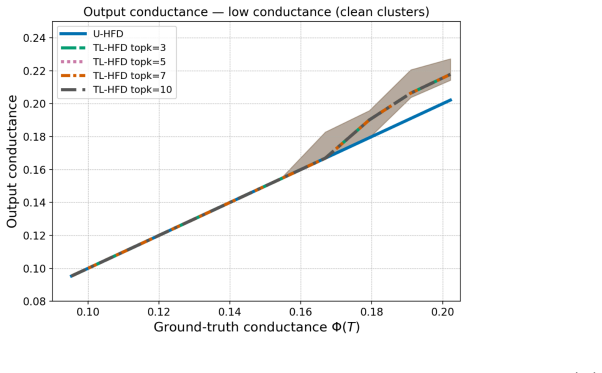
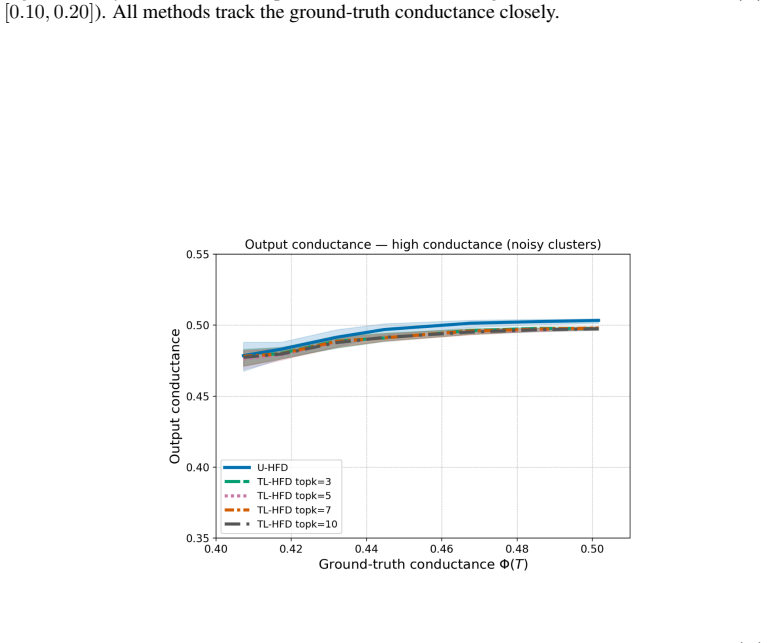
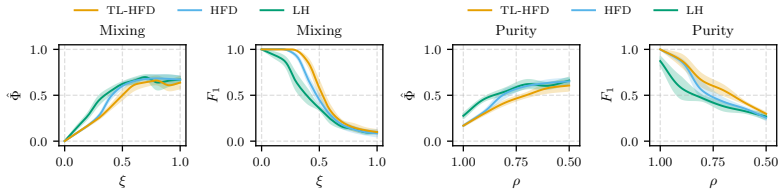
Local Hyper-Flow Diffusion (HFD) gives an edge-size-independent Cheeger-type guarantee for seeded clustering in general submodular hypergraphs, but existing HFD solvers do not keep intermediate computation local at every iteration. We introduce Thresholded Local HFD (TL-HFD), a first-order method that maintains an active region around the seeds, performs projected subgradient updates on that region and its immediate boundary, and expands via thresholded (top-k) boundary activation. We prove that the local update is exact: the degree-preconditioned projected subgradient step restricted to the active region and its boundary coincides with the unrestricted global update. We establish finite-time dual suboptimality for both exact and thresholded updates, treating the latter as inexact projected subgradient steps with explicit skipped-boundary error. We further derive an additive activated-volume bound controlled by realized local subgradient norms and the minimum boundary-push among newly activated vertices, and translate approximate dual optimality with localized support into a robust sweep-cut guarantee for early-stopped iterates. For general submodular cut-costs, each iteration is local in the scanned region and oracle-sensitive in the hyperedge primitive. Empirically, TL-HFD often matches or improves over HFD while activating less volume, with the largest gains on noisy instances where diffusion tends to absorb non-target vertices.
Editorial analysis
A structured set of objections, weighed in public.
Referee Report
Summary. The paper introduces Thresholded Local Hyper-Flow Diffusion (TL-HFD), a first-order local method for seeded clustering on submodular hypergraphs. It maintains an active region, performs degree-preconditioned projected subgradient steps on the region and boundary, and expands via top-k thresholded activation. Central claims include exact equivalence of the restricted local update to the global update, finite-time dual suboptimality bounds for both exact and thresholded (inexact) updates via an explicit skipped-boundary error term, an additive activated-volume bound controlled by local subgradient norms and minimum boundary-push, and a resulting sweep-cut guarantee that transfers to early-stopped iterates.
Significance. If the exactness result and the controllability of the skipped-boundary error hold, the work supplies a practical local algorithm that preserves the Cheeger-type guarantees of prior HFD while strictly limiting computation to an expanding but localized support. The finite-time dual bounds and the volume-controlled sweep-cut translation are notable technical contributions that could enable scalable implementations on large noisy hypergraphs.
major comments (2)
- [§4.2, Theorem 4] §4.2, Theorem 4 and the subsequent error analysis: the skipped-boundary error for thresholded updates is bounded using realized local subgradient norms together with the minimum boundary-push among newly activated vertices. No uniform positive lower bound on this minimum push is established for general submodular costs; when the push can approach zero the additive term may become arbitrarily large, undermining the claimed finite-time dual suboptimality for early-stopped thresholded iterates.
- [§5.1] §5.1, the sweep-cut translation: the argument that approximate dual optimality with localized support yields a robust sweep-cut guarantee for early-stopped iterates relies on the activated-volume bound remaining controlled. If the minimum-push term is not uniformly bounded away from zero, the volume control fails and the sweep-cut claim does not transfer.
minor comments (2)
- [Abstract] Abstract: the phrase 'oracle-sensitive in the hyperedge primitive' is not defined; a brief clarification of its computational implication would help readers.
- Notation: the degree-preconditioning matrix is introduced without an explicit equation number in the main text, making later references to it cumbersome.
Simulated Author's Rebuttal
We thank the referee for the careful and constructive review. The points raised about the dependence of our error and volume bounds on the realized minimum boundary-push are well-taken. We address each major comment below and will revise the manuscript accordingly to clarify the explicit dependence on this quantity and the resulting conditions for the guarantees.
read point-by-point responses
-
Referee: [§4.2, Theorem 4] §4.2, Theorem 4 and the subsequent error analysis: the skipped-boundary error for thresholded updates is bounded using realized local subgradient norms together with the minimum boundary-push among newly activated vertices. No uniform positive lower bound on this minimum push is established for general submodular costs; when the push can approach zero the additive term may become arbitrarily large, undermining the claimed finite-time dual suboptimality for early-stopped thresholded iterates.
Authors: The referee is correct that Theorem 4 expresses the skipped-boundary error in terms of the realized minimum boundary-push δ among newly activated vertices (along with local subgradient norms), without establishing a uniform positive lower bound on δ that would hold for arbitrary submodular costs. The manuscript's claim of finite-time dual suboptimality is made via this explicit error term, so the bound remains formally valid but its practical utility degrades as δ → 0. We do not claim a δ-independent rate for general submodular hypergraphs. We will revise §4.2 to (i) emphasize the explicit dependence on δ, (ii) add a remark that the bound is meaningful when the activation threshold ensures δ is bounded away from zero, and (iii) note that choosing the threshold based on local subgradient magnitudes can control this in practice. This strengthens rather than undermines the stated result. revision: yes
-
Referee: [§5.1] §5.1, the sweep-cut translation: the argument that approximate dual optimality with localized support yields a robust sweep-cut guarantee for early-stopped iterates relies on the activated-volume bound remaining controlled. If the minimum-push term is not uniformly bounded away from zero, the volume control fails and the sweep-cut claim does not transfer.
Authors: We agree that the sweep-cut guarantee in §5.1 is derived from the activated-volume bound, which itself depends on the minimum boundary-push δ. When δ is small the volume control can weaken, so the transfer of the Cheeger-type guarantee to early-stopped thresholded iterates holds only under the same conditions that keep the volume bound controlled. The manuscript already states the volume bound with explicit dependence on δ and local norms; the sweep-cut claim therefore inherits this qualification. We will revise §5.1 to explicitly restate the conditions (positive lower bound on δ) under which the robust sweep-cut guarantee applies to early-stopped iterates, making the scope of the result precise. revision: yes
Circularity Check
No significant circularity detected
full rationale
The paper positions TL-HFD as an algorithmic extension of prior HFD work and derives new results: exact coincidence of restricted local projected subgradient steps with global updates, finite-time dual suboptimality bounds, and an additive activated-volume error term controlled by local subgradient norms and minimum boundary-push. These steps rely on explicit error analysis and sweep-cut translation rather than reducing by construction to quantities already fitted or defined inside the present manuscript; no self-definitional loops, fitted-input renamings, or load-bearing self-citation chains appear in the claimed derivation chain.
Axiom & Free-Parameter Ledger
axioms (2)
- domain assumption Hypergraph cut costs are submodular
- standard math Projected subgradient method converges under standard step-size rules
Reference graph
Works this paper leans on
-
[1]
Langley , title =
P. Langley , title =. Proceedings of the 17th International Conference on Machine Learning (ICML 2000) , address =. 2000 , pages =
2000
-
[2]
T. M. Mitchell. The Need for Biases in Learning Generalizations. 1980
1980
-
[3]
M. J. Kearns , title =
-
[4]
Machine Learning: An Artificial Intelligence Approach, Vol. I. 1983
1983
-
[5]
R. O. Duda and P. E. Hart and D. G. Stork. Pattern Classification. 2000
2000
-
[6]
Suppressed for Anonymity , author=
-
[7]
Newell and P
A. Newell and P. S. Rosenbloom. Mechanisms of Skill Acquisition and the Law of Practice. Cognitive Skills and Their Acquisition. 1981
1981
-
[8]
A. L. Samuel. Some Studies in Machine Learning Using the Game of Checkers. IBM Journal of Research and Development. 1959
1959
-
[9]
Advances in neural information processing systems , volume=
Local hyper-flow diffusion , author=. Advances in neural information processing systems , volume=
-
[10]
Science , volume=
Higher-order organization of complex networks , author=. Science , volume=. 2016 , publisher=
2016
-
[11]
Advances in neural information processing systems , volume=
Learning with hypergraphs: Clustering, classification, and embedding , author=. Advances in neural information processing systems , volume=
-
[12]
Proceedings of the 23rd international conference on Machine learning , pages=
Higher order learning with graphs , author=. Proceedings of the 23rd international conference on Machine learning , pages=
-
[13]
Proceedings of the 20th ACM SIGKDD international conference on Knowledge discovery and data mining , pages=
Heat kernel based community detection , author=. Proceedings of the 20th ACM SIGKDD international conference on Knowledge discovery and data mining , pages=
-
[14]
2006 47th annual IEEE symposium on foundations of computer science (FOCS'06) , pages=
Local graph partitioning using pagerank vectors , author=. 2006 47th annual IEEE symposium on foundations of computer science (FOCS'06) , pages=. 2006 , organization=
2006
-
[15]
Proceedings of the National Academy of Sciences , volume=
The heat kernel as the pagerank of a graph , author=. Proceedings of the National Academy of Sciences , volume=. 2007 , publisher=
2007
-
[16]
Proceedings of the thirty-sixth annual ACM Symposium on Theory of Computing , pages=
Nearly-linear time algorithms for graph partitioning, graph sparsification, and solving linear systems , author=. Proceedings of the thirty-sixth annual ACM Symposium on Theory of Computing , pages=
-
[17]
Journal of Complex Networks , year=
Hypergraph artificial benchmark for community detection (h--ABCD) , author=. Journal of Complex Networks , year=
-
[18]
Network Science , year=
Artificial benchmark for community detection (abcd)—fast random graph model with community structure , author=. Network Science , year=
-
[19]
Networks , volume=
Cutsets and partitions of hypergraphs , author=. Networks , volume=. 1973 , publisher=
1973
-
[20]
Information Processing Letters , volume=
Modeling hypergraphs by graphs with the same mincut properties , author=. Information Processing Letters , volume=. 1993 , publisher=
1993
-
[21]
SIAM Review , volume=
Hypergraph cuts with general splitting functions , author=. SIAM Review , volume=. 2022 , publisher=
2022
-
[22]
Advances in neural information processing systems , volume=
Inhomogeneous hypergraph clustering with applications , author=. Advances in neural information processing systems , volume=
-
[23]
Submodular hypergraphs: p-
Li, Pan and Milenkovic, Olgica , booktitle=. Submodular hypergraphs: p-. 2018 , organization=
2018
-
[24]
Proceedings of the Thirtieth Annual ACM-SIAM Symposium on Discrete Algorithms , pages=
Cheeger inequalities for submodular transformations , author=. Proceedings of the Thirtieth Annual ACM-SIAM Symposium on Discrete Algorithms , pages=. 2019 , organization=
2019
-
[25]
Convergence Rates of Inexact Proximal-Gradient Methods for Convex Optimization , year =
Schmidt, Mark and Roux, Nicolas and Bach, Francis , booktitle =. Convergence Rates of Inexact Proximal-Gradient Methods for Convex Optimization , year =
-
[26]
Justifying recommendations using distantly-labeled reviews and fine-grained aspects , author=. Proceedings of the 2019 conference on empirical methods in natural language processing and the 9th international joint conference on natural language processing (EMNLP-IJCNLP) , pages=
2019
-
[27]
SIAM Journal on Optimization , volume=
On the convergence of alternating minimization for convex programming with applications to iteratively reweighted least squares and decomposition schemes , author=. SIAM Journal on Optimization , volume=. 2015 , publisher=
2015
-
[28]
The Theory of Max-Min and its Application to Weapons Allocation Problems , pages=
The directional derivative , author=. The Theory of Max-Min and its Application to Weapons Allocation Problems , pages=. 1967 , publisher=
1967
-
[29]
International conference on machine learning , pages=
Stochastic gradient descent for non-smooth optimization: Convergence results and optimal averaging schemes , author=. International conference on machine learning , pages=. 2013 , organization=
2013
-
[30]
PLOS ONE , volume=
Contact patterns in a high school: a comparison between data collected using wearable sensors, contact diaries and friendship surveys , author=. PLOS ONE , volume=. 2015 , publisher=
2015
-
[31]
Discrete Applied Mathematics , volume=
Approximation techniques for hypergraph partitioning problems , author=. Discrete Applied Mathematics , volume=. 1995 , publisher=
1995
-
[32]
Journal of Machine Learning Research , volume=
Quadratic decomposable submodular function minimization: Theory and practice , author=. Journal of Machine Learning Research , volume=
-
[33]
Proceedings of the forty-seventh annual ACM Symposium on Theory of Computing , pages=
Hypergraph markov operators, eigenvalues and approximation algorithms , author=. Proceedings of the forty-seventh annual ACM Symposium on Theory of Computing , pages=
-
[34]
Journal of the ACM (JACM) , volume=
Spectral properties of hypergraph laplacian and approximation algorithms , author=. Journal of the ACM (JACM) , volume=. 2018 , publisher=
2018
-
[35]
Advances in neural information processing systems , volume=
The total variation on hypergraphs-learning on hypergraphs revisited , author=. Advances in neural information processing systems , volume=
-
[36]
Advances in Neural Information Processing Systems , volume=
Consistency of spectral partitioning of uniform hypergraphs under planted partition model , author=. Advances in Neural Information Processing Systems , volume=
-
[37]
Computer networks and ISDN systems , volume=
The anatomy of a large-scale hypertextual web search engine , author=. Computer networks and ISDN systems , volume=. 1998 , publisher=
1998
-
[38]
Page, Lawrence and Brin, Sergey and Motwani, Rajeev and Winograd, Terry , institution =. The
-
[39]
International conference on machine learning , pages=
Random walks on hypergraphs with edge-dependent vertex weights , author=. International conference on machine learning , pages=. 2019 , organization=
2019
-
[40]
Proceedings of the 29th ACM International Conference on Information and Knowledge Management , pages=
Hypergraph random walks, laplacians, and clustering , author=. Proceedings of the 29th ACM International Conference on Information and Knowledge Management , pages=
-
[41]
Hypergraph
Takai, Yuuki and Miyauchi, Atsushi and Ikeda, Masahiro and Yoshida, Yuichi , booktitle=. Hypergraph
-
[42]
2021 IEEE Information Theory Workshop (ITW) , pages=
Landing probabilities of random walks for seed-set expansion in hypergraphs , author=. 2021 IEEE Information Theory Workshop (ITW) , pages=. 2021 , organization=
2021
-
[43]
International Conference on Machine Learning , pages=
Capacity releasing diffusion for speed and locality , author=. International Conference on Machine Learning , pages=. 2017 , organization=
2017
-
[44]
Proceedings of the 23rd ACM SIGKDD international conference on knowledge discovery and data mining , pages=
Local higher-order graph clustering , author=. Proceedings of the 23rd ACM SIGKDD international conference on knowledge discovery and data mining , pages=
-
[45]
Proceedings of the Web Conference 2021 , pages=
Strongly local hypergraph diffusions for clustering and semi-supervised learning , author=. Proceedings of the Web Conference 2021 , pages=
2021
-
[46]
2002 , publisher=
Zien, Jason Y and Schlag, Martine DF and Chan, Pak K , journal=. 2002 , publisher=
2002
-
[47]
PlOS ONE , volume=
Local hypergraph clustering using capacity releasing diffusion , author=. PlOS ONE , volume=. 2020 , publisher=
2020
-
[48]
Journal of the ACM (JACM) , volume=
Expander flows, geometric embeddings and graph partitioning , author=. Journal of the ACM (JACM) , volume=. 2009 , publisher=
2009
-
[49]
SIAM Review , volume=
Flow-based algorithms for improving clusters: A unifying framework, software, and performance , author=. SIAM Review , volume=. 2023 , publisher=
2023
-
[50]
Mathematical Programming , volume=
Variational perspective on local graph clustering , author=. Mathematical Programming , volume=. 2019 , publisher=
2019
-
[51]
2021 IEEE/ACM International Conference On Computer Aided Design (ICCAD) , pages=
HyperSF: Spectral hypergraph coarsening via flow-based local clustering , author=. 2021 IEEE/ACM International Conference On Computer Aided Design (ICCAD) , pages=. 2021 , organization=
2021
-
[52]
Gleich, David F and Seshadhri, C , booktitle=
-
[53]
2023 , publisher=
Zhu, Yu and Segarra, Santiago , journal=. 2023 , publisher=
2023
-
[54]
Wei, Jingtian , year=
-
[55]
Kamal, Raj and Bagchi, Amitabha , journal=. A. 2024 , publisher=
2024
-
[56]
arXiv preprint arXiv:2412.03008 , year=
Provably Extending PageRank-based Local Clustering Algorithm to Weighted Directed Graphs with Self-Loops and to Hypergraphs , author=. arXiv preprint arXiv:2412.03008 , year=
-
[57]
arXiv preprint arXiv:2507.10570 , year=
Local Clustering in Hypergraphs through Higher-Order Motifs , author=. arXiv preprint arXiv:2507.10570 , year=
-
[58]
Ameranis, Konstantinos and Chen, Antares and DePavia, Adela and Orecchia, Lorenzo and Tani, Erasmo , journal=
-
[59]
Veldt, Nate , booktitle=
-
[60]
Forty-first International Conference on Machine Learning , year=
Fast algorithms for hypergraph pagerank with applications to semi-supervised learning , author=. Forty-first International Conference on Machine Learning , year=
-
[61]
Proceedings of the ACM Web Conference 2024 , pages=
Densest subhypergraph: Negative supermodular functions and strongly localized methods , author=. Proceedings of the ACM Web Conference 2024 , pages=
2024
-
[62]
52nd International Colloquium on Automata, Languages, and Programming (ICALP 2025) , year=
Submodular Hypergraph Partitioning: Metric Relaxations and Fast Algorithms via an Improved Cut-Matching Game , author=. 52nd International Colloquium on Automata, Languages, and Programming (ICALP 2025) , year=
2025
-
[63]
Proceedings of the 2019 conference on empirical methods in natural language processing and the 9th international joint conference on natural language processing (EMNLP-IJCNLP) , author=. Proceedings of the 2019 Conference on Empirical Methods in Natural Language Processing and the 9th International Joint Conference on Natural Language Processing (EMNLP-IJ...
2019
-
[64]
Proceedings of the 26th ACM SIGKDD International Conference on Knowledge Discovery & Data Mining , pages=
Minimizing localized ratio cut objectives in hypergraphs , author=. Proceedings of the 26th ACM SIGKDD International Conference on Knowledge Discovery & Data Mining , pages=
-
[65]
Science Advances , volume=
Generative hypergraph clustering: From blockmodels to modularity , author=. Science Advances , volume=. 2021 , publisher=
2021
-
[66]
2023 , publisher=
Zhong, Hao and Zhang, Yubo and Yan, Chenggang and Xuan, Zuxing and Yu, Ting and Zhang, Ji and Ying, Shihui and Gao, Yue , journal=. 2023 , publisher=
2023
-
[67]
International Conference on Machine Learning , pages=
P-norm flow diffusion for local graph clustering , author=. International Conference on Machine Learning , pages=. 2020 , organization=
2020
discussion (0)
Sign in with ORCID, Apple, or X to comment. Anyone can read and Pith papers without signing in.