REVIEW 2 major objections 2 minor 19 references
Robust Diffusion Models via Divergence-Induced Weighted Denoising
T0 review · 2 major / 2 minor · reviewed 2026-06-26 · grok-4.3
Pith's one-line read Replacing the standard MSE loss in diffusion models with a nonlinear f-divergence transformation yields a weighted denoising objective that improves robustness to data contamination.
desk verdict The paper reduces f-divergences to per-sample weights on the DDPM denoising loss and shows FID gains under contamination, but the lognormal reduction step needs verification. read the letter →
The pith
A machine-rendered reading of the paper's core claim, the machinery that carries it, and where it could break.
The reading
What carries the argument
divergence induced weighted denoising, in which the derivative of the local f-divergence with respect to the denoising residual serves as an influence weight on each training sample
What would settle it
An empirical measurement showing that the actual likelihood ratios under DDPM sampling deviate substantially from the predicted lognormal form for typical denoising errors would undermine the one-dimensional reduction of the f-divergence.
Extended reading notes
Core claim
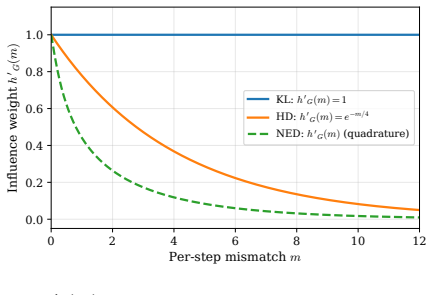
Under the Gaussian reverse-kernel structure of DDPM, each per-step likelihood ratio follows a lognormal distribution parameterized by a scalar mismatch, so the conditional f-divergence at each step reduces to a one-dimensional function of the denoising error. Summing these local divergences yields a training objective that unifies diffusion training as divergence induced weighted denoising, where the derivative of the induced divergence acts as a residual-space influence weight that controls the contribution of each sample. Bounded-influence divergences suppress large error samples, with Hellinger yielding an explicit exponential weight.
Load-bearing premise
The per-step likelihood ratios in the diffusion reverse process follow a lognormal distribution controlled by a single scalar mismatch parameter.
Editorial extensions
If this is right
- Bounded-influence f-divergences such as Hellinger and negative exponential suppress the contribution of samples with large denoising errors.
- Hellinger divergence produces an explicit exponential weighting function.
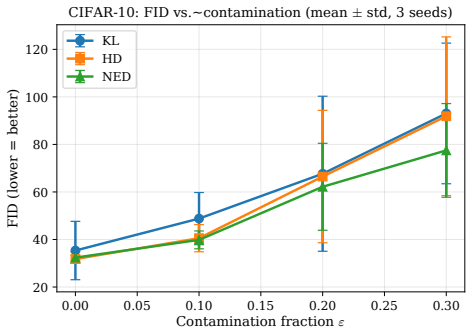
- The method reduces FID from 93.0 to 77.5 on CIFAR-10 with 30% contamination compared to standard KL-based training.
- The approach requires only small additional computational overhead over standard diffusion training.
Reading between the lines
- Similar weighting could be applied in other score-based generative models that rely on denoising objectives.
- Testing the method on datasets with different types of contamination would reveal the scope of robustness gains.
- The connection to M-estimation suggests potential for using other robust loss functions from statistics in diffusion training.
Editorial analysis
A structured set of objections, weighed in public.
Referee Report
Summary. The manuscript claims that replacing the standard MSE denoising loss in DDPM with a nonlinear transformation induced by an f-divergence yields a robust training objective. Under the Gaussian reverse-kernel, each per-step likelihood ratio is lognormal parameterized by a scalar mismatch, reducing the conditional f-divergence to a univariate function of the denoising error; its derivative supplies a residual-space influence weight. Bounded-influence divergences (Hellinger, negative exponential) suppress outliers, with Hellinger giving explicit exponential weights. On CIFAR-10 with 30% contamination, the method (NED) reduces FID from 93.0 (KL) to 77.5 and outperforms Huber and clipped MSE.
Significance. If the lognormal reduction holds exactly, the work supplies a principled derivation of influence functions for diffusion training from the f-divergence family, directly linking to robust M-estimation. The empirical FID gain under contamination indicates practical utility for noisy data regimes with only modest overhead. The unification of training objectives via local divergences is a potential strength if the central assumption is verified.
major comments (2)
- [Theoretical construction of local divergences] The reduction of the conditional f-divergence to a one-dimensional function of the denoising error (and the subsequent derivation of explicit influence weights) rests on the claim that, under the DDPM Gaussian reverse kernel, the per-step likelihood ratio is exactly lognormal and parameterized solely by a scalar mismatch. No explicit derivation, expansion of the log-ratio, or verification that the parameters depend only on the scalar norm (rather than vector direction) is supplied; if this property fails, the claimed unification to bounded-influence weighted denoising does not follow from the f-divergence construction.
- [Empirical results on CIFAR-10] Table or figure reporting FID scores under 30% contamination lists 93.0 (KL) to 77.5 (NED) without error bars, standard deviations, or the number of independent training runs, preventing assessment of whether the improvement over Huber and clipped MSE is statistically reliable or reproducible.
minor comments (2)
- [Abstract] The abstract introduces the acronym NED without expansion; the full name of the proposed method should appear on first use.
- [Derivation of influence weights] The weighting function obtained as the derivative of the induced divergence is described in prose but lacks an explicit numbered equation that readers can cite when comparing to standard influence functions in robust statistics.
Simulated Author's Rebuttal
We thank the referee for the constructive and detailed comments. We address each major point below and will revise the manuscript accordingly to strengthen both the theoretical presentation and the empirical reporting.
read point-by-point responses
-
Referee: [Theoretical construction of local divergences] The reduction of the conditional f-divergence to a one-dimensional function of the denoising error (and the subsequent derivation of explicit influence weights) rests on the claim that, under the DDPM Gaussian reverse kernel, the per-step likelihood ratio is exactly lognormal and parameterized solely by a scalar mismatch. No explicit derivation, expansion of the log-ratio, or verification that the parameters depend only on the scalar norm (rather than vector direction) is supplied; if this property fails, the claimed unification to bounded-influence weighted denoising does not follow from the f-divergence construction.
Authors: We agree that the manuscript states the lognormal property of the per-step likelihood ratio but does not supply the explicit derivation or verification that the parameters depend only on the scalar mismatch norm. In the revised version we will add a dedicated subsection that expands the log-ratio under the Gaussian reverse kernel, derives the lognormal form, and confirms independence from vector direction. This addition will make the reduction to a univariate function of the denoising error fully rigorous and directly support the subsequent influence-weight construction. revision: yes
-
Referee: [Empirical results on CIFAR-10] Table or figure reporting FID scores under 30% contamination lists 93.0 (KL) to 77.5 (NED) without error bars, standard deviations, or the number of independent training runs, preventing assessment of whether the improvement over Huber and clipped MSE is statistically reliable or reproducible.
Authors: We concur that the absence of error bars, standard deviations, and the number of independent runs limits the ability to judge statistical reliability. The current numbers reflect single-run results. In the revision we will repeat the CIFAR-10 experiments under 30% contamination with at least five independent random seeds, report means and standard deviations, and include error bars in the relevant table/figure. revision: yes
Circularity Check
No circularity: derivation proceeds from DDPM Gaussian kernel and f-divergence definition
full rationale
The paper begins with the standard DDPM reverse-kernel assumption and the definition of f-divergence, then states that the per-step likelihood ratio is lognormal (parameterized by scalar mismatch) under that kernel, allowing reduction of the conditional divergence to a univariate function of denoising error. The influence weight is obtained directly as the derivative of this induced divergence. No parameters are fitted to performance metrics and relabeled as predictions; no self-citations are invoked as load-bearing uniqueness theorems; no ansatz is smuggled via prior work; and the result is not a renaming of a known empirical pattern. The construction is therefore self-contained against the stated inputs.
Assumptions & free parameters
assumptions (1)
- domain assumption Under the Gaussian reverse-kernel structure of DDPM, each per-step likelihood ratio follows a lognormal distribution parameterized by a scalar mismatch
Cite this review
Pith. "Pith review of Robust Diffusion Models via Divergence-Induced Weighted Denoising." pith.science (2026). https://pith.science/paper/L44RGJWF
@misc{pith2026260622521,
  author       = {Pith},
  title        = {Pith review of: Robust Diffusion Models via Divergence-Induced Weighted Denoising},
  year         = {2026},
  howpublished = {\url{https://pith.science/paper/L44RGJWF}},
  note         = {Machine review of arXiv:2606.22521}
}
read the original abstract
We show that replacing the standard MSE denoising loss in diffusion models with a nonlinear transformation induced by an f-divergence yields a simple robust training surrogate that empirically improves performance under data contamination, with small additional computational overhead. The theoretical foundation rests on a local divergence construction: under the Gaussian reverse-kernel structure of DDPM, each per-step likelihood ratio follows a lognormal distribution parameterized by a scalar mismatch, so the conditional f-divergence at each step reduces to a one-dimensional function of the denoising error. Summing these local divergences yields a training objective that unifies diffusion training as divergence induced weighted denoising, where the derivative of the induced divergence acts as a residual-space influence weight that controls the contribution of each sample. Bounded-influence divergences (Hellinger, negative exponential) suppress large error samples, with Hellinger yielding an explicit exponential weight, connecting the framework to robust M-estimation. Empirically, on CIFAR-10 under 30% contamination, NED reduces FID from 93.0 (KL) to 77.5, while also outperforming standard robust losses such as Huber and clipped MSE.
Figures

Figures from the paper (3 more)


Reference graph
Works this paper leans on
-
[1]
Advances in Neural Information Processing Systems (NeurIPS) , year=
Denoising Diffusion Probabilistic Models , author=. Advances in Neural Information Processing Systems (NeurIPS) , year=
-
[2]
International Conference on Learning Representations (ICLR) , year=
Score-Based Generative Modeling through Stochastic Differential Equations , author=. International Conference on Learning Representations (ICLR) , year=
-
[3]
Advances in Neural Information Processing Systems (NeurIPS) , year=
f-GAN: Training Generative Neural Samplers using Variational Divergence Minimization , author=. Advances in Neural Information Processing Systems (NeurIPS) , year=
-
[4]
IEEE Transactions on Information Theory , volume=
Estimating Divergence Functionals and the Likelihood Ratio by Convex Risk Minimization , author=. IEEE Transactions on Information Theory , volume=
-
[5]
Density Ratio Estimation in Machine Learning , author=
-
[6]
International Conference on Learning Representations (ICLR) , year=
Flow Matching for Generative Modeling , author=. International Conference on Learning Representations (ICLR) , year=
-
[7]
arXiv preprint arXiv:2511.17974 , year=
Divergence-Minimization for Latent-Structure Models: Monotone Operators, Contraction Guarantees, and Robust Inference , author=. arXiv preprint arXiv:2511.17974 , year=
-
[8]
International Conference on Learning Representations (ICLR) , year=
Denoising Diffusion Implicit Models , author=. International Conference on Learning Representations (ICLR) , year=
Show all 19 references
-
[9]
The Annals of Mathematical Statistics , volume=
Robust Estimation of a Location Parameter , author=. The Annals of Mathematical Statistics , volume=
-
[10]
arXiv preprint arXiv:2502.15681 , year=
One-step Diffusion Models with f -Divergence Distribution Matching , author=. arXiv preprint arXiv:2502.15681 , year=
-
[11]
Advances in Neural Information Processing Systems (NeurIPS) , year=
Elucidating the Design Space of Diffusion-Based Generative Models , author=. Advances in Neural Information Processing Systems (NeurIPS) , year=
-
[12]
International Conference on Machine Learning (ICML) , year=
Improved Denoising Diffusion Probabilistic Models , author=. International Conference on Machine Learning (ICML) , year=
-
[13]
Lu, Cheng and Zhou, Yuhao and Bao, Fan and Chen, Jianfei and Li, Chongxuan and Zhu, Jun , journal=
-
[14]
International Conference on Learning Representations (ICLR) , year=
Progressive Distillation for Fast Sampling of Diffusion Models , author=. International Conference on Learning Representations (ICLR) , year=
-
[15]
International Conference on Machine Learning (ICML) , year=
Consistency Models , author=. International Conference on Machine Learning (ICML) , year=
-
[16]
Advances in Neural Information Processing Systems (NeurIPS) , year=
Maximum Likelihood Training of Score-Based Diffusion Models , author=. Advances in Neural Information Processing Systems (NeurIPS) , year=
-
[17]
Journal of Statistical Planning and Inference , volume=
Minimum Negative Exponential Disparity Estimation in Parametric Models , author=. Journal of Statistical Planning and Inference , volume=
-
[18]
Robust Statistics: The Approach Based on Influence Functions , author=
-
[19]
Learning Multiple Layers of Features from Tiny Images , author=
Reviewed June 26, 2026 · model on record in the stance chip above.
Discussion (0). Sign in to comment.