REVIEW 3 major objections 4 minor 39 references
TauPolaris: reconstructing tau lepton polarimetric vectors with conditional normalizing flows
T0 review · 3 major / 4 minor · reviewed 2026-08-12 · deepseek-v4-flash
Pith's one-line read A conditional normalizing flow reconstructs tau polarimetric vectors from missing neutrino momenta, improving spin observables and HL-LHC sensitivities.
desk verdict Solid ML reconstruction paper with a real resolution gain, but the headline HL-LHC entanglement significance leans on an explicitly stated yet untested yield-extrapolation assumption. read the letter →
The pith
A machine-rendered reading of the paper's core claim, the machinery that carries it, and where it could break.
The reading
What carries the argument
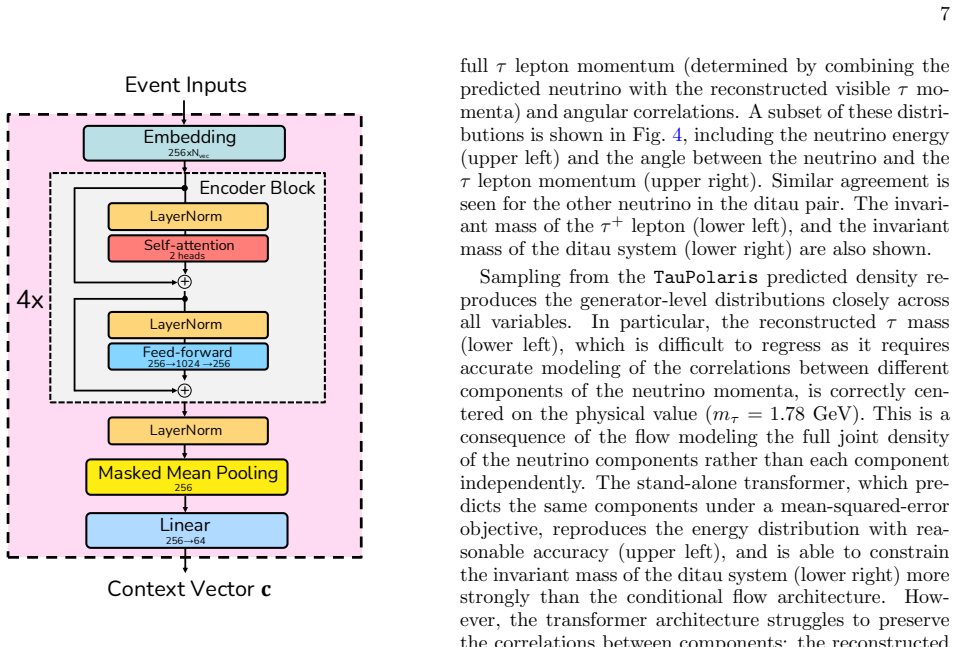
The central object is the conditional normalizing flow: an invertible neural transformation f mapping neutrino kinematics nu to a Gaussian latent variable z, conditioned on a context vector c learned by a transformer encoder. The density is given by the change-of-variables formula log p(nu|c) = log N(z; 0, I) + log |det J_f(nu|c)|, which makes the full joint density tractable and lets the model capture correlations and multimodality in the neutrino posterior. The most probable neutrino configuration (MAP) is found by gradient ascent in the latent space, exploiting the isotropic Gaussian base to stabilize optimization; sampling from the latent distribution reproduces the generator-level kinematic distributions. The neutrino momenta are parametrized in a per-tau orthonormal basis aligned with the visible tau momentum, which closely matches the basis in which the spin correlations are expressed, and displacement variables sensitive to the tau lifetime are included as conditioning inputs.
What would settle it
A reader could settle the projection by recomputing the pseudoexperiment significance with the signal-to-background ratio actually measured in that bin under HL-LHC pileup conditions; if the ratio falls below the scaled value, the at-least-4.3-sigma separation would not be reproduced.
Extended reading notes
Core claim
The paper's central claim is that the polarimetric vectors of tau leptons can be reconstructed well enough to make spin-correlation measurements at the LHC significantly more powerful, by using a conditional normalizing flow to estimate the momenta of the invisible neutrinos. The flow models the joint probability density of the neutrino kinematics given the reconstructed event, so sampling from it reproduces the generator-level distributions and its mode provides an accurate per-event estimate. Compared with a transformer regressor trained on a mean-squared-error loss, the flow's MAP estimates improve the interquartile-range resolution of the reconstructed cos theta spin variables by about 40%, and its sampled density resolves the multimodality that biases point regression toward the visible tau direction. From the fitted spin density matrix, the paper projects that HL-LHC data can separate the entangled standard-model H to tau tau state from a separable classical-correlation state with significance at least 4.3 sigma, that the sensitivity to the CP mixing angle improves by 18% overall relative to previous approximate methods, and that polarimetric-vector variables can separate Higgs from Z events independently of the Higgs CP state.
Load-bearing premise
The load-bearing premise is that the signal-to-background ratio in the most signal-rich bin of the experimental CP analysis remains unchanged when the dataset is scaled from 62.4 $fb^{-1}$ to 3 $ab^{-1}$ at the HL-LHC, since the quoted entanglement significance is projected under that scaling.
Editorial extensions
If this is right
- The MAP estimates from TauPolaris improve the resolution (IQR) of reconstructed spin observables by about 40% relative to an MSE-trained transformer and about 20% relative to sampling, so spin-correlation fits become more precise for the same event sample.
- At the HL-LHC, the fitted spin density matrix can separate the standard-model entangled H to tau tau state from a separable classical-correlation state with at least 4.3 sigma significance using concurrence and 4.0 sigma using the Bell-variable m12.
- The sensitivity to the CP mixing angle in H to tau tau improves by 18% overall compared with previous approximate methods, with up to 88% improvement in the 3pi 0pi0-3pi 0pi0 channel and first-time reconstruction of the phi_CP angle in 3pi 1pi0 decays.
- Variables constructed from the reconstructed polarimetric vectors (cos theta+k cos theta-k, cos theta+n cos theta-n - cos theta+r cos theta-r, and the tau polarizations) separate Higgs from Z to tau tau events and are invariant under the Higgs CP mixing angle, providing new background-suppression handles.
Reading between the lines
- Inference: Because the flow provides a per-event uncertainty on phi_CP, an optimized event selection or likelihood reweighting using that uncertainty could push the CP sensitivity beyond the 18% reported, which uses only one fixed split.
- Inference: The same conditional-flow density approach should transfer to other missing-energy final states with sparse visible objects, such as W to tau nu or heavy-resonance decays, wherever a simulator can provide training pairs.
- Inference: A direct test of the method's probabilistic calibration, such as coverage of the true neutrino momentum by the predicted posterior, would clarify whether the per-event uncertainties are trustworthy enough for future precision analyses.
Signed reviews
Editorial analysis
A structured set of objections, weighed in public.
Referee Report
Summary. The paper introduces TauPolaris, a conditional normalizing flow for reconstructing the undetected neutrino momenta in tau decays from reconstructed event-level features, and uses the resulting momenta to build tau polarimetric vectors. The flow is trained on Pythia+Delphes samples of H->tautau and Z/gamma*->tautau events; a transformer conditioning network summarizes the inputs, and a MAP estimate is obtained by gradient ascent in the latent space. The authors compare the flow with a stand-alone transformer regressor on independent test samples, reporting improved resolution of spin observables, and demonstrate three applications: a HL-LHC projection for distinguishing entangled from non-entangled H->tautau spin states, an 18% improvement in sensitivity to CP violation in H->tautau, and new spin-correlation variables for suppressing Z->tautau background.
Significance. The methodological core is sound and well presented: the full conditional density approach is a natural improvement over point regression for the intrinsically ambiguous neutrino reconstruction problem, and the paper provides concrete evidence for this through independent test samples, physically sensible reconstructed tau masses, and a direct comparison with a same-input transformer baseline. The public code release is a strength, and the 300k pseudoexperiments give a solid statistical basis for the entanglement projection. The headline entanglement significance, however, is conditional on an extrapolation assumption that is explicitly stated but not stress-tested, and the no-entanglement null hypothesis is one specific separable benchmark rather than a general test for the absence of entanglement. The CP and background-suppression sections are plausible demonstrations, but the 18% improvement statistic would benefit from a more explicit derivation.
major comments (3)
- [Section V (yield extrapolation)] The quoted 'at least 4.3 sigma' entanglement separation is obtained by scaling the yields of the highest-BDT-score window of Ref. [4] from 62.4 fb^-1 to 3 ab^-1 under the stated assumption that the signal-to-background ratio in that window is preserved. This assumption is load-bearing because the no-entanglement pseudoexperiment distribution is set by the background yield and shape, and HL-LHC pileup, trigger thresholds, tau identification, and the BDT score distribution will not remain exactly as at 62.4 fb^-1. Please add a robustness study in which the S/B ratio is degraded by, say, 20% and 50%, or rephrase the abstract's claim as conditional on this preservation assumption.
- [Section V (Eq. 15 and Fig. 8)] The pseudoexperiment p-value is computed against a single separable state with C_kk=-1 and all other C_ij=0. This is a reasonable and physically motivated benchmark, but it does not by itself support the abstract's statement that 'the presence of quantum entanglement can be distinguished from its absence.' A different separable state could produce different reconstructed C and m_12 distributions. Please either profile over a family of separable states, or soften the claim to 'distinguished from the classically-correlated benchmark considered here.'
- [Section VI (Eqs. 16 and 17)] The 18% improvement in CP sensitivity is based on the asymmetry A defined in Eq. (16) and the summary statistic A_total in Eq. (17). Since A is computed from normalized CP-even and CP-odd histograms, its proportionality to the sensitivity of a binned likelihood fit is not automatic; the text asserts this but does not derive it or specify precisely what N_c represents in Eq. (17). Please provide a derivation or a direct likelihood-based validation of the weighting, and define N_c explicitly, so that the 18% claim can be checked.
minor comments (4)
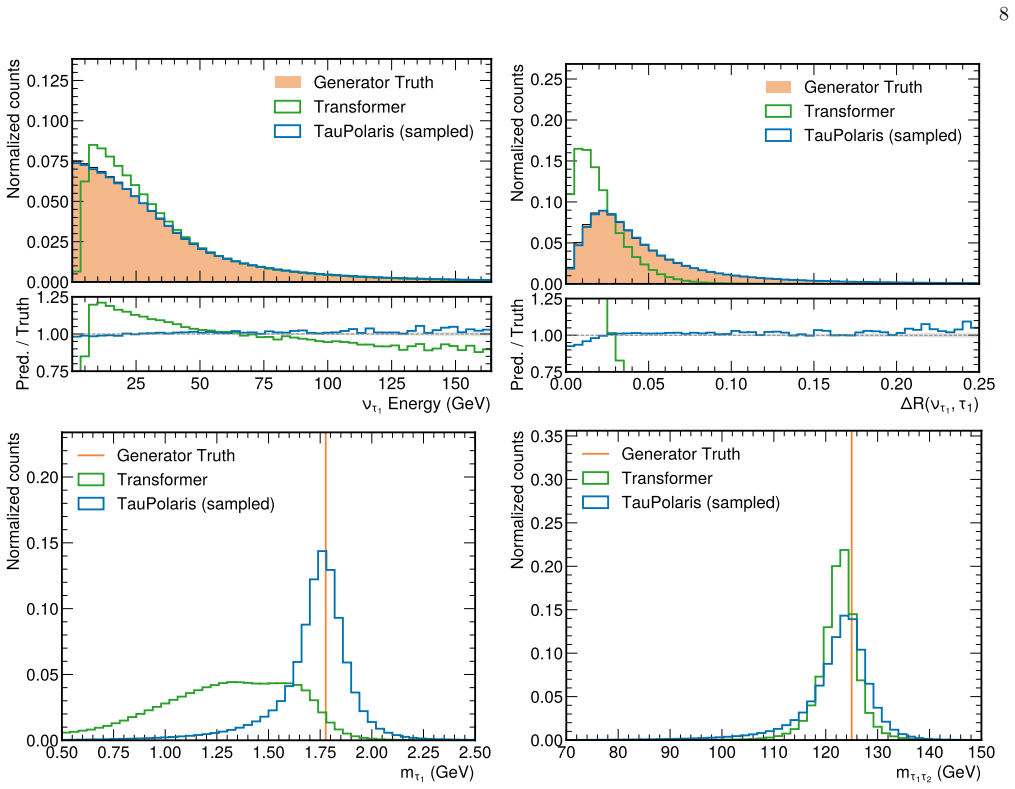
- [Section IV.D / Fig. 4] The axis label in the upper-left panel of Fig. 4 appears to read '1 Energy (GeV)'; please check that it correctly identifies the neutrino energy variable.
- [Section IV.B] The hyperparameters selected by Optuna are described only in the text; for reproducibility, please include the final hyperparameter values or a configuration file alongside the code release.
- [Section V] The abstract's significance statement does not mention that the quoted 4.3 sigma is a statistical-only projection with no nuisance parameters. Please add a qualifier such as 'statistical-only' or 'under the simplifying assumptions described in Section V'.
- [Section VII] The background-suppression variables are demonstrated through normalized distributions only; a quantitative measure such as signal efficiency versus background rejection would make the claimed utility concrete.
Circularity Check
No significant circularity: the flow is trained on generator-level neutrino kinematics and the spin observables are extracted in an independent step; the HL-LHC projection uses an explicit S/B-preservation assumption that is a limitation, not a circular input.
full rationale
The paper's derivation chain is self-contained. The conditional normalizing flow models p(ν|c) for generator-level neutrino momenta and is trained with the negative log-likelihood in Eq. (9); the spin-density-matrix elements are not training targets. Polarimetric vectors are computed from the estimated neutrinos using decay-topology formulas in Sec. IV.E, and the B± and Cij elements are extracted afterward from cosθ distributions by binned maximum likelihood in Sec. V. The flow therefore does not have the final spin observables or significance as fitted inputs. The comparison against the transformer baseline is an empirical benchmark on an independent test set with generator truth (Figs. 4-6), not a construction: an MSE-trained regressor returns the conditional mean, while the flow's MAP is the mode of the learned density, and the claimed resolution improvement is measured, not assumed. The 4.3σ entanglement projection scales yields from CMS [4] to the HL-LHC under the explicitly stated assumption that the signal-to-background ratio in the highest-BDT window is preserved; an unvalidated extrapolation is a correctness risk or limitation, but not circularity. The no-entanglement null is a specific separable benchmark state defined in Eq. (15), which is a modeling choice rather than a self-referential input. No load-bearing self-citation or imported uniqueness theorem is used; the only self-references are to the public TauPolaris code repository and to a reimplementation of TauSpinner/TAUOLA, neither of which supplies a premise of the derivation. I find no step in which a prediction reduces by definition to a fit or to a self-citation chain.
Assumptions & free parameters
free parameters (4)
- Number of conditional flow blocks =
9
- RQ spline bins =
20
- Context vector dimension =
64
- Event selection cut on sigma_phi_CP =
1.4 rad
assumptions (6)
- domain assumption The tau spin density matrix is parameterized as in Eq. (2) with coefficients B and C, and polarimetric vectors provide the optimal spin observables.
- domain assumption The Higgs spin correlation matrix for CP-even, CP-odd, and mixed scenarios is given by Eq. (3) with mixing angle alpha as in Eq. (4).
- domain assumption The reweighting formula W_T = 1 + sum B cos theta + sum C cos theta cos theta (Eq. 7) correctly reproduces arbitrary spin density matrices from spin-uncorrelated samples.
- domain assumption The Delphes 3.5 CMS fast simulation plus hand-applied track and vertex smearing adequately models detector resolution for this study.
- ad hoc to paper The no-entanglement null hypothesis (Eq. 15: C_kk = -1, all other C_ij = 0) represents the relevant separable alternative to the SM entangled state.
- ad hoc to paper The yield extrapolation to the HL-LHC preserves the S/B ratio of the highest-BDT-score category of Ref [4] at 3 ab^-1.
Cite this review
Pith. "Pith review of TauPolaris: reconstructing tau lepton polarimetric vectors with conditional normalizing flows." pith.science (2026). https://pith.science/paper/L4IHCYED
@misc{pith2026260810961,
  author       = {Pith},
  title        = {Pith review of: TauPolaris: reconstructing tau lepton polarimetric vectors with conditional normalizing flows},
  year         = {2026},
  howpublished = {\url{https://pith.science/paper/L4IHCYED}},
  note         = {Machine review of arXiv:2608.10961}
}
abstract
The kinematics of tau lepton decay products depend on the tau spin, giving access to the spin correlations and CP structure of the process that produced them. The optimal spin observable is the polarimetric vector, which points along the most likely direction of the tau spin. Determining it requires the momenta of the neutrinos produced in the tau decays, which escape detection and must therefore be inferred. We present TauPolaris, a tool for reconstructing tau polarimetric vectors by estimating the undetected neutrino momenta with a conditional normalizing flow. Rather than performing a point regression, the method models the full conditional density of the neutrino kinematics, providing both the most likely configuration for each event and an estimate of its uncertainty. The resolution of the reconstructed spin observables improves on that obtained from networks trained with a mean-squared-error loss. Using simulated LHC proton-proton collisions, including detector resolution effects, we demonstrate the method in three applications. For tau leptons produced in Higgs boson decays, we show that the presence of quantum entanglement can be distinguished from its absence with a significance of at least $4.3\sigma$ at the High-Luminosity LHC. We demonstrate an 18% improvement in the sensitivity to CP violation in $H\rightarrow\tau\tau$ decays. Finally, we introduce new variables for suppressing the $Z\rightarrow\tau\tau$ background in Higgs boson searches.
Figures


Figures from the paper (8 more)


Reference graph
Works this paper leans on
-
[1]
Prospects of measuring the parity of Higgs particles,
M. Kramer, J. H. Kuhn, M. L. Stong, and P. M. Zerwas, “Prospects of measuring the parity of Higgs particles,” Z. Phys. C64, 21 (1994), arXiv:hep-ph/9404280
arXiv 1994
-
[2]
CMS Collaboration, “Analysis of theCPstructure of the Yukawa coupling between the Higgs boson andτleptons in proton-proton collisions at √s= 13 TeV,” JHEP06, 012 (2022), arXiv:2110.04836 [hep-ex]
arXiv 2022
-
[3]
ATLAS Collaboration, “Measurement of the CP prop- erties of Higgs boson interactions withτ-leptons with the ATLAS detector,” Eur. Phys. J. C83, 563 (2023), arXiv:2212.05833 [hep-ex]
arXiv 2023
-
[5]
M. Fabbrichesi and L. Marzola, “Quantum tomography withτleptons at the FCC-ee: Entanglement, Bell in- equality violation, sinθ W , and anomalous couplings,” Phys. Rev. D110, 076004 (2024), arXiv:2405.09201 [hep- ph]
arXiv 2024
-
[6]
Con- straining new physics in entangled two-qubit systems: top-quark, tau-lepton and photon pairs,
M. Fabbrichesi, R. Floreanini, and E. Gabrielli, “Con- straining new physics in entangled two-qubit systems: top-quark, tau-lepton and photon pairs,” Eur. Phys. J. C83, 162 (2023), arXiv:2208.11723 [hep-ph]
arXiv 2023
-
[7]
Quantum information and CP measure- ment in H→τ +τ − at future lepton colliders,
M. M. Altakach, P. Lamba, F. Maltoni, K. Mawatari, and K. Sakurai, “Quantum information and CP measure- ment in H→τ +τ − at future lepton colliders,” Phys. Rev. D107, 093002 (2023), arXiv:2211.10513 [hep-ph]
arXiv 2023
-
[8]
Y. Zhang, B.-H. Zhou, Q.-B. Liu, T. A. Wu, S. Li, T. Han, S.-C. Hsu, and M. Low, “Entanglement and Bell nonlocality inτ +τ − at the LHC using machine learn- ing for neutrino reconstruction,” JHEP04, 190 (2026), arXiv:2504.01496 [hep-ph]
arXiv 2026
-
[9]
CMS Collaboration, “Measurement of theτlepton polar- ization in Z boson decays in proton-proton collisions at√s= 13 TeV,” JHEP01, 101 (2024), arXiv:2309.12408 [hep-ex]
work page Pith review arXiv 2024
Show all 39 references
-
[10]
ν-flows: Conditional neutrino regression,
M. Leigh, J. A. Raine, K. Zoch, and T. Golling, “ν-flows: Conditional neutrino regression,” SciPost Phys.14, 159 (2023), arXiv:2207.00664 [hep-ph]
2023 arXiv
-
[11]
Fast and improved neutrino reconstruction in multineutrino final states with conditional normalizing flows,
J. A. Raine, M. Leigh, K. Zoch, and T. Golling, “Fast and improved neutrino reconstruction in multineutrino final states with conditional normalizing flows,” Phys. Rev. D109, 012005 (2024), arXiv:2307.02405 [hep-ph]
2024 arXiv
-
[12]
Entanglement of formation of an ar- bitrary state of two qubits,
W. K. Wootters, “Entanglement of formation of an ar- bitrary state of two qubits,” Phys. Rev. Lett.80, 2245 (1998), arXiv:quant-ph/9709029
1998 arXiv
-
[13]
A comprehensive guide to the physics and usage of PYTHIA 8.3,
C. Bierlich, S. Chakraborty, N. Desai, L. Gellersen, I. He- lenius, P. Ilten, L. L¨ onnblad, S. Mrenna, S. Prestel, C. T. Preuss, T. Sj¨ ostrand, P. Skands, M. Utheim, and R. Ver- heyen, “A comprehensive guide to the physics and usage of PYTHIA 8.3,” SciPost Phys. Codeb.2022, ...
2022 arXiv
-
[14]
Extraction and validation of a new set of CMS PYTHIA8 tunes from underlying- event measurements,
CMS Collaboration, “Extraction and validation of a new set of CMS PYTHIA8 tunes from underlying- event measurements,” Eur. Phys. J. C80, 4 (2020), arXiv:1903.12179 [hep-ex]
2020 arXiv
-
[15]
Documen- tation ofT auSpinneralgorithms: program for simulat- ing spin effects inτ-lepton production at LHC,
T. Przedzinski, E. Richter-Was, and Z. Was, “Documen- tation ofT auSpinneralgorithms: program for simulat- ing spin effects inτ-lepton production at LHC,” Eur. Phys. J. C79, 91 (2019), arXiv:1802.05459 [hep-ph]
2019 arXiv
-
[16]
TAUOLA: A Li- brary of Monte Carlo programs to simulate decays of po- larized tau leptons,
S. Jadach, J. H. Kuhn, and Z. Was, “TAUOLA: A Li- brary of Monte Carlo programs to simulate decays of po- larized tau leptons,” Comput. Phys. Commun.64, 275 (1990)
1990
-
[17]
The tau decay library TAUOLA, update with exact O(α) QED corrections inτ→µ(e)ν¯νdecay modes,
M. Jezabek, Z. Was, S. Jadach, and J. H. Kuhn, “The tau decay library TAUOLA, update with exact O(α) QED corrections inτ→µ(e)ν¯νdecay modes,” Comput. Phys. Commun.70, 69 (1992)
1992
-
[18]
The tau decay library TAUOLA: Version 2.4,
S. Jadach, Z. Was, R. Decker, and J. H. Kuhn, “The tau decay library TAUOLA: Version 2.4,” Comput. Phys. Commun.76, 361 (1993)
1993
-
[19]
Universal Interface of TAUOLA Technical and Physics Documentation,
N. Davidson, G. Nanava, T. Przedzinski, E. Richter-Was, and Z. Was, “Universal Interface of TAUOLA Technical and Physics Documentation,” Comput. Phys. Commun. 183, 821 (2012), arXiv:1002.0543 [hep-ph]
2012 arXiv
-
[20]
DELPHES 3, A modular framework for fast simulation of a generic collider experiment,
J. de Favereau, C. Delaere, P. Demin, A. Giammanco, V. Lema ˆ ıtre, A. Mertens, and M. Selvaggi, “DELPHES 3, A modular framework for fast simulation of a generic collider experiment,” JHEP02, 057 (2014), arXiv:1307.6346 [hep-ex]
2014 arXiv
-
[21]
Description and Performance of Track and Primary-Vertex Reconstruction with the CMS Tracker,
CMS Collaboration, “Description and Performance of Track and Primary-Vertex Reconstruction with the CMS Tracker,” JINST9, P10009 (2014), arXiv:1405.6569 [physics.ins-det]
2014 arXiv
-
[22]
Performance of reconstruction and identification ofτleptons decaying to hadrons andν τ in pp collisions at √s= 13 TeV,
CMS Collaboration, “Performance of reconstruction and identification ofτleptons decaying to hadrons andν τ in pp collisions at √s= 13 TeV,” JINST13, P10005 (2018), arXiv:1809.02816 [hep-ex]
2018 arXiv
-
[23]
Identification of hadronic tau de- cay channels using multivariate analysis (MV A de- cay mode),
CMS Collaboration, “Identification of hadronic tau de- cay channels using multivariate analysis (MV A de- cay mode),” (2020),https://cds.cern.ch/record/ 2727092
2020
-
[24]
nflows: normalizing flows in pytorch,
C. Durkan, A. Bekasov, I. Murray, and G. Papamakarios, “nflows: normalizing flows in pytorch,” (2020),https: //zenodo.org/records/4296287
2020
-
[25]
Pytorch: An imperative style, high-performance deep learning library,
A. Paszke, S. Gross, F. Massa, A. Lerer, J. Bradbury, G. Chanan, T. Killeen, Z. Lin, N. Gimelshein, L. Antiga, A. Desmaison, A. K¨ opf, E. Yang, Z. DeVito, M. Rai- son, A. Tejani, S. Chilamkurthy, B. Steiner, L. Fang, 18 J. Bai, and S. Chintala, “Pytorch: An imperative style, ...
2019 arXiv
-
[26]
Optuna: A next-generation hyperparameter optimiza- tion framework,
T. Akiba, S. Sano, T. Yanase, T. Ohta, and M. Koyama, “Optuna: A next-generation hyperparameter optimiza- tion framework,” (2019), arXiv:1907.10902 [cs.LG]
2019 arXiv
-
[27]
Glow: Genera- tive flow with invertible 1x1 convolutions,
D. P. Kingma and P. Dhariwal, “Glow: Genera- tive flow with invertible 1x1 convolutions,” (2018), arXiv:1807.03039 [stat.ML]
2018 arXiv
-
[28]
Neural Spline Flows,
C. Durkan, A. Bekasov, I. Murray, and G. Papamakar- ios, “Neural Spline Flows,” (2019) arXiv:1906.04032 [stat.ML]
2019 arXiv
-
[29]
Identity mappings in deep residual networks,
K. He, X. Zhang, S. Ren, and J. Sun, “Identity mappings in deep residual networks,” (2016), arXiv:1603.05027 [cs.CV]
2016 arXiv
-
[30]
Gaussian error linear units (GELUs),
D. Hendrycks and K. Gimpel, “Gaussian error linear units (GELUs),” (2023), arXiv:1606.08415 [cs.LG]
2023 arXiv
-
[31]
Attention is all you need,
A. Vaswani, N. Shazeer, N. Parmar, J. Uszkoreit, L. Jones, A. N. Gomez, L. Kaiser, and I. Polosukhin, “Attention is all you need,” (2023), arXiv:1706.03762 [cs.CL]
2023 arXiv
-
[32]
On layer normalization in the transformer architecture,
R. Xiong, Y. Yang, D. He, K. Zheng, S. Zheng, C. Xing, H. Zhang, Y. Lan, L. Wang, and T.-Y. Liu, “On layer normalization in the transformer architecture,” (2020), arXiv:2002.04745 [cs.LG]
2020 arXiv
-
[33]
Decoupled weight decay regularization,
I. Loshchilov and F. Hutter, “Decoupled weight decay regularization,” (2019), arXiv:1711.05101 [cs.LG]
2019 arXiv
-
[34]
Adam: A method for stochastic optimization,
D. P. Kingma and J. Ba, “Adam: A method for stochastic optimization,” (2017), arXiv:1412.6980 [cs.LG]
2017 arXiv
-
[35]
Methods for a mea- surement ofτpolarization asymmetry in the decayZ→ τ τat LHC and determination of the effective weak mix- ing angle,
V. Cherepanov and W. Lohmann, “Methods for a mea- surement ofτpolarization asymmetry in the decayZ→ τ τat LHC and determination of the effective weak mix- ing angle,” (2018), arXiv:1805.10552 [hep-ph]
2018 arXiv
-
[36]
The polarimeter vector forτ→3πντdecays,
V. Cherepanov and C. Veelken, “The polarimeter vector forτ→3πντdecays,” Comput. Phys. Commun.299, 109153 (2024), arXiv:2311.10490 [hep-ex]
2024 arXiv
-
[37]
Hadronic structure in the decayτ→ν τ π±π0π0 and the sign of theν τ helicity,
D. M. Asneret al.(CLEO), “Hadronic structure in the decayτ→ν τ π±π0π0 and the sign of theν τ helicity,” Phys. Rev. D61, 012002 (2000), arXiv:hep-ex/9902022
2000 arXiv
-
[38]
How to pin down the CP quantum numbers of a Higgs boson in its tau decays at the LHC,
S. Berge, W. Bernreuther, B. Niepelt, and H. Spies- berger, “How to pin down the CP quantum numbers of a Higgs boson in its tau decays at the LHC,” Phys. Rev. D84, 116003 (2011), arXiv:1108.0670 [hep-ph]
2011 arXiv
-
[39]
HEPData record for arXiv:2606.03510,
CMS Collaboration, “HEPData record for arXiv:2606.03510,” (2026),https://doi.org/10. 17182/hepdata.172938
2026 arXiv
-
[40]
K. V. Mardia and P. E. Jupp,Directional Statistics, Wi- ley Series in Probability and Statistics (Wiley, 2000)
2000
Reviewed August 12, 2026 · model on record in the stance chip above.
Discussion (0). Continue with ORCID to comment.