REVIEW 5 minor 50 references
Maxwell's lesser demon: a quantum engine driven by pointer measurements
T0 review · 0 major / 5 minor · reviewed 2026-08-14 · deepseek-v4-flash
Pith's one-line read A demon that reads only a pointer's position can drive a quantum heat engine beyond the Otto window.
desk verdict A genuine extension of measurement-driven engines, with a macroscopic pointer and an honest accounting of reset and backaction costs; no load-bearing flaw found, and it deserves a serious referee. read the letter →
The pith
A machine-rendered reading of the paper's core claim, the machinery that carries it, and where it could break.
The reading
What carries the argument
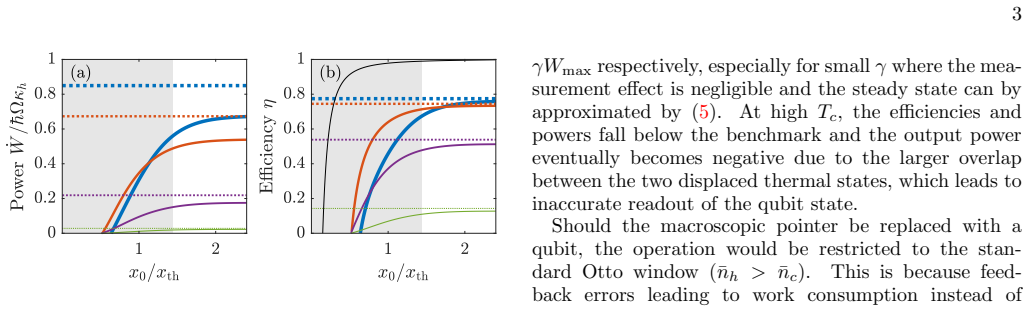
The load-bearing object is the pointer: a harmonic oscillator of frequency $\omega$ whose equilibrium position is displaced to $\pm x_0$ by the qubit state through $\hat H = \frac{\hbar\Omega}{2}\hat{\sigma}_z + \hbar\omega\hat{b}^\dagger \hat{b}$, with $\hat b = \hat a + \hat{\sigma}_z x_0/\sqrt{2}$. The hot bath drives qubit excitations; the cold bath, coupled to the displaced mode, continuously resets the pointer and thereby pays the erasure cost, which the paper notes exceeds the ideal erasure bound by more than $4 k_B T_c$. The active demon's interrogation is modeled by the coarse-grained generator $\mathcal{L}_m \rho = \gamma \mathcal{D}[\hat{\sigma}_x \hat P]\rho + \gamma \mathcal{D}[\hat P]\rho$, which packages a Poissonian sequence of projective left/right pointer measurements and conditional spin flips; in the ideal regime $\gamma \ll \kappa_c$ the measurement reduces the steady state to its excited branch, giving the benchmark power $\gamma W_{\max}$ and the efficiency bound of Eq. (8), with a Zeno freeze setting in for $\gamma \gtrsim \kappa_c$. The passive demon replaces the external agent with the position-dependent Rabi drive $\hat V(t) = \hbar\zeta f(\hat x)e^{-i(\Omega-\Delta)t}|e\rangle\langle g| + \mathrm{h.c.}$, whose optimal working point $\Delta \approx 2\omega x_0^2$ arises because the qubit frequency is effectively modulated by the pointer position. The thermal width $x_{\rm th} = \sqrt{\coth(\hbar\omega/2k_B T_c)}$ is the scale that separates usable from unusable pointer states.
What would settle it
Simulate or build the model with $\Omega = 100\omega$, $x_0 = 2.5$, $\kappa_h = 10^{-3}\omega$, $\kappa_c = 0.1\omega$, $\bar{n}_h = 1$, and sweep the cold-bath temperature: the claim predicts positive net power and near-benchmark efficiency whenever $x_0/x_{\rm th} > 1$ and negative power when the thermal width exceeds the displacement; observing positive net work in the overlap regime $x_0/x_{\rm th} < 1$ would refute the distinguishability condition.
Extended reading notes
Core claim
The discovery is a measurement-driven engine that works with a 'lesser' demon: the demon's only interface with the working medium is a pointer, and the pointer alone carries the information used for feedback. The engine cycle is not strobed; hot-bath excitation, cold-bath pointer reset, and random demon interrogations coexist continuously. In the resolved-sideband regime $\Omega \gg \omega \gg \kappa_c \gg \kappa_h$ with $x_0 \gg x_{\rm th}$, each projective pointer measurement that finds the pointer on the left is followed by a spin flip, extracting energy close to the ergotropy of the entangled spin-pointer steady state. At low cold-bath temperature the steady-state power approaches $\gamma W_{\max} = \gamma \hbar(\Omega - 2\omega x_0^2)p_\infty$ and the efficiency approaches the bound of Eq. (8), with both benchmarks approached simultaneously. The engine continues to produce net work when the cold bath is as warm as the hot bath, $\bar{n}_c \ge \bar{n}_h$, provided the displaced pointer states remain distinguishable, whereas a qubit pointer in the same role confines operation to the Otto window $\bar{n}_h > \bar{n}_c$. The passive demon, a red-detuned field addressing the qubit only when the pointer sits at $-x_0$, reproduces the same physics around detuning $\Delta \approx 2\omega x_0^2$.
Load-bearing premise
The whole performance picture rests on treating every pointer interrogation as an instantaneous, error-free projective position measurement followed by an ideal spin-flip feedback, approximated by the coarse-grained generator of Eq. (6); if real measurements are slow, inefficient, or the feedback is imperfect, the predicted power and the ability to run beyond the Otto window could degrade.
Editorial extensions
If this is right
- A measurement-driven heat engine can be fully autonomous, with no externally timed strokes: steady-state work, heat, backaction, and information flows are all defined by the stationary solution of the generator.
- The same working medium can be operated either by an active random-measurement demon or by a passive stationary field; both give comparable power, and the passive version avoids the separate backaction cost term $\dot{Q}_{\rm ba}$.
- Information gained through a macroscopic pointer is a usable thermodynamic resource even when the demon has no direct access to the working medium---the demon stays 'lesser' yet the engine still beats the Otto window.
- The operating criterion $x_0 > x_{\rm th}$ gives a concrete design rule for experiments: prepare the pointer displacement beyond its thermal width and the engine should produce positive work even when the cold and hot baths have equal occupation.
- Concrete platform targets follow from the model---ultrastrongly coupled molecular vibronic systems, hybrid optomechanics, and trapped-ion spin-oscillator setups---where the predicted power-efficiency curves should be visible.
Reading between the lines
- The distinguishability condition $x_0 > x_{\rm th}$ suggests a broader design rule for measurement-driven thermal machines: any meter whose readout resolves two thermal distributions better than their overlap could extend the operating window of a quantum engine, whether the measurement is projective or continuous.
- The optimal-detuning condition $\Delta \approx 2\omega x_0^2$ could be turned into a spectroscopic tool: scanning the drive detuning and recording output power would map the pointer displacement and hence measure the qubit-oscillator coupling strength.
- A natural stress test is to replace the ideal projective pointer readout with a noisy or inefficient one; the model's branch-weight formula $p_\infty = \bar{n}_h/(2\bar{n}_h + 1 + \gamma/\kappa_h)$ predicts how performance degrades, and a finite measurement error would show up as an effective shift of the Otto-window boundary.
Signed reviews
Editorial analysis
A structured set of objections, weighed in public.
Referee Report
Summary. The paper presents a self-contained spin-boson model of a Maxwell-demon engine in which the demon is restricted to reading the position of a harmonic-oscillator pointer rather than the qubit working medium directly. A hot bath excites the qubit, a cold bath resets the pointer, and work is extracted either by an active demon performing Poisson-distributed projective pointer measurements with conditional spin-flip feedback, or by a passive demon realized as a position-dependent coherent drive. The central claims are that the active engine can simultaneously approach analytical power and efficiency benchmarks, and that the macroscopic-pointer engine operates in occupation-number regimes where a qubit-pointer Otto engine would fail, provided the pointer states are distinguishable (x0 ≳ xth). The paper also explicitly identifies measurement backaction and compares the pointer-reset cost with Landauer erasure.
Significance. If correct, this is a valuable conceptual contribution to measurement-driven quantum thermodynamics: it provides a fully specified, autonomous model that keeps the demon at arm's length from the working medium, and it accounts for measurement backaction and pointer-erasure costs rather than hiding them. The analytical benchmarks are consistent with the stated master equation, the approximations (secular hot-bath coupling, weak coupling, γ ≪ κc, x0 ≫ 1) are stated and justified, and the numerical projector truncation is described. A particular strength is that the coarse-grained measurement generator in Eq. (6) is the exact unconditional Lindblad dynamics for ideal Poisson projective measurements with spin-flip feedback, because D[P] = D[1−P]; this removes any concern that one measurement outcome is being silently dropped. The 'beyond Otto' comparison is internally consistent as a comparison with the qubit-pointer version of the same engine.
minor comments (5)
- [Eq. (4), preceding definition] The text defines the cold-bath occupation as nbar_c = 1/[exp(ℏΩ/kBTc)−1], but Eq. (4) and Fig. 2 use nbar_c as the thermal occupation of the pointer oscillator at frequency ω. Please correct the definition to use ℏω, or introduce a separate notation such as nbar_c(ω), and state the convention explicitly in the caption of Fig. 2; as printed, the definition prevents a reader from reproducing the beyond-Otto region.
- [Eq. (8)] The efficiency upper bound in Eq. (8) is stated without derivation. Since it is one of the two analytical benchmarks used in Fig. 2, please add a short derivation in the appendix or a footnote, showing how it follows from the steady-state excitation probability p∞ and the heat-flux expression in Eq. (15).
- [Abstract and Conclusions] The abstract says the engine operates in regimes where 'quantum Otto engines would fail,' but the comparison in the text is specifically with a qubit-pointer version of the same engine. Please qualify the statement (for example, 'qubit-pointer Otto engines') so that the claim is not read as a blanket statement about all quantum Otto engines.
- [Footnote [30]] The projector truncation condition 2N+1 ≤ max{x0^2, 1} is cryptic. Please add one sentence explaining why this cutoff is chosen and why the truncation can only understate, rather than inflate, the reported power and efficiency.
- [Fig. 4 caption] The caption notes that the master-equation model may no longer be reliable for ζ ∼ ω; this caveat should also appear in the main text before the plot is discussed, since the comparison between the active and passive schemes in that regime is one of the paper's quantitative conclusions.
Circularity Check
No significant circularity: the engine benchmarks are derived from the stated master equations, and the only same-author citation is contextual and not load-bearing.
full rationale
The paper's central results are not fitted inputs renamed as predictions. The model is fixed by the Hamiltonian (1), the hot and cold dissipators (3)-(4), and the coarse-grained measurement-feedback generator (6), the latter attributed to standard references [31-34] rather than to the present authors' prior work. The steady-state power formulas (7) are exact traces over this generator, and the benchmark power gamma-W_max and efficiency bound (8) are stated as approximations valid for gamma << kappa_c and x0 >> 1; Fig. 2 then compares numerical solutions to these analytical benchmarks, so the benchmarks are not imposed on the numerics. The 'beyond Otto window' claim is a direct comparison of the same model at high cold-bath temperature with the qubit-pointer Otto variant, not a circular restatement of an assumption. The only same-author citation is [27], used in the introductory discussion of interpretations of incoherent measurement schemes; it is contextual and load-bearing nowhere. Approximations such as the finite-rank projector in footnote [30] and the efficiency-definition caveat in footnote [36] are explicitly disclosed and do not make any target result true by definition.
Assumptions & free parameters
free parameters (7)
- pointer displacement x0 =
2.5 (numerical example)
- measurement rate gamma (active demon) =
varied 10^-4 to 10^-1 omega
- driving strength zeta (passive demon) =
0.1 omega (numerics)
- hot bath coupling kappa_h =
10^-3 omega
- cold bath coupling kappa_c =
0.1 omega
- frequencies omega, Omega =
Omega = 100 omega
- temperatures Th, Tc (occupancies nbar_h, nbar_c) =
nbar_h = 1 in figures
assumptions (4)
- domain assumption Born-Markov and secular approximation for the hot bath dissipator
- domain assumption Cold bath thermalizes the displaced pointer mode with added pure dephasing neglected
- domain assumption Instantaneous projective pointer measurements with Poissonian statistics and ideal feedback
- domain assumption Weak driving limit for the passive demon, corrections to dissipators omitted
Cite this review
Pith. "Pith review of Maxwell's lesser demon: a quantum engine driven by pointer measurements." pith.science (2026). https://pith.science/paper/L4P7YRAU
@misc{pith2026190810102,
  author       = {Pith},
  title        = {Pith review of: Maxwell's lesser demon: a quantum engine driven by pointer measurements},
  year         = {2026},
  howpublished = {\url{https://pith.science/paper/L4P7YRAU}},
  note         = {Machine review of arXiv:1908.10102}
}
read the original abstract
We discuss a self-contained spin-boson model for a measurement-driven engine, in which a demon generates work from thermal excitations of a quantum spin via measurement and feedback control. Instead of granting it full direct access to the spin state and to Landauer's erasure strokes for optimal performance, we restrict this demon's action to pointer measurements, i.e. random or continuous interrogations of a damped mechanical oscillator that assumes macroscopically distinct positions depending on the spin state. The engine can reach simultaneously the power and efficiency benchmarks and operate in temperature regimes where quantum Otto engines would fail.
Figures


Reference graph
Works this paper leans on
-
[36]
K. Jacobs, Quantum Measurement Theory and its Appli- cations (Cambridge University Press, Cambridge, 2014)
work page 2014
-
[27]
Strasberg, G
P. Strasberg, G. Schaller, T. Brandes, and M. Esposito, Phys. Rev. X 7, 021003 (2017)
2017
-
[1]
the qubit is excited and the field is able to extract a positive net energy from it
This is because the frequency of the qubit is modulated by the pointer position, and at this driving frequency, the field addresses predomi- nantly the qubit only when the pointer is located at−x0, i.e. the qubit is excited and the field is able to extract a positive net energy from it. Hence one can modify the scheme by removing the position dependence f(x...
-
[2]
This does not cause a backaction-induced direct flow of energy to the pointer, a minor contribution to the energy balance when Ω ≫ ω, which is inherent to the position-dependent case and appears explicitly as ˙Qba in the previous measurement-feedback scheme. The dotted line in Fig. 3 shows the output power and efficiency achievable by non-invasive interrogat...
-
[3]
M. O. Scully, M. S. Zubairy, G. S. Agarwal, and H. Walther, Science 299, 862 (2003)
2003
-
[4]
M. O. Scully, Phys. Rev. Lett. 104, 207701 (2010)
2010
-
[5]
M. O. Scully, K. R. Chapin, K. E. Dorfman, M. B. Kim, and A. Svidzinsky, Proc. Natl. Acad. Sci. 108, 15097 (2011)
work page 2011
- [6]
Show all 50 references
-
[7]
Klatzow, J
J. Klatzow, J. N. Becker, P. M. Ledingham, C. Weinzetl, K. T. Kaczmarek, D. J. Saunders, J. Nunn, I. A. Walm- sley, R. Uzdin, and E. Poem, Phys. Rev. Lett. 122, 110601 (2019)
2019
-
[8]
Roßnagel, O
J. Roßnagel, O. Abah, F. Schmidt-Kaler, K. Singer, and E. Lutz, Phys. Rev. Lett. 112, 030602 (2014)
2014
-
[9]
Manzano, F
G. Manzano, F. Galve, R. Zambrini, and J. M. R. Par- rondo, Phys. Rev. E 93, 052120 (2016)
2016
-
[10]
Klaers, S
J. Klaers, S. Faelt, A. Imamoglu, and E. Togan, Phys. Rev. X 7, 031044 (2017)
2017
-
[11]
Elouard, D
C. Elouard, D. A. Herrera-Mart´ ı, M. Clusel, and A. Auff` eves, npj Quantum Inf.3, 9 (2017)
2017
-
[12]
Elouard and A
C. Elouard and A. N. Jordan, Phys. Rev. Lett. 120, 260601 (2018)
2018
-
[13]
Buffoni, A
L. Buffoni, A. Solfanelli, P. Verrucchi, A. Cuccoli, and M. Campisi, Phys. Rev. Lett. 122, 070603 (2019)
2019
- [14]
-
[15]
Mandal and C
D. Mandal and C. Jarzynski, Proc. Natl. Acad. Sci. 109, 11641 (2012)
2012
-
[16]
A. C. Barato and U. Seifert, Europhys. Lett. 101, 60001 (2013)
2013
-
[17]
Strasberg, G
P. Strasberg, G. Schaller, T. Brandes, and M. Esposito, Phys. Rev. Lett. 110, 040601 (2013)
2013
-
[18]
J. M. Horowitz and M. Esposito, Phys. Rev. X 4, 031015 (2014)
2014
-
[19]
J. V. Koski, A. Kutvonen, I. M. Khaymovich, T. Ala- Nissila, and J. P. Pekola, Phys. Rev. Lett. 115, 260602 (2015)
2015
-
[20]
Cottet, S
N. Cottet, S. Jezouin, L. Bretheau, P. Campagne-Ibarcq, Q. Ficheux, J. Anders, A. Auff` eves, R. Azouit, P. Rou- chon, and B. Huard, Proc. Natl. Acad. Sci. 114, 7561 (2017)
2017
-
[21]
Quantum thermodynam- ics in a single-electron box,
J. V. Koski and J. P. Pekola, “Quantum thermodynam- ics in a single-electron box,” in Thermodynamics in the Quantum Regime , edited by F. Binder, L. A. Correa, C. Gogolin, J. Anders, and G. Adesso (Springer, Cham,
-
[22]
Elouard, D
C. Elouard, D. Herrera-Mart´ ı, B. Huard, and A. Auff` eves, Phys. Rev. Lett.118, 260603 (2017)
2017
- [23]
- [24]
-
[25]
Faist, F
P. Faist, F. Dupuis, J. Oppenheim, and R. Renner, Nat. Commun. 6, 7669 (2015)
2015
-
[26]
Alicki and M
R. Alicki and M. Horodecki, J. Phys. A: Math. Theor. 52, 204001 (2019)
2019
-
[28]
Strasberg, Phys
P. Strasberg, Phys. Rev. E 100, 022127 (2019)
2019
-
[29]
S. Seah, S. Nimmrichter, and V. Scarani, Phys. Rev. E 99, 042103 (2019)
2019
-
[30]
(4) can be obtained from the usual Born-Markov sec- ular approximation [31, 41], assuming an oscillator bath linearly coupled to the ˆ x-quadrature
Eq. (4) can be obtained from the usual Born-Markov sec- ular approximation [31, 41], assuming an oscillator bath linearly coupled to the ˆ x-quadrature. This would also result in an additional pure dephasing term ∝D [ˆσz]ρ, which however scales with the bath spectral density a...
-
[31]
Sewell, in AIP Conference Proceedings, Vol
G. Sewell, in AIP Conference Proceedings, Vol. 962 (AIP,
-
[32]
For numerical simulations, we consider instead ˆP = ∑N n=0 ˆD†|n⟩⟨n| ˆD for numerical stability while avoiding convergence issues due to discontinuities in position representation
An ideal position measurement is such that ˆPx =∫ 0 −∞ dx|x⟩⟨x|. For numerical simulations, we consider instead ˆP = ∑N n=0 ˆD†|n⟩⟨n| ˆD for numerical stability while avoiding convergence issues due to discontinuities in position representation. Here, the cutoff N is chosen suc...
-
[33]
Breuer and F
H.-P. Breuer and F. Petruccione, The Theory of Open Quantum Systems (Oxford University Press, 2002)
2002
-
[34]
Hornberger, Europhys
K. Hornberger, Europhys. Lett. 77, 50007 (2007)
2007
-
[35]
H. M. Wiseman and G. J. Milburn, Quantum Measure- ment and Control (Cambridge University Press, 2009)
2009
-
[37]
A. E. Allahverdyan, R. Balian, and T. M. Nieuwen- huizen, Europhys. Lett. 67, 565 (2004)
2004
-
[38]
The definitions coalesce in the regime of operation considered, since ˙Qba∝ω whereas ˙W, ˙Qh∝ Ω≫ω
Depending on interpretation, one could include the cost of the measurement process in the efficiency, either as an additional “heat” input, η = ˙W/ ( ˙Qh + ˙Qba), or as work expense reducing the net output,η = ( ˙W− ˙Qba)/ ˙Qh. The definitions coalesce in the regime of operation ...
-
[39]
Lloyd, Phys
S. Lloyd, Phys. Rev. A 56, 3374 (1997)
1997
-
[40]
H. J. Carmichael, Statistical Methods in Quantum Optics 1 (Springer, Berlin, 1999)
1999
-
[41]
Szczygielski, D
K. Szczygielski, D. Gelbwaser-Klimovsky, and R. Alicki, Phys. Rev. E 87, 012120 (2013)
2013
-
[42]
Alicki, J
R. Alicki, J. Phys. A: Math. Gen. 12, L103 (1979)
1979
-
[43]
Alicki, J
R. Alicki, J. Chem. Phys. 150, 214110 (2019)
2019
-
[44]
Reitz, C
M. Reitz, C. Sommer, and C. Genes, Phys. Rev. Lett. 122, 203602 (2019)
2019
-
[45]
J. P. Long and B. S. Simpkins, ACS Photonics 2, 130 (2015)
2015
-
[46]
Shalabney, J
A. Shalabney, J. George, J. Hutchison, G. Pupillo, C. Genet, and T. W. Ebbesen, Nat. Commun. 6, 5981 (2015)
2015
-
[47]
Yeo, P.-L
I. Yeo, P.-L. De Assis, A. Gloppe, E. Dupont-Ferrier, P. Verlot, N. S. Malik, E. Dupuy, J. Claudon, J.-M. G´ erard, A. Auff` eves,et al. , Nat. Nanotechnol. 9, 106 (2014). 6
2014
-
[48]
Hybrid mechanical systems,
P. Treutlein, C. Genes, K. Hammerer, M. Poggio, and P. Rabl, “Hybrid mechanical systems,” in Cavity Op- tomechanics, edited by M. Aspelmeyer, T. J. Kippen- berg, and F. Marquardt (Springer, Berlin, 2014) pp. 327–351
2014
-
[49]
Monsel, C
J. Monsel, C. Elouard, and A. Auff` eves, npj Quantum Inf. 4, 59 (2018)
2018
-
[50]
von Lindenfels, O
D. von Lindenfels, O. Gr¨ ab, C. T. Schmiegelow, V. Kaushal, J. Schulz, M. T. Mitchison, J. Goold, F. Schmidt-Kaler, and U. G. Poschinger, Phys. Rev. Lett. 123, 080602 (2019). 7 APPENDIX: V ALIDITY OF THE HOT BA TH DISSIP A TOR Here we compare the local and global secular form...
2019
Reviewed August 14, 2026 · model on record in the stance chip above.
Discussion (0). Continue with ORCID to comment.