REVIEW 2 major objections 3 minor 28 references
Sharp bounds on the failure of the hot spots conjecture
T0 review · 2 major / 3 minor · reviewed 2026-08-05 · deepseek-v4-flash
Pith's one-line read This paper proves the exact maximum of the hot spots ratio in every dimension
desk verdict Big result, clean upper bound, but the lower-bound sieve scaling has an ε²-vs-ε slip that currently breaks the construction. read the letter →
The pith
A machine-rendered reading of the paper's core claim, the machinery that carries it, and where it could break.
The reading
What carries the argument
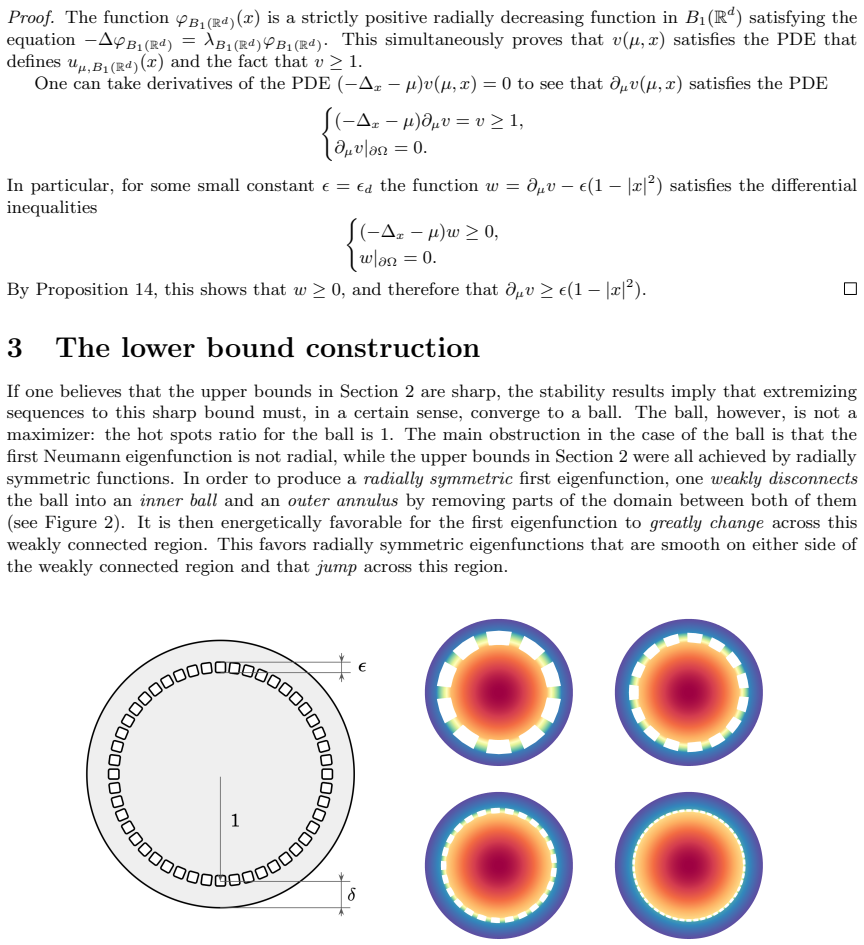
The analysis is carried by η_d, an explicit radial eigenfunction of the Helmholtz equation on the unit ball with boundary value 1, written in terms of a Bessel function. The upper bound follows from a chain of inequalities: compare the normalized Neumann eigenfunction to the Dirichlet-type function u_{μ,Ω}, apply Talenti's rearrangement inequality to pass to the ball, then use monotonicity in the eigenvalue. The lower bound is produced by Neumann sieve domains—balls with a thin, highly perforated shell—whose effective first eigenfunction is radial and converges to η_d as the shell thins and the connectivity parameter approaches the ball's first nonzero Neumann eigenvalue. A key intermediate
What would settle it
Verify Proposition 20 numerically for a fixed dimension d: for each 0 < β < μ_{B_1(R^d)}, check whether the first positive eigenvalue h^(1)_{0,β,δ} of the radial effective problem is strictly smaller than the first eigenvalue h^(0)_{1,β,δ} of the non-radial ℓ=1 problem for all sufficiently small δ; if any β in that range yields h^(1)_{0,β,δ} > h^(0)_{1,β,δ} for a sequence δ→0, the lower-bound construction does not reach S_d.
Extended reading notes
Core claim
For every d ≥ 2, the supremum S_d of the hot spots ratio over connected Lipschitz domains is exactly η_d(0), where η_d is the radial function solving −Δη_d = μ_{B_1(R^d)}η_d on the unit ball with η_d = 1 on the boundary. No Lipschitz domain attains this value: extremizing sequences exist but must converge to a ball, and if a domain has unit-ball volume and its hot spots ratio is within ε² of S_d, then its Fraenkel asymmetry is at most C_d ε. As d → ∞, S_d converges to √e, matching the previously best known upper bound. The paper also determines the sharp function V_d(α), the largest possible measure of the set where the first Neumann eigenfunction exceeds α times its maximal boundary value;
Load-bearing premise
The lower bound relies on the claim that for every β below the ball's first nonzero Neumann eigenvalue, the first nontrivial mode of the effective sieve is radial once the sieve is thin enough; if that radiality fails, the constructed domains would not approach η_d.
Editorial extensions
If this is right
- The hot spots ratio of any connected Lipschitz domain in dimension d is bounded by η_d(0), so the worst possible failure of the hot spots conjecture is now known exactly in every dimension.
- Since no extremizer exists, the supremum can only be approached; the quantitative stability statement says that any domain whose ratio is within ε² of the supremum must be within O(ε) of a ball in Fraenkel asymmetry.
- As d → ∞, the maximal ratio tends to √e, confirming that the previous upper bound was asymptotically sharp.
- For any fixed threshold α > 1, the set where the first Neumann eigenfunction exceeds α times its boundary maximum has measure tending to zero exponentially fast as d → ∞, so the hot spots conjecture becomes 'true in measure' in high dimensions.
- The sharp formula for V_d(α) gives a complete description of the distribution of super-level sets of the first Neumann eigenfunction, not just its L∞ norm.
Reading between the lines
- The underlying mechanism suggests that interior hot spots arise only when the eigenfunction is forced to be radial by a weak disconnection; domain classes that rule out such sieves—for instance simply connected planar domains—may continue to satisfy the original conjecture.
- The asymptotic value √e is the same one that appears from one-dimensional Gaussian marginals, hinting that high-dimensional spectral shape optimization collapses onto a Gaussian profile; it would be worth testing whether other spectral problems show the same dimensional reduction.
- The paper's remark that in d ≥ 3 the holes can be connected to the boundary by capacity arguments makes it plausible that convex high-dimensional domains attain the same supremum; this is a testable route toward the paper's Conjecture 10.
- The measure-theoretic bound likely transfers to L^p norms, giving quantitative hot-spots control in every L^p with exponentially small constants as the dimension grows.
Editorial analysis
A structured set of objections, weighed in public.
Referee Report
Summary. The paper studies the hot spots ratio S_d, the supremum over connected Lipschitz domains in R^d of the ratio of the maximum of the first nontrivial Neumann eigenfunction in the interior to its maximum on the boundary. The authors claim that S_d equals an explicit Bessel-type quantity η_d(0), that no extremizer exists, that extremizing sequences must converge to a ball at a quantitative rate, and that S_d → √e as d → ∞. They also prove a measure version V_d(α) and infer that the hot spots conjecture is asymptotically true in measure in high dimensions. The upper bound is obtained by a comparison principle, Talenti rearrangement, and monotonicity of the radial Dirichlet problem; the lower bound is constructed via a thick Neumann-sieve approximation of an effective two-parameter problem D_{β,δ}.
Significance. If correct, this would be a complete quantitative resolution of a well-known open-ended question around Rauch's hot spots conjecture, with matching asymptotics to the best known upper bound of Mariano–Panzo–Wang. The upper-bound argument is elegant and appears sound, and the stability statement is strong and explicit. The lower-bound Neumann-sieve construction is original and, if made fully rigorous, would be a substantial technical contribution. The paper is also transparent about the provenance of its ideas. However, the lower-bound homogenization as written contains a scaling error that invalidates the main equality claim in its present form.
major comments (2)
- [§5, Definitions 22–23, Lemma 25, Proposition 24] The spherical sieve condition (5) implies |S_ε| ≈ α ε² |S^{d-1}|. The necks N_ε are radial tubes of length ε over S_ε. For a trace jump J, the minimal Dirichlet energy in N_ε is ≈ (J²/ε)|S_ε| = α ε |S^{d-1}| J², which tends to 0. The target form (3) contains βδ∫_{S^{d-1}}J² = α∫_{S^{d-1}}J², independent of ε. Hence the first identity in Lemma 25, and with it Proposition 24 and Proposition 17, cannot hold as stated: the sieve domains have vanishing connectivity, their nontrivial Neumann eigenvalue tends to 0, and the lower bound S_d ≥ η_d(0) is not established. The likely repair is to require |S_ε|≈α ε |S^{d-1}|, i.e. replace ε^{-2} by ε^{-1} in (5) and rerun the estimates of §5.2; but as submitted Theorem 4 is only an upper bound.
- [§4.2, proof of Proposition 20] The spectral-decoupling argument is only sketched. The statements "Applying Courant-Fischer... spectrum decouples" and "the only interaction ... goes to zero" are asserted without the eigenvalue lower bounds and compactness needed to justify convergence of h^{(1)}_{0,β,δ} to β and the one-dimensional character of the outer limit. The sign pattern for r>1 is obtained after passing to a subsequence, with no proof of uniqueness of the subsequential limit (K_β is assumed to be -1). Since Proposition 20 is what guarantees radiality of ψ_{β,δ} and hence the applicability of the sieve construction and Proposition 18, this gap needs to be filled before the lower-bound claim can be accepted.
minor comments (3)
- [Lemma 29] The sentence "c σ_d is a radial eigenfunction of the Laplace operator" is inaccurate because σ_d is a probability measure on a sphere, not a function. The intended statement is that the density of the projection π_{1*}σ_d (equivalently, the Fourier transform of σ_d) is proportional to \tilde η_d. The subsequent Gaussian limit is standard.
- [Definition 22] The existence argument says "splitting the ball into roughly exp(−2/ε) pieces"; for balls of radius e^{-1/ε} on S^{d-1}, the relevant number of pieces is dimension-dependent, roughly exp(−(d−1)/ε). This should be corrected.
- [Proof of Lemma 26] The displayed estimates contain garbled notation "ϵ− 1 ϵ" and "ϵ−2"; please reformat and check the exponents. As written the proof is hard to follow.
Circularity Check
No circularity: the upper and lower bounds are independent, and self-citations are peripheral.
full rationale
The paper's central claim S_d = ||η_d||_∞ = η_d(0) is not circular. The upper bound (Section 2) proceeds through the chain ψ_Ω/max_∂Ω ψ_Ω ≤ u_{μ_Ω,Ω} ≤^♯ u_{μ_Ω,B_1} ≤ u_{μ_B1,B_1} = η_d, using the comparison principle, Talenti rearrangement, and monotonicity in μ. These are external standard tools; no parameter is fitted to the target value. The function η_d is defined purely from the ball's Dirichlet and Neumann spectral data, and the theorem derives its maximal value, rather than assuming it. The lower bound (Sections 3–5) is a fresh construction: a family of Neumann-sieve domains is introduced and shown to converge to an effective bilinear form D_{β,δ}; Proposition 20 analyzes the effective eigenfunction, and the limit β→μ_B1, δ→0 recovers η_d. This is an independent construction, not a renaming of the answer. The paper cites the first author's prior work [Dio24] only for folklore lower bounds and for motivating Conjecture 10, neither of which is load-bearing for Theorems 4 or 8; Theorem 4's proof does not reduce to that citation. No uniqueness theorem from the authors' prior work is invoked. The only substantive concern visible in the text is a possible scaling error in Definition 22/23 (the ε^{-2} volume fraction would make neck conductance O(ε), potentially invalidating Lemma 25 and Proposition 24). That is a correctness/falsifiability problem, not circularity: it does not make the claimed result equivalent to its inputs by construction. Therefore the circularity score is 0.
Assumptions & free parameters
free parameters (3)
- beta (effective connectivity parameter) =
n/a; optimized in the limit beta -> mu_{B_1(R^d)}
- delta (outer annulus thickness) =
n/a; sent to 0
- epsilon (sieve scale) =
n/a; sent to 0
assumptions (5)
- standard math Talenti's rearrangement inequality and the maximum principle for Laplace supersolutions
- standard math Szego-Weinberger eigenvalue bound mu_Omega <= mu_{B_1(R^d)} and the Brasco-Pratelli sharp stability estimate
- domain assumption Existence of epsilon-spherical sieves satisfying the uniform distribution condition (5) via a probabilistic construction
- standard math Bessel integral representation and high-dimensional Gaussian asymptotics for sphere measures
- standard math Uniqueness of radial solutions to the Helmholtz equation and monotonicity of u_{mu,B_1(R^d)} in mu
Cite this review
Pith. "Pith review of Sharp bounds on the failure of the hot spots conjecture." pith.science (2026). https://pith.science/paper/L4SVSETJ
@misc{pith2026250816321,
  author       = {Pith},
  title        = {Pith review of: Sharp bounds on the failure of the hot spots conjecture},
  year         = {2026},
  howpublished = {\url{https://pith.science/paper/L4SVSETJ}},
  note         = {Machine review of arXiv:2508.16321}
}
abstract
The hot spots ratio of a domain $\Omega\subset \mathbb{R}^d$ measures the degree of failure of Rauch's hot spots conjecture on that domain. We identify the largest possible value of this ratio over all connected Lipschitz domains $\Omega\subset \mathbb{R}^d$, for any dimension $d$. As $d\to \infty$, we show that this maximal ratio converges to $\sqrt{e}$, which asymptotically matches the previous best known upper bound by Mariano, Panzo and Wang. For $d\ge 2$, we show that sets extremizing the hot spots ratio do not exist, and extremizing sequences must converge to a ball at a quantitative rate. We then give a sharp bound on the measure of the set for which the first Neumann eigenfunction exceeds its maximal boundary value. From this we deduce that the hot spots conjecture is asymptotically true "in measure'' as $d\to \infty$.
Figures


Figures from the paper (1 more)

Reference graph
Works this paper leans on
-
[1]
On N eumann eigenfunctions in lip domains
Rami Atar and Krzysztof Burdzy. On N eumann eigenfunctions in lip domains. Journal of the American Mathematical Society , 17(2):243--265, 2004
work page 2004
-
[2]
On the hot spots conjecture of J
Rodrigo Ba \ n uelos and Krzysztof Burdzy. On the hot spots conjecture of J . R auch. Journal of Functional Analysis , 164(1):1--33, 1999
work page 1999
-
[3]
Henri Berestycki, Louis Nirenberg, and SR Srinivasa Varadhan. The principal eigenvalue and maximum principle for second-order elliptic operators in general domains. Communications on Pure and Applied Mathematics , 47(1):47--92, 1994
work page 1994
-
[4]
Sharp stability of some spectral inequalities
Lorenzo Brasco and Aldo Pratelli. Sharp stability of some spectral inequalities. Geom. Funct. Anal. , 22(1):107--135, 2012
work page 2012
-
[5]
The hot spots problem in planar domains with one hole
Krzysztof Burdzy. The hot spots problem in planar domains with one hole. Duke Mathematical Journal , 129:481--502, 2005
work page 2005
-
[6]
A counterexample to the `` H ot spots" conjecture
Krzysztof Burdzy and Wendelin Werner. A counterexample to the `` H ot spots" conjecture. Annals of Mathematics , pages 309--317, 1999
work page 1999
-
[7]
Monotone properties of the eigenfunction of N eumann problems
Hongbin Chen, Yi Li, and Lihe Wang. Monotone properties of the eigenfunction of N eumann problems. Journal de Math \'e matiques Pures et Appliqu \'e es , 130:112--129, 2019
work page 2019
-
[8]
Le probleme de la passoire de N eumann
A Damlamian. Le probleme de la passoire de N eumann. Rend. Sem. Mat. Univ. Politec. Torino , 43(3):427--450, 1985
work page 1985
Show all 28 references
-
[9]
Convex sets can have interior hot spots
Jaume de Dios Pont . Convex sets can have interior hot spots. arXiv preprint arXiv:2412.06344 , 2024
2024 arXiv
-
[10]
Del Vecchio
T. Del Vecchio. The thick N eumann's sieve. Ann. Mat. Pura Appl. (4) , 147:363--402, 1987
1987
-
[11]
The nodal surface of the second eigenfunction of the L aplacian in R ^D can be closed
Soren Fournais. The nodal surface of the second eigenfunction of the L aplacian in R ^D can be closed. J. Differential Equations , 173(1):145--159, 2001
2001
-
[12]
Hoffmann-Ostenhof, T
M. Hoffmann-Ostenhof, T. Hoffmann-Ostenhof, and N. Nadirashvili. The nodal line of the second eigenfunction of the L aplacian in R ^2 can be closed. Duke Math. J. , 90(3):631--640, 1997
1997
-
[13]
Euclidean triangles have no hot spots
Chris Judge and Sugata Mondal. Euclidean triangles have no hot spots. Annals of Mathematics , 191(1):167--211, 2020
2020
-
[14]
Erratum: E uclidean triangles have no hot spots
Chris Judge and Sugata Mondal. Erratum: E uclidean triangles have no hot spots. Annals of Mathematics , 195(1):337--362, 2022
2022
-
[15]
hot spots
David Jerison and Nikolai Nadirashvili. The “hot spots” conjecture for domains with two axes of symmetry. Journal of the American Mathematical Society , 13(4):741--772, 2000
2000
-
[16]
Rearrangements and C onvexity of L evel S ets in PDE , volume 1150 of Lecture Notes in Mathematics
Bernhard Kawohl. Rearrangements and C onvexity of L evel S ets in PDE , volume 1150 of Lecture Notes in Mathematics . Springer, 1985
1985
-
[17]
James B. Kennedy. Closed nodal surfaces for simply connected domains in higher dimensions. Indiana University Mathematics Journal , pages 785--798, 2013
2013
-
[18]
The N eumann sieve problem revisited
Andrii Khrabustovskyi. The N eumann sieve problem revisited. Journal of Mathematical Analysis and Applications , page 129933, 2025
2025
-
[19]
The hot spots conjecture can be false: S ome numerical examples
Andreas Kleefeld. The hot spots conjecture can be false: S ome numerical examples. Advances in Computational Mathematics , 47(6):85, 2021
2021
-
[20]
Kennedy and Jonathan Rohleder
James B. Kennedy and Jonathan Rohleder. On the hot spots conjecture in higher dimensions. arXiv preprint arXiv:2410.00816 , 2024
2024 arXiv
-
[21]
Location of hot spots in thin curved strips
David Krej c i r \' k and Mat e j Tu s ek. Location of hot spots in thin curved strips. Journal of Differential Equations , 266(6):2953--2977, 2019
2019
-
[22]
Improved upper bounds for the H ot S pots constant of L ipschitz domains
Phanuel Mariano, Hugo Panzo, and Jing Wang. Improved upper bounds for the H ot S pots constant of L ipschitz domains. Potential Analysis , 59(2):771--787, 2023
2023
-
[23]
The second boundary value problem in regions with a complex boundary
Vladimir Alexandrovich Marchenko and GV Suzikov. The second boundary value problem in regions with a complex boundary. Matematicheskii Sbornik , 111(1):35--60, 1966
1966
-
[24]
Scaling coupling of reflecting B rownian motions and the hot spots problem
Mihai Pascu. Scaling coupling of reflecting B rownian motions and the hot spots problem. Transactions of the American Mathematical Society , 354(11):4681--4702, 2002
2002
-
[25]
Lecture \#1
Jeffrey Rauch. Lecture \#1. F ive problems: A n introduction to the qualitative theory of partial differential equations. In Partial differential equations and related topics: Ford Foundation sponsored program at Tulane University, January to May, 1974 , volume 446 of Lecture ...
1974
-
[26]
An upper bound on the hot spots constant
Stefan Steinerberger. An upper bound on the hot spots constant. Revista Mathematica Iberoamericana , 39(4), 2023
2023
-
[27]
High-dimensional probability: A n introduction with applications in data science , volume 47
Roman Vershynin. High-dimensional probability: A n introduction with applications in data science , volume 47. Cambridge university press, 2018
2018
-
[28]
The hot spots conjecture on a class of domains in R ^n with n 3
Peng-fei Yang. The hot spots conjecture on a class of domains in R ^n with n 3 . Acta Mathematicae Applicatae Sinica, English Series , 27:639--646, 2011
2011
Reviewed August 5, 2026 · model on record in the stance chip above.
Discussion (0). Continue with ORCID to comment.